Book Review

  • Rewired: The Post-Cyberpunk Anthology, Ed. James Patrick Kelly & John Kessel

    Rewired: The Post-Cyberpunk Anthology, Ed. James Patrick Kelly & John Kessel

    Tachyon, 2007, 424 pages, US$14.95 tpb, ISBN 978-1-892391-53-7

    One of the most endearing traits of Science Fiction as a genre is its almost pathological need to examine itself for new trends. Commentators steadily scour new publications for trends, recurring leitmotivs and emerging clichés. When The New Thing proves to be difficult to identify, they go back to The Formerly New Things and kick them around for inspiration. But the sad truth is that cyberpunk remains the last coherent SF movement, its shadow still looming over genre criticism fifteen years after it was clinically declared dead from embarrassment.

    One suspects that the deathbed conversation over cyberpunk will keep on going until the entire genre is absorbed by the singularity, and then be carried over by intelligence much vaster than ours yet still punier than John Clute. In the meantime, any pretext is good enough for a post-cyberpunk reprint anthology like Rewired.

    The choice of anthologists isn’t accidental: Both James Patrick Kelly and John Kessel were active writers in the heydays of cyberpunk –although whether they were part of the movement or opposed to it as “humanists” depends on who you speak to.

    Students of genre history will have a lot of good material to digest in Rewired: Not only does it come with a lengthy introduction discussing the characteristics of “Post Cyberpunk” (“PCP”) SF, it’s also peppered with excerpts of correspondence between cyberpunk chairman Bruce Sterling and Kessel, in which both authors tackle issues surrounding the movement and its aftermath.

    But people don’t read reprint anthologies for the introductions: many of them read it for the table of content. For beyond the empty “post-cyberpunk” claims (yes, yes, SF has absorbed the lessons of cyberpunk; can we move on, now, please?) Rewired is most interesting as an attempt to define a canon for modern science-fiction. The choice of pieces is not accidental, and even a quick glimpse at the content of the book will reveal a number of proto-classics that have a good chance to form the SF canon of the last dozen years.

    Many of the big names of recent SF are there, even when the stories themselves may or may not be the most representative of their work. There’s even an odd dash of exoticism is calculated to make Science Fiction look like a genre with literary respectability. Hard-SF favorite Greg Egan (“Yeyuka”) sits next to the red-hot Cory Doctorow (“When Sysadmin Ruled the Earth”) and underrated veteran Walter Jon Williams (“Daddy’s World”), while Jonathan Lethem and Gwyneth Jones lend their respectability to the exercise. There’s a bit of something for everyone in this anthology, even for those who know the corpus: It’s hard to avoid re-reading the brilliance of David Marusek’s “The Wedding Album”, Charles Stross’ techno-heavy “Lobsters” or Bruce Sterling’s still-amusing “The Bicycle Repairman”.

    Meanwhile, like all good reprint anthologies, Rewired offers the chance to read some stories that may have escaped first notice: Paul Di Filippo’s “What’s Up, Tiger Lily” is a fun romp that proves again why Di Filippo remains one of the genre’s most overlooked short story writer.

    Even though, it’s hardly a perfect anthology. Some choices seem motivated by variety and/or notoriety, leading to puzzling selections. William Gibson’s “Thirteen Views of a Cardboard City”? Hmmm. And, of course, there’s never any accounting for taste either for the anthologists or the reader: Paolo Bacigalupi’s “The Calorie Man” and Christopher Rowe’s “The Voluntary State” still seem as overrated as when they were nominated for the Hugo. Your mileage, as they say, may differ.

    But if you forget about the “post-cyberpunk” marketing hook, Rewired more than holds its own as a reprint anthology of recent material. The names on the cover offer a good and recent overview of the genre, the table of content features a a few diamonds and that’s more than enough to make Rewired a welcome contribution to the ever-lasting genre discussions.

    [June 2008: Noted without further comment: Tachyon Publication seems to be developing a line of reprint anthologies seemingly designed to re/define genre movements. After Rewired, the last few months have seen the publication of The New Weird and Steampunk. One awaits Infernocrusher.]

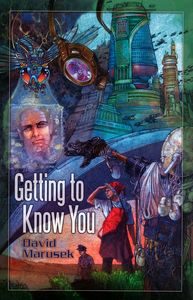
  • Getting to Know You, David Marusek

    Getting to Know You, David Marusek

    Subterranean Press, 2007, 297 pages, US$40.00 hc, ISBN 978-1-59606-088-3

    The worst thing anyone can say about David Marusek’s Science Fiction is that there isn’t enough of it.

    For a writer whose bibliography dates back to the mid-nineties, Marusek’s output so far has been scarce and precious: Barely a dozen stories since 1993, and at least two of them rank amongst the finest SF stories published during the nineties. Marusek fans finally got their wish for a novel in 2005 with Counting Heads, the first volume in a projected series. With Getting to Know You, Subterranean Press brings together Marusek’s portfolio of stories, and if the result can feel familiar to fans of the author’s much-anthologized best pieces, it’s also a strong argument in favor of writers who put quality above quantity.

    Getting To Know You opens with an introduction in which Marusek briefly discusses his relationship to short stories, highlighting the experimental nature of their writing, and how “you wouldn’t exactly call me a prolific short story writer” [P.14] He also adds that five of the stories in this anthology are set in the same universe as Counting Heads.

    Marusek’s best-known story so far is probably “The Wedding Album”, which made a splash upon publication in 1999, was widely nominated for a number of award and eventually won the 2000 Theodore Sturgeon Award. The same story opens Getting To Know You, and it’s an inspired choice: In the span of a novelette, Marusek manages to set up an affecting human drama, several vertiginous perspective shifts, at least one scene that’s as hilarious as it’s spectacular, and a future history that still hasn’t been explored by the rest of Marusek’s writing in this universe. It’s one of the finest SF short stories published during the nineties, and it’s a good anchor for this volume. It also a decent introduction to the type of dense, humane, unflinching Science Fiction that typifies Marusek’s work. There are a lot of very exciting ideas here, but also a number of unsettling scenes and tragic destinies. Marusek’s fiction can have the manic energy and inventiveness of golden age SF, but it’s certainly not so nostalgic when it comes to the consequences of the technologies he explores. The mixture of peppy toys and downbeat fates echoes through the entire anthology.

    “The Earth is on the Mend”, for instance, is pure post-apocalyptic fiction, almost mainstream in its purposeful lack of ideas. “A Boy in Cathyland” settles the fate of a minor character in “The Wedding Album” in a manner that will not please readers of the original novella. Neither tale stand out against their heavy competition elsewhere in the collection. Neither does “Listen to Me” later on, though “My Morning Glory” is short and terrifying in its implications. (For a measure of Marusek’s merciless humor, consider that he calls it “my only story with an unalloyed happy ending” in his story introduction. It’s all a matter of perspective, of course. Marusek would get along splendidly with Peter Watts.)

    “Yurek Rutz, Yurek Rutz, Yurek Rutz” is a bit heftier, as an epistolary tale that exploits Marusek’s unusual living conditions in Alaska and provides a few smiles. Echoes of the tale provide one of the very few grins in “VTV” a story with “no redeeming value” (writes the author as introduction) that goes for broke in an effort to alienate the reader from human society. There’s a clever setting up of expectations in the way Marusek describes a media gone out of control in service of an audience that can only be roused of its complacency with spectacular blood-letting.

    “Cabbages and Kale or: How We Downsized North America” and “Getting to Know You” will be more familiar to Counting Heads readers, as they look at other facets of Marusek’s imagined universe. Both tales are told with an energetic, falsely-funny tone that belies surprisingly disturbing implications.

    But for Counting Heads flashbacks, the ultimate is to be found in “We Were Out of Our Minds with Joy”, a line-edited version of which makes up the first part of Marusek’s first novel. It’s still a triumphant story, a strong novella and a Science Fiction masterpiece that bursts with invention even at a time where post-Singularity tales are multiplying. Readers with fresh memories of Marusek’s novel will probably skip this story, but not including it in this anthology would have been ridiculous, especially since it allows scholarly readers to see the slight changes between the originally published version and the one that made it in the novel.

    Those lucky enough to be able to afford the limited signed edition of Getting to Know You will also get a small chapbook reprinting “She Was Good, She Was Funny”, a 1994 thriller tale (then published in Playboy magazine) featuring a philandering narrator, a jealous husband, and the implacable Alaskan climate. A perfect little desert on top of a sumptuous meal. The story may not be science-fiction, but it’s recognizably by Marusek with its clever conceit and curiously triumphal ending.

    If Getting to Know You proves anything, it’s that much like Ted Chiang, Marusek’s slow-but-steady pace has its advantages: His short story output is solid, and show a skilled writer working at a consistent level. But there’s more to this book that a collection of stories loosely bound together: From the recurring themes, approaches and tonal beats in his stories, we get a far more representative portrait of Marusek’s fiction than one could glean from either Counting Heads or his best-known stories in isolation. A love and respect for Alaska; a jokey kinetic tone that hides darker undercurrents; an accessible, even compelling writing style; an enthusiasm for ideas that doesn’t shy away from their appalling consequences: These are what makes Marusek a writer to watch, even if the pace of his publications can be trying at time.

    So, when is his next novel due in bookstores?

  • The Family Trade, Charles Stross

    The Family Trade, Charles Stross

    Tor, 2004, 303 pages, C$34.95 hc, ISBN 0-765-30929-7

    Most polls prove it: the single biggest reason why people pick up books by specific authors is because they are already familiar with their work. In an American market where 100,000 books are published every year and most people don’t read even one book per month, why should casual readers take a gamble on unproven authors when they can just buy a “name” book knowing what to expect?

    Of course, some authors make an effort to avoid being pigeonholed. Although Charles Stross is better known for idea-crammed Science Fiction, he consciously diversified genre, publisher and readership with The Family Trade, delving into so-called fantasy for Tor Books. His process was even amusingly codified on his blog as “Five rules for cold-bloodedly designing a fantasy series”. But when a quintessential Science Fiction writer like Stross feels free to play in another genre, no one should be surprised if some of his established strengths carry through the genre frontiers.

    So the result is a book labeled as fantasy, but conceived according to the rigor of hard-SF. Miriam Beckstein is a Boston-based high-tech/business journalist, but her latest scoop is more trouble than her bosses can stand: she finds herself fired and sent home. Coincidentally, an artifact from her past unlocks a latent ability to travel between parallel worlds, at the price of terrible headaches.

    It’s a promising setup, but it’s what Stross does with it afterward that transforms The Family Trade from a run-of-the-mill fantasy (“Plucky orphan discovers that she’s rich and powerful in another world”) to an excellent start to an ongoing series. Whereas lesser writers may have dawdled in describing the wonders of discovering another parallel universe, Stross thinks harder: The parallel world is still at a medieval-era level of development, and taking advantage of world-walking isn’t simple when there’s another culture and language to learn. But it gets better, because Miriam is far from being the only world-walker, and the rest of her family really doesn’t want her running around without supervision. Miriam may be fearsomely intelligent (there are no “you stupid heroine” moments here), but her opponents are just as crafty in their own way, and her continued existence depends on a web of complex political alliances more than her family’s filial bonds. Further revelations make it even clearer that the source of the family fortune is not legal, and that other families definitely want Miriam to die.

    In between learning the social rules of her second universe and defeating assassination attempts, Miriam turns her business experience into a plan to profit from her ability. Complications quickly pile upon further complications, making The Family Trade a lively and sometimes-unpredictable read.

    Stross’s typical strengths are a mixture of accessible prose, fascinating ideas and a willingness to engage with social and economic issues. All of those traits are admirably deployed in The Family Trade, resulting in a mesmerizing reading experience. This is a terrific first volume in an ongoing series, although impatient readers should be warned that this is really the first half of a tightly-linked two-volume set: Get both The Family Trade and its follow-up The Hidden Family if you want to reach a satisfactory conclusion to Miriam’s initial adventure.

    But Stross fans already know that everything the man writes is gold: In the past five years since Singularity Sky, Stross has established himself as a solid and reliable writer whose books just keep on getting better and better. Now even the most reluctant anti-fantasy readers can pick up this series without fear of disappointment. And as Stross cold-bloodedly designed, this is a series with quasi-limitless potential. If Stross can keep up the density of plot developments, this is going to be a wild ride.

  • Pacific Edge, Kim Stanley Robinson

    Pacific Edge, Kim Stanley Robinson

    Tor, 1990, 326 pages, C$20.00 hc, ISBN 0-312-85097-2

    Compulsive readers like myself often end up focusing on volume more than retention. Too many books! Not enough time! Trying to remember specific details of a story weeks after reading it can be a struggle. Fortunately, the best novels rise above this limitation: The mark of a good book can be how well it sticks in mind, fighting its memory pointers against so many forgettable titles.

    And so it is that as I revise this, weeks after reading Kim Stanley Robinson’s Pacific Edge, I still have vivid memories of it. Which is curious, since this is not a conventionally action-packed novel. Taking place in a pleasant near-future where humanity has largely managed to find balance with nature, this is the third novel in Robinson’s “Three California” triptych. After post-nuclear (The Wild Shore) and overheating-dystopian (The Gold Coast) scenarios, Robinson tackles the old “there is no drama in utopia” nonsense by showing us how love and pride can still matter at a time of peace and abundance.

    Like its predecessors, Pacific Edge follows the adventures of a none-too-bright young man living in Orange County, along with his friends and family. It also features an older “Tom Barnard” to coach our protagonist and a shadow narrative that stands halfway outside the novel as counterpoint and explanation.

    Plot-wise, Pacific Edge is chiefly concerned about environmental issues and sentimental matters. Our characters live in a sustainable community, so ecological issues constantly hover above their heads as vital elements of their lives. Half of the novel’s plot strands revolve around the protagonist discovering and fighting against a corporate takeover of water rights, a battle that earns him the enmity of several powerful opponents. To complicate matter further, romantic complications arise when an old flame takes an interest in him after leaving an influential member of the city council who is also part of the takeover. This may be utopia, but there are still important issues to get passionate about.

    Fans of Robinson’s writing will be delighted to read his usually skillful prose, which navigates a tough path between plot, characterization, political speculation and sweeping description. Robinson takes risks that would destroy a story in the hand of lesser writers, and the result is just as compulsively readable as his other books. The particularity of Pacific Edge is how it’s set in a future where the fate of the planet is never in doubt. This is a local story, taking place between a few participants, where baseball games, bicycle rides, community projects and ersatz families carry much importance. The way Robinson holds our interest with those comparatively small stakes is astonishing.

    In fact, some of the best moments of the book are nothing but characters experiencing their own world. The book opens with a radiant sequence in which the protagonist of the book cycles down a mountain, feeling as if nothing bad can happen: “Man! What a day!”. At the other end of the story, the same protagonist laughing after realizing that “he was without a doubt the unhappiest person in the world.” [P.326] Small moments, but exactly the kind of writing to stick in mind for a while.

    I may prefer The Gold Coast for its manic narration and its sense of redemption, but Pacific Edge seems to be the strongest volume in Robinson’s triptych. Eighteen years after publication, it’s still relatively unique in that it touches upon environmental issues without too much preaching, tackles emotional issues not often found elsewhere in Science Fiction and presents such a sense of utter serenity that even being the unhappiest person in that world seems preferable to many happy lives in this one.

    It doesn’t take much more to wonder where all the utopias have gone, and whether we’ll ever build one of our own. Humans born when this novel was published are now able to vote, but it hasn’t aged a wink since then. Great books do more than stick in mind: they keep their own relevance even as the years go by.

  • Debatable Space, Philip Palmer

    Debatable Space, Philip Palmer

    Orbit, 2008, 479 pages, C$14.99 tpb, ISBN 978-0-316-06809-3

    I admire the audacity of the marketing experts who allowed Debatable Space to be titled as such. Surely they must have sensed the potential here for easy jokes by silly reviewers? Debatable as in arguable, as in mixed, as in two-and-a-half-stars our of five? One imagines the lolbookcovers: “Debatable Space is debatable”. Allowing a first novel to carry that title is like duct-taping a “kick-me” sign on a kid and sending him off to recess.

    But then again, perhaps someone at Orbit had a buzz-baiting moment of candid honesty. For Philip Palmer’s Debatable Space has quite a few good things running in its favor, even if most of those good things carry along a number of less-pleasant aftereffects. It’s a dynamic, exuberant novel that lacks control and never quite knows when to cut it short. It’s a novel with the disadvantages of its very own qualities: It’s likely to be remembered as much for its problems as its virtues.

    It doesn’t start promisingly, as the daughter of a tyrant is captured by pirates and held for ransom in a far-future universe where post-human humanity has colonized a fraction of the galaxy. The style is slightly sharper, slightly hipper than usual, but it still feels like a familiar story. The sexual tension and the gory violence is up to the moment’s excessive standards, but the rest is familiar, as if the author was merely playing with generic SF elements to tell a standard space-pirates story.

    This impression never completely goes away, but fades quickly once the book delves deeper in its own plot. It turns out that the “daughter in distress” isn’t what she seems, and that the pirates have other plans in mind once the ransom doesn’t show up as expected. The flashier aspects of Debatable Space also become more obvious: The typographical tricks hearkening back to Ellison and Bester; the copious amount of sex and violence, the increasingly ridiculous odds faced by the characters; the intriguing references and concepts casually tossed off.

    But Debatable Space has a streak of weirdness that makes it difficult to predict. At three junctures, the story is interrupted to cover the back-story of the kidnapped “princess”: Lena is revealed to be a long-lived contemporary of ours, with a biography crammed with every possible adventure and occupation, from mousy academic to hard cybercop to despondent girlfriend to dictatorial president and much much more. It’s too flamboyant to be taken seriously (a theme that characterizes Debatable Space as a whole), but it’s certainly fun to read. As the novel unfolds, it also becomes more interesting in purely SF terms: I was particularly taken with the vision of a remote-controlled empire combining the worst aspects of cultural imperialism and consequence-free proxy usage. The “Dyson Jewels” are also a cool addition to the Big Dumb Object repertory.

    But even as Palmer does his damnedest to impress the peanut gallery, he also let slip a few curious inconsistencies. His future never quite holds up for scrutiny, let it be the incompatibility between his future’s advanced medicine and his stunted characters, or someone casually using a CD-Rom a thousand years in the future (“I slip the CD-Rom in the Quantum Beacon’s computer”… [P.250]) as if they weren’t already obsolete in 2007. Lena ability to escape media attention through her laughably numerous careers except when it suits the needs of the story also stretched the bounds of credibility.

    In short, Debatable Space feels raw, prickly, audacious and visibly flawed. As entertaining as it can be (and Palmer’s writing style is vivid enough to carry along its own narrative momentum), it’s also too scattered and too far-fetched to be particularly credible. The author acknowledges as such in an afterword appropriately called “Debatable Science” (“Alby after all is a super-intelligent ball of flame with a lisp”… [P.478]), but it doesn’t make the novel any easier to recommend without reservations. But keep an eye on Palmer’s next few novels: with more control and fewer distractions, he could be part of the next generation of good British SF writers.

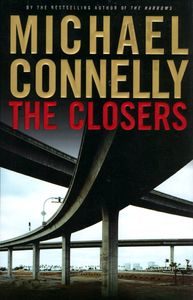
  • The Closers, Michael Connelly

    The Closers, Michael Connelly

    Little Brown, 2005, 403 pages, C$36.95 hc, ISBN 0-316-73494-2

    Rejoice: Harry Bosch is back on the job, and so is Connelly. After a few uneven adventures featuring Bosch as a none-too-comfortable Private Investigator, there’s a sense that everything is back on the right track as Bosch re-integrates the LAPD after the events of the previous volume. He’s not being put back on the homicide table, though: this time, he’s been assigned to the “Open-Unsolved” unit that seeks to close historical files left open. Partnered once again with Kizmin Rider, Bosch is asked to use his experience and his dogged determination to close the book on unsolved mysteries.

    This initially seems easier than expected: As Connelly explains, investigative techniques and tools have gotten much better in the past few decades. It’s now possible to analyze evidence kept in storage and match it against suspects. Thousands of such pieces still haven’t been processed in the labs, and as The Closers begins, it appears that one such piece has produced a match: a flesh scraping taken from a gun used in the murder of a teenager fifteen years earlier. The DNA matches that of a known criminal with ties to the girl’s neighborhood, which is even worse considering that the girl was biracial and the criminal has avowed neo-nazi sympathies.

    But, of course, nothing is that simple in a Michael Connelly novel. There will be complications.

    From the first few pages, Connelly proves that he’s back in top shape. As skilled as ever in entertainingly presenting exposition, Connelly quickly puts together Bosch’s new life: The office he works in, the easy partnership with Kizmin Rider, the renewed antagonism with Irving (“You are a retread. But you know what happens with a retread? It comes apart at the seams.” [P.41]), the atmosphere inside the LAPD and, perhaps more importantly, the numerous details of an investigation abandoned before a satisfactory conclusion. The DNA match may be suggestive, but Bosch wants to make sure that they’re after the right person.

    Unfortunately, they find out that there’s a lot more riding on this case than a simple unsolved murder. The case attracts political attention, which puts Bosch right where readers like him best: in the middle of a fight for his professional life, stuck between factions inside his own department. Not that this is the only kind of difficult situation that Bosch encounters during the investigation: a lengthy sequence following him as he goes undercover as a white supremacist proves to be one of the book’s highlights.

    The twists and turns are solid, and it’s interesting to see that the number of violent sequences is kept to a minimum: The Closers creates its suspense through sheer procedural suspense, as clues are tracked, details are uncovered and suspects are interrogated. It ends as many Connelly novels do, with Bosch as the chump of someone else’s deals.

    But even as it brings Bosch out of the cold, The Closers feels like a return to top form. Faithful readers won’t be surprised to find out that this novel is back to a third-person narration, leaving Bosch’s inner monologue to his off-LAPD career. It’s not a bad thing, since one of the complaints about Bosch two retirement novels was that it brought us perhaps a bit too closely inside the mind of Connelly’s taciturn character. The narration properly places Bosch farther away from the reader, where he can be cloaked with an intriguing sense of mystery: we don’t need to know what he’s thinking.

    And yet, it’s a sens of belonging, of righting past wrongs that ends up playing an important role in The Closers. Using Bosch to the best of his abilities as a mystery-solver, Connelly touches upon the nature of criminal-fiction closure and shows that he hasn’t run out of stories to tell about his best-known character.

  • The Arrival, Shaun Tan

    Arthur A. Levine Books, 2007, 128 pages, C$24.99 hc, ISBN 978-0-439-89529-3

    It’s easy to talk in clichés when discussing Shaun Tan’s The Arrival: Pictures are worth a thousand words; Form follows function; Silence is more eloquent than words; The true meaning of a Graphic Novel.

    And that’s not even discussing how good it is. Then it’s all about sui generis; a minor masterpiece; a visual feast; a young adult title that will appeal to adults and so on.

    But, to use one more cliché, you can believe the hype.

    The object itself leaves an impression before even opening the cover. It’s gorgeously designed as a faux-vintage photo album, all in sepia tones and tattered edges. The cover illustration would be a perfect match for archival photography, if it wasn’t for the strange white animal looking up at the man with the suitcase.

    Confusion only continues with the first few pages. The endpapers show sixty mugshots, presenting people of different ethnicity all looking at us. When the book itself begins, it does so with a mixture of writing in a strange alphabet, with official-looking stamps bearing the usual publisher’s information. Somewhere in a box stamped “Inspection”, we find the following summary for library cataloguers: “In this wordless graphic novel, a man leaves his homeland and sets off for a new country, where he must build a new life for himself and his family.”

    But words quickly become irrelevant as The Arrival truly starts. In small silent portraits, Tan efficiently sketches the portrait of a family on the brink of a major change. A man packs his belongings in a suitcase, embraces his wife, says goodbye to his daughter. Overhead, gigantic spiked tails suggest a gathering threat.

    The boat journey to elsewhere is uneventful, but the man’s arrival in his new country leads him to an Ellis Island-inspired sequence where he is herded, processed, inspected, evaluated, photographed and then freed in a bustling metropolis where everything is beyond strangeness.

    And that also goes for us, because The Arrival is quite simply not taking place in any world we can recognize. Beyond the received stereotypes of what it must have been like to immigrate to New York in the early twentieth century, Tan’s imagined world escapes easy understanding. The immigrant doesn’t understand anything, and neither do we: not only is the alphabet different, but animals have strange unusual shapes, foodstuff isn’t recognizable as such and social conventions have to be learnt anew. It’s hard to imagine any other approach doing better in presenting to us the culture shock that immigrants must feel after their arrival in their new countries.

    It’s a tough life (being effectively illiterate has surprising disadvantages), but Tan is careful to avoid any meanness in his work. The immigrant protagonist keeps on meeting people and making friends, lending to The Arrival an atmosphere of pleasant optimism that works better than the required gloom that seems to accompany just about any tale of immigration nowadays.

    Beyond the story, it’s difficult to say enough good things about the exceptional quality of Tan’s art. Pages of small photo-like drawings often alternate with gobsmacking page-sized art that can work as stand-alone pieces. (Indeed, that’s how I first saw Tan’s work: As part of the Art Exhibition at the 2007 World Fantasy Convention, where he won a Fantasy Award in the Best Artist category.) Fantasy fans will be particularly amazed at some of the imagery used to represent the strange new world. The gigantic machinery and sculptures surrounding the characters are impressive (especially seeing how they fit the voluntarily retro style of the drawings) but it’s the small details, the alphabet, the food and the pets, that really clinch the impression of something truly strange. That it works within Tan’s story of lessening alienation is what makes this book such a success, between art-book and graphic novel. The art is fantastically well detailed, and the story is compelling in its own right: the result benefits from the strengths of both forms.

    That The Arrival also works equally well with younger and older readers is just another reason to take a look at it. The Arrival has already started to get a decent following, landing on several Year’s Best lists, and there’s no reason to avoid following the crowd about this one. It’s one of those books that sticks in mind, impresses visitors, shows good taste and will be re-read regularly.

  • Our Dumb World, The Onion

    Little Brown, 2007, 245 pages, C$32.50 hc, ISBN 0-316-01842-2

    Every year, just in time for Christmas gift-giving, the fine folks at the satirical weekly newspaper The Onion come out with a big, thick tome of goodness. Since 2000, that has taken the form of a yearly compilation of The Onion’s best pieces, but 1999 saw the publication of Our Dumb Century a faux-retrospective of The Onion’s front pages through the twentieth century that proved to be one of the finest humour book of the last hundred years. This year, The Onion skips the yearly anthology in favour of another massive all-original tome: they take on the entire world with Our Dumb World, a flawlessly-designed parody of an educational geography textbook.

    Look at any randomly-chosen page, and you will see that every country is listed, along with their flag, representative photos, quick facts and an annotated map. But look closer, and you will realize that nearly every single line in this folio-sized 245-page book is a joke of some sort. Every single country in the world is put through the wringer, starting with the USA (14 pages of self-deprecation so acid, it feels as if foreigners wrote it) and ending with Greenland (“The Largest Land Mass on Earth”). The completeness of the coverage sometimes become a joke in its own right, with some countries grouped under the headings “A Bunch of God-Damned Islands”, “The Who Cares Islands”, “The Seriously Who Cares Islands” and “Three Countries You Thought Were in Africa”. The book is rarely funnier than when it reflects the image of a bunch of burnt-out comedy writers struggling to find anything to say about a country. (Hence the hilarious low-content take on Suriname: “Why do you insist on torturing yourself? You don’t have to read every page in this book. Who are you trying to impress?” [P.60])

    But people looking for a fun and innocuous gift for the entire family may want to read the entire book beforehand and double-check that the recipients have a well-calibrated sense of humour: Despite the jokey front-cover promise of “Better-Veiled Xenophobia”, Our Dumb World often feels like a book-length collection of stereotypes. Self-aware, self-parodying stereotypes, of course, but still rough on whoever is expecting more sophisticated humour. In the grand Onion tradition, countries often become extended riffs on a single joke, which can either play well or become repetitive.

    Some high concepts work better than others. Considering Andorra as “The Outlet Mall of Europe” is amusing, and looking at the Central African Republic as a generic no-name nation is a stroke of absurd genius. One of the biggest laughs of the entire book is the page about Jordan, which becomes a junior high-schooler’s love note to Queen Rania. (“Things about Queen Rania That are Beyond Belief: All of Them”) North Korea’s entry is “as if written by the North Korean Ministry of Information”, complete with type-written text glued in place.

    Other riffs don’t feel as funny, and often skirt platitudes: Nigeria as a con haven. Bolivia/Columbia as drug factories. The Netherlands as a gigantic red light district. More nuanced portraits are generally more interesting, such as in countries like the United Kingdom or Canada –not coincidentally, countries where Our Dumb World can be purchased as-is. Other concepts work because they go against the grain: There’s a brilliant entry on Switzerland as being “Neutral… Too Neutral” with ominous overtones: “2007: The Swiss enter ‘Phase Three’ which in no way involves relaying secret orders to the Papal Swiss Guard on Aug. 1, 2009 at exactly 4:17:03.29 p.m.”)

    And then there’s the stuff that’s just too dark to be funny. The writers at the Onion never forget that comedy feeds upon tragedy, but sometimes their good intentions run away from them. Most of the African entries are thinly balanced between rough humour and moral outrage, and the balance sometimes doesn’t hold: If you want to see the worst of it, turn to “Congo” and grit your teeth. But fans of The Onion already know what to expect.

    Sometimes pitch-black, sometimes repetitive, sometime merely amusing rather than truly funny, Our Dumb World falters and doesn’t quite offer what we may expect from the idea of “The Onion doing the World”. But it’s big book, and even if you take out half the jokes as being ordinary, there’s still enough here to be worth a look, as long as you don’t object to The Onion’s trademark mixture of sometimes-offencive humour and deconstructive methodology. It’s nowhere near the excellence of Our Dumb Century, but it’s still a heck of a deal. Or one hell of a gift if you’re not careful about your recipients.

  • The End of Harry Potter?, David Langford

    Gollancz, 2006, 196 pages, C$24.95 hc, ISBN 0-575-07875-8

    Some writing assignments are impossible. Imagine that in the lull between the publication of Harry Potter (Book 6) and Harry Potter (Book 7), someone writes a book billed as an attempt to predict how the Potter series will end. It’s a lucrative proposition ripe in potential embarrassment: Five minutes past the publication of the final volume, who’s going to even glance twice at a book attempting to guess what has finally been given form?

    There’s one catch, though: this “someone” ends up being David Langford, the award-winning fan-writer, Ansible editor and all-around fabulous author. I have praised the merits of his books before, from the nuclear comedy The Leaky Establishment to the essay collection The SEX Column… and Other Misprints. Ask anyone who’s ever voted for Langford at the Hugo Awards (he’s got more than twenty of them) and they will tell you this this isn’t just any other Potter cash-in: this is “David Langford takes on Harry Potter”.

    So what happens when you let loose former nuclear physicist, constant wit and forever critic Langford on one of the most celebrated series of our time? You get a good time.

    To be fair, The End of Harry Potter? doesn’t spend all that much time trying to second-guess J.K. Rowling’s series finale. After a perfunctory introduction in which Langford explains the limits of his thought experiment, the book settles into a comfortable examination of the Potter phenomenon from a variety of angles. Only a polymath like Langford could take us through the literary antecedents of the series, track down the mythological signification of character names, dismantle Rowling’s favourite plot devices, point out bloopers and blind spots, try to fit the Potterverse in reality, or pick apart the ethical problems inherent in the series’ overuse of memory charms.

    The best chapter remains “Casting Spells”, in which Langford speculates on the nature of magic in the Potterverse. On the menu: how new spells are created, whether they refer to a “central spell registry” and the way Occlumency is absolutely vital to upper-order magic: “…a mind-reading wizard who is an expert in Legilimency can see your idea for a spell taking shape before you begin to think the incantation.” [P.67]

    That’s why you ask a science-fiction writer to look at a fantasy series.

    It may not be an all-inclusive look at the Harry Potter universe, but it’s a fast, fun read. Langford is unable to resist the lure of familiar alternate endings to the series (“VOLDEMORT: No… I am your father” [P.173]), and jokes abound throughout the book. Don’t expect to spend a lot of time reading this book: It’s up to the usual Langford standards in delivering an addictive reading experience. He navigates a careful path between dismissing elements of the series end embracing its quirks, delivering a book which should appeal to the bright kids and adults who appreciate the series without necessarily pandering to them.

    A test of the book, of course, comes after reading Volume 7 of the series and matching what happens to Harry and his friends versus what Langford was brave enough to set in type. Since Langford doesn’t actually stretch his neck too far (and neither does Rowling, to think of it), he does fairly well: A number of his more confident predictions are to be found in the authorized ending, and what he gets wrong are usually smaller details. But even those don’t matter much: As it stands, the biggest problem with The End of Harry Potter is not what it gets wrong, but that it’s missing what Langford would have found to comment in the seventh volume of the series. It feels curiously incomplete. Is anyone pondering a revised and updated edition?

  • Ha’Penny, Jo Walton

    Tor, 2007, 319 pages, C$29.95 hc, ISBN 978-0-7653-1853-4

    Don’t expect this to be a completely objective review of Jo Walton’s Ha’Penny. In reviewing her Farthing last year, I made a few hasty remarks and eventually ended up on an “Issues in Farthing” panel alongside the author, her editor and fifty of their closest friends. I learned a lot from the experience.

    Fortunately, even the pickiest readers will find plenty to like about this second volume in the “Small Change” trilogy. The series, taking place in an alternate England where WW2 appeasement has led the country to a negotiated peace with the Hitler regime, remains an exploration of how so-called “good people” can come to support reprehensible policies. But whereas Farthing was about an unconscious slide into fascism, Ha’Penny goes even further by describing how people reach a willing accommodation with such situations.

    The novel brings back Inspector Carmichaels, a capable Scotland Yard investigator who is once again assigned to a case with political implications. This time, a deadly bombing in an expensive neighbourhood triggers the investigation. Early on, the matter is settled as an accident, but that conclusion only raises more questions: Why would a relatively well-off actress be involved in the delicate business of bomb-making? If it’s part of a campaign, who’s the target?

    As with Farthing, a female character narrates the other half of the story. Viola Lark, née Larkin, broke away from her upper-class family in order to strike it on her own as an actress. Things are going well for her, but family has a way of reaching back and before even realizing it, Viola is blackmailed in helping a terrorist plot. The target: Adoph Hitler, on the opening night of Viola’s new play…

    And so the duelling begins, with a delicious inversion of the usual thriller structure: Usually, we hope for the inspector to catch his prey, and for the plotters to fail. This time, things are different –an irony that eventually isn’t lost on the characters themselves. The twist is further deepened by the tangled loyalties of the characters, Carmichael gradually making compromises to fit in a fundamentally hostile regime even as Viola is manipulated by weak family connections and a reprehensible thug to do something that some readers may consider noble. Both characters are sympathetic and competent in their fields. They just happen to be stuck in an impossible situation, and unable to say no.

    Ha’Penny resembles Farthing in that it’s a fascinating look at another time, slightly skewed through the perspective of an alternate history. The world of London theatres at the end of the 1940s is fascinating, and Viola’s routine as she prepares to take the leading role in a cross-cast production of Hamlet accounts for much of the novel’s early interest. But we already know, from the novel’s first chapter, that things are not going to go well for her. Ha’Penny shares with its predecessor a slow-burn pacing, as pieces are put in position and the duelling plot-lines gradually comes closer. The last few chapters pull out the stops as the story reaches its grim conclusion.

    If Ha’Penny isn’t as striking as Farthing as a consequence of being a sequel in an already-established universe, it’s generally more interesting: I’m more partial to assassination thrillers than cozy murder mysteries and Ha’Penny moves slightly faster than its predecessor. Viola is a more interesting narrator than Lucy, while Carmichael’s increasingly tainted morals are worrisome. Meanwhile, the character of Walton’s diverging world is also getting more sophisticated. While Ha’Penny takes place too soon after Farthing to present important divergences, the London focus of the book allows readers to see how things are going in the more politically charged atmosphere of the capital and how the new Normanby government is assuming its newfound totalitarian powers. The parallels between that world and ours aren’t as angry or obvious as in Farthing, but they’re more pernicious in that they reflect how people often shrug off bad regimes and rationalize that things will be better… and that nothing is ever their fault.

    Newer readers are advised to start with Farthing as this follow-up spoils the first volume and has often-intricate links with its predecessor. (No, we don’t learn what happened to the Khans… but we get a good hint.) But then again newer readers are advised to pick up all Jo Walton novels on general principles. (See, that’s me not being objective.)

    The “Small Change” trilogy concludes in Half a Crown, due August 2008, and it’s going to be a long wait.

  • The Last Juror, John Grisham

    Dell, 2004, 486 pages, C$11.99 mmpb, ISBN 0-440-24157-X

    I often have trouble convincing people that John Grisham is a far more interesting author than most so-called serious readers are willing to concede. Detractors will point at his first few books as being the epitome of repetition. Meanwhile, I keep pointing at his post-Runaway Jury novels as the proof of what happens when an author starts self-consciously stretching the boundaries of his own pigeonhole. And The Last Juror is another perfect example of the process.

    Like most Grisham novels, it does include some element of crime in the southern states. But even marketed as any other Grisham novel, it’s actually about something else: life in a small town.

    The narrator of the story is one Willie Traynor, a young hotshot journalist who comes to Clayton, Mississippi in 1970 and unexpectedly becomes a part of the community: Smelling an opportunity, Willie buys the local newspaper employing him and starts making changes. As he learns more about the community and becomes part of it, The Last Juror becomes the story of a man and a town changing over the years. Willie himself narrates the story from the perspective of an older man who now knows better.

    I can’t help but admire the way this novel suckers readers with back-jacket copy promising a tense thriller, and then serves them a quasi-mainstream story of southern comfort. Oh, there is a criminal plot all right: The sordid murder of a young single mother, with a suspect that comes from the rural county’s most suspicious clan. The murder is shocking to the small community, but no one wants to tackle the accused’s family except Willie himself. When the murdered is convicted and placed behind bars, everyone breathes easier… at least until a set of circumstances and corrupt officials end up shortening the murderer’s sentence to a few years followed by an early parole. Trouble soon follows when members of the jury that convicted the murderer start dying shortly after his release…

    But this plot-line is just the clothesline on which hangs the rest of the novel. The bulk of The Last Juror is a description of how Willie becomes part of Clayton, ingratiating himself to the locals, befriending some extraordinary characters, attending community meetings and measuring his liberal urban attitudes against long-held local opinions. Clayton changes during the seventies: Vietnam divides the community, mega-department stores come to town, racial prejudice quiets down and Willie does his best to change with the times. His newspaper business goes well, but the real battle is in how the community regards him. He know he’ll never be accepted as a native son, but he does his best to become a part of Clayton.

    Through him, we also learn a few lessons in southern hospitality. The pacing of a rural community, the ways alliances grow between members of a small group, the burden of reputations that can be established early on, and so forth. Grisham’s always been a gifted storyteller, but The Last Juror is amazingly more interesting as a novel of atmosphere than a tale of crime fiction. This isn’t to diminish the role of the mystery in the novel: It provides a baseline of mysteries and tension that does much to launch the narrative and keep us reading. But the flavour of the story comes from the vignettes, the unusual incidents and the characters that revolve around Willie’s stay in Clayton.

    Grisham arguably cheats in his resolution of the story by providing resolution-by-coincidence, but it’s not as problematic as you may think: The pieces finally come together as we understand that Willie cannot remain in Clayton, and that the ties linking him to ten years in a small town have to be severed somehow. It doesn’t end happily, but it ends well.

    Colourful, amusing and entertaining, The Last Juror is an unexpected delight from Grisham, who continues to prove that he’s a far more interesting writer than one would assume. Popular opinion of his worth as a writer largely dates back to his first novels and the films that were adapted from them. But unlike other writers, Grisham has since moved on to more interesting and diverse material. Without severing the links to his past work, Grisham continues to set out in new directions. The Last Juror feels like an hybrid between one of his legal thrillers and his mainstream novels: Genre-aware without being genre-specific, but using the strengths of a good mystery as a backdrop on which to paint an engrossing story of small-town America. Not bad at all.

  • The Gold Coast, Kim Stanley Robinson

    Tor, 1988, 389 pages, C$4.95 mmpb, ISBN 0-812-55239-3

    The United States stuck in a series of small wars, everyone terrified of terrorists, commercial sprawl taking over parks and natural preserves, California mired in gridlock sixteen hours a day, defence industries becoming all-powerful, teenagers swapping meaningless sex and designer drugs. Sounds like today’s world?

    Too bad, because Kim Stanley Robinson wrote it as a dystopia twenty years ago.

    The second volume in his “three Californias” trilogy of alternate futures, Kim Stanley Robinson’s The Gold Coast isn’t meant to be a fun or glorious place: The portrait of the world it portrays is one of a hothouse running out of control. Stress is destroying people from within, society has gone trigger-happy in several non-metaphorical fashions, there is no end in sight and hope is dim. As the novel unfolds, it’s unclear whether something big is about to happen, or if -worse- nothing ever will.

    A young man named Jim McPherson is the nexus of the story, but The Gold Coast goes beyond him to present a kaleidoscopic view of the world in which he lives. The viewpoint regularly shifts to his family, his friends, and the people that they encounter along the way. Along the way, Robinson’s prose acquires a choppy, manic quality that reflects the way the world is over-revving. McPherson think of himself as a poet, but what he does is chop up word fragments and think it’s art. Nothing in his life is working: He’s not too bright, not too skillful, not too close to his father. His friends are his only source of happiness, and even that is being generous since no one can understand what he’s up to. When he gets the chance to help a small home-grown terrorist group, it’s a welcome distraction more than a political statement.

    Meanwhile, Jim’s overworked father is being pressured by his manager to lead a crucial weapon development effort for his corporation. An honest engineer, he finds himself trapped between complex rules of Pentagon weapon procurement and a boss that consciously flirts with psychopathology. Despite a superior product and honest estimates, he is soon hanging on to a losing bid.

    None of this sounds particularly promising on paper. It’s not even particularly heavy in SF concepts. But in Robinson’s hands, it quickly becomes compelling material. Pentagon bureaucracy has never been more mesmerizing. Slice-of-life plotting has seldom been more engaging. Even as The Gold Coast threatens to leave without delivering a story, the portrait of the world created by Robinson and the way he describes what happens to his characters is enough to make us care. There’s actually a certain perverse elegance in the way he sets up a portrait so intensely nihilistic that the ending, when it does shift the status quo for a few characters, comes as a welcome surprise. It’s not made of earth-shattering insights (in a crooked game, the only way to win is to walk away), but it’s a ray of hope in a novel that didn’t seem predisposed to them.

    There’s a good deal of echoing material to be found between this novel and The Wild Shore, Robinson’s previous “Three California” book. “Uncle Tom” is clearly meant to stem from the same person as the Tom in the previous novel, though in a different alternate world. Both novels show a willingness to avoid the easy clichés of dystopia, even allowing characters to find a measure of happiness in terrible environments.

    Meanwhile, Robinson scholars will note that the young McPherson shares a number of similarities with the author himself. As we discover who writes the long historical interludes about Orange County’s urbanization, the links become apparent.

    It may be too easy to find parallels between the novel and the way this world has turned since 1988. Sharp-eyes readers will note that the Cold War is alive and well in the book, and that some pieces of slang (such as “allies”) don’t fit well. But that’s missing the point: as we’re sliding into 2008, the world of The Gold Coast remains immediately understandable to us, and what it has to say about it remain just as relevant to us today. The Gold Coast has weathered the past two decades admirably well. Too well, actually.

  • The League of Extraordinary Gentlemen: Black Dossier, Alan Moore & Kevin O’Neill

    America’s Best Comics, 2007, 208 pages, US$29.99 hc, ISBN 978-1-4012-0306-1

    This is quite a remarkable… thing.

    It’s not a novel, and not quite a comic book. It plays games with the reader and works better as a multi-format trans-genre kick than a cohesive narrative. It’s certainly a paean to the mad genius of Alan Moore, but I doubt that it will be fully understandable by anyone but him. It’s a stunning, almost electrifying demonstration that publishing is still, in this digital era, a process that results in a tangible object. It makes you wonder why such playful pieces of multi-format meta-fiction aren’t more popular. In short, I’m pretty excited about it, but I’m not sure if my recommendation will convince anyone else, or if I will even be able to convey why I’m so enthusiastic about The League of Extraordinary Gentlemen: Black Dossier despite its flaws.

    The first thing to understand is that this is definitely a book best read by those who have followed, dissected and obsessed over the first two volumes of Alan Moore’s The League of Extraordinary Gentlemen comic book series. (Never speak of the movie. There was no movie. If you think there was a movie, you are wrong.) The first volume was about construction in showing how a group of special characters was brought together in an alternate Victorian-era England to combat a terrible menace. The second was about destruction in detailing how the League, in fighting the Martian invasion, fell apart after violent squabbling between its members.

    This third volume is about reconstruction, or maybe deconstruction. We still begin in London, but the plot has moved forward, past the second volume’s description of the “further adventures of the League” and into the nineteen-fifties. Very different nineteen-fifties, taking place shortly after the ten-year reign of the Big Brother regime. As the book opens, Wilhelmina Murray (now sporting a fetching shade of blonde) allows herself to be seduced by an arrogant so-called “spy” named Jimmy. But there’s more to this than a tryst with an unflattering caricature of James Bond: Before long, Wilhelmina and companion Allan Quartermain have knocked him out of commission, and used his access to the MI6 files to retrieve a “Black Dossier” filled with information about the Leagues over the centuries. The rest of the book is spent reading over their shoulders as they study the dossier and try to escape from London to another realm entirely.

    But the plot is not the point. The point is allowing Moore to reposition the series’ mythology in anticipation of the next entry in the League’s saga. Readers may have thought that Moore had said it all when his concluded his second tome with an atlas of the League’s discoveries, but it turns out that he was just scratching the surface: Once Black Dossier is over, it becomes obvious that he has redefined his imaginary world to include everything imaginary.

    Part of this freedom can be explained by the fact that Black Dossier was never serialized as a series of comic books: It was conceived and delivered as a single unit, and that has allowed Moore and illustrator Kevin O’Neill to take dramatic liberties with the format of the book. Beyond the usual comic book pages, the titular black dossier is presented in a dramatically different sections that would have been impossible to fit in the usual comic mass-market booklet: A naughty sequel to Fanny Hill is presented on thick linen paper, a Big-Brother-era “Tijuana Bible” is presented on cheap postcard-sized pulp stock… and that’s not even discussing the amount of nudity that O’Neill has allowed himself to draw in a book that won’t be carelessly picked up by the superhero crowd. (My edition of Black Dossier came shrink-wrapped. Other editions reportedly have uncut pages for the naughtier bits.)

    I could say that nothing can prepare you for the last surprise, but that’s not true: The book comes bundled with a pair of 3D glasses for an excellent reason. Wilhelmina and Allan’s last stop is the legendary Blazing World alluded to in the second volume, here portrayed in deliciously amusing red-and-blue 3D over seventeen detail-crammed pages. Jokes and vertiginous details abound, and everything ends on a meta-speech (delivered by a thinly-disguised Moore avatar) about the importance of fiction in shaping reality.

    And I’ve skipped over some of the best bits, such as the detour via a British spaceport, the lost Shakespeare play featuring the beginnings of the first League, the leggy presence of Emma Peel and a hilarious tale in which P.G. Wodehouse’s Bertram Wooster comes face-to-face with the League and a Lovecraftian horror.

    It’s hard to be too disappointed with this grab-bag of brainy fun, but I can make a good case that Black Dossier‘s appeal is far more cryptic than its predecessors. Big Brother aside, the cultural references are more opaque and the on-line companions are more essential than ever before. The slight chase story is a pleasant framing device for including all of the fun stuff, but it’s still a disappointment after the more interesting plots of the first volumes. There’s also a clear sense that this is an intermission, that the real third volume of The League of Extraordinary Gentlemen is still to come.

    For established fans, this is unlikely to be a problem. This is more of the stuff we’ve liked so much, and it definitely whets the appetite for another volume. The inclusion of more daring pieces, the carefully crafted design of the book, the extra freedom that Moore has enjoyed in making this book as a single unit are all exciting portents of things to come as the graphical novel weans itself off the tyranny of monthly periodical distribution. But these are esoteric areas of excitement, so it wouldn’t be surprising if Black Dossier feels incomprehensible to newcomers. But that’s all right; newer readers should start at the beginning (remember: the movie doesn’t exist), bookmark Jess Nevin’s site and they’ll become converts in no time.

  • The Narrows, Michael Connelly

    Little Brown, 2004, 427 pages, C$10.99 mmpb, ISBN 0-446-61164-6

    Count the pages to excitement: It doesn’t take three chapters in Michael Connelly’s The Narrows before everything is set in motion once again: The Poet is alive, Terry McCaleb is dead, Rachel Walling is stuck in a backwater assignment and Harry Bosch can’t stand retirement. Yes, it’s time for another Connelly reunion, as he meshes characters from three (and eventually four) of his sub-series. This one is for the fans, or more accurately everyone who’s ever wondered what would happen if a tough guy like Harry Bosch was let loose against a criminal mastermind like The Poet. Or what would happen if Rachel Walling met Bosch.

    This being a Connelly novel, though, it’s never quite as straightforward as a classic joint assignment. The two characters almost exist in universes of heir own, and this sense of mismatched gears is reinforced by the alternating narrations used from one chapter to the next: Bosch, still on his own after turning in his LAPD badge, narrates the events from his perspective as he did in Lost Light, whereas Walling’s (and the Poet’s) chapters are told in Connelly’s straightforward third-person prose. As in the previous book, the first-person narration brings us a bit too close to Bosch. At times, we can almost feel Connelly work twice as hard to hide facts from readers stuck in Bosch’s head. Needless to say, the alternating narration dramatically illustrates the difference between the two agents… even when they happen to work toward the same goal.

    One thing is for sure: Harry gets a lot of mileage from his Mercedes-Benz SUV as he tries to stop the Poet from killing again: The clues he inherits from Terry McCaleb lead him to destinations not too far away from Las Vegas, which proves handy given the revelations at the end of Lost Light. Bosch even holds a temporary apartment near McCarran International Airport, where he crosses paths with a character from another of Connelly’s novels. (Not that the fan-service stops there: Connelly indulges in even more meta-referential fun when he mentions that McCaleb’s funeral had been attended by Clint Eastwood.)

    Bosch eventually meets Rachel Walling at a surreal dig site in the Nevada desert, where six bodies are buried near a boat. The find isn’t accidental: The Poet is up to his usual games, leaving just enough clues to make the chase exciting. A small town where brothels outnumber convenience stores is next on their tour of Poet clues. Then, inexorably, it’s back to Los Angeles, where Connelly pulls out all the stops in staging a rain-drenched climax in the torrential waters of a flooded Los Angeles River. A twist in the epilogue can be read as a callback to a similar kick at the end of Bosch/McCaleb’s previous joint investigation in A Darkness More Than Light.

    Along the way, there are the expected number of complications for Bosch. Bosch tumultuous personal life has always been less convincing than his investigations, and The Narrows is no exception to the rule. Given his past romantic history, it’s not a surprise if he manages to screw up again with his ex-wife, and get close to Walling a few pages later.

    But once the big-budget theatrics of the climax are done, what’s left? For all of its fan-pleasing goodness, The Narrows does feel like a let-down. It doesn’t have the standalone heft of The Poet. It requires a pretty thorough knowledge of the Connellyverse. Bosch himself easily overshadows Walling, leaving little for her to do except react to both Bosch and the Poet. The antagonist himself feels lightweight, a serviceable villain fit to be bashed around by Bosch. Even if the separate pieces are crafted as carefully as ever, the patches and joints required to fix everything together threaten the impact of the work as a whole. What worked so well in A Darkness More Than Night was the contrast between two detectives, a partnership that could only end with both of them realizing they wouldn’t be able to work together again. The Narrows retreads the same territory, but also belies it by a bit of posthumous hand-off. Yet it doesn’t offer a strong enough rationale for Bosch and Walling to do business together, let alone tackle the fleeing Poet.

    In interviews, Connelly has said that The Narrows was written partly to conclude dangling threads, partly to conclusively settle the fate of The Poet and partly -we presume- to mark the end of Terry McCaleb’s arc as a character. But like many ageing authors, Connelly’s desire to link his entire universe together may prove to be more self-indulgent than worthwhile.

    But even hobbled by its predecessors, The Narrows is still a better read than most crime thrillers on the market today. Connelly’s writing remains sharp and his eye for procedural details is as fascinating as ever. Since Bosch allows himself to be talked back into more LAPD work during the course of the novel, there’s no reason to believe that the next book won’t be a return to form.

  • Improbable, Adam Fawer

    Harper Torch, 2005, 447 pages, C$10.99 mmpb, ISBN 978-0-06-073678-1

    Before even discussing the content of this novel, let’s first congratulate the designers of the mass-market paperback edition of the book for making me pick it up. I’m not exaggerating: I must have passed over the trade paperback of Adam Fawer’s Improbable a dozen times, but it just took one look at the lenticular 3D full-page mass-market cover to convince me that I had to have this book in my collection. It’s a beautiful curiosity, and a hit whenever I show it to other people.

    But the novel, you say, what about the novel?

    Well, the novel itself is just as unusual as its cover: A present-day suspense from a popular fiction imprint that’s really science-fiction in disguise, with enough hard mathematics to quality as hard-SF yet over-plotted like an overgrown thriller.

    We realize early on that protagonist David Caine is an exceptional young man, even if his gambling problem earns him the attention of the local mob in the first chapter. His formerly-promising academic career derailed by debilitating epileptic episodes, his ability for calculating probabilities is no match for a run of bad cards and so Caine agrees to an experimental treatment in the hopes of paying back his massive debt and regaining some measure of control over his life. But the treatment has unforeseen effects: before long, Caine can calculate the future with enough precision to make predictions, and change his actions based on what he foresees. And as other forces take an interest in his newfound talents, he comes to realize that there are much, much bigger secrets out there…

    In order to explain its unlikely premise, Improbable features more exposition scenes than you’ll find in a typical hard-SF novel. Statistics and quantum mechanics don’t come easily to the vast majority of people, after all, but Improbable features a few delicious exposition scenes (including one literal lecture) to explain it all. Don’t worry: They’re a delight to read, even for those with or without significant mathematical backgrounds.

    Where the novel falters, actually, is in the overabundance of more familiar thriller elements. There are, at some point, over four different organizations tracking down Caine, including an improbable number of double-agents and mercenaries. It gets confusing, and the novel wastes far too much time keeping those strands moving when it should be concentrating on its more unique elements.

    But those elements indeed make up for a memorable reading experience. Probabilities and quantum mechanics have been a staple of Science-Fiction literature for a long time, especially when used as a way to meditate on fate, predestination and the nature of choices available to us. One of the most memorable moments in Greg Egan’s Quarantine involved a chapter beginning in a different universe than the one resulting from the previous chapter. In a more fantastical setting, Jasper Fforde’s Lost in a Good Book played plotting games with decreasing levels of entropy. More recently, the last act of Elizabeth Bear’s Undertow offered a scene in which various possibilities were described before consciously settling upon one outcome. Without suggesting any filiation, Improbable has a number of equivalents scenes, including a spectacular moment in which Caine sees the probabilities in disposing of a powerful explosive. Smaller, less spectacular demonstrations of improbability also carry their own conceptual kick, such as a series of events leading to a non-stop train ride from one destination to another. Isn’t it cool when the novelist can fiddle with his plotting in plain view of the audience?

    On the other hand, some elements overplay their welcome. A lengthy sequence tying a lottery win into a grander plan for humanity feel forced and a bit sadistic for the victims of the events. The slingshot ending inevitably delves into mysticism, a twist which may not be entirely earned by the overwrought thriller mechanics of the rest of the novel.

    A tighter plot would have clarified the importance of other elements and made the reading experience more satisfying, but Improbable‘s sheer originality and genre-bending audaciousness make it good enough to recommend even with those flaws. The lenticular paperback cover isn’t just a gimmick: It’s a fairly good indication that there’s something unusual under that cover.

    (On the other hand, don’t be surprised if the cover actually makes it harder to read the novel: I don’t consider myself a particularly tactile person, and yet I found the sensation of the plastic strips under my fingertips far too close to numbness for my tastes, and ended up holding the novel by its first few pages in order to read without distraction.)