Book Review

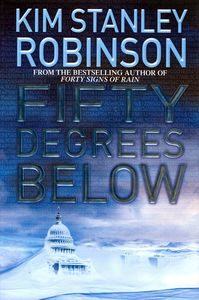
  • Fifty Degrees Below, Kim Stanley Robinson

    Fifty Degrees Below, Kim Stanley Robinson

    Bantam Spectra, 2005, 405 pages, C$35.00 hc, ISBN 0-553-80312-3

    Many things change yet stay the same in Kim Stanley Robinson’s second entry in his “Science in the Capital” trilogy, but this isn’t a problem as much as it’s a statement about Robinson’s extraordinary abilities as a writer. The first volume spent most of its duration setting up subplots before flooding Washington DC in a climax of biblical proportion. This time, the plot is in motion and things start happening right away. Global warming has reached runaway velocity, and temperatures soon hit titular record lows as the good folks at the NSF do their best to find ways to terraform Earth back to a semblance of equilibrium.

    While Forty Signs of Rain spent time going back and forth between Anne Quibler, her husband Charlie and their friend Frank Vanderwall. Fifty Degrees Below is almost all told from Frank’s viewpoint, a strange choice given the particularities of Frank’s view of the world. Educated in evolutionary biology, Frank keeps seeing the world in terms of primate socialization mechanisms, and it’s that outlook on life that leads him to adopt a consciously homeless lifestyle early in the novel as the housing crisis in Washington reaches acute level during the capital’s reconstruction. Spending his time between the office, his van, the gym and the park where he eventually builds a secluded treehouse, Frank joyously (“Ooop!”) reverts back to an optimodal life, a choice that will eventually have serious consequences are the temperature falls and the rest of his life heats up. Because Frank has found the beautiful woman he was chasing in the first volume… and she turns out to be a deep-secret agent with personal problems that soon become indistinguishable from national security. And that’s without counting the attractive presence of Diane, Frank’s boss at the NSA…

    But if the novel revolves around Frank, the world doesn’t and it keeps disintegrating. Khembali, the fictitious country introduced in the first volume, predictably disappears under the waves, and an audacious plan is hatched to reboot the Gulf Stream via a salt dumping scheme of epic magnitude. The tone of the novel changes a bit, introducing enough gadgets to push it a few more years in the future, and enough cloak-and-dagger thriller plotting to send things in a more conventional direction after the refreshingly free-form first volume.

    It all comes together thanks to Robinson’s usually excellent prose. The novel spends so much time in Frank’s primally satisfied brain that the very narration comes to reflect that emotion. We grin as Frank finds his true human potential, doing science even as he communes with nature. Ooooop! But at the same time, his romantic escapades are heart-wrenching, and we can’t help but be concerned whenever truly bad things start happening to him.

    Yet this is also the story of a planet in peril, and Fifty Degrees Below keeps the balance in mind as it tackles global action and a new activist role for science. NSF, under Diane’s hard-driven leadership, starts meddling in political activities, establishing “Permaculture” as its ultimate goal even as it proposes a “Scientific Virtual Candidate” before rallying to Phil Chase’s campaign.

    Once again, Robinson is able to strike narrative sparks from material that would have been unbearably dry in anyone else’s hands. Robinson’s progressive politics find explicit expression, and the novel’s readability remains exceptional event as it stays away from conventional plot mechanics. It ends with a political victory, a damaged hero, a planet in the balance and gathering clouds: Phil Chase has powerful enemies out there, and Frank’s messing with one of them in very personal ways.

    All good fodder for Sixty Days and Counting, the final volume in the trilogy. This has been an unusual, but satisfying series so far: the conclusion should be more of the same.

  • The World Without Us, Alan Weisman

    The World Without Us, Alan Weisman

    Harper Collins, 2007, 324 pages, C$32.00 hc, ISBN 978-0-00-200864-8

    Most environmentally-minded books usually show their eco-credentials by explaining the impact of humanity on nature. But Alan Weisman smartly does exactly the opposite, showing us what happens when humans go away.

    The thought experiment is elegant: “Picture a world from which we all suddenly vanished… How would the rest of nature respond if it were suddenly relieved of the relentless pressures we heap upon it and our fellow organisms? Could nature ever obliterate all our traces?” [P.4]

    The first question raised by this thought experiment is how to tackle the subject. There’s no laboratory experiment that will remove humanity and allow the author to see what happens without removing much of the book’s paying audience along the way.

    But there are ways to find out. Humans may be known for their insatiable lust for conquering the globe, but there are places that haven’t been colonized yet. This brings us to the last remaining square kilometers of primeval forest in Poland, a never-domesticated preserve that shows what temperate Europe was before humans transformed it to their liking. Better yet: there are a few places in the world where humanity has retreated, leaving behind traces of their presence. Pripiyat, the city closest to Chernobyl, stands as a particularly imposing monument to humanity’s transience.

    Because, as Weisman quickly demonstrates in the book’s two must-read chapters, few things can hope to survive without human maintenance. Chapter 2, “Unbuilding a home” fast-forwards through what happens to a typical north-American house when abandoned. Within years, water seeps in and weakens the wooden structure until the house collapses upon itself. Degradation of organic material is relatively rapid, but within decades even metal oxidizes, concrete disintegrates and plastics are under assault by water, temperature, sunlight, animals and bacteria. Five hundred years later in temperate climates, only the ceramics tiles in the bathroom will remain recognizable as such. (Home-owner shouldn’t read this chapter after expensive renovations.) Chapter 3 applies the same logic to cities and shows how quickly a city goes away when no one is there to take care of it. Post-apocalyptic SF fans will get quite a kick out of a serious study of what many have been wondering about over the years. (Curiously, Pripiyat gets a chapter and Savannah earns a passage, but Centralia, PA doesn’t even rank a mention.)

    This extrapolation is informed by expert advice, laboratory tests and historical precedent. Latter chapters study specific bits of infrastructure and human activity, and ultimately start wondering which human artifacts may last through the ages. Plastics, alas, may form the bulk of humanity’s few lasting contribution to the universe: very little of it ever degrades (“Except for a small amount that’s been incinerated, every bit of plastics manufactured in the world in the past 50 years or so still remains.” [P.126] is the killer quote in the “Polymers are Forever” chapter) and a surprising amount ends up washed on the shores of every ocean.

    But even as traces of humanity disappear, nature springs back. Not in the same primeval fashion as it did before humanity’s passage, but it does come back. Much of the thick forests in New England are reclaimed farmland, for instance, and the always-instructive example of radioactive Pripyat shows the extend to which wildlife can spring back to prominence if left alone for a while.

    Paradoxically, this is where The World Without Us is at its most optimistic. If some facets of the biosphere are already irremediably beyond repair (the great garbage patch of the Pacific will be there for a looong time), there is still some hope for a better relationship between nature and humanity, and the results could be rapidly seen as long as some action is taken quickly. It’s hope through humility, of course, a sobering realization of humanity’s truer place in the natural scheme. Of, as you may see it, a recognition of our responsibility now that we can alter the planet, and a recognition of the good we can do if we commit to reasonable stewardship.

    But the book would be so interesting if it wasn’t for Weisman’s arresting style, his judicious choice of international set-pieces and his willingness to let his interview subjects speak for themselves. As a piece of scientific journalism, The World Without Us runs deeper than a mere through experiment about humanity’s disappearance: it’s an exceptional documentary crossing oceans and scientific disciplines in order to inform us. There is a lot of absolutely fascinating material here, from a look at the Korean Demilitarized Zone (now such a heavily mined and regulated area that it has become the Korean peninsula’s best natural preserve) to the operation of the Panama Canal (far more than just a ditch through a jungle.)

    The book occasionally errs in numerous digressions that don’t necessarily advance the subject. But it’s hard to separate the chaff from the vital when nearly everything reported by Weisman ends up being so interesting. The style carries even the slower, less relevant passages, and set-pieces such as a quick look at the potential industrial apocalypse of the Texan petrochemical industry may not be strictly necessary, but they certainly leave a vivid impression.

    The book has already become an international bestseller, and is now reaching its second wave of readers intrigued by the glowing reviews and the fascinating subject matter. For once, believe the hype: this has a good chance of turning into a minor pop-science classic, and a reference tome for many post-apocalyptic SF writers. It’s a profoundly environmentalist tome that understands its time, avoiding strident calls for action in favor of a calm, almost appealing rhetoric. There’s a real hunger for disaster in a troubled early twenty-first century punctuated by falling towers, drowned cities and the promise of rising shorelines. The World Without Us plays with this sensibility, most notably with its unstated conclusion that we may be the most fragile, most vulnerable species in the whole ecosystem… and that the world can go on quite peacefully without us.

  • Presentation Zen, Garr Reynolds

    Presentation Zen, Garr Reynolds

    New Riders, 2008, 229 pages, C$32.99 tpb, ISBN 978-0-321-52565-9

    I started reading Garr Reynold’s Presentation Zen blog a few years ago. At the time, I had a professional interest in good presentation techniques (I’ve been known to give day-long PowerPoint seminars to needy colleagues), and if that part of my day job has lain fallow for a while, I’m still a faithful reader: Not only am I still continuing to develop presentation skills for myself, but Reynold’s style is engaging and rich in insights. Presentation Zen, the blog, is structured around the “blog like you’re writing a book” concept championed by such well-known experts as Seth Godin, Guy Kawasaki and Avinash Kaushik: Their blogs are dedicated to a specific theme and features fewer-but-longer posts all revolving around the blog’s common theme. Each entry is worth a quick read, and when they’re taken together, these type of blogs feel like a continuing education program in a given field.

    Presentation Zen, the book, is more than a snapshot of Presentation Zen’s first few years. It’s a package. Much as Reynolds will repeat that a presentation isn’t a document, a collection of blog posting isn’t a book. While regular readers will nod at a few common themes and approaches (“Oh, here’s the bento box riff!”), Presentation Zen also happens to be one of the best-designed technical books I’ve read so far.

    Which is more than appropriate for a book that presents “Simple Ideas on Presentation Design and Delivery”. As the title suggests and the subtitle makes clear, Reynolds is out to promote the idea that less is better. That presenters should separate the presentation from the document, and should strive to make the slides a part of their speech. An American designer/consultant periodically working and living in Japan, Reynolds is ideally suited to shake up the traditional view of slideware presentations. Presentation Zen seeks to stop people from hammering any type of argument in the dull six-bullets-per-slide PowerPoint format. It argues against repeating the content of a presentation to any living breathing audience. It suggests cleaner graphic design, eye-popping stock photography, flexible unity of design and (shock!) logo-less templates. (The examples of chart re-design on pages 123-125 are worth the price of the book by themselves.) It gives pointers on how to behave in front of an audience, it encourages presenters to think of themselves as creative thinkers and even throws in a detailed method for preparing presentations—away from the computer. A good chunk of the book is pure inspiration, with strong quotes and inspiring passages citing Zen philosophy elements.

    More importantly, it practices what it preaches. The book is fantastically designed: its gorgeous photography, generous white space, full-color layout and copious examples (including Guy Kawasaki’s foreword, which is presented as a slide show) not only give instant credibility to the book, they also enhance the sheer reading pleasure of the book. Yes, I said “sheer reading pleasure” for a business book. Reynolds’ prose is as clean and accessible as the rest of his book, and the book’s cleverly chunked structure is as compelling to read as, yes, a blog. How much fun is it to read? Well, consider that I got the book from my organization’s library (they bought it on my recommendation) and ended up reading it for pleasure at home. I may even buy a copy for myself.

    I also goes without saying that Reynolds’ ideas may not be applicable to all contexts and organizations. Presentation Zen is provocative in how it forces readers to think about why its recommendations may clash with their corporate culture. As far as my industry is concerned, it’s obvious that there are cultural penalties for making attractive presentations: People expect efficiency and speed in drafting presentations, which makes pretty design immediately suspicious. (The irony is that the same “quick and speedy” presentations usually involve lengthy “urgent” revisions by dozen of people that drag on forever and produce eye-straining results.) Other cultural factors make it impossible to even try separating the content from the presentations: Absent managers and meeting coordinators will insist on being provided on copies of the deck for distribution and “study” (Another ironic truth: nobody ever reads presentations once they’re given), and loudly complain if they can’t make sense of the presentation by itself. I could go on, but nobody ever wins in the corporate machine.

    But this isn’t a reason to give up. It’s easy to see how Presentation Zen can be a terrific addition in any preventer’s quiver of design techniques, even in the most rigidly traditional environments. I have already discussed the standout passage on how to simplify and redesign overly-busy charts, but other passages about slide design, presentation storyboarding and stand-up delivery can be stealthily adapted to every corporate template. Plus, hey, no one ever knows when some shock tactics may not be more efficient that the usual routine. (I’m not confessing to any practical implementation of any Presentation Zen ideas in my own presentations. Oh, no, never.)

    Of course, Presentation Zen is only as effective as its readers allow it to be. Let’s face it: presentation geeks like myself, who love designing and delivering presentations, already have a pretty good idea of what to do, and how vital it is to avoid “Death by Powerpoint”. Reynolds’ book has probably already reached a good chunk of its audience. Meanwhile, the truly hopeless PowerPointers bore on blissfully, completely unaware of a different way of doing things and unwilling to learn better. Thus it falls upon the converted masses, the Presentation Zen readers and the game-changers to take this book and shove it somewhere in their corporate culture where it can do some good. Suggest it to your organization’s library. Cite excerpts. Make copies of choice passages and leave them stapled to bulletin boards. Kill your audiences with Presentation Zen techniques and don’t leave them wondering how you did it. The topic may be zen, but this is an all-out war against dull presentations and ugly slideware decks. Read the book, live the book and get your next marching orders from Reynolds’ blog.

  • The Clan Corporate, Charles Stross

    The Clan Corporate, Charles Stross

    Tor, 2006, 320 pages, C$33.95 hc, ISBN 0-765-30930-0

    I won’t claim that Charles Stross can do no wrong: after all, I’ve read his web-published early novel Scratch Monkey and it’s still early in his career (his first novels were more or less published in 2003), but The Clan Corporate, third book in the “Merchant Princes” series, is a superb example of how he’s one of the most reliable, interesting and entertaining genre writers currently working.

    Ignore the “fantasy” label on the book jacket: Stross develops even his “fantasy” novels with the rigor and sheer extrapolative joy that is to be found in the best science-fiction. (This is, after all, the type of parallel-universe fantasy indistinguishable from sufficiently-advanced plot science.) But this third volume furthers bends the genre classification of the series by introducing strong thriller elements that take this novel to the boundaries of the techno-thriller.

    If you remember the end of the previous volume, you’re probably wondering how much mayhem a high-ranking defection has caused for Miriam Beckstein and her family. The answer, as you may guess, is more trouble than anyone can seem to handle: The Clan operations are in disarray, especially now that the US government has taken an interest in world-walking. The defector’s insurance policy, a nuclear device hidden somewhere in an American city, keeps ticking away despite all-out efforts to find the device. New characters make appearances, none more intriguing than Mike Fleming, an ex-boyfriend of Miriam’s, now working for the DEA but drafted in a new deep-secret interdepartmental government effort to find out more about the world-walkers smuggling merchandise just under their noses. In a post-9/11 environment featuring “Daddy Warbucks” as a particularly ruthless vice-president, the US government really isn’t playing nice.

    Oh yes, the “Merchants Princes” series hasn’t yet made its SF underpinning clear, but we’re not in fantasyland any more. Stross’ keen nose for thriller mechanics is familiar to fans of his “Laundry” sequence, but it’s developed to great effect here, placing Miriam against yet another capable enemy. Better yet, this volume’s introduction of real-world thriller elements makes it feel even closer to our reality than ever before.

    Not that she needs the extra complications, in between setting up a new business in third-Earth New London and trying to keep her own family away from her. After the events of the previous volumes, no one is particularly keen on seeing Miriam run around without supervision—she eventually finds out the limits of her freedom after a particularly bad mistake. Poked, prodded and ceremoniously prepared for unwanted nuptials, Miriam comes to realize that it will take the intervention of a third party to free her. Fortunately, third parties aren’t particularly rare in this series so far…

    Plot twists, developments and extended idea riffs continue to abound in this superbly readable entry in the series. The ending is abrupt, but the multi-party power struggle makes the plot deliciously convoluted, and the series’ distinction of featuring an abundance of very smart characters continues to produce unexpected sparks of interest. Miriam’s becoming less of a central character, but the series continues to chug along without any dip in interest. Stross has hit a fertile streak with this series, and his execution so far will be enough to reassure any reader that the series is in good hands.

    Still, one crucial word of warning to the impatient: The Clan Corporate is the first in a tightly-linked sequence of four books: It ends with a flurry of new plot developments and an unpleasant cliff-hanger. People susceptible to hissy fits over incomplete stories may want to stock up and wait until the fourth volume in the sequence comes out in 2009. Yes, that’s a long time. But it’ll be worth it.


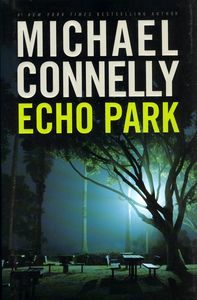
  • Echo Park, Michael Connelly

    Echo Park, Michael Connelly

    Little Brown, 2006, 405 pages, C$34.99 hc, ISBN 978-0-316-73495-0

    When I started my Michael Connelly Reading Project a year ago (“One book per month, every month, until I’m done”), I did so hoping that Connelly would prove to be just as good as his reputation made him out to be. Despite a few uneven novels, this has been proven true so far, and never more so with Echo Park, which goes rummaging once again in Connelly’s favorite bag of trick and puts everything together in an engrossing, page-turning reading experience.

    Not much has changed for Harry Bosch since the last novel: He’s still working with partner Kizmin Rider at the Open-Unsolved unit. Given Bosch’s dubious career-management skills and usual hostility toward authority figures, this already represents a minor miracle. But the comfortable balance is upset by the unexpected capture of a serial killer who confesses to more murders, including an unsolved case in Harry’s past. But what makes it worse this time around is the suggestion that Harry may have ignored a crucial clue –and ignored a suspect who went on to kill more victims. For someone of Harry’s nature, this revelation is almost too much to bear.

    But his problems pile up even higher when a field expedition to a burial site goes wrong and the suspected killer escapes, seriously wounding a recurring character along the way. Paired up once again with FBI agent and ex-paramour Rachel Walling, Bosch has to fight his own worst instincts to unravel the usual web of past crimes, political interference and LAPD quirks. At first glance, there isn’t much to this novel: the tropes are familiar, the characters are familiar (boo, hiss, Irving) and there doesn’t seem to be anything to send the series in a new direction.

    But the pleasure, as always, is in seeing Connelly put everything together with a deft hand. His style is just as compelling as it’s ever been, and his experience in presenting a complex back-story to the reader remains top-notch. It’s an even more impressive achievement considering that in lesser hands, this would have felt like a re-thread of well-worn quasi-clichés. Connelly even avoids tripping my usual distaste for serial-killer stories by neatly wrapping it it up in a bigger and more ruthless framework: Even the familiar political elements seem bigger and more repellent this time around. The conclusion may be as spectacularly nasty as some of Bosch’s previous investigations (along with the usual “Harry, we can never work together again” speeches), but it still feels like the right climax for this kind of story.

    The one sub-plot that never completely works is the same one that never completely works in most of the other Bosch novels: The half-hearted attempts to pair Harry with someone else, this time (once again) with poor bland Rachel Walling, who never gets a chance to shine when she’s paired with Connelly’s best-known character.

    Otherwise, Echo Park is another strong entry in the Connelly canon, made even more remarkable in how it re-uses the same elements and still makes it look fresh and fascinating. Not many authors can do that after seventeen novels (twelve of them featuring Harry), and that shows Connelly’s serious dedication to his craft and his readers. Go ahead, start your own Michael Connelly Reading Project: If you like even one of his novels, you’ll have trouble stopping before you’ve read them all.

  • Passage, Connie Willis

    Passage, Connie Willis

    Bantam, 2001, 780 pages, C$10.99 mmpb, ISBN 0-553-58051-5

    Sometimes, I get the feeling that I’m the only SF fan on the face of the planet who’s not a hundred-and-ten percent fan of Connie Willis’ work. Whenever I admit doubts about her stories, people spit at me, dogs bite my ankles and even babies stare in my direction with disgust.

    Well, okay, maybe not, but part of Willis’ skill is that she makes even the haters hate themselves. After all, isn’t she the smartest, the funniest, the best? Her story certainly have charm to spare: every word, every sentence is carefully put in place to make us dance like puppets to the tune she’s singing. Her stories are often funny on the page, but they’re developed with serious rigor. A major novel like Passage is a superb showcase for those skills.

    Just take a look at the premise: It’s a romantic comedy in which a psychologist studies patients experiencing Near-Death Experiences. Major cognitive dissonance right there, and that’s even before reading a single line of the novel.

    Even a few chapters in, the usual Willis trademarks are obvious: The frazzled protagonist struck in an amusing nightmare of overlapping complications; the copious amount of pop-cultural references; the amusing succession of slapstick comedy, hilarious exasperation and romantic entanglements. The plot takes time to emerge, but it does with increasing darkness, as the protagonist teams up with a researcher who has found a way to safely induce NDEs to volunteers. But something makes the volunteers run away, and soon it’s up to the protagonist to submit herself to her own study… with spectacular results.

    Objectively, it’s far from being a bad book: The compelling nature of Willis’ prose is as sharp as it’s ever been, and the comic complications keep piling up at a frenzied pace. The SF elements of the story are initially slight, but gradually acquire more and more heft. The many characters are leisurely developed and eventually…

    …eventually, we come to realize that the novel’s 780 pages are its own worst problem. There is no economy to the telling, and the repetitive nature of some complications start to take its toll. The story hangs in mid-air for a long time, asking far too much indulgence for missed phone calls, silly character decisions and an obstinate refusal to proceed forward. I often complain that hundreds of pages could be cut from some novels, but it’s not an exaggeration in Passage‘s case: A novel half as long could have done wonders for the story’s impact.

    But perhaps there’s a reason to the lethargy created by this pile of words: Willis seldom shies away from emotional sucker-punches, and there’s a shocking twist a hundred pages from the end that’s both surprising yet foreshadowed by dozens of small hints. It leads to a conclusion that will play really well with some, and remind a self-hating minority of doubters that blatant emotional manipulation remains one of Willis’ most accomplished strength as a writer.

    I have no doubt that my reaction to the novel is idiosyncratic and that it will go over really well with other readers: Willis’ bibliography is crammed with works (Doomsday Book, “Even the Queen” , “All my Darling Daughters”, etc.) that appeal to a certain segment of the readership while leaving others free to cry “emotional manipulation!” between fits of self-doubts. Passage thus fits in an enviable lineage: it’s the typical mixture of farce and tragedy, skillfully put together but not impervious to a cock-eyed “oh, really?” reaction. I suspect that I will appreciate this novel a lot more once I’m past my terrible thirties.

    But even confused haters will recognize that Passage is a powerful piece of work: risky, humane, brilliant and well-researched. The length is a problem, but maybe only to those who already have reservations about the novel as a whole: Others may see it as much more of a good thing. One thing is for sure: Passage doesn’t make it any easier to be critical of Willis’ work.

  • Jumper, Steven Gould

    Jumper, Steven Gould

    Tor, 1992 (2008 reprint), 344 pages, C$9.99 mmpb, ISBN 978-0-7653-5769-4

    One of the few good things about the big-screen Hollywwod JUMPER movie is how it brought back in wide circulation Steven Gould’s original Jumper, a much-lauded Young-Adult SF novel that long proved elusive to casual buyers.

    Now that the novel is once more widely available in a tie-in edition, the usual games can begin:

    • How much of the novel was faithfully adapted? (Not much.)
    • Do the changes improve upon the original? (Sometimes, maybe.)
    • Do the changes betray the artistic intent of the original story? (Indeed.)
    • Is the book better than the movie? (Yup, but you already knew that.)

    Little surprise here.

    But while it’s fun and haughty for book-lovers to dismiss the movie adaptation and make of the original novel some kind of flawless gem, it’s more interesting to note that if the film is a piece of hard-to-like nonsense, the novel also has a number of significant flaws. Some of the movie’s most intriguing elements do work better than the book, at least in presenting a plot framework that avoids unforgivable coincidences.

    (Also: while it’s unfair to the author to speak of his novel by looking at it through the lenses of the movie, that’s the only way it’s going to be read for a few years. These are the realities of the cultural marketplace, and they’re included in the royalties earned by the tie-in edition.)

    But let’s start at the beginning: Seconds away from being beaten by his abusive father, teenage narrator David Rice discovers that he can teleport to locations he can picture in his mind. His first jump takes him back to the local public library (which is also the case in the film, but never explained as “the protagonist’s first thought of a safe haven”) where he immediately starts plotting his escape from a life that has nothing to offer him. It’s a rough process: Gould puts his protagonist through tough decisions and harrowing situations as he experiments in order to find the limits of his powers.

    A major thematic deviation from the film takes place as David robs a bank to sustain himself: In the film, it’s a largely entertaining act with little moral consequences for the hedonistic protagonist; in the book, it’s an unpleasant but necessary action that causes even more trouble for David.

    This widening ethical gap only grows larger when the main plots are set in motion. In the film, a secret group of anti-jumper “paladins” hunt down David, drawing him in an underworld of battling jumpers and paladins. In the movie, David gets a personal reason to hunt down airplane hijackers and fight terrorists.

    Surprisingly, it’s tough to decide which plot-line is better: The book’s terrorist thread is precipitated by a coincidence so unlikely that it’s initially hard to accept that the author would use it to move forward the second half of the book. The gradual transformation of David into an anti-terrorist vigilante is equally hard to take seriously: at the rate airplane hijacking take place in the novel, few major airlines would be able to operate. Some of the pre-Internet details (such as using the services of a clipping agency) are now quaintly amusing, but there’s no denying that there are other reasons why this 1992 novel hasn’t aged so well in a post-9/11 world. The movie’s clichéd jumpers-versus-paladins storyline at least has the merit of moving the action along with family intrigue and a decent amount of mystery that is, alas, left to be revealed in an increasingly less-desirable sequel.

    But if Gould’s original vision had one undeniable advantage, it’s in the thematic richness and maturity revealed by David’s quest for vengeance. There are some very nice portraits of anger and how it’s transferred over from covert to overt targets. David is not a happy young man and his gift for teleportation only papers over the problem for a time, until it grows so overwhelming that he’s tempted to go much too far. Despite the tortured plot points, the dramatic arc of the novel is completely satisfying, whereas the movie’s protagonist doesn’t even have morals or ethics to guide him. And there’s no comparison between the twin romantic plot threads in book versus movie, not when the protagonist of the film is such a repellent bastard.

    Despite some of the film’s most hair-raising action sequences, the book definitely keeps an edge when comes the time to consider the smaller details of the action. Informed by the merciless standards of genre Science Fiction, the novel goes in intricate detail to describe the mechanics and consequences of teleportation: it helps that David is smart and able to improvise in order to put all chances on his side. Meanwhile, the film operates without consistency or elementary logic, contradicting and breaking its own rules. The two may not be closely related, but there are things in the movie that won’t make sense until you read the book. (And there are things that won’t make sense no matter what.)

    But anyone who’s made it this far in the review without being interested by any book-to-movie comparison can take comfort in the fact that Jumper, even with its plotting flaws, is a truly enjoyable Young-Adult Science Fiction novel. Its heart is at the right place, the writing is instantly compelling from the very first page, and if aspects of it aren’t as credible now, it remains a small gem. Now that it’s not that hard to find a copy, do yourself a favor and have a look.

  • The Princes of the Golden Cage, Nathalie Mallet

    The Princes of the Golden Cage, Nathalie Mallet

    Night Shade, 2007, 298 pages, C$10.99 mmpb, ISBN 978-1-59780-090-7

    Here’s my obligatory disclaimer: I really wanted to enjoy this book. I first met Nathalie Mallet at Vancouver’s V-Con convention in October 2007, but really started talking to her at the following month’s World Fantasy Convention in Saratoga. Like me, Mallet is a fluently bilingual French-Canadian living outside Quebec. Quite unlike me, she now has a novel on sale from an American publisher: The Princes of the Golden Cage, free copies of which were available by the boxful to WFC attendees.

    It’s a noteworthy book for several reasons, the most intriguing of which being that this is Night Shade’s first mass-market paperback publication. Traditionally known as a specialty trade paperback house, Night Shade now aims for a bigger market with this new format, and it speaks much of their confidence in the novel to have selected it as their first title in this new audience-friendly format.

    But you can imagine my anxious hope when The Princes of the Golden Cage finally ended in the pole position of my reading stack: What if I didn’t enjoy the book? After all, fantasy isn’t my genre of predilection: a lot of it bores me, when I’m not being quietly infuriated by the clichés of the genre.

    Since I’m more likely to stay silent than to be overly critical of friends and good acquaintances, you can guess by the existence of this review that I found quite a number of things to like about the book.

    The first obvious distinction is that this fantasy is set in a different mold, partly inspired by Arabian mythology and partly shaped by the demands of palace intrigue. The hero of the tale, Prince Amir, is the son of the Sultan, but that’s not much of a distinction given where he lives: an imperial palace where more than a hundred of the Sultan’s sons subtly compete for the title of heir while they await their father’s death. You can imagine the posturing, but Amir has opted out of the race: by focusing on academic pursuits, he hopes to stand aside from the melee and live a quiet life. Alas, events soon run against him: When his brothers start dying in mysterious, perhaps occult circumstances, he is summoned and put in charge of discovering the murderer. So much for keeping a low profile.

    Further complications arise when he befriends another young man who seems to enjoy an unusual amount of freedom. Then there’s princess Eva, already betrothed and yet so irresistible…

    It’s a fantasy, it’s a romance, it’s an adventure, it’s a mystery, it’s a big tangled web of intrigue and it’s almost immediately compelling. Prince Amir is a fine nebbish protagonist and while he’s not much of a hero at first (I wondered at times if the author wasn’t trying to pull off a BIG TROUBLE IN LITTLE CHINA inversion of sidekick/hero roles), he’s instantly likable and earns his own little triumphs. The twists and counter-twists piles up almost too neatly with the metronome precision of a tight movie script, but the overly-complicated ending ties it all together with a bow and a nice flourish.

    This being said, it’s regrettable that Night Shade goofed up its new paperback production process and let an unacceptable number of copy-editing mistakes in the book: The number of curious word substitutions clearly shows that a spell-checked manuscript isn’t necessarily free of errors. (Yes, I’m deeply aware of the irony in pointing this out on a review site that riddled with such mistakes. I know, I know.)

    I may not be the ideal or most dispassionate reader for this book, but I enjoyed it more than I thought and almost as much as I had hoped for. It may have a few first-novel rough edges (and the imperfect copy-editing makes me wonder if it wasn’t rushed in production), but I rarely enjoy fantasy novels as much as this one. A sequel, The King’s Daughter is already scheduled for mid-2008: does that mean I’ll have to take a chance and look in that “fantasy” section of the bookstore?

  • Monster Island, David Wellington

    Monster Island, David Wellington

    Thunder’s Mouth, 2006, 282 pages, US$13.95 tpb, ISBN 978-1-56025-850-6

    The recent revival of written zombie horror fiction has its leading lights: Brian Keene, Max Brooks and David Wellington. Monster Island was a sensation even from its beginning as a free serial on Wellington’s blog: The short punchy chapters, consciously written for maximum cliffhanging impact, drew in readers, raised Wellington’s profile and eventually led to a book publication deal for the book. (The online version is still freely available if you’re curious.)

    Four years later, as the media landscape has latched on zombies as their New Favorite Monster, is Monster Island still worth a read? Does it keep its interest at a time where books, video games, and even blogs post like it’s the end of the world, is Monster Island a charming curiosity of historical value or a horror novel that is destined to endure?

    While it’s still too early to judge its historical posterity, Monster Island still manage to hold its own in 2008. Its audience may not be as hungry for zombie stories as it once was (zombie fatigue may be setting in as even the local cineplex has its zombie-movie-of-the-month club), but the novel itself is a punchy, modern take on zombie tropes with enough winks, chills and screams to keep it all interesting.

    The novel barely deigns to describe the zombie apocalypse event itself: it begins a few weeks later, as an African warlord is running out of HIV medicine. The narrator, an ex-UN official reluctantly working for her, thinks he knows where useful medicine may still be found: the United Nations HQ medical clinic in New York. Getting there, of course, isn’t simple: The Hudson is choked with dead bodies, and the island of Manhattan is overrun by zombies. Even the heavily-armed teenage girls traveling protecting the narrator are outnumbered. But there aren’t just zombies on the island: there are bizarrely-organized human survivors, an unusually intelligent zombie leader and a bog mummy with bigger plans.

    Wellington’s contribution to the zombie mythology is that it’s oxygen deprivation that makes zombies the dumb schmucks that they are in fiction. If, say, a clever medical student deliberately induced death while hooked up to an oxygen machine, then the resulting zombie would keep most of its mental faculties. Presto: one capable antagonist! There are further complications, of course: Wellington can’t resist stepping beyond the zombies to suggest a far grander mythology at play, one with much bigger implications than the good-old undead-coming-back-to-life stuff.

    But the meat of the tale, so to speak, is in the way the narrator’s team encounters and fights the zombies in Manhattan. Here’s where Wellington has the most fun, with advanced weaponry, bulletproof zombies (revived SWAT officers with protective armor), lively confrontation and horror-show encounters with a group of humans led by a self-proclaimed president with more clichés than good sense. Wellington’s a darkly funny writer, and some of Monster Island is tough to digest until one realizes that entire sequences are designed to be macabrely amusing.

    Given the novel’s fast pacing and scattershot approach, it’s not a surprise if some elements don’t work as well, or if it stretches the bound of plausibility even for a zombie novel. The bloggish origins of the novel show in how this could have been a tighter novel with a bit more editorial attention and consistency-checking to make sure that the rules of the story remained consistent from beginning to end. The gradual shift away from the zombie genre into a more general horror framework may disappoint some readers.

    But the energy of the story and its fast pace do a lot to keep it from becoming dull. As we wait for the zombie craze to crest and go away, the stories with the best chances of surviving are those that will offer the best storytelling experience, not necessarily the most consistent genre element or the most radical innovations. Monster Island is still worth a read, and I give it good chances that this will still be true in a few years from now.

    [March and April 2008: Alas, Wellington’s two follow-up novels, prequel Monster Nation and sequel Monster Planet, get sillier and more difficult to enjoy. While Monster Nation (which does describe and explain the zombie apocalypse) has its share of gruesomely enjoyable moments, its conclusion gets increasingly less plausible thanks to increasing doses of mysticism, up to an including a final yadda-yadda about the origins of life, anti-life or whatever. Monster Planet continues in this vein, offering an increasing diversity of critters all jockeying for world domination until is becomes obvious why the book wasn’t simply titled Zombie Planet. Unfortunately, Wellington gets more frustrating the deeper he buries himself in metaphysical nonsense: he’s never as enjoyable as when he’s writing in SF/techno-thriller mode (some of the most fascinating passage of the books are those in which he describes the official military response) and therein lies a suggestion for his next few efforts.]

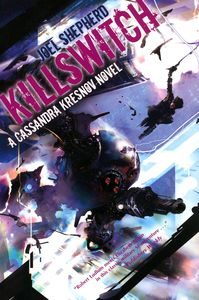
  • Killswitch, Joel Shepherd

    Killswitch, Joel Shepherd

    Pyr, 2007, 450 pages, C$17.00 tpb, ISBN 978-1-59102-598-6

    Killswitch is the third novel in Joel Shepherd’s “Cassandra Kresnov” series, after Crossover and Breakaway. While I read those first two novels with some interest, I could never find enough things to say about them to justify a full-length review. Worse: those two novels seemed both repetitive and strangely fake in their treatment of their heroine’s problems.

    Before explaining why Killswitch is a stronger, more noteworthy novel, let’s review the series so far: In a future where humanity has spread to a number of star systems, the major political lines are between the Federation and the League –two generic names that more or less describe how blandly Kresnov’s feels about them. Kresnov may begin the novel looking like an apolitical party-hard code-slinger, but the truth is more complex: she’s a sophisticated combat android trying to forget her past and fit in the relatively well-functioning multicultural society of Callay. Sadly, things don’t end up working like they should, and a kidnapping by covert operatives end up rousing the interest of Callay’s protection forces. Cassandra may just want to live simply, but her new masters won’t let her shirk away from what she’s been trained for, especially when she proves so devastatingly effective at protecting the president from enemy attacks. The matter of her sentience and legal status having been settled over and over again, she eventually (albeit reluctantly) finds a place as part of Callay’s security forces.

    The problem of the first two books aren’t obvious from the previous plot summary, but they stem from them: This is a pretty ordinary set of plot points. Beautiful-but-deadly military androids are fast approaching cliché, and the question of whether a well-functioning robot has rights equal to those of a human is the kind of classic SF question that has long worn out its novelty value. Breakaway seemed to rehash the exact same issues as Crossover did while bringing nothing new to them, either in theme or in plot. While Shepherd’s writing is competent and even exciting when tackling action sequences, it’s hardly spectacular otherwise and doesn’t do much to compensate for the novels’ pedestrian plots. To that one must add the often-unbelievable way Shepherd writes about his heroine: somehow, I doubt that hot lusty females spend as much time thinking about how hot and sex-obsessed they are as males seem to think they do. The barely-repressed lust expressed by Kesnov’s best friend Vanessa smacks more of male wish-fulfillment than actual character development.

    But things are different with Killswitch. The plot takes another direction as people from Kresnov’s past come back to cause problems. The political issues from the previous novels are further developed, but this time both Kresnov and the readers care a bit more about who’s right or wrong beyond the obvious statement that terrorism is baaad. It helps that the threat to Kresnov’s continued existence is far more ominous –how could it be otherwise with a kill-switch implanted deep in her neural system? Even the characters seem more fleshed-out, with Kresnov’s relationships deepening. The romantic tension with her best friend is finally discussed, and our heroine earns a very satisfying epilogue. The enviable nature of Callay’s well-adjusted multicultural society continues to be a highlight of the series: Shepherd (an Australian, one notes) paints such a compelling portrait of the planet that I’m tempted to emigrate there despite the risks presented by the series’ ever-ongoing carnival of high-speed pursuits, gun-fights and orbital combat.

    The obvious caveat is that readers will have to slog through two repetitive, sometimes indifferent novels before getting some return on their investment with Killswitch. I think it’s worth it, but readers with less interest in politics (or with more attuned gender-wonkery detectors) may balk earlier in the series. As the Cassandra Kresnov sequence seems open-ended, I’m more curious than ever to find out what else Shepherd has in store for his protagonist now that he’s dealt with most of the obvious questions.

  • Forty Signs of Rain, Kim Stanley Robinson

    Forty Signs of Rain, Kim Stanley Robinson

    Bantam Spectra, 2004, 358 pages, C$37.00 hc, ISBN 0-553-80311-5

    I have already written about my constant admiration of Kim Stanley Robinson’s work before, and things won’t change with this review of Forty Signs of Rain, a unique novel of science-fiction that conventionally shouldn’t work as well as it does, yet holds its own as a superbly entertaining work of fiction.

    Robinson, of course, rarely settles for conventional narratives. So when he decides to tackle the subject of global warming (after first glancing at the subject in Blue Mars), he does so by using the best-informed protagonists he could think of: the scientists at work in Washington at the intersection of science and politics. The novel begins as global warming is starting to have its first catastrophic impacts. Meanwhile, a young iconoclastic scientist named Frank Vanderwal is fed up with the bureaucracy and cautiousness of the National Science Foundation where he is finishing his one-year term. His colleague, Anne Quibbler, is busy balancing the demands of motherhood with those of a career even as her husband, Charlie Quibbler, is a stay-at-home dad who moonlights as a scientific advisor to an influent senator. (This senator, Phil Chase, is carried over from Antarctica, but so slightly as to be imperceptible to those who haven’t read Robinson’s previous book.)

    These three viewpoint on the issue having been established in all of their rock-climbing, breast-feeding, telecommuting banality, Robinson does not immediately jumps to the chase. Nearly half of Forty Signs of Rain passes before the first shapes of the overarching plot appear. This is a novel of characters, of good ordinary people engaged in science and all of its messy complexity. The inner workings of the NSF are carefully described (usually by Frank, who can’t stand it any more), while the interface between science and politics is probed. This is not the time for heroics, but for careful action. This is also science-fiction as it’s too rarely written: as an exploration of the facets of science as it’s conducted today in the real world.

    In doing so, Robinson also slyly attacks one of the hoariest clichés of bad SF: the mad scientist. The characters in Forty Signs of Rain are morally outstanding citizens who feel a moral and ethical need to contribute to society by their expertise. Their goal is a better world for all; their means are a conscience and the elements of the scientific method. With this uplifting novel, Robinson reclaims some much-needed credibility for the SF label in its purest sense, even if the science-fictional elements of the book are slight and subtle.

    Besides a few gadgets here and there, only the ending of the book stands as a bit of extrapolation. Yet the biggest irony of Forty Signs of Rain does happens late in the book, as the climax of the story is set in rain-drenched Washington, as a flood of biblical proportions cover the entire capital in meters of sludge and water. What was pure Science Fiction in 2004 turned out to be the unpleasant portent of the real-life flooding of New Orleans barely a year later. Validation of Robinson’s carefully researched novel never seemed more ominous.

    But these thematic elements would be wasted without Robinson’s usually delightful prose, which delves so deep into the character’s inner landscape as to reflect their emotional states. The writing occasionally takes on a quality halfway between internal monologue and typical third-person narration, blending a poetry of science with mundane everyday concerns. Just wait until you read the scene where a squirming child interrupts a head-to-head meeting with the president.

    Ultimately, it’s this blend of domesticity, sweeping thematic concerns and good old-fashioned political issues that makes Forty Signs of Rain such an unlikely page-turner. For a book in which little actually happens, it’s a delight-a-page experience. Fans of Robinson’s brainier previous work will be absolutely fulfilled by this latest work. Best of all, though, is the feeling that the real story is about to begin in the follow-up, Fifty Degrees Below.

  • The Hidden Family, Charles Stross

    The Hidden Family, Charles Stross

    Tor, 2005, 303 pages, C$34.95 hc, ISBN 0-765-31347-2

    Readers who thought that Charles Stross’ fantasy debut The Family Trade was heavily in clever details, plot twists and smart characters are about to get even more good stuff for their money with this follow-up: The Hidden Family piles on more complications, more developments and even more worlds to explore.

    This fantasy series’s premise is that a genetic trait in some humans allow them to travel between parallel worlds, at the price of terrible headaches. The first to discover this ability were inhabitants of another world, one that, by the early twenty-first century, is still stuck in medieval times. Using our world as a source of high technology, those families were able to consolidate their power base thanks to illegal trading on behalf of cartels in our world. (Think about a parallel world without border guards…) One of the several wild cards in this scheme is the sudden re-appearance of one Miriam Beckstein, a long-lost relative who was unknowingly raised in our world as an orphan, eventually becoming a high-tech/business journalist before discovering her gifts and being coerced in the family business. The Family Trade delivered a lot of back-story and intrigue in a short time and The Hidden Family picks off right where the previous book ended, not an accidental choice given how both books were conceived as a while unit before being split for publication.

    The first big twist of this installment, as hinted in the first volume, is that there is another world out there. Not just another America, roughly technologically equivalent to Victorian England, but another family of world-walkers waging war on the clans known to Miriam’s family. Our heroine is quick to seize upon this opportunity and see the potential profit margins in enabling technological transfers between more worlds. There are complications, of course: The regime at the other end is a totalitarian monarchy that wouldn’t take lightly to Miriam’s revolutionary ideas. And Miriam can’t go directly from here to there, but has to set up a transfer point in her family’s intermediate universe.

    As if those new developments weren’t enough, Miriam’s power base in her family is still very much in jeopardy: Her secret love affair with a cousin is already material for blackmail, her relatives can’t stand her lack of manners, and even the senior members of her family are contemplating whether she’s bringing in more trouble than she’s worth. Palace intrigue, plots and counter-plots all unfold in complex patterns, even as a key member of Miriam’s family business plans treason and defection…

    Fortunately, Stross’ crackling prose not only keeps all of those development as clear as possible, it makes reading the book an engrossing experience. This is one of those “just one more chapter” novels that hypnotize readers until the last page, leaving them wanting even more.

    Plot-wise, this is almost as busy as the previous installment, and the ideas just keep on piling up. The interactions between the world are rich in implications: the doppelgangering of locations in dual worlds, for instance, is an idea that constantly reveals new facets. The economic implications of world-walking are cogently explored (even if only conceptually as of yet) while the realities of a renaissance-era world-view constantly rub Miriam the wrong way, offering a subtle counterpoint to the triumphant medievalism so prevalent in classical fantasy.

    The Hidden Family is just the second installment in an ongoing series, so readers shouldn’t be surprised to find out that the end of this book only offers a respite of sorts for Miriam, just as other things go catastrophically wrong. There’s plenty of material for future plot threads here, and yet other possibilities remain unexplored for now, though I don’t doubt that Stross is busy preparing how best to integrate them in future installments.

  • The Lincoln Lawyer, Michael Connelly

    The Lincoln Lawyer, Michael Connelly

    Little Brown, 2005, 404 pages, C$36.95 hc, ISBN 0-316-73493-X

    Once again, it’s time for Michael Connelly to set aside protagonist Harry Bosch in favor of another character. Such “off-Bosch” novels are often the chance for Connelly to stretch a few writing muscles and try something different. The Lincoln Lawyer stands solidly in this tradition: Not only is it narrated by a very different character, but it’s also Connelly’s first outright legal thriller. It doesn’t spend much time in the courtrooms, but it’s all about the titular Lincoln lawyer, a defense attorney who’s forced to rediscover his moral compass.

    Mickey Haller may be a new narrator, but he’s not completely unknown to those who have followed the Bosch series in detail. Although fleetingly mentioned in The Black Ice as Harry Bosch’s half-brother, this connection never comes into play in this novel (and the links to the rest of the Connellyverse are so tenuous as to be invisible), so don’t expect even a cameo by Connelly’s taciturn detective.

    Not that any reader will wish for anything once The Lincoln Lawyer kicks into gear. Like most of Connelly’s novels so far, this is a ferocious page-turner, a perfect piece of entertainment designed to mesmerize its audience even as it slickly delivers the expected thrills.

    The beginning may be slow, but it’s definitely intriguing: As Haller struggles with the demands of life as a lawyer in urban-sprawled Los Angeles (he conducts most of his business from the back-seat of his chauffeured car, hence the title of the book), readers will get a taste for the reality of his work. As in other Connelly novels, we get a heavy dose of jargon, common attitudes and specialized knowledge: Haller’s usual clients are of modest means, and he effortlessly outlines the daily routine of a lawyer trying to do the best with what he’s got. By the time a well-off man named Louis Rouet asks for legal representation in an ugly assault case, we’re fully aware how badly Haller can use a “franchise client” who will pay steady bills for a long time.

    But Haller’s enthusiasm deflates once he begins to suspect his client’s innocence: “There is no client as scary as an innocent man” is the novel’s (fictional) epitaph, and that’s because nothing short of a not-guilty plea can be acceptable for an innocent: The usual options of “fair deals” with the prosecution become unavailable to lawyers representing an innocent man, and that’s the nightmare in which Heller finds himself even as rumbles about another innocent man unjustly convicted start echoing from his past.

    Typically for Connelly, there are a number of further twists and turns in the tale, which piles on the complications as it plows forward. The procedural charm of Connelly’s prose now deals with the world of defense attorneys rather than LAPD policemen, but the impact is the same. By the time the surprising ending rolls around, Haller has learned as much as the reader, and Connelly emerges from his first legal thriller with honors.

    It would be very unlikely to see Haller ride off in the sunset without expecting his return in a future novel. As Bosch himself approaches retirement and Connelly seemingly can’t resist the lure of linking his series, Haller would be a welcome addition to the policeman’s life, especially if the author ends up spending time examining how both half-brothers ended up on dissimilar sides of the law. As a character debut and a first attempt at another form of crime fiction, The Lincoln Lawyer is a remarkable effort, and it promises much more.

  • The Keep, F. Paul Wilson

    The Keep, F. Paul Wilson

    Tor, 1981 (2006 revision), 403 pages, C$4.99 mmpb, ISBN 0-765-35705-4

    I’m always impressed when the years move on and leave certain books unaffected. To the dismay of anyone trying to write for posterity (if there’s such a thing when there are bills to pay), decades can be very unkind to any kind of fiction. Beyond contemporary settings, there are dozens of ways for books to be stuck in time: outdated social assumptions, unfashionable prose or crude genre conventions. Even in Science Fiction or Fantasy, setting a story in the future or the past doesn’t necessarily erase the mark left by the writer’s present. So imagine my surprise to find out that F. Paul Wilson’s The Keep still feels just as fresh today as when it was published in 1981.

    There’s a trick, of course: The version of The Keep I read isn’t the version that was published twenty-five years ago. It’s been reviewed, retouched and reprinted, validated and enhanced along the way like few other early-eighties horror novels have been. Dig deep enough, and you will even find that it was adapted for the big screen in 1983 by none other than director Michael Mann. (Good luck seeing it, though: The film is conspicuously absent from DVD format catalogs, and rumor has it that Mann himself isn’t too keen on reviving it.)

    Then there’s the detail that the book was written to be a World War 2-era supernatural thriller, already taking it further away from instantly-recognizable contemporary cultural references. At a time where horror novels simply required a monster and people to slaughter, Wilson aimed for more ambitious targets by reaching back in time and space to set his monster/haunted-house story in 1941 Romania. When a group of Nazi soldiers occupies an isolated keep deep in the Transylvanian Alps, they awaken something out for their blood, at a determined pace of one death per night. Terrified, they ask for help; alas, the elite reinforcements prove ineffective. Desperate, they end up reaching out to an expert on local legends, a wheelchair-bound intellectual who happens to be Jewish. But even the scholar and his daughter don’t suspect the repercussions of what has been unleashed in the keep…

    One of the reasons why this book is still in print today is that it forms the cornerstone of Wilson’s Adversary cycle, which also spawned Wilson’s “Repairman Jack” series. While The Keep initially looks and feels like a particularly ornate vampire story, Wilson has a larger framework in mind, and the barest hints of the menace are revealed in this first volume. Suffice to say that this isn’t a mere vampire at play, and that the roots and consequences of the novel won’t be limited to 1941.

    But the best reason for the novel’s continued popularity is that it’s slickly written and a hugely enjoyable page-turner. Wilson’s prose is clean and compelling, and his ability to keep readers coming back for “one more chapter” is terrific. While the tight suspense of the first half eventually cedes way to a looser second half, the strong characters keep up interest until the end despite ever-larger developments. The delight with which Wilson multiplies the complications (by bringing in “good” Nazis, the looming menace of another concentration camp, a mysterious stranger traveling to the Keep, unexpected shifts in allegiances, and so on) is the stuff from which satisfying novels are made of. Plus, hey, it’s all-too-easy to lose sight of the most excellent premise: Nazis versus monsters! What’s not to like?

    The historical detail is convincing, Wilson generally avoids the easy Nazi clichés and the first 150 pages are a model of increasing tension. No small wonder that The Keep still attracts an audience more than a quarter-century after its publication. Even for experienced horror readers, the novel still carries its own kick. There’s a good chance that The Keep will still be just as readable in 2031.

  • Ice Station, Matthew Reilly

    Ice Station, Matthew Reilly

    St. Martin’s, 1999, 513 pages, C$9.99 mmpb, ISBN 0-312-97123-0

    When I write that some writers should be praised for their insane genius, I’m specifically thinking of Matthew Reilly. You can keep paying tribute to your literary prodigies, your award-winning wordsmiths and your tortured artistes: Meanwhile, I’ll be sitting in the corner whooping it up with one of Reilly’s pedal-to-the-metal action thrillers.

    Seemingly written for those who think that Hollywood action blockbusters are too slow and sedate, Reilly’s novels explode out of their premises, multiplying action sequences at the carefree expense of believability. It’s as if a Hollywood screenwriter was unleashed from the bounds of budgetary concerns and insurance liability: Suddenly, unbridled excesses and can-you-top-this action sequences become mere chapters in books that delights in exhausting the readers. Reilly’s novel are amoung the best in applying action movie mechanics to the novel form, and while the result won’t be for everyone, it’s a hugely enjoyable way to pass time.

    Ice Station may have been Reilly’s first professional publication (Contest was initially self-published; though re-worked and republished later on) but it already showcases Reilly’s characteristic style. Taking place in Antarctica, it initially describes how a team of Marines investigates the mysterious disappearance of nearly all personnel from a US research station. Things soon spiral out of control as the Marines are attacked from all sides: There’s a killer in the station, strange lifeforms in the pool at the bottom of the base, and enemy forces closing in on the surface.

    But that’s still mere prelude to the sheer insanity of the novel as it develops all of these threads. Because there’s something very dangerous about Wilkes Station where most of the action takes place: something buried deep in the ice, and something that several governments are clearly ready to fight over… or destroy if they can’t have it.

    But geopolitical considerations are mere background information when the shooting begins. Close-combat heroics, hovercraft demolition derbies, mutants, three successive waves of elite attackers, nuclear-powered weaponry and high-tech gadgets are only some of the elements that give Ice Station its hard-edged charm. The characters are secondary at the exception of protagonist Shane “Scarecrow” Schofield (who later goes on to star in three more of Reilly’s novels), but the centerpiece action sequences are very well-done. Reilly’s special genius is that he understands the mechanics of an action sequence: the impossible situations, the small accumulation of mini-objectives, the ratcheting tension in every twist and turn, the cool little ideas that help the protagonists fight their way out of desperate odds…

    I suspect that few serious critics will be kind toward Reilly’s work: He does cheat and lie to his readers in order to crank the tension, and the over-the-top ridiculousness of his accumulating action will be lost on anyone who’s not already a fan of kinematic action. But there’s a lot of clever genre-bending in Ice Station, which earns some distinction by being one of the few thrillers to set up an extraterrestrial element, then tops it with an even less likely development that manages to keep the novel in the realm of the techno-thriller.

    So, no, Ice Station will never get any respect, but it doesn’t really need any: As a techno-thriller, it wipes the floor with the shattered corpses of most other novels of its genre. Reilly’s talent is in his visceral understanding of what make a story move, both at the sentence-by-sentence and the structural level. He is, not insignificantly, a thriller writer with is own distinctive style, and that should be enough to earn him enough faithful readers to enable him to write whatever he wants. Insane geniuses deserve their own dedicated followers, you know.