Book Review

  • Little Brother, Cory Doctorow

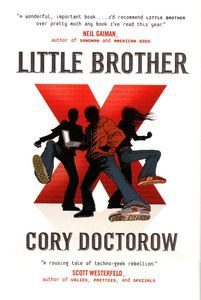
    Little Brother, Cory Doctorow

    Tor, 2008, 382 pages, C$19.95 hc, ISBN 978-0-7653-1985-2

    As a mild-mannered reviewer, I try to avoid throwing around terms like “importance”. But reading Cory Doctorow’s Little Brother, it’s hard to avoid thinking that of all the books I’ve read recently, this one has the best chances of carving its own little place in history.

    If it does become an important book, it won’t be by accident: Doctorow has deliberately set out to write something controversial with this book, and even the broadest-minded readers may experience twinges of discomfort at some points.

    It begins with a group of high-school friends skipping school to play an alternate-reality game in downtown San Francisco. But the game is soon interrupted by a terrible terrorist attack, and soon our narrator Marcus (otherwise named W1n5t0n) is apprehended on suspicions of terrorism. Roughly interrogated by authorities, he’s eventually released… but not all of his friends are, and San Francisco is soon overrun by police forces intent on maintaining an excess of peace and order. What’s a teenager to do? Rebel against the overreaching authorities, of course.

    Little Brother is literally written to rouse the young ones. A tale of hip high-tech resistance, this is a novel made to be put on the YA shelves of your local bookstore, read by disaffected teenagers and passed around in impromptu book clubs as the coolest thing ever. It makes Science Fiction (or at least techno-thrillers) look good, and serves as yet another reminder to adults that the hottest, most vibrant corner of SF is now written for young adults. Unlike past attempts at SF-for-teens, this doesn’t take place in a far deep-space future, but within the next five years, and tackles issues that are of vital interest to everyone right now.

    Best of all, it’s shamelessly, almost aggressively didactic. Marcus is pissed at the system, and his narrative is filled with tips and tricks on how to defeat it. Confound sensors, detect cameras, burn out RFIDs and hack the Internet using the how-to tutorials in this book. If Doctorow’s learned one thing about the Heinlein juveniles, it’s that there’s nothing wrong with a lot of exposition as long as it’s entertaining, and so Little Brother partly becomes an instruction manual on how to live in today’s world using today’s technology.

    This novel, more than many other “forward-looking” works of SF, lives in the now. It’s not a 9/11 novel as much as it’s a post-9/11 story that deals with our response to those events. Beyond the hacking tricks, this is also a novel of social engineering, one that ties together digital activism with the fight for civil liberties. In Little Brother, Doctorow finds the ultimate fictional expression so far of the mindset he espouses daily on the wildly popular blog Boing Boing. What looks like “digital rights management” to some actually becomes “civil rights restrictions” to others, and it’s difficult to separate one threat from another in the big cauldron of issues.

    So difficult, in fact, that chunks of Little Brother feel both reasonable and seditious at the same time: As Marcus fights the system that has unjustly harmed him, he espouses notions that are uncomfortably close to an anarchic strain of libertarianism. If there’s a serious political objection to make against Doctorow’s novel, it’s that Marcus’ rebellion is flashy and cool, but the other side of the revolution –the steady pressure from the less-radical masses —is given short thrift as an agent of change.

    But that wouldn’t be nearly so cool, and the novel does nod in the direction of mass opinion as Marcus finds himself too close to the middle of a movement that has escaped him. Doctorow’s techno-utopianism has a big bad enemy, but has no use for the little anonymous jokers who would use the very same tools to make trouble simply for the lulz.

    But we’re getting deep in considerations that would be wasted on lesser novels. As it stands, Little Brother is not just a joy to read, it’s a wonder to discuss. Its emphasis on civil rights is unusual no matter which segment of the population it’s marketed to, and its modern vitality is a welcome breath of fresh air in a field that seems content on paying homage to the past. As a part of Doctorow’s bibliography, it eclipses his previous books to become his masterpiece so far: I may like Down and Out in the Magic Kingdom a lot, but it doesn’t compare to the anger of Little Brother, and the intensity of Doctorow’s preoccupations match that of Overclocked as a faithful representation of the author’s defining themes.

    Young or old, conservative or liberal, SF fan or not, Little Brother is a novel of the here and now, carefully attuned to the era’s pet psychosis and designed to make us question what we take for granted. It’s the rare novel that tries to create better citizens. Time will tell whether its impact will survive its own print run, but it’s already making waves and creating discussion.

    [August 2008: Huh, look at that: there a quasi-Orwellian “1985” encoded in the ISBN of the book. Happy accident?]

  • A People’s History of American Empire, Howard Zinn

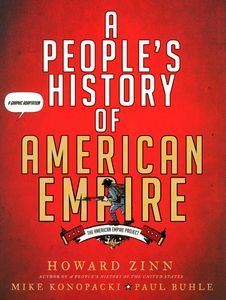
    A People’s History of American Empire, Howard Zinn

    Metropolitan Books, 2008, 273 pages, C$19.00 tpb, ISBN 978-0-8050-8744-4

    A book doesn’t have to be perfect in order to be fascinating. In fact, it can be more interesting to criticize a flawed work than stay inadequately mum when faced with perfection.

    So when I say that Howard Zinn’s A People’s History of American Empire is fascinating, understand that I mean “interesting, frustrating, revealing, naive, clever and annoying” at the same time. It’s a look at American History like no other, but that shouldn’t mean that readers should leave their skepticism at the door. It also means that there are a lot of other things to take in account beyond the strict confines of this didactic book.

    Because there’s no doubt that A People’s History of American Empire is out to reshape a few minds. It’s in its pedigree, in fact: I understand that Howard Zimm’s A People’s History of the United States is now a standard college textbook for left-leaning history classes, or just anyone who wants a slightly different flavor of American history than the triumphant tribute to the glory of the nation that is so popular with bipartisan school boards. This “Graphic Adaptation” of Zimm’s work is practically an original work, focusing on the notion that the American Empire was built on the back of oppressed workers and war-torn foreign nations.

    Then there’s the nature of the graphic adaptation itself. It’s a comic book, for goodness’ sake. It’s designed for easy reading. It’s not even twenty dollars! Forget EC Comics: Frederick Wertham was after this kind of material when he was complaining about the innocents being seduced by them illustrated funnies. A People’s History of American Empire is a painless, accessible way to understand American History from a more socialist perspective. The art may be rough and too-dependent on processed photographic reference, but it’s hard to stop reading: you have to admire the way the authors use the strengths of their medium to make casual readers absorb a colossal amount of information that would otherwise be too dense in any other format.

    The main thesis of the book is that the American Empire was created thanks to a set of foreign and domestic policies designed to maximize corporate profit and encourage military domination. So we get to read how the United States government manipulates its population, over and over again, to cheer for foreign wars that have substantial economic benefits. (The historical precedents to the Iraq invasion as numerous and reach early in American history: The Invasion of the Philippines and the war with Spain over Cuba, as presented here, offer clear parallels with recent history.) On the home front, the American Empire was strengthened by periodical purging of labor movements, both to keep corporate profits up and to keep the population hungry and cowering.

    To non-American readers, this seems like a surprisingly reasonable thesis: The willful and baroque justifications of so-called “reasonable pundits” against labor movements, national health-care and deep cuts to military spending can often look like pure comedy –until we realize that most of the US population pays dearly for those “moderate policies”. (And that the US’s continued neurosis is holding other countries back from even fairer societies.) Zinn’s book is preaching to the converted as soon as it crosses national borders.

    But sometimes, the book overreaches. I’m not too fond of conspiracy theories when social pressures do just as well, but conspiracy theories are often simpler to explain than taking apart entire systems of self-justification, self-interest and self-reinforcement. The weakest moments of A People’s History of American Empire are those where Zinn and his co-authors anthropomorphize deep social tendencies and suggest we blame a small cabal of politicians, operators, lobbyists or businessmen: Not only do those moments get close to conspiracies, but they take away from the bigger problem of a population massively deluded into doing harm to their own best interests.

    A similar complaint concerns the numerous personal testimonies used in the book, from union leaders to soldiers in foxholes: while evocative, they remain isolated data points in a much bigger context. The plural of anecdotes is not data, and it can be frustrating to see the book rely on an illustrated diary account to make points that can be dismissed by “Oh, that’s just one person’s experience.” While it’s one of my favorite maxims that history is something that happens to people, it doesn’t feel as if Zinn, in this book, has earned the right to hinge part of his argument on eyewitness testimonial. Said testimonials often work better when their context is familiar: The chapter on Daniel Ellsberg and the Pentagon Papers, for instance, feels like one of the book’s highlights because the rest of the story is so familiar. Other chapters dealing with Zinn’s own autobiography are also more interesting, because they are presented as one man’s brush with history and not history itself.

    This feeds into the other big problem of the book (and, I’m supposing, Zinn’s source material) in that it’s conceived as being in opposition to the mainstream view of American history. If you don’t know mainstream American History (and I’m not an expert either), it often feels as if you’re missing another half of the story entirely. (And the half that Zimm presents does regrettably downplay a lot of the better episodes in American history.) This is a didactic work, yet it often forgets to mention crucial chunks of the material being discussed. The often-episodic structure of the book probably makes sense in a bigger context, but if interludes like “The Jitterbug Riot” and “The Cradle of R&B Fandom” are fun to read, their relevance to Zinn’s larger argument (ie: disenfranchising more segments of society keeps it from demanding more rights) is best felt by inference.

    But as I re-read chunks of the book for this review, I’m struck at how these issues aren’t problems per se as spiderweb threads leading from this book to a more sophisticated understanding of American society and culture. There are many sources out there for those who want to tear down the happy facade of American triumphalism to take a look at the seedy underpinning of the American Dream, but it’s books like this one that will allow readers to make their own first connections between what hey haven’t considered before.

    My first reaction to this book was to find someone, anyone else with whom to discuss it. As simplistic as it may often feel, it contains a lot of material for thought, and would make an ideal choice for book clubs. It’s certainly not perfect, but it’s a welcome broadening of the conversation in a social context when even so-called left-leaning Americans hold opinions that would be considered profoundly conservative in other countries. Buy it (it’s cheap), read it and think about it.

  • The Greatest Movie Car Chases of All Time, Jesse Crosse

    The Greatest Movie Car Chases of All Time, Jesse Crosse

    Motorbooks, 2006, 176 pages, C$33.95 hc, ISBN 978-0-7603-2410-4

    I know, I know: A whole book about car chases? You’re either wondering what’s the point, pleased at the infinite diversity of subjects available to book buyers, of frustrated that you haven’t been able to sell that pitch to a publisher.

    One thing’s for sure: there couldn’t be a more appropriate publisher for this title than Motorbooks, which specializes in exactly what you think they do. The Greatest Movie Car Chases of All Time is a book for car enthusiasts who happen to like movies more than the other way around: the focus, we quickly find out, is as much on the nuts and bolts of the chase than on cinematic techniques.

    It’s also more than the titular list, which takes up only the last of the book’s eight chapters. Before we get to it, there is a lot of material about the special cars required to film high-speed mayhem.

    This focus on the behind-the-scenes automotive knowledge is apparent from the first chapter, which traces the history of the car chase through the lineage of the people responsible for making them. It’s an unusual choice for a historical overview, and while it may offer an incomplete portrait of a grander canvas, the insider knowledge is interesting enough to distinguish the chapter from more superficial histories of the form that you can probably find on-line.

    The second chapter, one of the book’s longest, is ostensibly about cinematography, but really becomes an excuse to look at the making of several of the car chases that will pop up again in the book’s final list. Chases from DIE ANOTHER DAY, BULLIT, RONIN and C’ÉTAIT UN RENDEZVOUS (featuring exclusive information from director Claude Lelouch) are extensively discussed.

    The next chapter keeps up the technical focus with a look on the specially modified cars used in film chases. The two BULLIT hero cars get a lot of attention, as do the Mini Coopers in the first ITALIAN JOB. Chapter four is a bit of an oddball, focusing exclusively on the past few James Bond movies; the narrative flow of the book changes, and the result feels like a magazine article sandwiched between other things. The fifth chapter feels similar, looking at the works of a specialized British company called Bickers Action, with an emphasis on production techniques that segues well into the next “Lights, Camera, Action” chapter which tackles the technical challenges of shooting a car chase with special cameras and techniques. Chapter Seven offers a return to the human element as it takes a look at the lives of the stuntsmen and precision drivers so essential to the chases.

    Chapter 8 is the long-awaited “Top Twenty”, and it’s an expected mix of big sequences (TERMINATOR 2), acknowledged classics (FRENCH CONNECTION), foreign imports (TAXI), car-centric films (GONE IN 60 SECONDS) and lesser-known films (THE SEVEN-UPS, ranking third right under RONIN).

    You will not be surprised that BULLIT (1968) earns the pole position on the list: not when images from the film adorn the cover and the book’s first page. Not when the foreword is from the film’s director Peter Yates. It’s a safe, classic and historically uncontroversial choice, even though younger viewers may look at the movie nowadays and not be as impressed by the chase than audiences back then. But since some of the more extravagant chases since then are elsewhere on the list (including my own favorites from THE ROCK and THE MATRIX RELOADED), there’s something for everyone.

    While I may not be as much of a car enthusiast as the usual readership of Motorbooks publications, There’s a lot to like in The Greatest Movie Car Chases of All Time, especially now that it’s hit the discount shelves. Abundantly illustrated, it can even find a way on your coffee table as a discussion piece. There’s solid information here in addition of the titular list, and even a few discoveries in the mix. Heck, C’ÉTAIT UN RENDEZVOUS is just a Google search away, and it’s almost as good as the book suggests.

  • The Overlook, Michael Connelly

    The Overlook, Michael Connelly

    Little Brown, 2007, 225 pages, C$27.50 hc, ISBN 978-0-316-01895-1

    And so my Michael Connelly Reading Project ends, after slightly more than a year of monthly Connelly novels, reaching back from Connelly’s first novel in 1992 to this latest offering. While I’m sure that there will be more Connelly novels in my future, this particular binge ends with a bang of a different sort —with Connelly’s leanest crime thriller yet.

    Merely half as long as the author’s other novels, The Overlook was initially serialized in the New York Times Magazine. In many ways, it’s a typical Connelly novel: It’s a Harry Bosch police procedural, firmly set in Los Angeles, involving a dead body and a tangled mystery. When the victim is discovered to have access to radioactive material, the case spirals out of the LAPD’s control and forces Harry to collaborate once again with FBI agent (and ex-lover) Rachel Walling. Homeland Security has been a part of the Connellyverse since Lost Light, but the stakes here feel more urgent and considerably more direct. The added clash between Harry, who considers this a police investigation, and Rachel, who sees it as a matter of national security, brings the usual jurisdictional conflict we’ve come to expect from the Bosch series.

    But the serial origins of the novel give it an urgency that’s been missing from many recent Connelly novels: it’s crisp, takes place within a single day and doesn’t necessarily sacrifice the qualities we’ve come to expect from the author’s work. Its short length is even structurally ironic when it show what happens when Harry’s street-cop instincts are right and the case isn’t as complicated as everyone else thinks it is.

    In short, it’s a refreshing return to the basics of police procedurals for Connelly, who looks positively sprightly compared to some of his contemporaries. The story moves, and considering how seldom Connelly’s regular novels waste time, you can imagine the impact of this one.

    The flip-side of this short and efficient entry is that it features very little development in the Bosch series. Harry’s got a bit of trouble with his newest partner, and poor Rachel Walling once again finds herself handled as a plot device to allow Harry some contact with a case that otherwise would be yanked out of his hands. That’s pretty much it: it’s a minor entry in Harry’s adventures, giving us a glimpse into what would happen if Connelly went the laconic Robert B. Parker route of giving his readers the strict minimum of what’s expected from him.

    It goes without saying that collectors and library patrons will be the ones least dissatisfied by the price/page ratio of this entry: The hardcover edition is grossly overpriced for cost-sensitive readers, and even the paperback look awfully thin when placed alongside its other Connelly siblings.

    On the other other hand, The Overlook (true to its serial origins) is the best entry point in the Bosch series in a long time: it doesn’t require any deep knowledge of Harry’s adventures so far, does a good job at teasing new fans with the strengths of Connelly’s writing, and is short enough to hook readers without much of a time investment.

    So it’s ironic that this public-friendly entry would mark the end of my formal Michael Connelly Reading Project. The best thing I can say about my experience over the past year-and-a-bit is that it’s been just as good as I’ve hoped for: Connelly is among the best crime writers out there, and even his weaker novels (Chasing the Dime, City of Bones) are still a head above most other thrillers out there. He’s done interesting things to keeping Bosch’s character evolving while guarding his series’ strength against radical changes. If you call yourself a fan of criminal thrillers and haven’t read Connelly yet, well, there are still a few good books in your future.

  • Ottawa, the Unknown City, rob mclennan

    Ottawa, the Unknown City, rob mclennan

    Arsenal, 2008, 173 pages, C$22.95 tpb, ISBN 978-1-55152-232-6

    I may spend most of my waking weekday hours in downtown Ottawa, but there’s always something new to learn about the city. It’s in that spirit that I grabbed a copy of Ottawa, the Unknown City, the type of tourism guide that’s more interesting for locals than fly-by tourists.

    Don’t look for a street-by-street guide of where to eat, sleep or shop: While Ottawa, the Unknown City does contain a few of those classic guidebook standbys, it’s best approached as a loosely structured book of anecdotes, historical facts, local wisdom and old-timer recommendations. If you ever wondered what a guide book designed for bathroom reading would look like, then have a look at “The Unknown City” books. (Arsenal Press has published such books for eight cities from Montréal, Toronto and New York to Vancouver and San Francisco.)

    Even for local residents, it’s filled by fascinating stuff. Perhaps the best parts of the book are the historical anecdotes and suppositions: “since they used soil taken from a landfill across the river, an Aboriginal burial site (…) some say it is entirely possible that the second Parliament Buildings include fragments of Natives’ bone in its structure” [P.25] An entire chapter is dedicated to the bad kind of “Notoriety”, including Ottawa’s 19th-century gang riots, Canada’s first political assassination or why some say that the Cold War began in Ottawa. It’s amazing how quickly some events fade from memory: I had no clue, for instance, that the Heron Bridge’s construction was interrupted by a fatal collapse in 1966, or that a $750,000 gold heist happened at the Ottawa Airport in 1974. There’s a great index at the end of the book to track down the anecdotes or do name-spotting.

    Other areas covered by mclennan (himself a well-known local literary landmark) include Transportation, Shopping, Sports, Entertainment (ie: which celebrities are from Ottawa), Nightlife and so on. Cleanly, even amusingly written, it doesn’t take much effort to keep reading this book, which is more than you can say about many guide books.

    Alas, there are a few errors. I’m not surprised that Rivière des Outaouais is mis-translated as Rivière de l’Outaouais [P.15] (even though that’s something that could have been fact-checked with Wikipedia or a simple comparative Google search) since it affects nothing and will only bother us francophones in the kind of slight so-the-Anglos-also-screwed-that-one-up exasperation we’re learned to laugh about. As a cinephile, however, I was far less happy to see mclennan write “Sam Raimi, who directed Superman Returns” [P.113] since Bryan Singer directed Superman Returns, and that breaks the cute “six degree of Lorne Green” chain of connections that he was propping up. And that’s not counting the slight exaggerations that are used whenever someone wants to claim local fame for everyone who’s had an extended stopover at the nearest airport. But, hey, that’s the way the game is played: Tom Cruise is from Ottawa! The Rolling Stones shot a video at Zaphod’s in 2005!

    The focus of the book is toward the not-so-young-yet-restless: there isn’t much about the city’s technological or official side. As with any project talking about Ottawa, it seems contractually bound to keep saying “Ottawa isn’t just about government! We’ve got culture, too!”, somehow missing the point that a good chunk of Ottawa’s charm is largely financed by its status as Canada’s capital. But feel free to ignore me: after all, I’m only one of those gray-faced federal public servants who represent everything that’s baaad about the city, never contribute to The Culture and who never ever spend money, oh buying books written by Ottawa authors. (But never mind that.)

    A book with “the unknown city” in its title is expected to reveal a few secret, and few will be disappointed by what mclennan has managed to discover. While tourists who fly in and out of Ottawa for a few days may not have the time to appreciate the anecdotes in Ottawa: The Unknown City, this is a perfect book for those who will stay for more than a few days, including those who have been here for decades.

  • Born Standing Up, Steve Martin

    Born Standing Up, Steve Martin

    Scribner, 2007, 209 pages, C$29.99 hc, ISBN 978-1-4165-5364-9

    There’s an admirable purity in stand-up comedy, which remains one of the most direct art form out there: a guy with a microphone, making a crowd react by the sheer power of his words alone. Jokes are easy, but comedy is hard and it takes a long time to learn how to do it well.

    That’s the best reason to read Steve Martin’s Born Standing Up, an autobiography that tackles Martin’s career from his days as a Disneyland employee to the point when he decided to quit stand-up in favor of film comedy. Nowadays, Steve Martin has a very different reputation than he had at the end of the seventies: His movie career has degenerated in easy safe self-parody (CHEAPER BY THE DOZEN? BRINGING DOWN THE HOUSE? THE PINK PANTHER?), while his work on projects such as Shopgirl has earned him serious literary accolades.

    But by the end of the seventies, Martin was one of the best-known stand-up comics in America, presenting to sold-out arenas. He held top billing for only a few years, but it took decades to get there: Born Standing Up tells how it happened, following Martin through small acting jobs, early stand-up gigs and how he gradually developed his style of comedy.

    Martin has earned accolade for his writing projects, and Born Standing Up is a fine example of his skill as a writer. The book is short and breezy to read, even when tackling the earlier years that are less interesting to audiences than Martin’s stand-up success. He chooses to end the book by a heartfelt chapter talking about his relationship with his parents. (Though I doubt it, there may be a second volume in the works: Martin chooses to focus this book on comedy, and it seldom mention the events of the past twenty-five years, and practically ignores his movie work after THE JERK.)

    Students of comedy will be pleased by the material in this book. (Though poor students of comedy will have already read the essay in The New Yorker that reprints almost all of the book’s best chapter.) We get a sense of the life of a would-be comedian as he learns how to deal with the crowd, chooses a comedy style that runs counter to people’s expectations and becomes better-known through various jobs and occupations, from live theater to scripted television, Johnny Carson appearances to Saturday Night Live (which gets less of a mention than you’d expect.)

    As a memoir, it’s what we would expect from “a Steve Martin autobiography”: it’s frank, it’s detailed, it’s revealing and it gives a good idea of the life he’s lived. Those who missed Martin’s stand-up years may want to hit YouTube and experience a number of his routines for themselves, just so to put everything else in a proper context. Humor theorists will get a kick out of Martin’s self-conscious attempts to undermine the very idea of stand-up comedy by disregarding the expectations of the crowd –a trick that, in good hands, leads to even more laughter through audience desperation when faced with non sequitur.

    This being said, people with tighter budgets and fainter affection for Martin may want to check this book at the library, or wait for the paperback: at barely more than two hundred airy pages (albeit with numerous pictures), it feels overpriced at nearly C$29, especially for those who have read the New Yorker article, which contains most of what readers will remember from the book. Readers who skip biography chapters until the person becomes successful (a group I’m always tempted to join) may not find all that much meat here; neither will those who expect a tell-all airing of dirty laundry. Particularly picky readers will bemoan the lack of an index.

    But there’s still a kick to Born Standing Up, especially if you want an inside look at the live of a touring comedian, and the dues that have to be paid before mastering the craft. Because, in the end, it’s still one guy with a microphone and a few carefully-chosen words versus a crowd of people who expect a good time.

  • 21 [Bringing Down the House], Ben Mezrich

    21 [Bringing Down the House], Ben Mezrich

    Pocket Star, 2002 (2008 revision), 340 pages, C$10.99 mmpb, ISBN 978-1-4165-8564-0

    Probability mathematics and compulsive risk-aversion have forever cured me of gambling urges, but that doesn’t lessen my fascination for casinos and Las Vegas. Things are always interesting whenever large sums of money are involved, especially when it’s about places designed to take money away from people… and when people figure how to turn that system against itself.

    Indeed, for a book revolving around blackjack at Las Vegas casinos, there isn’t much gambling per se at the core of Ben Mezrich’s docu-novel Bringing Down the House, now adapted to the big screen as 21: This is about a system, a business so simple that even disciplined students could be hired to follow its instructions. It’s about finding order over the chaos of card-dealing, and using a bit of cleverness to exploit a flaw in how casinos operate.

    The story begins in the mid-nineties, when a brilliant young MIT student is recruited by two of his friends who show him a weekend of lavish excess in Atlantic City. Intrigued, the student learns that his friends are part of a small group led by a mathematician who has refined a method to improve the odds in blackjack games. It works using spotters, who keeps a running count of how a given table is likely to produce high cards, and gamblers, who come in and exploit “hot” tables having an idea of how they should bet. It only works using groups of disciplined specialists, discreet communications and hit-and-run weekends.

    It’s isn’t strictly illegal, but casinos definitely don’t like it, which may serve to explain why the group’s leader won’t play, and where the story is eventually headed. At first, nothing is too excessive for the protagonist of the tale, who accumulates more money than he imagined. School soon becomes a memory when bekons a more lucrative way to spend his time. People leave and join the group. And then, well, obviously something happens to make them decide to stop…

    It’s never too clear where reality ends and fiction begins in this book: Mezrich, a gifted novelist, is not the protagonist of the story, and there’s an element of a twice-told tale in how neatly the dramatic tension of the story rises with every passing chapter. The dialogs, structure and dramatic choices are presumably punched up for maximum effect, but that’s okay: It does become a terrific story of money, choices, villains, intimidation and close escapes. By the end of the book, the casinos have figured out how to close the loophole (it’s easy for dealers to switch decks or start over, thus destroying the card count) and every player’s face has been included in the big book of miscreants who are not welcome in casinos.

    But the whole reality/fiction thing takes a step backward in Bringing Down the House mostly because it’s such a terrific, compulsively readable book. Fans of Vegas and casinos will sip it up in a single sitting, while others will be taken by this mixture of fact and fiction. There are tons of details about the way casinos operate, and author Mezrich himself becomes part of the story as he follows his friend to try out The System and delve deeper into Las Vegas lore.

    In the end, paying ten dollars for Bringing Down The House is a surer bet that feeding slot machines. Not that anyone will rely on simple games of chance when the blackjack tables seem far more interesting…

  • The Book of End Times, John Clute

    The Book of End Times, John Clute

    Harper Prism, 1999, 240 pages, C$44.95 hc, ISBN 0-06-105033-4

    This is a very strange book.

    Unless you haunt the dealer’s tables at specialized conventions, you’re unlikely to ever see a copy: It was published in millennium-feverish 1999 and disappeared almost completely from view shortly afterward, just as fast as most other Y2K-themed books did. It’s not rare (abebooks has 37 copies, only one of them priced higher than list), but it’s not something that’s ever likely to see print again.

    I myself had to travel to Florida to an academic conference, spot one of the last remaining copies in the dealers’ room and get it autographed by the author, who commented that This is a very strange book.

    Indeed. Commissioned to mark the big Y2K, it wrestles with millennial fever in a skeptical but not entirely dismissive tone. (Clute recognizes Y2K fever as unreasonable hysteria, but is concerned that the hysteria is keeping people from seeing more serious problems.) A large-format coffee-table book, it was designed with the best early-Wired visual aesthetics, a style that seems irremediably dated not even ten years later. And it also marks John Clute’s foray into social criticism, using the same tools that serve him so well in literary criticism.

    Clute is best known, of course, for his genre criticism: he is widely acknowledged as one of the top reviewers in his field, has shaped the language of SF criticism and has even co-written landmark encyclopedias. To see him grapple with social commentary is an interesting side-step into a slightly different, but not unrelated field: Criticism is about making connections, and here Clute is free to link just about anything he wants into this study of “The End Times”, imagined or possible.

    Not that he can stay away from literary commentary for long. I had to smile when Clute uses almost an entire chapter to riff on the Fall 1997 issue of Life magazine: the critic is never bereft of material. Later, Clute goes back to Science Fiction and studies its place in creating the hysterias of the end times. Through the book, there are quotes and nods to SF authors from H.G. Wells to Ken MacLeod. At the end of the book, the bibliography takes two pages; the Sources, five, with another page-and-a-half of copyright acknowledgments.

    Clute has become famous, or infamous, for his unabridged vocabulary and the complexity of his prose, and this book is up to his usual high standards. The content of the book also holds its own as a piece of social commentary. If some of the structure can be suspect, such as the overuse of the Life magazine commentary, the book is well-informed from a variety of literate sources. Clute has intriguing ideas (just wait to see what he does with the notion of a Tamaguchi), and reading the book today is an interesting experience given everything that has happened since 1999: Without too much effort, we’re left to wonder whether the state-encouraged mad responses to 9/11 became an outlet for all of this untapped hysteric energy. 2008’s developing crises only bolster Clute’s notions of unstoryable end times: death by oil price shock, mortgage foreclosures, food riots and global warming.

    Since this is a coffee-table book, the visual aspect of The Book of End Times is an integral part of the experience. A disjointed, exploding mess of colors, words, pictures, indenting and graphic elements, it’s a strange showcase for Clute’s words, which are usually seen in far more sedate company. It looks like a long Clute essay laid out over a twentieth century retrospective tossed in a blender. The first fifty pages are mystifying and the last fifty are repetitive, but the strident chaos of it lends to Clute’s words an uncanny urgency. It is not, however, a transparent design job: sometimes, thanks to poor contrast choices and ever-varying font sizes, it’s a struggle to read. The relationship between all elements of the design can often be a mystery, the kind of enigma that can only be put together by over-caffeinated designers with a shaky understanding of the text and tight deadlines to meet.

    For Clute fans, The Book of End Times proves to be an essential puzzle piece in an understanding of his critical framework: It clearly outlines a notion that would later seep into Clute’s literary criticism: the idea of the world as Story, and the problems we face in dealing with times that cannot be told as stories. (The obvious case here is environmental issues: Many of them can only be solved by routine, unexciting actions by many -carbon taxes, say, or lifestyle changes- rather than flashy and spectacular acts of heroism by one or a few heroes.) Clute’s work is a mosaic of recurring themes, and so The Book of End Times leads directly to essays in The Darkening Garden, and most likely to the content of the reviews to be published in the upcoming collection Houston do you read. (I wonder if it’s possible to get a copy of the Little Book of Aphorisms of the End…)

    From a brief chat with the author, I understand that the making of the book was chaotic and punctuated by radical changes in editorial directions. The result may not strike anyone as a must-read classic, but fans of Clute’s work, or sociological studies, will find fascinating material here. It’s dating itself fast, but not in the ways you’d expect. Perhaps, one day, we’ll get an updated plain-text version.

  • Contest, Matthew Reilly

    Contest, Matthew Reilly

    Thomas Dunne/St. Martin’s, 1996 (2003 rewrite), 334 pages, C$34.95 hc, ISBN 0-312-28625-2

    I have praised Matthew Reilly’s madness before, but it turns out that I really had no idea of what he was really capable of writing: Contest, his true first novel, provides a look at Reilly’s least-controlled, most chaotic self. The book’s publishing history itself has become a bit of a legend among Reilly fans: Written while Reilly was still in university, the book was rejected by numerous publishers before being self-published. Some of those copied were snapped up by an editor who commissioned Ice Station, and the rest has become publishing history.

    This edition of Contest is not the original version: It has been re-written with more characters, set in a slightly different location and presumably americanized for its intended audience. But it clearly does show an undisciplined, hyperactive writer who cares a lot more about breakneck pacing than originality or even plausibility.

    The premise itself is the kind of nonsense from which B-movie parodies emerge: In an intergalactic tournament where warriors from alien races battle each other for the prize, the latest iteration takes place… in the main branch of the New York Public Library. After careful consideration, a humble New Yorker doctor/dad has been selected to represent the human race. After dark, let the game begin!

    It’s tough to take the novel seriously after that, especially given the weak and far-fetched justifications used to set an alien rampage inside the NYPL. No amount of hand-waving or advanced technology can make this premise work well, and it’s further evidence of Reilly’s insanity that he never seriously tries: we quickly gather that he’s really writing a B-grade movie, and whatever exposition would be too troublesome to put on screen is simply discarded. It’s worth noting that the book jacket blurb never mentions the word aliens, or even alludes to the novel’s science-fictional nature.

    Fortunately, there are plenty of plot complications to keep us busy: Despite the so-called ironclad rules of the tournament. Our hero is actually stuck in the NYPL with his daughter, and at least one contestant is cheating like crazy. (The alien context overseers really don’t come across as particularly competent.) Some of the plot developments can be seen well in advance (say, as soon as the character is informed that “if you leave the Library, you have fifteen minutes until your bracelet explodes”), while other plot developments are sheer authorial bravado: As usual, never assume someone’s dead until you can conclusively identify the body. And always leave room for the possibility that the author is lying to you.

    There are few other ways to say it: Contest is often a ridiculous excuse for a novel, a cheap B-grade exploitation action movie somehow written in prose. But it does have energy, some misguided cleverness and a three-pages-a-minute pacing. It’s bad, bold and yet good, certainly a promising work from a thriller author who would learn much in his latter novels. But I feel safe in saying that there hasn’t been a thriller set in a library quite like this, and even if I think that the premise would have been just as interesting in a more realistic context (say, with criminals and mercenaries as the contestants in a crazy game-show: see MEAN GUNS for a version of this), the finished product remains a better-than-average commuter read. Latter novels have shown Reilly forging himself a reputation as a fast-paced, low-realism, go-for-broke writer, and Contest shows him at his least polished, most visceral state. It’s a must-read for Reilly fans, and memorable experience for others.

  • Sixty Days and Counting, Kim Stanley Robinson

    Sixty Days and Counting, Kim Stanley Robinson

    Bantam Spectra, 2007, 388 pages, C$30.00 hc, ISBN 978-0-553-80313-6

    Little about Kim Stanley Robinson’s “Science in the Capital” trilogy has been conventional so far, so it fits that the third volume, Sixty Days and Counting, also defies usual trilogy protocols. Mind you, it fits the subject: Critic John Clute often talks about the challenges of fiction in representing today’s “unstoryable” concepts that cannot have clearly-defined heroes and dramatic climaxes (such as environmentalism). This book puts the notion to the test, and though it may bore readers looking for more excitement, it does manage to remain true to its ideals.

    By the time thir third volume begins, the flashy battles have been won: Pro-environment Phil Chase is the President of the United States, the NSA has gained enough favor with him to be able to lead the massive new governmental programs required to deal with global warming, and the Gulf Stream has been rebooted thanks to a massive saline injection. In another context, this would mean the end of the story. Here, though, there are still plenty of small issues to consider. Frank Vanderwal is still brain-damaged and unable to make decisions, which gets more and more dangerous as a shadowy group sets its sights on him. Meanwhile, Charlie Quibbler returns to political life, leaving behind his son, who may still be affected by the influence of the Khembali monks.

    On a conventional plot level, only Frank’s struggles with brain damage, his lifestyle, his dangerous girlfriend and her unsavory, all-powerful ex-associates keep things moving. Frank struggles with decision-making following his assault in the previous book, but by the time he decides to have an operation that may solve the issue, he’s fighting for his life, chasing down covert agents and trying to uncover the identity of those who try to manipulate US elections. But even he can’t do it alone, and the ultimate resolution of that plot line is another one of Robinson’s attempts to defy expectations. Frank is a hero for how he reacts more than what he does. (Amusingly, the novel’s best moments are just as counter-intuitive: A moment in which Charlie verbally eviscerates World Bank representatives is a highlight, while an assassination attempt is completely under-played.)

    But chases and special agents all seem a bit silly given the series’ continuing reliance on domesticity, utopianism and the scientific method as plot drivers. Neither of those elements can be achieved with dramatic gestures and extraordinary heroes: they are built day after day, with an accumulation of small actions. And so Sixty Days and Counting (which refers to the grace period after a presidential inauguration) is a novel of phase transition, as Robinson suggests a way to turn the country around towards a better society. Heady stuff: readers interested in Robinson’s liberal politics are sure to appreciate the blueprint for change.

    The flip side of that argument, of course, is that readers looking for stronger dramatic plot drivers are going to be sorely disappointed. If people were still expecting something different this far ahead in the series, it’s too late to change course. Sixty Days and Counting is a logical follow-up in the course of Robinson’s career and a piece that echoes a good chunk of the author’s work so far, from the utopianism of Pacific Edge to the political musings of the Mars series, to the environmental message of Antarctica and the Buddhist themes of The Years of Rice and Salt. Readers who didn’t like any of that, well, should know that there’s another book that they’re not going to like…

    As for me, I continue to be surprised at how much I enjoyed the series even if it does a lot of things in ways that I shouldn’t enjoy. Granted, I tend to be more generous toward Robinson’s work that other readers (though not early on, nor always: I tried reading A Short Sharp Shock recently, and it practically fell from my uninterested hands.), so you may adjust expectations accordingly. I’m constantly on the lookout for true science-fiction and this series really does stick close to the ideals of fiction about science, even if in doing so, it risks short-changing its fictional interest. On issues such as global warming, unstoryable by definition, that may be the only defensible choice.

  • The Merchants’ War, Charles Stross

    The Merchants’ War, Charles Stross

    Tor, 2007, 336 pages, C$28.95 hc, ISBN 978-0-7653-1671-4

    Things never get any less complicated in this fourth volume in Charles Stross’ ongoing “Merchant Princes” series. Readers should be advised that in addition of being a fourth-in-a-series, The Merchants’ War is the second in a tightly-linked four-book sequence: They will be lost if they haven’t read the previous tomes, and few of the plot lines are resolved by the time the last chapter ends. Since, as of early 2008, the remaining books in the series still haven’t been published (that will have to wait until 2009), readers may want to stock the books for later reading.

    But if you’re reading this in 2010 (lucky you!), here’s where things stood at the end of the third volume: Series heroine Miriam Beckstein, a journalist having discovered her talents for walking between the worlds, narrowly escaped a terrible wedding via an ever more terrible coup against the world-walking Clans. Lost on the unfriendly streets of Third-Earth New London, it’s time for her to take back control of her own destiny, even at the risk of making waves against the authoritarian regime of New Britain. There are a lot of dueling plot-lines by this point in the series, and it’s a mind-bender to try to keep up with them all. Even Miriam, after being in the spotlight for the first books of the series, is becoming just another character among many even as her role in this book is a little more active than her forced isolation in the third tome. A fourth reality even gets added to the mix this time around, proving that things can never get too complicated. But Stross’ clean style, combined with his usual humor and hard-edged understanding of economic realities, is enough to keep things hopping.

    The series also keeps shifting in tone. The Merchant Princes have never been completely fantasy, but as the US government starts studying world-walking after being tipped off at the end of the second volume, Stross is bringing the series ever closer to Science Fiction: There is a superb sequence set in top-secret government laboratories in which the jargon flies as thickly as in Stross’ more conventional SF novels, and that in return promises even more interesting developments in latter books.

    In parallel, a team of explorers from Miriam’s clan has also set out to explore the possibilities of world-walking as a science, discovering a fourth Earth that hints of a long-gone advanced civilization. That sequence is also one of the highlights of the book, and also promises much in latter novels.

    At the same time, The Merchants’ War also keeps the series firmly set in the techno-thriller genre. After the incidents of the third volume, everyone is racing to find where the Clan’s “nuclear insurance policy” is located in Boston, and the scene in which they do find out is second in horrified interest only to the scene in which they discover another bomb they didn’t know about. Oh yes, this is a lively book.

    The twists and turns keep piling up, as do the ideas and character revelations. The mix of technologies that the Clan uses against the Nobility’s aggression is intriguing, even as it’s an excuse for a few laughs—such as transporting “re-enactors” forces in a schoolbus.

    But trying to review things at this point is like seeing half a movie and being asked for comments. The best thing to say so far is that the rhythm, inventiveness and quality of The Merchant Princes is intact after four books, and that all signs point to even more fascinating follow-ups. Sadly, these follow-ups still have to be published, and there are at least two of them to go before a natural breathing point.

    So there’s really no news to report: if you like the series, this book isn’t going to change your mind, but any further development will have to wait until everything is out.

    So, reader-from-2010, how good was it?

  • Crime Beat, Michael Connelly

    Crime Beat, Michael Connelly

    Little Brown, 2004, 375 pages, C$34.95 hc, ISBN 0-316-15377-X

    When I vowed, more than one year ago, to embark on my grandiose Michael Connelly Reading Project, I really meant it: I would read all of Connelly’s books, including this odd collection of non-fiction pieces written between 1984 and 1992 while he was a crime reporter. Starting in Florida, then moving on to Los Angeles, Crime Beat chronicles the raw material from which Connelly would inform his fiction. It’s an uneven book, unsatisfactory like reality usually is, but Connelly fans will find much to like and to inform in the pieces here collected.

    Perhaps the most essential pieces of the book are the first two ones: “Watching the Detectives”, an autobiographical introduction in which Connelly muses upon the real crimes and the telling details that have influenced his life, and “The Call”, a lengthy feature-piece that follows the Fort Lauderdale homicide squad during a particularly busy week. “The Call”, we gather, is one of Connelly’s best pieces from his Florida days: it shows a writer presenting facts crisply, yet with empathy for subjects that have become characters. It’s no accident if “Watching the Detectives” explicitly refers to details of “The Call” as important markers in Connelly’s career.

    The book itself is divided in three sections: The Cops, The Killers and The Cases, with an afterword called “The Novelist as Reporter” in which critic Michael Carlson too-briefly establishes further links between Connelly’s journalistic career and his fiction. Pieces reprinted span a range between immediate reporting to more thoughtful pieces covering subject from a certain distance and scope. It’s no accident if the most satisfying pieces are the broader ones: They allow Connelly’s fictional style to take over and can usually present complete stories. They’re also easier to read ten years later, as they try to present a self-contained unit of thought. Particular such highlights include “Crossing the Line”, a feature piece on the LAPD foreign prosecution unit that reaches across national borders to solve cases, and “The Gang that couldn’t shoot straight”, which describes a particularly inept assassination business.

    The problem with reprinting newspaper pieces is that there’s always a bigger, broader story hovering beyond the words on the page. Sometimes, even often, that story remains unfinished: too many pieces remind us that reality is seldom wrapped up neatly by the last page of the epilogue: Many pieces end with the frustrating note that the case remains open and unsolved even when, as readers, we can read between the lines and identify a likely suspect. (Or, when the suspect is still at large, “his whereabouts remain unknown”)

    To get around this problem, Connelly packages together a few stories about the same cases, following an issue through the years. The “Death Squad” chapter, for instance, ties together eight stories spanning more than two years in order to cover a case in which police officers shot three robbery suspects on thin pretenses.

    Despite the reasonable page count, Crime Beat isn’t a particularly long book: The design is airy, the pages are uncluttered, the margins are generous and there can’t be much more than 275 words per page. Fans of Michael Connelly and the True Crime section of the bookstore will get their money’s worth, but people with only a casual interest in criminal stories will definitely prefer Connelly’s fiction. Still, it is an interesting piece in his bibliography, and it does much to show where he comes from.

  • The Time Traveler’s Wife, Audrey Niffenegger

    The Time Traveler’s Wife, Audrey Niffenegger

    MacAdam/Cage, 2003, 518 pages, C$25.50 tpb, ISBN 0-965-81867-5

    For as long as Science Fiction has existed as a literary genre, its writers and fans have been equally busy considering it a Special Genre and complaining that no one takes it seriously. Why, they sigh, isn’t the mainstream paying attention to SF? Wouldn’t it be cool if mainstream authors wrote SF and SF story were taken seriously as Literature? Cue countless convention panels.

    But the twenty-first century so far has been receptive to the blurring of genre boundaries. Amusingly, though, the most successful experiments have come from outside SF looking in: mainstream writers playing with typical SF clichés in increasingly skillful ways, in books published and read as mainstream fiction. (More cynical commentators will snark that it’s easier to teach good writers how to use SF elements than teach SF writers how to write well.)

    And so we come to Audrey Niffenegger’s The Time Traveler’s Wife, a charming romance between a man unstuck in time and the woman around whom his life revolves. Henry’s life is complicated by a singular genetic trait: Uncontrollably, he travels through time, finding himself naked and confused in his past or future. The only constant is his wife, Claire, which he first meets when she was six but doesn’t see “in real time” until she is 20 and he is 28. Courtship can be complicated when you keep running into the same person at all stages of her life…

    Never mind the suspicious genetic rationale for Henry’s time-traveling ability (which behaves as fantasy, but is eventually explained away in scientific terms): Niffenegger has the good sense to develop the tale as rigorously as she can given her premise, and the result can be impressive. Henry develops criminal skills as a matter of survival (finding yourself naked in Chicago in the winter helps make do of scruples), teaches his younger self to cope, obsesses about being there at crucial events of his life, and so on.

    At times, it’s a harsh tale: There’s an obvious creep-factor in Henry meeting his to-be wife when she’s a child and he’s a fully-grown adult, but the novel does its best to acknowledge and mitigate the discomfort. On the other hand, the novel breaks other taboos with a smile, and gets grim when Henry defends Claire’s honor. There are heart-breaking scenes when their marriage goes through rough patches, and their first attempts to have a child prove gruesomely unsuccessful. The last hundred pages of the novel get grimmer and grimmer as hints of terrible things accumulate. A movie adaptation is scheduled for Christmas 2008: we’ll see what edginess remains on the screen.

    But this is first and foremost a romantic comedy, and the very unusual love story between Henry and Claire is milked for all it’s worth: Despite the element of time-travel, it’s an unusually believable relationship, and this believability does much to contribute to the book’s compulsive attraction: It’s not a short novel, but it feels much shorter thanks to a steady forward rhythm and a series of secrets and revelations strung along the entire length of the novel.

    The only nagging aspect to The Time Traveler’s Wife is implicit in its conceit: Henry’s travels through time are “unpredictable”, but dictated by dramatic needs more than anything else. Sequences describing Claire and Henry’s wedding, or the conception of their daughter, are virtuoso pieces of stunt plotting, but it’s at showy moments like those that the story gets less believable.

    Still, it’s a small price to pay for a memorable piece of writing. Genre critics will be fascinated to see the way Niffenegger is able to make juice out of the old pressed lemon of time-travel, not by topping decades of genre history, but by looking at the possibilities of the idea through the lenses of mature adult romance. Well-written, well-plotted and well-detailed, The Time Traveler’s Wife also happens to be one of those books that genre fans and genre haters alike are likely to enjoy. Mainstream and SF, for once united: it just took an uncommonly good book to do it all.

  • Callahan’s Con, Spider Robinson

    Callahan’s Con, Spider Robinson

    Tor, 2003, 286 pages, C$33.95 hc, ISBN 0-765-30270-5

    What is it about Spider Robinson’s “Callahan” books that makes them as charming as they’re infuriating?

    It’s not hard to see that the series has earned its place in SF history: Callahan’s Con is the tenth book in the cycle, which began with stories published in the mid-seventies and continues with a string of novels ending (so far) in 2003. At its best, the series is a unique blend of light-hearted wordplay, strikingly original characters, permissive politics and good old-fashioned idea-spinning. The story is usually set around a drinking establishment of some sorts, around which cluster a series of old wise regulars (not all of them human) and walk-in lost souls. The prose is sharp, easy, witty and conversational: when the Callahan books hit their stride, they bring readers in an imagined community having the equivalent of the best SF convention chats ever imagined. This, maybe more than anything else, certainly accounts for a chunk of Callahan’s popularity in SF fandom: it’s not hard to wish for the existence of a real Callahan’s where everyone would know your name.

    The flip-side of this appeal is obvious: At its worst, the series quickly becomes indolent, indulgent, self-satisfied, convinced of its own innate goodness and disdainful of anyone who falls outside the loose parameters of the target audience. After trying to kill the series a number of time (it features at least four changes of venues), Robinson kept succumbing to public demand for more of the same and, indeed, delivered more of the same. For those reading the books in rapid succession, the plots quickly became repetitive: Stranger walks through the front door, tells sad story, is comforted by infinitely wise super-characters. The process is repeated with a few strangers until a threat against the world/universe is discovered, logically deduced from the shakiest logical premises and solved through the inevitable application of a mass telepathy communion that, we’re assured, is in no way comparable to a mental orgy. Don’t forget the awfully heart-wrenching moment in which sad sacks reveal the terrible past trauma that pushed them to the edge because, hey, “Shared pain is lessened; shared joy, increased.”

    And repeat.

    Callahan’s Con may indulge in a few refinements, but it’s basically the same story. It moves the series to near-contemporary times, features mafia characters muscling in on Key West and features a confidence game whose working depend on a science-fictional device, but wait a bit and the requisite bits appear: the rigid bureaucrat who wants to destroy the characters’ carefree lives, the bon mots between narrator Jake and his patrons, the bizarre stories, the chain of logic leading to a death-defying scenario, the Truly Sad Moment… all there. The structure of the plot is lazy, moving from one element to the other to give each of the series’ characters a few speaking lines and a chance to hog the spotlight.

    But this is comfort food, and it doesn’t matter if it’s the same thing as in all previous volumes: Robinson’s cast of character are as charming as ever, the winks to other writers are numerous and his style remains the epitome of readability. Robinson even works overtime to correct some of the bad feelings left by previous books: the bureaucrat turns out to be a fearsome ally, and bridges are mended with former enemies. All is well that ends well, except for that Sad Moment that seems mechanically added to the book just to ward off the accusations that it’s a mere romp.

    There’s no doubts that readers who aren’t already familiar with the Callahan’s series may want to start at the beginning: there are so many references to previous books here that even series faithful with short memories may miss most of the extended gags. Taken on its own terms, Callahan’s Con is pure but substandard fan-service with lazy re-use of familiar plot beats. But fans (even doubtful ones) will like it, and there isn’t much more to say about any tenth volume in any series.

  • Bones of the Earth, Michael Swanwick

    Bones of the Earth, Michael Swanwick

    EOS, 2002, 335 pages, C$39.50 hc, ISBN 0-380-97836-9

    Michael Swanwick is a wonderful writer for many reasons, but one of them is that he never seems to write the same book twice. He bounces between various sub-genres of SF and fantasy, changing styles and approaches as the story warrants it. The only constant that his fans can expect is fine prose and ambitious literary themes: otherwise, it’s a new experience every time.

    Since Swanwick’s reputation is one of a literary SF writer, he surprised more than one reader with Bones of the Earth, a classic SF novel deeply set in the most honored traditions of the genre: time-travel, dinosaurs, secret government projects, cognitive breakthroughs… and eventually something else. Something stranger, yet even more familiar for SF fans.

    This classic feel even extends to the prose, which is easily some of the most accessible writing than Swanwick has ever produced: From the very first pages, as a scientist is given a fresh dinosaur head, we’re absolutely hooked forward. The novel merrily skips ahead to a paleontologists’ conference that also doubles as a convention for a few decades’ worth of time-traveling scientists. A mysterious yet showy military officer keeps a tight lid on the event and its potential paradoxes, but that doesn’t prevent our hero from getting glimpses of the future and where it may lead.

    Few books I’ve read in a while have the sheer narrative hooks that Bones of the Earth so cleverly unsheathes in its first hundred pages. It’s a good thing that I was reading it on a plane rather than on my morning commute, because I would have hated to stop mid-way through.

    Even then, much of the energy disappears during the third quarter of the novel, as characters are stranded in the past with tenuous hopes of rescue. The action shifts to a more classical adventure/survival mode, but the plot stops dead until the rescue and the return to the novel’s more exhilarating issues. (Writers should take note: Stranding characters nowhere and making them wait for rescue does exactly the same thing to a novel, especially when it’s obvious that the novel has bigger issues on its mind.)

    It all comes back together for a finale that picks up the classic tools and tropes of classic SF, all the way to a more or less triumphant resolution. There’s romance, there a Big Idea, there’s a round of applause: old-fashioned SF, written up to fine contemporary prose standards. The impression is further bolstered by a lot of well-researched material about paleontology here, as Swanwick transforms himself in a quasi-hard-SF writer in order to create the illusion of a credible novel.

    As a reviewer who has had… issues with Swanwick’s material before, it’s this transformation to an old-school SF style that has me most interested in Bones of the Earth: it strikes me that Swanwick’s work always tackles myth to a degree or another. It may be the case that he set out to write a classic SF novel and derived his approach from a deconstruction (formal or otherwise) of everything that SF fans love about classic examples of the genre: The ever-dizzying revelations, the straightforward narration, the abundance of scientific details, the paradoxes and logical games of SF situations… Bones of the Earth may be, in its own straight-faced way, as deliberate a take on a sub-genre as The Iron Dragon’s Daughter.

    But these critical games aside, this is a fascinating novel that earned its Hugo Awards nomination back in 2003. The first hundred pages is one of the most compelling opening act I’ve read in a while (ah, that ball trick…) and the willingness of the author to play the classic SF game is as gripping as it’s amusing. I’m still not sure how the same author can write all of those very different novels, but that’s Swanwick’s calling card, and the advantage in that approach is that there’s at least one novel for everyone in his growing bibliography.