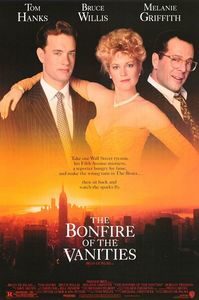
(On DVD, October 2008) This movie was critically lambasted upon release, but if it’s not quite a success, it’s not the disaster that some reviewers have reported. As an adaptation of Tom Wolfe’s novel, it manages to hit most of the high points of the novel, and if Wolfe’s prose can’t be fully adapted to the screen, it finds an appropriate counterpart in Brian de Palma’s swooping direction and ambitious cinematography. The long continuous opening shot is a small marvel of the form, while other sporadic flourishes keep things hopping along. Things aren’t as slick regarding the script, which does an intriguing job re-casting Wolfe’s story into a satiric comedy mold, but falters in the film’s second half with a number of limp scenes that don’t advance the story as efficiently as they should. It’s too bad that the manic quality of the original is only half-finished here. The result isn’t terrible, but it certainly could have been better. The first-generation DVD, regrettably, doesn’t include any supplementary material about the film, which is a shame given that an entire book has been written about the film’s troubled production.
(Second viewing, On Cable TV, August 2021) After enjoying TCM’s podcast adaptation/update of Julie Solomon’s The Devil’s Candy, which offers four hours of material on the making of The Bonfire of the Vanities, the mandatory next step was to watch the film itself. (Actually, I watched it between the sixth and seventh episode – the best possible timing considering that the seventh episode opens on the first public showing of the film.) Once again, a rewatch had me protesting that the result wasn’t that bad, even enjoyable. Oh, it’s clear that as a film, The Bonfire of Vanities falls considerably short of its potential. The dark cynical humour is mishandled and neutered by a final speech that shouldn’t be in the film. It’s miscast from top to bottom – Tom Hanks is not bad in the last third of the film when he’s free to play up his comic persona, but he’s really not the right choice for playing a high-powered adulterous stockbroker. Melanie Griffith has never been much of a draw for me, so her casting as an irresistible femme fatale is wasted. Morgan Freeman’s not bad, even when saddled with the film’s most awkward dialogue. Surprisingly, I found Bruce Willis to be the most watchable, but only when he fully plays into the quasi-noir role of the crumpled journalist working hard for his bylines. (This is not, however, the character in the book.) Visually, the film is far better than its script – The first ten minutes overpromise a film that’s not to be found later on, as a magnificent overhead shot of New York City leads to an astonishing steady-cam shot and then to the memorable image of Tom Hanks dragging his dog off to a sodden walk (and a misguided phone call that triggers everything that follows). Narratively, you have enough to keep viewers invested, but there is often a clash between the original intentions of author Tom Wolfe and the neutered execution that Brian de Palma ends up delivering. Part of it is clearly due to an attempt at mainstream filmmaking – I don’t think that major studios were ready back in 1990 to bet the bank on a highly cynical work, at least not as much as today. You can see the compromises all the way through, even as the atmosphere of a New York City divided along racial and class lines is still quite pertinent as long as you ignore the Bronx caricatures. It’s frequently (but intermittently) funny, at least enough to keep the film from being dull. I strongly suspect that The Bonfire of Vanities’ reputation partially comes from overinflated expectations considering the success of the original book, partially because entertainment pundits were (and are) always looking for a fall-from grace story from Hollywood, and partially because the gap between that the film aimed for and what it achieved is so visible. As someone who routinely watches near-unwatchable cinematic tripe made with only a fraction of The Bonfire of Vanities’ assembled talents, the circa-1990 hyperbolic pans of the film are embarrassing for those taking the potshots: The Bonfire of the Vanities is misguided, disappointing, even a case study in how even the best intentions can go wrong in such a complicated production as a Hollywood film, but there’s more than enough here to make viewers happy – even its problems can be entertaining once you get into them.







![Gwoemul [The Host] (2006)](https://www.christian-sauve.com/wp-content/uploads//gwoemul-2006-202x300.jpg)