Reviews

  • Batoru rowaiaru II: Chinkonka [Battle Royale II: Requiem] (2003)

    Batoru rowaiaru II: Chinkonka [Battle Royale II: Requiem] (2003)

    (In French, On Cable TV, May 2020) I’m really not the biggest fan of the first Battle Royale movie, but even I have to admit that it did have a clear narrative tension, which is sorely absent from its sequel Battle Royale II: Requiem. Not that it’s the only thing missing from this disappointing follow-up: taking the contrivances of the first film to another level, this sequel only makes sense in the mind of its screenwriters obsessed with criticizing post-9/11 America. The plot (about high schoolers equipped with explosive collars, bonded in pairs and sent to kill a terrorist before Americans bomb his island hideout) couldn’t be less convincing if it worked overtime, and the characterization is sorely missing. The anti-American message of the film quickly wears thin (and I say this as someone who lived, aghast, though 2001–2003) and the action never manages to create the level of tension seen in the first film. It’s all rather dull, repetitive, uninvolving and useless. Considering all of what’s happening in this film, the return to the battle royale concept, along with its overlong briefing sequence, completely undermines its theme. The “provocative” message is ham-fisted, ill-thought-through, and completely uninspiring as an alternative to American imperialism. Even fans of the first Battle Royale will not like this one.

  • The Hill (1965)

    The Hill (1965)

    (On Cable TV, May 2020) Now here’s something as merciless as it’s interesting—a WW2 film in which the heroes are British soldiers and the villain is… the British Army. Taking place at a military prison camp in which punishment is delivered to break the prisoners, The Hill is a film that goes against undeserved authority, against military leadership, against the idea that armies are all perfectly aligned against the enemy. Sean Connery stars as one of five new prisoners introduced to the titular Hill—a massive stack of rock and sand used to torture prisoners under the blazing Saharan sun. Our protagonist can’t stand the abuse inflicted by the camp’s leader, but fighting back is tricky in a military context. It’s all crisply directed by Sidney Lumet, who ably portrays the unrelenting heat and the claustrophobia of having nowhere to go. The opening cleanly establishes the area, and the ending is substantially bleaker than expected. Connery is very, very good here, consciously shedding his James Bond image in an attempt to avoid typecasting. Be sure to turn on the subtitles, as some of the dialogue is difficult to hear. More a prison film than a war movie, The Hill is nonetheless a successful drama.

  • Paradise Hills (2019)

    Paradise Hills (2019)

    (On Cable TV, May 2020) There is something bold, and yet fuzzily vague about Paradise Hills that prevents it from being a much better film. Clearly, the incredible polish of the film’s eerie visuals can’t be argued against—the Alice in Wonderland-inspired set design of the film is exceptional (if increasingly repetitive—probably due to budget), and director Alice Waddington does a pretty good job at presenting an off-kilter fantastic premise. It’s in the substance that Paradise Hills falters. The plot device of young girls in a mysterious futuristic boarding school is close to a cliché by now, and genre-savvy viewers will immediately suspect something along the lines of an organ-harvesting farm. (That’s not the answer, but it’s not too far either.) Knowing that there’s something lurking under the surface makes much of the film’s first half fastidious to watch—sure, there are great images, but when are we going beyond the appearances? Alas, the second half doesn’t turn out to be much better—the overall purpose for the re-education boarding school is lame (or rather, it only makes sense in Paradise Hills’s self-righteous misandry, along with the gleefully murderous ending) and the ending belongs to the apparently acceptable “it’s okay to kill as long as the victims are men,” school of thought. The set design and costumes are terrific, but the worldbuilding is a mess—there are bigger hints not only that this is fantasy rather than science fiction, but also that the world outside the school is not really ours, raising all sorts of questions about what’s the intended level of fantasy here. Fortunately, the cast is good, and used appropriately: Milla Jovovich in particular is great as the headmistress, making good use both of her persona, but also of her age. Paradise Hills definitely outstays its welcome by its second half: the answers to the mysteries are disappointing, the ideological excesses of the story become obvious, the hermetic visuals lose their newness and the thorns sequence seems thrown in for atmosphere rather than consistency. (In other words, it’s useless.) Still, it’s not that bad—better than average for that kind of lower-budgeted Science Fictional film, and one that has higher ambitions than usual.

  • James vs. His Future Self (2019)

    James vs. His Future Self (2019)

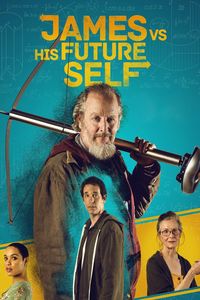
    (On Cable TV, May 2020) Oh my. Am I witnessing the birth of a new science fiction genre? James vs. His Future Self is the third or fourth Canadian Science Fiction film in recent memory to have been filmed in Sudbury. Let me coin the movement: Sudburypunk. I kid, but only a little—Sudbury has slowly become a bit of a destination for filmmakers eager to showcase Northern Ontario landscapes while still being able to count on a metropolitan area as a home base. The city has varied shooting locations, including the futuristic Science North complex, and isn’t too far away from Toronto. James vs. His Future Self is exactly the kind of low-budget science fiction film that can benefit from a bit of Sudbury care. It’s a likable SF comedy about a man getting lessons from his future self coming back in time to save his younger self. Among many strengths, it can boast of likable actors, a gorgeous love interest (Cleopatra Coleman, always terrific), sometimes hilariously profane dialogue, and a self-aware script that delights in upsetting expectations throughout. Over its running time, James vs. His Future Self went from holding my interest to earning my sympathy for the characters. Frances Conroy is particularly good as the off-kilter science matriarch—and let’s not forget Jonas Chernick and Daniel Stern sharing the same role. It’s all blatantly, charmingly Canadian—Sudbury’s Science North is even explicitly featured as itself. For a silly comedy, James vs. His Future Self does tackle heavy themes of themes of self-contradictions, actualization and personal evolution. The final scene is not unexpected, yet surprisingly poignant. If that’s how Sudburypunk is going to go, let me subscribe to whatever else is going to come out of it.

  • Ready or Not (2019)

    Ready or Not (2019)

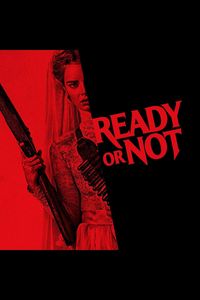
    (On Cable TV, May 2020) While I’m no fan of gory horror in general, I’m quite willing to make exceptions when the film is actually good. Or fun. Or interesting. Ready or Not ends up being all three, and for several good reasons. It’s a kill-the-rich satire, an anti-matrimonial fable, an intense horror film, a funny self-aware genre piece and a terrific showcase for Samara Weaving. The plot has to do with a mysterious rich-family curse that leads them to hunt and sacrifice newcomers to the family through a game of hide-and-seek. Which means that within minutes, our heroine is running inside a vast manor in a wedding dress, trying her best to remain undetected until sunrise. It doesn’t quite work out that way, of course—the set-pieces escalate in intensity with some very welcome comic relief along the way. Nicky Guadagni is a hoot as a mad troll doll, while Andie MacDowell is suitably leathery as the matriarch. It’s all superbly directed by Matt Bettinelli-Olpin and Tyler Gillett of “Radio Silence” fame. What takes Ready or Not one notch above the usual horror film is a sense of nuance, internal strife and a strong presence of the supernatural, remixed in a way we haven’t seen before. It’s gory and profane, but not unreasonably so given the overall atmosphere of the film. It toys expertly with the audience, knowing what they’ve seen before. As for myself, I did a complete 180 on Ready or Not, from a reluctant viewer of the opening to gleeful enthusiasm at the over-the-top finale. Can we spare a moment of mourning for the maids? The theme song is a powerful earworm.

  • Howard Lovecraft and the Kingdom of Madness (2018)

    Howard Lovecraft and the Kingdom of Madness (2018)

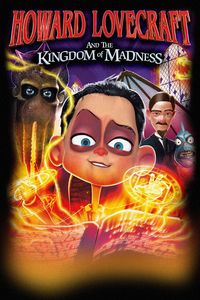
    (On Cable TV, May 2020) It’s weird enough that there would be one animated kid’s movie featuring a boy H. P. Lovecraft and his pet Cthulhu as a sidekick, let alone three. Howard Lovecraft and the Kingdom of Madness further delves into Lovecraftian lore by featuring an “uncle” who looks a lot like the adult Lovecraft, and his pet “Spot” being explicitly renamed Cthulhu as the main antagonist. A character is named Jeffrey West, another is voiced by Jeffrey Combs, and the film eventually leads us to Antarctica’s mountains of madness. Even as a third entry in the series, Kingdom of Madness is visibly a very low-budget film, although some of the voice talent (Hamil, Plummer, Wolfhard) is well known. Other annoyances from the previous films persist: the eye-shadow-heavy character design is still grotesque, but why change now? More serious is a lack of harmony between the grotesquerie and the cuteness I would expect from a kid’s movie—the visual design does not reach a pleasant middle ground, and that certainly limits the visual appeal of the result. On the other hand, some things are better this time around: The all-star reunion of Lovecraft’s characters (including Armitage) clearly underscores the grander nature of this trilogy-capping instalment, while a lot of nightmarish imagery, world-ending prophecies and characters getting slapped to the ground seem unusually intense for a kid’s film. Kingdom of Madness is also more engaging than previous instalments in that the plot is more interesting, and it allows young Lovecraft to confront himself and become somewhat less glum in the process. Still, this does feel like a series of films with a fuzzy audience: is it meant as an ironic romp for Lovecraft-loving hipsters? Is it for Lovecraft-loving parents to show their kids? Is it even for kids?

  • Tape (2001)

    Tape (2001)

    (On Cable TV, May 2020) Part of the reason why I’ve warmed up considerably to Richard Linklater over the past few years has been to recognize that he’s very much an experimentalist—his films are rarely the same, and he has messed with enough unusual tones and structures that we can even see him as a playful filmmaker. In that vein, Tape makes perfect sense—it’s a one-location, three-character, real-time drama shot on videotape (although, thankfully, not from a fixed viewpoint). Based on a play, it watches as three “friends” get together in a hotel room, past secrets are revealed, and confessions are extracted. The image quality, having been filmed on a turn-of-the-century video camera, is nothing short of atrocious — but the intensity of the drama is high and the formal experimentation of the film is interesting. It’s clearly a formalist low-budget experiment, but one that’s somewhat successful (although sometimes better listened to rather than watched). Linklater stalwart Ethan Hawke stars, with Uma Thurman delivering a stripped-down dramatic performance alongside Robert Sean Leonard to complete the cast. As with most theatre-based dramas, the first half sets up the conflicts and the second half detonates them, with plenty of triggers, reversals and revelations. Tape, for all of its self-imposed limitations, certainly has an interest that goes beyond the formalist experiment.

  • A Slight Case of Murder (1938)

    A Slight Case of Murder (1938)

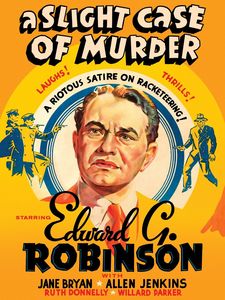
    (On Cable TV, May 2020) By the end of the 1930s, a few things had to be true for A Slight Case of Murder to exist — The lessons of the post-Prohibition era were getting clearer for everyone; Gangster movies were getting a bit overexposed and in need of some fresh angle; Edward G. Robinson was getting tired of his (admittedly great) numerous performances as a gangster; and the play “A Slight Case of Murder” had a modest Broadway run from September to November 1935. Combining all of these together meant a Warner Brothers gangster film adapted from the comic play, starring Robinson in a somewhat atypical but very satisfying turn playing a funny mobster. The premise has him turn to legal brewing after Prohibition, only to realize years later that he’s not good at being a legitimate brewer (not drinking his own beer makes him blind to how terrible it is). Further complications arise when his daughter brings back home a boyfriend employed as a policeman, and when he finds four dead rival gangsters in his living room. To be fair, A Slight Case of Murder is not that funny—it’s a comedy, but it aims for a few laughs and plenty of smiles rather than overdoing it. As a result, it’s not great but it’s certainly watchable. Robinson is remarkably at ease sending up his own image as a gangster, and the film is best seen as audiences of the time did—once you’ve become a bit too familiar with his other mob boss roles.

  • Mujeres al borde de un ataque de “nervios” [Women on the Verge of a Nervous Breakdown] (1988)

    Mujeres al borde de un ataque de “nervios” [Women on the Verge of a Nervous Breakdown] (1988)

    (In French, On TV, May 2020) I will eventually see all of Pedro Almodóvar’s filmography, good and bad movies alike. I seldom completely agree with his films—there’s a crucial difference in age, context, language and all—but they’re interesting even when they don’t quite achieve what they’re going for. Almodóvar can combine a quirky premise with sure-footed execution and the result is worth a look even if the screaming is all in Spanish. Women on the Verge of a Nervous Breakdown, considered one of his top-tier films, is a good illustration of this—it has an interesting hook (a dubbing actress sets out to understand why she was dumped) and then things get complicated with spiked gazpacho, Shiite terrorists, things thrown out of windows, gunpoint motorcycle hijacking, and a climax set at an airport (plus a priceless coda set at the protagonist’s apartment). It’s a farce but also an empathic examination of women under pressure, a cinephile’s homage to the form, a feminist statement and everything in between. It’s quite likable both at the film level and the character level—or the actor level, even: Rossy De Palma is mesmerizing here. The steady revelation of secrets helps keep this interesting, and the look at how dubbing professionals worked in the 1980s is evocative. Women on the Verge of a Nervous Breakdown may not be constantly hilarious, but it is consistently amusing. It’s a very strong piece of motivation for those seeking out the rest of Almodóvar’s filmography.

  • Bad Channels (1992)

    Bad Channels (1992)

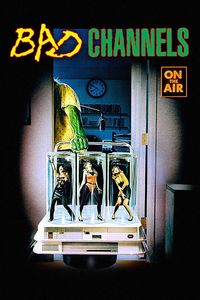
    (In French, On Cable TV, May 2020) Even by the lax standards of early 1990s horror comedies, Bad Channels isn’t any good. I’m not sure if there was any potential in its premise about aliens using a radio station to kidnap women, but bad control of tone and pacing from director Ted Nicolaou (admittedly working from a script co-written by Charles Band) mean that we’re either bored or dumbfounded. At least it’s not mean-spirited or gory (which helps a lot) but there’s a constant nagging feeling that it could have been much better. Much of the plotting feels arbitrary in order to hit the scenes that they were really going for. Even cute girls in fetching early-1990s outfits sadly can’t save this. Grotesque special effects don’t add much but clearly re-establish this as one of Band’s bargain-basement Full Moon Productions. For a film revolving around a rock station, the soundtrack is unsatisfying, badly integrated and eventually forgotten on the way to the conclusion. Considering that Bad Channels is coming from Charles Band, the question is open as to whether it could have been any better—the awful result seems on-brand for his production company, and we have to acknowledge that maybe no one wanted it to be any better. If you’re looking for a much better movie about a radio DJ confronting a world-ending menace, have a dose of Pontypool and don’t look back.

  • RKO 281 (1999)

    RKO 281 (1999)

    (In French, On Cable TV, May 2020) It makes perfect sense that one of the most famous movies of all time would spawn its own making-of TV movie. No, not a documentary—a full scripted drama with enough good actors to make this a prestige TV event. Yes, RKO 281 is a slick dramatization not only of the making of Citizen Kane, but the subsequent thunderstorm of disapproval that came from media mogul William Randolph Hearst, who was convinced the film was an attack on him and his girlfriend Marion Davies. As someone with a fair amount of knowledge about the film and its era, I was very happy with the result, even if I knew where the story was going. Some very impressive means have been spent to come up with convincing period details, and the cast is almost pitch-perfect for their roles—Liev Schreiber as Orson Welles? John Malkovich as Herman J. Mankiewicz? James Cromwell as William Randolph Hearst? Melanie Griffith as Marion Davies? RKO 281 is one wonder after another. Sixty years after the events depicted, the film pulls no punches: Hearst is the villain, and Hedda Hopper is the henchwoman. It all culminated, as film buffs know, in the dumbfounding decision to give that year’s Best Picture Academy Award to How Green Was My Valley—although this, curiously, is not in the film considering that RKO 281 ends soon after Citizen Kane’s premiere. (Maybe RKO 281 knew that biting the hand that hands over the Oscars was not a good idea, even for a 1999 TV movie.) It’s certainly not perfect (there are anachronisms and simplifications and not enough attention paid to the artistry of Kane) but it’s a decent dramatization, even if everyone will know not to take it as a documentary. Some special editions of Citizen Kane on physical media include this film as a bonus, and it’s a good one.

  • Varsity Show (1937)

    Varsity Show (1937)

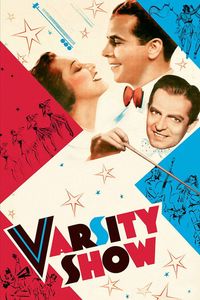
    (On Cable TV, May 2020) When measured against other musicals of the late 1930s, Varsity Show definitely comes across as a second-tier film. It doesn’t have snappy songs, barely ekes out a rousing finale thanks to Busby Berkeley, breaks no ground in matters of originality, and while it sports a fine Dick Powell, the rest of the cast isn’t particularly remarkable. (Well, except for Mabel Todd, very cute as a bespectacled blonde “class pest.”) On the other hand, Varsity Show does keep viewers’ attention and has a lot to offer if you’re willing to engage with it. Part of its fun is how it combines the archetypical “let’s put on a show” structure of a movie musical with the college campus culture of the 1930s—meaning that if you ever wondered what it would feel like to walk down a campus a few decades ago, then Varsity Show has a Hollywoodized answer for you. William Keighley’s direction is surprisingly interesting in the first few minutes, despite substandard actors—there are some Altmanesque ensemble cast-juggling and quick cuts to briskly introduce characters within the film’s 80 minutes. The first half of the film has strong comic moments, as students looking to put on a show hired an alumnus now on Broadway—while unaware that his last three shows have been a failure and he needs out of Manhattan fast. For twenty-first century viewers, there’s something utterly fascinating in seeing students from the 1930 complain about the stodginess of an authority proposing ideas that were in vogue back in the… 1910s.  The second half of Varsity Show cranks up the musical numbers as the troupe goes to New York City and the show does go on. It concludes with one of Busby’s signature epic numbers, where human figures are a mere component of something much bigger. Some of the film’s sauciest moments bring to mind pre-code film—I could have sworn at times that this was an early-1930s film. For all of those reasons—Varsity Show is not a great musical, but it’s a fun one as long as you’re indulgent.

  • Step Up Revolution (2012)

    Step Up Revolution (2012)

    (On Cable TV, May 2020) I’ve bounced all around the five-film Step Up series, from seeing the third in theatres to going home to watch the first and then the fifth and now the fourth. (Don’t worry—I’ll see the second soon.) The decision to locate Step Up Revolution in sunny colourful Miami is a good one, although the dubstep and flash-mob fascination date this film more solidly in 2012 than anything else I would have imagined. The plot itself, what with its promoter-destroying-neighbourhood hook, is rather jejune and more fitting to a kid’s movie starring a dog, but the point of the movie is the dance sequences, and there are quite a few good ones here. Never mind that our ragtag dance troupe requires props and costumes that would bankrupt any professional dance group. There are a few callbacks to the previous entries of the series (Moose shows up!), but Step Up Revolution generally stands alone. The calling card of the series is that it’s about as close as we’ll get to modern MGM musicals, and in that regard this fourth entry delivers the goods in energetic fashion: It’s best to look at it as a collection of dance numbers than a cohesive narrative. From that angle, the film’s highlights include a massive number on Ocean Drive, a cute bit at the Miami Museum of Fine Arts that pays homage to Miami’s art scene, a hilariously on-the-nose bit featuring a “businessman” flash mob and a finale set against a colourful stage made of shipping containers. The plot makes no sense, but the numbers are high-energy, Cleopatra Coleman has a supporting role, and the anti-capitalist message is good for the kids. All told, I can’t find any problem with Step Up Revolution. Why isn’t there a box-set of this series available for purchase?

  • 7 Faces of Dr. Lao (1964)

    7 Faces of Dr. Lao (1964)

    (On Cable TV, May 2020) Producer George Pal specialized in big special-effects heavy spectacles, and that’s how we ended up with SF classics such as Destination Moon, The War of the Worlds and The Time Machine. It’s also how we got the much stranger piece of western fantasy 7 Faces of Dr. Lao—and I here mean “western” as in “American west,” considering that the plot of the film gets started once the titular Dr. Lao stops by an Arizona town as it awaits the construction of a railroad. Lao isn’t a medical doctor—he’s a seven-thousand-year-old magician from the mysterious Orient (but played by Tony Randall under layers of makeup) with seven alter egos. All of them will be useful to untangle the romantic and financial complexity of the small town. Adapted from a fantasy novel by Charles G. Finney, 7 Faces of Dr. Lao ends up being another ideal special-effects showcase for Pal’s mixture of practical effects, heavy makeup, stop-motion animation and other visual effects tricks. Both the best and the worst thing about the film is that it’s almost chaotic in going from one special effect sequence to another. It’s definitely weird by the standards of Hollywood cinema at the time, and it clearly hasn’t aged particularly well in a CGI era. One can imagine 1964 audiences being wowed by the effects, although nowadays they’re often more grotesque than anything else. Randall is problematically cast as the Asian Dr. Lao but throws himself entirely in the seven (ish) roles required by the script. There’s something to be said about a “man comes into town” story in which said man isn’t a gunslinger but a magician with near-infinite wisdom. Sometimes, weird is a virtue in itself when it comes to Hollywood.

    (Second Viewing, On Cable TV, November 2020) Director-producer George Pal was always about spectacle, and it’s not because 7 Faces of Dr. Lao constrains itself to a small wild west town that it’s any less intent on wowing the rubes than Pal’s other more outlandish movies. Here, we have a one-man travelling circus rolling into town, what with a mysterious and desperately stereotyped Dr. Lao promising untold wonders to the local newspaperman while taking notes on the local controversy. It feels like small potatoes compared to the time-travelling, world-altering, lost-continent-sinking scope of previous Pal movies, but the draw here is still on the special effects as the circus springs up and multiple special effects are presented in episodic segments. Tony Randall is arguably the film’s central special effect, as he plays more than a handful of roles under heavy makeup. The film plays off spooky circus tropes, with a heavy dose of now-uncomfortable ethnic clichés. The result may be worth a look for visual purposes (it did well in Academy Award technical categories), but as an overall film or story, it’s scattered, offensive, dull and overdone in rapid intervals. 7 Faces of Dr. Lao is interesting because of its uneven tone and its special effects, but I will stop short of a recommendation.

  • Nightbreed (1990)

    Nightbreed (1990)

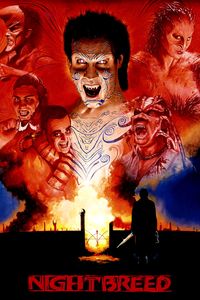
    (In French, On Cable TV, May 2020) There is something far more interesting than usual in Nightbreed when compared to most other horror films of that era. It has authentic sympathy for the monsters that would be antagonists in other horror films, and much of the protagonist’s journey is joining and protecting those monsters from human opponents. (As per Wikipedia, there’s an entire queer subtext to Nightbreed that flew over my head upon watching the film.) When writer-director Clive Barker set out to make the film, he was aiming for a menagerie of creatures on par with Star Wars, and a quasi-mythological resonance to the story. He doesn’t quite get there, but his intentions certainly resonate in the final result. The version I was the much-decried original cut of the film rather than the more definitive “Cabal Cut,” so quite a bit got lost—The serial killer subplot does make the film far trashier than it should have been and the result isn’t quite as interesting as the creatures it features. As an American backwoods gothic, Nightbreed brings to mind an approach not dissimilar to Guillermo del Toro’s love of monsters and empathy in approaching the other. If you’re looking for another reason to watch the film, there’s David Cronenberg playing the antagonist, which is good for a chuckle or two. Still, and perhaps to the chagrin of Nightbreed’s considerable cult following, this film is more one of missed opportunities than outright success—it doesn’t quite work, and I’m not sure that even a recut version would be significantly better.