Reviews

  • Smallfoot (2018)

    Smallfoot (2018)

    (On Cable TV, May 2019) There’s been a surprisingly robust subgenre of animated movies about large humanoids in the past few years, so you may be excused if you can’t tell Smallfoot from Abominable, Missing Link, The Son of Bigfoot and Mission Kathmandu. This one inverts the formula, by being told from the yeti’s point of view as he comes across and befriends a little boy. It’s a serviceable animated film—its technical qualities are good without being exceptional (although some of the character design is questionable), and the script is a cut above the strict minimum. The physical comedy often approaches Looney Tunes territory (appropriate for a film by the Warner Animation Group) even if the musical moments aren’t always well-integrated. But Smallfoot’s script remains its strongest suit, what with touching upon conceptual breakthroughs, seemingly necessary lies and getting along after years of open warfare. The result is sympathetic, and the ending reaches a thesis/antithesis/synthesis compromise that seems unusually complex—although this being a kid’s movie, it ends well for everyone. Smallfoot doesn’t have the Asian setting distinction of Abominable, the spectacular stop-motion of Missing Link or the regional charms of The Son of Bigfoot and Mission Kathmandu, but it’s perfectly acceptable in its own way.

  • Game of Thrones, Season 7 (2018)

    Game of Thrones, Season 7 (2018)

    (On Cable TV, April-May 2019) Considering Game of Thrones’ nine-year run, its unusual status as an adaptation having outrun its original material, the sweep of an intricate plot with at least a hundred speaking parts, the rabid devotion of its fans to resolving even the most intricate of its mysteries and the sheer gall of attempting a small-screen adaptation of a high fantasy series, it’s almost inevitable that its conclusion would fail to meet most expectations. It’s been a predictable spectacle to hear The Internets wail about various missteps of the conclusion. I’ll be more enthusiastic, largely because having done my time in the fandom trenches (Babylon-5 forever!), I’m far more willing to accept whatever has been completed. I’m not going to deny that this last run has its issues—as with the last few seasons, the nuts-and-bolts details of the scripts haven’t always come up to satisfy its bigger structural ambitions. The six concluding episodes had a lot of material to go through, but the rush to get it done means that a lot of connective tissue was elided or missing. A few plotting decisions, defendable in retrospect, don’t always make sense on a minute-by-minute basis. (The twist of Episode 5 being the best example of this.) Some Dumb TV Tricks also create their own problems, with cheap theatrics and artificial suspense trumping a satisfying ramping up (I’m looking at you, end-of-episode-3 Big Surprise). Some character arcs are not resolved in an entirely satisfying fashion (oy, Jaimie), although considering the very large cast, I’m generally satisfying with the way their stories turned out. And that goes for the series as a whole—while I’m not completely happy with the way the show-runners stuck the landing (sticking it to King’s Landing was fine, though), it concludes the series decently, provides the bare minimum amount of closure, ensure that the series is of a coherent piece and even provides a clue as to what will await readers in the concluding volumes of the book series. (I expect details to change, but I can definitely see the structure of the season leading to the broad strokes of the conclusion.)  Away from the story, elements of this seventh season’s cinematography, music, acting and special effects are nothing short of terrific. Could it have been better? Of course. But considering the scope and sweep of the show-runners’ ambition at the beginning of the journey a decade ago, what they have accomplished with Game of Thrones is still nothing short of a landmark.

  • Point of No Return (1993)

    Point of No Return (1993)

    (In French, May 2019) If you’re keeping track at home, 1993’s Point of No Return is the American remake of Luc Besson’s 1990 French film La Femme Nikita, and both of them can be said to have been prequels to the better-known 1995 film Léon. As a remake, if very close to the original—Americanized, for sure, but otherwise very similar in story beats and overall themes, and perhaps a bit less stupid than Besson’s script. The influences go deeper, of course—Nikita explicitly became not one but two TV shows, there’s a good case to be made for Alias tracing back its early-years lineage to either the French or American version of Nikita, Besson seems to be rewriting his female-assassin urtext every few years (Bandidas was in 2006, Colombiana was in 2011, Lucy was in 2014, Anna is next in 2019) and much of Milla Jovovich’s career seems to have been facilitated by this film. But progeny aside, what about Point of No Return? Well, as directed by John Badham it’s a serviceable action film. The suspense and action scenes can be effective despite their familiar nature, and that goes for much of the film as well—given the endless quasi-remakes of that story, the film does feel formulaic at this point, and even the little bits of interest illustrating the story don’t feel quite as fresh these days. Bridget Fonda does manage a very good action/drama performance, with some smaller but showy interventions by Gabriel Byrne and Harvey Keitel. Execution counts for a lot, and the early-1990s sheen of the film is fast approaching period-piece status, not to mention the trend-trendy filmmaking tracks of the film. The Nina Simone songs add a bit of colour, and Point of No Return frequently needs it.

  • Elle [Her] (2017)

    Elle [Her] (2017)

    (In French, On TV, May 2019) Unnerving from beginning to end, Elle is famed transgressive director Paul Verhoeven’s latest successful bid for relevance at a time when his 1980s work has influenced so many filmmakers that it’s practically mainstream. The film starts with no less than a rape, but the film arguably gets far stranger when its protagonist takes a decidedly matter-of-fact approach to her assault and decides to simply live with it (or at least attempt to). Of course, it’s not going to be so simple: in between harassment at work, an affair with her best friend’s husband, a milquetoast son, a narcissist mother and a mass-murdering father (!), there are enough subplots here to fuel at least four movies, not all of them in the same genre. In fact, Elle’s most unsettling characteristic is how it refuses to become a simplistic genre thriller at every turn, focusing instead on a vast, complex, sometimes unbelievable but full portrait of an authentic character. Our heroine has a lot going on in her life, and the film is about accepting the reality of it all. Even the rapist is unmasked well before the end, with what follows being more disturbing than the film’s first few moments. Lead actress Isabelle Hupert is magnificent in a daring, unusual, multifaceted role in which she never quite does what we expect from a lead character. The dark comedy of the film is unmistakable and made more effective by the film’s constant insistence on topics thought impossible to joke about. Well-directed and definitely in-line with Verhoeven’s most basic instincts of transgression, Elle is not mainstream entertainment, but it’s remarkably effective nonetheless. I don’t plan on seeing it again any time soon, I may never recommend it to anyone, but it did enjoy it (if that’s the right word) substantially more than I expected.

  • The Predator (2018)

    The Predator (2018)

    (On Cable TV, May 2019) Shane Black is far too good a writer-director to completely turn out a bad movie, but The Predator is his worst yet. It still does have flashes of humour and mildly inventive action, but it does struggles and succumb to the creative fatigue of a series either four or six films long at this point. Despite inventing new enemies, new motivations and changing the shape of the plot every fifteen minutes or so, The Predator can’t quite manage to get out of its predecessors’ shadow. Which is curious, because it’s probably the second-best film of the series (largely on account of the others not being particularly good). Black’s worst instinct can work against him at times—the film has its number of puzzling plot developments, far too much gore, lines that fall flat due to overreach and an infuriating amount of technobabble: not only is it too happy to bluntly equate autism with super-smartness (sigh), it doubles down on its idiocy by claiming that autism could be a next stage of human evolution. There’s a plot reason for that, mind you (summed up: “Predators want autistic braiiins”), but it’s still an incredibly moronic claim. Black has a long experience as an action screenwriter and it shows best in the small beats of his action scenes, but he often loses focus: there are too many characters and his sequences could be sharpened by forgoing some extraneous elements. The ensemble ennui isn’t helped by hit-and-miss actors—I could watch Olivia Munn all day at any time, but Boyd Holbrook isn’t charismatic enough in the lead role. Many of the ensemble cast are good actors with little to do, although it is cool to see Jake Busey show up briefly. The SF plot devices are weak, the action is uneven, but the film is on slightly more solid footing with its dialogue, occasionally being self-aware enough to be effective even in the middle of dodgy plot developments. I watched the film falter in between flashes of humour and wit, smothered by a surprising boredom at seeing pretty much exactly what the predator series has already done. That The Predator does better at exactly the same things that previous films in the series is only a half-success. It would be time to retire the concept, except that the film is meant to be the first reboot of a new series. So it goes today, with once-promising concept being ground down in overfamiliarity even when the results are half-competent.

  • Night School (2018)

    Night School (2018)

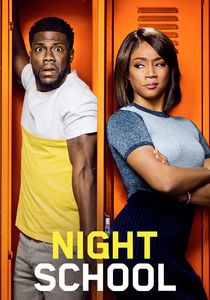
    (On Cable TV, May 2019) Star vehicles works best when you really, really like that star, and while I’m still relatively positive about Tiffany Haddish and Kevin Hart, I’m feeling that both of them, with their oversized comic personas, could be a bit over-exposed at the moment. (Hart more than Haddish given his longer time in the spotlight.)  This doesn’t help Night School, but to be honest there’s more than just that as an issue here. The film is lazy in the way most Hart vehicles have been so far, with him playing more or less the same character, and exhibiting the same tics. (Given that it’s partially based on exasperated annoyance, this is not conductive to a long-term career. We’ve seen what happened to Chris Tucker.)  The gags are obvious, predictable but more damningly far too long for their own good—many of them keep going well after the humour has been milked from it. Did no one re-read the script and suggest that some moments weren’t that funny? Oh wait—someone did, because Night School credits no less than six writers on this trifle of a movie. The stitches definitely show: The film errs between silly comedy and pseudo-heartfelt sentiment (and drags badly during those later sequences), and work best when it loosens up to feature the entire night school group rather than when it focuses on just Hart and Haddish. There are, to be fair, a few good moments. (Not all of them feature Megalyn Echikunwoke in lingerie.) But there are also a fair number of head-scratchers (even by dumb comedy standards), and unconvincing plot beats. The film’s worst trait is its predictability, largely based on the comic personas of the actors. The scenes can be seen coming well in advance, sapping much of the film’s energy. While Night School isn’t horrible, it’s also less than expected, and definitely less than it could have been. I can’t help but think that something got lost after the third or fourth writer.

  • Beautiful Girls (1996)

    Beautiful Girls (1996)

    (On Cable TV, May 2019) At first glance, there doesn’t seem to be much in Beautiful Girls to set the film apart from so many others. It starts as an urbane jazz pianist leaves Manhattan to go back home for a ten-year high school reunion, and rekindles old friendships, courtships and rivalries. So far so good. But the film gradually expands outward to cover an ensemble cast of characters, and as you go down the list of actors featured here, it’s hard not to marvel at the assembled talent: Matt Dillon, Timothy Hutton, Rosie O’Donnell, Natalie Portman, Michael Rapaport, Mira Sorvino, Uma Thurman… No wonder the film still gets some attention. Written by Scott Rosenberg, better known for Con Air, the dialogue has an enjoyably funny quality to it, especially when the characters played by O’Donnell or Portman come in to steal every scene they’re in. The mostly episodic film deals with a fair number of subplots, leaning into the whole small-town atmosphere made claustrophobic by the incessant snow. There’s a great use of “Sweet Caroline,” as well as a few other tracks that do much to make the film a period piece. It’s all quite comforting: By the time our New York character goes back home at the end of Beautiful Girls, we’re almost sorry to leave the place.

  • The Big House (1930)

    The Big House (1930)

    (On Cable TV, May 2019) There’s something almost comforting in reaching ninety years in the past and finding a film not so different from what we’d see on-screen right now. So it is that The Big House is a quasi-prototypical prison movie, already dealing in well-worn tropes barely two years after the introduction of sound in cinema. The technical credentials are occasionally crude, but there’s no denying a certain cinematic ambition in the use of miniatures, camera movements and overall direction—the prison cafeteria scenes may or may not have influenced White Heat, but they’re handled with a grace that goes beyond flat static shots and into something definitely more daring. No wonder that this manly muscular action drama was nominated for an early Best Picture Academy Award. Story-wise, there isn’t much here, what with its “innocent” hero (who still killed someone while driving drunk—something almost unforgivable today) being a victim of hardened criminals and tough prison warden. The ending prison riot sequence is definitely ambitious, though, what with army tanks getting involved in putting it down. The acting is strictly early-thirties stuff (with Chester Morris and Wallace Beery doing what they knew best), still a bit influenced by the silent-movie methods. Still, for all of its familiar bluntness, there’s a certain charm to The Big House, and definitely a viewing pleasure. Further proof that well-executed tales can be timeless, even when they’re extremely familiar.

  • Phoenix Forgotten (2017)

    Phoenix Forgotten (2017)

    (On Cable TV, May 2019) It’s almost redundant at this point to declare annoyance with yet another found footage horror movie—we’ve reached that saturation level years ago, and at this point you have to wonder why anyone would think it’s a good idea to adopt that style. Still, there’s a point in writer-director Justin Barber’s Phoenix Forgotten where it almost works for more than fifteen minutes: As a 2017 young woman directs her own documentary about the disappearance of her older UFO-obsessed brother back in 1997, there’s something almost compelling in the blend of HD footage with VHS-quality flashbacks, a growing mystery, unexpected clues and something that looks like a familiar but intriguing blend of UFO lore, military conspiracies and still-grieving parents. A few structural refinements are enough to keep up interested … and then the film nosedives. Hard. The final 20-minute sequence of the film is a very long and tedious Blair Witch Project-style wilderness video log with constant screaming, VHS glitches, characters growing mad and blurry stuff moving quickly on the screen in a mistaken attempt to make us think something is happening. The film ends where it began, with visual suggestions that the brother was indeed kidnapped by aliens. Nothing more. There’s no getting back to the present-day documentary, nor going beyond an obvious conclusion that was affirmed in the early moments of the film—which is after all a genre movie. While there are a few good moments here and there earlier in Phoenix Forgotten, the last act is a spectacular disappointment and the abrupt ending feels like cheating. This film certainly won’t change the minds of those who insist that found-footage movies are now in a creative dead-end.

  • Easy Money (1983)

    Easy Money (1983)

    (On Cable TV, May 2019) I have a growing suspicion that Rodney Dangerfield is best used as a supporting character (à la Caddyshack) than a leading man, and here comes Easy Money to reinforce my theory. It doesn’t take a lot of Dangerfield in this film to get tired of his blue-collar loser antics, straight-up early-eighties slobs-versus-snobs cheap comedy. The premise is simple enough to make you wonder why it hasn’t been re-used elsewhere: a man is promised a significant inheritance if he can just shape up for a year. Of course, that’s really a clothesline to hang a series of gags about an ordinary guy trying to control his ordinary-guy urges. It doesn’t always work but the film does hand him a victory at the end. (Dangerfield being Dangerfield, there’s no suspense as to where the coin will fall; plus he looks the same at the beginning of the year-long improvement plan than at the end.) The result is not exactly bad, but sometimes Dangerfield gets to be a bit too much, and Easy Money would be better with less of him in it—a curious thing to say about a star vehicle, but then again there are stars for whom the movie works in spite of them.

  • Free Fire (2016)

    Free Fire (2016)

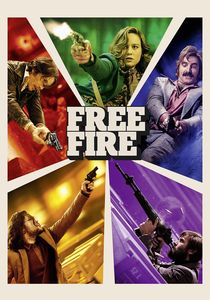
    (On Cable TV, May 2019) When I say that Free Fire isn’t quite as successful as it could be, this isn’t as bad a review as you’d expect. For one thing, it actually tries something somewhat ambitious: a genre thriller in which an ensemble cast sustain an extended shootout inside a run-down warehouse. It takes a lot of cleverness to stage such a lengthy sequence while keeping it intelligible, visually exciting, differentiating the characters and yet sustain the action over nearly ninety minutes. That the film doesn’t quite succeed does not invalidate the work required to bring it there. Alas, there’s a feeling that for all of writer-director Ben Wheatley’s inventiveness, there’s something missing from the result. The film doesn’t quite create the compelling viewing that such an exercise would suggest. Being unbelievably violent, it’s not joyful in the least (the high body count, including two lamented late-movie deaths, doesn’t help), and for all of the script’s rather good writing, there isn’t as much cool dialogue as could be hoped for. In short, Free Fire is not bad but it’s still a fair way away from the genre classic it could have been: the characters are bit bland — Brie Larson and Armie Hammer do well as the only competent ones in the place; the other cast members not so memorably—and the action doesn’t quite capture the full mayhem that could have been. I still consider it a good time viewing, but it could have been much more.

  • Peppermint (2018)

    Peppermint (2018)

    (On Cable TV, May 2019) In the spirit of gender equality, let’s agree not to give a free pass to gender-swapped bad movies such as Peppermint, taking on a hackneyed tale of vigilante violence that was tiresome when it was called Death Wish and only making it distinctive by putting Jennifer Garner in the lead role. Now, I’ll be among the last to complain about Garner getting steady work, and I will admit that her performance here is as ferocious and convincing as any other female actress. But there’s no getting around the idea that Peppermint is a terrible premise wrapped in even worse execution: If you can make it past the overwrought first fifteen minutes (in which an ordinary mom sees her family gunned down, then the murderer set free by a corrupt judge and herself committed to a mental asylum) without rolling your eyes helplessly, well, you may be ready for the rest of the film in which that ordinary mom resurfaces five years later after a self-imposed worldwide combat training tour. Her rampage of revenge is as predictable as it is tedious—we know where it’s going, and not even director Pierre Morel’s journeyman direction can dissipate the stone-cold ennui of seeing that same damn story play out once more. The film, as befits our morally corrupt social-media era, is not conflicted as much as it’s tacitly approving of the violence perpetrated by its so-called heroic character—there’s little exploration of the corruption of the heroine and quite a bit of cheering for revenge, and hopefully nobody innocent gets killed in the crossfire. As you can guess, I’m getting really tired of those kinds of dress-up medium-budget exploitation movies, no matter the gender flip. In fact, the gender flip may even make it worse—there’s a lot of material to explore in traditional nurturing notions of female strength being sent up through vigilante violence, but Peppermint can barely conceive of such an argument, much less explore it. What a waste. At least Garner should be able to get herself a few action movie roles now that she’s got Peppermint on her resume, not exactly erasing Elektra’s shame as much as updating it.

  • Just Getting Started (2017)

    Just Getting Started (2017)

    (On Cable TV, May 2019) There is, buried somewhere in Just Getting Started, everything required for a serviceable comedy. Nothing too ambitious, nothing too difficult, just the basic elements of a film you see, enjoy, perhaps recommend to friends and family. It’s a comedy set in a retirement home, with capable actors such as Morgan Freeman, Tommy Lee Jones and Rene Russo, with a little mix of mob-driven action and old-person comedy. Heaven knows that there’s a small list of those movies already. But this is not the film that Just Getting Started is now. Because what we’ve got here is a waste of everyone’s time and talent, a mixture of juvenile gags that feel worse when played by retirement-age actors. The romantic rivalry between the two male leads is wholly manufactured (and then quickly dismissed) and while there’s some fun in seeing Jones strut and wager through a character created to be perfect, the film doesn’t know what to do with the energy of his performance. Neither can it find a good place for Russo, nor make the most out of Freeman’s comedy. The cinematography is uneven, at times making good use of its southwestern scenery and at other being nothing more than flat comedy-grade images. Just Getting Started often stops and sputters, occasionally stumbling upon a good idea but never completely going to the fullest extent. What a shame. Fortunately, there are other similar movies that succeed much better.

  • Since you Went Away (1944)

    Since you Went Away (1944)

    (On Cable TV, May 2019) Some movies are more interesting as time capsules than stories, and the nearly three-hour ordeal that is Since you Went Away often feels more like time travel than entertainment. Taking us back to WW2 America, it’s a film meant to portray the sacrifices of a nation and bolster morale along the way. It’s occasionally fascinating in how it portrays the minutiae of the 1940s Midwestern-city life and courtship rituals, but the sheer duration and large scope make it feel more like a miniseries than a focused film. I’ll defend its place as a portrayal (however idealized) of the times and how legendary producer-writer (From the opening credits: “Script by The Producer”) David O. Selznick wanted to immortalize it. If you feared an excess amount of sentimentalism, you’ll be half-pleased: there’s a lot of melodrama in Since you Went Away, but the film rarely pulls its punches when it comes to show the deaths awaiting some characters going overseas. There’s nothing particularly wrong with the actors (including a teenage Shirley Temple, and a rather grouchy Monty Woolley), but there is nothing in this film that justifies its excessive length, complete with an intermission. In fact, the repetitiveness of the subplots (so … many … dead … soldiers) and the lack of forward narrative does start working against the film after a while. The endless harping on the same theme gets exasperating the farther we go past the two-hours-and-a-half mark and onto the film’s final staggering 172-minute running time. I’m sort of glad I’ve seen it and can scratch it off my best-picture nominee list, but I’m not sure I’ll ever volunteer to watch Since you Went Away again.

  • Magic in the Moonlight (2014)

    Magic in the Moonlight (2014)

    (On Cable TV, May 2019) We’ll get to the crux of the Woody Allen Problem in a few sentences, but Magic in the Moonlight, taken at face value, is ordinary late-period Allen, gentle and romantic and icky and a bit ordinary even as it’s perfectly enjoyable. The biggest strengths of the film are its actors, especially Colin Firth as a skeptical magician being asked to unmask a suspected fake psychic, and Emma Stone playing said psychic. Both are quite good, even though they may not necessarily belong in the same story. But criticizing Woody Allen for older-man-much-younger-woman romance is like taking Spike Lee to task for a focus on race relation (well, or would be except that Lee’s agenda is actually socially admirable)—what else needs to be said? Still, the story isn’t that stunning—the focus on magic has been done in other Allen movie, and this one feels like a fairly limp attempt to tackle matters of faith and skepticism. The humour is more comfortable than hilarious (the biggest laugh of the film comes from a character revealing himself from behind a chair) and the dialogue is cute without being particularly revelatory. It feels like discount Allen from Allen himself, retreading familiar ground without extending himself. This being said, the film is visually remarkable—the portrait of the 1920s French Riviera is lush enough that we wish we could go there for a holiday, and it’s bolstered by some better-than-average cinematography for an Allen film. Substantial qualms about the rote intergenerational romance aside (and I’ll grant you that it takes a considerable amount of willpower to put it aside), Magic in the Moonlight is a serviceable film, not unpleasant but not worth harping about. It may help viewers wean themselves off Allen as he becomes older and less acceptable. As of five years later, Allen finally seems marginalized by the industry, with distributor troubles and a more irregular production schedule. (2018 was, if I’m not mistaken, the first year since 1981 in which there wasn’t “a new Woody Allen movie” in theatres.)  Like an occasionally amusing guest who keeps pestering young women, Allen may finally have overstayed his welcome … and it’s about time.