Reviews

  • SuperGrid (2018)

    SuperGrid (2018)

    (On Cable TV, February 2019) One of the perks of being Canadian is a glut of nationally produced content on Cable TV channels. OK, that’s not quite a perk considering the somewhat variable quality of Canadian productions, but at least it gives our media landscape something slightly different from south-of-the-border cinephiles. Anyone with a camera, a pickup, ominous news stock footage and a desolate landscape (plentiful up north) can make a postapocalyptic film and have it qualify for CanCon regulations. I was probably expecting a bit too much from SuperGrid considering that it shares many filmmakers (including director Lowell Dean) with the surprisingly enjoyable Wolfcop movies. Unfortunately, the result far too often hews closely to the clichés of the genre. It’s not bad, but it certainly feels dull most of the time: the idea of environmental collapse, post-apocalyptic road movie through a forbidden zone to find a cure (à la Desolation Alley) all blend into a beige morass of deja vu even when we want to be indulgent about a Canadian Prairie Science Fiction film. This is an age of cheap CGI, so the film’s few successes in that area don’t leave much of a distinction. To be fair, SuperGrid does improve in its second half: When doing familiar material, the best way to distinguish oneself in through small detail and atmosphere, and so when the film does make it to its destination, the highlight on indigenous characters is worth a cheer, although by that time the film’s bleak and humourless approach is likely to have ground down any sharp emotional reactions. Even the more ambitious action set pieces are the very end of the film feel like too little too late, wrapped in too many clichés to be effective. Despite approaching SuperGrid with the most indulgent attitude, I’m left once again disappointed at the homegrown result.

  • The Good Earth (1937)

    The Good Earth (1937)

    (On Cable TV, February 2019) In looking for adjectives to describe The Good Earth, “grotesque” is one of the best I can find. It certainly wasn’t made to deserve such a description, nor was it received as such at the time … but time moves on. Today, an American writer would think twice about writing a novel entirely set in rural China, but Pearl S. Buck (writing from Nanking) was up to the challenge—and had the empathy to pull it off all the way to a Nobel Prize for Literature. The result was even a best-seller. Today, no Hollywood studio would dare shooting a China-set film with all-Chinese character using largely California-built sets and all-Caucasian main actors. But here we are: In the 1930s, I have a feeling that The Good Earth was perceived as daring, world-aware, perhaps even progressive in depicting an entirely different reality from the average American moviegoer. Today, though… The entire film seems like a gleeful act of extreme cultural appropriation, with such white-bread actors as Paul Muni and Luise Rainer playing Chinese farmers in obvious makeup. It doesn’t help that this long and epic depiction of Chinese peasant life will tax anyone unwilling to have a long sit. While the plot does have its highlights (locust swarm, civil war, etc.), it does remain a very mannered take on a long story and it takes a fair amount of fortitude to pay attention throughout. Still, for today’s audience it’s the brazenness of having a (nearly) all-Caucasian cast play Chinese characters that gets the most attention. At least we can fall back on the idea that the film does portray its characters with a fair amount of sympathy and well-researched details: for all of the weirdness of the casting and setting, the stereotypes are kept at bay and the film seldom turns to cheap Orientalist clichés along the way. Still, grotesque isn’t a bad adjective. It may best be applied to Katharine Hepburn in the not-dissimilar Dragon Seed, but it’s certain appropriate for The Good Earth as well.

  • Curly Sue (1991)

    Curly Sue (1991)

    (On TV, February 2019) As much as John Hughes dominated the 1980s comedy landscape, his decline in the 1990s was rapid and definitive. Curly Sue earns a special spot in his filmography by being the last movie he ever directed, after which he focused on producing and screenwriting before gradually retiring from Hollywood. It’s not exactly a high note on which to stop, but you don’t have to squint to find the Hughes touch even in the middle of a strictly formulaic product. From the moment we understand the dynamic between the main characters (a middle-aged man and a young girl as a con-artist team) and meet the missing part of the triangle, there’s not a whole lot left for the script but to go through the motions of mawkish sentimentalism. But Curly Sue’s workable premise is hampered with execution issues. The film aims much younger than it should, and the caricatures in lieu of characters are fit to frustrate adult watchers. (Family films aren’t particularly good if the whole family doesn’t enjoy them.) The needlessly violent slapstick doesn’t help in grounding the weak result. In terms of actors, the result is a mixed bag. Much depends on the young Alisan Porter in the title role and she is fortunately up to the task. The same can be said of Kelly Lynch as a wealthy divorce lawyer. Alas, the film does depend a lot on the inexplicable confidence that 1990ish Hollywood had in James Belushi as a leading man—the film would have been significantly different with another actor in his role. There is some skill in the way the plot pieces are moves around, but Curly Sue is disappointing even for Hughes completists.

  • Teenage Mutant Ninja Turtles II: The Secret of the Ooze (1991)

    Teenage Mutant Ninja Turtles II: The Secret of the Ooze (1991)

    (In French, On Cable TV, February 2019) Nobody expected a classic from Teenage Mutant Ninja Turtles II: The Secret of the Ooze, but the result is such that it will confound even those who thought they knew what to expect. Maximizing the jokey aspects of the first film and toning down much of whatever possible seriousness one could imagine from its silly premise, this entry in the series is dull until it gets silly enough to get a reaction. Whether this reaction is amusement or mockery is up to the viewer. Plotwise, the titular oozy premise of the film works as both backstory and pretext to introduce new villains. If it does feel partly more interesting than its prequel, it’s that we’re finally done with the origins story and on to something else. (Even if that “something else” is not that new either from the TV series or the later movie reboot.) Alas, there’s a long way from premise to execution: once you accept the idea of skilled martial artists fighting in bulky turtle suits, the film’s numerous fight scenes will be meaningless for anyone over twelve. The core of the series does remain the turtles, however, and the efforts required to suspend disbelief in the pre-digital era. There’s a heroic quality to portraying kung fu fighting turtles in live action, and the special effects for the entire film are both impressive and silly throughout. This sequel’s overall jokey tone reinforces the unreality of the film. Even if you somehow manage to suspend your disbelief and get over the film’s insistent absurdity, you will inevitably come to the moment where the turtles ham it up on a nightclub scene with none other than Vanilla Ice (“T-U-R-T-L-E Power!”) Maybe your brain will survive the experience. If it does, maybe it will be because of the inherent time-capsule aspect of a film self-consciously designed to appeal to early-1990s teenagers.

  • Deadpool 2 (2018)

    Deadpool 2 (2018)

    (On Cable TV, February 2019) One of my reactions to the first Deadpool film was a vague foreboding that this was the kind of movie you could only do once—that the joke would quickly overplay itself in a sequel. Now that Deadpool 2 is here, well, it does manage to avoid most of the problems that it could have had. It doesn’t take things easy—although with a bigger budget to play with, the bigger scope shouldn’t come as a surprise. Obviously, it does acknowledge its own status as a sequel and visibly tries to do what it can to avoid common sequels pitfalls. There’s a real emotional scaffolding built to support the crass jokes, and it does lead to a surprisingly involving conclusion that plays both with emotions and laughs. Surprisingly enough, the result does not overstay its welcome. The commentary on a few more years’ worth of superhero movies is something only a Deadpool film could get away with, and the script once again finds a sweet spot between parody and doing its own thing. Thanks to director David Leitch, of John Wick fame, the film has some spectacular action/CGI sequences—perhaps the best being a mad truck sequence through a city. Ryan Reynolds is up to his usual mix of charm and good-natured profanity, and he gets two good assists from the fantastic Zazie Beetz and a growling Josh Brolin—who manages to create as a credible antagonist in a comedy film. While I’m still not entirely comfortable with the amount of gore and language in Deadpool 2, it’s true that Deadpool would not be Deadpool without them. Considering the results, I’m surprisingly more upbeat than I thought I’d be at the prospect of an inevitable Deadpool 3.

  • Love in the Afternoon (1957)

    Love in the Afternoon (1957)

    (On Cable TV, February 2019) From a twenty-first-century perspective, looking at the totality of an actor’s filmography at once certainly has a different impact that chronologically living through it one movie at a time. As much as I like Audrey Hepburn, for instance (and I do!), it’s hard not to notice that in between 1954 and 1967, she made no less than seven movies at least partially set in Paris, and at least four of them with significantly older men. While Sabrina was partially set in Paris but obviously not filmed there, Funny Face and Love in the Afternoon (both 1957, shot a month apart) get the subgenre properly started. In the latter film, Gary Cooper plays an aging playboy who sets his sights on an inexperienced young daughter of a detective. The remarkable difference between the two characters (in age, in social status, in understanding the world) is enough to make any viewer uneasy, and it’s a measure of writer/director Billy Wilder’s skill and both stars’ charm that the film (barely) holds together. Hepburn is up to her usual self here, although if you want another Paris movie in which she calls her father an ebullient “Papa!”, you’ll be better served by How to Steal a Million Dollars. Cooper is a bit less bland than usual here, with a character that does service to his stature in the industry at the time. Maurice Chevalier rounds up the marquee names with an on-target role as a wise, compassionate and knowing private investigator to the stars. There’s no avoiding that the material here is tricky, and that Wilder steers his movie through material that would instantly doom other directors. (Although much of the same can be said about Funny Face and Charade.) There are, fortunately, quite a few laughs along the way, my favourite being the gypsy band following Cooper’s character around, mixing diegetic and non-diegetic musical cues. But while the film does have its strengths (seeing Hepburn, Cooper, Chevalier and Wilder working together being the best of them), its place in a well-defined sub-sub-genre of “Hepburn with older men in Paris” also invites unfavourable comparisons. Funny Face has Astaire dancing and Hepburn keeping up, while Charade plays far more smoothly with the romance with the far more charismatic Cary Grant. If Love in the Afternoon makes you queasy despite its old-school Hollywood charm, you’re not alone.

  • The Muppets Take Manhattan (1984)

    The Muppets Take Manhattan (1984)

    (On Cable TV, February 2019) A classical let’s-put-on-a-show musical … with Muppets. That’s the whole review right there: The Muppets Take Manhattan is a playful take on a hackneyed genre, except that the charm of the Muppets takes makes any plotting refinement completely useless. It starts with a step back from the original, as the Muppets disband and a few characters end up in Manhattan trying to survive after college. Inevitably, the plot converges on putting the group back together and throwing a show. The way to get there is slightly more complex, but this is really about classic tropes being played with by the Muppets and their charm carrying the day. It generally works, although many of the numerous pop-celebrity cameos will be completely alien to viewers thirty-five years later. There’s nothing outlandish here, but playing exactly as expected in a Muppets core value. The music is fine and so are the jokes, which is all we’re asking from The Muppets Take Manhattan. Fans will be very pleased.

  • Bird Box (2018)

    Bird Box (2018)

    (Netflix Streaming, February 2019) You can be out of touch and yet still feel that the cultural conversation is being manipulated, and that would cover my reaction and finding out that, out of nowhere, everyone in January 2019 was talking about the Netflix exclusive horror movie Bird Box. Much of the chatter had something to do with stupid people behaving stupidly—To promote a movie in which characters had to do things while blindfolded, Netflix sponsored influencers to do the same and then idiots ran with the idea to do even more dangerous things such as driving while blindfolded. One well-publicized car crash later, we were left to ponder where viral marketing ends. All of this, unfortunately, makes for a poor introduction to Bird Box—which is a kind of film best discovered out of nowhere rather than heavily marketed. It is, at best, an effectively realized horror thriller with an intriguing premise. But even then, it’s not able to sustain the scrutiny that a hype campaign creates. Simply put, the premise has to do with something invading earth and making sighted people go crazy suicidal. Screens or mirrors won’t protect you: the only way to go outside is to do it blind. (And ignore those who tell you to take off the blindfold, because they’re just trying to trick you.) Fast-forward a few years after the global catastrophe, and the story picks up with a mother (Sandra Bullock, effective) having to leave the confines of a comfortable secured home to undertake a dangerous journey to a possible sanctuary … with two kids in tow. In a way, Bird Box finds a niche in the spate of recent horror movies revolving in one way or another around sensorial deprivation, whether it’s sight (Lights Out) or sound (Hush, Don’t Breathe). It’s not badly executed on a technical level, although the less you think about the premise the better it’s going to be. The film does feel longer than it should thanks to a framing device that takes a long time to go through the inevitable plot points that it announces in the first few minutes of “now” time. The opening sequence is rather good, though—as there’s a catastrophic pandemic of suicides affecting our protagonist, it’s hard not to think that this is how The Happening’s first half should have felt like. Still, the story eventually settles down to a bunch of survivors in a house learning about the rules of the film’s horror and figuring out the essential facets of life under this new environment, followed by the protagonist and her kids making their way in a dangerous journey. While not particularly good, Bird Box remains an adequate film, and I think it may actually appreciate the longer it’s away from its initial hype.

  • The Taking of Pelham One Two Three (1974)

    The Taking of Pelham One Two Three (1974)

    (On Cable TV, February 2019) Knowing that it was coming from the middle of the bleak 1970s, a time when “urban” was always followed by “decay”, I was frankly expecting the worst from The Taking of Pelham One Two Three. How could a movie depicting a hostage taking in the NYC subway be anything but bleak and depressing? Fortunately, this isn’t quite the case: While the film is a slow-burn thriller, it’s not entirely bleak and can even be surprisingly engaging at times. Walter Matthau stars as the city official trying to piece together the elements of a criminal plan before they come to fruition, and the choice of giving this heroic role to an actor like him is indicative of a playful oddball sensitivity that runs through the movie: the characters have colds, are interrupted by visiting Japanese visitors, and one of the hostages stays asleep through much of the excitement. Thanks to director Joseph Sargent, 1970s New York City in this film is grimy but not always bleak and after a relatively tepid first half, The Taking of Pelham One Two Three gets going toward the end with a few good sequences. The musical theme is interesting and complements the interesting period piece atmosphere. I’m always fond of techno-thrillers, and the detail through which the film explains the minutiae of the NYC subway system is absolutely fascinating. In a few words, I had a great time with The Taking of Pelham One Two Three, and it’s definitely worth watching today even if you’re familiar with its vastly less remarkable remake.

  • Hang’em High (1968)

    Hang’em High (1968)

    (On Cable TV, January 2019) If you’re having trouble keeping track of Clint Eastwood’s westerns at home—I certainly can use a refresher from time to time—, Hang’em High is pretty much what it says in the title: This is the one where Eastwood (playing essentially the same character) gets hanged by a gung-ho posse too quick to designate a guilty party, but miraculously escapes and becomes a volunteer federal marshal eager to enact some revenge. The third act is also all about a big public hanging. In between, we get thoughts about frontier justice. If there’s anything looking like an unusual take on Eastwood’s persona here, it’s that his character ultimately works within a (very loose) judicial system, although Dirty Harry isn’t too far away in having him go to extraordinary lengths to punish villains with little regard to due process. (In how many movies has Eastwood played a lawyer? I rest my case, your honour.) The atmosphere of a frontier town is well presented, enough to make us reflect about the rocky colonization of the frontier and how justice took a bit longer to arrive. Eastwood is equal to himself (for better or for worse) and the film doesn’t quite have the worst qualities of later westerns that presented Eastwood as a quasi-supernatural figure. The Leone influence is clear, and that probably tells you all you need to know about the film’s direction. Hang’em High remains a solid Eastwood western, not particularly distinctive but not dull either.

  • Annihilation (2018)

    Annihilation (2018)

    (Netflix Streaming, January 2019) It’s rare to see first-class science fiction movies gets as weird and eerie as Annihilation—although, considering the source that is Jeff Vandermeer’s novel, it’s not that unexpected. The film clearly heads out to Stalker/Solyaris territory in presupposing a zone of strange phenomena and a group of explorers tasked with understanding some of what’s going on. Headlined by a power group of gifted young actresses (Nathalie Portman, Gina Rodriguez, Tuva Novotny and Tessa Thompson in glasses and curly hair—yes!), this film gets more and more unsettling as the group gets closer to the source of the anomaly, and it takes them apart in very literal ways. The really good production design and rainbow-hued cinematography give justice to the uncanny visuals and troubled subject matter—the film is not interested in theatrics (or even understanding what’s going on) as much as in studying grief, terminal melancholy and self-destruction. Everybody has a bad past in this film, and it’s that past that challenges them more than the alien presence at the heart of the zone. Compared to the writer/director Alex Garland’s previous Ex Machina, Annihilation is more subtle, more hermetic, more suitable to a range of interpretations (what’s with the tattoo thing?) than its preceding nuts-and-bolts nightmare. It’s just as thought-provoking, however, and a good example of the avenues that filmed Science Fiction has not yet fully explored.

  • Murder on the Orient Express (1974)

    Murder on the Orient Express (1974)

    (On Cable TV, January 2019) As much as it may displease some purists, there are times where the remake improves upon the original film, and my feeling after watching the original Murder on the Orient Express is that this may be one of those pairs. Oh, I liked it well enough—there’s something just delicious about seeing a gifted detective stuck in a remote location (here: a train immobilized by snow) as a murder has been committed and everyone is a suspect. Agatha Christie wrote strong material in her original novel, and it’s up to the filmmakers to do it justice. Under Sydney Lumet’s direction, the atmosphere is quite nice, and the editing is surprisingly modern with a number of flashback cuts. The ensemble cast is remarkable, with names such as Lauren Bacall (who looks fantastic), Ingrid Bergman, Sean Connery, Vanessa Redgrave, Michael York, Jacqueline Bisset and Anthony Perkins in various roles –some of them with very little time as the story goes from one interrogation sequence to another. Still, as absorbing as it can be, it’s probably worth watching the original before the remake, as the cinematic polish of the later Kenneth Branagh version is far better controlled, and so is the take on Poirot: Here, Albert Finney plays him far too broadly as a farce character, whereas the remake wisely makes sure that behind whatever eccentricity shown by the detective is a conscious veneer soon exposed. The Murder on the Orient Express remake doesn’t necessarily strip the original of anything worthwhile, but it does make it feel slightly less impressive.

  • The Remains of the Day (1993)

    The Remains of the Day (1993)

    (On Cable TV, January 2019) Anyone who starts a steady movie-watching program should be careful about scheduling and the danger of oversaturation. Watching too much of the same thing, especially if it’s not your proverbial cup of tea, is a recipe for disliking (or at least not caring for) some perfectly decent films. Or at least that’s the way I feel about The Remains of the Day, a smart, well-executed film that nonetheless feels like the same thing as countless other films. Clearly a Merchant Ivory production, it focuses on the stiff-lipped inner turmoil of a super-competent housekeeper as he struggles with what he wants compared to what is expected to him. It’s a very British drama, nearly to the point of parody as it studies the end of the servitude era and presents its protagonist as the last of his breed, to his own detriment as it condemns him to stay alone and detached. Adapted from a Kazuo Ishiguro novel, it does have interludes about the fascist tendencies of the British aristocracy, heavy romantic drama, convincing period details (such as ironing a newspaper). Still, I didn’t feel much love for the result, and I suspect that this isn’t due as much to the qualities of the film itself, but having seen too many similar stiff-upper-lip British downstairs drama films in a short period of time, with Anthony Hopkins and Emma Thompson playing more or less their own archetypical personas. I suspect that revisiting The Remains of the Day (which, to be fair, is slow-paced and almost requires an undergraduate degree in early-twentieth-century English history to follow) later on would end up in a more favourable assessment.

  • Ant-Man and the Wasp (2018)

    Ant-Man and the Wasp (2018)

    (Netflix Streaming, January 2019) It says much about the Marvel Cinematic universe’s self-assurance that it not only knows how to make decent movies (nearly) every single time, but counter-programs deliberate tonal shifts within the series itself. Much as the sombre Avengers: Age of Ultron was followed by the first comic Ant-Man, here we have the even-more sombre Avengers: Infinity War followed by the almost-as-comic Ant-Man and the Wasp. Once more featuring a charming Paul Rudd, this sequel also aims for a lighter, funnier, not quite as melancholic kind of film with the MCU … and that’s not a bad thing. It’s often very funny (with Michael Peña once again winning comic MVP), although the comedy aspect is balanced against more serious elements, including an unusually sympathetic antagonist as played by Hannah John-Kamen. Rudd is backed by capable supporting talent, including a much-welcome bigger turn from Evangeline Lilly, as well as characters played by veteran Laurence Fishburne, Michael Douglas and Michelle Pfeiffer. The transition from lighthearted caper film to more metaphysical fantasy in interesting to watch, and the top-notch special effects help sell the film’s wilder sequences, such as a car chase exploiting the scale-changing powers around which the Ant-Man series is based. It may not be particularly deep (and at times it feels like a filler episode in between the Infinity War/Endgame two-parter), but Ant-Man and the Wasp passes the time nicely—there’s something interesting, funny or entertaining every few minutes and that’s not a bad change of pace after the sombre conclusion of previous MCU film—which shows up in a ponderous post-credit sequence.

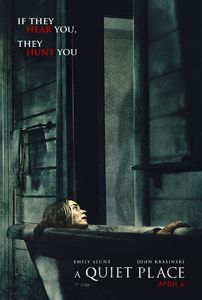
  • A Quiet Place (2018)

    A Quiet Place (2018)

    (Netflix Streaming, January 2019) There are quite a few things I don’t like about A Quiet Place from a strict logical standpoint. The premise of the Earth having been devastated by murderous aliens with a keen ear doesn’t survive a critical look. There are plenty of plot holes, dumb decisions and nonsensical implied backstory here, and by the time the normally quiet characters speak normally near a waterfall providing aural cover, one wonders why there aren’t human settlements near Niagara Falls, windy mountain passes, wavy beaches or heavy metal concerts. But A Quiet Place does a bit of essential misdirection in asking us not to think about those things—by focusing its story on an isolated family, paying careful attention to tactile details and featuring a soundtrack that could have been largely lifted from a silent movie, it sets up a simple but effective suspension of disbelief. Actor/writer/director John Krasinski, accompanied by his off-and-on-screen partner Emily Blunt, shows a clear and effective intention for his movie. He ends up making a very effective, very careful use of sound, especially in building up the suspenseful sequences. There is a lot of implied background in the way it simply shows us details about a family having been able to survive in a dangerous world. I’m not that happy with elements of the conclusion, nor the wider perspective of the imagined universe, but it works on a nuts-and-bolt level, and it certainly offers a different watching experience—there’s been a few sound-conscious horror movies lately (Hush and Don’t Breathe among others) but A Quiet Place has something slightly different to say by heading into the Science-Fiction realm. I’m not sure that the announced sequel has anything left to explore, but if this film is anything to judge, then we shouldn’t bet against John Krasinski undertaking further challenging projects.