Reviews

  • Shaft (1971)

    Shaft (1971)

    (On Cable TV, December 2018) My expectations may have been a bit too high for the original Shaft. The film, in the popular imagination, has become a bit of a Blaxploitation landmark, buoyed by its famous title song and Richard Roundtree’s untouchable status as an icon. Shaft remains one of the best-known Blaxploitation film, which acted as a precursor to modern black-driven American cinema. That’s a lot of weight to put on what is, after all, simply a crime thriller. The reality on the ground, or rather on a scene-by-scene viewing basis, is not quite as glamorous: While Shaft benefits greatly from Roundtree’s performance, its Oscar-nominated title tune (naïve, but still potent) and first-mover advantage in defining blaxploitation, it does feel tepid and dated—there’s definitely some coolness to it, but it doesn’t measure up as favourably as it once did as an urban thriller. Of course, what we see now after decades of imitators is not the same thing as the 1971 audiences saw, some for the first time: a black hero stylishly navigating a complex urban landscape between cops and organized crime. While I enjoyed it, I was clearly expecting more, probably conditioned by endless flashy imitators refining the lessons learned by the original Shaft.

  • Les affamés [Ravenous] (2017)

    Les affamés [Ravenous] (2017)

    (In French, On Cable TV, December 2018) Now here’s a fun curiosity— Les affamés is a French-Canadian zombie film, featuring some well-known local actors fighting the undead menace in rural Québec. It speaks to the democratization of genre elements that even that kind of project can be viable away from Hollywood. (Or maybe not that all surprising, given that the only thing you really need for a zombie movie is a farmhouse and red syrup.) Still, it is quite a thing to see grande-dame of Québec actresses Micheline Lanctôt cock a shotgun before going undead-hunting. Writer/director Robin Aubert makes the most out of the limited budget given to French-Canadian productions, setting his stories in forests, farm fields and isolated houses. Most of the elements of zombie movies are used in a straightforward fashion, although Aubert can’t resist adding an eerie element of zombie intelligence and proto-civilization by having them create towers out of ordinary objects. But never mind the quirks—the film delivers on the usual zombie-chomping action, what with lead actor Marc-André Grondin trying to hold everything together even in the face of an ongoing apocalypse. The result feels a bit odd by zombie-movie standards: a bit too pretentious at times (as in “yeah, we’re trying to do something more ambitious than the usual zombie movie”) even though its chief appeal—at least for me, as a French-Canadian viewer—is in setting familiar zombie tropes in very familiar settings with characters speaking a familiar patois. Les affamés offers two lasting visuals, but if I had to choose, I’d rather sacrifice the tower of chairs so that I could have more veteran Québec actors shooting zombies in the face.

  • Realive aka Proyecto Lázaro (2016)

    Realive aka Proyecto Lázaro (2016)

    (On Cable TV, December 2018) Speaking as a long-time written science fiction fan, a really nice thing about the 2010s has been the expansion, globalization and democratization of filmed SF, as more filmmakers around the world are using a common understanding of the genre, cheap digital effects and accessible production means to create small-scale visions that go where Hollywood wouldn’t. With writer/director Mateo Gil’s Realive, this means a Spanish/Belgian production tackling universal ideas with a European slant, not necessarily settling for the same answers that what we’d see from other sources. The SF theme is familiar—a terminally ill man, choosing to be cryogenically preserved in the hope of a later cure. But of course, things aren’t so simple—being revived decades later leads to profound side effects, and there’s no guarantee that a man out of time would be able to cope with a future where he has to relearn everything. And that’s not mentioning the big question lurking behind it all: revival isn’t cheap, someone financed our protagonist’s return to life—and they expect a return on their investment. Going back and forth between a contemporary and a future timeline, Realive opposes the present and the future, as well as the choices the protagonist must make in leaving loved ones behind. The future, mostly taking place in a medical clinic, is cold and antiseptic: Yet revival is messy, complicated, prone to setbacks and uncomfortable choices. Our protagonist is not always of admirable fortitude, and the film does have an ironic surprise for him at the end. Tom Hughes is not bad in the lead, with Charlotte Le Bon providing some emotional support, and the eye-catching Oona Chaplin as the most vivid character in the film. While there isn’t much here that seasoned Science Fiction fans won’t have seen in other (usually written) forms, it’s good to see filmed SF rise to the level of maturity of prose SF and keep a stinger in reserve. While Realive is perhaps a bit too downbeat to please large audiences, it’s a mature kind of SF film, and one that should exist alongside happier, more superficial fare.

  • Death Wish (2018)

    Death Wish (2018)

    (On Cable TV, December 2018) Ho boy, do I have mixed feelings about this Death Wish remake. For one thing, I’ve been watching a lot of urban-decay movies of the early 1970s lately, including the original Charles Bronson film. For another, well, I’m Canadian—my nearest metropolitan area is in the midst of an unprecedented murder wave and yet our yearly total barely exceeds what the city of Chicago alone experiences over two weeks (although Chicago’s own wave of violence seems to be receding after a particularly bad 2016). Seeing Death Wish isn’t just like seeing a very American nightmare given form, but one that seems to be coming back from the past. You already know the story, or at least can grasp it in a few words: A peaceful man turns vigilante after a brutal attack leaves his wife dead and his daughter in a coma. The rest is pure predictable plot mechanics to complete the cycle of revenge, making sure our hero develops the skills, evades the cops, tracks down the responsible parties and executes them in a way that leaves him in the clear. The first step in such a by-the-number reactionary thriller is to clearly establish that its world is a far more dangerous place than ours—and the film does have to lie quite a bit in order to get there, reaching for racial stereotypes and vilifying its targets. Poachers attack a farm just to make a convenient point, statistics are grossly inflated, and a Greek chorus of radio and social media voices is there to half-heartedly make and dismiss objections. Meanwhile, Bruce Willis broods his way through a role very much in-line with much of his indifferent 21st-century screen persona. Director Eli Roth may want to make a social statement (although I doubt it—his horror-movie instincts come up whenever there’s even a faint chance to put gratuitous gore on-screen) but Death Wish is, far more than its predecessor, an NRA-approved exploitation picture designed to make fearful people feel comfortable in their twisted version of the world. It would be a pretty reprehensible picture if it wasn’t for one thing: It’s actually executed decently. Roth has the budget to go for clean impressive cinematography, feature good actors even in thankless roles (Dean Norris once more takes on a familiar persona, but he’s sufficiently good at it that emerges intact from the deplorable results), and flex his directorial skills honed on much nastier pictures. He doesn’t stray that far from his roots—plot-wise the film hinges on convenient coincidences and at least one ridiculous Rube-Goldberg contrivance. But Death Wish, for all of its considerable problems, does actually work at what it intends to be: a gun-powered revenge fantasy, slickly made and updated to the current era.

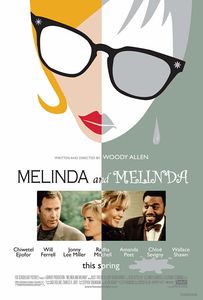
  • Melinda and Melinda (2004)

    Melinda and Melinda (2004)

    (In French, On Cable TV, December 2018) In the grand scheme of writer/director Woody Allen’s career, Melinda and Melinda feels both like a partial return to form and a transitional film. Occurring right before Allen’s European phase, it takes place in his Manhattan playground and features the kind of high concept that he played with in the earlier segments of his career—specifically, what if the same initial situation led to two separate stories, one tragic and one comic. Radha Mitchell stars as the same protagonist in both stories, with a typically good cast surrounding her in both versions. There is no single Allen analogue to be found here, showing the way that most of his European movies would go. Unfortunately, the concept of having playwrights arguing over whether life is a comedy or a tragedy by telling competing stories is perhaps better than the actual result: the cohesion between the stories is disappointing, as are the echoes going back and forth between the two of them. It’s the kind of device that a younger filmmaker may have been able to exploit more daringly, because as it is Melinda and Melinda often feels like a comfortable and perfunctory return to the kind of gently upper-class Manhattanite comedy that Allen did throughout his career. We’re more or less in the same apartment blocks, going to art-house movies, discussing literature and philosophy in the same ways other Allen characters have done. This does not, in other words, do much to expand Allen’s repertoire but it can be a comfy return to form for his audience. The result is predictably middle-of-the-road, liable to please those who think it will please them. It’s a specific kind of film, the kind where even an inconclusive abrupt ending becomes a gag in itself. In other words, don’t care too deeply about it.

  • The Yards (2000)

    The Yards (2000)

    (On Cable TV, December 2018) I take no real pleasure out of reporting that The Yards is much duller than I hoped for. Movie reviewers, contrarily to some perceptions, usually hope for the best—otherwise, why bother? At the same time, I’m favourably inclined to tales of protagonists fighting against corruption, stories where characters try to get themselves out of the criminal life, and semi-realistic dramas at an age where we’re saturated with superhero blockbusters. Then there’s the respectable real-life factor of the movie being based on events having involved writer/director James Gray’s father. But The Yards is not how to do it. Taking place in lower-class Queens, The Yards is about an ex-con stuck in-between small-time businessmen, institutionalized corruption, blue-collar labour and complex family drama. The result is not meant to feel good: Everything’s dark and dreary, characters get killed accidentally, lifelong friendships are destroyed and there’s little hope for the protagonist in the middle of those powerful corrupt forces. Boasting of a great cast but directed with little distinction, The Yards often doesn’t quite know what to do with its leads Mark Wahlberg, Joaquin Phoenix and Charlize Theron, not to mention living legends such as James Caan, Ellen Burstyn and Faye Dunaway in supporting roles. The result is procedurally wearying, a description that can be applied surprisingly well to many of Gray’s later works. The Yards may have echoes of On the Waterfront somewhere in its working-class corruption DNA, but that’s not enough to make it feel alive.

  • Tommy Boy (1995)

    Tommy Boy (1995)

    (In French, On Cable TV, December 2018) The formula behind Tommy Boy isn’t complicated—take an outrageous comedian with a funny physique (that would be the late Chris Farley) and cast him as a man-child chaos-maker, then pair him up with a somewhat more conventional comedian with an ability to freak out in amusing way (that would be David Spade) as the straight man, and send them off on a road trip. There’s a sub-genre with a list of movies a mile long all revolving around the same concept, and Tommy Boy doesn’t break any new ground in following tradition. The details are unimportant, what with two young men trying to save their auto part company from going under by going on an extended sales trip. There’s some mechanistic character development, perfidious antagonists, comedy legends in secondary roles (Dan Aykroyd!) and a car that gradually breaks down over the course of the trip. As is tradition with road movies, it also features both characters singing along to a song. Narrative cohesion isn’t a big concern of the script, as much of the details are of the episodic one-thing-after-another variety. In execution, however, Tommy Boy depends a great deal on the specific comedy of Farley and Spade (better yet; both of them together), a pop-heavy soundtrack and some outrageous visual gags. (If you’re a fan of cars gradually falling apart, this is a movie for you.) It’s not good, it’s not memorable, it’s not clever but it just may be enough for an undemanding viewing in-between more substantial fare. Just don’t get Tommy Boy confused with the other Farley/Spade movie.

  • Arthur (1981)

    Arthur (1981)

    (In French, On Cable TV, December 2018) Here’s a useless bit of childhood memory: Back when I was a boy, there was a French-Canadian TV show hosted by René Homier-Roy that offered viewers a choice between two movies to watch—viewers could call in during the following week, and pick the movie they wanted to see. Homier-Roy (a legend in French-Canadian broadcasting) would often pit 1981’s Arthur against other picks, nudging viewers toward it … only to be disappointed when viewers inevitably picked the other film. I only mention this because this is the kind of childhood memory that sticks in mind and leads middle-aged men to finally sit down and see what the fuss was about. Alas, the childhood curiosity was better than the adult review: While I can see how Arthur may have appealed to certain audiences in 1981, it feels like a stultifying bore in 2018. I’ll admit that my overall lack of interest in Liza Minnelli may have something to do with it—given that she’s the film’s love interest and hence the goal to motivate everything else, a lack of interest there means severely limiting the film’s appeal. More successful is Dudley Moore’s portrayal of the title character—a wealthy heir seemingly content in drinking himself to a constant stupor, and indulging in a few eccentricities along the way. He’s slated to marry another heiress, but then comes Minnelli’s character—a lower-class young woman—to change his ways. Arthur is really a belated coming-of-age romantic comedy, as an adult character who never had a reason to grow up suddenly has to—notably through the death of a surrogate father. There’s a touch of sadness to Arthur that prevents it from being an all-out feel-good romantic comedy, something reinforced with the gritty backdrop of early-1980s New York City. It works, but I was not as charmed or as amused as I expected it to be—but perhaps I’m unfairly comparing it to the shallowed but funnier 2011 remake. Sorry, René: I too would still pick something other than Arthur if you offered me the choice.

  • Another Wolfcop (2017)

    Another Wolfcop (2017)

    (On Cable TV, December 2018) The first Wolfcop was a welcome slide of crazy Canadian low-budget moviemaking, and I’m happy to report that sequel Another Wolfcop offers more of the same. Much more of the same, in fact, as the mythology is extended to include several fantastic devices beyond the titular Wolfcop. There’s an inspired bit of lunacy in writer/director Lowell Dean’s work here, as he uses the small-town hockey-loving setting to its fullest advantage and just lets his cast and crew have fun. It’s not perfect, but its flaws are often reflections of its nature—I’d like the result to be considerably less gross or gory, for instance, but wouldn’t that betray the low-down grindhouse feeling that the film is trying to ape? Clearly designed to appeal specifically to horror-comedy fans, Another Wolfcop certainly delivers. Leo Fafard is once again just right as the titular Wolfcop, with generally fine performances from other actors. Never mind the low budget, Kevin Smith cameo or incoherent world-building—the point of such a movie is seeing some demented red-syrup ice-rink action, and we get that in spades.

  • Rememory (2017)

    Rememory (2017)

    (On Cable TV, December 2018) There’s a very pleasant trend going on right now of smaller intimate science-fiction movies truly digging into the potential of the form in presenting character-driven stories. Rememory is certainly in that vein, with a grief-stricken man taking on an investigation in the mysterious death of an inventor. The invention, of course, is the film’s science-fictional device: a machine to record and play back memories. You don’t need much more to develop a story about guilt and mourning, digging into the possibilities of the device in literalizing metaphors and putting the characters through an emotional wringer. Peter Dinklage stars as the amateur sleuth, delivering an impressive performance even in occasionally substandard material. Unfortunately, the film itself doesn’t come close to achieving its thematic goals nor of meeting the level of Dinklage’s performance. Rememory is too dour and melodramatic to be completely successful—it eventually grates and annoys with its tepid pacing and overdrawn conclusion. But even with those flaws, there’s something interesting in this antidote to bigger-budget, lower-ideas blockbusters.

  • Seven Brides for Seven Brothers (1954)

    Seven Brides for Seven Brothers (1954)

    (On Cable TV, December 2018) OK, so here’s a fun question as we contemplate whether movies from another era are so horrible by our standards: Can we still enjoy them? Accepting that some movies would never, ever be exactly as they were if they were remade today, is it OK if we still find some fun in those older movies? What if they tickle some find of traditional reactionary lizard-brain sensibility? Because let’s be blunt: Seven Brides for Seven Brothers makes cute out of a horrible situation, with brothers kidnapping women intending to make them their brides, and carrying them back in the woods while their friends and family are prevented from rescuing them by a snow-blocked mountain pass. In any realistic scenario, you’d feel the impotent rage and extended fear of those family members at the village, unable to launch a rescue for months and imagining the worst scenarios for the kidnapped girls. Fortunately, Seven Brides for Seven Brothers is a musical comedy (and one that name-checks the Sabine women): nothing ever remotely bad happens to the girls, and they spend the winter months falling in love with their kidnappers (no Stockholm syndrome here, we’re assured). In between the foregone conclusion and the beginning of the story, we do get pretty good set-pieces. Stronger in dance than in songs, the film features a unique blend of lumberjack ballet, with the barn-raising sequence being a dance/comedy set-piece that, by itself, justifies the film’s longevity even in its now-dodgy cuteness. (The mournful single-take dancing/woodchopping routine of “Lonesome Polecat” is also quite impressive in a different register.) Howard Keel is a lot of fun as the lead (what a beard!), with plenty of great supporting performance for a main cast that starts with fourteen people). I also suspect that the film’s longevity can also be attributed to a certain originality: How many other lumberjack musicals do you recall? This, combined with the film’s unfailing cheer, still makes Seven Brides for Seven Brothers a lot of fun to watch. You may even rewind to re-experience the barn-raising sequence all over again.

  • The Lucky One (2012)

    The Lucky One (2012)

    (On Cable TV, December 2018) Here are the facts: The Lucky One is a romantic drama based on a Nicholas Sparks novel. I should just stop the review right here, because you already have all of what’s required to make up your mind about the movie and whether you’re likely to enjoy it. Most Sparks novels are built according to a similar melodramatic template, and this similarity is not helped at all by bland casting and unremarkable direction. The story has to do with a soldier making his way back from Iraq to a woman whose picture he found during combat, but really that’s just an extra-melodramatic setup for a “stranger comes into town” plot à la Safe Haven. It ends pretty much how you’d expect, which is tautologically the only way it could end up given the expectations of its audience. If it sounds as if I’m exasperated by the result, that’s true only up to a certain point. Past that, the film delivers exactly what it intends, and there is some atmospheric attractiveness in small-town romance stories with added dramatic flair. (Plus Zac Efron and/or Taylor Schilling. Although I’m getting old enough now that Blythe Danner is starting to look like the cute one in the film.) The Lucky One is the kind of movie that it wants to be, and you’d don’t have to see it if you don’t want to.

  • Cocktail (1988)

    Cocktail (1988)

    (In French, On Cable TV, December 2018) I’m not sure when “peak Tom Cruise” actually was, but there’s no denying that his late-1980s popularity following Top Gun was off-the-chart. Most of his projects back then (and still now) banked on his charisma. Cocktail certainly makes a lot of mileage with Cruise’s boyish charm: Here he plays an ambitious young man initially taking up bartending to make ends meet while working toward a business degree. But when his showy bartending earns him more attention than he knows what to do with, it leads to a break-up with his mentor, romantic entanglements and many more money-related complications. It gets very melodramatic very quickly, and the result is a mess that doesn’t quite know what tone to aim for. To be fair, there are a few great moments of the film, especially in the first half as the 1980s atmosphere is most visibly deployed and as the flair bartending style gets a lot of attention. But those moments of greatness probably work against Cocktail as a whole, especially once we’re off to increasingly unlikely and grandiose plot development that suck whatever energy the film was able to create in those moments. I suspect that Cruise’s presence in the film ended up creating part of the atonality problems: Cruise being Cruise, any film producer would want to give him a flashy part, a big smile and a happy ending, whereas a smaller-scale movie with a lesser-known lead actor probably could have delivered a rougher, more authentic drama about the ups and downs in the life of a bartender. Who knows? What’s obvious, though, is that the film doesn’t quite work as a seamless whole. The plot gets more arbitrary, and it feels stuck between down-and-dirty intentions and its star’s megawatt personality. Cocktail doesn’t mix well, and the result can be dumbfounding when seen thirty years later.

  • Rampage (2018)

    Rampage (2018)

    (On Cable TV, December 2018) Hey wow—I recall playing Rampage-the-videogame on personal computers in the late 1980s, wowed by a 16-colour palette (EGA forever!) and having rather a lot of fun with it. (I just had a spin through the online abandonware browser emulator and it’s pretty much what I remembered.) Rampage the movie, of course, is something else: A thin excuse to have monsters destroying good chunks of a city, finally proving that seventeen years after 9/11, we’re once again ready to rumble through devastated downtown areas. Dwayne Johnson (who else?) leads the film, playing the kind of superheroes that is de rigueur for that kind of movie. The scientific blablabla is nonsense, but it quickly gets us to the super-monsters destroying cities, albeit with a slightly harder edge than I expected from a big PG-13 movies: there’s some faintly upsetting almost-R violence in the film that I did not necessarily enjoy. Still, Rampage is meant to be dumb fun and it knows it: one of the best non-CGI parts of the film is Jeffrey Dean Morgan as a mysterious scenery-chewing Southern man-in-black kind of special operative stealing every scene he’s in. Johnson is up to his usual leading-man standard (but is he getting overexposed?) while Naomie Harris is always enjoyable to look at—this film not being an exception. Of course, the point of Rampage is seeing Downtown Chicago landmarks being destroyed as thoroughly as possible—surely I can’t be the only one thinking about a Rampage/Transformers 3 mash-up? The film is both better and worse than expected: better in that it delivers the goods and keeps moving, with some great special-effects sequences along the way. Worse, because of the too-high level of violence, and overall impression that we’ve seen urban destruction so often lately (even in director Brad Peyton’s oeuvre, as per the somewhat more ludicrously enjoyable San Andreas) that Rampage is going to sink back into anonymity within months.

  • The Freshman (1990)

    The Freshman (1990)

    (On Cable TV, December 2018) Well huh. Turns out that Marlon Brando was a trend setter on his way up, playing characters with raw honesty in the 1950s, and also on his way down, anticipating the whole self-parody of people such as Robert de Niro with 1990’s The Freshman. The references are not accidental—The Freshman features Brando as a mob boss in a film that has characters (including a film teacher) obsessing over The Godfather. It’s intentional, and it does work relatively well at times: Brando doesn’t look as if he’s having any fun whatsoever, but the characters grimacing around him look as if they do. Matthew Broderick stars as a hapless Midwesterner going to NYC to study film, and is immediately robbed upon arrival. We later discover it’s all a big scheme, but never mind the details. The Freshman is merely fine as a comedy: It doesn’t have big laughs, it does’nt build to an amazing climax, but it does the job of entertaining and that’s that. Director Andrew Bergman keeps things moving in the same direction, Penelope Ann Miller makes for a cute love interest and the focus on animals means some visual comedy as well. I don’t think that The Freshman has any staying power beyond seeing Brando poking fun at himself, even in a very restrained way. But it’ll do if you haven’t seen it yet.