Reviews

  • L’armée des ombres [Army of Shadows] (1969)

    L’armée des ombres [Army of Shadows] (1969)

    (On TV, October 2018) The popular depiction of the WW2 French Resistance is usually heroic, portraying them as virtuous stalwart fighters against the occupying Nazi regime. But the reality wasn’t so rosy nor clear-cut, and writer/director Jean-Pierre Melville knew better than most, having witnessed it firsthand. So when he tackled the topic in L’armée des ombres, he did so with a complete lack of romanticism. The French Resistance here is made of anti-heroes, cruel and doomed at the same time. It’s a rough business, and death is seldom clean. Their activities are sordid, set against ugly backdrops and the constant threats of betrayal from fellow Frenchmen. There are a few heroics, but they almost come across as accidents with terrible consequences. A sombre and anti-glamorous cinematography further reinforces the intended realism of the film. L’armée des ombres is certainly not a pleasant viewing experience, but it does offer a different view of the Resistance, something that usually remains an unexamined plot device in other, lesser movies.

  • 12 Strong (2018)

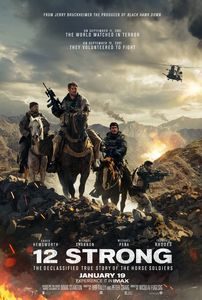
    12 Strong (2018)

    (On Cable TV, October 2018) Despite Hollywood’s supposedly left-leaning tendencies, it can be counted upon to deliver, year after year, a reliable stream of pro-war statements wrapped in the American flag, family values and unquestioned imperialism. The latest entry in the subgenre is 12 Strong, which heads back to the woolly post-9/11 days when the United States boldly invaded Afghanistan half a world away. Such initial force projection isn’t easy, and so the first boots on the ground belong to Special Forces, leading the charge that more conventional military troops would later follow. Afghanistan is not an easy country to invade, and much of 12 Strong portrays the adaptations of the American soldiers as the CIA sets up factions against each other. Our protagonists eventually take up horses as the only workable transportation in the country, leading to a somewhat surreal scene featuring a 21st-century cavalry charge. Surprisingly enough, 12 Strong ends with everyone making it back home against overwhelming odds, marking a rather pleasant change of pace given the number of movies focusing on recent American military disasters with few survivors. This is not a particularly deep film—there is practically not introspection here about the wisdom of invading other countries, nor about the looming quagmire that would sweep up American (and Canadian!) troops over there for almost two decades. The dramatic arcs of the film play on familiar threads: family, safety, and bonds between men under combat. Only the cavalry aspect of the film distinguishes it from so many other similar efforts. Still, the film is a decently entertaining watch under Nicolai Fuglsig’s direction. It does help that it features terrific actors: in between Chris Hemsworth, Michael Shannon, Michael Pena and William Fichtner, the cast is a bit too good for the limited material, but they do give it a dramatic heft. It’s too long for its own good, and even then doesn’t quite manage to flesh out its characterization. But it does come alive in battle scenes, and documents an underappreciated facet of the Afghan invasion. At times, 12 Strong feels like a throwback to the war-is-an-adventure school of filmmaking, but that’s a nice change of pace from the overly ponderous war movies of late.

  • Körkarlen [The Phantom Carriage] (1921)

    Körkarlen [The Phantom Carriage] (1921)

    (On Cable TV, October 2018) Like many silent films, director Victor Sjöström’s Körkarlen (The Phantom Carriage) is not an easy watch. It feels overlong, overacted, melodramatic and yet decidedly played in low-key compared to later efforts. Its distance from modern viewers is further lengthened by the fact it’s coming from Sweden, with entirely different codes and assumptions. Still, it does have something interesting to say, and its depiction of horror elements being used in the service of a drama-driven story. The plot is not linear (to the point of being a bit of a challenge to follow if you’re expecting the typical silent-movie narrative structure) and the special effects are effective. Further adding to the historical importance is the oft-cited influence of the film on that other significant Swedish filmmaker Ingmar Bergman. I wouldn’t necessarily recommend The Phantom Carriage to just anyone – budding film historians, especially with a specialty in horror cinema, will best appreciate the result.

  • Any Which Way You Can (1980)

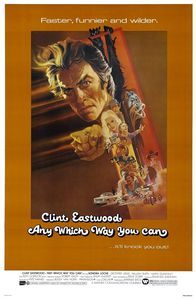
    Any Which Way You Can (1980)

    (In French, On TV, October 2018) The sequel to 1978’s Any Which Way but Loose once again features Clint Eastwood as a brawler looking for love (Sondra Locke, obviously) alongside his pet chimpanzee. As with its prequel, Any Which Way You Can also proves that Eastwood’s talent for comedy is … limited. Once again, the film is a comedy largely because it’s not a drama—it plays with incongruous elements, features Eastwood in a role when he can be cheered for punching people in the face and fighting Nazi bikers. Perhaps what’s most remarkable about this sequel is that it ends up giving to its protagonist what the original denied: The girl and the fighting victory. Whether this is a reflection of giving fans what they wanted or ushering the nicer, kinder, more entertainment-driven 1980s is a matter of debate, but it does make the sequel more conventional, more satisfying and somehow less distinctive. Any Which Way You Can is worth seeing if you’ve seen the first film or are an unconditional Eastwood (or Locke) fan, otherwise it’s not particularly memorable.

  • How to Steal a Million (1966)

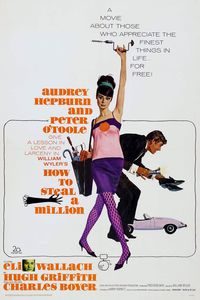
    How to Steal a Million (1966)

    (On TV, October 2018) I wasn’t expecting much from mid-1960s comedy How to Steal a Million except that it starred Audrey Hepburn, but I quickly grew charmed by the result. Hepburn plays the daughter of an art counterfeiter, trying her best to avoid her father’s handiwork from being discovered by appraisal experts. To this end, she befriends a burglar and quickly finds herself planning a museum heist. The plot is good enough to allow Hepburn to play her ingenue best (in her mid-thirties!), bouncing off Peter O’Toole’s charm and the fatherly attention of Hugh Griffith. Hepburn being her usual lovable self, the film unfolds at a pleasantly breezy pace, once again reuniting her with Paris and haute couture. It’s not necessarily one of Hepburn’s best movies, but she delivers here a quintessential performance: Funny, charming, intensely likable and more than cute. As a result, How to Steal a Million is the kind of film that isn’t necessarily listed as an essential 1960s film but packs a lot of entertainment. It’s perhaps best approached as a happy discovery.

  • Darkest Hour (2017)

    Darkest Hour (2017)

    (On Cable TV, October 2018) After decades of stellar character roles, it seems fitting that Gary Oldman would win his first Oscar for playing none other than Winston Churchill in a biographical film. Focused on the crucial months during which England found itself alone (well, alone with its globe-spanning empire) against the Nazis, Darkest Hour becomes a political thriller in which Churchill had to manoeuvre between the population and the Nazi-appeasing politicians. It’s fact-based without being entirely factual (that wonderful scene about Churchill riding the underground—never happened) yet made with such restraint that we’re led to imbue more credibility to the film than we should. There’s another word for it, of course, and that mythmaking: a deliberate attempt to further shape Churchill’s stature as the English bulldog, providing further Britannia Triumphant material. (There’s been a surprising number of those lately, from King Arthur to the newest iterations of James Bond focused on home territory—I’m thinking there’s a link with Brexit, but I’m not sure what it is yet.) Director Joe Wright seems in his element here, with a high-stakes historical drama and plenty of opportunities for respectable filmmaking. It’s not a bad movie despite the uncomfortable feeling of being manipulated through a very selective vision of history. To be fair, Oldman is very good, and Darkest Hour does manage to inject a lot of drama into historical events. It could have been worse, and if it did get Oldman a much-deserved body-of-work Oscar, then why not?

  • Ilsa, Harem Keeper of the Oil Sheiks (1976)

    Ilsa, Harem Keeper of the Oil Sheiks (1976)

    (In French, On TV, October 2018) Ew. But also: What was I expecting? Ilsa, She Wolf of the SS is notorious as a particularly vile piece of sex/gore exploitation filmmaking, and its first sequel (of three) Ilsa, Harem Keeper of the Oil Sheiks is very much in the same vein. Yes, there is a lot of nudity—star Dyanne Thorne has a compelling presence in or out of clothes. Alas, this sole redeeming feature is more than sunk by the nastiness of the rest of the film, during which gory deaths manifests itself through torture, genital mutilation, outright slavery, forced surgery and the likes. Perhaps worse yet is the film’s gleefully sadistic atmosphere: don’t go looking for sympathetic characters or anything feeling like a happy ending, because this is not that kind of film and the best we can hope is the greater evil being defeated by the slightly lesser evil. Even as a jaded horror viewer, I felt queasy during much of Ilsa, Harem Keeper of the Oil Sheiks—I have trouble imagining anyone actually wanting to be associated with this film. And yet, and yet, I’m almost certain that sometime in the future, I will succumb and try watching the other films in the series. Just to see if they’re any better. The curse of curiosity…

  • Happy Death Day (2017)

    Happy Death Day (2017)

    (On Cable TV, October 2018) Derivatives of Groundhog Day’s time-loop premise are now commonplace, and it takes a little bit more to avoid charges of being derivative. Happily, Happy Death Day eventually gets there: A comedic horror take on the reliving-a-day idea, it’s a film that eventually finds its groove and runs with it. It doesn’t start that promisingly, what with a college student waking up next to a one-night stand and going through a school day (that happens to be her birthday) before being brutally murdered … and starting over again. The expected scenes of time-loop movies are there, but there is a sharp edge to the horror element as our protagonist gets murdered time and time again. While the first half-hour of the film is a bit perfunctory, the film eventually improves, roughly at the same time as we gain an appreciation the lead actress. Jessica Rothe doesn’t have much name recognition, but this is going to change with her performance here, as she goes from an obnoxious sorority girl to a likable protagonist over the first half of the film and then keeps our interest for the remainder of the story. The “Confident” song montage is when the film finally comes into focus. A dark comic sense of humour from director Christopher Landon and writer Scott Lobdell certainly helps keep things interesting despite the film’s low-budget. Unhappily, the film eventually starts ignoring its own plot points (not much is made of the protagonist becoming weaker throughout the loops) but the ride is a fun one despite some third-act weirdness. I ended up liking Happy Death Day more than I thought at the beginning, and even more than I thought after twenty minutes of it. Even as a Groundhog Day derivative, it’s actually worth a look.

  • OSS 117: Rio ne répond plus [OSS 117: Lost in Rio] (2009)

    OSS 117: Rio ne répond plus [OSS 117: Lost in Rio] (2009)

    (In French, On TV, October 2018) The premise of the OSS 117 series is strange but simple: adapt older French spy novels as comedies by repurposing their plot and pushing their sexist and racist content to an absurd degree. It wouldn’t work if Jean Dujardin wasn’t headlining the cast, and in fact it works markedly less well in OSS 117: Rio ne répond plus than in the first film of the series. It turns out that even when exaggerated for comic purposes, sexist and racism aren’t that funny … and the film doesn’t have much more in its sleeve to get viewers laughing. Dujardin does have the comic timing (and the square-jawed looks) to take the parochialism into comic territory, but there the jokes fall flat as being irritating and repetitive. It’s no surprise if the female characters, played by Louise Monot and Reem Kherici, are far more likable than the misogynistic hero. Director Michel Hazanavicius replicates the original’s self-consciously old-fashioned filmmaking, but he can’t strike gold twice, and the film often becomes an ordeal rather than an enjoyable parody piece. At best, OSS 117: Rio ne répond plus is best seen right after the original film, but I expect that the growing exasperation with the character is liable to grow even worse when they’re watched back-to-back. Too bad, because there’s a kernel of interest here that could have been developed better.

  • Only the Brave (2017)

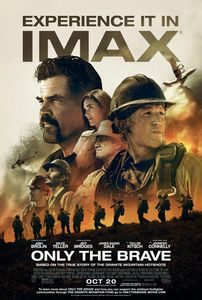
    Only the Brave (2017)

    (On Cable TV, October 2018) Hollywood has a fixation on making inspiring movies out of tragedies, and firefighter drama Only the Brave pushes this habit to the limit, leaving out a few less-savoury details along the way. The real events on which this film is based (and Only the Brave does itself a disservice by not stating this up-front) are tragic: nineteen close-knit firemen belonging to the fire crew of Prescott, AZ, died while fighting a brushfire. What the film insists on doing is to show the dedication, courage and tenacity of the doomed men, their relationships to be extinguished with their spouses, and so on. Everybody is ennobled in death, and the firefighters here are no exception. It’s a familiar script in that regard. What makes the film work beyond the mournful homage is in its execution from visually-strong director Joseph Kosinski. A solid cast headlines the film, with Josh Brolin as the chief leading the men in danger, and capable actors such as Miles Teller, Jeff Bridges, Jennifer Connelly and Andie MacDowell in supporting roles. The way the firefights are shown is also quite compelling—for a medium-budgeted film, Only the Brave has some exceptional special effects (in daytime, outside, wide-screen) to portray men fighting fires in dangerous circumstances. It’s almost certainly the best firefighter film since Backdraft and its earnestness does manage to keep the film going even when it’s not being subtle about what it’s doing. The film does end at the right moment, though: again, the real-life story had a very unpleasant epilogue, with the widows of some of the dead men having to fight the town council to secure benefits. That part is nowhere in Only the Brave, but then again some things are beyond Hollywood’s ability to transform in a noble uplifting film.

  • Faust: Eine deutsche Volkssage [Faust] (1926)

    Faust: Eine deutsche Volkssage [Faust] (1926)

    (Hoopla Streaming, October 2018) Bringing an imaginative version of the biblical story to the big screen, F.M. Murnau’s Faust remains remarkable today for its density of special effects and for an all-out approach to fantasy filmmaking. As a result, there’s quite a lot to see here (do try to watch as high-quality a copy as you can find), which is helped along by the reasonable running time of the film (a mere 106 minutes, when some contemporaries ran almost to three hours). The story is a remix of several versions of the Faust story, meaning that it’s familiar and yet a good clothesline on which to hang fantastic set pieces. A veteran Murnau being at the helm (this being his last German film before moving to Hollywood and working on Sunrise), there is an undeniable artistic intent here, which adds quite a bit to the film. It may not be to everyone’s taste (and it does take a while to get started) and like most silent movies it does require active viewing in order to make the most out of it, but Faust is a solid example of fantasy filmmaking, influential and still worth a look today.

  • Maze Runner: The Death Cure (2018)

    Maze Runner: The Death Cure (2018)

    (On Cable TV, October 2018) Considering my extremely low opinion of the first two Maze Runner movies, I’m as surprised as anyone else to find out that third instalment The Death Cure is a bit of an improvement. It may be that the enforced delays in the production of the film (put on hold for a year when series star Dylan O’Brien suffered a serious accident while shooting) helped distinguish it from the spectacular crash of the dystopian YA subgenre that occurred in the meantime. It may also be that, contrarily to the recycled and lazy post-apocalyptic settings of the first two volumes, this one heads back to a high-tech megacity as a backdrop to its familiar thrills. No matter why, and I’m not trying to argue that it’s any better than an average action movie, The Death Cure feels a little bit more interesting and a little bit less exasperating than previous instalments. There’s an interesting ensemble supporting cast (Nathalie Emmanuel, Giancarlo Esposito, Walton Goggins, Barry Pepper, Patricia Clarkson, Will Poulter, etc.) stuck with the uninspired material and quite a bit of special effects work to keep things looking dynamic even when the story is dull. Plot-wise and sight-wise, there isn’t a lot in The Death Cure that hasn’t been done better elsewhere (the coincidences and contrivances get heavy at times), but it can be familiar comfort fare for, say, cyberpunk fans looking for a minor dose of the stuff. Director Wes Ball keeps things rolling, so at least there’s a bit of kinetic energy to the nonsense. If I thought too much about The Death Cure (and I don’t really care to), I’d point out the hideous hypocrisy of having the city, a last bastion of civilization, burn to the ground while our teenage heroes claim this as a victory … but that sort of thing is depressingly common in post-apocalyptic YA fiction where the span-of-consequences seems to stop at the teenage protagonists with nary a care for anyone else. “Better than the previous volumes” in this case doesn’t quite translate in an absolute recommendation.

  • Biutiful (2010)

    Biutiful (2010)

    (On Cable TV, October 2018) There is a lot going on in writer/director Alejandro González Iñárritu’s Biutiful, and while not all of it makes sense or is properly developed, it does help maintain interest in a kind of film that I otherwise would find dull or ugly. Let’s see: Here we have a protagonist who’s not just estranged from the mother of his two children (sub-plot #1) but is also semi-psychic (#2), is dying of cancer (#3) and is involved in illegal immigration (#4) which lead to him welcoming the wife of a deported drug dealer in his apartment (#5). The issue here isn’t the number of subplots as much as they all seem to belong in different genres: their collision often smacks of contrivances, and I’ve left the most dramatic parts out of it. Fortunately, the film is anchored by a strong Oscar-nominated performance by Javier Bardem, who grounds even the most ludicrous content in reality, while remaining compelling enough to follow even when the film revels in unnecessary grimness and tragedy. There are plenty of ways Biutiful could have gone wrong, and yet it (mostly) stays interesting throughout as it goes for high drama and a weepy conclusion.

  • Star Trek II: The Wrath of Khan (1982)

    Star Trek II: The Wrath of Khan (1982)

    (Second viewing, On Blu-ray, October 2018) Now this is how you make a Star Trek movie. Learning from the lessons of the infamously slow-paced Star Trek: The Motion Picture, here comes Star Trek II: The Wrath of Khan to set things right. From better uniforms to a pair of great space battles to a memorable antagonist to a thematic exploration of character flaws to zippy pacing and reasonable odds, this film still stands as one of the most-improved sequels in Hollywood history. Writer/director Nicholas Meyer wraps surprisingly dense (and appropriate) thematic concerns in a relatively short running time. I hadn’t seen Star Trek II: The Wrath of Khan in a long time, and I had forgotten that the film is efficiently contained to, essentially, a bridge set and a handful of other locations. Kirstie Alley shows up in an early role as a young officer, the innovative CGI sequence still looks good, the actors are comfortable with their characters (with William Shatner and Ricardo Montalban free to scream as much as they’d like), the film builds upon the existing series mythology and we do get the feeling of a story slightly too big to fit in an hour-long episode, but well aligned with the rest of the franchise. Star Trek II: The Wrath of Khan is still a really good movie by anyone’s standards, but it also remains a particularly good Star Trek movie, perhaps still the best one so far.

  • Das Cabinet des Dr. Caligari [The Cabinet of Dr. Caligari] (1920)

    Das Cabinet des Dr. Caligari [The Cabinet of Dr. Caligari] (1920)

    (Kanopy Streaming, October 2018) German Expressionism remains a distinctive film style even decades after its heyday, and even today Das Cabinet des Dr. Caligari is remarkable as much for what it shows than for its innovative narrative. The surprisingly complex story (by silent film standards) has to do with a mad doctor, serial murders, vampires, lost love and hypnotism … or does it? Because the film comes with a twist ending that completely change the meaning of what preceded it, making it an early example of twisted plot movies. Still, as much as the plot can be interesting, the real value of director Robert Wiene’s Das Cabinet des Dr. Caligari is its gorgeous visual style, quite unlike anything done since then with lights and shadows painted on the floor, highly stylized backdrops, very unusual title cards and conscious decisions to alienate the viewer from any expected realism. It’s quite effective even today, and it does give to the film a moment-to-moment watchability that is often missing from other silent movies of the era. For a near centenarian movie, Das Cabinet des Dr. Caligari still packs a charge for modern filmgoers, even though it may not be as accessible as (say) the silent comedies of the era. Still, it’s worth tracking down. The film is available from archive.org, but it’s of medium quality at best—do yourself a favour and seek out as high a quality version as possible in order to enjoy the visual gorgeousness of German Expressionism at its finest.