Reviews

  • Cheung foh [The Mission] (1999)

    Cheung foh [The Mission] (1999)

    (On TV, January 2001) One of Hong Kong Action cinema’s strongest selling point is its sheer demented nature. Rather than waste time establishing realism, Hong Kong Action works on hypercharged kinetism, extreme theatrics and guns that don’t need reloading. The Mission tries to break away from this style with a slightly more realistic approach, but the result isn’t nearly as successful. The atmosphere and tone are much more somber, with unsweetened violence and -especially toward the end- a constant paranoia of sudden aggression. There are also too many main characters to deepen any of them. The action is brief, humorless, often without any of the suspense of the best examples of the genre. The Mission will do on a slow afternoon, and does work on several levels, but don’t expect it to be as entertaining as the other typical representatives of the genre.

  • Bordering on Aggression, Floyd W. Rudmin

    Voyageur, 1993, 192 pages, C$14.95 tpb, ISBN 0-921842-09-0

    An American invasion of Canada has long been a favorite topic for humor writers. While no one would seriously question the military superiority of the United States of America versus Canada’s mostly figurative military forces, it’s hard to imagine why the Americans would do such a thing. Canada and the States have been good buddy-friend nations for so long that the mere thought of a war between the two countries is enough to elicit giggles. US invading Canada (or the reverse) spawned one comedy film, CANADIAN BACON, and at least a few hundred “humorous” web pages.

    But Floyd W. Rudmin is dead serious when he discusses the subject in Bordering on Aggression, a book examining motives, plans and means by which the US could, if it was so inclined, take military control of Canada.

    The first myth that Rudmin destroys is the so-called long-standing friendship between the two countries. As most alert Canadian high-schoolers remember from their history course, Americans invaded Canadian soil in 1812 and again decades later during the Fenian insurrections. But Rudmin digs deeper in American military archives and starts uncovering detailed invasion plans all the way through middle twentieth century, the latest date at which such documents were declassified.

    Why invade Canada? Well, if ever the northern neighbours get a bit uppity about selling their natural resources at a fair price, then the US might take away what it needs. If that’s too unsubtle for you, just consider that in the event of Quebec independence, the US might take steps in order to protect its borders by pre-emptively securing trouble areas. If that wasn’t enough, just consider the old Manifest Destiny doctrine…

    Paranoid? Rudmin would rather maintain that he’s well informed. A large section of Bordering on Aggression details the military build-up at Fort Drum, ideally positioned to unleash a strike at the Canadian heartland. Rudmin argues at length that the official mission of the base makes no sense but is ideally suited to Canadian invasion.

    A lot of what Rudmin advances does fall under the “contingency” header. Somehow, I’d worry more about a US military that does not plan for all situations, including trouble in Canada. But, as could be expected, Rudmin maintains that US preparations go well beyond simply planning…

    While the above premise may still sound completely implausible, the book does a good job of developping the concept. Rudmin has included many sources and even though his sensationalistic bias is obvious, he should be able to instill a flicker of doubt in any reader’s mind. He’s most adept at anticipating criticism, though: He begins the book by warning us against the giggle factor inherent in discussing the subject, later stating flatly that “ridicule has historically been the technique favoured to dismiss concern” [P.179] Rudmin’s insistence to protect himself against almost all objections often make his argumentation seem somewhat defensive, but it also defuses many of the point that smart-alecky reviewers such as myself might be tempted to make.

    Even the ultimate concern is addressed: While most Canadian would welcome the news of American military preparations with a fatalistic shrug (“What can we do anyway?”), Rudmin cleverly concludes his book by suggesting that all Canadians learn Civilian Nonviolent Defence, a set of passive strategies designed to promote civil disobedience and economic sabotage. Rudmin suggests that such strategies worked previously in Denmark, India and Eastern Europe, so why not do the only sensible thing left to us? It’s an intriguing conclusion to an interesting book.

    Even if you’re not overly swept away by Rudmin’s thesis, the book appears too well-researched to be dismissed easily, and in any case makes several interesting points, independent to its main argument. The historical sections by themselves are fascinating. Worth a critical look.

  • Wo hu cang long [Crouching Tiger, Hidden Dragon] (2000)

    Wo hu cang long [Crouching Tiger, Hidden Dragon] (2000)

    (In theaters, December 2000) It was about time that someone married good drama with cool action scenes, and it took a director clearly more renowned for drama (Ang Lee: Sense And Sensibility, The Ice Storm) than action to do it. The result is an impressive blend of classical tragedy and modern imagery, where the plot is almost as interesting as the fights and the actors seem to switch effortlessly from one mode to the other. Michelle Yeoh and Chow Yun Fat turn in some of the best performances of their career, with impressive screen presences and convincing physical ability. The action scenes are impressive to behold and will warrant another viewing. Only the script isn’t as good as it might have been, with serious structural problems (there’s a twenty-minute flashback in the middle of the film that just kills all pacing) and a disappointing ending. But even with these flaws, Crouching Tiger, Hidden Dragon stands on its own as one of 2000’s best films, a deliciously impressive experience that will manage to delights such diverse crowds as action junkies, feminists, art-house audiences and popcorn crowds.

  • Vertical Limit (2000)

    Vertical Limit (2000)

    (In theaters, December 2000) If you can depend on any one director around to deliver a solid action film, it’s Martin Campbell. Here, he follows Goldeneye and The Mask Of Zorro with another technically superb piece of pure entertainment, the mountain-climbing thriller Vertical Limit. Granted, he doesn’t have a lot to work with in terms of plot: Filled with impossibilities, clichés, bad dialogue and major structural problems, Vertical Limit does not work on the page. (Though I’ll admit at being rather amused, as was the rest of the Ottawa-area audience, at the jab about French-Canadians. It helps that my mother’s a nurse named Monique.) The problem worsens with the casting, with blandness-incarnate Chris O’Donnell and Robin Tunney. (While competent actors both, they simply aren’t compelling as action heroes) But in an air-conditioned theater with a huge screen and heavy bass speakers, you can practically fool yourself that you’re having a good time. As soon as an action beat comes up, Campbell’s technical skills come in focus and you can be assured of audacious camera shots, expert editing and white-knuckle thrills. Too bad that most of the good action scenes are at the beginning and the middle of the film rather than at the end; this proves to be the single biggest failing of the film as it deflates more than it goes out with a bang. Certainly worth a look for action junkies, as it stands as one of the best action films of 2000. Granted, it wasn’t a very good year to begin with…

  • Unbreakable (2000)

    Unbreakable (2000)

    (In theaters, December 2000) Think comic books. Think comic book movies. Chances are that you’re thinking about superheroes. Zap! Pow! Bang! Special effects! Cackling villains! Intrepid superheroes saving the world! Who would have thought about, essentially, making an intimate realistic superhero origin story? M. Night Shyamalan could have make any film he wanted after the success of The Sixth Sense and he chose that project, a gift to comic book fans all over the world. The result is a nifty film that will sharply divide audiences if not outright infuriate them in the last fifteen seconds. Just keep in mind that it’s a superhero fantasy film that will most likely spawn a trilogy, and everything will be fine. The only serious flaw of the film is the languid pacing, which saps the energy that a snappier film would have had. As it is now, the film is far too slow to warrant more than a good rating despite its original intentions.

  • Terminator 2: Judgment Day (1991)

    Terminator 2: Judgment Day (1991)

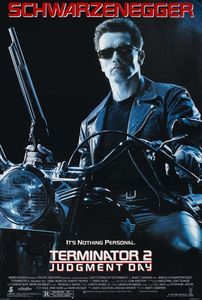
    (Third viewing, On DVD, December 2000) This has long stood near the top of my “favourite films” list, and a thorough examination of “The Ultimate Edition” DVD only confirms this opinion. James Cameron always delivers, and his 1991 magnum opus does everything you could imagine from a science-fiction film: Good story, fantastic characters, a lot of underlying philosophical issues, exhausting action scenes and impressive special effects. It has aged very well (at the exception of the trailer, a form of cinema whose execution and overall quality has risen dramatically with the introduction of AVID editing machines during the nineties, but that’s another essay for another time.) and still represent a career high for everyone involved. The DVD itself lives up to it’s “Ultimate Edition” billing, containing no less than three versions of the film, three making-ofs, an astonishing number of video featurettes, the complete script and oodles of miscellaneous information about the film. It’s a film school on a disc (or two) and it features everything to satiate your thirst of knowledge about the film. It’s so complete that it feels as if the only thing missing are the dailies. (There are even edit-your-own multi-angle segments and multi-audio-track sound editing demos) Truly a superlative, nay, an essential DVD: Great film, great use of the medium.

    (Fourth viewing, On DVD, July 2003) Yes, this film is ageing. But it’s ageing very well, and the fantastic thematic depth of the film more than compensates for the increasingly primitive special effects. One of the rare actions films to pack a steady punch even after multiple viewings, Terminator 2 is a wonder to behold on almost every level. James Cameron has rarely been as comfortable with the camera, and that also stands for the adult acting talent in the movie. The only increasingly annoying flaw is Eddie Furlong’s freshman performance, which is often the weakest link of the film. Otherwise, well, just sit down and enjoy the true conclusion to the Terminator series. (I scoff at T3) The “Ultimate Edition” DVD is still a stunning example of what is possible with the format, even after being superseded by yet another “Extreme Edition”.

  • Revelation Space, Alastair Reynolds

    Gollancz, 2000, 476 pages, C$22.95 tpb, ISBN 0-575-06876-0

    Any novel with the gall of putting “The first great science fiction novel of the century” on the cover upon publication in January 2000 is setting itself up for huge expectations. Things get more interesting when you realize that it’s a first novel for British SF writer Reynolds. Portentous announcement, or mere marketing hyperbole? Let’s find out.

    The first hundred pages of the novel are both promising and disquieting. While Reynolds shows a comforting writing ability and packs a high density of concepts in a few pages, he deals with at least three different story at several different times. Though things eventually converge, they are cause for some confusion, especially when the narrative jumps in time.

    Eventually, though, a story emerges, one of a dedicated (maybe mad) scientist named Dan Sylveste, who is much, much more important than he initially seems to be… or at least that’s why an elite assassin and a spaceship crew are willing to cross light-years and realtime decades in order to get him. Of course, Revelation Space wouldn’t be a grandiose space-opera without a few alien races, terrible galactic dangers and shattering betrayals. Those come in time.

    Fortunately for its own good, the book’s pace accelerates in time, and while it might take some work to get going through the first half, the rest of the book is as compulsively readable as anything published in the genre. Even clocking at nearly 500 dense pages, Revelation Space almost feels too short at times. The intricate detail in no way detracts from the pleasure of reading once all the necessary pieces have been assimilated by the reader. There is a lot of setup, but also a lot of sustained payoff. (Though the action often skips too quickly over dramatic moments, then settles down for long stretches of exposition. First novel technical faults.) Interactions between the characters are complex and multi-layered, often changing dramatically over time. Gadget freaks will find a lot of those, and even more socio-technical concepts scattered here and there.

    This might be Reynolds’ first novel, but he already shows most of the skills required to compete with some of his best contemporaries. Indeed, Revelation Space has much of the same feel than recent novels from the Brit school of Hard-SF as practiced by such authors as MacLeod, Baxter, MacDonald or Banks. No wonder if many formerly-disappointed fans are coming back to the genre because of these writers: It’s nothing short of a revitalization of the smart space opera / Hard-SF sub-genre that they’re bringing forth.

    As an SF novel, Revelation Space is very very good. Good enough to be, yes, “the first great science fiction novel of the century.” As a first novel, it’s so accomplished that it’s almost scary. I was lucky enough to find a British edition only a few months after its initial release in England and well before its release in North America. You’ve been warned; don’t miss it.

  • The Tao Of Steve (2000)

    The Tao Of Steve (2000)

    (In theaters, December 2000) Independent filmmaker attacks traditional romance in what ends up being an interesting, but ordinary film. Purporting to go behind the scenes of male seduction techniques, it merely end up being an entertaining film with enough fun quirks to warrant a look. The story’s been done before, a Don Juan falling for the one woman he can’t truly lure. That the Don Juan is overweight is merely misdirection. (In fact, watching carefully, it’s obvious that the lead actor is heavily padded to appear far more obese than he truly is.) Some scenes feel forced. (“I’m the special of the day”) Think of it as a date film for those dates who can’t be swayed by the usual romantic tripe.

  • Rosencrantz & Guildenstern Are Dead (1990)

    Rosencrantz & Guildenstern Are Dead (1990)

    (On VHS, December 2000) Where did it go wrong? I was a fan of the concept (a comedy showing the “other side” of Hamlet through minor characters’ eyes), the execution (extensive wordplays and logical games with extensive metafictional elements) and the actors (Richard Dreyfuss, Tim Roth and Gary Oldman). So why, despite some extremely funny segments, does the film feel so flat? I’ll take a chance and blame the budget (low), the adaptation (still feels like a theater play) and, primarily, the direction (flat and uninspired, especially for a comedy). Disappointment!

  • Proof Of Life (2000)

    Proof Of Life (2000)

    (In theaters, December 2000) The true test of a movie star is to watch said performer struggle in an average film. Here, Russell Crowe and Meg Ryan have to contend with an efficient, but hardly exceptional script, and only one of them rises above the material. It’s not Ryan, who seems miscast and ill-defined as “the wife” character. Crowe fares much better as a top-notch ransom negotiator, clearly showing why more and more people are calling him a genuine leading man. The rest of film is hit and miss: The cinematography gets a lot of mileage out of its lush South-American locale. The script contains both good moments (good opening, good conclusion and good technical details about the ransom business) and not-so-good moments. (The extraordinary coincidence that precipitates the film’s third act is almost unforgivable) It should be noted, however, that the film clearly shows excessive cutting room rethinking: While it’s refreshing to see that the romantic angle is barely mentioned, its half-hearted inclusion creates a few puzzling moments if not outright howlers, such as “Do you love this woman?” suddenly coming out of nowhere. The DVD version should be interesting to examine. Otherwise, David Caruso is sympathetic in a supporting role, the film plays better than expected, and Russell Crowe’s performance, again, is worth watching.

  • Meet The Parents (2000)

    Meet The Parents (2000)

    (In theaters, December 2000) Not another one of those predictable “comedies” that we’ve come to expect from Hollywood. Predictably enough (and the script is completely predictable), it’s built upon a dumb premise and a strategy of protagonist humiliation (Couple meet girl’s parents, dad’s a bastard and several things left unsaid suddenly pop up… Yes, everything-that-can-go-wrong-will) plus an uplifting finale that solves all problems. No wonder if Meet The Parents raked it in at the box-office, most probably attracting people who see only one or two films a year and whose critical abilities are more adapted to football games than cinematic endeavors. Satisfactorily directed by Jay Roach, sustained by Ben Stiller (not his best performance; no chance to go wild) and Robert De Niro. The film is long, obvious and unpleasant for most of its duration, picking up toward the end when Stiller’s character finally reaches his long-awaited boiling point and lashes out a long satisfying rant. That part being quickly over, we move on gratefully to the expected sugar-sweety finale. Word has it that there will be a sequel. Oh my.

  • Human Traffic (1999)

    Human Traffic (1999)

    (In theaters, December 2000) Trust the British to deliver top-notch exhilarating comedy. The “story” of five teenagers on a weekend of sex, drugs and techno music, Human Traffic quickly wins over its audience with hilarious fantasy sequences and fast-paced narration. Film techniques are blasted frenetically at the audience and after the first fifteen minutes you’re either in the film or outside the theater. Unlike other similar films, though, Human Traffic maintains its energy (and the constantly hilarious fantasy sequences) all the way to the finale. Moralists will tut-tut the ambivalent drug “message” and the lack of consequences for reckless activities, but it somehow comes across as realist, not offensive or preachy. It’s hard to describe in written terms the overall impact of Human Traffic without overusing words like “fun”, “energy” and “hilarious”, but just think of it as a lively gem just waiting for your discovery. If you’re still under thirty.

  • Gravity Dreams, L.E. Modesitt, Jr.

    Tor, 1999, 468 pages, C$8.99 mmpb, ISBN 0-812-56661-0

    In his previous novel Adiamante, R.L. Modesitt Jr. proved his talent for taking a standard space-opera premise and turning it into an unusually thoughtful piece of true science-fiction. Readers enthralled by that novel were more fascinated by social moral dilemmas than with the inevitable pyrotechnics. One reviewer coined (or re-used) the term “intellectual suspense” in reviewing Adiamante, and it still stands as one of the best general descriptors of Modesitt’s fiction.

    With Gravity Dreams, he applies the same willingness to peer behind some of SF’s standard gadgets to draw a wide-scale portrait of a new society built on better foundations than ours. If the plot is less satisfying than Adiamante, the book is nevertheless an improvement over his previous effort.

    To immerse the reader in thirty-first century Earth, Modesitt begins by using the time-honored device of the innocent. Few would call Tyndel, Gravity Dreams‘s protagonist, an innocent in the confines of his native society. He is initially, after all, an apprentice Dzin master, a teacher/mentor of the fundamentalist state religion.

    But keeping him in this state would make a rather boring novel. So Tyndel (through a somewhat bizarre set of events) is exiled outside his community to the neighboring Lyncol, a high-tech society that looks upon Tyndel’s community as charmingly quaint. Unfortunately for him, his rescue from Dzin required expensive treatment, which he will have to repay.

    Before he can even properly learn the rules of his new environment, Tyndel is exiled again, this time as a laborer in a distant space station. Don’t worry, he’ll eventually learn to cope. The novel is obviously a bildungsroman in which the author can indoctrinate both protagonist and readers to cool new social ideas.

    I may sound flippant, but the truth is that I enjoyed Gravity Dreams a lot, especially the ideas that are brought forth by Modesitt. None-too-convincingly disguising his libertarian sympathies, Modesitt writes of a society where widespread nanotechnology has brought forth a non-negotiable need for personal responsibility. A large portion of Gravity Dreams‘s thematic strength is built on an exploration of a society that expects responsibility from truly adult citizens.

    Tangentially, that strikes me as one of SF’s next big themes. With emerging technologies putting ever-more powerful capabilities at the grasp of everyone, the need for everyone to behave responsibly. Call it the “polite society” argument of gun enthusiasts. Unfortunately, recent history has proven that there’s still a long way to go before reaching this point, as numerous cases of vandalism, real or virtual (think spamming, online harassment or website defacement), continue to make headlines. Like it or not, increased power without increased accountability cannot depend on the assumption of good behavior.

    While the above may not be explicitly mentioned in the book, it is the type of reflections inspired by Gravity Dreams, a novel that could have been a perfectly good space-opera without depth. Ironically, the most plot-driven moments of Gravity Dreams (with its late-coming revelation of interstellar Dangers That Must Be Conquered) are the weakest parts of the narrative, paling in comparison with Tyndal’s training and relationship issues.

    Moral lessons served as entertainment aren’t rare, of course, but it’s always pleasing to see a result so professionally realized. Instead of turning in run-of-the-mill space adventures, Modesitt chooses to inspire as much as he entertains, and the result is not only one of the best SF novels of 1999, but also another proof that Modesitt is one of our best SF writers around.

  • Groove (2000)

    Groove (2000)

    (In theaters, December 2000) Don’t bother looking for a plot: This is basically a “let’s have a rave” film featuring pretty much what you’d expect as associated events: A romance that takes too much time, a naive guy who takes too much drugs, a police raid, a DJ that gets his groove back, two couples with relationship problems, etc… There’s some good music, though not quite enough. At least the main romance features appealing protagonists, and there are some pretty good jokes here and there. It does present a rather good impression of rave culture, though it ends up being a bit too sweet and, yes, conventional. (While Groove makes Go‘s rave scenes look like a preppy party, it’s itself seriously outclassed by the contemporary Human Traffic as an exploration of the hows, whys and weirds of the party scene.) The end film looks a lot like a director’s first feature (which it is) where an inexperienced crew gets some experience. At least they show some good potential: The credit scene is impressive in how it quickly introduces all the main characters, and the rave scenes do have an inherent energy.

  • How the Grinch Stole Christmas (2000)

    How the Grinch Stole Christmas (2000)

    (In theaters, December 2000) It’s interesting how expectations can make or break a film. A film on the borderline can be either rather good or rather bad depending on how much you were expecting from it. In this case, I was expecting the worst from Ron Howard’s The Grinch, especially with Jim Carrey as the title character. To my surprise, I found myself giggling alarmingly often, and was pleasantly entertained by the result. I had no particular knowledge or attachment to the Seuss book or the original cartoon version, so any liberties taken with the source material don’t particularly concern me. Granted, the film is a mixed bag. Among the bad: The musical interludes, the set design, the “explanation” of the Grinch’s grouchiness and the Who nose makeup design. Among the good, obviously, is Jim Carrey himself: the film reaches its best moments whenever he’s acting his sarcastic, anarchistic, grouchy characters. But, alas, as this is essentially the tale of the imposition of social conformity on the only independent-thinking character of a small group, the ending of the film is predictably awful, as the Grinch is coerced in becoming another one of the boring morons of Whoville. I’d continue with some further social commentary, but you surely get my point. Still, the getting there is often far more fun than expected, with some subversive adult in-jokes thrown in the mix. (Watch for a visual Ice Storm reference that completely destroys Whoville’s wholesome image) And, hey, Christine Baranski gets both some screen-time and tight outfits. If that’s not enough to convince you, well…