Albert Brooks

  • Lost in America (1985)

    (On Cable TV, July 2022) Thirty-five years later, Lost in America’s laughs have shifted in ways writer-director-star Albert Brooks couldn’t quite anticipate. The idea of a yuppie couple getting rid of everything in order to wander throughout America in an RV is almost the plot of an Oscar-winning drama hailed for its contemporary sensibilities (Nomadland), and the very concept of yuppie ennui seems quaintly naïve in a real world where pandemics, climate catastrophe and political barbarism have become accepted touch points. Bouts of misogyny, entitlement and dumb plotting don’t help the result, and so Lost in America doesn’t feel like much of a comedy anymore, despite clearly having been created as such. Our plot gets rolling literally, as our lead couple is frustrated by professional setbacks and liquidate their holdings to travel throughout the United States. Except that she unaccountably blows the rest of their savings in Vegas and they find themselves stuck in Arizona, at the lowest rung of the working class. The film clearly aims to be something more than a silly comedy but it’s most effective when compared against something—in this case, 1980s Hollywood’s obsession that Regan-era material success and a nice lifestyle were somehow corrosive and wrong. Fast-forward to 2022, where housing is financially unattainable, going out in public may get you a fatal illness and climate-related extreme weather is destroying housing, and viewers would enjoy slapping the characters of this film for the extravagant privilege of choosing to leave it all behind. But that was the joke even back then—what’s left today, however, is a bitter mixture of humiliation “comedy” (such as the protagonists arguing that a casino should give their lost money back) and what seems like a missing third act when characters decide to do what they could have done at any point of the film and a few title cards tell the rest of the story. Lost in America, fittingly, never finds a destination—it just ambles on until it pulls on the side of the road and calls it quit. There are still a few chuckles (even if Julie Hagerty gets saddled with an inglorious role as the irresponsible one required for the plot to move forward) but they’re substantially more bitter now. Whether this is an improvement (and something that further reinforces Brooks’ intention) is something that viewers will need to decide for themselves.

  • The In-Laws (2003)

    (In French, On TV, May 2022) One of the problems of having been an active cinephile throughout the 2000s (evidence of which is freely available elsewhere on this site) is that it was difficult, in the moment, to identify what was so characteristic during the decade – it’s harder than you think to identify fads from lasting innovation, and so the elements that make us associate film to a specific era. Until you see a film much later than that era, of course. So it is that The In-Laws now feel irremediably dated to the early 2000s, with a fake gloss, dubious stylistic choices made easy by the technology of the time, and a slap-dash approach to plotting that assumes a very decade-specific kind of stupidity from its audience. A remake of the quirky 1979 Alan Alda/Peter Falk vehicle, this version features Michael Douglas as a loose-cannon CIA agent, and Albert Brooks as the milquetoast in-law who suddenly gets drawn into comic international schemes. From the opening “action” scene, featuring very dubious action sequences and -more crucially- the use of “Live and Let Die” that creates Bond comparisons that the film can’t sustain, The In-Laws is in trouble: It’s polished and expansive, but not that funny, the action isn’t that good and the result feels useless. While Douglas and Brooks are well cast (perhaps too much so – Douglas can’t help but be cool and credible, while Brooks can’t help but be neurotic and terrified), the rest of the film is silly rather than amusing, and the plot mechanics are intensely predictable. An overlong ending proves that the film has overstayed its welcome. Perhaps most damning of all, twenty years later, is realizing that this was a wholly unremarkable mainstream Hollywood release at the time – so unremarkable that it didn’t seem like the kind of thing I had to watch at the time. Hence one doubt in revisiting a decade I actively lived through: maybe it’s not quite as good as I remembered it.

  • Critical Care (1997)

    Critical Care (1997)

    (On Cable TV, June 2021) There’s something fantastically creepy about Critical Care’s darkly comic approach to the American medical system, so advanced that it can keep anyone alive but only if the money is there. James Spader plays a young doctor who learns the real world in between a cynical mentor and two sisters trying to seduce him into pulling the plug on their dearest, richest father. Under the direction of a sardonic Sidney Lumet, the film never cracks a smile and so, perhaps, doesn’t tip its hand as to whether it’s really a comedy. The clinical set design borrowing (still) from science fiction doesn’t necessarily make things any funnier, although if you’re not cracking a smile at the seduction scenes, then you may not be paying attention. The god complex of doctors is fully scrutinized and the deeply unhealthy relationship between patient care and their financial means also goes under the microscope. While Critical Care was not a commercial success, it’s got an interesting cast that becomes stronger with time. Just have a look at these names: Kyra Sedgwick, Helen Mirren, Anne Bancroft, Albert Brooks (terrific and terrifying), Jeffrey Wright, Margo Martindale, Wallace Shawn, Colm Feore… that’s a nice cast. The film is not without missteps and missed opportunities: the move to a courtroom late in the film breaks its spatial unity, and I’m not sure that all of its thematic opportunities have been equally well explored. But Critical Care is still acerbic enough to classify as a bit of an overlooked film — not a classic, not even a gem, but something surprising enough to be worth a look if deadpan comedies with a bitter edge have any appeal.

  • The Scout (1994)

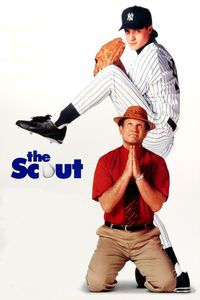
    The Scout (1994)

    (On TV, May 2021) You can watch The Scout for its casting (Albert Brooks and Brendan Fraser with a little bit of Dianne Wiest — an interesting combination), or for its focus on baseball, or for its premise in following a disgraced baseball scout finding “the best baseball player that ever lived” in Mexico. What you won’t do, however, is watch it because it’s any good, since in chasing down far too many rabbits (baseball excellence, scout aiming for redemption, protagonist with central trauma, mental illness treatment, satire of celebrity media) and too many tones (anything from heartwarming pseudo-parental bonding to broad comedy), The Scout loses itself into a jumble of different ideas imperfectly executed. It’s not a difficult film to watch nor is it all that obnoxious, but it is a mess and it ends up raising more questions than satisfaction. At least Fraser is not bad (in a role that portends his take on George of the Jungle, oddly enough) and baseball fans will probably enjoy the look at mid-1990s New York Yankees, but otherwise, it’s more frustrating than anything else.

  • Broadcast News (1987)

    Broadcast News (1987)

    (On Cable TV, March 2020) This almost counts as a second viewing of Broadcast News for me—I distinctly recall seeing the last half of it sometime during the 1990s and being both impressed by the film’s intelligence and disappointed at the somewhat sad ending. But half a film isn’t the same as the entire one, and watching this in middle age doesn’t hit quite the same as an older teen. One thing remains constant, and it’s that Broadcast News still captures the organized madness of TV news like few other films: writer-director James L. Brooks uses the medium’s fundamental tension (entertainment versus substance) as an engine through which to propel a romantic triangle and a series of thorny ethical crises. Holly Hunter is the rock on which the film rests, as a news producer attracted to two very different reporters—William Hurt as the pretty-boy anchor, and Albert Brooks as the solid but prickly expert. (Meanwhile, Joan Cusack is very cute in a supporting role, and owns a flashy action sequence in the first act. Oh, and Jack Nicholson has a cameo as, well, pretty much that universe’s equivalent to God.) It’s all very clever and witty—filmmaking for middlebrow adults able to tolerate a bit of theatrics in order to illustrate a more subtle point. I liked Broadcast News even more this almost-second-time around now that the ending doesn’t strike me as particularly sad, just appropriate.

  • This is 40 (2012)

    This is 40 (2012)

    (Video on-demand, March 2013) Aimless character-driven comedy about the humanity of relationship makes for a nice change of pace from a diet of highly-plotted action-driven special-effects extravaganza, and you couldn’t ask for more amiable actors than Paul Rudd and Leslie Mann as lead protagonists.  This is 40 aims to provide a warts-and-all look at the dynamics of an established marriage, and it doesn’t take a lot to see echoes of universal experience in the sometimes-horrid thoughts expressed here.  Still, it’s about sticking together no matter how difficult circumstances can be, and it helps that the dialogue is both cutting and revealing.  There is a lot of depth to the ensemble cast, with particularly challenging roles for Albert Brooks and John Lithgow as polar-opposite grand-dads.  Everyone is playing their part in a very relaxed fashion, which may explain how and why such a seemingly plot-less film can sustain attention for so long.  Where the film falters is in its coda, which wraps up too quickly without giving decent send-offs to the myriad subplots introduced throughout the picture.  Still, this is a film about moments, not dramatic arcs: Writer/Director Judd Apatow’s been mining the less-romantic aspects of romance throughout this career, and This is 40 fits squarely in this niche.