Pierce Brosnan

  • Die Another Day (2002)

    Die Another Day (2002)

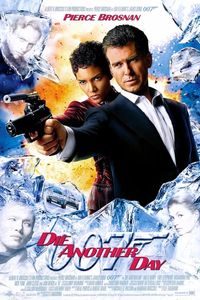
    (In theaters, November 2002) Forty years after Doctor No, James Bond is back with his twentieth movie, and Die Another Day is kind of a half-hearted renewal. In the first hour, we actually see something new: James Bond failing and being captured. Shocking! you say as the suave British spy does things never seen before. He is tortured (with a Madonna song, appropriately enough), exchanged for another prisoner and has to fight his way back in the service. Tons of winks to previous Bond adventures are there for the sharp-eyed viewer, including a further nod to “the original James Bond” for those hardcore Bond fans. The only sour notes come from Halle Berry, whose Jinx has to be one of the worst Bond Girl ever: her line delivery is flat and perfunctory, with the added disadvantage of a crass attitude that make Bond look downright humble. Yikes! The second half of the film isn’t as appealing, given that it simply delivers Yet Another Bond Adventure with the usual trappings, boring action sequences and overlong finale. Jinx is scarcely worth rescuing, the villains are flat, the directing/editing gets more and more incoherent as the film goes along and some truly hideous CGI shots (Bond surfing amongst the icebergs) contaminate the otherwise good visuals. I did like parts of the end sequence, but the rest is just dull, dull, dull… Still, it’s hard not to like Rosamund Pike and the sword-fighting sequence. Add those to the good first hour, and we’ve got a better-than average Bond. Which is all you need, really.

    (Second viewing, Jellyfin streaming, January 2025) Oof; I hadn’t seen Die Another Day in more than two decades and had forgotten almost all of it.  The good news are that it had a lot that I didn’t remember, and the bad news are that I had forgotten just how much of a sub-standard Bond it was. Oh, I don’t dislike all of it — it’s fun, after the dour and brooding Craig era, to see Bond in a good old over-the-top 1990s action movie adventure.  There are fancy gadgets, megalomaniac villains, spy films twists and turns, baby-faced Rosamund Pike looking very cute, and Pierce Brosnan being pretty good in the middle of it all.  The problem is that the rest of the film has severe problems.  Preposterous villain, irritating Bond girl (Halle Berry, wasted), slap-dash CGI sequences, too-frenetic editing, insipid writing and references to the franchise’s history that often feel hammered in.  Also, I don’t like Samantha Bond as Moneypenny.  Revisiting Die Another Day after watching a lot of the other Bond films leads me to reassess my first-viewing opinion — everything right and wrong I’ve noticed back in 2002 still stands, but the result is definitely in the lower tier of the series. Still fun to watch, though.

  • The World Is Not Enough (1999)

    The World Is Not Enough (1999)

    (In theaters, November 1999) A mixture of the excitingly new and the distressingly familiar. Things start off in a promising fashion, with an extended pre-credit snippet that features an inventive action scene and intriguing new elements (Bond making mistakes, etc…) Unfortunately, the film loses steam as it goes along, only to end on a trite conventional finale that barely elicits anything beyond vague satisfaction. The villain Renard is, again, promisingly introduced (he cannot feel any pain!) but wasted in a role that could have been filled by anyone else. At least the series’ vaunted sex-appeal is distressingly high, what with Sophie Marceau and Denise Richards. Plus, Pierce Brosnan finally proves without a doubt that he’s the best James Bond since Sean Connery. The World Is Not Enough, however, is an average Bond film at best, satisfying without being truly interesting.

    (Second viewing, On VHS, August 2001) Like most blockbusters cursed with a strong whiff of stupidity, this is one film that’s not quite as offensive the second time around. Just as forgiving the American Godzilla‘s brain-damaged script makes subsequent viewings oddly endearing, this James Bond adventure might even work better the second time around, if only because you now know when to pay attention. (It helps to have a good book handy to use during the boring parts, of which there are quite a few, all things considered. Is it ironic that the last fifteen minutes are among the most boring? I can’t decide.) This being said, Sophie Marceau turns up in looking great as an unusual Bond girl, while Denise Richard’s overall performance really starts to grate. (I think she’s attractive… but her delivery might be improved by sleep, unconsciousness or a long coma. “Unconvincing” is a gentle word to describe her work. I’ll just rent Wild Things again.) Still think that Brosnan’s the best Bond, close behind Connery. Still think that whatever the faults, James Bond films are good fun.

  • Tomorrow Never Dies (1997)

    Tomorrow Never Dies (1997)

    (In theaters, December 1997) So this is what happened to James Bond after The Rock: A lot of action, but not much of a solid plot. Still, better than Goldeneye. Pierce Brosnan is a great James Bond. As if killer gadgets, a lovely credit sequence and a few great lines weren’t enough, we get Michelle Yeoh as the very best Bond girl ever. Tomorrow Never Dies is far from being a very good Bond (Bad usage of Teri Hatcher, strange impression of deja-vu versus other Bond movies) but it’s as entertaining as anything we’ve come to expect from the franchise. Even spending the entire movie being half-sick standing against the rear wall of the movie theatre didn’t torpedo the experience for me.

    (Second viewing, On Cable TV, September 2019) Time has been kind to Tomorrow Never Dies, especially when you compare it to some of the later entries in the series. Fresh off the renewal that was Goldeneye, this second Pierce Brosnan outing gets back to the basics of the Formula without too much second-guessing. We’re back to grandiose villains, Bond girls, big stunts and ingenious gadgets, handled competently. Brosnan’s take on Bond is endearing in these second installments, blending character traits in a format acceptable to the 1990s… and later decades. Jonathan Pryce turns in a striking villain, one that still has relevance now in an era of normalized lying. Teri Hatcher doesn’t have much of a role here, but Michelle Yeoh remains one of the best bond girls in the series, combining beauty, wit and action chops to rank as Bond’s equal. (It helps that in the Brosnan era, Bond actually cares quite a bit about his partners). Action-wise, we’re in the late nineties and that means over-the-top action sequences, a bit too aggressively edited but impressive in their panache — I particularly liked watching the Hamburg parking-lot chase (with Bond chuckling in the back seat at the effectiveness of his gadgets), but the Hanoi motorcycle chase also has its strong moments. The James Bond theme gets one of its better remixes here thanks to David Arnold.  Ricky Jay shows up at the brains of the evil outfit, while Judy Dench once again takes the M role to the next level. Compared to the Goldeneyeand a surprising number of its successors, Tomorrow Never Dies is straight Bond formula competently executed, something that I’d like to see once more after the off-brand and intermittently interesting entries in the Craig era. You liking of it (especially compared to its immediate predecessor) will depend on whether you’re in the mood for a straight-up, no-flourishes Bond adventure.