Month: May 2019

  • My Stepmother is an Alien (1988)

    My Stepmother is an Alien (1988)

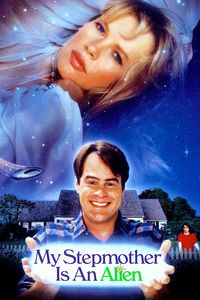
    (On Cable TV, May 2019) Considering the continuous parade of dumb movies coming out of Hollywood, it’s probably unfair to single out the 1980s as being a particularly stupid decade. This being said: Wow, the 1980s were a particularly stupid decade, and you don’t have to look much farther than My Stepmother is an Alien as a mortifying example of that. The production history of that film is wild—the first draft of the film, written four years earlier, was meant to be a horror film as an allegory about child abuse. Good luck detecting any of that original intention in the deliberately idiotic result as it appears on-screen, though: Here we have a Science Fiction comedy in which no less than Kim Basinger plays an alien being sent to Earth to seduce a nebbish scientist (Dan Aykroyd) who accidentally holds the key to her planet’s survival. It’s already unpromising, and you haven’t experienced the execution of it all yet. The film squarely feels as if it’s been written for the kids’ market, and not the smart kids’ market. I’d like to talk about the film’s charm, but that’s a stretch—at best, there’s a nod of appreciation at Aykroyd playing a good-dad scientist (to Alison Hannigan, in her first movie role). Then there’s a Basinger, as a naïve (yet incredibly old) alien unaware of the effect she’s having on everyone else. There’s maybe a good film struggling to get out of this mess, but it’s not one we can get from what’s on-screen. The 1980s have produced some memorable films, and some infamous ones, but My Stepmother is an Alien is neither of them—it’s just dumb and forgettable.

  • Sister Act 2: Back in the Habit (1993)

    Sister Act 2: Back in the Habit (1993)

    (In French, On Cable TV, May 2019) Clearly rushed into production to capitalize on the success of a first film released the previous year, Sister Act 2: Back in the Habit makes the most out of Whoopi Goldberg’s appeal but can’t quite overcome a slap-dash script and a by-the-numbers production. Trying to recapture the preposterous premise of the original is ridiculous, but they give it a try even if it’s a lazy way to get an up-and-rising singer “back in the habit.”  The result feels like a re-thread of Dangerous Minds despite predating it by two years, as a tough teacher manages to turn around the life of her inner-city students through the power of creation, expression … and gospel singing. But it may be presumptuous to ask too much of the film considering its intentions as a hasty sequel to the original. The point here, like all musical comedies, is music sung loud and clear after a few initial setbacks. The students are fine (with standout performances here by young Lauryn Hill and Jennifer “Love” Hewitt) but the standout star remains Goldberg, floating above the film through sheer energy and comic talent. Sister Act 2: Back in the Habit will do as a mediocre follow-up to the original … as long as you don’t expect too much.

  • Steel Magnolias (1989)

    Steel Magnolias (1989)

    (On Cable TV, May 2019) I’ll be the first to admit that I’m not the target audience for Steel Magnolias—I imagine it being best suited to a cross-generational selection of female viewers, the closer to its southern setting the better. But no matter who you are, the film is a feast of great acting and excellent dialogue dunked in a warm bath of gentle southern-USA atmosphere. I had a lot of fun watching the first two thirds of the film, what with such notables as Dolly Parton, Julia Roberts, Olympia Dukakis, Sally Field, Shirley McLaine and Daryl Hannah at her arguable peak. It’s not an entirely cheerful film (the third act focuses on a character’s death and the other characters’ subsequent mourning) but it’s often very funny—especially once you factor in the combination of gifted actresses biting into theatrical dialogue. The last third of the film will work either better or worse depending on the audiences—while the point of Steel Magnolias is to show how the tightly-knit community reacts to the death of one of their owns, the film does milk those moments as hard as it can, and does feel overly manipulative at times. That’s not enough of a problem to stop recommending the film, though: the quality of the dialogue and the relationship between the characters remains the best reason to see the film, even if you think it won’t appeal to you.

  • The Buddy Holly Story (1978)

    The Buddy Holly Story (1978)

    (In French, On Cable TV, May 2019) “The Day the Music Died” happened sixty years ago, more than a decade and a half before my birth and I still get unaccountably forlorn about it. Watching The Buddy Holly Story so soon after La Bamba only magnifies the sense of loss in seeing three immensely capable musicians (Buddy Holly, but also Richie Valenz and Big Bopper) disappear—what could have they had made had they lived? There is a timeless finality in death, of course, and The Buddy Holly Story clearly leans into ennobling its main character, highlighting his uncompromising approach to making music, his innovative genius, and his moral righteousness as he eschews the excesses of the rock-star lifestyle. Perhaps the biggest surprise of the film to contemporary audiences is seeing Gary Busey as a credible Buddy Holly, lean and young and smart to an extent that seems difficult to reconcile with his latter-day persona. Otherwise, the film is a standard music biography—good reprise of hits, a loose adherence to the truth, a sticks-to-fame story here strengthened by a tragic ending (that is portrayed through an end text, overlaid over a mute portrayal of Valenz). Watch La Bamba immediately afterwards for a more elegiac and perhaps more interesting take on the same event—plus a far better treatment of Valenz than his mute walk-in appearance at the end of this film. Otherwise, the film will be good to remind anyone of Holly’s place in rock-and-roll history, as well as a medley of his greatest hits, especially during the climactic end sequence when the film quickly does his best-of. The Buddy Holly Story isn’t hard to watch, and fans of 1950s pop music will get a kick out of bringing back those years to life (even if the liberties with the real history are annoying even after a quick Wikipedia fact-check).

  • The Pope of Greenwich Village (1984)

    The Pope of Greenwich Village (1984)

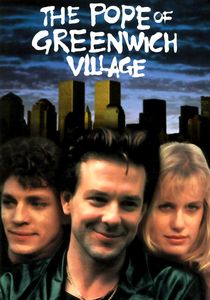
    (On Cable TV, May 2019) Not every film has to be a high concept of startling originality, but even by the standards of low-stake crime drama, The Pope of Greenwich Village struggles to be interesting. Best described as a crime drama featuring two young Italian-American friends trying to make enough money to get out of their stifling NYC neighbourhood, this is a film about scams, hustles and crimes not turning out like they should. Of course, our characters won’t settle for education, good boring jobs and saving enough money on their own time—it must be a get-rich scheme to get them out of there, and it’s not as if the film will seriously question this assumption. Or call out as one of the characters starts by being obnoxious, and then keeps on making life miserable for everyone else involved—including the putative protagonist. There’s a fair case to be made that the film isn’t about anything more than being an actor’s showcase, in this case for Eric Roberts (as the obnoxious one) and Mickey Rourke (as the likable one). (The film started as being for De Niro and Pacino, but things changed along the way.)  I have to say that this is probably the most sympathetic character I’ve ever seen from Rourke. The atmosphere isn’t bad, but everything simply feels dull—occasionally enlivened by a comic moment, but not leading to a convincing or satisfying ending. There are occasional attempts to reach for Godfatheresque grandeur in its depiction of the Italian-American community experience, but let’s not be ridiculous—The Pope of Greenwich Village doesn’t even make it halfway there.

  • The Nun (2018)

    The Nun (2018)

    (On Cable TV, May 2019) The nice thing about having been raised Catholic is the appreciation that as a religion it’s got some excellent potential for horror worldbuilding—having the Vatican as an authority keeping tabs on demonic possession around the globe is by itself worth a few movies’ worth of material. The Nun is one of them, even if it’s not particularly good or bad at it. Efforts to tie the film to the overall Conjuring horror universe are perfunctory at best (and frankly, I think I’ve lost track of what The Nun is supposed to be: a prequel to The Conjuring 2 which was a sequel to a film based on a true story that has now spawned another series of spinoffs? Or something like that.)  The setup is, as usual, much more compelling than the execution: the idea of an Eastern Europe abbey leaking evil since it was bombed during WW2 is not bad at all, but what the film does with it is far more pedestrian. There are a few nice touches—Having Taissa Farmiga play in a spinoff of a series starring her sister Vera is kind of interesting, for instance, even if the film doesn’t do anything with that. Don’t peek too closely at the details either: While it’s satisfying to hear a character defiantly growling out “I’m French-Canadian,” his accent is pure European French. Oh well… The Nun feels like so much of other 2010s horror films—high concept, by-the-number execution with a few arresting visuals made possible only through a lot of CGI substituting for clever writing. It works as your slick weekly horror movie if you’re looking for that kind of ride, but it doesn’t strike a nerve either in lasting scares or conceptual audacity.

  • The Color of Money (1986)

    The Color of Money (1986)

    (In French, On Cable TV, May 2019) I’m one of those weirdos that doesn’t particularly care for the original The Hustler (1961), so I was coming to The Color of Money with low expectations. Which may have worked to the later film’s advantage, as I found it more interesting than its predecessor. It helps that this follow-up does what sequels often loath to do—use the previous film as back-story while telling a new story in which returning characters are developed in interesting ways. Much of the credit for this creative intention goes directly to the authors of the novel from which The Color of Money is adapted, who conceived it as a sequel to the novel that spawned The Hustler. Paul Newman is back as a former professional pool player, now more interested in staking bets for younger players. Playing against him is Tom Cruise as a younger, more impulsive player, and the great-looking Mary Elizabeth Mastrantonio as the third party in their merry crew. (Plus, John Turturro as an evil hustler.)  The relationship between the three characters is what sustains The Color of Money on its way to the final tournament in Atlantic City, with everyone changing and allying themselves differently every few scenes. The middle of the film even sees a significant plot rearrangement, as the mentor/mentee relationship gives way to the mentor getting himself back into the game. While not quite as dramatic as its twenty-five-year distant prequel, The Color of Money nonetheless makes for fascinating viewing. Director Martin Scorsese being Scorsese, there are a few technically impressive shots here, as well as new ways of showing familiar things—most notable being the pool-as-tennis sequence, and some shorts from the perspective of the ball. The ending isn’t particularly cheery, but it does work to cap off the film in a satisfying way. It’s not quite as ambitious or universal as The Hustler, but The Color of Money does feel more enjoyable.

  • Stop! Or My Mom Will Shoot (1992)

    Stop! Or My Mom Will Shoot (1992)

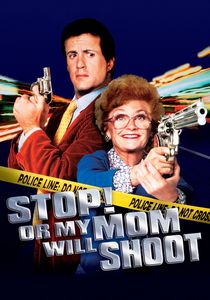
    (In French, On TV, May 2019) Some titles live on in infamy—not necessarily the films, but the titles, and Stop! Or My Mom Will Shoot is way up there with the worst. It does sum up the film’s premise nicely, though, as Sylvester Stallone plays a super-cop who’s saddled with an overbearing mother who screws up his ongoing investigations. As a concept, it’s not the worst idea in the world: it could have worked as intended, as a take-off on the kind of buddy-cop movie that was so popular at the time. Alas, the execution is limp: predictable, unfunny, about as in-your-face as it could be. What’s more, it feels stuck in a weird borderland in between too dumb to be realistic, yet not absurd enough to fully play into the premise. Estelle Getty is not really to blame as the titular mom, but Stallone is not even up to his low standards here—although try to watch the film in French if you can, as his dubbing actor is marginally more competent at line reading than he is, and thus gives the impression that he’s a better actor. Not that it’s enough to rescue this film from easy punchlines and lapidary assessments—as a title, Stop! Or My Mom Will Shoot is awful, but it turns out that the movie is as well.

  • Cyborg (1989)

    Cyborg (1989)

    (In French, On Cable TV, May 2019) I was never a big fan of Jean-Claude van Damme in his prime period, and it’s dull movies like Cyborg that explain why. Here, a generic post-apocalyptic landscape acts as a backdrop to a series of poorly justified fight sequences. The occasional flashes of interest in the story and cyborg effects soon pass, hampered by a limited budget and a lack of imagination. Director Albert Puyn isn’t known for high quality productions, and his work on Cyborg is true to form: aside from very occasional instances of visual flair, it feels like an incredibly generic piece of 1980s action filmmaking. The lead actors may be attractive (Deborah Richter in particular), but the film gets boring very quickly once the martial arts sequences begin.

  • Troop Beverly Hills (1989)

    Troop Beverly Hills (1989)

    (In French, On Cable TV, May 2019) Let’s face it: I would probably have hated Troop Beverly Hills had I seen it any time before my forties. It’s not a terrible film, but it’s clearly aimed at younger girls and I didn’t have the empathy to see that until a bit later in life. The premise isn’t complicated, with a ditzy Beverly Hills socialite taking responsibility for her daughter’s Girls Scout (oops: “Wilderness Girls”) troupe and combining that work with her other overriding passions. The plotting is strictly kids-grade material, with an outlook that celebrates the simple-mindedness of its adult heroine. But once you understand who it’s aimed for, the film does become quite charming. Much of that credit goes to curly red-haired Shelley Long, who turns in a terrific performance as a shallow but likable socialite trying to get over her ongoing divorce by taking care of a few girls—and put the harsher-than-thou matrons in their place. It’s certainly not great art, but the now-quaint late-1980s fashion makes Troop Beverly Hills, with the added attraction of a few celebrity cameos and early performances by Carla Gugino and Tori Spelling. Amusingly, I see that the film has appreciated with time—the right expectations (this being a wish fulfillment or rather wish-empowerment fantasy rather than a satire of the rich and famous) helping to correctly frame its reception.

  • Less than Zero (1987)

    Less than Zero (1987)

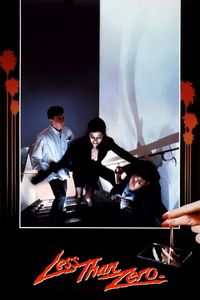
    (In French, On Cable TV, May 2019) If you’re looking for a film that exemplifies some of the worst excesses of the 1980s, Less than Zero would be a good way to start. Taking place among the privileged but disaffected youth of the Los Angeles rich, it reduces young adulthood to a meaningless series of parties, hook-ups and endless lines of cocaine. The more cynical will point at the film’s pedigree, traced back to a semiautobiographical novel written by a young L.A. native, and wonder how much of the novel appealed to the Hollywood studio executive culture. No matter how it came to be, though, Less than Zero is not the most uplifting film out there. While it ultimately pays some sort of acknowledgement at drugs being bad (killing off a main character to make the point), it does take place in this dispiriting environment of meaningless hedonism and rampant abuse. Still, there are a few things worth noticing here and there: Jamie Gertz frequently looks amazing (A reminder: I came of age in the big-hair late 1980s), while Robert Downey Jr. has an ironic role as a drug-addled young man. James Spader also has an early role as the film’s remorseless antagonist drug dealer. The indignation of the film rings a bit false considering how thoroughly it wallows in filth, but that was Beverly Hills in the 1980s. It doesn’t help that the film doesn’t have much of a plot, seemingly content to repeat itself with different inflections. Less than Zero had, upon release, quite a reputation associated with it and the novel’s author, enfant terrible Bret Easton Ellis—hype and fear that their transgressive fiction would prove the new mainstream. That has largely been forgotten over the decades, but I’m not sure that this absence of hype has been kind to Less Than Zero: Stripped of the importance placed on it, it frequently feels like a performative melodrama meant to shock but otherwise hollow.

  • A Dangerous Method (2011)

    A Dangerous Method (2011)

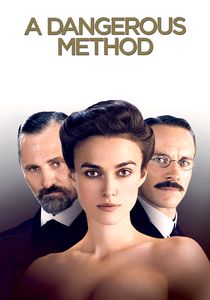
    (On Cable TV, May 2019) Now here’s a subject matter you don’t see every day: A slickly made film exploring the evolution of the relationship between Sigmund Freud and Karl Jung, and the woman between them. A Dangerous Method is clearly an actor’s showcase: In keeping with late-career David Cronenberg’s work, it’s low on gore, violence or overdone drama, but no less intriguing through its solid look at the roots of modern psychoanalysis. Even if you don’t happen to put too much stock in Freudian (or Jungian) theory, there’s some fun in seeing Viggo Mortensen and Michael Fassbender playing two titans of psychology, with Keira Knightley as a patient who becomes something more. (She especially good earlier on, as she plays several shades of hysteria.) The historical recreation is polished—aside from some dodgy CGI depicting a nautical approach to New York City. A Dangerous Method has an unusual, highly intellectual subject matter and I could use more of these kinds of film even if they’re best appreciated in a very specific mood.

  • The Hunter (1980)

    The Hunter (1980)

    (In French, On TV, May 2019) Steve MacQueen lived fast and died young at 50, after a mere twenty-three-year career as a leading man. The Hunter has the distinction of being the last film he did before his death from a drawn-out battle with cancer. He’s clearly older here than in the roles that made him famous, and the age is part of the point: Showcasing an older bounty hunter protagonist, The Hunter blends action and light comedy even from the first few scenes. Largely episodic in nature, the film takes us from one bounty-hunting assignment to another, in between domestic scenes showing the protagonist’s unusual lifestyle (but “cool”—because MacQueen), his struggles being an expectant father and a psychotic stalker taking aim at his pregnant girlfriend. The bounty-hunting episodes are far more entertaining than the more grounded and suspenseful domestic material: The farm combine sequence is a highlight, as is an extended chase in downtown Chicago that culminates with a car driving off the corncob Marina towers into the Chicago River. Too scattered to be wholly effective, The Hunter nonetheless has a few good action beats, and offers a glimpse into what kind of actor Steve MacQueen could have been had he lived longer: he clearly wasn’t going to let age make him look any less cool.

  • Benny & Joon (1993)

    Benny & Joon (1993)

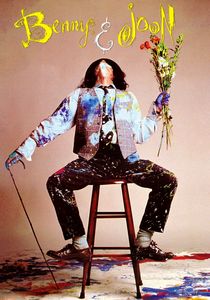
    (In French, On Cable TV, May 2019) By now, I’ve seen enough movies about mental illness that I’ve grown immune to most of the usual ways the topic can be approached. But not every film about mental illness has to be a tear-jerky emotionally disturbing drama, and that may explain my tepid liking for Benny & Joon: While there is something to be said about its occasionally twee take on two non-neurotypical people finding love, it does dare to try something else. Much of the film rests on the very different performances from its lead actors, from Aidan Quinn’s quiet Benny to Mary Stuart Masterson as the schizophrenic Joon, but especially Johnny Depp’s impressive performance going through silent film-inspired comedy routines. The rest of the cast features many known actors even in small roles, from Julianne Moore (playing an ex-exploitation film actress), to Oliver Platt, C. C. H. Pounder, Dan Hedaya and William H. Macy. It can also rely on a charming small-town atmosphere, even when things aren’t going so well for our characters. Soundtrack fans should be aware that Benny & Joon does a lot of mileage to the very familiar tune of “500 Miles.”  After a bit of a romantic fantasy, the film eventually confronts the reality of living with a schizophrenic person, but in a way that ensures it will end well. Which, which optimistic, is not a bad message on which to end those kinds of movies.

  • Dying Young (1991)

    Dying Young (1991)

    (In French, On Cable TV, May 2019) A good old-fashioned weeper, Dying Young is built on a premise that has been made before (Dark Victory, gender-switched) and after (Me before You)—it’s an entirely unsurprising caretaker-falling-in-love-with-a-dying-person film, executed with very 1990s style and period-appropriate stars. Clearly relying on its star power, the film features Julia Roberts as a nurse and a then-slim Vincent D’Onofrio as the ailing patient. In terms of plot, that’s pretty much it—it goes through the motions of its predictable plotting, but slowly enough that you start being exasperated at both the speed and the obviousness of it all. Both actors are worth a look, though: D’Onofrio has some good material to rely on, and circa-1991 Roberts, fresh off her meteoric breakthrough role in Pretty Woman, was spectacular to behold. Unfortunately, the movie really isn’t as good as its actors—despite good production qualities, it feels on autopilot from beginning to end, especially if you’ve seen any of the many similar movies. The soundtrack will feel very familiar to those of us who were 16 in 1991. Otherwise, there’s really not much to say about Dying Young—it’s almost exactly what the plot summary tells you.