Month: March 2021

  • Marie Curie (2016)

    Marie Curie (2016)

    (On TV, March 2021) This is my fourth movie about Marie Curie in barely more than a year and a half, and I’m kind of astonished to see that they don’t really repeat each other. The 1940s American one is a straightforward heroic biography that delivers the essentials without fuss; the 1990s French one is a whimsical take that focuses on the romantic comedy of the Curies’ courtship and their acceptance by the academic community; the 2020 American film irritates by its progressive overreach, jumbled structure and factual inaccuracies (yes, worse than the 1940s version); while this Polish 2016 take on Marie Curie focuses on the unpleasant aftermath of Curie’s discoveries: the discrimination, the whispers when Pierre dies and she finds a new companion. It’s the hangover after the wild party and its tepid approach to the material means that it will test the patience of several viewers. It’s visually polished, although not necessarily in any flashy way. I did have a bit of trouble believing in the period detail, something that’s not necessarily helped by the late film’s blurring on past and present. Writer-producer-director Marie Noëlle clearly goes for a feminist interpretation of Curies’ story, but that’s in no way any different from any other interpretation of Curie’s life and work — she has been held up as a feminist icon for generations, and none of the movies about her (not even the 1940s one!) fail to underscore her struggles for acceptance. So, what’s left? Not a lot worth praising over other takes: This Marie Curie is more informed about Curie’s later life, sometimes more adventurous in its cinematography, and a good showcase for star Karolina Gruszka. Otherwise, I simply may be burning out on Curie as a topic — I couldn’t not watch the film given my high esteem of the historical figure, but at the same time I’m probably getting over-familiar with the material and going through a mildly allergic phase.

  • The Broken Hearts Gallery (2020)

    The Broken Hearts Gallery (2020)

    (On Cable TV, March 2021) Dear Internet: Please tell no one, but I love myself a good romantic comedy. Predictability is not a problem if the lead actors, comedic set-pieces and sense of fun are all compelling, and the latest illustration of my avowed liking for the genre is to be found in Canadian low-budget production The Broken Hearts Gallery. Taking as a starting point a romantic hoarder’s issues in getting rid of mementoes of failed relationships, this is a film that comfortably sets itself in the Manhattan world of concept art galleries, quirky social media phenomenon, and musings on the nature of twentysomething romance. Executed in lively style by writer/director Natalie Krinsky, it’s a breezy, fun, highly likable romantic comedy that leans more heavily on the romance than the comedy, but does get its share of chuckles. The key to The Broken Hearts Gallery’s success is Geraldine Viswanathan, whose perfect take on an imperfect character is crucial at earning the attention, and then the affection of its audience. Shot in Toronto but credibly set in Manhattan, it’s a compelling watch from beginning to end. Of course, nothing is really surprising here, and some idiot plotting gets in the way — but there’s plenty of merit in delivering a comfortable experience for fans of the form.

  • The Night Flier (1997)

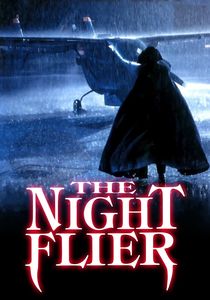
    The Night Flier (1997)

    (In French, On Cable TV, March 2021) I recall just enough of the original Stephen King short story to report that adaptation The Night Flier feels reasonably faithful. The plot is expanded slightly, but the concept remains the same: A tabloid journalist investigating a series of gruesome murders realizes that the common link is a mysterious personal aircraft going from one small airport to another. His believe-nothing credo is sorely tested when he discovers a plane filled with dirt and blood, revealing the murderer to be a vampire. It all builds up to a nice confrontation in a tiny rural airport, and there’s a strong atmosphere at play, as the film plays with the notion of a free-flying vampire and deserted spots to gather victims. The other half of the film has to do with a cynical journalist (the always-interesting Miguel Ferrer) getting far more than what he bargained for in tracking down a lead to a bizarre story. The third act is on predictable rails, but The Night Flier itself represents a modest surprise. It’s more watchable than you’d expect (especially given the glut of mediocre King adaptations in the 1990s), and even its grand-guignol conclusion has its charm.

  • The Delirium Brief [The Laundry Files 8], Charles Stross

    Tor, 2018, 384 pages, C$35.00 hc, ISBN 978-1250196095

    Over a sufficiently long period of time, every spy series has an episode in which the agent goes rogue. (Well, except for the Mission: Impossible series, where it happens in nearly every film.)  With The Delirium Brief, Charles Stross takes The Laundry Files series one step further, by having the British government shut down the occult intelligence agency its protagonists are working for. Without warning, without delay — removing the sole agency responsible for keeping trans-dimensional horrors at bay. Mayhem ensues.

    Of course, there’s a reason for all this, and those play outside the narrative as well. After a trilogy of sometimes-disconnected entries in the series expanding its scope and cast of characters, The Laundry Files was in sore need of a disciplined escalation. As significant as the destruction of Leeds in the previous episode was instrumental in the series’ progression toward a Lovecraftian singularity, there was a feeling that previous episodes introduced various new characters and advanced the plot, but left plenty of material on the floor, just ready to be used more significantly.

    The Delirium Brief is the payoff. Not the entire payoff, but an opportunity for Stross to riffle through the mantelpieces of the seven previous volumes of the series and grab any artillery left around in order to push the series to the next level. With the notable exception of the second book’s Hades Blue (which was always been an odd fit in the rest of the series), nearly the entire surviving gang is back in action this time around, and that goes from the heroes to the villains.

    The barely-resolved climax of the previous book takes a much better place as this newest entry begins, with initial series protagonist “Bob Howard” (not his real name, not even a real human at this point in the series) being thrust in front of cameras to explain The Laundry’s lacklustre response to a trans-dimensional invasion with a five-figure body count. Bob is not a PR person. Bob would rather fiddle around with computers. But Bob is what the Laundry has left — as the government turns its unsympathetic attention toward the Laundry, two things soon become clear: It wants some heads to roll, and there’s a vastly eviler force behind it whispering that The Laundry should be eliminated. After an opening that squarely renews with the series’ roots in espionage thrillers, the action gets crackling as The Laundry is shut down. This isn’t your average fire-everyone pique: this means that essential services keeping horrors away from the Kingdom are suddenly interrupted, that most of the senior management of the organization is targeted for arrest and the various spells binding its employees are no longer effective.

    As someone with quite a bit of experience in Canada’s surprisingly benevolent public service, I had a bit of a problem with that section of the book on purely practical grounds — While the series’ depiction of the British civil service is often very similar to the Canadian experience, this specific bit rang incredibly false. But as Stross has explained at length, much of the novel was rewritten in the heat of the Brexit shock, perhaps as exemplary a breakdown of public stewardship as has been witnessed in the Westminster system. There are also the demands of fiction to consider: I can argue until tomorrow that this kind of wholesale firing would never pass muster with Canadian public service unions, the point here is to get all Laundry characters on the run, and actively plotting against their own government in order to save the realm.

    In that respect — whew, does The Delirium Brief work as intended. Even after a curiously dispassionate previous book in which a major British city is destroyed, this entry feels as if all the stops have been removed. The trans-dimensional horrors are taking over the British government, and our heroes are (as usual) fighting a desperate rear-guard action to save at least something of normalcy. The price to pay is considerable — not necessarily in terms of a body count, considering that even I was surprised at the number of main characters surviving to the end, but in terms of the compromises made to even eke out a smaller defeat. The situation is so desperate that the protagonists have to make terrifying compromises and league with a lesser evil… that’s still remarkably evil.

    As I’ve mentioned, for long-time series readers, this is the payoff. As Stross has often promised, this is the mid-point of the Lovecraftian singularity designated by CASE NIGHTMARE GREEN. Some retrofitting is necessary to make all of the narrative pieces fit together (notably in bringing back cultists and avatars of the Black Pharaoh), but it works well. The antagonist, represented by preacher Raymond Schiller (back from being left for dead in anther dimension at the end of the fourth book), is a repellent piece of work, with methods that bring moments of stomach-churning erotic horror. By this point of the series, as with other Stross series, The Laundry Files is getting grimmer by the volume, with the breezy narration barely offsetting a universe of chill-inducing horrors. Even having smart-aleck Bob back as the main narrator isn’t enough to make us forget that Bob is no longer Bob, that the series has moved far past paperclip jokes and that the narrative is describing the mid-phase of a Lovecraftian singularity putting everyone in existential danger.

    Even then, the book is a breeze to read — I managed it in less than a day, so invested was I in finding out what was going on. From the point when Bob survives an attempt to abduct and eliminate him on the streets of London, it’s a wild ride to the end. The characters that are assembled have already been developed to the point where the fun is in having them all interact. (Compared to the book that introduced her, I was surprisingly fond of bubbly elven sorceress Cassie this time around, for instance — it does help that we don’t spend too much time in her head. There’s a paradoxical effect here in that, by showing mid-to-high-level Laundry employees leaguing together, the agency does lose quite a bit of its mystique: there’s a feeling that there’s not a lot left to discover about the organization or its universe at this point, which makes sense considering that the action is moving at a faster pace that takes advantage of everything we know about The Laundry Files at this point.

    The effectiveness of the results is undeniable: The Delirium Brief is the best book of the series in a long while, because it gets back to the roots of the series and goes forward with the entire cast of characters. Compulsively readable, cleverly imagined and largely true to the series’ evolution (at the expense of the humour, alas), it’s a big irrevocable step forward and a reward for faithful series readers so far.


  • Evelyn Prentice (1934)

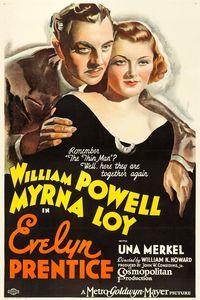
    Evelyn Prentice (1934)

    (On Cable TV, March 2021) The pairing of William Powell and Myrna Loy would be glorious in The Thin Man, but you get another glimpse at their chemistry in Evelyn Prentice, a substantially darker melodrama dealing with contemplated affairs, attempted blackmail and definite murder. Powell is impeccable as a high-powered lawyer who neglects his wife by working too much. Loy’s character, exasperated by loneliness and motivated by an overly affectionate client of her husband, starts looking around for company and ends up manipulated by a seductive poet. When he is found murdered shortly after visiting him for a final time, it’s her husband who ends up involved in a middle act filled with dramatic ironies. By the time he realizes that she may be involved, the film ends on high-powered courtroom drama as he manages to forgive his wife, find the truth and resolve the situation to everyone’s benefit. Evelyn Prentice is short and punchy, not quite going for comedy but not without its share of amusingly ironic moments. Powell and Loy are great even at lower intensity, and the film has the well-polished rhythm of mid-1930s studio pictures, with scarcely an element out of place. Modern audiences will notice that there’s definitely a double standard at play in how adultery affects wife and husband differently, but that’s almost a given for movies of that time. Still, it doesn’t affect the film’s impact as much as you’d think: Powell and Loy are good enough as to make even humdrum material feel much better, and indeed the film is seldom any more enjoyable than when Powell goes on a legalistic rampage, or when Loy wrestles with conflicting emotions. Evelyn Prentice isn’t a great film and it definitely pales in comparison to the duo’s work in the contemporary Thin Man series, but it’s an entertaining time nonetheless.

  • Flora & Ulysses (2021)

    Flora & Ulysses (2021)

    (Disney Streaming, March 2021) I’m old enough to be still amazed by how modern special effects technology has become so sophisticated and so cheap that even lower-budgeted direct-to-streaming movies can feature an entirely digital main character without too much fuss. So it is that Flora & Ulysses is a blend of superhero fantasy, family film with animals, reconciliation romantic fantasy and slapstick comedy. Matilda Lawler stars as Flora, a ten-year-old dreamer who wishes her parents were back together and finds a hyper-smart squirrel (Ulysses) to help her out. That’s right: superhero squirrel, human sidekick. Most of the plot developments and the conclusion are right out of the subgenres being mixed, but so it goes for family movies. There are a few other things worth mentioning—for one, the explicit number of Marvel superheroes mentioned and illustrated in the film’s opening sequence—that’s when you remember that Disney owns much of western culture at the moment. Now, I’m favourably predisposed toward this film because it features a squirrel protagonist, but the film is pleasant enough to be enjoyed — the lead character is likable, and even the film’s descent into familiar plot devices can’t quite wipe away its quirkiness. Flora & Ulysses may be the best (or maybe the only) squirrel-centric film since The Great Rupert.

  • Dead & Buried (1981)

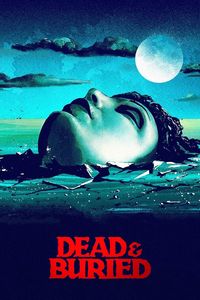
    Dead & Buried (1981)

    (In French, On Cable TV, March 2021) Lulled into a false sense of familiarity by Dead & Buried’s first third, I almost missed the film’s swerve into far weirder territory — I’ve seldom seen a horror film improve so definitely in its last act. At first, it feels like the type of folk horror movie we’ve seen countless times — the creepy isolated village that murders tourists in some sort of pagan ritual nonsense. But as our sheriff-hero starts investigating the murders, the film becomes something a bit more interesting — the atmosphere becomes more sharply defined, and there’s clearly another plot at work. I was reminded of the much-later Silent Hill films by the time the entire plot was uncovered, the special effects (thanks to Stan Winston) became more gruesome and the film’s horror graduated from dull slasher to body horror undead reanimation with a side of reality-warping. Director Gary Sherman doesn’t do much, but all is explained when you find out that the screenwriter is Ronald Shusett of Alien fame — the script isn’t up to that level, but it’s better than usual. That doesn’t mean that Dead & Buried is a good movie — it’s too slow to rev up into something interesting, and by the time it does, it’s almost too late anyway. But the final ten minutes are not the ten minutes you may have imagined from the first ten minutes, and that’s almost too rare a compliment in early 1980s horror. Anyone willing to give it a try should be wary of the first hour — Dead & Buried gets better after that.

  • Room Service (1938)

    Room Service (1938)

    (On Cable TV, March 2021) In the Marx Brothers filmography, Room Service is perhaps more distinctive for being the one film not written by the Brothers themselves. As a theatrical play adaptation, it’s clearly different — more cohesive, less anarchic, but also less tailored to their own strengths. Still, you can see the Brothers doing what they can to bend the material to their preference — Harpo doesn’t speak, Groucho does and Chico hustles. Much of the action takes place in a hotel room where the protagonists are plotting to put on a show despite acute financial problems — there’s a white whale that can solve all of their problems, but hooking him won’t be easy, considering the interference of the hotel manager who wants them out of there right away. Ann Miller shows up in an early-career appearance, and it’s hard to believe that she’s only 15 here: having lied about her age by five years to get her RKO contract, she easily looks older but doesn’t have that many scenes to shine. The comedy is decent and sufficiently outside their screen persona to be interesting, but clearly not up to the Brothers’ usual standards. It’s much better when you grade it not against other Marx movies, but against other 1930s theatrical comedy adaptations: it’s funnier than most, certainly more absurd than others and faster-paced as well.

  • Susan and God (1940)

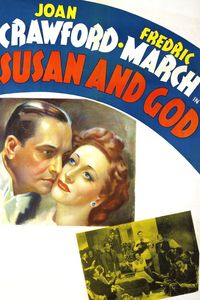
    Susan and God (1940)

    (On Cable TV, March 2021) Try as I might, I just couldn’t get interested in Susan and God. Watching it because it’s directed by George Cukor, I was reminded that, having seen the best of his filmography, I’m now seeing the rest. As a comedy, it’s limp, and as a drama, it’s insubstantial. I’m not Joan Crawford’s biggest fan, and Fredrick March leaves me unmoved most of the time. There’s some promise in the premise (bored socialite claims to have found religion, then proceeds to blow up friendships and relationships by exposing everyone’s sins) but the execution is bland and featureless. I can sort-of-see the echo of the end of prohibition in how the film tackles self-righteousness and piety-as-tourism, but it’s really not enough to elevate the entire film from the doldrums. Too bad, really, because reading reviews of Susan and God has me thinking that this is the kind of material that appeals to me… but what I saw on-screen was simply not enough to stay interested.

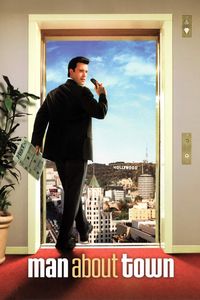
  • Man About Town (2006)

    Man About Town (2006)

    (On TV, March 2021) I thought I had seen most movies in Ben Affleck’s middle period, but somehow Man About Town had escaped me. I can understand why: Released straight-to-DVD at a time when I was watching most new releases theatrically, it’s also a curiously hermetic industry-insider film with no way for outsider audiences to sympathize with the results. The problems start early on, as the film sets itself up as the middle-age crisis of a Hollywood talent agent (the not-yet-middle-aged Affleck) striking him just as he’s following a journalling class at the local self-improvement establishment. Suddenly, his wife is having an affair, a journalist is threatening to expose long-buried professional secrets and he feels that (horrors!) money, success and expensive cars aren’t the most important things. Revealingly enough, screenwriters are the film’s villains. If this all sounds like a Hollywood agent’s idea of a perfect film project, you may start to understand the way Man About Town feels like a dispatch from an alien planet. This seems to be a film made for Hollywood agents, and while they number in the thousands, the film doesn’t do enough to reach audiences outside that circle. As a work of movie industry inner-gazing, it’s far more irritating than most other entries in the genre: the protagonist is not particularly likable from the onset and he doesn’t grow any more sympathetic through the film, most of which complications fall under the category of rich-person problems. What’s a bigger shame is that the cast assembled here is actually not too bad. John Cleese is typically good as a teacher who acts as a catalyst for the action, while Bai Ling plays crazy like no other actress. Other familiar names pepper the cast, further reinforcing the insider outlook of the film. Man About Town is often a baffling film, but I suppose that when Hollywood makes movies about itself for itself, it can baffle everyone else.

  • Triumph des Willens [Triumph of the Will] (1935)

    Triumph des Willens [Triumph of the Will] (1935)

    (archive.org Streaming, March 2021) As much as I think that we should deplatform Nazis of all stripes, it does bother me a bit that you can’t find Triumph of the Will anywhere on YouTube or other mainstream streaming sites — no commercial outfit will tolerate it despite its importance in movie history, or as a provocative archival document. That explains both why the film is regularly mentioned in extended lists of historically important films, and that you have to go to good old impartial non-profit archive.org in order to see it. I really did not enjoy viewing Triumph of the Will — nominally a documentary describing the 1934 annual meeting of the Nazi Party, it endures today as a descent in the middle of Nazi madness, a document self-congratulating members of a fascist party for their extremism, and promising much more to come. Seldom have so many villains been featured in one single film: Watching massive crowds of civilians throwing Nazi salutes drives home the point that this is a cast of thousands of Nazis, several of whom would not survive the incoming war. Director Leni Riefenstahl was not running a cheap operation in executing Triumph of the Will: there are enough aerial shots, impressive camera placements and staged crowd movements to underline how this was a well-financed documentary aimed to galvanize its audience and possibly intimidate opponents. It’s a sobering film in many ways. You can watch the film and be reminded why so many Germans followed Hitler despite the silly moustache and terrible haircut: his oratory skills come through clearly, even in translation, and—of course—he had the single biggest advantage an orator could have: leadership and an army of thousands. It’s equally sobering to hear everyone so singularly dedicated to fascist objectives, praising the Fuhrer as part of a mass cult of personality. It’s even worse to realize that the fully-developed aggressive rhetoric showcased here had only one inevitable outcome: armed expansion. The Germans did not somehow stumble into war in September 1939: They deliberately planned and prepared for it over nearly a decade, then whipped themselves up in the necessary frenzy to start it. It’s not at all ludicrous to draw parallels between the Nazis and modern authoritarian movements, especially in the United States: beyond the awful hair lies thousands of people all looking at an aggressive fascist regime as a way to further their own ambitions, and that’s the dangerous part. These things can be seen coming years in advance, and take just as long to fight and put down. As I said: I really did not enjoy Triumph of the Will, but at the same time I can now defend its inclusion in extended essential movies — it’s well-done (for the time) to such an extent that it raises troubling questions about art as propaganda yet remains a provocative document in its own right. I’m not going to forget it any time soon.

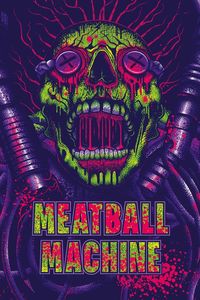
  • Meatball Machine (2005)

    Meatball Machine (2005)

    (In French, On Cable TV, March 2021) No one does insane horror comedies like the Japanese, and Meatball Machine is yet another example why: Complicating a romance with alien parasites, extreme body horror, biomechanical monsters and a tragic climactic fight between ex-lovers, it’s a classic example of splatter horror so extreme that it becomes almost comic. But while it’s cartoonish, it’s not really funny. Obviously designed by directors Yūdai Yamaguchi and Jun’ichi Yamamoto to shock the mundanes, it’s a film with just enough plot to stuff in as many gory special effects as the director wants to pay for. Body horror is the currency of the gags here, and you’re not really meant to follow exactly the finer points of the narrative. Shots after shots are meant to showcase the gore effects at a frantic pace that’s supposed to minimize the questions we may be tempted to ask along the way. It definitely plays to an audience that is somehow conditioned to expect things like this, leaving everyone else wondering what’s going on. I can tolerate such movies well enough (actually, I like them more than more realistic horror films that seem psychopathic from their inception) but it’s not as if I actively seek them out or give them more than a moment’s notice. Meatball Machine is over-the-top horror that clearly knows what it’s doing — but it consciously closes itself from a wider audience. Even a more overly comedic bend would have done wonders to make the film more accessible.

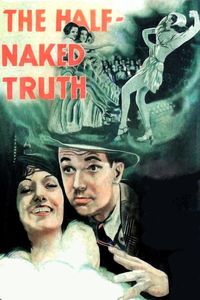
  • The Half-Naked Truth (1932)

    The Half-Naked Truth (1932)

    (On Cable TV, March 2021) After seeing the entire Mexican Spitfire series, it’s hard not to seek out other movies featuring Mexican-born Lupe Velez, not only one of Hollywood’s most striking beauties of the 1930s but also one of the few Latin actresses to find success playing explicitly Latin characters. The Half-Naked Truth finds her in the middle of her Hollywood career, well-established but not yet the headliner she would later become. Here she plays a hot-tempered dancer, often only a prop for the true protagonist of the film, a publicity agent doing his damnedest to promote his client. Velez is always worth looking at, of course, but even she becomes a supporting player to Lee Tracy’s unhinged performance as a motormouth hustler. The comedy is fast and absurd and intense — far more than you’d expect from a 1930s film, excluding the screwball genre. But it works — although the film eventually drives to a somewhat underwhelming conclusion, and seems to be missing a third act somewhere. It’s useful to note that many members of the film’s crew would go on to do bigger things later on, such as director Gregory La Cava going to much-better comedies such as My Man Godfrey. Still, even as an early work for everyone involved, it’s more than watchable.

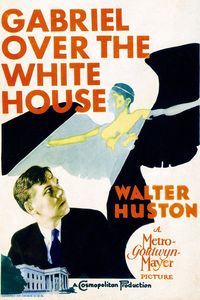
  • Gabriel Over the White House (1933)

    Gabriel Over the White House (1933)

    (On Cable TV, March 2021) Considering that I’ll watch almost any movie dealing with the American presidency, having a look at a film called Gabriel Over the White House was a given (or would have been had my DVR properly recorded it the first two times I tried). But it’s fair to say that I really didn’t know what I was getting into with the film. The first half-hour is interesting enough — we’re first shown the presidency in the middle of the Great Depression (itself a drastic change from the trappings of the presidency introduced over the years), with a shockingly cynical president (played by Walter Huston) clearly enjoying his corruption of the office. But one car accident later, the president finds himself between life and death. Visual clues hint at divine intervention in his recovery, especially when, overnight, he becomes a presidential scholar and righteous moral crusader. So far so good if you’re looking for a comforting fantasy of moral redemption in the White House. It’s also a film notable for confronting the issues of the Great Depression at a time when Hollywood tried to avoid the entire issue — we’re reminded of the employment crisis, the prevalence of racketeering, starving farmers, the prohibition and foreclosures. But then—whew—, the film takes a huge right turn into benevolent dictatorship, with armed police forces conducting deadly military raids on racketeers (although that happens after racketeers machine-gun the White House). The film is absolutely supportive of this fascist takeover of the United States, showing how the divinely inspired president’s good ideas (including familiar things such as a federal police or an air force, neither of which existed at the time) lead the world toward utopia, with the villains being summarily executed and the Washington Covenant showing enlightenment to humanity. As director Gregory La Cava’s film ends with a paean to the fascist protagonist, calling him “the greatest man who ever lived,” we’re left blinking in amazement. The relevance of the film today couldn’t be clearer, with Gabriel Over the White House being an amazing demonstration of the traditionally thin line between American politics and Christian crusading. It’s a weird, weird fantasy, the likes of which would now be dead on arrival from any major American studio. It’s frighteningly revelatory about the state of American political thinking in the 1930s, as the United States was not that far away from the overall European slide into authoritarianism that eventually led to World War II — the gulf between this film’s third act and Triumph of the Will is not that large. It does make Gabriel Over the White House a borderline-reprehensible film, but a fascinating object of study even now. As the old misattributed saw goes: “When Fascism comes to America, it will be wrapped in the flag and carrying a cross.”

  • Criss Cross (1949)

    Criss Cross (1949)

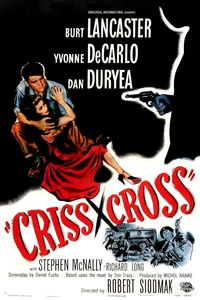
    (On Cable TV, March 2021) Any list of landmark film noirs will probably include Criss Cross, and for good reason: As a slickly made criminal thriller describing a heist job going badly, it features a striking sense of place for late-1940s Los Angeles, some clever moments, decent-enough direction and a fatalistic ending that exemplifies the core strengths of the genre. Burt Lancaster has one of his first major roles as a man drawn into a dangerous affair and an even more dangerous criminal plot, and if you’re paying attention, you’ll see Tony Curtis for a few brief moments as a dancer in his uncredited screen debut. (Curtis and Lancaster would later reunite on a few other films, including Trapeze and the terrific Sweet Smell of Success.)  Still, the main draw here is a script that doesn’t have any time for niceties or sentimentality. The location shooting in Los Angeles is brief but effective, further reinforced by special-effect work that lowers the difference between studio shooting and exteriors (most notably through some really good rear-screen projection). Director Robert Siodmak helped define what we think of as noir, and he’s purposeful with his material all the way to the dispiriting conclusion. The fog-drenched heist sequence is still a wonderful piece of work even today. See Criss Cross as a precursor to films such as Heat, certainly — or just as a great noir.