Month: April 2021

  • The Green Years (1946)

    The Green Years (1946)

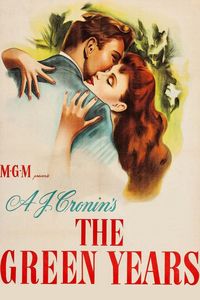
    (On Cable TV, April 2021) There is, on paper, not much to distinguish The Green Years from stereotypical Dickensian sad stories, as a young orphan boy comes to stay with distant relatives after losing his mother. Despite the inevitable setbacks and villains, trials and tribulations, we can broadly guess where the story is going to go—but that doesn’t really take into account the likable Oscar-nominated performance of Charles Coburn as the patriarch who takes our plucky protagonist under his wing, often going against the indifference or outright hostility of other members of the family. Also noteworthy are long-time couple Hume Cronyn and Jessica Tandy, amusingly playing father-and-daughter. The Green Years is not that good, but it does have its fine moments and the kind of fist-pumping victory (with a side order of vengeance from the grave) that we expect from such family melodramas.

  • The Corn is Green (1945)

    The Corn is Green (1945)

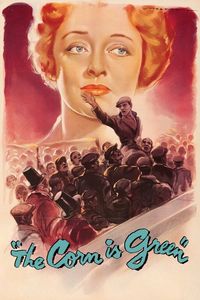
    (On Cable TV, April 2021) Inspiring teacher stories are often timeless, and seeing a star like Bette Davis aged fifteen years older in order to play a matronly teacher doing her damnedest to send a student from a poor remote mining town to Oxford is a high concept that remains accessible even decades later. Of course, there’s a difference between a good idea and a compelling execution, and while The Corn is Green is a serviceable example of its sub-genre, it’s not exactly riveting entertainment if you fall outside its intended audience. The recreation of a small Welsh town in a Hollywood studio is about as good as was possible at the time, while seeing Bette Davis heavily made up to look older and heavier is nothing short of interesting. Still, given the unsurprising, generally linear thrust of the plot, there isn’t much more to The Corn is Green than what you can gather from its log-line and production era. It’s not bad, but I’m not sure I’m going to remember it much longer.

  • The Facts of Life (1960)

    The Facts of Life (1960)

    (On Cable TV, April 2021) If you’re watching the Lucille Ball/Bob Hope headliner The Facts of Life and expecting something like the three other films they did together, you’re going to be surprised. Not that surprised, as Hope is still trading bon mots and Ball has occasional moments of comedy, but surprised nonetheless, because The Facts of Life is about two married people grappling with having an affair, and there’s an entire undercurrent of guilt and drama running close underneath the jokes. It’s somewhat reflective of its era in American cinema, where the rigid standards of censorship were ever-so-slightly relaxed in reflection of how society was changing, but not quite blown apart as they’d ben by the end of the decade. As a result, The Facts of Life does feel like a strange halfway film — willing to contemplate a difficult topic, but not able to completely give it the treatment it would have deserved, and possibly held back by the persona of its stars. As a result, it’s not completely satisfying, but neither it a failure — the film was nominated for a handful of Academy Awards and presents Hope in one of his better quasi-dramatic roles. It’s worth a look, especially for Hope fans who are already used to seeing him in other goofier roles.

  • South Central Love (2019)

    South Central Love (2019)

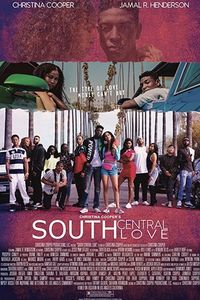
    (On TV, April 2021) With a title like South Central Love, you already know what to expect — love in one of Los Angeles’ least privileged neighbourhoods, with its attendant racial and poverty issues. It does take a long time for the romance to rev up between our likable hero and just-as-likable heroine as they try to set themselves apart from so many other people in a neighbourhood seemingly eager to keep them back. As someone who’s a continent away from South Central Los Angeles (although I did walk through it once), I found the film interesting for its de4piction of a completely different way of life — the irony being that as a low-budget effort, South Central Love is not creating a new world as much as showing how things are. Writer/director Christina Cooper also stars in the film, and manages to create a convincing sense of place from what she has at her disposal. Ironically enough, South Central Love is at its best when stepping away from the clichés of South Central in order to develop its romance. It’s not so distinctive nor remarkable when it abruptly tries to wrap this love story in a far more familiar tale of crime and loyalty in the ghetto — despite my own liking for genre stories, I almost wish the film would have dispensed with the crime elements that come to dominate the third act in order to keep on showing something that few films do: young people building a life without major movie-grade crises affecting them. Still, I liked the result well enough — South Central Love is engaging even to white suburban middle-aged men such as myself, and there’s a compelling quality to the script that kept me interested much longer than comparable romantic films. Looking at Cooper’s IMDB page, I see that she has an amazing number of projects in pre-production — I’ll be curious to see what else she’ll end up achieving.

  • For Me and My Gal (1942)

    For Me and My Gal (1942)

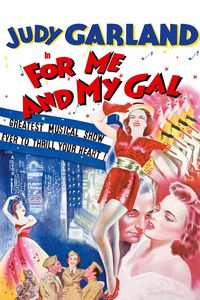
    (On Cable TV, April 2021) While rough and unpolished around the edges, For Me and My Gal owes much to its early pairing of Judy Garland and Gene Kelly. For Kelly, this was his film debut, and while it’s far from taking advantage of his talents in dancing or choreography, his considerable charm as a performer is already apparent. For Garland, this was a first adult role after some time as a child or teen star — to twenty-first-century audiences, she here appears unusually cute and relaxed, before her drug abuse and personal issues prematurely aged her. As a couple, both of them are quite likable. As for the story itself, it’s an often-unwieldy fusion between vaudeville comedy, wartime heroism and conventional romance, as Kelly’s character mains himself in order not to be drafted into World War I, then changes his mind after being called a coward by everyone. Don’t worry — For Me and My Gal ends well, but there’s a good chunk of the film that steps away from comedy and into more serious drama right on time to whip American audiences to serve in the first days of America’s involvement in World War II. Still, the fun of the film is in the musical numbers, Kelly’s early performance as a young man and Garland looking unusually good. It’s an early prototype for other movies Kelly would make later (two more of them with Garland, although she was struggling by the time The Pirates and Summer Stock rolled around) but you can already see the greatness here in Kelly’s ease in front of the camera and as a singer/dancer. For Me and My Gal is a minor entry compared to what would follow, but it’s well worth a look.

  • The Four Feathers (1939)

    The Four Feathers (1939)

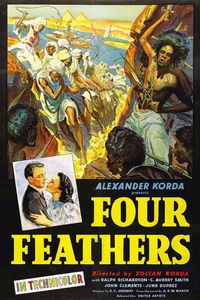
    (On Cable TV, April 2021) British film producer Alexander Korda was well known throughout World War II as an immigrant more British than the British-born, putting together films that sang the praises of the embattled country even when they putatively took place in other historical eras. In this context, The Four Feathers is notable for a few things, starting with an early spectacular use of colour at a time where such a process was costly and difficult to handle — especially in the harsh location shooting conditions that the filmmakers experienced in Sudan. Widely considered the best rendition of an often-adapted novel (most recently in 2002, with Heath Ledger), it’s a tale meant to stir any young man with patriotic fervour, as it shows its protagonist turning away from service, then being labelled a coward (through the titular feathers) by family and friends. The highlight of the film remains the spectacular battle sequences shot in naturalistic colour in the middle of the desert. There’s a kinship here with later films such as Zulu, unfortunately, all the way to the built-in racism and colonialism that we’re asked to espouse as self-evident:  Don’t look too close at the depictions of non-English characters. It’s by an accident of history (albeit not an unpredictable one) that The Four Feathers landed in theatre screens just as England needed a patriotism booster. It’s still, despite quite a bit of disturbingly outdated material, a decent watch.

  • Four Days in November (1964)

    Four Days in November (1964)

    (On Cable TV, April 2021) The assassination of John F. Kennedy was not even a year old by the time Mel Stuart put together Four Days in November, an incredibly detailed documentary about JFK’s final trip to Dallas, the assassination, and the immediate aftermath all the way to his funeral. Put together from contemporary news feeds, a few dramatizations, a few interviews and a heavy dose of narration with the soothing classical intonations of Richard Basehart, it’s a meticulous recreation not only of the assassination itself, but everything surrounding it, from the reasons why JFK headed to Dallas (seeking to repair a few rifts in the Democratic Party) to the extraordinary preparations for a state funeral that is meant to help a nation grieve. There’s a clear difference in emphasis between Four Days in November and more recent takes on the event — the fetishization of conspiracy theories about JFK’s assassination means that we seldom get any objective presentation of the events any more: everything has to be fiction with heavy doses of mysteries and conspiracies and a mad quest to explain the fantasies of generations of conspirationists. Compared to this thickening fog of misdirection, Four Days in May has a straightforward approach to the events that make it feel almost freshly affecting again — the incredible coincidences (what with Joan Crawford and Richard Nixon being at the same party as JFK in the days before the shooting) that pepper real history and the wealth of detail often forgotten in snappier documentaries. It’s quite a summation of a complex series of exceptional events, and perhaps where anyone interested in the JFK assassination should start. It’s missing a few things (the Zapruder film, for instance, would not be revealed for a few more years—not to mention the conclusions of the Warren report) but it’s refreshingly absent from the modern mythology that has grown around the event.

  • The 5,000 Fingers of Dr. T. (1953)

    The 5,000 Fingers of Dr. T. (1953)

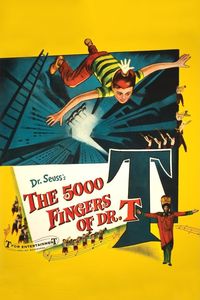
    (On Cable TV, April 2021) I’m not usually averse to goofy whimsical musicals, but even I have my limits and The 5,000 Fingers of Dr. T. probes at some of them. Written by Theodor “Dr. Seuss” Geisel, it’s a musical that stems from the fantasies of a young boy who intensely dislikes his piano lessons — as he dreams about a tyrannical piano teacher and his 500-boy piano, the film goes deep into a fantasy that was probably too far ahead of its time to execute convincingly. It’s certainly weird enough, with outlandish set designs that bring to mind the Seuss books and a fantastical approach that seems exuberant for the 1950s while being too timid for contemporary audiences used to CGI flights of fancy. One thing that does harm the film is a lack of humour to go along with its imagination — the film remains far too serious for its own good, perhaps too preoccupied by the demands of its complex production to allow for moment-to-moment whimsy. There are ambitious musical numbers, but few of them are catchy, likable or memorable — much of the film plays out among too-sparse sets that add a degree of clinical asepticism at odds with what the film should be. I couldn’t help but compare the result to Willie Wonka and The Chocolate Factory, which, while dated by contemporary standards, is far more at lease with its own lunacy. The 5,000 Fingers of Dr. T. is probably worth a look if only for how weird it is by early-1950s standards… but don’t expect too much.

  • Experiment Perilous (1944)

    Experiment Perilous (1944)

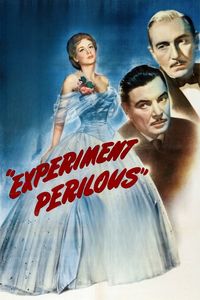
    (On Cable TV, April 2021) With Jacques Tourneur at the helm and Hedy Lamarr in the lead, you can go confidently in Experiment Perilous knowing two things: it’s going to be a thrilling ride and she’s going to look great. The film does fulfill its initial promises on both counts: As a psychologist drawn to the dysfunctional lifestyle of a reclusive couple, George Brent plays the role of an amateur investigator uncovering the troubling truth in a way expertly drawn out by Tourneur and the script he’s working from. Ever-beautiful Lamarr shows up quite late in the film, but remains an object of fascination throughout. The result is very much a domestic thriller à la Gaslight (released almost at the same time), with strong touches of gothic romance and even a whiff of noir. Experiment Perilous eventually escalates into a spectacular aquarium-shattering drapes-burning action-packed confrontation in a Manhattan brownstone for a result that should leave anyone at least moderately entertained. (Amazingly enough, there’s even a title drop of “Experiment Perilous” midway through the film.)

  • Blackout (2008)

    Blackout (2008)

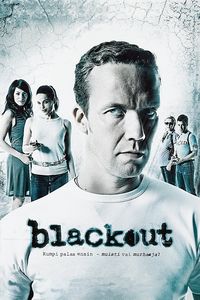
    (In French, On Cable TV, April 2021) I’ve got faint praise and exasperated criticism for Blackout, even when I acknowledge that it’s a horror movie made according to the often-ludicrous standards of the genre. The compliments first: For a film largely focused on three strangers stuck in an elevator, director Rigoberto Castañeda wrings a surprising amount of style and energy to the result. In between Amber Tamblyn, Aidan Gillen and Armie Hammer, the cast is surprisingly well-known. Then, the mild criticisms:  While the film focuses on a trio in an enclosed environment, Blackout escapes strict minimalism: there are enough flashbacks and peeks outside the elevator (not to mention excursions in the elevator shaft) that the entire result escapes the rigour of more high-concept takes, such as Devil. Even at 85 minutes, there’s not a whole lot to sustain the plot, and the style can’t quite compensate. Finally, the exasperation: As this is a horror film, it’s not enough for three strangers to be stuck together in a small box: one of them has to be a serial murderer, and this is actually held back as a revelation for far too long. (Also, once it’s revealed, much of the film stops making sense — “what idiot serial murderer would leave his apartment with a dead body inside?” comes to mind.)  One of the drawbacks of having only three characters in an elevator is that it’s harder to create drama out of only a relationship triangle — even the aforementioned Devil started out with a pentagram of people. This does reinforce Blackout’s very artificial approach to plotting: we’re often reminded that this is a horror movie with little relationship to reality, and by the wilder third act (in which everyone dies at least once, thanks to fantasy sequences) nothing really matters. The ending isn’t really surprising, and any opportunity for deeper thematic commentary takes a back seat to grand-guignol shocks. The result is somewhat redeemed by the style and the actors (although the recent controversies about Armie Hammer have made it much funnier to say, “Hammer plays a character who’s not the serial killer”) but there’s definitely something lacking in order to get Blackout to fulfill its potential.

  • Far from the Madding Crowd (1967)

    Far from the Madding Crowd (1967)

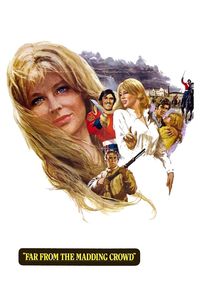
    (On Cable TV, April 2021) I am of two complementary minds about the 1967 version of Far from the Madding Crowd. The first, having already been exposed and (mildly) bored by the 2015 version, is a lack of enthusiasm at the freshness of the story. I really didn’t care enough about the twenty-first century version to be able to dig deeply into the differences between the two — it was enough knowing that this is not a kind of story I respond too deeply to (although I note that a similar story in French-Canadian setting, Maria Chapdelaine, has become a bit of a classic) and letting a 1960s-style take on the story take its turn in 169 languid minutes. The other part of me is tempted to point at both versions of Far from the Madding Crowd, adapting an 1874 novel, and say, “See, this is how you learn about how different eras of filmmaking adapt similar non-contemporary material!”  There’s no big reinterpretation à la action-movie rethinking of Les Trois Mousquetaires — while both versions of Far from the Madding Crowd place different emphases on elements of the whole, they’re still very much the same recognizable story set in very much the same kind of setting. While the 1960s version it noteworthy for cast and crew having become famous later on—Julie Christie in the lead role, Terence Stamp as a suitor and Nicholas Roeg as cinematographer—it’s also notable for bucolic rendition of the 19th century English countryside as interpreted by the sensibilities of the time, and that’s not insignificant. This being said, Far from the Madding Crowd is best suited to those willing to sit slightly less than three hours to hear all about romance in rural Victorian England.

  • I Am Richard Pryor (2019)

    I Am Richard Pryor (2019)

    (On Cable TV, April 2021) As someone who watched his movies as a 1980s kid, Richard Pryor was the likable goofball who was featured in Superman III and Brewster’s Millions, a kid-friendly comedian who got his laughs by mugging for the camera. That, to put it mildly, is a hilariously erroneous impression of Pryor, who had decades of experience as an edgy comedian before settling down for family-friendly fare. I Am Richard Prior chronicles the very different phases of his life, from clean-cut (and moustache-less) young comedian to his far more provocative period, beginning in the late 1960s and gradually fading away in the 1980s as he took on the family fare I watched as a kid. As you may expect, the film focuses far more on what he brought to American culture in his edgier phase, with album names I can’t even bring myself to write here, and a take-no-prisoners approach to stand-up that mixed incredibly personal material with an unwillingness to comfort audiences. Pryor was a model to an entire generation of later comedians, and the bits and pieces we hear throughout I Am Richard Prior are only the tip of a much funnier body of work. The not-so-different flip side of this public persona was Pryor’s messy personal history, from a sordid childhood to decades-long drug abuse, numerous marriages (although this aspect is not emphasized here, because his last wife, Jennifer Lee Pryor, also produced the film), many children to different mothers, one spectacular injury where he set himself on fire while freebasing cocaine and miscellaneous health problems, perhaps explaining his death from a third heart attack at 65. Compared to other “I am” documentary biopics from Network Entertainment, I Am Richard Pryor is far more honest about the flaws of its subject. I strongly suspect that this is due to the openness of the family and friends participating in the documentary — Pryor made no attempts to hide this part of his life even in public stand-up performances (to the point of joking about setting himself on fire), so it’s not as if there are any lesser-known incidents to leave undisturbed. Jennifer Lee Pryor is unabashedly frank (and often hilarious) in discussing her deceased husband’s issues, which does help round out his portrait. It does amount to a pretty good overview of an interesting person, and one that does not shy away from his less admirable traits. The only remaining warning about I Am Richard Pryor is that a little bit of Pryor’s comedy is liable to make you seek out the rest of his work, and there’s a lot of it.
  • The Enchanted Cottage (1945)

    The Enchanted Cottage (1945)

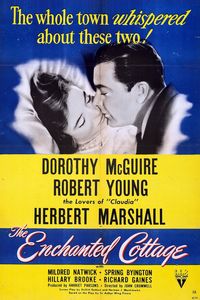
    (On Cable TV, April 2021) If you want a comfort movie, The Enchanted Cottage has to be right up there with the greats. A fantastical romantic drama, it features two drab, wounded newlyweds who arrive at, well, an enchanted cottage that helps both see each other as their idealized selves. Notwithstanding the troubling issues of equating physical beauty with personal values, director John Cromwell’s film is a comforting fantasy in which everything is slated to go right for its well-deserving protagonists. There isn’t much to the story (one suspects that a modern film would cut to the chase, but would anything be left for a feature-length film?), but that doesn’t matter — The Enchanted Cottage is a film made to be re-watched more than watched, secure in the knowledge that everything will be all right. It would have been fun to delve more deeply into the cottage’s history and accompanying mythology, but that’s clearly a wish from someone who’s more comfortable with fantasy tropes than romantic ones — others will argue that The Enchanted Cottage is exactly what it means to be, and that it’s catnip for movie-watching couples. That it has endured for decades as a well-regarded romance says it all — timeless stuff even in comfort.

  • The End of the Affair (1999)

    The End of the Affair (1999)

    (On Cable TV, April 2021) I was surprised to realize that I’d never seen The End of the Affair — as a multiple Academy Awards nominee during the period where I was actively chronicling the films I saw, I probably gave it a miss considering how little I cared about sordid affair dramas. I still don’t, but at least I can now go half a review without snidely dismissing the film as mushy claptrap. Or, um, maybe not. Directed by Neil Jordan from a Graham Greene novel and featuring no less than Ralph Fiennes and Julianne Moore, it’s not as if you can’t figure out from those four names what kind of film you’re going to get — something well-mannered, languidly paced, well-written but never energetic and almost hermetically consumed with the navel-gazing of two adults behaving badly. The End of the Affair is romantic drama given maximalist treatment with plenty of pauses, delays, torpid pacing and moments meant to evoke erotic tension. It does sort-of-work — There’s a lot more nudity than you’d expect from Moore or Fiennes, and it’s actually quite tasteful in its specific way. It does feel like an inheritor to the doomed-romance British tradition of films like Brief Encounter, and there’s never any doubt that it’s not going to end well. (Especially when the film begins with “This is a diary of hate” from someone who’s not an emo teenager.)  One of the reasons why I’m happier seeing the film now rather than in 1999 is that I’ve grown more sympathetic to the result: it may not be my cup of (intensely simmering) tea, but I can appreciate the maturity of the results, many of the good lines, quite a bit of the restraint in which it’s executed and the overall atmosphere of doomed lovers. The End of the Affair is a very specific kind of film, but it’s not badly executed as those go.

  • The Lair of the White Worm (1988)

    The Lair of the White Worm (1988)

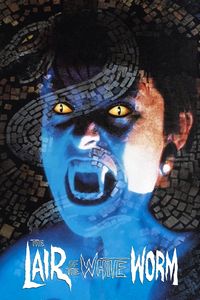
    (In French, On Cable TV, April 2021) I clearly wasn’t prepared for the sheer wondrous weirdness of The Lair of the White Worm and seeing Hugh Grant’s in the credits actually misled me further. This is not your Hugh Grant movie of later years: in the hands of legendary director Ken Russell, this is a crazy horror/comedy that goes all-out on grossness, gore, fetichism, and folk horror. Peter Capaldi (!) joins Grant in adding further casting interest to the result, which is really not the film you’d expect. While not a marquee name these days, Amanda Donohoe is probably the film’s highlight as the sultry evil Lady Sylvia. This is the kind of off-kilter work where a dream sequence featuring the film’s two female leads fighting aboard an airplane is the kind of thing that you take in stride. (Plus vampire teeth that look as if they’d lacerate anyone’s mouth in moments.)  It features quite a bit more kink, phallic symbols and nudity than you’d expect from a film of its time and place. The visuals are more daring as well, and the result has this crazy mixture of horror and comedy that works surprisingly well (because it usually doesn’t). You can see why The Lair of the White Worm has earned a bit of a cult following over the decades — I’m probably going to want to watch it again in a year or two just to make sure that what I remember from the film is indeed what happened.