Month: September 2021

  • Cloudburst (1951)

    Cloudburst (1951)

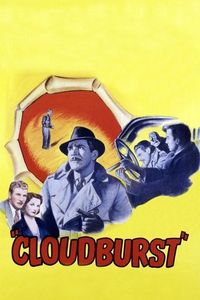
    (On Cable TV, September 2021) Now here’s something interesting: A British film noir set in the post-war years and focusing on a code-breaking protagonist. No, “Bletchley Park” is not mentioned — Cloudburst was completed decades before the extent of the Allies’ code-breaking was declassified—, but there’s something almost reverential in the way the code-breaking is treated here. Part of it is a gimmick (including a sloppy code left on the scene of the crime) and part of it comes from screenwriter Leo Marks, who did work in code-breaking during WW2 (although, ironically, not at Bletchley Park). The Canadian-born protagonist is initially presented as a promising young man with an ideal life and an expectant wife, but then — the wife is killed in a hit-and-run, and the protagonist goes on a roaring rampage of revenge to find and kill those responsible. Using his wartime skills, he makes mincemeat of the first culprit, then hits a wall in tracking down the passenger. Ironically enough, things get moving once again when the authorities bring him the coded message he left on the scene of his first murder and ask him to, essentially, investigate himself. It’s all handled with a certain competence: Francis Searle directs the material appropriately from within a burgeoning Hammer studio, and Robert Preston lends his voice to the lead. It’s a satisfying watch despite some unconvincing staging and some strange plotting oversights — the code-breaking aspect really helps to set it apart from the pack, and Preston’s character gets more and more interesting when he’s stuck between his own revenge and the police closing in. Thanks to all of those added details, Cloudburst remains well worth a look—especially as a slight deviation from the usual noir material.

  • Without you I’m Nothing (1990)

    Without you I’m Nothing (1990)

    (On Cable TV, September 2021) As someone who finds Sarah Bernhard curiously attractive, the idea of spending 90 minutes watching a film adaptation of one of her one-woman shows was irresistible. But I clearly had no idea what I was getting into, as the result is very specifically hers. While superficially the usual mix of songs and stand-up numbers, the entire thing teeters precipitously on the edge of camp, irony and artifice. She wears disguises, becomes a variety of personas, takes on spoken-word material that clearly isn’t autobiographical, satirizes circa-1990 society (which does have some timeless quality), does unusual covers of recognizable songs… and that’s just the performance material, because in-between we get a disinterested announcer, a crowd that leaves the venue (the last one leaving a harsh review), semi-erotic interludes and even more material that defies description. It all culminates in a burlesque performance that leaves only the bare minimum to the imagination. Throughout, we get the sense that it’s a self-aware performance on top of other self-aware performances, with a thick lathering of irony that makes everything feel even weirder. What to make of it? I’m not sure, except that it’s a fun ride with Bernhard. Side note: the film’s title is bland, but it’s shortened from the much-funnier title of the off-Broadway show it’s adapted from: Without You, I’m Nothing, With You, I’m Not Much Better.

  • Gojira tai Mekagojira [Godzilla vs. Mechagodzilla] (1974)

    Gojira tai Mekagojira [Godzilla vs. Mechagodzilla] (1974)

    (On Cable TV, September 2021) Coming toward the end of the classic Toho era of the Godzilla cycle, Godzilla vs. Mechagodzilla clearly shows how crazy the narrative was getting by this fourteenth instalment of the series. Sure, we’ve got Godzilla living on Monster Island and a few friends. We also have apelike aliens trying to hatch an evil plan against earth. But we also have an ancient prophecy, a vision of great destruction and some shenanigans about a fake Godzilla before the skin is stripped away to reveal the villainous Mechagodzilla. All of this builds to the usual rubber-suit wrestling match, complete with Godzilla’s charming ping-pong eyes. It’s all pleasantly crazy, especially when you realize that it blends elements of The Planet of the Apes with some references to Leone’s Spaghetti Westerns. Jun Fukuda’s direction and the colour cinematography are still quite a bit of fun today, although the convolutions of the plot are really not as interesting as the series’ usual scenes of kaiju causing propriety destruction. I’m still trying to find my way around the series, but Godzilla vs. Mechagodzilla is not a bad addition, and by that point of the series, viewers have learned to tune out or enjoy the more outlandish plot elements.

  • Angrily Ever After (2019)

    Angrily Ever After (2019)

    (On TV, September 2021) As far as BET original romantic comedies go, Angrily Ever After is strictly middle-of-the-road stuff — fun enough to watch (perhaps preferably while doing other things) but not memorable enough to stick in mind. That, mind you, is already not too bad — there are enough terrible BET original movies to make anyone appreciate the not-so-bad ones. In this case, the plot revolves around a young news anchor who, thanks to an emotional outburst against her fiancé and his too-intimate friend, ends up losing her job, her engagement, her apartment, her book contract on “Having it all” and much of her self-respect in one day. Things don’t necessarily get any better once she’s hired for another job, as her outburst has led her to be typecast as the “angry black woman” expected to issue enraged commentary on the issues of the day. For someone with a Masters in Journalism, that’s quite a step down — but she’s got other problems, such as confronting the white woman telling her that no $50,000 refunds are allowed on her wedding resort reservation — at best a year-long postponement. The ticking clock being activated, the rest of Angrily Ever After boils down to — is she going to get back with her two-timing ex-fiancé, that sexy new guy at the new workplace, or something else? Don’t worry — it all works out thanks to contrivances (what kind of moron kisses another woman in front of the bridal shop where his fiancée is trying her dress?), plot cheats and the weight of audience expectations. The portrayal of the TV business is hilariously warped: No channel ever hires someone for colour commentary and has them discover the exact nature of it on the air.)  It’s definitely heavier on romance than comedy — not that many funny situations here nor snappy dialogue, but at least it ends well. Jasmine Burke is lovely in the lead role, with Ta’Rhonda Jones providing much of the comic relief as the best friend character. You can argue that director Terri J. Vaughn’s film doesn’t manage to fulfill expectations — slack on comedy, not that exceptional on romance either, and curiously timid when it’s time to comment on social media toxicity or expectations toward young female professionals. But Angrily Ever After is watchable without being terrible, and it wraps up with a big smile at the “Joy of Losing It All.”  I’ve seen worse.

  • Lord Jones Is Dead (2016)

    Lord Jones Is Dead (2016)

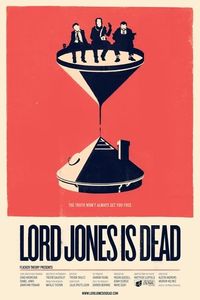
    (On Cable TV, September 2021) You wouldn’t necessarily expect a theatrical piece featuring three characters to delve deeply into matters of journalistic ethics and the future of newspapers, but that’s exactly what Lord Jones Is Dead aims to do. Adapted from a play, the film presents three journalists (two writers, one photographer) trying to stay sane during a particularly meaningless news stakeout. Camped near a humble Johannesburg suburban bungalow trying to get a glimpse of a minister’s rumoured mistress while other people are doing more interesting things, our characters argue, complain, play and come to (ineffectual) blows over the course of the day. Their main topic of contemplation is the news itself — specifically the way the Internet undermines journalism, sending it to the common lowest denominator, emptying advertising revenues and harming the noble profession. Of course, our insiders know better than anyone else how the sausage is made — one of them may still have his ideals, but another one doesn’t, and the third member of the trio isn’t much of a referee. Various episodes try to stretch the film to various degrees of success — the musical number is oddly charming, but Austin Andrews’s directorial showmanship gets ridiculous at times — spinning the camera and having the character speak intently to his cell phone works solely because it’s a close-up, otherwise it would be ridiculous staged as a long shot. Nonetheless, Lord Jones is Dead becomes a surprisingly entertaining film — it milks every single possibility out of its setting and characters, creates some depth to their shared history and common acquaintances, and actually wrestles with topics of somewhat specialized interest. Jonathan Pienaar is a highlight as the jaded and bemused photographer who barely gets to act as an elderly figure. It’s true that my above-average interest in journalism issues predisposes me favourably to the film, but there’s something simply admirable in tackling a narrow (but vital) topic in the way Lord Jones is Dead does, stripping down setting in order to focus on character and having fun with the mise-en-scène along the way.

  • Get Yourself a College Girl (1964)

    Get Yourself a College Girl (1964)

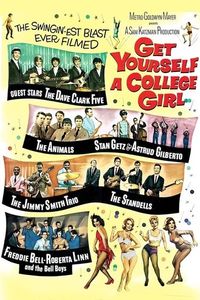
    (On Cable TV, September 2021) If there’s one defining feature to the wave of 1960s movie musicals, it’s the growing acceptance that pop music was fundamentally changing into a teen-driven, hits driven form of entertainment. Never mind sheet music or songs from bandleaders — pop was clearly going for billboard charts and groups singing to the teenagers. You can see this shift being particularly pronounced in such non-prestige pictures as Get Yourself a College Girl, which was as much a musical revue show as any of the classic musicals, but aimed at the new teenage set. Strong similarities with the Bikini Beach series abound — silly plots, young women in bikinis, a slight anti-establishment edge (in this case, dealing with ambitious politicians), many musical performances by artists of the day, and a cheeky approach to courtship and sex that now feels tame despite pushing limits back then. It’s not an unpleasant watch — even if the plot is nothing interesting, there are enough musical acts in varied genres (including The Animals, a young Nancy Sinatra and Astrud Gilberto crooning, “The Girl From Ipanema”) to keep things astonishing throughout. Not cinematically good but almost invaluable from a pop-anthropology viewpoint, Get Yourself a College Girl is a trip back in time that’s worth taking at least once.

  • I Love You, Beth Cooper (2009)

    I Love You, Beth Cooper (2009)

    (In French, On Cable TV, September 2021) It’s certainly possible that all teenage high-school romantic comedies are timeless — that despite the gadgets introduced or taken away over the years, teenagers are still more or less the same as they’ve been for decades, and that their struggles are the same. That would explain why I Love You, Beth Cooper is so familiar despite being twelve years old by now, and why it barely earns anything more than a shrug. The spark is there, though — as the film begins, an overeager valedictorian makes the titular lovelorn confession in front of a crowd — despite Cooper already being in a relationship and our protagonist not having much of a chance. But Hollywood has a magic of its own, and before long our protagonist and his best friend are palling around with Cooper and her two best friends. Compressing the action in one madcap day, I Love You, Beth Cooper goes through the expected motions, with Cooper not being the girl everyone thought, bullies being humbled, sexual discoveries made and adventures had. It’s not intolerable, but there are so many little annoying things about the result that it just feels off. The humiliation comedy is considerable, and the film has dubious ideas about comedy that are fit to make anyone squint in doubt. For director Chris Columbus (who’s hardly a can’t-miss director), this is a misfire of unusual proportions. Paul Rust doesn’t do too badly as the male lead, but Hayden Panettiere isn’t anything special as Cooper — dozens of actresses could have done just as well, if not better. I Love You, Beth Cooper all amounts to a curiously disposable teen romantic comedy — frantic and disorganized, often trying too hard (such as the movie quotes-spouting character) but whose formulaic delivery can’t ignite the material. It wasn’t good when it came out, isn’t good now and won’t be good in another dozen years… but I can guarantee that teenagers won’t have changed much by then.

  • Score: A Hockey Musical (2010)

    Score: A Hockey Musical (2010)

    (On Cable TV, September 2021) There are films, good or bad, that just make you want to say, “Wow, that exists.”  So it is that Score: A Hockey Musical is exactly what it says — a hockey musical. A low-budget one, so don’t go about expecting extravagant choreography or polished singing — it simply aims to deliver on its title, and little more. The plot, if you must ask, has to do with a talented newcomer being discovered as a hockey sensation and becoming famous in the process, leading to a reappraisal of his values and how fame has corrupted them. In other words, near-exact transposition of the classical musical ur-plot about an unknown character becoming a singing sensation and losing touch with themselves. It’s moderate fun as long as you can skip the narrative contrivances. There are several, several cameos from circa-2010 Canadian celebrities from the musical and hockey fields. Writer-director Michael McGowan certainly has noble and patriotic intentions, but can’t rely on Golden-Age MGM’s depth of technical talent. Accordingly, the lyrics are obvious, the melodies somewhat boring, the singing talent not always up to the task and everything definitely lacks polish. Arguably more adept at evoking fun than being fun by itself, Score: A Hockey Musical is not a terrible watch, but it’s one that requires a good degree of Canadian indulgence in order to fully appreciate. Despite its flaws, I’m glad it exists.

  • Bitchin’: The Sound and Fury of Rick James (2021)

    Bitchin’: The Sound and Fury of Rick James (2021)

    (On Cable TV, September 2021) I’m not going to pretend I knew all that much about Rick James — sure, I knew the music (“Superfreak”), sure, I knew about the later-life memes by way of David Chapelle. But the rest… not so much. So, I was ideally primed to see Bitchin’: The Sound and Fury of Rick James, which asks James’ friends and family to take a look at his legacy ten years after his death. The opening is surprisingly cinematic, as they open his storage unit years after James’ death, and start looking at memorabilia. What follows is, in many ways, a familiar story: a capable artist reaching heights of fame and being consumed by drugs and excess, sinking back into obscurity before a later-life pop-culture revival. The film is, as is often the case with friends-and-family docupics, somewhat sympathetic to James — many of the less-savory events of his life (say, the kidnapping and assault charges) are barely touched upon and while his drug use is condemned, it’s always paired with the weird quasi-admirative relationship everyone has with “the rock-star lifestyle.” That does temper the fun of the rest of the documentary, which features quite a few of James’ best-known numbers, a cogent overview of the musical genre he was working in and some amusing stories about his relationship with Prince. There’s even a detour through Toronto at a culturally important time, as James evaded the US draft during the Vietnam War. Much of this exhilaration comes falling down in the film’s second half, as drugs take over his life (including a disastrous TV performance) and almost certainly hastened his early death. While Bitchin’ certainly does not make a saint out of its subject, it does make the too-familiar biographical trade-off of privileging access to interviewees over a completely honest presentation. That kind of decision is increasingly untenable in an environment where you can fact-check documentaries by a simple Wikipedia check. The result is not a bad documentary: writer-director Sacha Jenkins assembles a documentary that’s reasonably entertaining throughout. But it’s missing some crucial content, and that makes it difficult to recommend it wholeheartedly. Any viewing should be accompanied by some judicious fact-checking.

  • Passenger 57 (1992)

    Passenger 57 (1992)

    (In French, On Cable TV, September 2021) The mid-to-late-1990s still reign supreme as the best-ever era for big brash action movies, but the early-1990s were quickly putting together the pieces to get there, and transitioning from the dour 1980s buddy-cop clichés to the vastly more ludicrous style of the latter decade. Passenger 57 isn’t that good of a movie, whether you’re talking about an action film or a straight-ahead thriller: it’s got some weird ideas about spatial unity of action (going from the plane to a country fair and back), is slightly too enamoured of Wesley Snipes as its protagonist (although it did launch his career as an action hero), sounds dissonant with its jazzy score, and doesn’t seem quite so willing to exploit the elements at its disposal. Still, there’s some entertainment value in seeing Snipes as an overconfident air security expert dealing with a terrorist engineering his high-flying escape. As antagonist, Bruce Payne regularly out-acts Snipes by chewing scenery as if it was an onboard meal. The classic line “Always bet on black” is perfectly placed here, explaining its enduring appeal even for white guys like myself. Alex Datcher has a small but eye-catching role as a likable flight attendant, while you can spot Elizabeth Hurley as a supporting villainess. I’m still dubious about many of the script’s attempts to extend the action — the opening can sporadically slow, while the third-act detour off the plane seems out-of-place in a thriller that is otherwise centred around civil aviation. But it’s watchable, even if for the wrong reasons. There’s no doubt that the same concept would have been made very differently even five years later (case in point: Executive Decision and Air Force One), and so you can see in Passenger 57 one of the transition points between 1980s thrillers and 1990s action.

  • Avril et le monde truqué [April and the Extraordinary World] (2015)

    Avril et le monde truqué [April and the Extraordinary World] (2015)

    (On TV, September 2021) There are plenty of things I like in animated family film Avril et le monde truqué… and plenty I don’t. On the good side, it’s an almost insanely ambitious steampunk story, quickly sketching an alternate reality where Napoleon III dies freakishly, scientists are kidnapped, petroleum is somehow never discovered as an energy source and we find ourselves in 1941 with wood-powered everything, near-complete environmental collapse, the French going against the British and plenty of other surprises when a mysterious force appears. With a visual look borrowing much from the ligne claire school of comic books, the film at least looks interesting, which is followed though by a few spectacular set-pieces. As far as steampunk movies are concerned, this is one that plays big — the possibilities of animation are unleashed and the result comes from a rich imagination. On the other hand, there are two constant irritants (possibly idiosyncratic) that kept me from having a good time. The most specific one is clearly influenced by having read a lot of written Science Fiction with an emphasis on plausibility: The world sketched by Avril et le monde truqué is a nonsensical mess, only believable by easily impressed kids and few others. The idea of holding back scientific progress by kidnapping scientists and hiding them is roughly as plausible as the world becoming a grey plant-less wasteland due to tree harvesting. Of course, this is a film that eventually reveals its evil puppeteers to be sentient Komodo dragons, so it’s not as if it’s going for plausibility in the first place. The other problem, perhaps more serious, is a mixture of a depressing opening and the meaningless of death. Thirty minutes in, our unappealing heroine is scrabbling together a miserable existence following the death of her parents and the prolonged agony of her talking cat, all set against a large-scale portrait of war and environmental collapse. Dispiriting stuff — but don’t worry, as death in this film is a mere suggestion after seeing the number of characters resurrected from the dead on a fairly regular basis. There’s a sloppiness to the script that matches that of the world-building, and it’s hard to remain invested in the story when I’m constantly groaning, “This is so stupid” under my breath. It does mark co-directors Christian Desmares and Franck Ekinci’s Avril et le monde truqué as the product of a creative crew unsure of itself and all too willing to shove absurdities under the unacceptable excuse of “this is a kids’ film” — better filmmakers take care to craft something that can sustain adult scrutiny. I will champion the film as an unusual, even striking steampunk science fiction film but being distinctive is really not the same thing as being satisfying, and we here see the difference starkly.

  • La casa 3 [Ghosthouse] (1988)

    La casa 3 [Ghosthouse] (1988)

    (In French, On Cable TV, September 2021) Acceptably executed but narratively suspect, La casa 3 best shows its low-budget exploitation roots in the way it throws better movies in a blender and tries to pass the incoherent result as something that is worth our attention. It has a haunted house, creepy clown dolls, spooky time-travelling radio signals, an exploding mirror, and a bus-smashing downer finale — if you’re expecting all of those elements to fit together harmoniously, well, it’s not for nothing that the film is well known in so-bad-it’s good circles. It does help that the film, written and helmed by Italian exploitation veteran Umberto Lenzi, is rather better shot than would be the norm for lower-budgeted, markedly commercial films such as this one. The creepy clown doll is rather better than the rest of the film and so are snippets of the score, but that’s really not quite enough to shake the low-imagination, slap-dash way La casa 3 is put together. The story, characters and individual plot beats are terrible in ways that the presentation can’t quite overcome.

  • Promising Young Woman (2020)

    Promising Young Woman (2020)

    (On Cable TV, September 2021) I was not looking forward to Promising Young Woman. On paper, especially with spoilers (it’s hard to resist not looking up the synopsis when nearly every reviewer raves about the ending), it feels like a buzzword bingo regurgitating the past few years in gender-based social activism: female filmmakers unloading grievances is not anything new or all that original. I’ve seen many such movies over the past few years, and they’re starting to blur together in clichés: all female protagonists are traumatized, all male characters are bad, the police/justice system won’t save you, violent revenge is the way to go, and so on. But to see Promising Young Women being nominated for a Best Picture Academy Award gave me some hope that it would go beyond the obvious — while the Oscars have always courted the approval of the chattering class for their social activism (remember: The Academy Awards are the façade of what Hollywood would like us to think about Hollywood), they don’t usually go out of the way to nominate bad films. And indeed, it doesn’t take a long time to figure out that, despite soapbox messages and an aggressive intention to provoke, Promising Young Woman is a really well-crafted thriller, propelled by writer-director Emerald Fennell’s genuinely daring storytelling, great scene-to-scene narrative momentum (even in the film’s most difficult to watch moments) and well-crafted pacing. It is meant not just to press buttons, but to hammer them with glee, daring viewers to keep up with an escalation in revenge narratives. I’m not going to pretend to be unmoved or un-scandalized by the result — I certainly have issues with the mini-speeches featured in the narrative (oh, there’s the bit about nice guys, there’s the bit about women keeping other women down, there’s the bit about the judicial system being terrible… and there’s the inevitable bit about the seemingly good guy not being such a good guy) and I could pick apart the script showing where everyone reacts to the heroine with further confrontation, further justifying the film’s point of view. But I’m not really interested in scoring points: the film doesn’t let the protagonist’s aberrant behaviour go unquestioned, and the ending is indeed something that navigates a very fine line between a downbeat lesson and a triumph of warped justice. Carey Mulligan (an actress I don’t usually very much) is terrific here in playing a complex character that’s not necessarily meant to be a virtuous avenging angel. Bo Burnham is also quite good as a male lead who spans a spectrum of good or bad. But the star here is a script that, despite a few annoyances, does manage something fresh and compelling even with brutal material that riffs on emerging clichés. Promising Young Woman is far from my favourite film of the year, but I understand the acclaim and the Oscar nomination. I even get how, in its own way, it could be a moral lesson of sorts: To repeat something I’ve said about the not-dissimilar Fatal Attraction, this is the kind of story we tell ourselves to keep each other in line.

  • Murderers’ Row (1966)

    Murderers’ Row (1966)

    (On TV, September 2021) Dean Martin is back as suave spy-photographer-womanizer Matt Helm in Murderers’ Row, a follow up to The Silencers: another Bond parody in which attractive co-stars help him foil dastardly plans. This second of four Helm movies is certainly in-line with the first: we get Helm at home with a plethora of gadgets optimized for the playboy lifestyle (pouring drinks in glasses, pouring women in pools), we get Dean Martin songs on the soundtrack (with another affectionate jab at Frank Sinatra), we get cartoonish villains, we get sexy co-stars. Indeed, Murderers’ Row benefits from a terrific co-star — none other than 1960s vintage Ann-Margret as a scientist’s daughter who comes to help the protagonist. The tone here is also an extension of the previous film: a mix of sex comedy in describing Helm’s alcoholic libidinous life, of spy thriller over-the-top evil plans, and of curiously restrained comedy to glue everything together. Spectacular sights include hovercrafts and an entire third act shot on a vast industrial construction site. It’s sort-of-fun if you can stomach Murderers’ Row’s good-natured sexism (if such a thing can exist), although it often feels — as with its predecessor—that it can’t quite commit to the comedy and leaves many jokes on the table. The pacing is also an issue, as the film seems far denser and more interesting in its first act, only to grow lax and repetitive in the second. Still, Martin is quite good at essentially playing his own rat-pack persona and if this is the kind of thing to make you smile, then Murderer’s Row should count as one of the better Bond imitators of the era.

  • California Split (1974)

    California Split (1974)

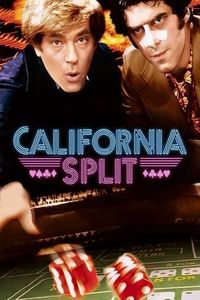
    (On Cable TV, September 2021) I don’t gamble and I’m not often a Robert Altman fan, so my expectations going into California Split ran low. This is, after all, a very Altmanesque film (complete with overlapping dialogue made possible by the then-innovative technique of using eight-track mixing) about two gamblers meeting each other and going through the highs and lows of the lifestyle. Surprisingly, though, I quite liked the result. From a clever opening sequence mixing an instructional tape with ironic counterexamples, the script has a sure-footed take on the toll and exhilaration of full-time gambling, taking us to casinos and pawn shops along the way. It helps to have two capable actors anchoring the cast: George Segal as the gambling apprentice, but especially Elliott Gould as the inveterate devotee to a life spent chasing the next sure thing. The atmosphere of mid-1970s Los Angeles and Reno is nicely portrayed, and the typically Altmanesque cacophony is used to good effect when it comes time to represent the confusion of a gambler on a multi-hour binge. Interestingly enough, California Split resists the temptation to offer a moral lesson— while one of the protagonists may have had a moment of clarity, the other clearly intends to keep on doing what he’s been doing not-that-successfully. It all comes together for a film that’s still quite entertaining, with a filmmaking technique that feels appropriately modern at times.