Author: Christian Sauvé

  • Slumdog Millionaire (2008)

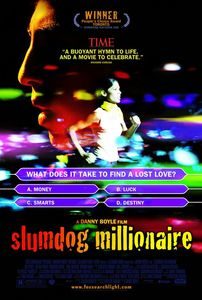
    Slumdog Millionaire (2008)

    (In theaters, February 2009) For a feel-good movie about getting the money, the girl and the dream, this film will make you feel bad for quite a while. It’s hard to do otherwise, though, when picking characters out of the most unbelievably poor slums of Mumbai. The conceit that drives the tale (quiz-show questions alluding to the character’s life, as shown in flashbacks) is nothing short of clever, and the most interesting thing about the film may be how deftly it starts weaving through three time-lines, building a story out of snippets. As a look at contemporary India, it’s as depressing as it’s exhilarating, reflecting the real-life disparities to be found there at the moment. This being said, the payoff is long in coming, and the film’s self-assurance in building its premise isn’t always carried through in the lengthy over-explained segments that make up the bulk of the film’s content. Fortunately, the three set of lead actors are charming, and it all builds up to a great finale. In some ways, it’s old-fashioned film-making married to hip contemporary global awareness, and that’s got a lot going for it; no wonder the film did well on the Oscars nomination roll.

  • The Reader (2008)

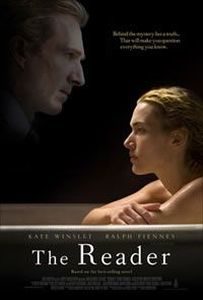
    The Reader (2008)

    (In theaters, February 2009) Imagine, for a moment, hearing of a movie featuring “forbidden love between a young man and an older woman… nazis… women in prison”. Promising, right? Alas, all of this is ruined by the film’s dreaded “Oscar-worthy drama” pedigree, which makes fifteen minutes’ worth of plot turned into a two-hour film feel like most of a lifetime. Even Kate Winslet’s frequent nudity isn’t much of a selling point given how frequently she disrobes on-screen. If you have the patience to sit still through dull melodrama, there are a few interesting moments in The Reader: The filmmakers are good at portraying illicit passion, relatively competent at examining collective guilt and not too bad in portraying very flawed characters stuck in their decisions. But none of this actually translates into anything more than shameless pleas for Oscar nominations and superficial respectability. The moment you look closer at the plot, it falls apart: The film’s big dramatic moment (indeed, its title) depends on a secret that would never exist given the character’s biography. It all amounts to an exploitation film, but not the good kind of exploitation film that could have been titled Hannah, She-Wolf Of The SS. More of a feel-good-to-feel-bad formula drama to exploit the Holocaust once more, made without energy, wit or care for the audience’s time.

  • Push (2009)

    Push (2009)

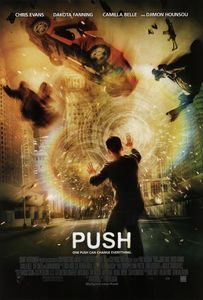
    (In theaters, February 2009) I wasn’t expecting much from this teen action thriller: Psychic powers are a bit lame in the SF field, and the first few minutes are so clumsy that it’s a wonder when the film does improve later on. But thanks to a few good characters, plot twists and clever sequences, Push manages to end up on an up note. No, the plot doesn’t make sense when you consider the knowledge that a non-precog character should or should not have had when writing a certain set of letters. But it hardly matters when the film rushes straight-ahead into the suspense and action sequences. It could have been considerably better, mind you: The direction is harsh and chaotic, the script is a bit too bloodthirsty and the art direction sees the Hong Kong location as an excuse to be as garish as it can be. But the same Hong Kong location makes up for spectacular backdrops, exotic location and an interesting Asian cast. In some ways, this is this year’s Jumper, what with young psychic people fighting against shadowy organizations in exotic locales. But in other ways it’s quite a bit better as long as you get past the film’s various annoyances and flawed direction. The ending blatantly leads to a follow-up: maybe, if there’s a sequel, it will be a bit better.

    (Second Viewing, on DVD, May 2011) I think I like the movie a bit more upon a re-view: The script has moments of invention, Paul McGuigan’s direction is energetic, the actors bring something extra to the film (with special mentions of Dakota Fanning, Chris Evans and Djimon Hounsou’s work) and Hong Kong makes for a great location. Too bad the DVD isn’t anything special: The commentary (featuring McGuigan, Fanning and Evans) is about shooting experiences and them trying to understand the script. Of the handful of deleted scenes, one one actually brings something new. Finally, the only special feature is an obnoxious “Science behind the fiction” piece that relies on a single biased talking head to try to make viewers believe in psi powers. It’s disappointing when perfectly good unpretentious SF is ruined by those who take it too seriously.

  • Nacho Libre (2006)

    Nacho Libre (2006)

    (On DVD, February 2009) Well, what can we say? It’s from Jared Hess, the writer/director of Napoleon Dynamite, so it’s hardly surprising if viewers either think it’s genius or lame. I’m much closer to thinking “lame” myself, although I have to admire the conceptual audacity of the premise: Making a movie about an overweight monastery cook becoming a Mexican wrestling champion ranks pretty highly on the “things I’d never thought would lead to a movie” scale. Alas, that one-note premise isn’t backed up by anything resembling comedy: assortments of odd moments don’t add up to jokes, and whatever laughs there are in the film often look like accidents for a script that seems determined to be more bizarre than funny. Jack Black’s usual shtick is toned-down to the point where it’s both inoffensive and dull; it speaks volumes that he’s considerably funnier on the DVD audio commentary track than in the movie itself. Otherwise, well, it’s obvious that this is one of those films that claims “It didn’t get it; it wasn’t funny” as a badge of success. Think about Napoleon Dynamite and let that film be your guide to how you feel about this one.

  • Fear and Loathing: The Strange and Terrible Saga of Hunter S. Thompson, Paul Perry

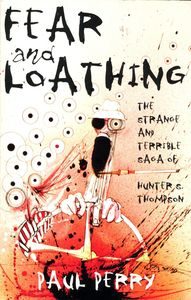
    Fear and Loathing: The Strange and Terrible Saga of Hunter S. Thompson, Paul Perry

    Thunder’s Mouth, 1992 (2004 revision), 274 pages, US$14.95 tpb, ISBN 1-56025-605-2

    Since I have declared 2009 “The Year of Hunter S. Thompson” in my reading list, I have decided to supplement my Thompson with books about Thompson. While the writer may have lived only one life, it’s rich enough to allow many different interpretations by biographers.

    There’s a fundamental difference, though, in the books that were written while Thompson was alive and those published after his suicide in 2005. Much like there’s a difference between the books that seek to portray Thompson as the wild and crazy gonzo writer, and those who seek to go beyond the surface. Paul Perry’s Fear and Loathing, alas falls in the less-satisfying categories.

    The biggest problem with Perry’s book is that it was written in the early nineties, and its 2004 re-edition barely adds four pages of meaningless fluff. While it’s true that Thompson’s most interesting work spanned only a few years in the late sixties and early seventies, it’s also fair to say that any book that does not deal with Thompson’s last years (including his resurgence partly fueled by the Fear and Loathing in Las Vegas film), and ultimately his death, is incomplete. Time has moved on, leaving Perry’s biography in place.

    The other problem is that while Fear and Loathing acknowledges the gap between Thompson-the-legend and Thompson-the-man, it seems quite happy in printing the legend. In many ways, it’s the only possible choice when trying to fit Thompson’s life in less than 300 pages: cut the periods where nothing is happening, print the good stories, and keep going. This isn’t an entirely superficial book (although the lack of references is telling), but it’s best read as an introduction to Thompson, not a definitive biography.

    It probably sounds as if I didn’t enjoy Fear and Loathing, but that’s really not true. After a rather dull and distant first section (up until Hell’s Angels, roughly), the biography picks up once Perry can interview people with stories to tell about Thompson the wild man. Ralph Steadman (who illustrated the cover and provided a small color portfolio of illustrations) is one of the book’s primary sources, and the energy of the narrative picks up once he’s able to talk, first-hand, about the Kentucky Derby, or the America’s Cup event they were asked to cover together, not to mention the disastrous trip in Zaire for the Ali-Foreman boxing match. It becomes even more interesting once Perry himself enters the picture as the Runner’s World editor who was able to convince Thompson to write an article on the Hawaii Triathlon. If Fear and Loathing has a highlight, it’s in providing a quasi-epilogue to Hell’s Angels by describing first-hand a meeting between Hunter and Ken Kesey, twenty-five years after separating. Another strong moment is in learning of dealings between Thompson and editing legend Ian Ballantine. The second half is a joy to read, even when it’s glossing over important moments.

    But as suggested above, the book ends on a truly strange note, depicting 1990s Thompson becoming a fitness freak (in part thanks to Perry), mere paragraphs after discussing his 1990 arrest. This is a view somewhat inconsistent with the other profiles of Thompson, and though it provides a certain form of narrative closure, it seems trivial in light of the next fifteen years of Thompson’s life.

    Now that the first wave of post-eulogy titles is firmly in bookstores, we’re getting not only the complete story of Thompson’s life, but well-rounded ones as well. I will admit that this review was written as I was reading William McKeen’s Outlaw Journalist, a biography that is, in almost all respects, a better book that Fear and Loathing. But it’s also twice the size and is written by a journalism expert. Fear and Loathing, for all of its shortcomings, does manage to provide a short, coherent and quick overview of Thompson’s life: perfect for newcomers to the gonzo legend, or people with no time to spare.

  • Milk (2008)

    Milk (2008)

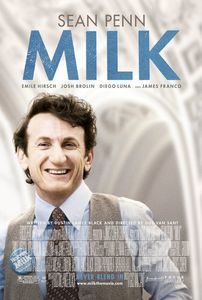
    (In theaters, February 2009) Even viewers with little specific interest in gay issues will find much to like about this didactic tale of political activism with a tragic ending. Based on a true story of Harvey Milk, “the first openly gay man to be elected to public office in California”, the film is a time-capsule slice of San Francisco during the late seventies, a biography of a most unusual man and a primer on how to affect social change via political activism. As a result, it’s not exactly the most action-driven or funniest film on the planet. But it does represent a strong lesson in the way things work, and does so with a minimal amount of preaching. Covertly, it’s intensely relevant to today’s political issues: It’s hard to see the story of 1978’s Proposition 6 without thinking about 2008’s Proposition 8, or hear the anti-gay arguments of Milk’s opponent without thinking that they are seriously on the wrong side of history. Philosophically, it’s hard not to be impressed by a film that advocates steady political and social change over revolution, given how the latter is far more dramatic than the former. Alas, it’s the tragedy at the end of Milk’s life that acts as the dramatic driver to the film, mixing up a number of the lessons one could learn from it. (One also gets the feeling that the story of the Moscone-Milk assassinations was also far more complex than the simplified Milk-centric version presented on-screen.) Sean Penn is convincing in the lead role, while Science Fiction fans will be amused to see Frank M. Robinson (who was Milk’s speech-writer) in a series of cameo appearances. The period feel of the piece is remarkable and the film doesn’t overstay its welcome despite a relatively tepid rhythm.

  • Made In Jamaica (2006)

    Made In Jamaica (2006)

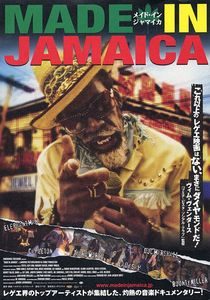
    (In theaters, February 2009) More of an extended multi-artist music video anthology with added contextual material than a true documentary, Made In Jamaica refuse to provide narration or explanation, relying solely on captured footage and interviews. Alas, the filmmakers rarely question what their interview subjects tell them, and the result is a quick introduction to reggae-dancehall that quickly becomes a frustrating superficial look at a multi-faceted issue. While it touches upon most of the aspects of the modern Jamaican reggae culture (the poverty, the aggression, the misogyny, the roots/dancehall split), it says little on some of its most damning aspects and almost nothing at all about its regressive take on heteronormativity. There are about half a dozen junctions where the film ventures into something interesting, then shies away from it. For instance, a pretty good moment when the film contrasts Elephant Man’s rote statements about promoting peace with concert footage where he sings about killing other people, is as close as the film gets to questioning its subjects. Another example of the film’s occasional gems is Lady Saw’s frank admission that she became a rude girl for purely commercial reasons, buried in a too-short look at the genre’s troubling male-dominated culture. For a dancehall fan such as myself, one of the film’s big ironies was that the musical performances I enjoyed the most (Third World’s “96 degrees in the Shade”, Gregory Isaac’s “No Woman No Cry” and a wild cross-cultural take on “I Shot the Sheriff”) were firmly on the roots divide, and the smartest interview subjects were also the roots people. I have long suspected that I would like reggae-dancehall a lot less if I understood the lyrics, and Made In Jamaica went a long way in confirming this suspicion. Good but hardly transcendent, this is a gateway documentary that often works better as an extended video musical anthology: Some of the sights are spectacular, and it is a treat to actually see some familiar names signing.

  • The International (2009)

    The International (2009)

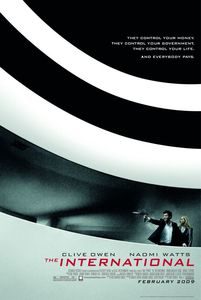
    (In theaters, February 2009) Such is the randomness of filmmaking: Five month’s worth can make all the difference between banks-as-invincible-entities and banks-as-bailout-beggars. Which is unfortunate, because a thriller based on the idea of a bank going rogue and severely punishing anyone looking into it isn’t necessarily bad (heck, it even happened with BCCI, which shares a suspicious number of letters with this film’s IBBC), and The International is as it bests when it realistically grapples with how to expose international money-for-weapons schemes. Clive Owen is irreproachable as the rumpled hero in the middle of it all, but one can’t say the same thing about a film that doesn’t quite know what to make of itself. Rumors of extensive re-shoots may explain the abrupt and inconsequential action sequences, including a spectacular-but-nonsensical shootout at the Guggenheim museum. At least the rest of the film offers a few real-life visual thrills as it hops between Europe and New York, delivering a procedural thriller whose flaws don’t quite match its strengths. A few ideas are wasted, and the conclusion is a bit of a downer. It all makes up for a middle-of-the-road thriller, promising but ultimately too scattered to be efficient. It may be respectable for what it tries to achieve, but sadly it doesn’t seem determined to get there.

  • Final Destination 3 (2006)

    Final Destination 3 (2006)

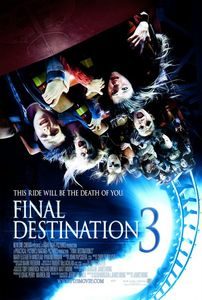
    (On DVD, February 2009) You would think that a teen horror series’ third installment would have sucked all of the thematic enjoyment of the premise, leaving little but a string of cheap kills and generic characters. And you would be right, but it doesn’t necessarily mean that Final Destination 3 is a complete waste of time. Despite the overly familiar nihilism of the premise (which was charming in the first film, but meaningless by the third one), the set-pieces of the film are conceived with a certain degree of ingenious cleverness, and the direction isn’t completely incompetent. There is a bit of nudity to redeem the over-the-top gore, and the writers have a better-than-average understanding of the cat-and-mouse game between the audience and the movie that the series has set up for itself. (The film is strong in Rube-Goldbergian machineries of death, and they generally work more surprisingly than anyone would expect) Don’t go into this film expecting more than a standard teen horror gore-fest and you’ll be fine. This isn’t anywhere near the original, but it sustains at least a bit of attention. The 2-discs DVD edition has a pretty nice array of features, from a cute animation short on everyday dangers to a self-aware discussion of “Dead Teenager Movies” to an excellent making-of documentary that is far too good and entertaining for the kind of film this is: it’s actually liable to make you fonder of the film than you’d think.

  • Rolling Thunder, John Varley

    Rolling Thunder, John Varley

    Ace, 2008, 344 pages, C$24.95 hc, ISBN 978-0-441-01563-4

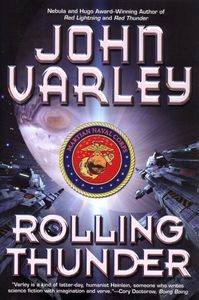
    Varley fans who complained about Red Thunder and Red Lightning aren’t likely to feel much better after reading Rolling Thunder, the newest installment in a series that seems intent on showing how ordinary the author has become. It’s not a terrible novel, but it’s intensely familiar, leads to a conclusion that seems pasted from Varley’s previous work, and it survives only thanks to Varley’s usual gift for compelling narration.

    A generation removed from Red Lightning, Rolling Thunder‘s narrator is one Patricia Kelly Elizabeth Podkayne Strickland-Garcia-Redmond, daughter of the previous book’s Ray. As the novel begins, she’s stuck on Earth, serving her time in the Martian Navy by acting as an immigration officer. It’s been a few years since the Martian Revolution of the previous volume, and Earth hasn’t quite adjusted to the change. The situation around the world is worse than ever, in part thanks to the disaster descriped in the previous novel, but Mars isn’t ready to let everyone immigrate en masse.

    When Podkayne’s great-grandmother is suddenly scheduled for bubble stasis for medical reasons, it’s a mandatory ride home and family reunion for her, then a reassignment to the entertainment division of the Mars Navy where she becomes a jazz singer. (Don’t worry: she justifies why the music she sings is all made out of classic numbers. As usual with writers of Varley’s generation, the future doesn’t belong to pop music —or anything made after the sixties.) A tour to Jupiter’s Moons doesn’t go as planned, though, and the consequences are dire both for Podkayne and for the human race.

    Like its predecessors, Rolling Thunder is grossly chopped into two relatively independent sections, separated by time. A disaster leaves Podkayne unchanged, but affects everyone else’s perception of her, with dangerous results for the young woman. It all leads to a conclusion that seems to borrow equally from The Ophiuchi Hotline and Steel Beach.

    Also like its predecessors, the saving grace of Rolling Thunder isn’t to be found in its overarching plot, but in its moments or line-by-line narration. The homages to Heinlein are just as blatant as in the previous books, but the clear-voiced narration holds up things better than you’d expect, with lengthy yet appealing digressions on how things are done at that time. This being said, I wonder if Heinlein could have pulled off the dark ending of this novel, in which the characters basically run far far away in order to avoid the apocalypse threatening the rest of humanity.

    As a science-fiction novel, it’s a minor work. It’s even more disappointing coming from Varley, although none of the three books in its series have been particularly impressive. With a bit of effort, this could have been a novella: the plot density is laughable, especially when the bulk of the novel seems to be Podkayne telling us about her day-to-day life.

    If readers have made it thus far in the series, they might as well keep going: It’s an amiable entry in the series and the fact that it’s slight and negligible doesn’t make it less than entertaining. What’s more, it’s a stepping stone to what Varley says is the fourth and final tome in the series, Dark Lightning, to be written and published in a few more years. Not that we’re in any hurry.

    It’s a sign of the novel’s minor impact that it’s not particularly interesting to dissect or even comment: If Varley’s your thing, this will do while you await for his next novel. But there’s no denying that Varley’s best works seem more and more distant.

  • Defiance (2008)

    Defiance (2008)

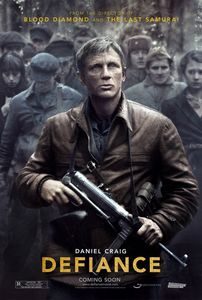
    (In theaters, February 2009) In time, no single aspect of World War 2 won’t be turned into a movie, and this little-know story of resistance in the Polish backwoods is often more interesting than you’d expect. When small-time bandits turn their survival skills to the protection of Jewish refugees, the film becomes an amalgam of war drama, small-scale action and survival Robinsonade. Daniel Craig is effective in the lead role, lending his increasing Bondish gravitas to a film that sorely needs it. Elsewhere, the heavy hand of Hollywood movie-making can be seen rewriting history for maximum thrills (such as a tank battle with a nick-of-time rescue) and buffing up small characters into exposition mouthpieces. Defiance seldom shies away from underscoring whatever mood the film wants audiences to feel, and the result often ends up feeling forced. The interplay between the various groups involved in the story (Nazis, sympathizers, Polish-Jewish elders, Russian resistance, etc.) merely hints at the complexity of the true story. But even discounting the manipulation, Defiance still manages to feel like solid entertainment with a dash of history: Edward Zwick is comfortable with historical dramas, and the result is not too unpleasant once you stop identifying with the horrid conditions in which the characters spend most of the film. There are worse films out there, even in the limited “footnotes of WW2” sub-genre.

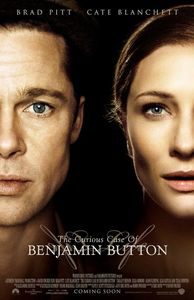
  • The Curious Case Of Benjamin Button (2008)

    The Curious Case Of Benjamin Button (2008)

    (In theaters, February 2009) Every crop of Oscars contenders includes overlong weepy dramas, and The Curious Case Of Benjamin Button is 2008’s entry in the sweepstakes. Based around the fantastical premise of a man aging backwards, the film feels free to explore issues about youth, aging, living and dying. With intentions like those, you won’t be surprised to find out that the end of the story is solid weeping time, the film sparing no effort in lining up every single piece of symbolism it has accumulated during its considerable length. From the first few moments, it’s obvious that this film goes from scope and length rather than any single conception of narrative efficiency: The scenes drag on with unrelenting digressions, bit players, slow accents and separate set-pieces. This is a life epic told as watered-down fable (Fans of Big Fish will find something familiar in Benjamin Button‘s off-beat sweep through the twentieth century), a mode that will charm certain viewers and leave others riffing on the melodramatic weight of the film’s every moments. For some, the irony will be that the film comes from director David Fincher almost ten years after the hyper-aggressive Fight Club: the technical polish of the film is just as considerable, but the narrative style is almost half as dense. There’s something admirable in the way the film so obviously reaches for tears in its final thirty seconds, even when the manipulation is all perfectly obvious. Acting-wise, there’s little to say except for Brad Pitt’s measured performance through the ages, and the able supporting work from a diverse cast. Don’t be surprised that the film plays better at home, with ample leisure time, than in the cramped seats of a movie theater.

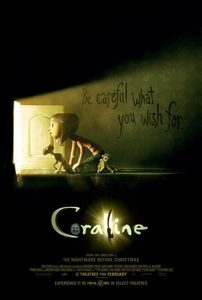
  • Coraline (2009)

    Coraline (2009)

    (In theaters, February 2009) There are two big reasons why this film is worth seeing, but the most obvious one is the visual polish of the piece, which blends flawless stop-motion animation with computer-generated enhancements and, if you’re lucky or rich, can even be experienced in showy 3D. Yes, the 3D thing is a gimmick: There are a number of shots in the film that make little sense in 2D, although director Henry Selick is smart enough to avoid the old unsubtle poke-the-audience-in-the-eye shtick. 3D aside, though, Coraline is a gorgeous piece of visual imagination, with enough spectacular design to keep you coming back to the film even on a 2D screen. That, in large part, is due to the second big reason why you should see Coraline: The quality of Neil Gaiman’s oddball imagination, which (despite a few changes from the original novella) powers the unusual fantastic elements of the story. It’s familiar without quite being like anything else seen before, and this originality is what separates it from so many run-of-the-mill juvenile fantasies. It’s not an unimpeachable film (dig a bit, and plenty of vexing thematic problems arise), but it’s different, confident and competent. Too bad that the technology won’t allow 3D projection on small screen for a few years: Unlike many other examples of the genre so far, Coraline earns some extra credits with another dimension, even while it’s perfectly good in 2D. But don’t wait or fret: just see it.

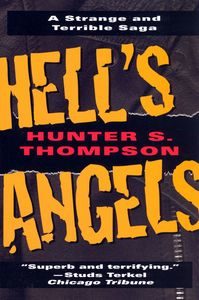
  • Hell’s Angels, Hunter S. Thompson

    Hell’s Angels, Hunter S. Thompson

    Ballantine, 1967 (1996 reprint), 273 pages, C$17.00 tpb, ISBN 978-0-345-41008-5

    Let’s face it: most books have a useful life measured in years, if not months. Once they’ve been removed from bookstore shelves, put out-of-print and remaindered, books quickly fade away from public attention. Non-fiction withers away even less gracefully than fiction: The world outside the book evolves, leaving the subject behind as a historical curiosity.

    Hunter S. Thompson’s Hell’s Angels is part of a tiny minority of enduring non-fiction titles. Still in print forty years after publication, it’s still being purchased and read today. Two reasons explain why: First, it’s a book by Hunter S. Thompson, a writer whose legend burns just as brightly today than in 1967. Second, it’s a crackling good read about a fascinating subject that remains of interest today.

    For if the hippies of San Francisco’s mid-sixties have faded away, the Hell’s Angels that flourished at the same time are still very much active today. Their outlaw legend has shifted somewhat: People (especially in French Canada) now tend to associate their illicit activities with organized drug-running and biker wars rather than the anarchic hooliganism of their early years. But the mystique endures just as it did in 1965, the year when Thompson wrote his first article on the San Francisco-area Hell’s Angels and ended up up riding with them for another year while researching his book-length narrative. (The ride ended when, as Thompson describes in the gut-punch last chapter, he himself was “stomped” and beaten by the Angels.)

    One of the reasons why Hell’s Angels remains so readable today has to do with Thompson himself: Though he calls the Angels stupid and ignorant, there’s no doubt that he has considerable sympathy for the outlaws and the way they can get away with what they do. Thompson himself wasn’t an entirely straight arrow at the time, and fans will recognize typical Thompson stories as he describes how he “somehow” ended up firing a shotgun outside his apartment at night. Thompson, in fact, spends more time decrying mainstream treatment of biker gangs (calling the contemporary media coverage woefully ignorant, sensationalist and patronizing) than he does condemning the Angels.

    By living with the gang for a year, Thompson also manages to understand and describe them better than anyone else at the time: His exploration of the psycho-sexual dynamics of the Angels is brutally frank (even today) and completely engrossing. The portrait he draws up is that of a familiar type: men who can’t find a place in mainstream society, hanging together in a mutual support group. When Hunter ends his book with dire predictions that motorcycle gangs are part of the way American is going to become in the future, history proves him right.

    But socio-political analysis aside, the best moments of this great book end up being the first-hand descriptions of a Hell’s Angels run on a small California community, as both Angels and local authorities are practically begging for a confrontation. It ends up being a non-story, with Thompson stuck in the middle, but it’s also a segment that would mark a turning point for him: Hell’s Angels may not be completely gonzo journalist, but it’s certainly a prototype of articles in which the process of getting the story becomes the story.

    In-between, you get passages describing the pure thrill of pushing a motorcycle so close to the edge that you can’t see beyond the next turn in the road. You get a sense of San Francisco during the sixties. You get Hunter S. Thompson as a young man trying out his full powers as a writer. But more than that, you get a crackling good read, even forty years after publication. This is a book that has endured for good reasons: It’s a minor classic in its own way, and it’s well worth picking up.

    [June 2009: I wouldn’t go so far as to call Tom Wolfe’s The Electric Kool-Aid Acid Test an essential companion to Thompson’s Hell’s Angels, but it does offer another look at mid-sixties San Francisco and in discussing Ken Kesey’s psychedelic lifestyle, often overlaps with Thompson’s motorcycle gang. (In fact, Thompson is acknowledged as having provided audio tapes to Wolfe.) But modern readers will trip over the most annoying thing about The Electric Kool-Aid Acid Test, which is Wolfe’s stream-of-altered-consciousness prose style: Impressionistic at beast, unreadable at worst. If it does a fine job at portraying a particular mindset, it also graphically shows why the hippies went away since then. Still, patient readers will find a few nuggets of interest in the depiction of the times, as well as random factoids and references. Heinlein’s Stranger in a Strange Land is referenced casually, as is Clarke’s (unattributed) Childhood’s End. Plus there’s the fascinating etymological tidbit that “bummer” (as in: “a bad trip”) was adopted by the hippies from the Hell’s Angels slang for, yes, “a bad trip” –you can figure out what part of the anatomy hurts after a bad motorcycle ride. Ultimately, though, much of Wolfe’s book is simply too difficult to read to be truly rewarding. Of historical interest.]
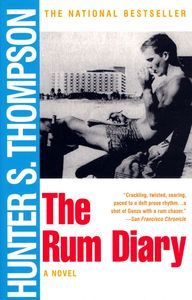
  • The Rum Diary, Hunter S. Thompson

    The Rum Diary, Hunter S. Thompson

    Simon & Schuster, 1998, 204 pages, C$15.50 tpb, ISBN 978-0-684-85647-6

    Published in 1998, in the waning dusk of Hunter S. Thompson’s career, The Rum Diary is nonetheless a formative work for the American writer/journalist: The first draft of the novel was completed in the early 1960s, as Thompson himself bounced around New York, Puerto Rico and Big Sur. Finally published (and somewhat re-written) in the late nineties, The Rum Diary offers a curious bookend to Thompson’s career. Conceived early but finished late, it offers a parallax view into the writer’s head.

    The plot, unsurprisingly, concerns the adventures of an American journalist, Paul Kemp, as he makes his way from New York to San Juan as a small newspaper staffer. There are, as you may expect, a number of complications: Kemp is fascinated by a Caucasian women who flew in on the same plane as he did, and then there’s the free-flowing atmosphere of San Juan during the late fifties, a barely modernized land where rum flows as freely as water.

    Let’s be blunt for a moment: If it wasn’t for the fact that this novel was written by Hunter S. Thompson, there wouldn’t be many reasons to read it. The prose is fine, but hardly transcendent and nowhere as explosive as latter-day Thompson. The plotting is generally aimless. The characters aren’t worth caring about. The Rum Diary trades on the reputation of its author as a hard-drinking rabble-rouser: Could this novel be autobiographical? Can it offer clues regarding the rest of Thompson’s work? Does it contain a Rosebud! moment when we suddenly understand the rest of Thompson’s life?

    Well, no. In most aspects, it’s a fairly ordinary, aimless novel of a young man trying to survive after drinking too much in a quasi-foreign land. Puerto Rico may be American territory, but Kemp’s life in San Juan is one of an expatriate, congregating with the other English-speaking Caucasians and looking at the native population with a heavy dose of, well, fear and loathing. If the novel has one thing that can stand separate from the reputation of its author, it’s the description of San Juan as a place: Thompson clearly establishes the atmosphere of the time, the peculiarities of an environment so far away from everything else, and the bonds that form before fellow cast-offs. Still, Thompson isn’t particularly kind to Puerto Ricans, and occasional racial slurs make it through the novel. (Raw excerpts of The Rum Diary, before re-writes, can be found in Thompson’s Songs of the Doomed collection: in them, he’s even less kind.)

    But it’s far more interesting to compare Kemp and Thompson, or rather Thompson before the legend and Thompson after. The Rum Diary only has a little of the madness to be found in works like Fear and Loathing in Las Vegas: Kemp can be moody and contemplative, whereas latter-day Thompson was belligerent and manic. (Their drugs of choice at the time may have something to do with it.) It’s tempting to go back to Kemp and see there the potential not just for latter-day Thompson, but what would have happened if the younger Thompson had been taken seriously as a writer of fiction, if he had avoided the drugs of late-sixties San Francisco, if he had found himself just as Kemp narrowly seems to find himself at the end of The Rum Diary. But that’s asking a lot of a novel that is, after all, just one that describes a not-so-young-man living it up in an exotic land. Yet that may be the only thing worth asking about a novel where drunken episodes substitute for plotting.

    It goes without saying that The Rum Diary‘s first audience should be those who have considerable knowledge and sympathy for Thompson before even cracking open the first page. This is a filler in the grand tapestry of Thompson’s work, and it may even best be read at the end of his bibliography rather than at the beginning; until the first San-Juan-era version of the manuscript is made available, who’s to say how much of what we’re reading from from Thompson-the-novice and what’s from Thompson-the-veteran? His biography, Gonzo, makes it clear that publishing the novel was not a grab at literary respectability as much as it was a way to make money: a more solvent Thompson wouldn’t have allowed the publication of the novel. Doesn’t that perfectly place The Rum Diary in Thompson’s oeuvre?