Author: Christian Sauvé

  • Federal Protection (2002)

    Federal Protection (2002)

    (On DVD, July 2003) Flashback alert! What does a movie about a federally-protected ex-hitman moving in a quiet suburban neighbourhood remind you of? Yes, that’s right, The Whole Nine Yard. This straight-to-video film not only replays the same basic idea, but also does so in Montréal, which here unconvincingly stands-in for “Little Rock, Arkansas”. (No amount of American flags and lone US-Post mailboxes can hide the characteristic architecture, Canadian money and equally-lone Canada Post mailboxes) Armand Assante is the “Bruce Willis” of this film, though the character dynamics beyond that change a lot: Here, he seduces the neighbour’s wife while her husband is in cahoots with his mistress to reveal Assante’s location to the mob. Yes, it really sounds like a rip-off, but it’s executed with some competence and the result is a great deal more interesting than you’d expect from such a premise. Dina Meyer is frequently hot as the mistress and Assante does a lot to help the film’s credibility. Also notable is the film’s intention to play most of the story straight, with only occasional comedic moments. The finale is far too long, the budget is limited, some of the tone shifts are uncomfortable and the “ripoff!” impulse never goes away, but it’s a decent enough film, better than some of the worst things I’ve seen in theatres this year. The DVD contains no special features of note.

  • The League of Extraordinary Gentlemen (Volume 1), Alan Moore & Kevin O’Neill

    America’s Best Comics/DC Comics, 2002, 192 pages, C$24.95 tpb, ISBN 1-56389-858-6

    One of these days, I will write about copyright and the public domain and how corporations are holding real human intellectual achievements for ransom in exchange for imaginary monetary gains. I will discuss how our culture feeds on itself and how unlimited copyrights are choking vitality out of it. And whenever I do, I will reference Alan Moore’s The League of Extraordinary Gentlemen at length.

    But not today, because I want to spend some time just discussing Moore’s remarkable work. It’s not the first of his stories to find its way on my bookshelves (already furnished with a copy of Watchmen and V for Vendetta), but it’s well worth some attention even for non-comics fans. A steampunk fantasy in which some of the best-known fictional heroes of the Victorian era are brought together to fight threats to the British empire, The League of Extraordinary Gentlemen is indeed an extraordinary piece of work mixing superhero fantasy, literary allusions and historical flair.

    On the eve of the release of the July 2003 movie adaptation, I scoured local comic shops and managed to get the last available copy in the Ottawa area, fresh out of the “new arrivals” box. The trade paperback edition of the first series (a second is currently being published, with a third one announced) contains all six episodes of the story, plus miscellaneous art and a collected “serial” short story written by Moore in the style of H. Rider Haggard.

    Why Haggard? Maybe because he’s the author of the Alan Quatermain stories, and Quatermain is one of the five “extraordinary gentlemen” of the title. Completing the cast are Mina Harker, Captain Nemo (Woo! My favourite!), Doctor Jekyll (including Doctor Hyde) and the invisible man. All of which are safely out of copyright by now, hence available for play. (Allusions to their contemporary detective Sherlock Holmes are also sprinkled through, though by 1898, Holmes is still presumed dead from his Reichenbach Falls showdown. One also suspects that Moore has steered away from Holmes in reaction to the endless Holmes pastiches found elsewhere in steampunk.)

    The League of Extraordinary Gentlemen essentially reprises superhero comic book fantasies: the story is strictly comic-book stuff, complete with a climactic battle aboard a flying fortress. But superhero fantasies have rarely been this emotionally extreme. This is from a script by Alan Moore: it’s not for kids. The Invisible Man is an amoral psychopath and a serial rapist capable of casual murder. Mr. Hyde doesn’t appear to be any better. Alan Quatermain is introduced while in a deep heroin-induced stupor and spends most of the story re-learning how to be heroic. Even Nemo has a rich past as a pirate. All of which makes for a fascinating group dynamic, with portentous implication for their next adventures. (Indeed, I’m told that one particular conflict is settled in a grisly fashion in Volume Two.)

    But the real reason to read this graphic novel is in the intricate historical and literary allusions. Moore has performed some heavy-duty research to enhance the credibility of his imagined universe and it shows. From the second page onward, we’re treated to a richly-detailed alternate-universe Victorian England, complete with a bridge across the Channel, cavorite, the Nautilus, Moriarty and references to just about every single known (or less-known) Victorian-era character. This is one comic book worth re-reading, certainly with a concordance in hand. (Check out Jess Nevins’ Heroes & Monsters, an earlier version of which can be found on-line.)

    It all amounts to one impressive graphic novel. While I’m not a fan of Moore’s ultra-violent sensibilities nor of Kevin O’Neill’s flat and angular artwork (which, at least, has the merit of looking like a hypothetical Victorian-era comic book), The League of Extraordinary Gentlemen is definitely something else, a work of brilliance that stands apart from just about anything else you’ve read before. The historical tone is nearly perfect, and the sense of playful storytelling is contagious.

    It’s not a surprise to find out that the 2003 film is nothing like the graphic novel. A poor re-imagining without any of the depth in Moore’s writing, the film aims for cheap thrills over intellectual satisfaction. Worse; in botching a good concept and delivering a flat adventure film, it ends up being a less interesting, less exciting work than the original material. You don’t need my recommendation to grab a copy of the graphic novel; just do, already.

  • Wicked Game aka Extreme Heist (2002)

    Wicked Game aka Extreme Heist (2002)

    (On DVD, July 2003) Now here’s a real curiosity: On one hand, this straight-to-video release is in many way the most horrible thing you’ve ever seen passed as a putative “movie”: muddy digital film quality, dumb plotting and some of the worst acting you’re ever likely to see. (No joke nor hyperbole! Motoko Nagino is one hot Asian lady, but her line delivery is atrocious!) And yet, despite the micro-budget, the movie periodically erupts in a flurry of eye-popping stunts and cool action sequences. In many ways, this is a lot like an American early-Jackie Chan film, a comparison made easy by the raw, goofy charm of lead actor Johnny Yong Bosch. Intricate fight scenes, heart-stopping stunt driving and a nifty parachute climax pepper the inane plot like so many unexpected goodies. In this case, even the micro-budget becomes an advantage, as there’s scarcely any place for CGI trickery, stunt doubles or fancy camera angles; everything feels dangerously real. (One standout shot has a protagonist hanging on top of a crashing car, inside a shack, hitting his head against a low wood beam! Ow!) As the film advances, it becomes clear that this is practically a stunt demo reel, strung together by a small crew in order to gain experience and have some fun. Considered this way, Extreme Heist is far more sympathetic, a little unpretentious movie that does because it can. Heck, considered this way I might even recommend that you take a look. The DVD edition is marred by an awful digital transfer and contains no special features: a real shame considering the making-of story that must lie behind the film!

  • Chopper (2000)

    Chopper (2000)

    (On DVD, July 2003) Coming straight from Australia, this docu-fictive account of the life of criminal Mark Brandon “Chopper” Read is stuffed with interesting moments, but you’ll have to work hard at understanding anything. Hey, I think Australia’s a great nation filled with cool people, but when I can’t understand anything at all in a movie that doesn’t even feature subtitles (those insensitive DVD-making clods!), I’m not particularly interested in following the film. Fortunately, the French-language audio track was more intelligible. While the film lost something in translation, it was still better than to try to decipher the thick Australian street-talk. Yes, Chopper is obviously a low-budget film: the lengthy shots, grainy film stock, oversaturated colours, static camera and sparse sets aren’t just a stylistic choice. I suppose that the target audience of the film already knows “Chopper”, because the film presents important clues about his achievements in what is almost a casual fashion; pieces are missing here and there, and there’s no making-of on the disc to help us figure it out. It is, indeed, a fictional representation of a real person. In any case, the real winner of the film is Eric Bana, whose representation of “Chopper” runs a fine line between jovial innocence and hard-edged brutality. Frightening and charismatic at once, it’s easy to see why he was hired for The Hulk after this film. (The irony, though, is that he deliver a better performance as a “Hulk” here than in the latter film.) The film does features quite a few clever moments, but not quite nearly enough to compensate for its uneven quality. As mentioned, the Canadian Alliance-Atlantis DVD contains no special features worth mentioning and no subtitles, but it does sport a more intelligible French-language track.

  • C.H.U.D. (1984)

    C.H.U.D. (1984)

    (On VHS, July 2003) Wretched. No other word for it. Obviously a B-grade film with its low-budget feel, from unconvincing acting to muddy cinematography, dirty sets and laughable monsters. Ostentatiously about toxic wastes creating monsters in New York’s underground tunnels, C.H.U.D. is closer to an endurance contest as a laboriously overworked plot is slooowly set up with a bunch of amateur actors. I suppose that genre enthusiasts might get some value out of it, but everyone else may want to steer clear away. It’s dull, not particularly involving, saddled with a ridiculous “climax” that falls flat and peopled with uninteresting characters that don’t die quickly enough. Celebrity-watchers may notice a younger John Goodman in a cameo role as a hungry policeman. Otherwise, well, you’ve got other things to do.

  • Black Point (2002)

    Black Point (2002)

    (On DVD, July 2003) Hmmm: A straight-to-video thriller starring David Caruso. How less promising can a film possibly be? As it turns out, though, Black Point actually holds some interest. Plot? An ex-soldier falls for the moll of a local northwestern drug lord, three million dollars pop up, betrayals ensue. There are a few fun plot twists, one amusing threat of icy lynching, a spectacular blonde heroine (Susan Haskell) and a decent pace nonetheless. Sure, the film looks cheap; the cinematography is optimized for full-frame presentation and the set designs are definitely sparse. (Plus, the town of Black Point definitely feels underpopulated.) Character-wise, it’s also a dud: The hero is a hero because the film says so, the motivations of the heroine remain muddled and the bad guys aren’t particularly interesting. But as long as your expectations are kept low, you just might get some enjoyment out of the whole thing. The bare-bones full-screen (yuck) DVD’s most interesting feature is a series of trailers for other RemStar straight-to-video features: funny stuff!

  • American Gods, Neil Gaiman

    Harper Torch, 2001, 592 pages, C$10.99 mmpb, ISBN 0-380-78903-5

    This is a protest review.

    My formative years in reading Science-Fiction were shaped by a checklist of Hugo-winning novels. Whatever won, I read and in doing so, gained an appreciation for most of SF’s greatest works. Hence my somewhat sentimental belief that Hugos should be given to… wait for it… the best science-fiction novel of the year. Not horror. Not fantasy. Not pseudo-literary pretentious crap. True, honest, unabashed science-fiction.

    In the past few years, I have often been disappointed in the collective judgement of Hugo voters. (Forever Peace? What the hell were they thinking?) It got worse in the past two years: Harry Potter? Why? Aren’t there World Fantasy Awards for this kind of stuff? I love the little wizard, but he’s clearly not starring in SF novels.

    Then came American Gods. Folks, Neil Gaiman may be a god amongst writers, but this stuff isn’t SF. And yet, grudgingly, I came to accept (after a lengthy period of denial, anger, depression and bargaining) that sooner or later I’d have to read the novel for completion’s sake. So I held my nose, bought the paperback (I may be a spiteful purist, but I’m not a cheap spiteful purist) and read the darn thing.

    It’s not a bad book at all.

    But it’s not Science Fiction.

    Oh, one almost hesitate at times. The story involves a gigantic battle between the gods (who are, incidentally, living among us under various disguises), pitting old deities against newer ones. Upon his release from prison, protagonist “Shadow” is hired as an assistant by one of the most influential gods and gets to see most of the struggle. Where American Gods is meaningful to the Hugos is in its all-too-brief depiction of the modern gods. We get a fleeting glimpse of technology replacing mysticism, but also of belief carrying over. When people stop praying, it doesn’t necessarily mean they’re less superstitious; who hasn’t felt a little frisson of simple belief when confronted to the incomprehensibility of modern technology? Don’t we worship what we don’t understand? For that matter, what is Science Fiction’s responsibility in creating those new gods/archetypes (aliens, AIs, cyberpunks or time-travellers) taking over the older ones?

    Alas, that particular SF novel remains to be written, for Gaiman seems far more interested in dealing with the old gods in all of their bloodthirsty furor. The “opposing side” of technoweenies and Men in Black is teasingly mentioned when strictly necessary, creating unfulfilled expectations. While strictly speaking an urban contemporary fantasy novel, American Gods is too enamoured with old folklore to let go. This causes unnecessary lengths (the various passages describing the arrival of gods in America struck me as being particularly dull) and also locks the novel in an old-fashioned fantastic mentality. A science-fiction novel might have explored the relative merits of those newer gods and conveyed a more contemporary feel. (along with a lesson in memetic evolution, I bet)

    We can only assume that this wasn’t Gaiman’s intention. But whenever I could let go of those assumptions and enjoy the story for what it was, American Gods proved to be enjoyable on its own terms. The protagonist is enough of a blank slate to be interesting (curiously enough) and Gaiman is adept at extracting some wonder out of today’s world. The writing is usually crisp and clear —with some intentional exceptions. At times scary and hilarious, profound without being inaccessible, this is an epic novel with a off-beat tone and a lot of affection for modern-day ordinary America.

    In short, American Gods is a perfectly respectable piece of contemporary fantasy. I certainly don’t regret reading it and you can now even consider me as being mildly interested in Gaiman’s work. But—and you can certainly see this coming—it’s not science-fiction and I certainly regret its selection as the winner of the 2002 Best Novel Hugo Award. Science Fiction, dammit! I protest!

  • Bad Boys II (2003)

    Bad Boys II (2003)

    (In theaters, July 2003) You don’t have to be a sadistic teenage sociopath to enjoy this film, but it definitely helps. Given that the original Bad Boys was the last dying gasp of the 1984-1995 era of R-rated buddy-cop adventures, it’s fitting that this sequel feels, in many ways, like a throwback to the eighties. Equal parts “Miami Vice” and “Grand Theft Auto: Vice City”, this is first and foremost an action film, and it is never better than during the first fantastic car chase, featuring disintegrating cars dumped from a vehicle carrier on a claustrophobic Miami bridge. Memorable stuff even in a summer season packed with great car chases. (And memorable even though the basic concept has been used previously in Tokyo Raiders, much like the shantytown smash-down may very well have been suggested by a similar sequence in Police Story.) Other action sequences hold up rather well, and clearly show that even if director Michael Bay proves to be illiterate, he can move the camera and film mayhem like nobody else. Stupid action movies like this one are his forte, not pretentious pseudo-patriotic drivel like Pearl Harbor. His nervy direction is one of Bad Boys 2‘s many pleasures, along with the cool Miami locations, a wonderful Gabrielle Union, a très slick Will Smith, Joe Pantoliano’s caricatural cop chief and a few good comedy bits. Heck, even Martin Lawrence is generally tolerable, anchored as he is by Smith’s solid presence. He’s annoying, but he’s supposed to be. Had the movie concentrated on its strengths, if would have been a dynamite piece of action film. Alas, it doesn’t, and goes floundering in lengthy “hilarious” digressions (Martin’s exstasy trip is unbearable), gratuitous gross-outs and lame setups. It all adds up to a bloated two-and-a-half-hours film that contains a bit too many clunky elements to be totally successful.

    (Second viewing, On DVD, March 2004) I love filmed mayhem, and few recent films have delivered so much of it as Michael Bay’s cheerfully sadistic sequel. It’s far from being a perfect film as a whole (dumb humor, choppy storytelling, uneven interest, etc.) but parts of it attain something very close to action perfection. The MacArthur Freeway chase sequence is an anthology piece; the shantytown destruction is a guilty pleasure; the opening credit sequence is a model of big-budget storytelling and the hearse pursuit is a gift for everyone’s inner sadist. Still, whatever you think of the film, there’s plenty of good things to say about the special-edition DVD, which gives an unparallelled glimpse in the making of a big-budget action film. There is little or no narration; the “video diary” approach, on the other hand, is tremendously effective. There is no audio commentary on the film, but the plethora of extras on the second disk make this absence irrelevant. I was especially impressed by the Freeway chase making-of. Spectacular!

  • American Psycho II: All American Girl (2002)

    American Psycho II: All American Girl (2002)

    (On DVD, July 2003) I don’t think anyone expected anything great from this straight-to-video sequel to the underrated 2000 black comedy. While this isn’t up to the level of quality of the first film, it’s actually not bad at all. Story: Patrick Bateman’s teen killer dedicates her life to crime-fighting, and if a few other students threaten her inevitable internship at the FBI… well, they’ll have to be taken out of consideration, right? The biting black comedy works more often than it doesn’t and if there are a number of useless plot twists in the third act, the film’s conclusion still packs a cute little punch that goes a long way toward satisfying any viewer with a taste for that foolishness. Interestingly enough, there’s very little gore in this film despite the regular murders: the emphasis is on the sarcastic narration and the black comedy more than the visceral horror thrills. William Shatner (yes, him) turns in an amusing performance as a middle-aged teacher, while Mila Kunis just may do good things if she keeps getting interesting roles like the psychotic “Rachael Newman”. As a teen horror film considered on its own merits (and not as a sequel), it’s surprisingly decent (far better than most of the crap that actually makes it to theatres) because it’s more funny than grisly. The DVD contains a few deleted scenes (some good stuff there), outtakes (ditto) and two commentary tracks, but director Morgan J. Freeman’s whiny, obvious patter is insufferable after ten minutes.

  • 28 Days Later… (2002)

    28 Days Later… (2002)

    (In theaters, July 2003) It’s not particularly original to mix zombie films with post-apocalyptic SF, but I suppose that every generation needs its own “last man on Earth” story. Crudely shot on muddy digital video, 28 Days Later looks and feels exactly like the kind of film to acquire a cult following. Naturally, it’s also the kind of film to deserve cries of “overrated!” Certainly, it’s not all that good: Most of the film’s first half is spent hearing character say “don’t do this!” and then seeing other character do exactly that, with dire consequences. The latter half of the film slides into an unreal Ramboesque fantasy of one lone man decimating a bunch of villains. (Plus, it deals with primal topics our enlightened age would rather avoid) Director Danny Boyle adopts the stylistic philosophy that fast cutting, loud noises and grisly half-images equate terror. Alas, for some, this merely equals boredom: it will work for some and work against others. While not particularly bad nor good, 28 Days Later still holds some interest, especially if you haven’t drunk your fill of post-apocalyptic horror.

  • Darwin’s Blade, Dan Simmons

    Morrow, 2000, 368 pages, C$37.95 hc, ISBN 0-380-97369-3

    If you’ve been browsing the web for longer than six months, chances are that you’ve heard of the Darwin Awards, those dubious honorifics posthumously given “those who improve our gene pool… by removing themselves from it” (see their web site at www.darwinawards.com) or, more prosaically, to people so stupid they deserved to die. Darwin Awards lists get forwarded through the Internet regularly, cramming stories of fatal mishaps in countless email boxes at depressingly predictable intervals. (There is an interesting lack of self-awareness in blindly forwarding stories of stupid behaviour to everyone on your contact list, but I digress.)

    Darwin’s Blade begins with a fictionalization of what may be the Darwin Awards’ most famous stupidity-induced death. I won’t spoil it, but this bizarre accident manages to showcase the deductive skills of one Darwin (“Dar”) Minor, an accident investigator with far more skills than one may suspect. Chapters later, as Darwin out-drives a pair of Russian thugs, he finds himself thick in the middle of a sordid insurance-scamming business where families die and billions of dollars are defrauded. Firefights, dogfights, sniping, romance and more wacky insurance cases are quick to follow.

    Dan Simmons hops from genre to genre with great skill and success: Hyperion and its sequels rocked the science-fiction world and Summer of Night blew away more than one horror reader. Now, Darwin’s Blade is Simmons’ entry in the (techno)thriller genre. The action moves furiously from one thing to another, there is a pleasant density of technical details for just about every new gadget, military matters are mixed with detective work and the action ratchets up to (no kidding) a mano-a-mano duel in the middle of a grassy plain. Mixing high technology with primitive human stupidity, Darwin’s Blade is one tasty book for readers with a penchant for thrillers about unusual knowledge. As with his previous novels, Simmons has studied a genre and understood what readers want. Also obvious is Simmons’ penchant for recycling: Darwin’s Blade immediately evokes the similar accident-investigator story “Entropy’s Bed at Midnight” (from Lovedeath) and at one point echoes an idea from his short-short horror story “Two Minutes Forty-Five Seconds” (in Prayers to Broken Stones).

    Like most thrillers, the appeal of Darwin’s Blade depends a lot on its protagonist. In Darwin Minor, we’ve certainly met a capable hero, perhaps even a little bit much so. For he’s not simply a top-rated accident investigator (one whose eponymous aphorism states that “the simplest solution is usually stupidity.”) Oh no; Excellent driver, PhD-holder (in nuclear physics, no less), Vietnam veteran Marine, expert sniper, champ sail-glider, world-class chess player, literature-lover, Darwin Minor packs enough interests to fill a full trilogy. But in what may be one of Darwin’s Blade most amusing flaw, his multiple talents are uncovered as the story requires them. By the time a flashback describes how a 19-year-old Darwin, already PhD in Nuclear Physics, defends a Vietnamese nuclear power plant against attack without it having a link to his academic background, well, it’s not hard to feel as if Simmons has crammed one too many talents in his stoic hero. Fortunately, there is a point to all of those skills besides the demands of the plot… but it’s made a bit too late to comfort the least indulgent readers.

    The other not-quite-so-amusing flaw of the novel may be glaring to some and transparent to others, depending on their degree of familiarity with, yes, the Darwin Awards. Many well-known stories are simply transplanted in Darwin’s Blade with scarcely any winks to the knowledgeable audience. Besides the first few pages, the worst instance of this takes place at the end of Chapter 14, where the punchline of the whole sequence is obvious as soon as we read the words “chicken cannon”. Nearly everyone who knows what a chicken cannon is and how it’s used is also familiar with the one single famous anecdote about it. Unfortunately, Simmons takes five pages to spell it out.

    But no matter: those quirks aside, super-protagonist Darwin Minor is one heck of a hero and the density of ideas, concepts and gadgets in Darwin’s Blade more than outweighs the faults it may have. Thanks to Simmons’ delicious prose and efficient plotting, the book roars along with the speed of an Acura NSX and delivers plenty of fun thrills despite the occasional disbelieving giggle or two. Simmons fans should be comforted; the man has successfully genre-hopped again.

  • Psychohistorical Crisis, Donald Kingsbury

    Tor, 2001, 727 pages, C$10.99 mmpb, ISBN 0-765-34195-6

    Even more than fifty years after their original publication, Isaac Asimov’s Foundation trilogy stands as one of Science-fiction’s enduring classics. While the book’s narrative qualities now seem charmingly quaint at best, the strength of the trilogy’s main conceit has survived the ages: What if we could develop a hard science (say, psychohistory) that could accurately predict the behaviour of large human groups? What if this knowledge was used to prevent (or attenuate) major social catastrophes?

    The implications of this concept have been mulled over at lengths by fans since then, but even Asimov’s subsequent exploration of the Foundation Universe (with some half-dozen sequels, plus an “authorized” posthumous trilogy by Bear, Brin and Benford) hasn’t slowed the speculation. Now, with an entire 750-pages “unauthorized” sequel thousands of years after the events of Asimov’s trilogy, Donald Kingsbury acquires some serious street creds as the most obsessed Foundation fan ever.

    That, in case you’re still wondering, is a good thing. Kinsbury adjusts some of Asimov’s most unlikely missteps (the Mule’s psi powers are ingeniously retro-explained as a direct mind-link, with stupendous implications for the plotting of the novel), forgets all about that Robots and Empire nonsense added in the last few books and presents a galaxy-spanning sequel. He also questions the very foundations (har-har) of Asimov’s premise, and what it means for the average human living in that universe.

    I have noted, in my previous review of the Foundation trilogy, how psychohistory (and most of Asimov’s later retrofits) could lead to an absolute power fantasy in which total control was exerted to control humanity’s fate. I certainly wasn’t the only one to make the remark (it even figures as a major plot point of Asimov’s last Foundation novels), and it’s only one of the kernels from which Kingsbury spins his tale.

    It starts with a bang, as our protagonist -”Eron Osa”- is found guilty of unspoken (presumably unspeakable) crimes. Before his eyes, his “fam” (an artificial brain almost essential to advanced thinking) is destroyed as punishment. Eron is then released in the city, left to contemplate his new dumber existence. He doesn’t remember his crime —nor most of his life. The fam’s destruction took along his skills, his memories and all knowledge of his actions. Who is he? What has he done?

    It’s an intriguing mystery and the first fifty pages of Psychohistorical Crisis are dynamite science-fiction. The thrill of discovering Kingsbury’s take on Asimov’s universe is deftly mixed with the initial mystery and the dense idea-rich prose. For readers weaned on the Foundation series, nostalgic about classical SF and anxious for the Next Big SF Novel, Psychohistorical Crisis is almost too good to be true; a high-powered update on one of SF’s most celebrated creation.

    Almost inevitably, the feeling passes; the novel is very long, after all. The mystery of what Eron did isn’t forgotten as much as it’s explained in excruciating detail -though a book-length flashback describing his life! While the story is stuffed with wonders and supplemented with plenty of interesting intellectual digressions, the initial rush of the novel is lost, and so is the snappiness of the pacing. There’s not a lot of conventional action (our characters think a lot), but then again the whole Foundation series has always been a celebration in intellectual contemplation.

    It recovers somewhat by the end of the book as plot lines converge toward the titular crisis and the mystery of Eron’s crime is made clear. Yes, the rambling pacing could have been improved and most of Kingsbury’s digressions could have been edited out. (The novel itself is longer than the original trilogy) But with Psychohistorical Crisis, Kingsbury finally delivers on the follow-up novel we’ve been waiting for ever since 1982’s Courtship Rite (No, The Moon Goddess and the Son doesn’t count): a thick, rich, almost embarrassingly good Science-fiction novel versed both in the traditions of the genre and the latest scientific thinking. It’s at once comfortable and daring, with the potential to snag fans of everyone in between Isaac Asimov and Cory Doctorow. While the self-conscious plotting of the book cannot live up to its initial expectations, it does deliver something as good. Delicious… and filling!

  • The Spheres of Heaven, Charles Sheffield

    Baen, 2001, 440 pages, C$35.50 hc, ISBN 0-671-31969-8

    Recently, as I was discussing the current state of Science-fiction with a far more more learned acquaintance, I found myself admitting that I’ve run out of patience with “ordinary” SF. The genre has limitless possibilities and the universe as a canvas: Why is it that writers are content in recycling stock premises, tired conventions and material we’ve already read countless times? Let’s forget the past fifty years and move forward, people! Our future has changed since 1980!

    Alas, Charles Sheffield’s The Spheres of Heaven isn’t new SF. At all. Not only is it a sequel (it can be read independently from The Mind Pool, but it’s still a sequel), but its imagined universe smells suspiciously familiar. Interstellar travel is handled by “Link” gates, but they are not accessible to us: Humanity is locked out of the galaxy by alien races fearful of our potential for violence. The Solar System is colonized from Mercury to the Oort Cloud, but after twenty years of isolation, there’s a strong sense of stagnation. But here come the aliens, and they need good-old human audacity to solve a prickly problem involving a new Link and disappearing ships.

    That’s the setup. Alas, it takes nearly two hundred pages to do anything with it. And what’s explored isn’t the tension between violence and stagnation, but yet another dull story of first contact with conquest-thirsty aliens from another dimension.

    Excuse me as I yawn.

    It could have been interesting had the writing been up to the task. But Sheffield’s never been a character-driven author nor a master stylist. If you strip away his ideas, you usually end up with a dull novel indeed, and this is the fate that awaits The Spheres of Heaven. It’s lifeless and just takes forever to rev up. From the exploration of the alien environment to the formation of protagonist Chan Dalton’s team, The Spheres of Heaven seems padded and then dull: To put it simply, too many words are used for the density of action described.

    It doesn’t help that the novel constantly focuses on the wrong things. At the beginning of the novel, the accretion of Dalton’s team is fascinating, yet Sheffield insists on cutting away at every other chapter. Then Sheffield does the unforgivable: why assemble such a crack team of fascinating specialists if you’re not going to do anything with them? Later, Friday Indigo’s trip becomes another central focus, leading to another loss of tension in the narrative.

    Another problem with The Spheres of Heaven is how it often reads like a novel for teenagers, retrofitted to appeal to adults. (Sheffield has written teen novels for Tor, so that may not be a completely ridiculous theory). Sure, the characters have sex lives and are often ex-addicts, but the overall plotting and execution seems to appeal to unsophisticated SF readers. Details such as the composition of the strange watery environment in which environment our characters are stuck takes forever to explain when even the most casual reader thinks “Heavy water!”

    Idea-wise, there’s not much to digest in The Spheres of Heaven. We’ve seen most of it elsewhere, and usually better-used. Dimension-hopping’s been done before. So have expansionist aliens, human quarantine, first contact and/or exploration of strange environments. (And I say this without having read the previous book!)

    It’s a shame, really, because Sheffield has been capable of far better things. But The Spheres of Heaven has all the hallmarks of a slap-dash hack job, the type of book written for quick bucks and paid by the word. Even Sheffield enthusiasts may have a hard time finishing this one. It’s not appallingly bad (certainly, we’ve seen worse, even from this author), but it has no compelling features either. Sense my lack of patience, will you?

  • Southern Cross, Patricia Cornwell

    Pocket, 1998, 382 pages, C$10.99 mmpb, ISBN 0-425-17254-6

    This is the first Patricia Cornwell book that I read, and as such, there are things that I do not know. I have been told, for instance, that Cornwell’s best work is the “Kay Scarpetta” series, but I have no way of affirming this for myself without reading her other books. I have seen references to a previous novel featuring the protagonists of Southern Cross, but can’t verify the assertion. I suppose that the Scarpetta novels are more serious fare, and that Southern Cross is a departure of sorts for the normally staid Cornwell.

    But there is one thing I can say without need for comparisons with other Cornwell works and it’s that Southern Cross is just not a very good book. On this, I have no need to consult with Cornwell enthusiasts: Failure is obvious whatever the context. It’s not a complete disaster, mind you. It’s just that this novel is simply too dull to be liked.

    A large part of this failure can be blamed on Southern Cross‘s chosen tone: The light, borderline-comic crime novel genre is well established (Hiassen, etc.) but isn’t a natural fit for every author. It takes more than characters with funny names, sprawling incompetence and amusing vignettes to sustain the interest of chuckle-deprived readers. A touch too much drama may sour the bouquet; a too-heavy hand on the tiller can make the whole thing crumble in trivialities. Sadly, Cornwell does both in this botched attempt to amuse readers.

    Southern Cross takes place in Richmond, Virginia, a typical Southern city whose best years are unfortunately long gone. The tobacco industry is fast dying, poverty is rampant, racial problems can resurface at any time and natives aren’t keen on seeing g’darn Yankees try to impose their way. Unfortunately, that’s the perception when super-cop Judy Hammer comes in with her team to try to solve Richmond’s crime problem through computer analysis and better policing methods.

    As a Canadian, I’m basically ignorant when it comes to the reality of the southern United States. Plenty of prejudice has made its way up north and Southern Cross doesn’t do much to correct them. Rednecks named “Bubba” may or may not exemplify the South, but one certainly star in Cornwell’s novel and while his portrait is eventually sympathetic, it’s not exactly flattering. The same goes for the incompetence, stupidity and stereotypes confronting Hammer’s team as they try to do their jobs. Hilarious interludes include a fight between a police officer and a dispatcher (the fun of which is carried over in the resolution and the aftermath), a governor who seems vastly more competent than anyone else and a black policeman slightly too sensitive to perceived racial slurs.

    But those comic highlights are far and few. The rest of the novel seems mired in pointless sequences and interminable dialogues about trivialities. Worse; there is a highly dramatic subplot running through the novel involving the murder of a secondary character, a narrative thread that seems to belong in another book entirely. Technological details are, er, unconvincing. The resolution of the book means nothing, concentrates on subplots and may even suggests that the villains may go free for lack of proof. Overall, the tone is both scattered and forced, as Cornwell can’t focus her narrative to a cohesive plot and simply tries too hard to include “light” elements while forgetting to make them mean something.

    There are fine character portraits and a few amusing moments in here, but they seem to belong in another novel. As it currently stands, Southern Cross is a mess that can’t support its own weight, a tedious read occasionally enlivened by flashes of interest. It certainly doesn’t make me curious about the rest of Cornwell’s oeuvre, even though I’ve been told that the rest is much, much better…

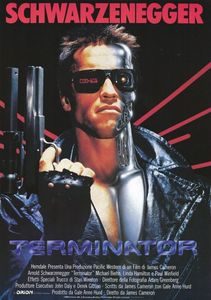
  • The Terminator (1984)

    The Terminator (1984)

    (Second viewing, On DVD, June 2003) Once you see beyond a few dated special-effects shots, this movie holds up amazingly well almost two decades later. This first instalment in the series looks good for its low budget and presents, almost in a nutshell, all the ideas that would later pop up in the sequel. Arnold Schwarzenegger looks too young (and has too much hair), but ably demonstrates his star qualities in a role that seems almost custom-built for his (limited) talents. Linda Hamilton is adorable as the fluffy Sarah Connor and the eighties setting now seems almost emblematic rather than dated. The Special Edition DVD presents plenty of extras, including fascinating deleted scenes (further showing the way to the second film) and a revealing look behind the scenes of Cameron’s “true” first film. We may be tempted to see this film merely as the first volume of a series but it’s actually quite good as a standalone film of the era.