Reviews

  • Leviathan (1989)

    Leviathan (1989)

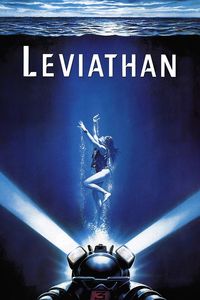
    (In French, On Cable TV, July 2020) Watching Leviathan so soon after Deepstar Six may not have been such a great idea. After all, those were two of the three big underwater thrillers released in 1989 — along with The Abyss, which is so much better than the other two that it will immediately be excluded from further comparison. After meticulously comparing the merits of both remaining movies, I think I can pass a narrow judgment that I liked Deepstar Six slightly better, even despite Leviathan being the most ambitious film. It certainly has an interesting B-string 1980s cast: In-between Peter Weller, Ernie Weller, Richard Crenna, Daniel Stern and the rather cute Amanda Pays, there are a few familiar faces here. The plot has some degree of Alien-inspired complexity to it, what with a blue-collar crew in a hostile environment, a mysterious discovery aboard a derelict ship and a corporate conspiracy that’s absolutely not meant to be helpful. The creature itself is conceptually interesting, amalgamating the people it consumes, but not very well executed given the special effects limits of low-budget 1989 filmmaking. (I wasn’t going to mention The Abyss again, but its special effects were the absolute Oscar-winning limit of what was possible at the time—we 2020 viewers have gotten used to much better for even low-budget features.) Perhaps the clearest example of the outer reaches of the film’s production comes at the very end, with editing placing a monster on one side of the survivors and a Coast Guard ship on the other—the shots are very obviously spliced together despite not matching at all. Ah well—but the mechanistic copying of Alien gets annoying, and I remember Deepstar Six as being a bit more effective at portraying the reality of a deep-sea crew, and exceeding lower expectations. This being said, the difference between the two isn’t all that great, and anyone with more affection for the cast would be justified in liking this one better.

  • Murder by Death (1976)

    Murder by Death (1976)

    (CTV Streaming, July 2020) I recall seeing bits and pieces of Murder by Death as a kid, so I was more than curious to re-watch the film, only remembering that it was about parodies of fictional detectives being set up to solve the perfect murder. Going in the film otherwise almost entirely unaware, I was amazed at the cast of the film: Peter Sellers, Alec Guiness, Peter Falk, David Niven, Maggie Smith and none other than a very young James Cromwell! Then I was bowled over once over again, as I recognized the archetypes they were playing—Falk imitating Humphrey Bogart’s Sam Spade, Niven as a pitch-perfect incarnation of William Powell’s Nick Charles, and so on. I could have done without the casual racism of Sellers’ Charlie Chan, but it does get us the rather wonderful spectacle of having him going toe-to-toe with his inspiration Alec Guiness in a scene or two. None other than Truman Capote shows up as the main antagonist of the film, setting up a perfect murder that none of the world-class detectives will be able to solve. As Murder by Death is working from a Neil Simon script, you can expect a steadily amusing script and dialogue—although the film doesn’t quite get as hilarious as it could have been. The structure of the story seems lopsided as well, with a very long time spent on introductions and setting up the premise, then zipping to a conclusion. It doesn’t get any better once we realize (after an android or two) that the film is absolutely not meant to make conventional narrative sense. There are six successive plot climaxes in a row getting more and more absurd, the joke being turned on the viewers expecting this comedy to make any kind of narrative sense. Murder by Death becomes a letdown after such a promising start, but the result is still worth a look if only for the cast and the playfulness of the script as it charges forward, determined to upend most expectations.

  • Crash Dive (1943)

    Crash Dive (1943)

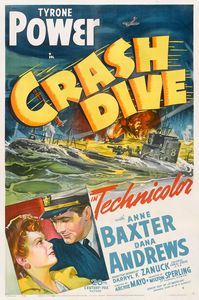
    (On TV, July 2020) At first glance, Hollywood made many movies like Crash Dive during WW2—heroic dramas about men in combat, puffing up just about every branch of the armed forces. But there are two crucial differences here, and one interesting element worth mentioning. The first and most obvious difference between Crash Dive and many other propaganda films is that it’s filmed in colour—lending a quasi-documentary quality to the results when the camera focuses on the submarines where much of the plot takes place. The second difference is a much-bigger emphasis placed on the romantic narrative: compared to other war movies where combat against the enemy was enough of a narrative, Crash Dive spends a lot of time in a romantic triangle between a woman and two men (one the commanding officer to the other). Finally, one element worth mentioning is a supporting role for Ben Carter at a time (and in a war movie genre) that did not usually have roles for black actors. The blend of wartime action and romance is interesting, but it doesn’t make for a particularly cohesive film. Crash Dive is not bad, but its message is on the nose, and the addition of a romantic narrative reinforces the impression that there are many movies just like it, except set elsewhere than in submarines.

  • Seppuku [Hara-kiri] (1962)

    Seppuku [Hara-kiri] (1962)

    (Criterion Streaming, July 2020) I wasn’t expecting much of Seppuku, but that’s not the film’s fault—I may have overdosed on samurai movies a while back, and I wasn’t necessarily looking forward to another early-1960s black-and-white Japanese samurai drama. So, I was a bit surprised when the opening sequence of director Masaki Kobayashi’s film drew me in with unusually modern cinematography, heavy on tracking shots and insistent editing. Then you get into the mystery of the film’s plot, as a samurai comes to commit ritual suicide in a lord’s courtyard while making specific demands. There’s clearly a reason behind his requests, and much of Seppuku is a mystery pieced together through flashbacks and revelations. For a film set in 17th-century Japan with its very specific social codes, this is an unusually accessible film, as the information required to make sense of it all is intelligibly presented. In some ways, the film is a rough analogue of a courtroom drama, as it explores social constraints according to the limits the participants have set upon themselves. By the time we piece together the explanation, Seppuku has become an elegant story of revenge, exploiting flaws in the opponent’s self-image to drive them to destruction. Now, I’m not a fan of the entire film—I think that the flashback sequences take too long and lessen the growing suspense. I also have some minor issues with bits and pieces here and there. But overall, I can see why the film has enjoyed a bit of a pop-critical renaissance for the past few years (having recently cracked the IMDB-250, not normally known for more challenging filmmaking) and why it’s held in such high esteem. I actually like Seppuku more than some (but not all) of Kurosawa’s samurai films, which is saying something even in a small pool of references.

  • Du Barry was a Lady (1943)

    Du Barry was a Lady (1943)

    (On Cable TV, July 2020) Like many other hobbies, movie-watching gets more rewarding the more you put into it. If you’re the kind of person who watches a film a year, then go ahead and enjoy the film on its own merits. But if you’re the kind of cinephile who enjoys tracking down filmographies, sub-genres and how movies exist in context, then a film can become far more than the sum of its parts. While watching Du Barry Was a Lady, for instance, I was struck by how it brings together many people that I liked elsewhere. It has one of Gene Kelly’s earliest roles, for instance—and even at this early stage, he gets play the likable cad, singing and dancing even if it’s not (yet) to his own cinematography. It has one of Lucille Ball’s foremost movie roles, where she gets to be strikingly beautiful and funny. It has Red Skelton, semi-restrained from his usual comic tics and funnier for it. It has one of my favourite supporting actresses of the era, Virginia O’Brien, lovely and hilarious as she sings in her usual deadpan style. (“Salome” has funny lyrics, but half of the song’s many laughs come from O’Brien’s side glances, facial expressions and hand movements.) It has Zero Mostel playing small-time hustler, Tommy Dorsey as (what else?) a band leader and an entire song dedicated to Vargas pin-ups girls (Happily, Miss September is the best). Du Barry was a Lady is also, perhaps more significantly, one of Arthur Freed’s early MGM musicals and you can see bits and pieces of it as inspiration for the tone and content of his later movies. Compared to this thick web of associations and context, it does feel as if the film itself is not as good as its components. Much of the first half is a nightclub comedy (giving generous time to the on-stage acts) paying particular attention to Ball, Kelly and O’Brien, while the second loosens up by going back to Louis XV-era France for some sillier comedy focused on Skelton. It’s not bad, but the film is more interesting for its numbers and showcases than by itself—as mentioned before, “Salome” is worthy of an anthology reel, and it’s a treat to see Ball, Kelly and Mostel in early roles. I liked Du Barry was a Lady a lot, but I suspect that I’m getting a lot more out of it by virtue of having seen, in rapid succession, many of the other movies with which it shares a web of associations.

    (Second Viewing, On Cable TV, November 2021) What I like about revisiting classic Hollywood films is that even a few months can mean a world of difference in how you approach a film knowing more about its stars and their careers. You can watch Du Barry was a Lady (as I did the first time) without knowing much about its players and still appreciate the film on its own terms. But come back to it with a greater appreciation for Red Skelton, Gene Kelly, Lucille Ball, Virginia O’Brien, Zero Mostel and Tommy Dorsey and his Orchestra, and the film becomes nothing short of a quasi-miraculous union of distinctive talents. Skelton delivers another of his usual performances here, and stays (mostly) under control for the first half of the film. Ball was on the upswing at the time, distinguishing herself as a dependable comic performer – but this was the film (her first as an MGM star) that changed her hair colour to red… a distinction she’d keep the rest of her career. Kelly was barely known at the time, but here gets a terrific solo dance number that clearly wowed others enough to give him bigger roles as a dancer. Gorgeous O’Brien gets an anthology number in “Salome” (sung deadpan, but complete with hilarious acting) as well as a decent supporting role. Zero Mostel makes his big-screen debut here, whereas Tommy Dorsey (aka D’Orsay in the French Royalty sequences) and his orchestra get a welcome showcase. Finally, who can resist the rather wonderful “I Love an Esquire Girl” featuring no less than twelve terrific Vargas girls? (Miss September being my favourite, even the second time around.)  The film itself is uneven: the first present-day half is not bad, but the second historical one is rather dull. But it’s by bringing together several talented performers that Du Barry Was a Lady finds its true calling. It’s not a completely satisfying film, but it’s well worth another look, possibly fast-forwarding from one great sequence to another.
  • Death Warmed Up (1984)

    Death Warmed Up (1984)

    (In French, On Cable TV, July 2020) It turns out that there was more than Peter Jackson making horror movies out of New Zealand back in the 1980s, but looking at Death Warmed up and comparing it to (say) Bad Taste, it’s obvious why Jackson became an international sensation and writer-director David Blyth didn’t. Working from a script that has two prologues and welds together a bunch of familiar splatter/slasher horror tropes without necessarily saying anything more interesting about them, he delivers a workmanlike horror film, a bit better than the norm at the time but still not quite good enough to be particularly memorable. Production values are on the low side, and the elements of the story aren’t handled with any kind of flair. A gratuitously mean ending causes little reaction, reflecting the lack of interest in the rest of the film. It’s interesting in that Death Warmed Up is clearly inspired by the American horror movie craze of the early 1980s while being just different enough to be distinctive, but it remains more a curio for horror fans looking to expand their knowledge of New Zealand cinema beyond the essential.

  • The Atticus Institute (2015)

    The Atticus Institute (2015)

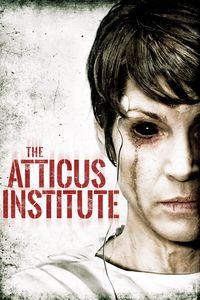
    (In French, On Cable TV, July 2020) In the fine tradition of horror films puffing themselves up with made-up “based on a true story” hokum, horror mockumentary The Atticus Institute purports to tell us about “the only case of possession ever recorded by the United States Government.” In this case, a parapsychology institute studies a woman exhibiting paranormal powers that are later revealed to be the work of a demon possessing her. Cue the US Army taking control of the institute in an effort to weaponize the demon, which (as five out of five scientists will tell you) is a terrifyingly bad idea. It goes where you expect it to go, with the demon going on a rampage inside the institute and everyone being powerless to stop it. Writer-director Chris Sparling handles the mockumentary aspect reasonably well, without too many questions as to how or why the footage exists, and the mid-1970s period convincingly recreated—although some of the camcorders have a strong 1980s vintage air to them. I have issues with some of the grandiose dialogue from the characters, but that’s almost part of the fun. At least it’s short enough not to overstay its welcome. The Atticus Institute is not all that good as a movie, but I’ve seen quite a bit worse in the found-footage horror subgenre.

  • Notfilm (2015)

    Notfilm (2015)

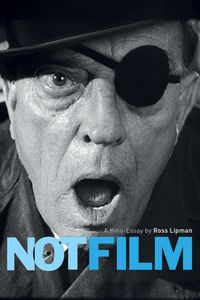
    (On Cable TV, July 2015) Came for Buster Keaton, stayed for Samuel Becket and drifted off thanks to director Ross Lipman. I’m always amazed at the amount of stuff I don’t know, and the link between noted author/playwright Samuel Becket (of “Waiting for Godot” fame) and comedian Buster Keaton was a missing link in my overall culture. What everyone should know before seeing Notfilm is that back in 1965, Samuel Becket somehow managed to convince a bunch of people to make a short 20 minutes experimental film called, well, Film. It starred Buster Keaton and was received like most experimental films—people called it interesting and/or incomprehensible. Forty years later, a filmmaker working on the restoration of Film got the idea of producing an accompanying making-of/retrospective feature called, ahem, Notfilm. The project grew and grew as Lipman interviewed the producers of the film and as many people he could find that had something to say about it. He found very rare audio footage of Becket (who famously disliked being recorded), uncovered intriguing contradictions coming from Becket, and started exploring the multiple facets connected to that summer 1965 shoot in Manhattan. By the time we realize that the cinematographer of Film is the brother of the filmmaker behind 1929’s classic Man with a Movie Camera, and that a teenage Leonard Maltin showed up on set to meet Keaton for the first time, we’re far past the point of wonderment. Becket being from the literary/theatrical world, we have an opportunity to talk about Grove Press and theatre in addition to film. Such an expansive approach to a topic means that Notfilm is often unwieldy. It’s certainly not focused (some information is repeated a few times; the introduction does not introduce Film properly yet spoils much of Notfilm’s later impact), and it’s inconsistently interesting—I was enthralled by matters about Buster Keaton, for instance, but not that interested in explorations of Becket’s oeuvre. My interest varied quite a bit, but at the end I had the impression of having been exposed to a hurricane of trivia, some of it uninteresting but others absolutely fascinating. It’s also refreshing in how it keeps blasting ideas at the viewer and daring them to keep up.

  • Men at Work (1990)

    Men at Work (1990)

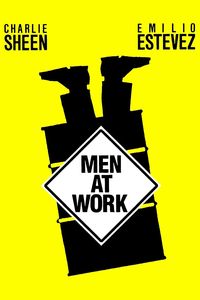
    (On Cable TV, July 2020) There’s something very perfunctory to the dark comedy of Men at Work that makes the film far less distinctive than it wishes to be. It’s still special in that it brings together brothers Charlie Sheen and Emilio Estevez as good friends involved in a murder thriller in small-town California. Garbagemen by profession but certainly not professionals by any means, our two heroes seem content to goof off all day long until they’re stuck with an observer on their daily routes, and accidentally find a murder victim. Things get wilder once their observer proves to be crazier than themselves, and the agents of the small-town conspiracy go looking for them. While the camaraderie between the two leads is exceptional, the rest of the film plays off familiar elements. Keith David gets increasingly funnier as his demeanour is stripped to its fundamentals, and Leslie Hope is eye-catching as the love interest. But much of Men at Work seems perfunctory in the way that very average circa-1990 comic thrillers could be, stuck between two decades’ very different aesthetics and not quite distinctive enough to be memorable. It’s still not a bad watch, but it’s far less memorable than I would have expected.

  • No Time for Comedy (1940)

    No Time for Comedy (1940)

    (On Cable TV, July 2020) If you like James Stewart (and who doesn’t?), No Time for Comedy has him in a good role as a young romantic lead, a gifted comic playwright playing opposite an actress (the rather wonderful Rosalind Russell) through high and low times in their relationship. As a portrait of another era where playwrights were household names, No Time for Comedy is interestingly off-beat—it speaks to readers and movie fans alike in having Stewart as an agreeably awkward writer as the protagonist. Russell was very near the peak of her early roles at the time of this film (shortly after great turns in The Women and His Girl Friday) and her screen persona is a good match for the material. Both Stewart and Russell had better roles in 1940 alone—for Stewart, his foremost turn as a young romantic lead came the same year in The Shop Around the Corner—but it’s actually fun to see them both in a lesser-known film playing to their strengths. If anything, No Time for Comedy is a perfectly acceptable little comedy (despite an unconvincing slide into manufactured drama in the third act), and it’s not quite as overexposed as His Girl Friday or The Shop Around the Corner from the same year. Stewart and Russell are perfectly up to their personas, and the result is a nice little discovery.

  • The Manor (2018)

    The Manor (2018)

    (On Cable TV, July 2020) Movie reviewers often get a pretty good idea of a movie from its first few minutes. Not always, mind you—there are famous cases of slow burns delivering final deflagrations, but the craft and style in which a film is conducted are usually obvious early on. In The Manor’s case, it takes a surprisingly short time to realize that the film is going to be unusually bad. From the opening credits onward, as they try to ape an early-1980s style through synth music and in-your-face lettering, the familiar sinking feeling of a terrible low-budget production sets in. Despite a few visual flourishes, the film is so ineptly put together than we lose the suspension of disbelief essential to a movie viewing: we’re not watching a film as much as we’re watching people acting, a director framing his shots and an editor splicing the result together. The elements of The Manor’s awfulness are cumulative and go far beyond simply a bad script: overacting, awkward staging, bland cinematography, direction that can’t give a sense of space, editing that’s just a little bit too slack (or annoys though useless subliminal images), cartoonish special effects and so on. Even the titular manor just looks like a big country house. Those issues compound a script that already doesn’t make a shred of sense or decency, with stock elements jammed together in a whole that becomes increasingly bewildering the longer it goes on. Surprisingly enough, asylum outpatients, rednecks, cousins-on-cousin incest, monster puppeteers and religious nuts don’t make as interesting a blend as you’d think when in the wrong hands. And that’s not even talking about the terrible dialogue, which even the best actors wouldn’t be able to make believable—and these are not the best actors. While The Manor may aim for style, it ends up detached from reality in such a way that you seriously start wondering what everyone involved was thinking. Struggling to find anything nice to say about the film, I have to admit that I like seeing Rachel True even in the worst dreck (although I feel sorry for her), and I do think that director Jonathon Schermerhorn has a good eye from time to time. Danielle Guldin’s character would have worked better in a comedy, but that goes for much of the film in general. Alas, The Manor is not a comedy—it’s really meant as a horror film, but it fumbles its way there. Films like this one are why I don’t take the Razzies or any other “worst movie of the year” lists seriously when they focus solely on big-budget studio productions, because this is far worse than anything on the most irritating Razzie shortlist. The universe of bad movies is far bigger than we can imagine, and The Manor is like opening a door to cinematic horrors beyond any imagination.

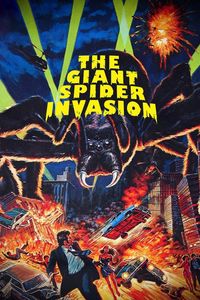
  • The Giant Spider Invasion (1975)

    The Giant Spider Invasion (1975)

    (In French, On Cable TV, July 2020) There are movies out there that you watch simply to be able to say (or answer), “Hey, have you seen that movie with the big spider built on a Volkswagen Bug?” To be fair, you have to be connected to the bad-movie community to know that the big spider has been built on a Bug frame, but The Giant Spider Invasion would not be remembered today if it didn’t have a bit of a reputation as one of those so-bad-it’s-good films. Produced on a tiny budget but taking advantage of the mid-1970s craze for creature horror movies, it’s incoherent, dull, offensive, mystifying and almost a chore to watch when it’s not featuring spiders on-screen. (Legend has it that the film started out featuring ordinary tarantulas, but the producer kept saying, “bigger, bigger, BIGGER!” throughout the production, which forced the directors to get creative and end up with a car-sized spider built on a car frame.) But when it gets cracking in its third act, it sports an oddly charming giant spider moving onto a small town and eating people. The special effects are terrible, but they have the likability of an eager high-school production. It’s not quite enough to make anyone forget about the nonsense that The Giant Spider Invasion spouts on the way there, but it does offer a bit of a late balm… and it does lead to asking others, “Hey, have you seen that movie with the big spider built on a Volkswagen Bug?”

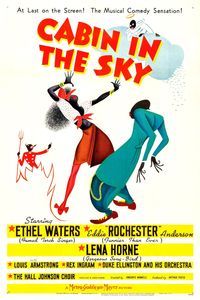
  • Cabin in the Sky (1943)

    Cabin in the Sky (1943)

    (On Cable TV, July 2020) What’s historically important about Cabin in the Sky is that it was one of the very few black-dominated musicals at a time when major film studios were reluctant to even put black performers on-screen at all. The story is a religious-themed (but funny) parable about God and the devil battling it out over a man’s soul, but the film exists for the decent musical numbers, showing a very different rhythm than other musical comedies of the time. Clearly, the reason to see the film is for Lena Horne as a sexy seductress… whew! This being said, she’s not the star here: Ethel Waters has more to do (musical wise) and deserves the spotlight. Elsewhere in the cast, Louis Armstrong shows up playing the trumpet. Cabin in the Sky is billed as Vincente Minelli’s first solo directorial effort even if some of the musical numbers are directed by Busby Berkeley. The worth of the performances that the film captures easily outweighs the sometimes-racist plot elements (and the other assorted stereotypes, such as facing off the mammy against the town harlot). It’s easy to make comparisons between this and Stormy Weather, as both were rare examples of black-cast MGM musicals in successive years—Cabin in the Sky is stronger on plot, but weaker in just about everything else, most crucially dancing and music. Still, both make a compelling case for a parallel universe in which black cinema from studios would be kick-started decades before the blaxploitation era—and it’s hard not to notice how these musicals play on an entirely different and more uplifting register.

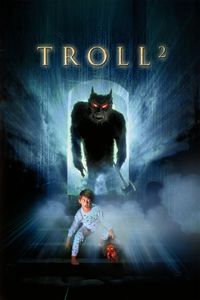
  • Troll 2 (1990)

    Troll 2 (1990)

    (In French, On Cable TV, July 2020) A legend of the so-bad-its-good genre, Troll 2 does manage to bring together the counter-intuitive elements of the best of those movies: Halfway-competent technical credits that offer the basics of a watchable film, albeit with occasional terrible dips that bring attention to themselves. Also included: A nonsensical script that offers renewed surprises of the bad sort. Plus: Incompetent acting, confounding sequences, botched conclusions, extraneous characters… it’s all there, and the result actually lives up to the anti-hype and the Internet memes. (This being said: watching it in French, the badness of the result is hampered by good-faith efforts from the translators to make a better product and the competency of the dubbing voice actors. Although there’s a limit to how much they can improve it.) Troll 2 is best watched in a double feature with Best Worst Movie for added context. It’s really a bad movie, but it’s bad in entertaining rather than dull or depressing ways.

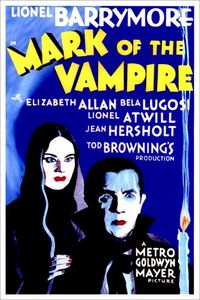
  • Mark of the Vampire (1935)

    Mark of the Vampire (1935)

    (On Cable TV, July 2020) There’s an ongoing conversation about “subverted expectations” in some fannish circles that constantly frustrates me. If you believe the conversation (and it’s not always clear how ironic it’s meant to be), fans are fragile little creatures incapable to dealing with anyone that messes with their preconceived expectations of how a show, a series or a story should go. As much as it frustrates me to admit it, there may be a point to this—genre stories have their own expectations, and messing with those expectations comes with some peril. That conversation isn’t new, and my case in point is Mark of the Vampire, a 1935 film that, not even five years after Universal’s Dracula, already played with genre expectations. Specifically (and sorry for the 85-year-old spoiler), it starts by following the Dracula plot template faithfully, only to conclude by having the vampires be an acting troupe out for some nefarious purpose. Something that started out as a horror film thus ends up strictly mainstream (although of the crime genre). Reviews at the time were divided, and they kept on being divided in the decades since then. While the rug-pulling trick may be conceptually interesting (especially as part of a critical conversation about, indeed, subverted expectations), it’s not doing any favours to an audience that settles in to watch a vampire movie that operates according to the plot template of vampire movies. There’s probably a mitigating factor in noting that up until the twist, Mark of the Vampire is a very familiar film—if you’ve seen, well, anything close to a Stoker adaptation, it doesn’t seem to do anything better or all that different. The twist sets it apart even as it sabotages the implied contract between audience and filmmaker. Of course, there’s no real reason to get annoyed about it—I’ll wager that the numbers of Mark of the Vampire fans is in the hard dozens at this time, and the way to approach old movies is often more analytical than personal. I suspect that as a result, Mark of the Vampire is going to remain a footnote to other more straightforward vampire movies of the era. But, at least, it will be remembered.