Reviews

  • Pumping Iron (1977)

    Pumping Iron (1977)

    (Netflix Streaming, July 2017) Most documentaries come and go, sinking to the depths of popular consciousness as their topic becomes of less currency, as events overtake what it presents, as everyone moves on and often retreat in obscurity. But once in a while, lightning strikes. In Pumping Iron’s case, a look at the bodybuilding culture of the mid-seventies had the incredible luck of capturing a showdown between future-megastar Arnold Schwarzenegger, and future Incredible Hulk Lou Ferrigno. The first half of Pumping Iron introduces its subject through beige gyms and outdated clothing styles, first focusing on the rivalry between Mike Katz and Ken Waller. Documentarian George Butler is working in the prehistory of modern nonfiction movies, but his approach is very much up to the latest reality-TV standard—focusing on drama, introducing his subjects in interviews while showing them interact. After a first half that feels like an introduction, Pumping Iron goes overseas to film the 1975 Mr. Olympia contest in Peoria (South Africa), and in looking at the personalities of Ferrigno and Schwarzenegger. It helps that even at that time, Schwarzenegger is a magnetic presence: flirting, charming, but also capable of playing pranks and demolishing an opponent’s morale. Schwarzenegger, portrayed as a charming villain, overtly discusses how bodybuilding is as mental as it is physical, and how he is willing to use underhanded means in the name of competition. If Pumping Iron remains interesting today, it’s not solely because of its good overview of the then-marginal bodybuilding subculture. It’s not simply because it presents a decent pair of rivalries between bodybuilders. It’s squarely because Schwarzenegger faces off with Ferrigno, and Schwarzenegger wins. But that’s fair—George Butler got lucky, and the only thing to do when you get lucky is to enjoy it.

  • Heavy Metal (1981)

    Heavy Metal (1981)

    (Second viewing, Netflix Streaming, July 2017) In-between kid’s stuff and adult matters, there’s a teenage gray zone in which topics inappropriate for kids are discussed in ways inappropriate from adults. Too often, any effort to escape kids’ stuff ends up in a puerile mixture of violence, nudity and bad language for their own sake rather than in support of more enlightened discussions. So when Heavy Metal magazine was founded (in France as Metal Hurlant) as an adult alternative to kids comics, it ended up taking the easy path. Much of the same true for Heavy Metal the movie, which delves into grandiloquent yet meaningless drivel, embarrassing nudity, teenage power fantasies, gratuitous gore, pervasive swearing and a cynical worldview that smacks of poseur nihilism rather than experienced weariness. It really doesn’t help that the film ran out of time and budget before being completed, with a lot of shortcuts visible on-screen as cheap animation, truncated stories and insufficiently rotoscoped results. This anthology of animated stories contains ten entries, very loosely tied together by one of the worst framing stories (a green ball of evil!) ever put on film. “Soft Landing” gets things going smoothly with a unique rotoscope-dominated airbrushed style set to anthemic music. Then it’s off to the bottom with terrible framing story “Grimaldi”, trying-too-hard “Harry Canyon” and the embarrassing teenage power fantasy “Den”. I first saw Heavy Metal as an older teenager, but even then I knew that this particular segment was drivel. Things don’t necessarily improve with “Captain Sternn”, an overlong and unfunny attempt at a joke segment. On the other hand, “B-17” is the highlight of the film: It’s gratuitously gory in the darkest Twilight-Zone sense, but it’s interesting to watch and does offer some kind of conclusion, as arbitrary as it may seem. (It’s penned by Dan O’Bannon, who has quite a few more good stories to his credit.) This is followed by “So Beautiful and So Dangerous”, which is juvenile and unfinished, but at least has the decency to drop the all-darkness-all-the-time motif for some dumb fun and humour (and robosexual jokes). Alas, the longest and worst segment “Taarna” concludes the film with an embarrassing barbarian fantasy film that spends minutes ogling its mute female protagonist rather than deliver a satisfying story. “Den” and “Taarna”, taking together, give a pretty good glimpse at the inner fantasies of late-seventies teenagers, but seen from today’s perspective make for a movie that you’d be ashamed to suggest to anyone. The occasional good music and rare good segments don’t manage to make Heavy Metal anything but a slightly noxious representation of geek obsessions back then. Alas, they may still be more current than we’d wish.

  • Bronson (2008)

    Bronson (2008)

    (Crackle Streaming, July 2017) I’ve seen four movies from writer/director Nicolas Wendign Refn so far, and Bronson may be my favourite. But keep in mind that I don’t particularly like Refn’s stuff: There is something about Refn’s use of ultraviolence and his refusal to emphasize plot that I find off-putting. Only God Forgives was dull, Neon Demon wasn’t interested in its own horror story, and Drive … eh, it was good but not as good as advertised. Bronson, in comparison, seems to acknowledge its own artificiality in presenting a stylized vision of a British criminal’s life: Bronson-as-narrator (impressively played by Tom Hardy) addresses the audience, literally plays to a theatre audience and presents the highlights of his life in a deliberately exaggerated fashion. It works, but its humour is tempered by the inherent violence of Bronson’s character, as likely to smile at others than to beat them unconscious at the slightest provocation. The presence of a visible narrator does change the rhythm of the film compared to other biopics: it removes the need for obligatory connecting sequences and allows the film to span decades in just 90 minutes. There’s something honest in the way Bronson falsely idolizes its subject, giving him the loudest megaphone to indulge in rough humour and winner-takes-all rhetoric, but allowing viewers to realize how insane Bronson can be in doing so. In allowing such a full-throated voice to the criminal, it also allows a far better representation of its subject than conventional tut-tutting biopics. (Also see The Wolf of Wall Street as another example.) Not necessarily pleasant, but certainly unique, Bronson is the second of Refn’s films, after Drive, that I’m conventionally glad to have seen rather than checking off a box in a list.

  • Blue Thunder (1983)

    Blue Thunder (1983)

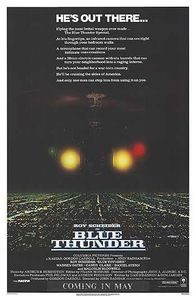
    (On Cable TV, July 2017) You say “dated”, I say “period piece”. You say “techno-thrillers age poorly”, I say, “techno-thrillers preserve the obsessions of the time”. But mostly, I say that Blue Thunder remains far more relevant today than anyone would have expected. It is, for sure, a movie of its exact time: In 1983 Los Angeles, the police force experiments with a high-powered helicopter for crowd control in anticipation of the 1984 Olympic Games. The fancy titular helicopter brings together a package of high technology such as on-demand access to police databases, pervasive surveillance technology, stealth features, deadly weaponry and primitive augmented-reality targeting. Hot stuff—even if today, you could get nearly everything in that list in your average phone save for the weaponry. If the evolution of technology in older movies fascinates you, then Blue Thunder ought to be on your list of movies to watch given how clearly it exploits 1983’s cutting-edge … yet has quite a bit of relevance to today’s hot-button topics of government intrusion in private lives, and indiscriminate targeting of civilians in the name of security. You may want to ignore the plot along the way, though, given how many contrivances are required to set up the action sequences. On the other hand, come for the technology and stay for the action sequences, because Blue Thunder does eventually work its way to a spectacular prolonged action sequence above the skies of downtown Los Angeles, between helicopters and military jets, buildings and police cars. Director John Badham shows his mastery of action sequences here, to the point where they still compare well to contemporary movies. Roy Scheider is sympathetic enough as the protagonist, while Malcolm McDowell almost earns hissing as the villain. I expect a drone-centric remake any time soon. In the meantime, Blue Thunder is well worth revisiting, both for what it has to say (usually against its titular helicopter) and for the way it illustrates its message with well-executed action sequences.

  • Masterminds (2016)

    Masterminds (2016)

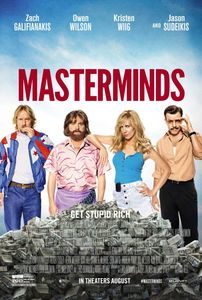
    (On Cable TV, July 2017) I may be overdosing on criminal comedies featuring idiots, explaining my tepid reaction to Masterminds. On paper, it does sound promising: What if an idiot working for an armoured car company found a way to steal a considerable amount of money … only to be stalked and targeted by equally idiotic accomplices? Throw in a cast including such notables a Zach Galifianakis, Owen Wilson, Kirsten Wiig, Leslie Jones or Kate McKinnon and you’ve got the making of a good-enough comedy. But it takes more than comedians and a premise to make a film, and as Masterminds lurches from one mildly amusing set-piece to another, there’s a feeling that director Jared Hess is up to the kinds of tricks that made his previous films (Napoleon Dynamite, Nacho Libre, Gentlemen Broncos) so divisive. Masterminds makes the classic blunder of keeping an unfunny gag running for as long as possible, sapping audience goodwill at periodic intervals. There are clearly attempts at making something amusing in this film, and some of them even succeed. But the overall result is not particularly funny, and the criminal plot of the film really isn’t strong enough to pick up the slack. Owen Wilson seems a bit lost in a role that robs him of his usual genial nature, and Wiig is up to more or less the same kind of awkward comedy that either works or not. This being said, Gallifinakis is not bad, and comic-chameleon Kate McKinnon continues her prodigious streak of disappearing in the roles she’s given. Masterminds doesn’t exactly deserve a spot on worst-movie list, but it certainly disappoints.

  • Zero Days (2016)

    Zero Days (2016)

    (On Cable TV, July 2017) Documentarian Alex Gibney is almost a national treasure at this point, able to transform complex modern topics in hard-hitting yet compulsively viewable documentaries. In Zero Days, he takes on one of the most fascinating computer security issues of the century so far, which is to say the Stuxnet worm that, in 2005, spread over the planet yet appeared to very specifically target uranium centrifuges used in the Iranian nuclear weapon development program. Throughout it duration, Zero Days patiently describes the way the worm was discovered, its complex peculiarities, what was hidden in the code, and why, piece by piece, security experts identified the United States and/or Israel secret services as likely candidates for the worm’s development. But as Gibney can’t get any official confirmation, he gets mad and, midway through, brings out his own confidential sources: Intelligence Community officers who, concerned with the potential of cyber-weapons, are willing to confirm and explain what had, up to this point, been merely informed speculation: NSA and Israel developed Stuxnet, then Israel made it more virulent and allowed it to escape with little thought about detection. (It probably also ran the more aggressive Stuxnet alongside a more conventional campaign of targeted assassination of Iranian nuclear experts.) Much of this story is familiar to people even remotely knowledgeable about cyber-security (check out Stuxnet’s Wikipedia page for details) but then Zero Days has a final revelation of its own: Nitro Zeus, a set of exploits and plans designed to bring down Iran’s infrastructure. It’s that kind of capability that led the NSA officers to leak details of US operations. It’s also that kind of stuff that should keep you awake, especially now that more leaks have suggested the existence of a Nitro Zeus aimed at Russia … and Russia’s own infrastructure-meddling experiments in Ukraine. Twenty-first-century warfare is not going to be about tanks and missiles, and it’s going to reach people in their own homes. Zero Days is a good primer on how bad it can be. By the time it replays the Obama administration’s happy announcement of a deal regarding the end of Iran’s nuclear program, the implied meaning is far more sinister: The US won its first cyber-war. But there will be others.

  • Passengers (2016)

    Passengers (2016)

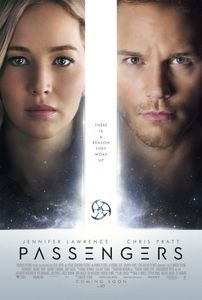
    (On Cable TV, July 2017) Hmmm. As much as I’d like to like Passengers a lot, there a bit too much nonsense, mismatched tones and wasted opportunities to be entirely comfortable with the result. On the one hand, I do like that it’s an original Science-Fiction movie (for Hollywood values of “original”, which is to say one that only has half a dozen predecessors in print SF) and one that’s slickly made: the setting is terrific, and the film has the budget to fully presents its environment. I love the first half-hour, in which a man wakes up alone in a gigantic spaceship, 90 years from its destination: With a bit of tweaking, it could stand in for the first section of an adaptation of Allen Steele’s terrific short story “The Days Between”. Chris Pratt is pretty good as the desperately alone protagonist, stuck in a nightmare caused by automated arrogance. Never mind that the plot doesn’t make a bit of real-world sense yet, because there’s more to come. The film becomes uglier as our protagonist decides to wake up a carefully chosen passenger, essentially dooming her to the same drawn-out death than him. That moral choice is not indefensible as a plot point, but it does set up expectations that are dashed when the film moves on to “but there was a catastrophe on the way, so it’s all OK!” as an excuse for his actions. A harsher conclusion would have made the gesture carry more weight, although it likely would have robbed Passengers of its mainstream appeal. There are quite a few logical and scientific errors later on, and they do sap the movie of its accumulated goodwill. Not much of the film’s problems can be blamed on its very short cast, though: Chris Pratt makes for a credible everyday man, and while we’re past peak-Jennifer Lawrence adulation, she’s rather good in a role that asks for some very dramatic moments. To be fair, I also liked Passengers a whole lot more watching it moment-by-moment than I would have expected by reading some of its harsher reviews—at times, the vitriol-versus-film ratio reminded me of the Prometheus episode, in which a slickly-made SF movie gets roasted for factors that don’t faithfully reflect the entire film. It’s also worth noting that what bothers people most about Passengers is an integral part of the film’s plot, and that it’s never avoided or downplayed. If this sounds like a half-hearted defence of the film, then I suppose it is—Passengers doesn’t have what it takes to be a great SF movie, but it definitely has its strong moments and haunting sequences. Passengers also shows, in many ways, how mass audiences are now willing to accept and play with concepts that used to be cutting-edge SF a few decades ago—as much as I can quibble with the errors, the distasteful nature of its premise or the way it plays safe, it’s also a polished piece of space-set SF the likes of which I’d like to see more often.

  • Private Benjamin (1980)

    Private Benjamin (1980)

    (In French, On TV, July 2017) I was originally tempted to launch this review by comparing Private Benjamin to the 1981 Bill Murray comedy Stripes, but it’s a comparison that only goes so far: While both movies follow a similar structure in transforming their protagonist from a civilian zero to a military hero, they do look at the same subject from very different perspectives. While Stripes is more of a goofy slob-power fantasy, Private Benjamin is largely about the self-empowerment of a young woman cast adrift. And that carries an entirely different tone, much like the fact of this being a female-led film does lend it a distinctive comic flavour. It does work … but much of the impact of the comedy seems blunted by the intention to have it mean something more. Behind the laughs, and to the conclusion of the movie, Private Benjamin is about tough choices that may or may not lend themselves to giggly laughs. As such, there’s a tension at the heart of the film between Goldie Hawn’s more overtly comic moments (“the army with the condos and the private rooms!”) and its more serious intention of resisting male domination. (But then again this is a movie about a woman whose husband dies on top of her on their wedding night.) It works, but it doesn’t quite click. Some of the material in the beginning is audacious; some of the material in the middle is funny; some of the material at the end is depressing. Hawn herself is great, and she’s supported by a good cast that has an early appearance by Armand Assante. This is one of the rare cases when a remake may be interesting—Most of the themes remain contemporary, and I’m not sure that nearly forty years have changed much in the way women are integrated in US military forces.

  • Driving Miss Daisy (1989)

    Driving Miss Daisy (1989)

    (On Cable TV, July 2017) In retrospect, it seems almost amazing that such a restrained piece of social-issue cinema as Driving Miss Daisy would go on to win the Best Picture academy award. It is, after all, nothing much more than the story of a growing friendship between an elderly Jewish lady and her black chauffeur, spanning years from the fifties to the seventies. Arguably more about aging than race relations, Driving Miss Daisy is a surprisingly quiet movie. No big speeches, a few soft-spoken disagreements, unusually generous pacing (which is to say: slow) and plenty of character moments. Jessica Tandy won an Oscar for her role as the lady who learns better, while Morgan Freeman broke through the mainstream with his performance. While the result hasn’t aged very well (it’s curiously well-mannered), it’s still not a bad film by any means. Still, most will see it either as Oscar completionists or fans of Morgan Freeman.

  • The Amityville Horror (1979)

    The Amityville Horror (1979)

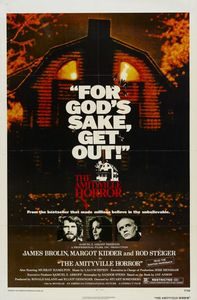
    (On Cable TV, July 2017) Not all haunted house movies are created equal, and despite The Amityville Horror’s reputation, it ranks toward the low end of the scale. Part of it has to do with its familiarity: The haunted-house story has become a cliché at this point, and The Amityville Horror doesn’t renew much along the way, what with its hallucinations, Catholic curses, familiar plot points (save the dog!) and rather long duration time. James Brolin, Margot Kidder and Rod Steiger all do good work, but the subject matter is just tired—even more so if you’re not inclined to give any credence to the “based on real events” claim that surrounds the film. A few period details are intriguing (such as the acceptance of the paranormal by a supporting character) but much of it just feels dull, and some of the most promising material (the black ooze, for instance) don’t seem to pay off meaningfully. I used to think that the 2005 remake wasn’t very good, but it turns out that the original isn’t really good either.

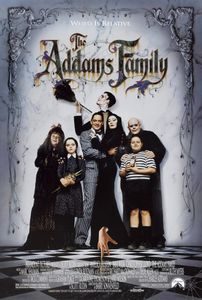
  • The Addams Family (1991)

    The Addams Family (1991)

    (On DVD, July 2017) There are times when you watch an older movie and it’s so good that you wonder why you haven’t seen it before. I’ll be the first to admit that The Adams Family isn’t a perfect film: As a macabre-themed comedy, it’s not built around a plot as much as gags and atmosphere, so it’s likely to be the kind of film that you find wonderful from beginning to end … or not. As far as I’m concerned, The Adams Family hits the right buttons in the right order. From the opening credit sequence (which features a font similar to Men in Black, also directed by Barry Sonnenfeld), it’s a ride through a darkly funny imagination. But there’s more than black comedy in play here: The appeal of The Addams Family isn’t necessarily in the macabre stuff as much as the solid family unit being demonstrated through the jokes. The lustful relationship between Morticia and Gomez is straight-up #relationshipgoals idyllic, and the film show over and over again that the Addams clan can rely on itself to take care of outsiders. And while the plot is simple, there’s some structural genius in the way it brings in an outsider to show what’s happening in that family, and to allow the intruder to be captured by the family’s charm. Otherwise, the jokes aren’t always obvious and even when they are, their delivery is perfect. (I laughed far too much at “Are they made from real Girl Scouts?”) The Addams Family does have the advantage of relying on an ensemble cast of terrific actors ideally suited to their role. Anjelica Huston has a career-best role as Morticia Adams, perfectly spooky and sexy at once. Raul Julia and Christopher Lloyd both get to ham it up as brothers, while Christina Ricci got her breakout role here as Wednesday Addams. The stable of characters works well, but the production design and loopy humour is what sets this film apart. This delight-a-minute visual extravaganza may not work on everyone else equally, but as far as I’m concerned, The Addams Family is a classic that I should have seen much earlier.

  • Chariots of Fire (1981)

    Chariots of Fire (1981)

    (On Cable TV, July 2017) It brings me no joy to say it, but: Wow, Chariots of Fire is a dull movie. The opening sequence sets the tone, all slow motion running and Vangelis’s classical theme. Now, I’m not saying that it’s a bad film, but it’s so clearly addressed at another kind of viewer that I’m left pointing out how little appeal it has for the rest of us. What it does well is giving us a glimpse at the psyche of the British immediately following the First World War: The film sombrely begins with reminders of the fallen soldiers and their absence still being felt in British universities. It keeps going with a sober exploration of the role of faith and religion at the time, setting up the dilemmas facing our two running protagonists as they make their way to the 1924 Paris Olympics. Ben Cross and Ian Charleson do good jobs in the lead roles. That’s all well and good (and an early sequence had me reading about the Trinity Great Court Run) but the film itself moves at a snail’s pace, with comparatively low stakes and a subject matter that does quite manage to reach me. Fortunately, Chariots of Fire doesn’t need my critical appreciation, not when it’s an Oscar-winning classic with thirty-five years of acclaim. But I’m surprised at how uninteresting it is, when so many of its contemporaries can be watched with interest even today.

  • Miss Congeniality 2: Armed and Fabulous (2005)

    Miss Congeniality 2: Armed and Fabulous (2005)

    (In French, On TV, July 2017) No one will ever claim that Miss Congeniality 2: Armed and Fabulous is a modern classic. While some may have a justifiable soft spot for the original, it quickly becomes clear that this sequel has more interest in predictable box-office gross than any kind of artistic intention. Dragged back kicking and screaming into the world of pageantry when it becomes clear that her identity has been forever blown on national live TV, our returning protagonist (played with usual dedication by Sandra Bullock) knows fully well what’s expected from her this time around. Still, she gets to make humiliating mistakes, go rogue, tackle Dolly Parton to the ground (because why not?), vamp it up at a transvestite show (because again why not?) and impart some of her hard-won lessons to another female agent who could use a makeover. It’s formula and cute and saccharine like the first film, and it even lets William Shatner do a little bit of hamming along the way. The very essence of sequels is to do the same thing again but not too differently and in this light then Miss Congeniality 2: Armed and Fabulous fulfills its ambitions. Fans of the first movie should like it. Everyone else may need to consider whether they want to subject themselves to more of the same.

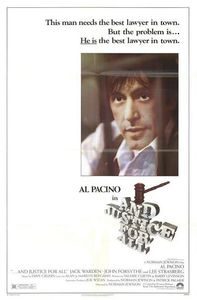
  • …and justice for all. (1979)

    …and justice for all. (1979)

    (On Cable TV, July 2017) For a movie that’s nearly forty years old, And Justice for All still works remarkably well. It’s recognizably from the late seventies, but it tackles evergreen notions of idealism versus cynicism, as exemplified by an impetuous lawyer (Al Pacino, in a career-establishing performance) stuck between his ideals and the realities of the judicial system. It’s very darkly humorous (call it a courtroom drama with a body count) but it doesn’t make the mistake of being nihilistic: throughout, we can cheer for our protagonist as obstacles pop up. Pacino is terrific, director Norman Jewison keeps everything at a slow boil, old-school veteran John Forsythe makes for a loathsome villain, Christine Lahti is good in her big-screen debut and Jeffrey Tambor also pops up as an unhinged lawyer. (Almost all of the characters are unhinged in their own way, but that’s the film.) While the script is riddled with contrivances and satirical moments, it’s that bigger-than-life quality that gives And Justice For All it peculiar charm and timeless appeal.

  • Assassins (1995)

    Assassins (1995)

    (In French, On TV, July 2017) The good news are that Assassins is a crazy movie in the best sense of the term: It’s disconnected enough from reality to be enjoyable as a big basket of overdone action sequences and familiar genre elements. The not-so-good news is that it’s not really a good movie—much of the storyline is dull and for a movie involving the Wachowskis and Brian Helgeland, it fails to capitalize on its sizzle factor. Thanks to veteran director Richard Donner, there are some good sequences here and there: the taxicab blocked-by-a-bulletproof-window duel is ingenious in the way more of the movie should have been. Sylvester Stallone and Antonio Banderas ham it up enough as competing assassins. But the best thing about Assassins may be Julianne Moore: For an actress who has such a firmly established persona of mature dignity, it’s a real treat to see her in a pre-stardom role that asks her to be trashy/techno in one sequence, then doe-eyed/cute for the rest of the film. Assassins is also the source of the delightful “Antonio Banderas’s Laptop Reaction”.gif, so there’s a tiny bit of internet meme history along the way. Assassins isn’t a major movie in any way and has already ended up as a footnote in other people’s careers, and it should be approached as such: Not as a movie expected to be good, but a grab bag of things that may be interesting.