Reviews

  • Forty Signs of Rain, Kim Stanley Robinson

    Forty Signs of Rain, Kim Stanley Robinson

    Bantam Spectra, 2004, 358 pages, C$37.00 hc, ISBN 0-553-80311-5

    I have already written about my constant admiration of Kim Stanley Robinson’s work before, and things won’t change with this review of Forty Signs of Rain, a unique novel of science-fiction that conventionally shouldn’t work as well as it does, yet holds its own as a superbly entertaining work of fiction.

    Robinson, of course, rarely settles for conventional narratives. So when he decides to tackle the subject of global warming (after first glancing at the subject in Blue Mars), he does so by using the best-informed protagonists he could think of: the scientists at work in Washington at the intersection of science and politics. The novel begins as global warming is starting to have its first catastrophic impacts. Meanwhile, a young iconoclastic scientist named Frank Vanderwal is fed up with the bureaucracy and cautiousness of the National Science Foundation where he is finishing his one-year term. His colleague, Anne Quibbler, is busy balancing the demands of motherhood with those of a career even as her husband, Charlie Quibbler, is a stay-at-home dad who moonlights as a scientific advisor to an influent senator. (This senator, Phil Chase, is carried over from Antarctica, but so slightly as to be imperceptible to those who haven’t read Robinson’s previous book.)

    These three viewpoint on the issue having been established in all of their rock-climbing, breast-feeding, telecommuting banality, Robinson does not immediately jumps to the chase. Nearly half of Forty Signs of Rain passes before the first shapes of the overarching plot appear. This is a novel of characters, of good ordinary people engaged in science and all of its messy complexity. The inner workings of the NSF are carefully described (usually by Frank, who can’t stand it any more), while the interface between science and politics is probed. This is not the time for heroics, but for careful action. This is also science-fiction as it’s too rarely written: as an exploration of the facets of science as it’s conducted today in the real world.

    In doing so, Robinson also slyly attacks one of the hoariest clichés of bad SF: the mad scientist. The characters in Forty Signs of Rain are morally outstanding citizens who feel a moral and ethical need to contribute to society by their expertise. Their goal is a better world for all; their means are a conscience and the elements of the scientific method. With this uplifting novel, Robinson reclaims some much-needed credibility for the SF label in its purest sense, even if the science-fictional elements of the book are slight and subtle.

    Besides a few gadgets here and there, only the ending of the book stands as a bit of extrapolation. Yet the biggest irony of Forty Signs of Rain does happens late in the book, as the climax of the story is set in rain-drenched Washington, as a flood of biblical proportions cover the entire capital in meters of sludge and water. What was pure Science Fiction in 2004 turned out to be the unpleasant portent of the real-life flooding of New Orleans barely a year later. Validation of Robinson’s carefully researched novel never seemed more ominous.

    But these thematic elements would be wasted without Robinson’s usually delightful prose, which delves so deep into the character’s inner landscape as to reflect their emotional states. The writing occasionally takes on a quality halfway between internal monologue and typical third-person narration, blending a poetry of science with mundane everyday concerns. Just wait until you read the scene where a squirming child interrupts a head-to-head meeting with the president.

    Ultimately, it’s this blend of domesticity, sweeping thematic concerns and good old-fashioned political issues that makes Forty Signs of Rain such an unlikely page-turner. For a book in which little actually happens, it’s a delight-a-page experience. Fans of Robinson’s brainier previous work will be absolutely fulfilled by this latest work. Best of all, though, is the feeling that the real story is about to begin in the follow-up, Fifty Degrees Below.
  • Vantage Point (2008)

    Vantage Point (2008)

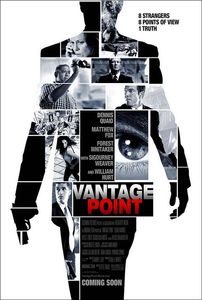
    (In theaters, February 2008) What an odd film: The stunning trailer promised a Rashomon-type assassination thriller with twisty levels of truth. The reality is a lot sloppier: While Vantage Point does offer multiple successive perspective on the same set of events, the impact never goes beyond that of a curious way to present a fairly straightforward thriller. The twists aren’t as impressive as you may think (the identity of a traitor can be guessed early on) and many elements feel forced in order to manipulate a reaction from the audience. The first few minutes are clunky from tons of hesitant exposition, while some elements of the plot never work like they should. There’s an interesting vibe to some of the material (the deliberately dovish president, the nebulous nature of the terrorists, the faint vibe that this may not turn out to be OK), but there’s also a sense that the film isn’t running on all cylinders. Ironically, it’s when the film drops the multiple-viewpoints pretense that it really kicks in high gear: The car chase through the streets of Valencia is good fun (a grim Dennis Quaid really sells the intensity of the pursuit), and the climax does actually work in a certain fashion. But the result seldom rises above its gimmicky flash: the twists are there for the sake of the twists, and if there’s a certain cleverness to it all, Vantage Point still feels as if it’s missing an important chunk.

  • The Spiderwick Chronicles (2008)

    The Spiderwick Chronicles (2008)

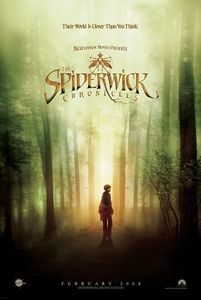
    (In theaters, February 2008) With the Potter series in full money-making bloom, studios are racing to cash on other children’s series. The results may often be dire (even with the best of source material, such as The Golden Compass), but Spiderwick manages to be a good-enough example of the form. As three siblings discover the secrets surrounding their new upstate New York house, they realize that there’s an invisible world out there, and that it’s not entirely friendly. Elements of classic fairy mythology are well-used, but it’s the generally unobjectionable script that holds everything together along with capable kid actors and satisfying special effects. The early few minutes aren’t particularly pleasant as the rebellious boy is shown to be well, rebellious, but he soon rises to the occasion presented by the discovery of the house’s secrets. While the plot is generally predictable (including its underwhelming ending), it’s not blatantly idiotic and even manages to hold on to a certain pleasant quality. I particularly enjoyed the sub-thematic content about books and the knowledge they represent. While this won’t become a classic, it’s going to hold up as a pleasant family film that the adults may even like.

  • Le scaphandre et le papillon [The Diving Bell And The Butterfly] (2007)

    Le scaphandre et le papillon [The Diving Bell And The Butterfly] (2007)

    (In theaters, February 2008) I really didn’t want to see this film: Stories of people overcoming physical handicaps to find peace, happiness and Oscar nominations aren’t high on my list of priorities, but when a film gets four such nominations, well, I can always follow the crowd and make an effort. So when I say that the film managed to overcome my own preconceptions, you can figure out that it’s something special. Adapted from the true story of a man almost completely paralyzed by a stroke and left with the control of only one eye, Le Scaphandre Et Le Papillon takes an intensely subjective approach to its subject at first. Thanks to focus issues and staccato movements meant to represent human eye motion, the film sticks the viewer inside the protagonist’s head as he has to figure out how to communicate with the world again. It’s a painful, sometimes horrifying process, minutely detailed while the basics for communications are re-established in far more than the blink of an eye. (I deny anyone not to hyperventilate during one particular scene in which sewing needles are involved.) It’s a brilliant piece of cinema, and it more than establishes the protagonist’s situation before we are allowed, once again, objective camera angles. I don’t think anyone could have expected a better adaptation of nigh-impossible source material. There’s some biting humor through it all, though the film becomes increasingly predictable and conventional the longer it went on. But the result is exceptional (if not always pleasant, at least seldom preachy) and it has a good chance to stick in memory long after the rest of the Oscar-nominated slate of 2007 has faded in memory.

  • The Hidden Family, Charles Stross

    The Hidden Family, Charles Stross

    Tor, 2005, 303 pages, C$34.95 hc, ISBN 0-765-31347-2

    Readers who thought that Charles Stross’ fantasy debut The Family Trade was heavily in clever details, plot twists and smart characters are about to get even more good stuff for their money with this follow-up: The Hidden Family piles on more complications, more developments and even more worlds to explore.

    This fantasy series’s premise is that a genetic trait in some humans allow them to travel between parallel worlds, at the price of terrible headaches. The first to discover this ability were inhabitants of another world, one that, by the early twenty-first century, is still stuck in medieval times. Using our world as a source of high technology, those families were able to consolidate their power base thanks to illegal trading on behalf of cartels in our world. (Think about a parallel world without border guards…) One of the several wild cards in this scheme is the sudden re-appearance of one Miriam Beckstein, a long-lost relative who was unknowingly raised in our world as an orphan, eventually becoming a high-tech/business journalist before discovering her gifts and being coerced in the family business. The Family Trade delivered a lot of back-story and intrigue in a short time and The Hidden Family picks off right where the previous book ended, not an accidental choice given how both books were conceived as a while unit before being split for publication.

    The first big twist of this installment, as hinted in the first volume, is that there is another world out there. Not just another America, roughly technologically equivalent to Victorian England, but another family of world-walkers waging war on the clans known to Miriam’s family. Our heroine is quick to seize upon this opportunity and see the potential profit margins in enabling technological transfers between more worlds. There are complications, of course: The regime at the other end is a totalitarian monarchy that wouldn’t take lightly to Miriam’s revolutionary ideas. And Miriam can’t go directly from here to there, but has to set up a transfer point in her family’s intermediate universe.

    As if those new developments weren’t enough, Miriam’s power base in her family is still very much in jeopardy: Her secret love affair with a cousin is already material for blackmail, her relatives can’t stand her lack of manners, and even the senior members of her family are contemplating whether she’s bringing in more trouble than she’s worth. Palace intrigue, plots and counter-plots all unfold in complex patterns, even as a key member of Miriam’s family business plans treason and defection…

    Fortunately, Stross’ crackling prose not only keeps all of those development as clear as possible, it makes reading the book an engrossing experience. This is one of those “just one more chapter” novels that hypnotize readers until the last page, leaving them wanting even more.

    Plot-wise, this is almost as busy as the previous installment, and the ideas just keep on piling up. The interactions between the world are rich in implications: the doppelgangering of locations in dual worlds, for instance, is an idea that constantly reveals new facets. The economic implications of world-walking are cogently explored (even if only conceptually as of yet) while the realities of a renaissance-era world-view constantly rub Miriam the wrong way, offering a subtle counterpoint to the triumphant medievalism so prevalent in classical fantasy.

    The Hidden Family is just the second installment in an ongoing series, so readers shouldn’t be surprised to find out that the end of this book only offers a respite of sorts for Miriam, just as other things go catastrophically wrong. There’s plenty of material for future plot threads here, and yet other possibilities remain unexplored for now, though I don’t doubt that Stross is busy preparing how best to integrate them in future installments.

  • Jumper (2008)

    Jumper (2008)

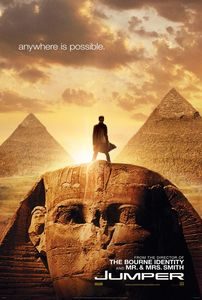
    (In theaters, February 2008) Twice during this film, I thought I was hearing the opening strains of favorite songs, only to be disappointed with lame generic pop-rock. Much of the same holds true for Jumper as a film: Sometimes hinting at greatness, but constantly disappointing with lackluster execution. The premise itself is intriguing, setting up a young man with the power of teleportation, and then a larger mythology of “jumpers” and “paladins”. But little of it feels satisfying: In what I’m guessing is an effort to set up future sequels, few elements are developed, and whatever is explained doesn’t feel as if it fits together. (I’m thinking of genetic lines, mostly) But this mushiness also holds true on most other levels: Hayden Christiansen speaks with marbles in his mouth and his clumsy romantic scenes with Generic Girlfriend cause horrible flashbacks to Attack Of The Clones. Samuel L. Jackson is fabulous as usual, but the film doesn’t seem to understand what to do with him. The same also goes for the film’s dazzling variety of locations, which ultimately feels underwhelming and under-used: There are some poor plot choices for teleportation locations… heck, there are poor plot choices everywhere. (Remind me: Do they have to have seen the location they want to go to?) I’m still not convinced that director Doug Liman can tell a story cleanly without shaking his camera and overcutting his action scenes for no good reasons at all. There are some action scene here and there that should pop with kinetic excitement, but their cross-cutting silliness simply sucks away most of their energy. It doesn’t help that the script is so thin, and that it’s strangely empty of either fun or humor. I hope that some of the missing answers are in the book, but in the meantime the film is a disappointing example of wholly average entertainment. [One day later: Wow, the book is something else entirely.]

  • In Bruges (2008)

    In Bruges (2008)

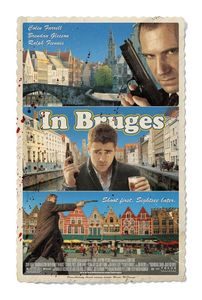
    (In theaters, February 2008) The problem with black comedies is that often, the darkness can snuff out the comedy. That’s what increasingly happens here, as the hilarious story of a pair of hit men waiting out an assignment in the picturesque Belgian city of Bruges is interrupted by violent flashbacks and gory deaths. As a comedy, In Bruges initially works well: There’s a nice absurdity to the misadventures of the hit men (Collin Farrel as an ADD-addled firebrand and Brendan Gleeson as an older veteran), the dialogs are fantastic and the unpredictable nature of the plotting is engrossing. This isn’t about real-world assassins, but an idealized, Pulp Fiction-infused ionic representation of murdering men with honor. In Bruges may not be a hilarious film, but it’s steadily amusing: racist midgets, anti-Bruges kvetching, a profane boss (Ralph Fiennes, wonderful), musings on the morality of killing bottled-armed people… it adds up. But what also adds up is an increasingly dark vein of violent developments, up to an including graphic deaths. While there’s an elegance to the way even smaller lines get their payoffs, there are also a few loose pieces in the mix: The girlfriend seems wasted once her plot function of providing a character with a gun is accomplished. The partially-blinded guy seemed destined for a bigger part. Even the ending, as ambiguous as it is, doesn’t completely satisfy. On the other hand, I don’t think that the city of Bruges will ever get a better promotional film.

  • The Lincoln Lawyer, Michael Connelly

    The Lincoln Lawyer, Michael Connelly

    Little Brown, 2005, 404 pages, C$36.95 hc, ISBN 0-316-73493-X

    Once again, it’s time for Michael Connelly to set aside protagonist Harry Bosch in favor of another character. Such “off-Bosch” novels are often the chance for Connelly to stretch a few writing muscles and try something different. The Lincoln Lawyer stands solidly in this tradition: Not only is it narrated by a very different character, but it’s also Connelly’s first outright legal thriller. It doesn’t spend much time in the courtrooms, but it’s all about the titular Lincoln lawyer, a defense attorney who’s forced to rediscover his moral compass.

    Mickey Haller may be a new narrator, but he’s not completely unknown to those who have followed the Bosch series in detail. Although fleetingly mentioned in The Black Ice as Harry Bosch’s half-brother, this connection never comes into play in this novel (and the links to the rest of the Connellyverse are so tenuous as to be invisible), so don’t expect even a cameo by Connelly’s taciturn detective.

    Not that any reader will wish for anything once The Lincoln Lawyer kicks into gear. Like most of Connelly’s novels so far, this is a ferocious page-turner, a perfect piece of entertainment designed to mesmerize its audience even as it slickly delivers the expected thrills.

    The beginning may be slow, but it’s definitely intriguing: As Haller struggles with the demands of life as a lawyer in urban-sprawled Los Angeles (he conducts most of his business from the back-seat of his chauffeured car, hence the title of the book), readers will get a taste for the reality of his work. As in other Connelly novels, we get a heavy dose of jargon, common attitudes and specialized knowledge: Haller’s usual clients are of modest means, and he effortlessly outlines the daily routine of a lawyer trying to do the best with what he’s got. By the time a well-off man named Louis Rouet asks for legal representation in an ugly assault case, we’re fully aware how badly Haller can use a “franchise client” who will pay steady bills for a long time.

    But Haller’s enthusiasm deflates once he begins to suspect his client’s innocence: “There is no client as scary as an innocent man” is the novel’s (fictional) epitaph, and that’s because nothing short of a not-guilty plea can be acceptable for an innocent: The usual options of “fair deals” with the prosecution become unavailable to lawyers representing an innocent man, and that’s the nightmare in which Heller finds himself even as rumbles about another innocent man unjustly convicted start echoing from his past.

    Typically for Connelly, there are a number of further twists and turns in the tale, which piles on the complications as it plows forward. The procedural charm of Connelly’s prose now deals with the world of defense attorneys rather than LAPD policemen, but the impact is the same. By the time the surprising ending rolls around, Haller has learned as much as the reader, and Connelly emerges from his first legal thriller with honors.

    It would be very unlikely to see Haller ride off in the sunset without expecting his return in a future novel. As Bosch himself approaches retirement and Connelly seemingly can’t resist the lure of linking his series, Haller would be a welcome addition to the policeman’s life, especially if the author ends up spending time examining how both half-brothers ended up on dissimilar sides of the law. As a character debut and a first attempt at another form of crime fiction, The Lincoln Lawyer is a remarkable effort, and it promises much more.

  • The Keep, F. Paul Wilson

    The Keep, F. Paul Wilson

    Tor, 1981 (2006 revision), 403 pages, C$4.99 mmpb, ISBN 0-765-35705-4

    I’m always impressed when the years move on and leave certain books unaffected. To the dismay of anyone trying to write for posterity (if there’s such a thing when there are bills to pay), decades can be very unkind to any kind of fiction. Beyond contemporary settings, there are dozens of ways for books to be stuck in time: outdated social assumptions, unfashionable prose or crude genre conventions. Even in Science Fiction or Fantasy, setting a story in the future or the past doesn’t necessarily erase the mark left by the writer’s present. So imagine my surprise to find out that F. Paul Wilson’s The Keep still feels just as fresh today as when it was published in 1981.

    There’s a trick, of course: The version of The Keep I read isn’t the version that was published twenty-five years ago. It’s been reviewed, retouched and reprinted, validated and enhanced along the way like few other early-eighties horror novels have been. Dig deep enough, and you will even find that it was adapted for the big screen in 1983 by none other than director Michael Mann. (Good luck seeing it, though: The film is conspicuously absent from DVD format catalogs, and rumor has it that Mann himself isn’t too keen on reviving it.)

    Then there’s the detail that the book was written to be a World War 2-era supernatural thriller, already taking it further away from instantly-recognizable contemporary cultural references. At a time where horror novels simply required a monster and people to slaughter, Wilson aimed for more ambitious targets by reaching back in time and space to set his monster/haunted-house story in 1941 Romania. When a group of Nazi soldiers occupies an isolated keep deep in the Transylvanian Alps, they awaken something out for their blood, at a determined pace of one death per night. Terrified, they ask for help; alas, the elite reinforcements prove ineffective. Desperate, they end up reaching out to an expert on local legends, a wheelchair-bound intellectual who happens to be Jewish. But even the scholar and his daughter don’t suspect the repercussions of what has been unleashed in the keep…

    One of the reasons why this book is still in print today is that it forms the cornerstone of Wilson’s Adversary cycle, which also spawned Wilson’s “Repairman Jack” series. While The Keep initially looks and feels like a particularly ornate vampire story, Wilson has a larger framework in mind, and the barest hints of the menace are revealed in this first volume. Suffice to say that this isn’t a mere vampire at play, and that the roots and consequences of the novel won’t be limited to 1941.

    But the best reason for the novel’s continued popularity is that it’s slickly written and a hugely enjoyable page-turner. Wilson’s prose is clean and compelling, and his ability to keep readers coming back for “one more chapter” is terrific. While the tight suspense of the first half eventually cedes way to a looser second half, the strong characters keep up interest until the end despite ever-larger developments. The delight with which Wilson multiplies the complications (by bringing in “good” Nazis, the looming menace of another concentration camp, a mysterious stranger traveling to the Keep, unexpected shifts in allegiances, and so on) is the stuff from which satisfying novels are made of. Plus, hey, it’s all-too-easy to lose sight of the most excellent premise: Nazis versus monsters! What’s not to like?

    The historical detail is convincing, Wilson generally avoids the easy Nazi clichés and the first 150 pages are a model of increasing tension. No small wonder that The Keep still attracts an audience more than a quarter-century after its publication. Even for experienced horror readers, the novel still carries its own kick. There’s a good chance that The Keep will still be just as readable in 2031.

  • Ice Station, Matthew Reilly

    Ice Station, Matthew Reilly

    St. Martin’s, 1999, 513 pages, C$9.99 mmpb, ISBN 0-312-97123-0

    When I write that some writers should be praised for their insane genius, I’m specifically thinking of Matthew Reilly. You can keep paying tribute to your literary prodigies, your award-winning wordsmiths and your tortured artistes: Meanwhile, I’ll be sitting in the corner whooping it up with one of Reilly’s pedal-to-the-metal action thrillers.

    Seemingly written for those who think that Hollywood action blockbusters are too slow and sedate, Reilly’s novels explode out of their premises, multiplying action sequences at the carefree expense of believability. It’s as if a Hollywood screenwriter was unleashed from the bounds of budgetary concerns and insurance liability: Suddenly, unbridled excesses and can-you-top-this action sequences become mere chapters in books that delights in exhausting the readers. Reilly’s novel are amoung the best in applying action movie mechanics to the novel form, and while the result won’t be for everyone, it’s a hugely enjoyable way to pass time.

    Ice Station may have been Reilly’s first professional publication (Contest was initially self-published; though re-worked and republished later on) but it already showcases Reilly’s characteristic style. Taking place in Antarctica, it initially describes how a team of Marines investigates the mysterious disappearance of nearly all personnel from a US research station. Things soon spiral out of control as the Marines are attacked from all sides: There’s a killer in the station, strange lifeforms in the pool at the bottom of the base, and enemy forces closing in on the surface.

    But that’s still mere prelude to the sheer insanity of the novel as it develops all of these threads. Because there’s something very dangerous about Wilkes Station where most of the action takes place: something buried deep in the ice, and something that several governments are clearly ready to fight over… or destroy if they can’t have it.

    But geopolitical considerations are mere background information when the shooting begins. Close-combat heroics, hovercraft demolition derbies, mutants, three successive waves of elite attackers, nuclear-powered weaponry and high-tech gadgets are only some of the elements that give Ice Station its hard-edged charm. The characters are secondary at the exception of protagonist Shane “Scarecrow” Schofield (who later goes on to star in three more of Reilly’s novels), but the centerpiece action sequences are very well-done. Reilly’s special genius is that he understands the mechanics of an action sequence: the impossible situations, the small accumulation of mini-objectives, the ratcheting tension in every twist and turn, the cool little ideas that help the protagonists fight their way out of desperate odds…

    I suspect that few serious critics will be kind toward Reilly’s work: He does cheat and lie to his readers in order to crank the tension, and the over-the-top ridiculousness of his accumulating action will be lost on anyone who’s not already a fan of kinematic action. But there’s a lot of clever genre-bending in Ice Station, which earns some distinction by being one of the few thrillers to set up an extraterrestrial element, then tops it with an even less likely development that manages to keep the novel in the realm of the techno-thriller.

    So, no, Ice Station will never get any respect, but it doesn’t really need any: As a techno-thriller, it wipes the floor with the shattered corpses of most other novels of its genre. Reilly’s talent is in his visceral understanding of what make a story move, both at the sentence-by-sentence and the structural level. He is, not insignificantly, a thriller writer with is own distinctive style, and that should be enough to earn him enough faithful readers to enable him to write whatever he wants. Insane geniuses deserve their own dedicated followers, you know.

  • Rewired: The Post-Cyberpunk Anthology, Ed. James Patrick Kelly & John Kessel

    Rewired: The Post-Cyberpunk Anthology, Ed. James Patrick Kelly & John Kessel

    Tachyon, 2007, 424 pages, US$14.95 tpb, ISBN 978-1-892391-53-7

    One of the most endearing traits of Science Fiction as a genre is its almost pathological need to examine itself for new trends. Commentators steadily scour new publications for trends, recurring leitmotivs and emerging clichés. When The New Thing proves to be difficult to identify, they go back to The Formerly New Things and kick them around for inspiration. But the sad truth is that cyberpunk remains the last coherent SF movement, its shadow still looming over genre criticism fifteen years after it was clinically declared dead from embarrassment.

    One suspects that the deathbed conversation over cyberpunk will keep on going until the entire genre is absorbed by the singularity, and then be carried over by intelligence much vaster than ours yet still punier than John Clute. In the meantime, any pretext is good enough for a post-cyberpunk reprint anthology like Rewired.

    The choice of anthologists isn’t accidental: Both James Patrick Kelly and John Kessel were active writers in the heydays of cyberpunk –although whether they were part of the movement or opposed to it as “humanists” depends on who you speak to.

    Students of genre history will have a lot of good material to digest in Rewired: Not only does it come with a lengthy introduction discussing the characteristics of “Post Cyberpunk” (“PCP”) SF, it’s also peppered with excerpts of correspondence between cyberpunk chairman Bruce Sterling and Kessel, in which both authors tackle issues surrounding the movement and its aftermath.

    But people don’t read reprint anthologies for the introductions: many of them read it for the table of content. For beyond the empty “post-cyberpunk” claims (yes, yes, SF has absorbed the lessons of cyberpunk; can we move on, now, please?) Rewired is most interesting as an attempt to define a canon for modern science-fiction. The choice of pieces is not accidental, and even a quick glimpse at the content of the book will reveal a number of proto-classics that have a good chance to form the SF canon of the last dozen years.

    Many of the big names of recent SF are there, even when the stories themselves may or may not be the most representative of their work. There’s even an odd dash of exoticism is calculated to make Science Fiction look like a genre with literary respectability. Hard-SF favorite Greg Egan (“Yeyuka”) sits next to the red-hot Cory Doctorow (“When Sysadmin Ruled the Earth”) and underrated veteran Walter Jon Williams (“Daddy’s World”), while Jonathan Lethem and Gwyneth Jones lend their respectability to the exercise. There’s a bit of something for everyone in this anthology, even for those who know the corpus: It’s hard to avoid re-reading the brilliance of David Marusek’s “The Wedding Album”, Charles Stross’ techno-heavy “Lobsters” or Bruce Sterling’s still-amusing “The Bicycle Repairman”.

    Meanwhile, like all good reprint anthologies, Rewired offers the chance to read some stories that may have escaped first notice: Paul Di Filippo’s “What’s Up, Tiger Lily” is a fun romp that proves again why Di Filippo remains one of the genre’s most overlooked short story writer.

    Even though, it’s hardly a perfect anthology. Some choices seem motivated by variety and/or notoriety, leading to puzzling selections. William Gibson’s “Thirteen Views of a Cardboard City”? Hmmm. And, of course, there’s never any accounting for taste either for the anthologists or the reader: Paolo Bacigalupi’s “The Calorie Man” and Christopher Rowe’s “The Voluntary State” still seem as overrated as when they were nominated for the Hugo. Your mileage, as they say, may differ.

    But if you forget about the “post-cyberpunk” marketing hook, Rewired more than holds its own as a reprint anthology of recent material. The names on the cover offer a good and recent overview of the genre, the table of content features a a few diamonds and that’s more than enough to make Rewired a welcome contribution to the ever-lasting genre discussions.

    [June 2008: Noted without further comment: Tachyon Publication seems to be developing a line of reprint anthologies seemingly designed to re/define genre movements. After Rewired, the last few months have seen the publication of The New Weird and Steampunk. One awaits Infernocrusher.]

  • Waitress (2007)

    Waitress (2007)

    (On DVD, January 2008) You wouldn’t necessarily expect a film about an unexpected pregnancy in the middle of a loveless marriage, leading to an affair between two married people, to be a feel-good movie. And yet that’s exactly what it is: a sometimes-bitter, but mostly-sweet film about a woman rediscovering herself and taking control of her own life. The direction is charming, the script is steadily amusing and the acting is right where it needs to be: Nathan Fillion and Kari Russel are an ideal romantic couple, and the supporting characters hold their own. The ending is a perfect cap. What doesn’t work as well is a certain unevenness of tone whenever the abusive husband is concerned: as soon as he enters the picture, Waitress seems to hop into a far less pleasant reality –which is part of the idea, but still disconcerting. I could quibble about the deus-ex-inheritance of the ending, but it does fit a certain fairytale ideal. Plus, I can’t stay mad at any film that uses Cake’s “Short Skirt Long Jacket” so effectively. Don’t be surprised to develop a sudden craving for pie while watching.

  • Volver (2006)

    Volver (2006)

    (On DVD, January 2008) As someone without much knowledge of Aldomovar’s work other that “oooh, Aldomovar”, I watched Volver feeling as if a good chunk of the film was hidden away from view. But even on a pure surface level, it remains an interesting, often endearing look at the lives of a few desperate women. Even with the deaths, betrayals and less-pleasant details of the film, it still feels like a feel-good comedy. Penelope Cruz is radiant as the driven protagonist; she seems like an entirely different actress in Spanish while away from the tepid roles she’s been offered in English. What really amused me most about the film, though, was that as a seasoned fantasy/horror fan, I had no trouble accepting the possibility of a ghost, clinging to that explanation long after I should have figured out the truth. Otherwise, well, the film is definitely too long and the cultural context can be a handful to absorb at once, but that does tie back to my lack of familiarity with the director’s other work.

  • Les Voisins [The Neighbours] (1987)

    Les Voisins [The Neighbours] (1987)

    (On DVD, January 2008) Some TV specials should never escape the vaults, and this eighties TV-movie is a fine example of why some archives are better off mouldering in silence. The DVD’s promotional material will try to sell you the film as a satire about the emptiness of suburban lives, but it fails to add that the film itself becomes the equivalent of nails scratching a blackboard. The dialog, the acting, the cinematography: everything is so grossly amateurish that it’s hard not to suspect a practical joke or a modern art project. But the effect is indistinguishable from a truly awful film: I contemplated life, obsessions and my DVD remote throughout most of the film, wondering if I absolutely had to go through it. The shifting levels of dialog alone (sometimes formal, sometimes slangy, always stilted) are enough to drive anyone crazy. The worst thing about Les Voisins, though, is that it’s crammed with half a dozen competent and funny actors who would go one to much better things: it’s disheartening to see people such as Louise Richer stuck with a z-grade script and even worse direction. Avoid, just avoid.

  • Untraceable (2008)

    Untraceable (2008)

    (In theaters, January 2008) I anticipated this film with a mixture of cringing and dread: “Cyber-Crime Movies”, after all, have a terrible track records: From The Net to Firewall (with a special dispensation for Hackers‘ in-jokes), the field’s been a laughingstock of dumb technological mistakes and routine thriller with a techno paint-job. Untraceable goes through the motions well and almost masters the jargon early on (you can spot the line where fiction leaves reality), but life keeps ticking out of this paint-by-number film almost as fast as the victims of the lame “Internet killer” anchoring this story. Diane Lane stars as an FBI agent on the case, but it doesn’t take three acts to figure out the predictable outcome of the film as the identities of the victims come closer and closer to her. Worse: The unnerving nature of the film’s high concept actually gets less and less interesting as the script ties it up together, as disappointing motivations get in the way of a pesky exercise in torture-porn film-making. The setups are obvious, the suspense is practically absent and the script seldom gets to the quick of its thesis on consequence-free voyeurism. The film’s last thirty seconds are a mish-mash of reheated vigilante justice and an ironic coda that only server to highlight the issues avoided and the hypocrisy of the entire project. Tssk-tssk-tssk; so many wasted opportunities here. I’ll grant that it’s better than Firewall, but that’s the very definition of low expectations.