Reviews

  • The Black Ice, Michael Connelly

    Warner, 1993, 439 pages, C$10.99 mmpb, ISBN 0-446-61344-4

    Whenever a reasonably good and consistent author emerges, reviewers inevitably wonder what will be the novel to break their stride. What’s the worst they can do? What is the least of their capabilities?

    The Black Ice may be an above-average police procedural, but this second entry in my Michael Connelly Reading Project (“One novel per month, every month, until I’m caught up”) is the weakest of the half-dozen Connelly novel I’ve read so far.

    Once again, the star of the show remains Harry Bosch, the laconic LAPD policeman that has since become Connelly’s signature character. For Harry, things are tough at work and about to get tougher as a policeman’s corpse is discovered. Suicide, say early results, but Bosch isn’t convinced –even as his superiors aren’t fond of too-clever deductions. In typical Connelly fashion, the subsequent investigation takes Harry in dangerous places, especially when the death turns out to be linked to the drug underground of Los Angeles, with an even more problematic Mexican connection.

    Throughout most of its duration, The Black Ice is slick procedural detective fiction, and it uses a number of L.A.-specific elements to spice up the narrative. Fruit flies have seldom been so important in a police procedural thriller, and even routine scenes such as a visit to a low-end bar end up having unexpected spikes of drama. Before the end of the novel, we’re even treated to a big SWAT action sequence.

    For readers who aren’t following Bosch’s novels in linear order, The Black Ice doesn’t particularly depend on the events of the first volume. Only Bosch’s romantic history and distrust of the LAPD’s Internal Investigations unit carry through most clearly. After the troubled romance of the first volume, Harry is after yet another opportune girlfriend this time around, although don’t worry –later volumes show that it won’t last. The internal investigation angle is trickier: Harry doesn’t trust the LAPD and the LAPD doesn’t trust him either. In Connelly’s fiction, though, this is business as usual.

    But “business as usual” ends up being the key expression to describe one of Connelly’s most average effort so far. His typically fluid prose remains just as apt at hooking readers into a complex web of competing subplots but The Black Ice, for the longest time, lacks the distinctive edge that usually gives an extra boost to Connelly’s fiction. Critics will struggle to find something to say about it and turn in shorter-than-usual reviews. Until the last quarter of the narrative, it’s “just” another murder investigation with a drug angle. What happens afterwards is definitely a spoiler, but that extra quasi-insane twist eventually becomes the most distinctive element of the novel.

    And yet, even if The Black Ice is satisfying crime fiction, it’s still a notch under what Connelly can usually write and the difference is perceptible. Since the result is still superior to the average, it’s easy to forgive Connelly this misstep. The mark of a great author, after all, is how he can be above the norm even in his weakest moments. The Michael Connelly Reading Project rolls on, far from being disappointed.
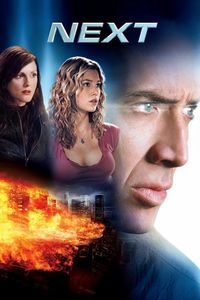
  • Next (2007)

    Next (2007)

    (In theaters, April 2007) Adaptations of Philip K. Dick stories are either SF classics or B-grade pap, and Next goes straight in the second category as a limp action film that never uses its premise to its fullest extent. Oh, Nicolas Cage is entertaining enough as a Las Vegas magician with a few special powers, but there’s little of note in the tedious film that surround him. The action scenes are by the numbers (all the best images are in the trailer), the special effects look substandard, and the ending takes back the entire third act. Boo! Though not quite egregiously offensive or awful, Next nonetheless leaves no lasting impression and will soon go languish in bargain bins all around the world, right next to Paycheck. Isn’t that just a waste?

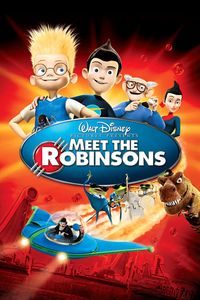
  • Meet The Robinsons (2007)

    Meet The Robinsons (2007)

    (In theaters, April 2007) This second Disney CGI effort after the uneven Chicken Little is a good step up for the new animation house: Not only is it a solid kid’s film, it espouses a number of worthwhile values and even presents a mission statement of sort of Disney itself. Not bad for a film dealing with a genius twin being carried away in the future. The pacing is brisk, the characters are surprisingly well-defined, the animation is fine and little of it is saccharine or maudlin. Better yet: the film often allows itself little forays in bizarre territory, such as when a dozen characters are introduced in ninety seconds, or when a family dinner turns into a cheaply dubbed martial arts sequence. Not exactly the kind of thing you’d expect from the fairly standard trailer. Perhaps the best thing about this film from a purely geek perspective is how it embraces the notion of technological progress as an extension of human values; that’s a nice SF attitude right there, and it does much to make me fond of the movie. (Heck, I even went back two weeks later to see it as a 3-D feature and still enjoyed it.)

  • Death Proof (2007)

    Death Proof (2007)

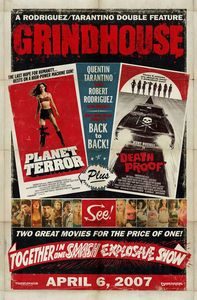
    (In theaters, April 2007) Seen as part of Grindhouse: “In comparison, Quentin Tarantino’s subversive Death Proof is far less even: it dawdles along on Tarantino’s usual verbal pyrotechnics, then delivers a jolt of exploitation adrenaline. But then the movie resets to another format, turning the cards and screwing around with audience expectations. It’s a ride and a half, perhaps too conceptually clever for its own sake.”

  • Planet Terror (2007)

    Planet Terror (2007)

    (In theaters, April 2007) Seen as part of Grindhouse: “Robert Rodriguez’s Planet Terror is by far the most entertaining film of the duo: A self-aware parody of zombie films, it’s crunchy-delicious in its avowed awfulness, and never misses an outlandish beat when it sees one.”

  • Hot Fuzz (2007)

    Hot Fuzz (2007)

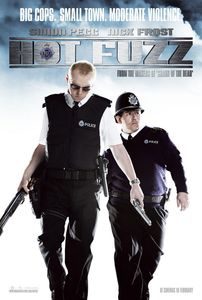
    (In theaters, April 2007) The boys of Shaun Of The Dead are back with another genre comedy, and this time it’s both the quaint English countryside character comedy and the big old Hollywood action movie who successively come under fire. Simon Pegg is exceptional as the super-agent “Nick Frost” transferred from London (where he makes the rest of the force look bad) to a small village where nothing happens. Nothing? Well, OK, not nothing: maybe a continuous series of suspicious incidents… It’s all fun and surprisingly gory jokes until the two-third mark, at which point the film changes gears and truly tackles action movie clichés with a delirious energy. The solid all-star cast does little to distract from the fun. So far, this is the comedy to beat this year…

  • Grindhouse (2007)

    Grindhouse (2007)

    (In theaters, April 2007) For a movie industry that is renowned for not taking risks and always presenting the same thing, American cinema can still be surprising from time to time. Case in point: the wonderful cinematic experience that is Grindhouse, complete with two full-length movies, fake trailers, fake film damage, “missing reels” and intermission cards. (Canadian theatres even got the bonus trailer Hobo With A Shotgun). It’s long, it’s self-indulgent, it’s hyper-violent… but it’s a trip and one of the best prepackaged movie-going experience I ever had in a multiplex. The movies themselves aren’t all that special, but it’s the whole experience that makes the show. Robert Rodriguez’s Planet Terror is by far the most entertaining film of the duo: A self-aware parody of zombie films, it’s crunchy-delicious in its avowed awfulness, and never misses an outlandish beat when it sees one. In comparison, Quentin Tarantino’s subversive Death Proof is far less even: it dawdles along on Tarantino’s usual verbal pyrotechnics, then delivers a jolt of exploitation adrenaline. But then the movie resets to another format, turning the cards and screwing around with audience expectations. It’s a ride and a half, perhaps too conceptually clever for its own sake. Still, the entire package that is Grindhouse is a success and a great big gift to movie geeks. Whatever you do, don’t miss Don’t!

  • 253, Geoff Ryman

    Griffin , 1998, 384 pages, C$17.95 tpb, ISBN 0-312-18295-3

    (Preferably read online at http://www.ryman-novel.com )

    Now here’s an early-web curio that most may have forgotten: a “hypertext novel” in the purest sense, a story without much of a main plot but plenty of characters. 253 of them, in fact: the number of people that can fit in a London tube train. Every one of them to be described in 253-word long chapters. The train (we quickly learn) is doomed to a terrible crash, making the lives of its passengers seem even more poignant.

    High concepts such as “interactive novels” are often bandied about by amateur writers convinced of their genius and self-importance. Often, they’re just rehashes of cheap “make your own adventures” YA novels. Less often, they can take on deeper themes about the way we live stories (such as Kim Newman’s exceptional Life’s Lottery). Geoff Ryman isn’t just any writer (a fact that has grown even more obvious since 253) and his hypertext novel is considerably more ambitious than a piece of stunt writing.

    Inevitably, there are many ways to read 253. Paperbound readers will find a “paper remix” of the book available in bookstores. But that’s a very linear interpretation of the work: the fullest experience is freely available from the web site on which Ryman originally wrote the novel. Here you will find the introductory material, tragic conclusion and the 253 character profiles that form the backbone of the novel. Thanks to the hyperlinks, you will be able to jump from one character profile to another as they interact, building a fuller picture of what is happening aboard that doomed train. Navigating through the novel becomes your own interpretation of the book: Characters encountered in a particular context will have a different resonance later on when they’re seen from other viewpoints, perhaps irremediably affecting the experience of 253.

    For instance, I started reading 253 with the firm intention of doing it linearly: I would read all of the introductions, then all of the character profiles, then the conclusion. But only a few characters into the story, I started following the links that suggested a story. A young man with a crush on an older woman? Let’s click and see what she sees! What, she’s married and her husband is following her? Let’s click and see what happens! Ryman has been clever enough to include a number of such mini-dramas in the hypertext, and it’s not uncommon, following links, to go from one of those stories to another. In some ways, the free-form nature of 253 offers a clearer look at the way storytelling is wired in our brains: I found that I simply couldn’t resist the attraction of a suggested narrative. (Clearly, I’ve been spending too much time reading John “The World can be read as Story” Clute.)

    The number of characters also allows Ryman many fiction-bending possibilities, as it eventually becomes apparent (especially in the last car) that not every character is inhabiting the same world, the same genre or the same story. Some are lost in dreary domestic drama; others are stuck in a crime thriller; at least one would feel at ease in a science-fiction story (having discovered the proof of the entirely reasonable assertion that all males are slightly autistic), whereas a bunch of them eventually transform their train ride in a musical comedy. A “Tall, ravaged, nervous-looking middle aged man” named Geoff Ryman [Passenger 96] even makes an appearance as part of a roving comedy troupe. But even he isn’t the strangest character on-board: That honour could either go to another man studying his fellow passengers and writing the novel’s epitaph (Passenger 252), mysteriously blank character 70, “Pigeon-chested, pigeon-toed” character 121 (my personal favourite) or the ultimate passenger 253, who sends the entire novel into an entirely different direction altogether.

    It makes a unique reading experience: So many characters in such a condensed fashion, with unexpected links and a variety of lives worth experiencing. 253 often recalls the old joke about the dictionary (“great vocabulary, lousy plot”), but here the diversity and interconnectedness (or lack thereof) of the characters is the fabric from which the narrative is made. The train crash is the epilogue than caps off the story in tragic fashion, a sad note in what is otherwise an exhilarating experience (albeit occasionally tedious, when read too quickly). I’m half-glad, half-disappointed I got to experience it at home in front of my computer: In an ideal world, I might have done better had I read it on my PDA during my own lengthy bus rides to and back from work.

  • Ghost Rider (2007)

    Ghost Rider (2007)

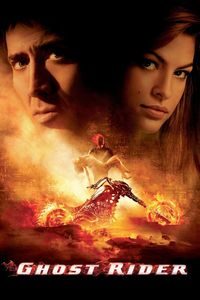
    (In theaters, April 2007) Let’s name names, shall we? Writer/director Mark Steven Johnson, you are the one responsible for the insipid waste of time that is Ghost Rider. The failure isn’t all that surprising after the barely-better Daredevil: the only thing worth pondering is how Johnson was able to get another studio directing job after that train-wreck. Like its predecessor, Ghost Rider wastes every promising element it has, and compresses handily in a moderately interesting trailer that pretty much says everything worth knowing about the film. (The film itself is worse than anything you could imagine from the trailer.) Even the combined appeal of Nicolas Cage and the curvaceous Eva Mendes can’t rescue this turkey as it loses itself in a deeply predictable morass of clichés. The special effects are sub-standard, but it’s really the dull story that fails to engage. Save yourself the trouble: re-watch the trailer again and let this one go.

  • Fracture (2007)

    Fracture (2007)

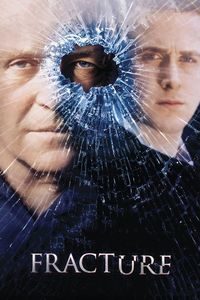
    (In theaters, April 2007) At a time where out-of-left-field plot twists are becoming the norm in the thriller genre, it’s a refreshing change to see a competent howhedidit rather than a ludicrous whodunit. Here, there’s little doubt that Anthony Hopkins’ character shot his wife: the only question is how he was able to do it and yet do his best to escape every effort to convict him for the crime. Despite at least one huge whopper of a coincidence and a very convenient suicide, Fracture nonetheless moves along at a pleasant pace, in no small part due to Hopkins’ self-aware acting, and a decent turn by Ryan Gosling as a young cocky lawyer who learns better. Pay attention, and you will even hear a heartening bit of public service boosterism. Otherwise, well, Los Angeles is convincingly portrayed, the direction is efficient, and there’s a guilty thrill in looking at the brilliant antagonist as everyone plays according to his plan. While not flawless, or even truly memorable, this film will do as rainy afternoon entertainment.

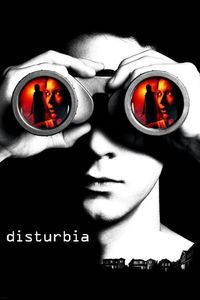
  • Disturbia (2007)

    Disturbia (2007)

    (In theaters, April 2007) I expected nothing from this teen Rear Window wannabe, so imagine my surprise at a well-done and reasonably entertaining teen thriller. Shia Lebouef emerges as a compelling lead in this film, and he’s ideally suited to the mixture of drama, comedy, romance and thriller that develops as Disturbia unfolds. There are some modern twists to the story, but the bare bones of a voyeur thriller are there, with an adolescent dash of mischief. It’s hardly perfect, what with the cheap plot twists, incompetent voyeuristic skills of the characters and manipulated dramatic twists… But it holds up to casual viewing, and ends up being much better than the cheap “Rear Window remake for teens” label might suggest.

  • The Road, Cormac McCarthy

    Knopf, 2006, 241 pages, C$30.00 hc, ISBN 0-307-26543-9

    A man and a woman are walking down a path near the Rideau Canal.

    It’s spring and the snow blanketing Ottawa will stay away for a few months. Patches of green suggest that summer is coming up. The canal is a popular lunchtime destination for the office workers who won’t stay locked up inside their cubicles.

    The man and the woman walk together, but they don’t hold hands. They’re not in other relationships either, but if they were, they wouldn’t be walking together like that.

    Turns out I read a Pulitzer-winning novel last weekend, he says.

    Thats quite unlike you, she says.

    It was an accident. Cormac McCarthys The Road. I wanted to see what the fuss was all about. Even Oprah picked-

    You read a book from the Oprah Book club? Now thats unusual-

    Hey, I paid nine dollars extra to get the hardcover without the Oprah sticker. Please.

    Right. And I suppose that this book is…

    Science-Fiction.

    I knew it.

    But its really something else. Post apocalyptic. The guy who wrote it isnt a Science Fiction writer.

    So he just accidentally wrote SF?

    Maybe. I mean, the point of the story is to show a man and his son at a time where everything has been destroyed. Theres no fancy science, no gadgets, no big plot to save the world. Just two people walking down a road, trying to survive until they can find more food.

    They can just catch rabbits.

    Its not so simple. This is a post-post-apocalyptic story, years after the big event that killed off everything.

    Nuclear war?

    Maybe. It’s not clear and I dont think the author even cares. The stopped clocks and the ash falling down say nuclear war, but the lack of radioactivity and the big booms could mean an asteroid strike. But if that was the case, half the globe would be OK… oh I just dont know.

    I guess it doesnt matter, then.

    No. The point is that by the time the book begins, everythings deader than dead, and every place has been looted more times than you can count. All the plants are gone, most of the people are gone, and the only way anyone can eat is to get lucky and find cans that have somehow escaped everyone else.

    Wow. That doesnt sound too good.

    The prose tries really hard to find all the possible synonyms for gray ash. Its not a novel for depressives.

    It could make anyone feel better, though. Show you how things could be worse.

    I dont think reading about a baby being roasted on a spit is going to make anyone feel better about their lives.

    Ew.

    Sorry about that.

    Just dont mention it again.

    Okay.

    Okay.

    They announced it won the Pulitzer this morning: For prose fiction.

    For a Science Fiction book.

    They say its for literary merit. For good writing.

    Such as?

    Writing without dialogue tags. Removing apostrophes. Stuff they teach in university.

    That must make all of your scifi friends mad.

    You should see what they say on the blogs. Half of it says science fiction rocks, the other half is beating themselves up about how the book is bad SF that stole everything from other genre books.

    What about you?

    The novel is all right. Its not telling a story you can cheer for, but its much better than genre fiction at atmosphere and prose. Even if it stays a one tone melody through the book.

    You’re going to die, you ‘re going to die for three hundred pages?

    Something like that. You forgot the part where they walk and eat.

    They do that a lot?

    Its pretty much all they do. Its a good thing the ending is more optimistic. Though after everything that came before, it doesnt take much to make a happy ending.

    Not my kind of book, I think.

    I wouldnt even try to suggest it to you. But its not that bad. And if it can convince some people that science fiction can be respectable, well thats just a bonus.

    They stop at a bend in the canal. Lunchtime’s more than halfway over, and they’ll have to head back to the cubicles before long. Leaning against the metal railing, they watch a small boat go past.

    And you know what, he says, it does make you feel glad to be alive.

    She grabs his hand and squeezes it.

    She has never done that before.

    But it’s a start.

  • Elantris, Branson Sanderson

    Tor, 2005, 622 pages, C$10.99 mmpb, ISBN 0-765-35037-8

    Hold on to your hats: I’m about to say nice things about a classical genre fantasy novel.

    Yes, I know: I’m not supposed to like fantasy, especially if it’s in the overdone “medieval societies, kingdoms, lost magic, palace intrigue” vein. But there are exceptions, and Brandon Sanderson’s Elantris is one of them.

    For one thing, it fits in one single volume. Though follow-up stories are certainly possible, Elantris is its own 600-pages beast and it closes on a satisfactory conclusion that doesn’t need a sequel. One-shot novels seem so rare in fantasy that this is a welcome distinction, if not even an innovation.

    The theme continues with the book’s opening blurbs, which will really try to make you believe that this is an unusual fantasy novel. No quests! No elves! No mages in robes! And that’s true enough: Elantris manages to avoid the typical quest narrative and keeps the usual genre decorations to a minimum.

    And yet, if you look closely at the novel, it’s easy to apply John Clute’s structure of fantasy: You have a kingdom in which magic is thinning away, and protagonists who are actively working at solving the issue, some treating the symptoms while others try to understand the deeper roots of the problem. The entire narrative schematic of the novel is one that points toward healing and redemption —literally in the case of one character and metaphorically for the entire land where Elantris takes place.

    But never mind the question of whether Elantris is traditional fantasy or not: The real reason why I’m so pleased with the novel is far less abstract: it’s all about the fun of reading. Sanderson’s clear writing and the strength of his characters make it impossible to put down the novel once it starts going. From the first few pages, Elantris establishes a strong trio of viewpoint characters that will carry us to the end of the story: Raoden, a young prince who wakes up “dead” and is condemned to exile; Sarene, his fiancée (soon to be a “widow”) who’s coming from far away to unite two kingdoms through marriage; and Hrathen, a priest who is sent to the city in order to cleanse its rot. Polished but transparent prose add to the characterization to form the essence of strong storytelling. Clearly, Sanderson’s got some talent if he can make a fan of even anti-fantasy curmudgeons like me.

    I particularly enjoyed following the Sarene chapters, as she proves herself a formidable presence in a court where she’s either seen as an interloper, a nonentity or a victim. Trained in the diplomatic arts, she sets in motion a number of intricate schemes even as members of the court underestimate her. There’s dramatic irony is our knowledge that her fiancé is not completely “dead”… and that she even comes to meet him under very strange circumstances. Meanwhile, Raoden wastes no time in exile in trying to solve the mystery of the once-radiant city of Elantris, and Hrathen has plans of his own to take control of the kingdom on behalf of his master. But Raoden’s a goody-goody two-shoe and Hrathen is another one in a long line of unpleasant fantasy priests; it’s really Sarene who ends up forming the backbone of the novel’s appeal.

    Strong scenes, terrific descriptions and an eventful plot do the rest: Elantris is the kind of novel that rewards lengthy reading sessions. There’s an intricate relationship at play between the names, magical system and glyphs (complete with graphical appendix!) that proves how much thought went into this novel. That Elantris is a first novel is a minor wonder: The writing is assured, enjoyable and skillful to a degree that confirms why Sanderson has spent two years on the Campbell Award ballot.

    Heck, it’s good enough to make me think that I’ve been too quick to dismiss classical fantasy. It certainly leads me to suspect that I’ll be spending some time paying attention to Sanderson’s next few books. The qualities that make Elantris work so well -plot, characterization, prose- are a writer’s strengths, not particularities of genre. This very impressive debut bodes well for the rest of Sanderson’s career… and maybe even for fantasy in general.

  • Vulcan’s Forge, Jack B. DuBrul

    Forge, 1998, 371 pages, C$8.99 mmpb, ISBN 0-812-56461-8

    Even since Clive Cussler grabbed the modern American adventure novel by the throat and gave it a wedgie, writers have been struggling to imitate his success and rip off his formula. There may be a few forthright mimes in the bunch (Craig Dirgo’s The Einstein Papers was a conscious attempt at aping the formula, but Dirgo has the distinction of being a frequent Cussler collaborator), but there are also outright copycats such as Jack Du Brul’s Vulcan’s Forge. (But don’t think that Cussler disapproves. There’s a big honking blurb from him on the cover of the Forge paperback edition.)

    How is it a copycat? I’m glad you asked. Grabbing my steel pointer and a schematic plan of Vulcan’s Forge, allow me to poke at the novel’s protagonist, a true squared-jawed American hero named Philip Mercer. Take note: Mercer is built according to the precepts of serial fiction, not simply the needs of a single novel. He is single (though handsome and suave enough to be able to seduce any woman easily, at least once per novel), independently wealthy as a freelance geologist, and tough enough to be willing to travel anywhere on the globe to deal with the problem at hand. Proficiency with survival techniques, big vehicles and weaponry is assumed. Aficionados of Dirk Pitt will oooh in recognition at the Mercer home, an innocuous building that has been completely re-built to act as a museum, research library and depository of cool toys.

    Cussler fans will also nod whenever one of the two main antagonist is revealed: A rich man with dastardly plans for a chunk of the United States, a plan that plays well with the schemes of the other main antagonist. The threat, of course, directly links to Mercer’s professional credentials as a geologist, suggesting that further books in the series will all depend in some way or another on a series of rocky premises. The plot is ludicrous and the science is worse, but that should be seen less as a problem, and more as a further proof that Du Brul is writing in the Cussler vein. Heck, there’s even some underwater action built-in.

    Fortunately, it work relatively well. Though no one will recognize this as a fine piece of literature or even a superior thriller for the ages, Vulcan’s Forge goes through the right motions with some skill, and the result is readable enough. It is a bit longer and blander that it ought to be (some editing would have been able to tighten the action), but not enough to matter. There’s also a late late plot twist that doesn’t matter one bit and makes the novel even more preposterous than it already is. But since it’s a Cussler copycat, can it actually be too preposterous?

    Your answer to that question will determine whether you’re likely to enjoy this novel. It’s strictly a formula thriller meant to launch a series, and as such it’s better than many other attempts. I certainly prefer it to Craig Dirgo’s The Einstein Papers, to name only one such recent example. Philip Mercer’s not an unlikeable protagonist (though I can’t say the same of the company he keeps), so there’s a very good chance that I’ll pick up his next few adventures. Of course, it’ll remain to be seen whether Du Brul will stick to the Cussler formula, or branch out to something of his own.

    [April 2007: Ew. Du Brul’s follow-up, Charon’s Landing, is a step down in almost every way: Not only is it considerably duller and lengthier, it’s also taken with a rabidly conservative viewpoint that keeps poisoning whatever enjoyment is left in the novel. Here, Good old Philip Mercer has to fight big bad environmentalists, but don’t worry: his manhood is sufficient enough to turn a convinced antagonist into his love-kitten in a matter of pages. Virulent denunciations of environmentalist excesses may net Du Brul the usual Crichton-loving readership, but it makes the novel unpalatable to everyone else. Not that a correction there would have helped the rest of the novel as it muddles through a plot that offers little of note. Not the most auspicious follow-up novel.]

    [May 2007: Huh. Du Brul novels keep going but don’t necessarily feel like they’re part of a consistent series. Third volume The Medusa Stone is much better than either the first or second volume as it pits Mercer against a complex web of international intrigue in Africa. The action is unusual, the pacing keeps up and there are a number of fairly interesting scenes here and there. It’s not so successful as far as characters are concerned: Mercer can’t keep a girlfriend and presents a serious risk to his acquaintances, but characters are almost irrelevant in this type of novel. It’s acceptable beach reading, though it still falters even as a simple Cussler copycat. It’s good enough to make me grab the next Du Brul novel at used book sales, but certainly not good enough to go and buy them new.]

  • The Black Echo, Michael Connelly

    Warner, 1992, 482 pages, C$10.99 mmpb, ISBN 0-446-61273-1

    I’ve been a fan of Michael Connelly ever since discovering Trunk Music a few years ago. Since then, I have read most of his early masterpieces and fan favourites (The Poet, Blood Work, The Concrete Blonde…) but, like some oenophiles storing great vintages “for another day”, simply accumulated his novels without reading them.

    Well, this insanity ends this month. For this is the start of the Michael Connelly Reading Project, a comprehensive effort to read one Connelly book per month, every month, until I’m done. In chronological order, skipping over those I’ve already read (with potentially hilarious consequences).

    Obviously, I have to start at the beginning: Connelly’s debut, The Black Echo.

    It’s not just Connelly’s first novel, but also the introduction of his best-known character, LAPD investigator Harry Bosch. Vietnam veteran, jazz enthusiast, laconic and taciturn, Bosch makes for a protagonist in perpetual tension. He’s incapable of living outside a rigid hierarchy, yet he’s got a problem with authority. He fits the mold of a classic Private Investigator, but chafes away in an unglamourous police job after a brush with celebrity. He comes to the series with a fully built past made of a lousy childhood, a stint in Vietnam, a police career and no permanent romantic entanglements.

    It’s pure luck (or is it?) if his latest investigation starts with an anonymous corpse discovered dead in a Hollywood hill drainage tunnel. At first, it looks like a simple case of drug overdose, except for one thing: Bosch knows the victim. They were in Vietnam together as “tunnel rats”, and Bosch can’t let this one go. As he tracks down the threads of the investigation, he’ll discover that the crime wasn’t just the end of a person’s life, but a step in a much bigger plan… one that will see him go back underground.

    For established fans of Michael Connelly, the biggest surprise with The Black Echo is how accomplished a first novel it is. It may not be among Connelly’s finest efforts, but it compares favourably to most police procedurals and already showcases the strengths of his fiction: The familiarity with police procedures and mindsets; the clean prose; the use of Los Angeles as a location; the sharply drawn characters; the intricate plotting; the excellent scenes; the mounting tensions between Bosch, the criminals and the hierarchy in which Bosch operates. It’s very slick stuff, and it seems mastered right off the bat. Like all Connelly novels, this one works from the very first page.

    There are, inevitably, a number of small missteps. Some of the plot twists are a bit obvious, to the point where I even found myself rightfully thinking “Oh, please, Connelly, don’t go this way.” He does, but part of the strength of the book is how it can survive even that. ( I suppose that my predictive abilities would have been even stronger had I remembered The Concrete Blonde in greater detail.) There is also a bit of a lull at mid-book, between beats of the investigation.

    Ultimately, it ends deep under Los Angeles, taking advantage of Bosch’s past as a tunnel rat. The path from the initial examination of Bosch’s friend to the final frenetic pursuit in city sewers is enjoyable and compulsively readable. Connelly knows his stuff, and the hooks he sets in his story make The Black Echo a believable episode in the life of a protagonist who has already seen a lot and will see even more in the rest of the series.

    The Black Echo‘s quality wasn’t lost on the book-reading public: Not only did it launch Connelly’s career, it also netted him an Edgar Award for best first novel of the year. For Connelly fans, it’s now an essential read and a bit of a cornerstone. My Michal Connelly Reading Project couldn’t have started on a better note.