Busby Berkeley

  • Babes on Broadway (1941)

    (On Cable TV, June 2022) I’m going to make this review rather short, considering that it could almost double as the one I just wrote about is quasi-prequel Babes in Arms.   Here goes: Judy Garland and Mickey Rooney both star in this Broadway-themed variation on the “backyard musicals” they so often did together in the early stages of their career. She sings, he emcees and together they put on a show. Much of the filmmaking crew is the same, working under the celebrated Freed Unit of MGM musicals. There’s quite a bit of wartime propaganda, including pulling up a few adorable British poppets for sympathy. Alas, well, the film does introduce its climax with, well, let me quote that for you: “What’s wrong with doing something old? Something tried and true. Well, how about a minstrel show? Does that appeal to you? A good old-fashioned minstrel show!” at which point twenty-first century audiences are screaming NOOOOO. That’s right: after a rather sweet and unremarkable film, Babes on Broadway, exactly like Babes in Arms, concludes with an expansive Busby Berkeley extravaganza featuring… dozens of people in blackface. As with the first film, it’s a significant minus in a movie that doesn’t have a lot of unique pluses. It’s exactly why it’s one of the least-seen, least-broadcast Arthur Freed-produced musicals in the twenty-first century. (Whenever it dusts it off, TCM is careful to accompany it with a verbal warning AND a blackface documentary as follow-up.)  See it once to say that you did, then never think about it again.

  • Broadway Serenade (1939)

    (On Cable TV, May 2022) The 1930s were big on Broadway musicals, and Broadway Serenade stars high-pitched operatic singer Jeanette MacDonald in a familiar story about a married couple in which she strikes it big and he doesn’t. It all leads to a big musical number directed by Busby Berkeley that will be, for many, the single biggest reason to see this otherwise undistinguished film. (Robert Z. Leonard otherwise directs the rest of it.)  MacDonald is a hit-or-miss kind of star – while her vocal talents were undeniable, they weren’t always suited to the kinds of musical comedies in which she starred – an opera singer forced into a movie singer role. I’d rather watch Virginia Gray (who looks wonderful here), but that’s not necessarily a knock against MacDonald. The sexist plot isn’t worth remembering (especially given the flaws of the male protagonist – many of which go unacknowledged by the film) but the musical numbers are much better. After all, Broadway Serenade was designed as a star vehicle for MacDonald. It’s effective as such – but anyone looking for Broadway musicals has several many better choices to pick from.

  • Garden of the Moon (1938)

    (On Cable TV, May 2022) Director Busby Berkeley does (mostly) non-musical comedy in Garden of the Moon, a humdrum film showing the management of a nightclub by an unscrupulous owner dealing with a temperamental band leader. It’s amiable stuff, not all that funny nor all that musical: contrary to many Berkeley films, this one remains very sedate while it presents the nightclub band doing its thing. (But then again, this was Berkeley’s last musical for Warner Brothers – by that time, the musical genre in which he specialized was seen as expensive and on its way out. He’d get his revenge a few years later at other studios as the genre regained in popularity.)  Garden of the Moon is watchable without necessarily being good – the film’s most memorable moment comes very late in its running time, as the owner fakes death to keep his star signed up. That doesn’t make it unsatisfying, but only Berkeley completists will seek out this one.

  • The Gang’s All Here (1943)

    (On Cable TV, May 2022) Like many Busby Berkeley musicals, The Gang’s All Here is an otherwise average genre entry made remarkable by a few signature scenes. In this case, Berkeley’s colour debut earns its rave largely through Carmen Miranda performing “The Lady in the Tutti-Frutti Hat” while backed up by dozens of fruit-clad dancers – a visually inventive anthology number (girls waving gigantic bananas!) no matter how you see it. True to form, the film also scores a terrific concluding segment, “The Polka-Dot Polka,” again due to Berkeley’s staging of a large-scale hallucinatory ensemble dancer number. It’s not just in colour: It’s incredibly colourful in its design, and clearly shows how Berkeley could marry new elements to his cinematography. The rest of the film? Fair, but not particularly remarkable. The plot is equal romance, equal musical, and equal wartime propaganda. Benny Goodman and his orchestra show up for a bit part and a few numbers. There’s also a version of “Brazil” that’s good for an earworm or two. Miranda gets a really good showcase here, and Berkeley also scores a good directing coup with a complex one-shot opening sequence taking up from fiction to, well, more fiction. Some contemporary reviews made comparisons with Fantasia (I’d add 2001: A Space Odyssey) and they’re not wrong – even more so than many black-and-white Berkeley productions, The Gang’s All Here gets its best visual impact by pure shapes and movement, with the humans being mere props to a bigger vision. It may not be one of Berkeley’s very best musicals on a sustained basis, but it ranks as a can’t-miss entry in his filmography solely due to its high points.

  • Blonde Inspiration (1941)

    (On Cable TV, May 2022) As someone who spent a lot of time reading about pulp fiction magazines of the 1940s–1950s (albeit of the Science Fiction genre), I had a favourable predisposition toward Blonde Inspiration: After all, it’s a romantic comedy set against the world of western pulp fiction magazines, with a writer protagonist (John Shelton) trying to make it big as an author. It does help a lot that he’s the heir to a sizeable family fortune, as his worth to the magazine publishers he works with is more as an investor than an author. But don’t fret—thanks to the intervention of the lovely Virginia Gray’s character, he’ll manage to expose fraudsters, make his name as a fiction writer and get the girl. All the way to writing an entire issue of a magazine for himself when the usual writer flats-out refuses to work until he’s paid. Alas, this plot summary sounds better than the film as it exists – despite a decent amount of potential and some rather charming period detail for anyone who once dreamt about the life of pulp fiction writers (if you’re curious about that, have a look at the adventures of Harlan Ellison and Robert Silverberg as short-fiction writers in 1950s–1960s Manhattan – able to finance a modest urban lifestyle by writing a stream of short stories and throwing them over the transom of locked publishers’ doors.), Blonde Ambition struggles to create enough narrative rhythm. Director Busby Berkeley doesn’t have his usual tools here – the film isn’t a musical and doesn’t feature any dance sequences—so he falls back on a serviceable directing style that is undistinguishable from many other for-hire directors of the time. I enjoyed Blonde Inspiration, but I didn’t love it, and considering the potential hook that the film had for me, that’s not exactly a ringing recommendation.

  • Gold Diggers of 1937 (1936)

    (On Cable TV, May 2022) For a series that gleefully aimed at female characters looking to marry rich, it’s interesting that Gold Diggers of 1937 spreads the cynicism around both sexes, poking fun at upwardly-mobile women as much as commission-hungry salesmen. The familiar opening (as a group of young women discuss their prospects for marriage next to a salesman’s convention) is soon undercut by the glum realization that insurance salesmen aren’t the best prospects – which does stop a train full of girls from getting a free meal. While our lead couple (the likable Dick Powell and Joan Blondell) has met on the train, the action gets going once they find themselves working at the same insurance office, and a wealthy businessman decides to sign a very lucrative policy. But plot progressively takes a backseat to the musical numbers – Powell and Blondell don’t need much more than their own selves to make “With Plenty of Money and You” crackle, but then director Busby Berkeley’s work kicks into high gear right in time for the film’s near-hallucinatory climactic number “All’s Fair in Love and War.” It’s a familiar patten for Berkeley, but at least the film ends on a high note. While it may not be as striking as its two immediate predecessors, Gold Diggers of 1937 is nonetheless a rewarding musical – funny, melodic and visually impressive when it counts.

  • Forty Little Mothers (1940)

    (On Cable TV, May 2022) An awkward mixture of genres stops Forty Little Mothers from being completely successful, but it’s still worth a look. Much of the film rests on the shoulder of Eddie Cantor, in a far more dramatic vein than his earlier, lighter roles: Here, he plays a down-on-his-luck schoolteacher who finds an abandoned baby and decides to raise it himself rather than give it to an orphanage. That would be enough material for an entire drama, but then he gets a job at an all-girl school and has to content both with resentful schoolgirls (mad that he replaced their favourite teacher, and trying their best to get him fired) and hiding the baby from the school administrators, since he’s a boarder. The drama, fortunately, gets less overpowering when the girls become his biggest allies in raising the kid, and Forty Little Mothers goes for a more comic approach in its later half. Fortunately, it all ends well for everyone – including the baby and its mother. It’s regrettable that the film stuck so much to the drama, because director Busby Berkeley (best known for his musical choreography) is on firmer footing when shooting comedy. There’s quite a bit of delightful material involving the headmistress and her assistant, with a few glances and chuckles suggesting much naughtier material right under the surface. Alas, this was six years in the pre-Code era, and so the potential for something much more enjoyable remains unrealized. If you think you spot Veronica Lake and Virginia O’Brien in the background, you’re not wrong – MGM went deep in its roster of ingenues to fill up those forty schoolgirl roles. Too bad that Forty Little Mothers, as presented, seems a bit scattered between heart-wrenching drama and much lighter comedy – the film’s tone goes from one end of the spectrum to another, at the expense of a unified comic approach.

  • They Made Me a Criminal (1939)

    (On Cable TV, May 2022) You won’t find that many drama films in director Busby Berkeley’s filmography – the man who defined kaleidoscopic dance routines in the 1930s was best used in musicals and light-hearted fare, but by 1939 his time at Warner Brothers was nearly up, and movie musicals were on the way out. As a result, he ended up directing drama They Made Me a Criminal in which a boxer, convinced he’d killed a man, goes in self-exile in the desert — where he finds redemption, romance, and purpose. It’s not that much of a plot (and this being before noir’s heyday, there’s a surprising restraint in dwelling on the fatalism of the character’s fate) but the film moves effectively even when it’s not that memorable. They Made Me a Criminal is perhaps more interesting behind the scenes as a film of beginnings and endings – an ending for Berkeley, who would move to MGM and find renewed success in the new glossy colour musicals that were about to define the studio’s glory days; and beginnings for the Dead End Kids that litter this film, since they would go on to become the East Side Kids and then the Bowery Boys. (Although this film won’t make converts to their brand of humour and malapropisms.)  There are many, many ways in which this film could have been better – leaning on the grimness of the story or conversely highlighting its humanistic aspect, or taking out the insufferable kids – but They Made Me a Criminal is not that unpleasant to watch. John Garfield gives plenty of dramatic energy to a role that could have been underwritten, and the time spent in the desert marks a change of pace if you’re jaded about the urban landscapes of 1930s Warners crime movies.

  • Hollywood Hotel (1937)

    (On Cable TV, May 2022) There’s a reason why “Midwestern hopeful comes to Hollywood for fame and fortune” is such a cliché, and it goes way back to the 1930s, a decade in which studios released a flood of such films. There was clearly some mythmaking at work, and some laziness as well: if you’re supposed to write what you know, then Hollywood was ideally suited in talking about Hollywood. Some of those films have had decent legacies (the original A Star is Born, for instance), while others are near-undistinguishable TCM fodder. They’re still enjoyable in their own way, but don’t be surprised if you can’t quite tell them from others. (For an extra challenge, have a look at the multiple Broadway musicals from the same era!)  Hollywood Hotel does manage to distinguish itself in a few ways. For one thing, its Midwestern hopeful is a man (Dick Powell), a singer/musician lured to Hollywood by way of a contest. (In the film’s over-the-top opening sequence, the entire town and Benny Goodman make a show of his departure.)  As another wrinkle, the love interest comes into the story as a substitute for a temperamental diva (Lola Lane, quite amusing). While the film follows a solid arc of early success, discouragement and ultimate stardom, the way getting there goes through a few evocative tangents, including a bit of comedy at a drive-in restaurant. (Also, alas, some unfortunate blackface that annoys even the film’s characters.) If you’re familiar with Hollywood history, you’ll see an early for Ronald Reagan, a screen appearance from gossip columnist Louella Parsons, and a supporting role for Benny Goodman and his orchestra – including a performance of the now-standard “Hooray for Hollywood.”  Oh, and it’s directed by Busby Berkeley, even though he doesn’t add much of his visual touch to the musical numbers. This doesn’t make Hollywood Hotel all that good – but it does add some additional interest to something that could have been far more generic – you have no idea of how many hopefuls-to-Hollywood movies were made in the 1930s, and most of them are far duller than this one.

  • Easy to Love (1953)

    (On Cable TV, March 2022) With a title like Easy to Love for such a middling musical, it’s irresistible to reply that it’s more like Easy to Like, right, right? A mid-career Esther Williams vehicle (notoriously filmed as she was pregnant, with choreographer Busby Berkeley reportedly not caring much about her safety), it’s very similar to her other aqua musicals—not necessarily a compliment given their generic nature. The standout moment of the film comes in its climactic sequence: a grandiose Berkeley number with waterski jumpers photographed in colour against a Floridian backdrop. Alas, the rest of the film isn’t as… easy to like. There are the usual romantic hijinks, set against the former Cypress Garden theme park and involving no less a romantic lead like Van Johnson (among three others). In Williams fashion, it’s watchable enough, but not particularly interesting until the final aquatic number. That number, on the other hand, is good for anthology reels (literally—it’s featured in That’s Entertainment II) so that’s reason enough to see Easy to Love right there.

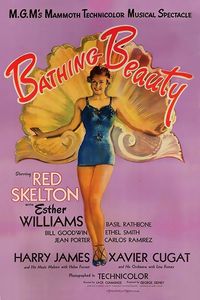
  • Bathing Beauty (1944)

    Bathing Beauty (1944)

    (On Cable TV, May 2021) There’s probably one heck of a box-set (or, these days, “digital collection”) in some distant future in which Red Skelton’s early-1940s films are brought together to give a better appreciation of the incredible run he had as a comic performer at the time. No, his broad ingratiating style isn’t to everyone’s liking. No, the films are not usually high art. But he usually gave it everything he had and he was blessed with some of the era’s most amazing actresses as co-leads, whether it’s Eleanor Powell, Ann Sothern, Lucille Ball, Virginia O’Brien or, in the case of Bathing Beauty, aquatic athlete Esther Williams. The story is contrived to the point of bewilderment (what with a newly married couple not consummating the marriage, and the husband chasing her back to the college she works at) but that’s part of the point, as Skelton plays a virtual stranger chasing a woman while claiming, “but I’m her husband!”  There’s quite a bit of idiot plotting required in making it work, but Skelton’s comedic style is one that easily accommodates such shenanigans as indulged by director George Sidney. As usual for a Williams film, there are a number of musical interludes and aquatic sequences that have cemented her enduring image. (The final sequence, choreographer by Busby Berkeley, is a favourite for re-creations and homages, especially in Berkeley retrospectives.)  There’s a silliness to the college comedy that feels timeless, some snappy tunes and an overall amiability that makes Bathing Beauty hard to dislike. It’s also, crucially, a good showcase for Skelton’s talents, and a reminder of why he was a box-office draw at that time.

  • Strike up the Band (1940)

    Strike up the Band (1940)

    (On Cable TV, April 2021) Fifth in a series of ten movies that paired Judy Garland with Mickey Rooney, Strike Up the Band uses the couple’s most frequent formula: a series of contrivances leading them to put on a show in order to save something or someone or other. Clearly patterned on Babes in Arms (same stars, same premise) but with a slightly bigger panache to wow the audiences, the film is clearly meant to be familiar to the audiences at the time. Early-1940s Garland and Rooney had plenty of youthful sparkle and the camaraderie that came from working together so often. The plot itself is bland, but some of the numbers are still well worth seeing: with Busby Berkeley at the helm, it’s no surprise if the lavish, complicated dance number “Do the La Conga” is the film’s highlight, with plenty of dancers moving to a catchy rhythm. (There’s also a fun number with instrument-playing fruits — and it’s announced by the opening credits.)  It’s an early production of the Arthur Freed unit that would go on to make many of MGM’s most celebrated musicals, so there’s clearly the spark (if not quite the polish) of later well-known productions. For film buffs, Strike Up the Band is a bridge between Garland/Rooney’s “Andy Hardy” teen movies and the musical super-productions she would later star in. It’s amiable enough to be worth a watch — and some of the numbers are memorable.

  • Small Town Girl (1953)

    Small Town Girl (1953)

    (On Cable TV, January 2021) The best movie musicals of the 1950s manage to combine an interesting premise with great individual set-pieces, and while Small Town Girl isn’t much more than a second-tier MGM musical, you can clearly see how one feeds into the other to create something remarkably entertaining. Of course, I’m twice-biased in saying so: Ann Miller is one of my favourite stars of that period, and the film provides her with both a meaty role as a romantic antagonist and a pair of good dance numbers. Furthermore, I’ve been curious about the “Take Me to Broadway” hopping dance that opens That’s Entertainment II for a while, and this is the film it comes from. The premise is not that bad, especially when measured against so many of the Broadway musicals of the time: Here, a rich young man eloping with his fiancée (Miller) is caught speeding through a small town, and the local judge orders him to remain detained in the town jail for thirty days. Attempts to lighten the sentence are (relatively) successful, and so from his vantage point on the main square, he becomes part of the town’s day-to-day life to the point of falling for the judge’s daughter and having serious second thoughts about his fiancée. (Which is just as well, since she’s a shallow fortune chaser who starts making plans with another man while he’s inside. Just so there’s not discomfort with the plot.)  There are other attractions as well — Bobby Van is magnificent in the exhausting “Street Dance” in which he hops around town, S. Z. Sakall turns in a great supporting role, and an uncredited Busby Berkeley provides choreography. Small Town Girl is not meant to be particularly deep or spectacular—this was clearly a B-grade effort for MGM—but it works more often than not, and offers further proof that in its heyday, the movie musical could be perfectly entertaining even when it wasn’t at its best.

  • Footlight Parade (1933)

    Footlight Parade (1933)

    (On Cable TV, January 2021) Hailing from the first half-decade of Hollywood movie musicals, Footlight Parade pales in comparison to later films in the same vein, but still packs a few moments of fun. Featuring none other than James Cagney as a producer of live shows trying to compete with those newfangled movie musicals, it’s an opportunity to see Cagney in a rare non-gangster film during that decade. (He started as a musical star but accidentally became better known for gangster roles.)  The story is a somewhat standard comic backstage musical, and in keeping with later films from codirector Busby Berkeley, keeps most of its musical highlights for the last act. The story has to do with a producer putting together three big numbers for a single night, and the steps taken to find stars and ultimately protect the secrecy of the numbers by locking up the entire crew for three days. While Footlight Parade is primarily directed by Lloyd Bacon, the imprint of Berkeley on the musical number is unmistakable, especially during the “By a Waterfall” number featuring three hundred dancers executing kaleidoscopic figures in a swimming pool. It’s impressive but reminiscent of other numbers—I had far more fun during the comedic (and hummable) “Honeymoon Hotel” number clearly showing the Pre-Code nature of the film. Other artefacts of the film’s production year include a surprising number of bare legs, some barely avoided profanity and passing acknowledgement of prostitution, especially in the “Shanghai Lily” number. Ruby Keeler looks wonderful in early scenes with glasses, while Dick Powell has an early role here as a romantic lead. Still, it’s Cagney borderline manic dialogue, especially in the first half, that holds most interest in terms of acting: much of the film’s later half simply rolls off the musical numbers after the buildup. Footlight Parade doesn’t look as impressive when compared to its contemporaries (even 42nd Street seems more satisfying) or later, savvier takes on movie musicals. But it still has its own kick, and that’s more than enough to warrant a watch by movie musical fans.

  • Billy Rose’s Jumbo (1962)

    Billy Rose’s Jumbo (1962)

    (On Cable TV, November 2020) Musicals had practically gone out of vogue by the early 1960s and genre epicentre MGM was clearly looking to recapture some of their past glory with Billy Rose’s Jumbo, a wide-scale musical set in the colourful world of the circus. Film scholars tell us that the project was in development for decades, starting in the 1930s, before the studio greenlit the film. The result is clearly meant to be expansive—with its succession of numbers taking advantage of circus iconography (Busby Berkeley was involved, in what I believe was his last film project), it’s meant to be a throwback to the glory days of MGM musicals. The result is not bad—especially for the 1960s, where the quality of musicals generally took a nosedive—but it does take a while to build up some interest. Doris Day stars as the daughter of the circus owner, with none other than Jimmy Durante playing her father. (There’s even a recreation of his classic “What elephant?’ gag.)  Both have impressive solo circus numbers, but I’m not smart enough to guess what part of their performances was theirs and what (if anything) was done by a double. Billy Rose’s Jumbo is watchable enough from a twenty-first century perspective, but if anyone tried to guess its production year, they’d probably peg it as a mid-1950s film—which explains why it wasn’t a box-office success and why it did not reignite the MGM musical era. That’s too bad for the filmmakers and studio, but, on the other hand, it has produced a musical for the ages, a bright colourful take on the circus world that you can very well pair with the more serious The Greatest Show on Earth for a double-shot of 1950s circuses.