Month: December 2021

  • The Student Prince in Old Heidelberg (1927)

    The Student Prince in Old Heidelberg (1927)

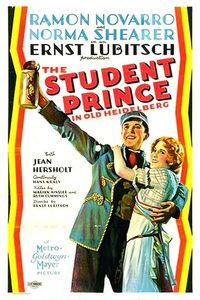
    (On Cable TV, December 2021) As much as I try to like silent films, sometimes it just doesn’t work. I was maybe expecting too much out of The Student Prince in Old Heidelberg: as a film by Ernest Lubitsch, I was looking forward to something much funnier than this melancholic tale of old-world royalty being denied true love. It’s not badly made by the standards of the time, but it takes a dedicated silent film fan to sit through the film’s rather long 105 minutes. Norma Shearer stars alongside Ramon Novarro, but don’t hope for many romantic pyrotechnics along the way, especially considering how the film is fated to end. Those looking for the Lubitsch touch may want to temper their expectations — The Student Prince in Old Heidelberg is professional but lacking his usual verve.

  • Happiest Season (2020)

    Happiest Season (2020)

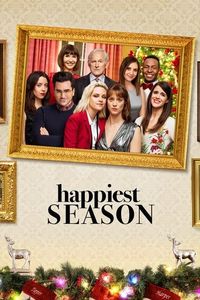
    (Amazon Streaming, December 2021) There’s a good chance that Clea DuVall will leave a stronger legacy as a writer-director than an actress — at least if her work keeps improving the way it went in-between The Intervention and Happiest Season. Her latest spin on the dysfunctional family Christmas comedy features sad-faced Kristen Stewart as a young woman heading to attend the holiday celebrations with her girlfriend’s very traditional family a few states away… but with her girlfriend having neglected to tell her parents about her relationship, or even coming out of the closet in the first place. Not that it’s the only secret just waiting to explode as tensions run higher and higher on the way to Christmas. Thus is the stage set for a mild comedy of manners, lies, misunderstandings, humiliation and a cathartic finale. Best seen as a small-scale film featuring dramatic showpieces, it plays with Christmas tropes while still, ultimately, bowing to familiar values. The acting talent here is not bad — Stewart is clearly in her very specific niche, alongside such notables as Aubrey Plaza (in a somewhat looser role than usual), Alison Brie, the ever-captivating Mary Steenburgen as a matriarch, and Victor Garber is a charming take on the befuddled father trying to make sense of his family suddenly expressing themselves. Still, it’s Dan Levey who steals the show as a stereotypically catty best friend showing up for the pyrotechnics. Despite a few mystifying contrived plot turns, Happiest Season delivers on its promise of decent Christmas film — it’s several steps above the usual Hallmark comfort material even if, in the end, it’s not that different.

  • Space Jam: A New Legacy (2021)

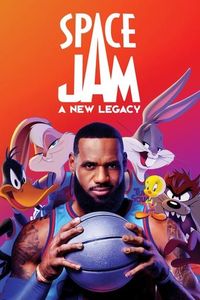
    Space Jam: A New Legacy (2021)

    (On Cable TV, December 2021) Let’s not pretend that the first 1996 Space Jam was an artistic masterpiece or a heartfelt achievement — it was meant to sell toys, glorify Michael Jordan and keep the Looney Tunes relevant. As such, Space Jam: A New Legacy is very much in-line with expectations. Somehow, though, it feels worse. The film does not exist in a context where it’s one of many original works pushed by Warner Brothers — it’s meant as a tentpole among many other tentpoles, squeezing all potential out of commercially viable concepts. When LeBron James is absorbed by the film’s “Warner 3000 Serververse” to meet with the Looney Tunes and interact with the rest of the Warner-owned intellectual properties, the film feels like a dystopian celebration of cultural prostitution, with noble emotions packaged in sellable units for some uncaring financial overlord. I’m being more cynical than usual here, and I’m not sure why: After all, if there’s any movie studio that I like more than others, it’s Warner Brothers all the way to the gangster films of the 1930s. I’m also unusually fond of blending universes for comic purposes, and any metafictional component usually grabs my interest. But as the film greedily pillages from dozens of Warner franchises, I’m not amused as much as made acutely conscious of the hard walls between the Warner, Disney, Sony or Paramount properties — it’s all a hustle meant to subjugate storytelling to corporate initiatives, and A New Legacy is particularly naked in its intent. I’m not saying that it can’t be funny or surprising or entertaining (I’m not sure who I was least expecting to show up here: Ingrid Bergman, or A Clockwork Orange’s droogs) but it’s more wearying than anything else for anyone with any degree of media literacy. (It’s increasingly infuriating to see The Iron Giant being heralded as one of Warner’s masterpieces when it was essentially dumped and ignored by the studio upon initial release.) LeBron James himself is fine in his own role — but trying to make the film all about father-son bonding seems hilariously misguided when there aren’t more than five minutes of footage unmodified by special effects in the entire film. At least the Looney Tunes are decently funny, and their integration with other Warner properties is closer to the spirit of the cartoons than the cash-grab of the film. Otherwise, A New Legacy is definitely not interested in being just a film: it’s interested in selling you Warners, LeBron, Looney Tunes, basketball, video-games and chunks of the Warners back-catalogue — essentially, whatever is worth discretionary money to the target audience. I wouldn’t be so annoyed by the result if Warners was still in the business of making strong standalone films. But A New Legacy exists during a period in Warner’s leadership that’s all about retreads and catalogue exploitation to an extent that feels like storytelling bankruptcy. I sat through it without pain, but I felt distinctly more cynical by the end of it. Which is saying a lot considering where I started from.
  • Man of the World (1931)

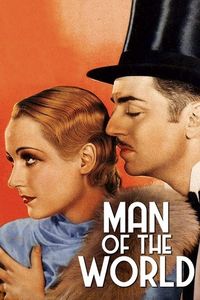
    Man of the World (1931)

    (On Cable TV, December 2021) As a fan of William Powell’s screen persona as perfected in the Thin Man series, I’m almost always interested in the earlier entries in his filmography. Powell started work in the silent era, but usually played villains and cads: it took a while for his specific talents for sophisticated comedy to be recognized. Man of the World is perhaps a better fit for comparison than most films of the early sound era, given how it paired him for the first time with future wife and frequent on-screen partner Carole Lombard. Here, he plays an American expatriate in Paris, a former newspaperman specializing in saucy revelations, blackmail and a little bit of conning. His meticulously planned racket falls apart once our heroine makes her entrance — she’s a woman worth giving up crime for. For Powell, the role is halfway-there in terms of screen persona: he plays a semi-likable rogue with some witty sophistication, but his character is not likable enough to warrant the happiest romantic ending (although he doesn’t end off all that badly). As for Man of the World, it does have a few moments and bon mots, but you’d hardly call it essential, other than for marking the first on-screen Lombard/Powell pairing.

  • Let it Snow (2013)

    Let it Snow (2013)

    (On Cable TV, December 2021) As far as Hallmark Christmas romantic comedies go, Let it Snow isn’t all that good, but at least it tries to get away from the usual formula. Not all of the formula, though, as the idea of a cynical young woman leaving her comfortable surroundings to go to a rural area remains intact — but this time around she’s a hospitality executive travelling from Arizona to Maine in order to write a report on how to maximize the profits from her company’s new acquisition. Of course, what she encounters on-site is an unsustainable boutique experience filled with a handful of regulars charmed by the small homely feels of Christmas at the lodge. (You have to feel sorry for the older woman handling the buffet cooking by herself, as she logically shouldn’t have time to ever leave the kitchen for days.) Oh, and there’s a sexy young man right there to make her rediscover the magic of Christmas. The building blocks used by writer-director Harvey Frost are as obvious as his destination, and the film’s production values are as ambitious as its plot, which is to say: not very much. Let it Snow is all pleasant enough, but there’s nothing else to do here for more reluctant viewers than riff on the pile of absurdities, bad staging, dull acting and insipid writing in the result. It’s very much the kind of film that is watched six weeks out of every year, and then becomes unpalatable as soon as the gifts are unwrapped.

  • Mignonnes [Cuties] (2020)

    Mignonnes [Cuties] (2020)

    (Netflix Streaming, December 2021) Understand this:  Entire industries now prey on your outrage. The angrier you get, the more attention you pay, the dumber you become, the more money you give. That outrage is often tangentially related to the real world, or even manufactured entirely. So it is that in late 2020, alongside the American presidential campaign, a lucrative amount of controversy stemmed from the trailers and posters released by Netflix in order to promote Mignonnes: opponents saw the way the promotional material featured pre-teen girls in sexually provocative poses and jumped to the conclusion that the film was promoting pedophilia. But that, as anyone having actually seen the film could tell you, is a hideous misrepresentation of what the film is about. (Again, remember: people will lie in order to get you outraged.)  Coming from the socially-conscious low-budget segment of the French film industry, Mignonnes ends up being a squirm-inducing, dramatically sensitive portrayal of a young immigrant girl’s attempt to forge herself an identity in-between her ultra-traditional family and an environment that objectifies teenagers. As a parent, Mignonnes often feels like a horror film given how it portrays young girls emulating actions that would be considered inappropriate at any age, pushed along by dance videos and social media. The climax of the film has our protagonist going to the end of her attempt to play older… and being greeted by horrified stares from everyone else. In other words: marketing aside, the film does more to confront and uphold reasonable social values than most other pre-teen movies out there. But the outrage took over, portraying a delicate, wryly witty film into something that it isn’t. (The deceitful outrage was technically bipartisan, but let’s be honest: most of it came out of the insane right-wing echo chamber.)  Too bad for Mignonnes, which, while not an easy film to watch, is far more nuanced and responsible than the hot takes would have you believe. It does play with fire for shock value, but there’s no doubt that it’s on the side of the fire-fighters. It’s also brilliantly funny in its transgression: There’s a joke about condoms midway through the film that goes from gag-inducing to being surprisingly hilarious, and that should give you an idea of how writer-director Maïmouna Doucouré handles her material. Mignonnes is not boring and it’s not comfortable, and it’s especially not what many people would like you to be angry about.

  • Five Feet Apart (2019)

    Five Feet Apart (2019)

    (In French, On TV, December 2021) Terminally ill teenagers are a surefire draw for younger audiences when it comes to ill-fated tragic romances, and so Five Feet Apart takes us in the daily lives of cystic fibrosis patients, a genetic disorder that forces a strict regiment of medication and habits. The title comes from a guideline for patients not to get closer than six feet from each other, given the dangers of fatal cross-infection. (How familiar, post-2020.)  Our meticulous heroine falls for a bad boy with slack habits, and in an attempt to create intimacy, decides to reclaim a foot from the disease, and remain five feet from her boyfriend. It all leads to predictable tragedy by the third act, with no happy ending in store for our bacteria-crossed lovers. Sick teenager romances being what they are, the result is a mixture of surface effectiveness powered by deliberate manipulation. Haley Lu Richardson does well in a somewhat familiar lead role, but the entire film feels like many others, except with a different terrible disease as a plot device. A few things do work, however: Setting the story in a hospital gives an interesting claustrophobia to the atmosphere, and the details of how patients manage their disease help stave off some of the inherent romanticism of the tale. Still, the best Five Feet Apart can manage is a mixed response, its best assets weighed down by elements that may be inherent in the very story it’s trying to tell.

  • YellowBrickRoad (2010)

    YellowBrickRoad (2010)

    (In French, On Cable TV, December 2021) There is an interesting grab-bag of elements at play in YellowBrickRoad — a Pied Pier legend update, some Wizard of Oz mythology, and the relatively unusual idea of a forest path out of time leading hikers to insanity and death. There’s clearly something to do with that idea, especially when it gets away from horror’s dark rooms into a daytime prison without borders. The additional historical material does provide a welcome bit of business surrounding the low-budget execution of the premise, which maximizes a low budget through outdoors photography. Alas, writer-directors Jesse Holland and Andy Mitton can’t manage to make good use of those elements. The script barely touches upon its own ideas, while the cinematography is surprisingly ugly and the actors don’t do much to provide additional attachment where the script remains vague. More frustratingly, YellowBrickRoad doesn’t lead anywhere (fine for the story, not-so-fine for the audience): the characters go crazy and die in various ways, but the central mystery remains largely opaque, and it’s not as if we care about the characters, what happens to them, or even getting answers. YellowBrickRoad is filled with unrealized potential but disappointing execution: I’m sure there’s a much better movie to be made out of the basic building blocks of the film, but this isn’t it.

  • You’re a Big Boy Now (1966)

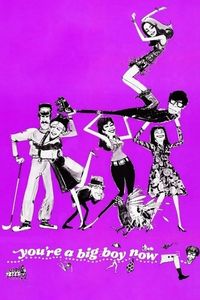
    You’re a Big Boy Now (1966)

    (On Cable TV, December 2021) I suppose that most twenty-first century viewers will come to You’re a Big Boy Now because it’s an early film by Francis Ford Coppola. Fortunately, it does have its charms aside from this pedigree — as a precursor to the New Hollywood era that would be unleashed during the following two years, it takes a decidedly un-classic approach in describing the formative experiences of a young aimless man. If you’re thinking that this sounds a lot like The Graduate (which came later), well yes — the similarities were even acknowledged by Mike Nichols as he began production on the later film. Considering that I’m not a big fan of The Graduate, it shouldn’t be surprising if I prefer You’re a Big Boy Now just a bit more — it’s not quite as self-absorbed, it’s more visually audacious and it’s often far funnier than its best-known equivalent. The portrait of mid-1960s Manhattan is often wonderful, especially when the film engages directly with its surroundings (such as the climactic chase sequence through a department store). As a piece of early New Hollywood, You’re a Big Boy Now is eloquent: you can sense the old way of doing movies being shattered here, a new audience being courted and a new style emerging. It still feels quite modern despite its age, and ends up a surprisingly satisfying early Coppola.

  • Spontaneous Combustion (1990)

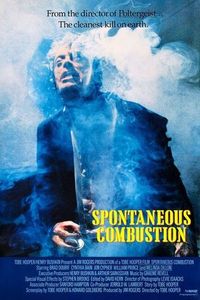
    Spontaneous Combustion (1990)

    (In French, On Cable TV, December 2021) It’s a shame that the inherent goofiness of Spontaneous Combustion doesn’t translate into much more than an average horror film, especially considering that it’s written and directed by Tobe Hooper — it clearly announces the bad later half of Hooper’s career, where the spark of his earlier films was blown out and never came back. You can actually see some of that creativity at work early in this film — the prologue sets up a love story between two test subjects that logically leads to a very special child, but the film loses steam from that point, becoming nothing more than an incoherent blend of plot points that, taken together, end up making a very dull film. (Comparisons to Firestarter are obvious and not complimentary to Hooper’s film.) Brad Dourif doesn’t do much in the lead, and the result ends up being a strong disappointment considering the elements involved. Spontaneous Combustion may be worth a look if you’re trying to piece together how Hooper’s career degenerated over time, but there isn’t a lot there for sheer entertainment.

  • The Wackiest Ship in the Army (1960)

    The Wackiest Ship in the Army (1960)

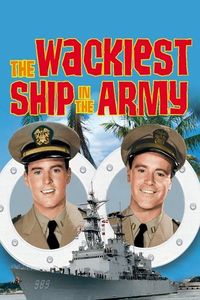
    (On TV, December 2021) It’s one of the paradoxes of Hollywood that many people can do their best while working on a specific film, and yet the result can still feel underwhelming. In the case of The Wackiest Ship in the Army, we have Jack Lemmon in a familiar role, stuck in a familiar story, with a familiar tone. Semi-comic naval stories set against the Pacific theatre of WW2 are a surprisingly robust subgenre, and so are stories of naval officers being given an unusual command (in this case, a sailboat — the magazine article that was the loose inspiration for the film discussed how an older ship was transferred to the U.S. Army, but the film doesn’t explain its own title). Lemmon (an actor with many Pacific theatre WW2 movies in his filmography) brings his usual blend of manic comedy considering how his character does his best with an unimpressive vessel and an unprepared crew. There are the usual comic hijinks, all the way to a climactic contribution to the war effort. The intent to entertain is clear and successful, even if everything isn’t nearly as fresh as it wants to be. The Wackiest Ship in the Army is not bad, but it definitely lives in the shadow of Operation Petticoat, Mister Robert, Father Goose and other WW2 comedies set in the same area.

  • O. Henry’s Full House (1952)

    O. Henry’s Full House (1952)

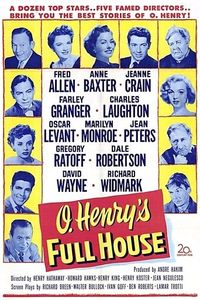
    (On Cable TV, December 2021) Although far less famous now, O. Henry (a pseudonym of William Sydney Porte) was a steady fixture of English textbooks throughout the twentieth century, his deeply ironic short stories being the kinds of things teachers could use as examples of literary devices that students would enjoy reading. (“The Gift of the Magi,” in particular, still has some power.) The flip-side of that popularity is that some of his stories have now fallen into easy cliché, so a film adaptation of five of his best-known tales does often seem far more conventional than intended. O. Henry’s Full House does have a few other things running for it, though: It features none other than John Steinbeck as host, telling us about Henry and introducing each of the five segments. There’s also the matter of casting, with such notables as Marilyn Monroe, Charles Laughton, Oscar Levant… and Richard Widmark reprising his character from Kiss of Death. There are also some surprisingly good credentials behind the camera as well, with Howard Hugues directing one segment co-written by Ben Hecht. Still, the overall impact of the stories is good without being great: Since Henry’s narratives are often built around an ironic surprise ending, it doesn’t take long to learn to accurately guess where the segments are going. (And that’s not counting the cases where we already know how the stories will end.)  Still, the execution is not bad, and everything can be watched rather easily. For English literature fans, O. Henry’s Full House is an intriguing film not just for the Henry adaptations, but also for Steinbeck’s only movie appearance.

  • Shoplifters of the World (2021)

    Shoplifters of the World (2021)

    (On Cable TV, December 2021) The recent glut of movies that act as homage to older musical acts is as interesting as it’s exasperating — I’m sure that the fans love it, but it can leave the rest of us in the cold. There’s also a fair amount of juvenile gatekeeping built in those films, something that seems even worse in Shoplifters in the World. This is a film about The Smiths and a few particularly obsessive fans, one of them so distraught by the band’s breakup that he goes to the trouble of holding hostage a hard-rock radio DJ so that the station’s format goes to all-The Smith all-the-time while he’s holding the gun. This, in the universe of the film, is seen as an unqualified good — a way to bring The Smiths to the masses, to teach everyone that the sum of musical culture is contained in The Smiths and that their lives have no meaning without The Smiths. The fundamental goodness of The Smiths is so self-obvious that even the DJ threatened by death is gradually won over to the cause. (This could work in a comedy, except that Shoplifters of the World is executed as small-scale drama.)  Meanwhile, our sad-sack circa-1987 teenage characters go from terminal small-town existential angst to meaningless partying while The Smiths take over the airwaves and everything gets better. Despite my dripping sarcasm, the film isn’t that bad — Helena Howard is cute, Joe Manganiello is very likable as the DJ, the sense of late-1980s teenage alienation is evocative and there’s something to be said about this film being an anti-Hugues take on similar material. But as much as Shoplifters of the World works overtime to wallow in the legacy of The Smiths, it seems to be working just as hard to exclude those who are not fans. By the time the hijacker finally gets arrested, we’re more tempted to think, “Finally! No more of that music!” than being particularly sympathetic to his upcoming legal issues.

  • Operazione Goldman [Lightning Bolt] (1966)

    Operazione Goldman [Lightning Bolt] (1966)

    (On TV, December 2021) The 1960s were rife with films trying to cash in on the James Bond craze, and considering that very few of them lasted the test of time, seeing them pop up now and again on classic movie channels feels as if there’s an almost-inexhaustible supply of them just lurking under the surface of respectable retro cinema. Lightning Bolt, reflecting the qualities of what would later become imitative Italian cinema, runs off with all of what it could steal from Dr. No to provide a better-than-average Bond imitation—the average being abysmal. The plot? Stopping a dastardly plot to destroy American rockets launched from Cape Canaveral. The setting of the third act? An underwater base not too far from the Bahamas. The protagonist? A super-competent, super-womanizing, dark-haired suave special agent with an unlimited expense account. The scenery? Mostly made of a succession of attractive women. All according to the template. What Lightning Bolt does better than the usual Bond imitator, though, is found in a few ideas halfway developed, the fantasy aspect of being able to buy whatever is required (including a yacht) and some dialogue that, even in translation, isn’t too bad at all. It’s not a good movie and its appeal is gradually dulled by far too many repetitive sequences indifferently executed by director Anthony Dawson, but if you’re going to watch Bond rip-offs, I can think of several worse examples than Lightning Bolt.

  • Honeymoon for Three (1941)

    Honeymoon for Three (1941)

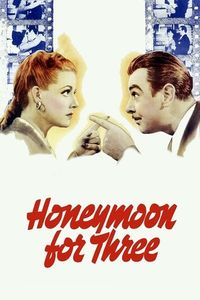
    (On Cable TV, December 2021) I’ll watch just about any movie that features a novelist as a protagonist, even when Hollywood’s understanding of a novelist’s psyche has more to do with fantasy than reality. We’re certainly in comfortable myth in Honeymoon for Three, as George Brent plays a celebrity novelist who has such known issues with womanizing that his friends and colleagues try to protect him when a crazed fan focuses her attention on him during a book tour. As romantic comedies go, it’s watchable without being particularly memorable — although Ann Sheridan looks exceptionally good here with a semi-severe braided hairstyle. The rest of the film (a remake of the 1933 feature Goodbye Again) has ups and downs — some of the dialogue is interesting, while the rest is merely serviceable, and it doesn’t take any cinema literacy to know how it’s going to end. Still, Honeymoon for Three breezes by at a scant 75 minutes despite a comic style that stays perhaps more restrained than it should have been. Anyone with a good understanding of the gruelling nature of book tours will probably appreciate even more the film’s almost fantasy-like portrayal of them.