Author: Christian Sauvé

  • YellowBrickRoad (2010)

    YellowBrickRoad (2010)

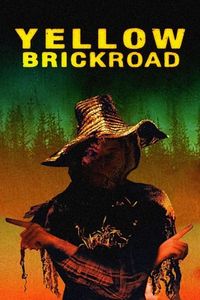
    (In French, On Cable TV, December 2021) There is an interesting grab-bag of elements at play in YellowBrickRoad — a Pied Pier legend update, some Wizard of Oz mythology, and the relatively unusual idea of a forest path out of time leading hikers to insanity and death. There’s clearly something to do with that idea, especially when it gets away from horror’s dark rooms into a daytime prison without borders. The additional historical material does provide a welcome bit of business surrounding the low-budget execution of the premise, which maximizes a low budget through outdoors photography. Alas, writer-directors Jesse Holland and Andy Mitton can’t manage to make good use of those elements. The script barely touches upon its own ideas, while the cinematography is surprisingly ugly and the actors don’t do much to provide additional attachment where the script remains vague. More frustratingly, YellowBrickRoad doesn’t lead anywhere (fine for the story, not-so-fine for the audience): the characters go crazy and die in various ways, but the central mystery remains largely opaque, and it’s not as if we care about the characters, what happens to them, or even getting answers. YellowBrickRoad is filled with unrealized potential but disappointing execution: I’m sure there’s a much better movie to be made out of the basic building blocks of the film, but this isn’t it.
  • You’re a Big Boy Now (1966)

    You’re a Big Boy Now (1966)

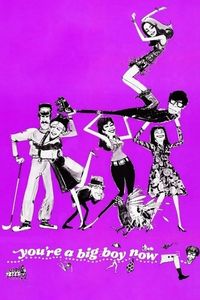
    (On Cable TV, December 2021) I suppose that most twenty-first century viewers will come to You’re a Big Boy Now because it’s an early film by Francis Ford Coppola. Fortunately, it does have its charms aside from this pedigree — as a precursor to the New Hollywood era that would be unleashed during the following two years, it takes a decidedly un-classic approach in describing the formative experiences of a young aimless man. If you’re thinking that this sounds a lot like The Graduate (which came later), well yes — the similarities were even acknowledged by Mike Nichols as he began production on the later film. Considering that I’m not a big fan of The Graduate, it shouldn’t be surprising if I prefer You’re a Big Boy Now just a bit more — it’s not quite as self-absorbed, it’s more visually audacious and it’s often far funnier than its best-known equivalent. The portrait of mid-1960s Manhattan is often wonderful, especially when the film engages directly with its surroundings (such as the climactic chase sequence through a department store). As a piece of early New Hollywood, You’re a Big Boy Now is eloquent: you can sense the old way of doing movies being shattered here, a new audience being courted and a new style emerging. It still feels quite modern despite its age, and ends up a surprisingly satisfying early Coppola.

  • Spontaneous Combustion (1990)

    Spontaneous Combustion (1990)

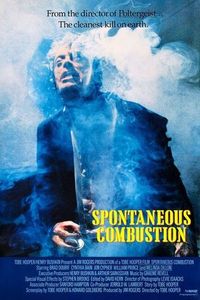
    (In French, On Cable TV, December 2021) It’s a shame that the inherent goofiness of Spontaneous Combustion doesn’t translate into much more than an average horror film, especially considering that it’s written and directed by Tobe Hooper — it clearly announces the bad later half of Hooper’s career, where the spark of his earlier films was blown out and never came back. You can actually see some of that creativity at work early in this film — the prologue sets up a love story between two test subjects that logically leads to a very special child, but the film loses steam from that point, becoming nothing more than an incoherent blend of plot points that, taken together, end up making a very dull film. (Comparisons to Firestarter are obvious and not complimentary to Hooper’s film.) Brad Dourif doesn’t do much in the lead, and the result ends up being a strong disappointment considering the elements involved. Spontaneous Combustion may be worth a look if you’re trying to piece together how Hooper’s career degenerated over time, but there isn’t a lot there for sheer entertainment.

  • The Wackiest Ship in the Army (1960)

    The Wackiest Ship in the Army (1960)

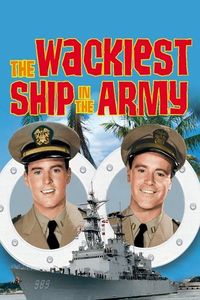
    (On TV, December 2021) It’s one of the paradoxes of Hollywood that many people can do their best while working on a specific film, and yet the result can still feel underwhelming. In the case of The Wackiest Ship in the Army, we have Jack Lemmon in a familiar role, stuck in a familiar story, with a familiar tone. Semi-comic naval stories set against the Pacific theatre of WW2 are a surprisingly robust subgenre, and so are stories of naval officers being given an unusual command (in this case, a sailboat — the magazine article that was the loose inspiration for the film discussed how an older ship was transferred to the U.S. Army, but the film doesn’t explain its own title). Lemmon (an actor with many Pacific theatre WW2 movies in his filmography) brings his usual blend of manic comedy considering how his character does his best with an unimpressive vessel and an unprepared crew. There are the usual comic hijinks, all the way to a climactic contribution to the war effort. The intent to entertain is clear and successful, even if everything isn’t nearly as fresh as it wants to be. The Wackiest Ship in the Army is not bad, but it definitely lives in the shadow of Operation Petticoat, Mister Robert, Father Goose and other WW2 comedies set in the same area.

  • O. Henry’s Full House (1952)

    O. Henry’s Full House (1952)

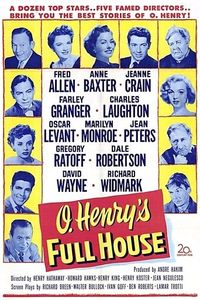
    (On Cable TV, December 2021) Although far less famous now, O. Henry (a pseudonym of William Sydney Porte) was a steady fixture of English textbooks throughout the twentieth century, his deeply ironic short stories being the kinds of things teachers could use as examples of literary devices that students would enjoy reading. (“The Gift of the Magi,” in particular, still has some power.) The flip-side of that popularity is that some of his stories have now fallen into easy cliché, so a film adaptation of five of his best-known tales does often seem far more conventional than intended. O. Henry’s Full House does have a few other things running for it, though: It features none other than John Steinbeck as host, telling us about Henry and introducing each of the five segments. There’s also the matter of casting, with such notables as Marilyn Monroe, Charles Laughton, Oscar Levant… and Richard Widmark reprising his character from Kiss of Death. There are also some surprisingly good credentials behind the camera as well, with Howard Hugues directing one segment co-written by Ben Hecht. Still, the overall impact of the stories is good without being great: Since Henry’s narratives are often built around an ironic surprise ending, it doesn’t take long to learn to accurately guess where the segments are going. (And that’s not counting the cases where we already know how the stories will end.)  Still, the execution is not bad, and everything can be watched rather easily. For English literature fans, O. Henry’s Full House is an intriguing film not just for the Henry adaptations, but also for Steinbeck’s only movie appearance.

  • Shoplifters of the World (2021)

    Shoplifters of the World (2021)

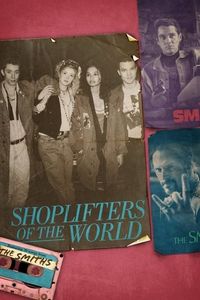
    (On Cable TV, December 2021) The recent glut of movies that act as homage to older musical acts is as interesting as it’s exasperating — I’m sure that the fans love it, but it can leave the rest of us in the cold. There’s also a fair amount of juvenile gatekeeping built in those films, something that seems even worse in Shoplifters in the World. This is a film about The Smiths and a few particularly obsessive fans, one of them so distraught by the band’s breakup that he goes to the trouble of holding hostage a hard-rock radio DJ so that the station’s format goes to all-The Smith all-the-time while he’s holding the gun. This, in the universe of the film, is seen as an unqualified good — a way to bring The Smiths to the masses, to teach everyone that the sum of musical culture is contained in The Smiths and that their lives have no meaning without The Smiths. The fundamental goodness of The Smiths is so self-obvious that even the DJ threatened by death is gradually won over to the cause. (This could work in a comedy, except that Shoplifters of the World is executed as small-scale drama.)  Meanwhile, our sad-sack circa-1987 teenage characters go from terminal small-town existential angst to meaningless partying while The Smiths take over the airwaves and everything gets better. Despite my dripping sarcasm, the film isn’t that bad — Helena Howard is cute, Joe Manganiello is very likable as the DJ, the sense of late-1980s teenage alienation is evocative and there’s something to be said about this film being an anti-Hugues take on similar material. But as much as Shoplifters of the World works overtime to wallow in the legacy of The Smiths, it seems to be working just as hard to exclude those who are not fans. By the time the hijacker finally gets arrested, we’re more tempted to think, “Finally! No more of that music!” than being particularly sympathetic to his upcoming legal issues.

  • Operazione Goldman [Lightning Bolt] (1966)

    Operazione Goldman [Lightning Bolt] (1966)

    (On TV, December 2021) The 1960s were rife with films trying to cash in on the James Bond craze, and considering that very few of them lasted the test of time, seeing them pop up now and again on classic movie channels feels as if there’s an almost-inexhaustible supply of them just lurking under the surface of respectable retro cinema. Lightning Bolt, reflecting the qualities of what would later become imitative Italian cinema, runs off with all of what it could steal from Dr. No to provide a better-than-average Bond imitation—the average being abysmal. The plot? Stopping a dastardly plot to destroy American rockets launched from Cape Canaveral. The setting of the third act? An underwater base not too far from the Bahamas. The protagonist? A super-competent, super-womanizing, dark-haired suave special agent with an unlimited expense account. The scenery? Mostly made of a succession of attractive women. All according to the template. What Lightning Bolt does better than the usual Bond imitator, though, is found in a few ideas halfway developed, the fantasy aspect of being able to buy whatever is required (including a yacht) and some dialogue that, even in translation, isn’t too bad at all. It’s not a good movie and its appeal is gradually dulled by far too many repetitive sequences indifferently executed by director Anthony Dawson, but if you’re going to watch Bond rip-offs, I can think of several worse examples than Lightning Bolt.

  • Honeymoon for Three (1941)

    Honeymoon for Three (1941)

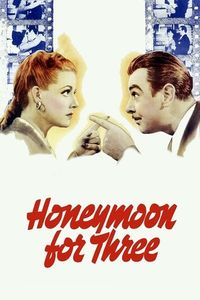
    (On Cable TV, December 2021) I’ll watch just about any movie that features a novelist as a protagonist, even when Hollywood’s understanding of a novelist’s psyche has more to do with fantasy than reality. We’re certainly in comfortable myth in Honeymoon for Three, as George Brent plays a celebrity novelist who has such known issues with womanizing that his friends and colleagues try to protect him when a crazed fan focuses her attention on him during a book tour. As romantic comedies go, it’s watchable without being particularly memorable — although Ann Sheridan looks exceptionally good here with a semi-severe braided hairstyle. The rest of the film (a remake of the 1933 feature Goodbye Again) has ups and downs — some of the dialogue is interesting, while the rest is merely serviceable, and it doesn’t take any cinema literacy to know how it’s going to end. Still, Honeymoon for Three breezes by at a scant 75 minutes despite a comic style that stays perhaps more restrained than it should have been. Anyone with a good understanding of the gruelling nature of book tours will probably appreciate even more the film’s almost fantasy-like portrayal of them.

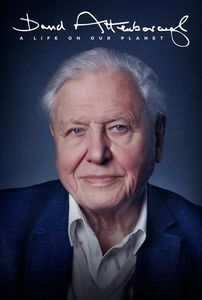
  • David Attenborough: A Life on Our Planet (2020)

    David Attenborough: A Life on Our Planet (2020)

    (Netflix Streaming, December 2020) If read about public speaking, you will inevitably run into the axiom that emotion trumps logic in convincing audiences. But there’s something that trumps even the most emotional speakers, and that’s authority. You will inevitably pay more attention to someone with solid credentials (especially if you’re already familiar with them) than J. Random Individual. (So, what are you doing getting movie reviews from me?) Accordingly, when none other than nature-documentary authority David Attenborough himself decides to headline a documentary feature outlining the environmental degradation that he has witnessed over his very long career, he’s got immediate credibility. Fortunately, he’s also able to supplement this authority with emotion and, yes, some cold facts and logic as well. The story he’s telling in A Life on Our Planet is now new and it’s not comforting. It’s an overview of how, in Attenborough’s 90+ years of life, the Earth has become increasingly more crowded, hotter, polluted, and less hospitable to wildlife. The impacts of human-driven global warming may be irreversible, upsetting the delicate balance that has fostered human civilization. For much of its duration, it’s a justified tale of gloom and degradation, as Attenborough tells us that what he saw back in the 1960s as a working documentarian simply does not exist any more. There’s an uplifting fillip at the very end of the film, but it’s not enough to take away from the remarkably glum assessment of the film and its exhortation to take action now in order to save ourselves and future generations from the worst of it. Attenborough makes a genial companion to dark predictions: he speaks plainly, can show his own historical archive footage and doesn’t have much to lose in convincing audiences. After all, he could be spending his nineties in retirement — and he’s not going to be the one suffering much longer from the ongoing ecological collapse. When speaking about elders and their advice, A Life on Our Planet does seem like an exemplary showcase: it’s clearly from personal experience, and it manages to reach audiences in a slightly different way than many other similar documentaries. Few people have as much authority on the topic as Attenborough, and it’s an eloquent legacy to pass on his own experience to younger generations.

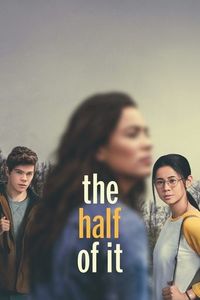
  • The Half of It (2020)

    The Half of It (2020)

    (Netflix Streaming, December 2020) Cyrano de Bergerac kind-of-goes Midwestern gay high-school romance in The Half of It, as the story focuses on a young woman with a crush on another female teenager who gets to express her affections by ghostwriting the romantic communications of a friendly guy. Of course, adherence to the classics only goes so far, and the film eventually acquires its own quality when the jock character proves to be a great platonic friend, the object of her affections isn’t necessarily interested, and the entire thing becomes a way for our protagonist to realize what she really wants. The Half of It gets sloppy in part — the third act seems unsupported by what precedes it, as new subplots are quickly introduced and discarded, the focus shifts to some supporting characters and the carefully deliberate pacing of the first part of the film seems abandoned to deliver a conclusion that hasn’t quite figured out how to be as precise as earlier moments in the film. Fortunately, Leah Lewis is very likable in the lead role, clearly portraying the desperation of being a bright urbane young person stuck in a very small and narrow-minded town on the edges of nowhere. Writer-director Alice Wu does get most of it right — but it’s that missing fraction, the late-movie messiness and unfocused plotting that hold back The Half of It from being as exemplary as it could have been. As a result, it may not be as much of a crowd-pleaser as many similar films — it’s fun all right, but there are other better movies if you’re in a hurry. But then again, being in a hurry isn’t exactly a match with The Half of It’s overriding sensibilities.

  • Drive (2020)

    (On TV, December 2021) Some films have the flaws of their qualities, and documentary Drive is both fascinating and frustrating for the same reason: While justified by a single good idea (what will happen to the act of driving when cars become automated?), it then goes off driving in all directions at once. Becoming a grab-bag of loosely connected sequences more than a coherent argument, Drive is about disabled people getting the means to drive themselves; celebrities reminiscing about childhood drives; a staunch advocate of human driving; fancy “art cars” showing that they’re more than about getting from point A to point B; a pair of very likable teenagers sharing their feelings as they learn to drive; a short history lesson about the impact of personal mobility in North America; and plenty of other things. I’m not really begrudging the highs of writer-director Scott Harper’s film: Hearing Jully Black belt out an impromptu acapella cover of Gary Numan’s “Cars” is an unqualified delight. But somewhere along the way, Drive seems to lose itself in a meander of sidestreets. The journey is clearly more important than the intention at the onset of the trip, because a good chunk of Drive could exist without any mention of its starting doubts about driving automation. Is that a problem? Well, it could be if you were still hankering for a sustained argument around the consequences of automated driving. (And preferably one that goes beyond knee-jerk nostalgia and rote techno-skepticism — Drive isn’t really interested in what automated driving means beyond not handling the wheel.)  As it is, it does feel like a bait-and-switch from a clear compelling premise to whatever the filmmakers accumulated during shooting. Its success will clearly hinge on whether you’re willing to stay on-board once it starts taking detours.

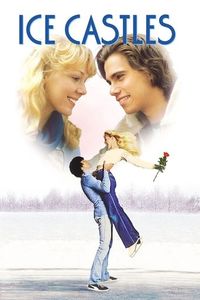
  • Ice Castles (1978)

    Ice Castles (1978)

    (On Cable TV, December 2021) Sometimes, there just isn’t much to say: Ice Castles is a movie about ice skating and… well… that’s that. It’s the story of a young girl who wants to be a figure skater, encounters adversity in the form of sudden blindness and eventually achieves her goals by the end of the film, but not before reuniting with the man in her life and staying true to her values. So brave, so heartfelt and yet so ordinary. The disability angle is clearly there to earn sympathy in a schematic manner, but the film makes it work. At least the lead actors aren’t bad — Lynn-Holly Johnson was a figure skater before turning to acting (most notably here and in a later James Bond film), while Robby Benson is not bad as the boyfriend. Under writer-director Donald Wrye, Ice Castles is executed competently by late-1970s standards, meaning that it will appeal to its target audience. Otherwise, what else is there to say?

  • #Saraitda [#Alive] (2020)

    #Saraitda [#Alive] (2020)

    (Netflix Streaming, December 2021) I wasn’t expecting much from #Alive — zombie films are overplayed, and it takes more than a slightly askew premise (such as a young man stuck in his apartment as the rest of the world goes crazy) to get beyond the genre fatigue. Still, there is something in the way the film approaches its premise that just happens to match recent real-world pandemic experience: the sense of isolation as illness sweeps the world outside, the fragile domestic bubble only valid as long as we don’t try to get out. #Alive get a lot of mileage out of this — the first half of the film, easily the best, doesn’t upset this spatial unity even as the apartment’s surroundings are presented in detail. Things get slightly weirder and less cohesive once our protagonist ventures outside, makes an ally and has to physically battle hordes of zombies weeks into the crisis. But that’s inevitable in a script that creates an atmosphere of claustrophobia without necessarily being hermetic in its presentation. One of the big advantages of #Alive over other lesser zombie movies is that it does take the time to clearly show the protagonist’s environment, allowing viewers to invest themselves in what-if-I-was-in-this-situation scenarios. Like it or not, the COVID pandemic will alter our conception of extraordinary events for the rest of our lives, and zombie films (as exemplars of the genre) will come to take many of the cues explored during that time. The South Korean origin of the film isn’t as much of a barrier as many would think — thanks to writer-director Cho Il-hyung, the film is accessible and compelling for wide global audiences. While it’s too early to see how well it will age (there’s a real chance it will be dated rather than enhanced by its timeliness), #Alive does rank well in an overexposed genre.

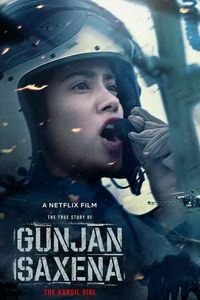
  • Gunjan Saxena: The Kargil Girl (2020)

    Gunjan Saxena: The Kargil Girl (2020)

    (Netflix Streaming, December 2021) There’s something very familiar in The Kargil Girl’s premise and execution, as a young girl fascinated with flying becomes one of the first female pilots in the Indian Air Force, but not after a considerable amount of disappointment, discrimination and verbal abuse. It’s squarely in the same vein as many other inspiring ceiling-smashing films, no matter whether they’re from India or elsewhere. Writer-director Sharan Sharma’s execution is fluid, with some exemplary editing taking us across several years — although the film itself does remain slightly too long and repetitive at 112 minutes. The advantage of its subject matter is that it enables the filmmakers to talk about female empowerment while throwing it a climactic war sequence, combining into broad appeal. It’s reasonably entertaining even if the melodrama does get intense at times. Still — The Kargil Girl is better than many other recent Indian films, and not as annoying in its execution as many others.

  • I Want You (1951)

    I Want You (1951)

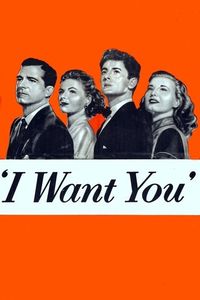
    (On Cable TV, December 2021) There’s a clever double sense to I Want You’s title that hints at its dual nature — an expression of romance, of course, but also an exhortation to enlist: “I want you for U.S. Army,” says Uncle Sam. And that, in a nutshell, is what the film is about — small-town romantic drama as the Korean War heats up and American men are once again asked to go back into combat despite knowing exactly what this means this time around. This film is very much of its time, and that’s perhaps what’s most interesting about it: it’s a slice-of-life dramatization of what must have been an overwhelming topic of conversation across American circa 1950 and the film’s decidedly low-key approach makes it feel more convincing than an overblown melodramatic approach. Director Mark Robson can depend on decent performers (Dana Andrews and Dorothy McGuire in the lead) to get the film’s rather delicate drama across. It’s probably not the kind of film that you want to sit down for thrills and laughs, but it’s a remarkable film for its own specific reasons — capturing America at a specific time, not a dramatic one but still a pivotal one.