Book Review

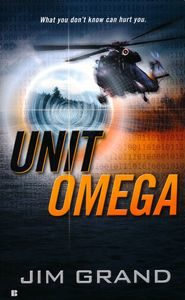
  • Unit Omega, Jeff Rovin as Jim Grand

    Unit Omega, Jeff Rovin as Jim Grand

    Berkley, 2003, 277 pages, C$9.99 mmpb, ISBN 0-425-19321-7

    As the year grinds down to a halt during the December holidays and as I reflect on the number of books I have read and reviewed this year, I find myself fascinated not by a big thick meaty masterpiece, but by a trifle of a thriller.  Part of the attraction is due to surprise: Packaged as wide-scale military fiction, Unit Omega turns out to be a small science-heavy adventure that almost works better when its two protagonists are just talking to each other.  It’s charming and refreshing, and it’s completely unlike what I was expecting when I purchased the book.

    Unsurprisingly, I got it from a used book store: Long out of print and now unavailable except through specialized sellers, Unit Omega was apparently published in late 2003 and quickly sank without a trace shortly thereafter, leaving in its wake a scant six customer reviews on amazon.com.  None of them were particularly positive, much of the hostility having to do with a misleading cover promising military action from a United Nation unit specializing in “investigating unusual scientific phenomena”. (“The military is facing an enemy like none ever seen before.”)

    The true nature of the novel, after a perfunctory mysterious prologue, quickly becomes something of a laugh.  Because the “unusual scientific phenomena” unit of the United Nation ends up being one lone young scientist holed up in the basement of the United Nations headquarters in New York, idly contemplating writing science-fiction novels on the job while his putative boss tries to get him a real budget.  Harold Collins is bright and enthusiastic about pushing back the frontiers of science, but he’s stuck in a miserable situation.  Opportunity strikes when a phone call is patched to his office: A once-respectable scientist has reason to believe that the Loch Ness legend has a grain of truth to it and wants a third-party to investigate what she has found.  Bored out of his mind, Collins spends his yearly travel budget on a trip to Scotland, and manages to convince a young and attractive magazine editor to come along.

    Number of transatlantic flights spent stuck in coach: One.  Number of military helicopters in the novel: Zero.

    Their investigation unfolds as a deliciously low-tech affair, with consumer-grade camera equipment and wet suits rented from the local dive shop.  The plot is just as threadbare: Collins does discover something, figures out what it is and comes back.  A comfy epilogue quickly follows, complete with the promise of another novel in the series.  If you were expecting explosions, fighter jets or even a military uniform, you may spare yourself some trouble and reset your expectations accordingly: Unit Omega is one of those rare techno-thrillers with no military involvement whatsoever.

    It’s best to call it low-grade science-fiction: The “Loch Ness anomaly” is a natural scientific phenomenon, implausible but generally well-developed.  The protagonist seems to have absorbed the ideas and attitude of classic genre Science Fiction, and a shortened version of his simple adventure wouldn’t have felt out-of-place in as a novelette in Analog magazine.  As far as I’m concerned, that’s part of the appeal: Collins is a likable nerd, and his budding romance with his travel companion (obviously designed to reach fruition much later in the proposed series) is conventional but entertaining.

    In fact, most of Unit Omega is just plain fun to read.  The undermining of the “elite United Nation unit” trope is fit for giggles and the novel plays up those subverted expectations throughout the rest of the narrative.  As a story, it has a substantially more likable personality than the usual generic military thrillers it’s meant to evoke, and it reminded me of the kind of boyish adventures that SF used to do so well.  It’s not, in other words, a particularly deep or meaningful novel… but it’s rewarding and memorable in its own fashion.

    It’s worth noting that “Jim Grand” is really (as per the Copyright page) Jeff Rovin, a professional writer with one of the most diverse bibliographies you’re likely to see.  It’s a shame that he doesn’t seem to have a permanent web presence: I’d love to read him talk about his work, and how he manages to write a few books per year.  Unit Omega has exactly one follow-up to date, the similarly mis-marketed Operation Medusa published a month later.  I think I’ll start lurking in used book store to find a copy.

  • Old City Hall, Robert Rotenberg

    Old City Hall, Robert Rotenberg

    Touchstone, 2009, 372 pages, C$29.99 hc, ISBN 978-1-4165-9285-3

    Like many Canadians who don’t live in Toronto, my feelings about the city are a mixture of envy and distrust.  Toronto is, in some ways, Canada’s most important city –which is fine: after all, it’s tough to be anything else when about a sixth of the country’s population lives nearby.  (What’s less endearing is Toronto’s tendency to assume that anything not within commuting distance of the CN Tower might as well be on another primitive planet.  But I digress.)  Toronto is an order of magnitude bigger than my Ottawa hometown and I can never completely get used to its scale and density.  On the other hand, recent years have taught me that Toronto can be a lot of fun when approached the right way, and that while I could never live there, it’s an awesome place to visit a few times a year.

    These considerations aren’t completely foreign to Robert Rotenberg’s Old City Hall, a crime-fiction debut that lavishes attention on its characters –the most important of them being Toronto itself.  For everyone who wished the Torontonian equivalent to Robert B. Parker’s Boston or Michael Connelly’s Los Angeles, don’t look any further than Old City Hall.

    It begins with a celebrity radio host accused of murdering his wife.  The evidence against him is overwhelming, not the least being the seemingly-incriminating statement “I killed her”.  But don’t jump to early conclusions: Old City Hall soon reveals itself to be an old-fashioned mystery/procedural that describes almost everything about the subsequent trial.  Witnesses, policemen, lawyers, and journalists all become involved in trying to discover the truth behind the crime.

    The best part of the novel for anyone reasonably familiar with Toronto is the care and detail through which Rotenberg describes his hometown.  From the Don Jail to the titular Old City Hall, though details about traffic to the city’s fascination for the hapless Maple Leafs, Toronto comes alive and those who have wandered around its downtown district will be able to picture the backdrop to many of the novel’s sequences.

    But even for readers without much knowledge of Toronto, Old City Hall shines for its lavish attention to characterization.  Nearly every character of significance is sketched with skill and depth, providing full backgrounds to even the most inconsequential witnesses.  I was particularly struck by “Albert Fernandez”, a young Crown attorney who’s insanely ambitious, yet strangely likable and, ultimately, honourable in his own fashion.  It helps that Rotenberg writes clearly, with constant narrative momentum and mysteries.  Why isn’t the radio host talking?  What are the policemen missing?  Who’s lying?  Will the Leafs win the Stanley Cup?

    Unfortunately, the last fifty pages of the book feel like a messy let-down once the various parts of the plot are resolved.  Rotenberg’s problem is in attempting to do too much at a time where readers could have been satisfied with far less.  Not content with revealing the crucial circumstances of the events, he piles up overly complicated family drama far past the point where readers will care.  From a careful and enjoyable procedural crime thriller, Old City Hall becomes a jack-in the-box of unneeded and useless revelations; the novel would have ended on a stronger note without most of them.

    But that’s a late and minor sour note to a debut novel that promises much from Rotenberg’s next efforts.  The ensemble of characters introduced in Old City Hall seem rich enough to warrant a continuing series, and Toronto can always use one more high-profile crime series.  In the meantime, Old City Hall is a joy to read, and it’s a decent paean to Canada’s largest city.  Even for those of us who don’t live there, and never intend to.

  • How to Live Safely in a Science Fictional Universe, Charles Yu

    How to Live Safely in a Science Fictional Universe, Charles Yu

    Pantheon, 2010, 239 pages, C$27.00 hc, ISBN 978-0-307-37920-7

    It used to be that Science Fiction was something best enjoyed by a small self-selected bunch of geeks.  Nothing wrong with that; in fact, I’m often tempted to argue that SF in its purest essence is best when it’s meant to be literature for nerds who otherwise wouldn’t crack open any fiction.  Every genre serves a purpose, and SF’s reason for existing may have been to provide entertainment to the techno-scientific subculture.

    That, however, stopped being true a long time ago.  As SF movies got more popular, as SF television series multiplied, as SF took over video games, Science Fiction has diffused itself into the world, earning some permanent space in the mind of every reasonably-socialized citizen of the western world.  SF won; hurrah!  Call it a snowball effect: as SF becomes more popular, it becomes more accessible to more people; as it becomes more accessible, it grows even more popular.

    But there are consequences to such pervasiveness, and the biggest is that people will use Science Fiction for their own purposes.  While a common snotty stereotype among the SF fans is that popularity will invariably dumb-down the material, there is also a possibility that it will spur some truly oddball creation using SF tropes in ways that would never be imagined by old-school SF fans.

    I know nothing about Charles Yu except that he’s under 35, and that’s enough to make a few safe predictions: He has lived in the American cultural matrix all of his life.  No surprise if his brand of literature is influenced by a boiling cauldron of SF-flavoured references.

    How to Live Safely in a Science Fictional Universe is one of those increasingly common novels that use Science Fictional elements with a good understanding of how they work, but don’t quite fit the straightjacket description of genre SF.  Unlike previous generations of SF novels written by mainstream writers with a distant, incomplete or dismissive view of Science-Fiction, Yu’s cohort simply picks what they want to use from SF’s bag of tricks in the service of what they’re trying to do.  Yu’s first novel is playfully meta-fictional, intensely self-reflective (to the point of having a narrator sharing his name with the author), doesn’t attempt to deliver a fully-imagined reality and doesn’t really want to play by the stylistic or narrative guidelines of the genre.

    It’s nominally about a time-travel machine repairman who gets in trouble when he kills a future version of himself, but that’s really just a narrative framework on which to hang reflections on personal destinies, a process of self-growth, funny snippets about the nature of science-fiction universes and an interesting look at a protagonist who knows that something very unpleasant is about to happen to him.  There are plenty of nods to classic SF writers in-between “Holy Heinlein” [P.160], a “Niven Ring” [P.162] and “Holy Mother of Ursula K. LeGuin” [P.213], plus some cleverness in skewering the narrative conventions of SF world-building with the titular passages.

    The meta-fictional games (referring to the novel by its own page numbers, or as a book to be written by the narrator who’s aware that he’s writing one) are the extra proof that Yu’s novel is meant to be taken as literary diversion rather than hard-edged speculation.  As such, How to Live Safely in a Science Fictional Universe works more often than it should: If the novel feels shorter and les substantial than narrative-heavy classical-mode SF novels, that’s a prejudiced reading from a genre-SF perspective.  It may be more fulfilling to consider the book as a playful mainstream novel that fully engages with a science-fictional trope.  It’s certainly a joy to read –not for the story, but for the moments, digressions, references and new ways to look at familiar issues.  Despite the novel’s emo-mopey attitude, I smiled quite a bit more than I expected, and I’m going to carry the amusing bits longer than the maudlin ones.

    For those taking a wider-spectrum view of the novel and what it means, I note that it fits well between Michael Ruben’s  The Sheriff of Yrnameer, Nick Harkaway’s The Gone-Away World, Audrey Niffenegger’s The Time-Traveler’s Wife and Larry Doyle’s Go Mutants! (not to mention Junot Diaz’s The Brief Wondrous Life of Oscar Wao) as hip quasi-mainstream novels that take a somewhat light-hearted approach to blending genre or genre-friendly elements into a literary framework.  The generation that grew up on VHS horror movies, Nintendo gaming, Star Trek: The Next Generation and the Gulf War is finally finding its voice… and it has a vision of the present that’s influenced by Science Fiction.  Gernsback and Campbell wouldn’t necessarily approve of the result, but they’re not around to complain.

  • Fade, Kyle Mills

    Fade, Kyle Mills

    St. Martin’s, 2006 paperback reprint of 2005 original, 344 pages, C$9.99 mmpb, ISBN 0-312-93418-1

    Kyle Mills may not be a best-selling thriller author, but he’s certainly an interesting one.  His bibliography shows a preference for tackling unusual subjects with an off-beat sensibility:  His best work to date may be Smoke Screen, a low-intensity comic thriller taking place within the smoking industry.  In other novels, he has featured characters poisoning the US drug supply, taking on Scientology-like cults, discovering Edgar J. Hoover’s secret files or publicly helping terrorists.  While not everything he writes is of equal interest, even his most forgettable novels have one or two elements worth mentioning.

    Fade won’t rank as one of his best, but it certainly shows the way Mills can take familiar thriller elements and rearrange them in an unusual fashion.  The main character of the novel is, at first glance, the kind of guy you find at the middle of just about every modern American thriller: A super-competent Special Forces operative, a one-man army capable of winning the War on Terror by himself.  Except that Salam al Fayed (“Fade”) has been wounded in action years ago and sent to retirement by a government too cheap to pay for surgery that would avert his eventual paralysis.  When former best friend Matt Egan comes knocking to ask him to perform one last mission, he’s unaware that Fade has nurtured his resentment to a dangerous level.

    Most thrillers would then go on to that last mission, to the promise of healing, to friendship between brothers-in-arms.  But this is where Fade goes off the rails: Our protagonist vehemently refuses to accept that last mission.  When the government tries to take him in through a local SWAT force, Fade kills most of them, leaving their team leader (an attractive policewoman) alive.  Contacted again by Egan, he vows deadly revenge against his ex-friend and whoever authorized the botched SWAT raid.

    But there’s a further flip in store, because while most thrillers would take painstaking efforts to paint Fade as an outright villain, Mills turns him into a strangely likable anti-hero; witty, desperate for a date with the policewoman he spared, not above acute gadget fever and definitely not deadly when he can be vengefully funny.  Fade, can often be read as a comic novel, especially when a plan for poisoning his enemies turns into a somewhat more lax experience, or when Fade hires colourful mechanics to transform his car into something more spectacular.  There are strong echoes of Smoke Signal’s smirking tone in the way much of the novel unfolds, with amusing dialogue between characters that should hate each other but seem to get along quite well, and unusual sequences that sometimes threaten to veer into absurdity.

    As far as simple reading pleasure is concerned, Fade fares well despite the often-tangled web of loyalties the reader is asked to consider.  The novel has a few standout sequences and nice character moments, such as the tense negotiations between Fade and Egan as to whether the latter’s family should be kept out of the revenge equation.  Contrarily to much of Mills’ bibliography, Fade’s intimate focus has little interest for world-shaking theatrics when there’s a character with real problems to solve within the American heartland.

    But the tension between the novel’s sometimes-serious plotting and sometimes-silly sequences eventually lands Fade in a narrative dead-end from which there’s only one unpleasant exit.  Its conflicted hero is equally deadly as he is charming, and that helps make the novel’s final moments feel bittersweet.  On the other hand, they’re a further mark of distinction for an author who doesn’t seem to want to play by the same rules of so many other interchangeable modern thrillers pitting reliably white American operatives against just-as-reliably Arab antagonists.

    Fade is less predictable than most other novels in its category, and that makes it quite a bit intriguing.  On the other hand, it remains to be seen if that kind of unorthodox approach is what has kept Mills from hitting greater sales numbers.  The danger is always that his Bookscan numbers would dip under what publishers consider to be viable threshold.  Without access to the sales numbers, it’s still easy to note (with some worry) that Mills doesn’t have an upcoming novel listing despite a last publication of two years ago.  Hopefully this is just a blip…

    [Trivial bibliographic note, but: The first edition of the mass-market paperback has an error on the copyright page stating that the “St. Martin’s Paperbacks edition” was published in “May 2005”… that is, one month before the release of the first hardcover edition.  Amazon.com has the proper May 2006 release date.]

  • Level 26: Dark Origins, Anthony E. Zuiker and Duane Swierczynski

    Level 26: Dark Origins, Anthony E. Zuiker and Duane Swierczynski

    Dutton, 2009, 406 pages, C$33.50 hc, ISBN 978-0-525-95125-4

    Some novels are unexplainable, but this isn’t one of them.  It doesn’t take much more than a look at Level 26: Dark Origins’ dust jacket to understand that this is a book about money, the corporatization of entertainment and a repellent vision of the future of prose fiction.  Pompously billed and trademarked as the world “first Digi-Novel™”, Dark Origins’ main narrative hook is entirely external to the story: This is a novel with multimedia extensions.  If you want the so-called “full experience”, you need to log onto a web site and sell your soul to the Penguin Group (or at least engrave your email address in their marketing databases) to watch video segments, email snippets and other assorted miscellanea.

    (Actually, it’s even more pretentious than that.  Let me quote from the dust jacket: “Level 26 takes the best features of books, film and interactive digital technologies and roll them all into a raw, dark, and intense storytelling experience we’re calling the world’s first “digi-novel™.”)

    This has the sole virtue of feeling new.  But not really; also published in 2009, Jordan Wiseman and J.C. Hutchins’ Personal Effects: Dark Arts also tried to expand the putative “boundaries of the novel” by providing a pouch full of fake credit cards, photos and other documents (some of them with web addresses and phone numbers set up expressly for the book) that meant to provide a supplement to the prose narrative.  Like Dark Origins, Dark Arts (what’s with the Dark fascination?) was billed as a collaboration between an experienced thriller novelist and a creator best known for other kinds of entertainment.  Anthony E. Zuiker created the CSI series; Jordan Wiseman led several Augmented-Reality Games.  It starts to reason that both books would attempt to extend a novel through a mixture of ARG tropes and short multimedia clips.

    In both cases, I deliberately approached the novels as their own narratives, ignoring the included or web-accessible miscellanea.  Neither novel did particularly well when considered as just-novels.  Dark Arts was a run-of-the-mill supernatural thriller, with a few good scenes but not much in terms of narrative interest.  Dark Origins, on the other hand, is quite a bit worse… to the point where it’s easy to think that it wouldn’t have been worth publishing if it hadn’t been doped with multimedia supplement and a truckload of hype.  (In an article, Zuiker refers to Dark Origins as the “world’s first interactive crime novel”, which betrays an appalling comprehension of the word “interactive”: Passive consumption, even across multiple linked media, is not interactive.)

    Level 26 is underwhelming starting from its very premise: A super-competent retired FBI profiler is brought back in service to track down a super-competent serial killer…  Yes, indeed, “visionary creator” Zuiker couldn’t be bothered to do better than yet another Thomas Harris rip-off as the basis of his “bold new creation”.  If you haven’t yet overdosed on quasi-supernatural serial killers and the tortured profilers who can’t stop tracking them, then Dark Origins may push you over the edge.  All of the usual components are there: The family suddenly threatened by the killer, the inexplicably rich and competent psycho, the elaborate games that the antagonist plays with the police… it’s all there, down to the reluctant ex-boss, regular doses of meaningless gory deaths, kidnapping of the hero’s love interest, final horrific confrontation, and so on.

    But Dark Origins can’t leave a clichéd formula alone without adding its own special brand of stupid sauce.  Perhaps the worst is the titular “Level 26”, which presumes a scale of evil from 1 to 25 so finely graduated that we can just imagine FBI psychologists arguing the merits of a 17 rating versus a 16.  (To quote, once again, from the tedious dust jacket: “It is well-known among law enforcement personnel that murderers can be categorized as belonging to one of twenty-five levels of evil, from the naive opportunists starting out at level 1 to the organized, premeditated torture-murderers who inhabit level 25.”) But the “Level 26” nonsense also has to compete with a vision of the world so warped (even by the noir standards of serial killer glorifications) that it includes the presence of Homeland Security goons who follow the hero around with an explicit mandate to kill him if he stops tracking down the serial killer.  With allies like those, why bother having a serial killer?  Few will be surprised to find out that the killer’s formidable resources, available time and multiple competencies are never explained, since narrative coherence and logic were discounted in favour of video clips.  That’s how it goes in Digi-Novels™.

    (More pettily, that serial killer is seriously referred to as “Sqweegel”, bringing about unfortunate associations with Alvin and the Chipmunks: The Squeakquel.)

    For readers who quite like prose narratives and resist the corporate push to commoditize novels like other bits of safe and predictable multimedia entertainment, the creative bankruptcy of Level 26: Dark Origins as a novel is a bit of a balm.  It doesn’t herald anything like the “book of the future” nonsense that had been bandied about by breathless press clippings –This isn’t much more than another curiosity whose interest will go extinct at about the same time the novel goes out of print and the web site is closed down by the publisher. (I’ve got an entire bookmark folder filled with online supplements that didn’t last five years.)

    Attempts to reinvent the novel via trademarked multimedia gizmos are doomed to failure for a number of reasons, the biggest one being that it’s useless and expensive: the novel is not a broken form of entertainment, and attempts to shackle it to other audiovisual pieces that –significantly- take far more resources to produce than a-guy-typing-away are curiosities at best, shameless “intellectual properties”-building at worst.  I will note (with some schadenfreudian cackling) that adding a multimedia component to a book’s marketing campaign also increases the sell-through required to break even.  Dark Origins is billed as first novel in series: Given the results, I’m not seeing it going much beyond the contracted-for trilogy.  Unless the marketing database of email addresses ends up being more valuable than the royalties…

    So what’s left to say, other than Level 26: Dark Origins is a dull piece of fiction that’s not worth your time as a narrative nor as a “digi-novel™”?  That the commercial intent of the project reeks of desperation?  That Zuiker should leave books alone?  That the business model is flawed from conception? Maybe all of those things, but mostly none of those things: It’s not a fearless prediction that this project will sink without a trace and leave the rest of the industry unaffected.  Meanwhile, go read another novel without multimedia add-ons, celebrity endorsements or unwarranted self-importance: it’ll last longer.

  • The Quantum Thief, Hannu Rajaniemi

    The Quantum Thief, Hannu Rajaniemi

    Gollancz, 2010, 330 pages, C$34.99 hc, ISBN 978-0-575-08887-0

    Hannu Rajaniemi’s The Quantum Thief was easily the most-anticipated first SF novel of 2010.  Helped along by enthusiastic praise by People in the Know (starting with Charles Stross, who not only provided an eye-popping cover blurb, but started talking about the novel months before publication), The Quantum Thief was eagerly awaited; an anomaly given the author’s thin bibliography at shorter lengths –The last first SF novel with so much buzz was Paolo Bacigalupi’s The Windup Girl, and it came after several Hugo-nominated short stories.

    A quick look at the cover blurb is enough to sustain any enthusiasm: We’re promised an exciting future adventure filled with reliable SF buzzwords from bizarre post-humans to dazzling hard SF.  Charles Stross’s cover blurb is designed to make any jaded hard-SF fan perk up (“Hard to admit, but I think he’s better at this stuff than I am.  The best first SF novel I’ve read in many years.”), and virtually everything else about the book seems optimized to appeal to genre SF quirks.  Almost as an afterthought, we’re led to understand that the plot outline has something to do with a super-competent gentleman thief, a daring prison escape and an even more daring heist.

    After reading the book, a few things are still true: The Quantum Thief is indeed the debut SF novel of the year and it does herald the arrival of a major new talent.  It’s invigorating, it’s filled with ideas and it’s firmly steeped inside the core assumptions of the genre.

    But you’re going to have to work in order to enjoy it, perhaps a bit more than you may expect.

    In-between gevulots, googols, Tzaddikim, Sobornost and spimescapes, there’s enough new vocabulary in The Quantum Thief to make you feel as if you’re learning a new language in order to appreciate the novel.  The opening segment is like being thrown in a lake with vague instructions on how to swim.  For a while, the narrative hovers at the edge of understanding, with just enough connecting tissue to keep going, but with a strong sense of alienation that underscores how different this future can feel.

    But this is a classic case of how high-end genre Science Fiction should work: From incluing to demonstrative definitions, SF has developed its own strategies for presenting imagined worlds, and Rajaniemi is playing that particular world-building game as well as anyone else currently writing.  It’s a challenge, but it’s a challenge that SF readers will relish; indeed, it’s one of the reasons why a lot of us read Science Fiction in the first place.

    At least there’s some comfort to be found in the plotting.  While the setting of The Quantum Thief is strange, its heist-based narrative structure is far more traditional: Our gentleman-thief protagonist is clearly inspired by Arsène Lupin, and the amateur-detective going against him cleanly echoes the traditional narrative structure of those novels.  No matter how tangled the technology and its resulting society, the storytelling heart of Rajaniemi’s debut is pure classical form.

    Still, I suspect that the main complaint against The Quantum Thief will be that while world-building is a good thing in theory, it’s no excuse to make the novel harder to read than it should be.  Rajaniemi is showing off with this first novel, and his prose style calls attention to itself by being a bit more difficult (dense, verbose, indulgent; take your pick of adjectives) than SF’s usually more transparent standards.  It feels a lot like early China Mieville’s work in how it delights in baroque prose pyrotechnics; but readers will note that current-day Miéville seems eager to strip down his style.

    While I have my own reservations about the final result, there’s little doubt that as a debut SF novel, The Quantum Thief is a solid success.  Rajaniemi is writing from the perspective of someone who understands and loves Science Fiction, and so the novel is aimed squarely at other genre-SF readers.  It reminds me a lot of Stross’ own debut Singularity Sky, and considering the progress that Stross has made since then, the parallel suggests that Rajaniemi is a major author in the making.

    Constrained to a city on Mars, The Quantum Thief offers only a glimpse at the universe Rajaniemi wants to play with: The inevitable sequels have an entire universe to explore.  Considering that Rajaniemi has already sold an entire trilogy, we can only imagine how good he’s going to be by the time we’ll get to read the third one.

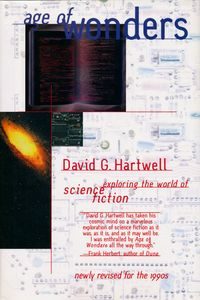
  • Age of Wonders, David G. Hartwell

    Age of Wonders, David G. Hartwell

    Tor, 1996 revision of 1984 original, 319 pages, C$36.95 hc, ISBN 0-312-86151-6

    I must have read Age of Wonders three times in either of its incarnations, so I’m a bit surprised that I have never formally reviewed it on-line.  But my own search engine tells me that I haven’t… so here’s a quick recommendation for one of the best book ever published on the American Science Fiction genre and its subculture.

    (I might as well make a few pre-emptive disclaimers before going any further, since there are a number of links between Hartwell and myself: : I’m on a quest to collect all issues of his New York Review of Science Fiction magazine, he has edited novels by people I consider to be friends, I’ve got a handful of his books personally dedicated to me, we have shared a number of conversations throughout the years, I have moderated at least one panel with him and he has –briefly- driven me around Orlando.  We are, in other words, just a bit more than nodding acquaintances.)

    Originally published in 1984, Age of Wonders was last revised in 1996 to incorporate a number of changes in the field.  While that revision is now fifteen years old, don’t let the pre-Web publication date distract you from the book’s vast and timeless understanding of Science Fiction.  Its first point of interest is the way it explains why “the Golden Age of Science Fiction is twelve”.  It’s at that age, after all, that bright teenagers pick up a chronic reading habit, a reading regimen that often contains a large proportion of Science-Fiction.  From his understanding of the field, Hartwell shows how disaffected teenagers often find in SF a literature that appeals to their sense of the world, and how they never completely let go of their affection for the genre after that.  Ask around SF conventions, and you will often find people who correspond exactly to this profile –including myself.

    Hartwell then proceeds to sketch a history of the fannish subculture that has, since the beginning, surrounded the Science Fiction genre.  It has forever been in the nature of SF’s readership to communicate among itself, and the presence of fandom is one of the things that still makes the SF genre so different from other literary fields: It fosters SF’s awareness of itself as a distinct entity, structures the conversation within the field and provides authors with encouragement that, in some cases, is more valuable than the potential monetary rewards offered by a wider readership outside the genre.  Science-Fiction fandom is small, but it’s concentrated.

    Age of Wonders also spends quite a bit of time discussing the nuts and bolts of the impact that SF has on its readers.  Hartwell dedicates entire chapters to the study of the “Sense of Wonder” so particular to SF, to the tortuous relationship that Science Fiction has with real science and reality, to the reasons why clear prose has long been SF’s dominant stylistic requirement and to the biggest historical controversies within the field.

    Hartwell illustrates those points with anecdotes drawn from fandom’s long history, quotations from other writers, informed opinions and, in one case, a deconstruction of a short story to see how it works.  It’s worth noting that Hartwell writes Age of Wonders from a well-rounded perspective drawn from his experience as a fan, an academician and an active editor within the field.  While the book is immensely useful as a pedagogical resource (it comes with a few appendices to provide a solid bibliography of essential works), it’s clearly written and immediately accessible to non-academician.  Its affection for the genre is obvious, but that doesn’t blind it to some of SF’s structural faults.

    Whether you’re an insider looking for a theoretical framework, or an outsider trying to understand what makes Science Fiction so different, Age of Wonder is an essential resource. Reading though it once again, I was struck by how much material I once knew and had forgotten since then: it reminded me that, without any doubt, Hartwell has forgotten more about SF than I (and most other people) will ever know.

    Fifteen web-dominated years after its publication, it’s worth pointing out that in many ways, Age of Wonders reflects a certain experience of Science Fiction that will remain of its era.  Today’s SF fan is markedly likelier to discover the genre through media sources (film, TV or video games) than to come across paperback spinners at their local drugstore.  The factors leading to a chronic teenage reading habit (ie: isolation, boredom) may not be as acute given today’s multiplicity of web-driven entertainment options.  The experience of fandom has also changed dramatically over the past decade and a half, web sites taking the role once played by local generalist conventions as gathering places for the casual fan.  Conventions have grown at once bigger and more specialized, as Hollywood-dominated Comic-Con now makes headlines while literature-focused Readercon can still thrive.  Most notable, however, is the way the geek experience that Hartwell describes has become a fairly mainstream lifestyle in-between massively successful entertainment such as Halo, Inception and The Big Bang Theory.

    I would be the first in line to buy a third edition of Age of Wonders.  Any update would have to navigate a path between a historical acknowledgement of the fannish experience, and the way geek culture has become just another market segment.  Is there anything in the written SF subculture that still distinguishes it from a more casual acquaintance with SF media?  Is written-SF still a vital side-stream of American culture, or is it merely another competing entertainment option?  Is there still something significant to a love for Science Fiction that links with a lust for the future, sympathy for technology and a self-imposed marginalization from society?

    Leaving aside the still-hypothetical question of a third edition, 1996-era Age of Wonders remains an essential component of any serious non-fiction collection about Science Fiction.  It clearly and usefully describes the genre, its readers, its reasons for existing and its essential inner workings.  It’s good enough to re-read every decade, no matter which edition you can get.

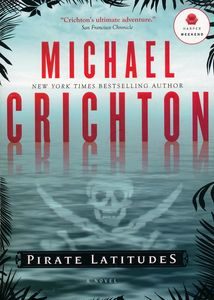
  • Pirate Latitudes, Michael Crichton

    Pirate Latitudes, Michael Crichton

    Harper Weekend, 2010 reprint of 2009 original, 419 pages, C$13.99 tp, ISBN 978-1-55468-811-1

    A close look at Michael Crichton’s bibliography shows a sometimes-baffling mixture of commercial instincts and contrarian beliefs.  Crichton always wrote to market, and this eventually came to justify novels that challenged orthodoxy; his belief that he was smarter than everyone else meshed well with the commercial opportunities offered by controversy, and that’s how we ended up with carefully crafted alarmist screeds such as Jurassic Park, Prey and Next, or critic-baiting reactionary tracts such as Rising Sun, Disclosure or State of Fear.

    Pirate Latitudes, published after Crichton’s death, is another, happier kind of commercially-driven project.  Seizing upon the perennial craze for pirate-related material, it’s a novel that delivers swashbuckling action and adventure in a strictly conventional fashion ripe for cinematic adaptation.  It’s a lot like Congo or Timeline in that it exhaustively explores the dramatic opportunities a place and time (17th century Caribbean), every chapter showcasing a new thrill.  Stripped of political controversy and free to exploit the new dangerous technologies of a bygone era, it’s a novel that lets readers enjoy the core strengths of Crichton’s writing without suffering from any of its assorted baggage.

    The hero of Pirates Latitudes is a capable British privateer named Charles Hunter, hired by the Governor of Jamaica to take advantage of an unusually profitable opportunity: A Spanish galleon has been left behind by the main fleet, and is believed vulnerable to attack while it’s moored at a nearby island.  Gathering capable crewmembers, Hunter prepares his expedition and sets out for plunder.  As you may expect, the way to the treasure and back won’t be simple or easy: The 17th century Caribbean is a dangerous place, and readers are right to expect a steady rhythm of thrills and adventure on the high seas.

    Whether it’s navigating shallow waters, taking on other ships in naval combat or fighting off a kraken, Pirate Latitudes delivers everything we’d expect from a pirate-themed novel.  It’s perfectly balanced between fiction and fact, with a sea monster and an uncommon series of adventures on one side, and careful descriptions of the era and nautical details on the other.  Crichton’s fiction has seldom been subtle, but it has usually been skilful and the way Pirate Latitudes can exploit the popular idea of the pirate (as depicted in the Pirates of the Caribbean film series, most notably) to develop it half-realistically is one of the novel’s most charming aspects.  There’s a ton of trivia about navigating sail ships cleverly meshed in the narrative, and it’s surprisingly enjoyable.

    Narratively, the novel is almost a complete success, save for the initially curious ending.  Unlike what you’d expect from a pirate novel, it doesn’t actually end with a massive naval battle and an all-out boarding assault: those occur earlier in the novel, as do the sea monster attack, dangerous island expedition and triumphant assault on the gold-filled ship.  As the first section makes it clear in rounding up the members of the expedition, Pirate Latitudes is structured around a caper plot rather than a more conventional kind of pirate adventure.  The ending will seem underwhelming if you’re not familiar with the kind of vengeful double-cross that the form dictates.  The characters are all exceptionally accomplished in their own way, which creates a lot of opportunity for extraordinary acts and solid dialogue.

    It all amount to a fun novel: not terribly deep nor as meaningful as Crichton’s other controversy-seeking contemporary thrillers, but a decent companion to some of Crichton’s more entertaining books.  It’s also, in its own way, a decent send-off for Crichton, who deserved better than the bitter aftertaste of State of Fear and Next as his final send-off.  One last novel by Crichton reportedly remains to be published, but it’s going to be assembled from notes and a partially-written manuscript: Pirate Latitudes is the last novel truly written by Crichton, and it’s a reminder that before he became the darling of contrarians, he had an impressive career as a fine popular entertainer.  Readers might as well enjoy the experience of a master craftsman deftly delivering one last crowd-pleasing work.

    Even if you can’t read, don’t worry; it’ll be adapted as a movie sooner or later.

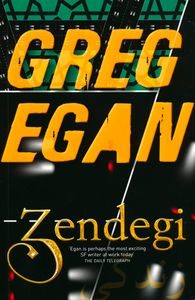
  • Zendegi, Greg Egan

    Zendegi, Greg Egan

    Gollancz, 2010, 332 pages, C$24.99 tp, ISBN 978-0-575-08618-0

    After two quasi-incomprehensible novels that pushed the edge of what even jaded hard-SF fans were willing to stomach, Greg Egan’s latest novel Zendegi is a return to a more accessible style that will remind his faithful readers of Teranesia.  Set in a near future and focusing intensely on mid-step technological issues, it’s notable for its attention to characters, openness to non-western culture and pessimistic contradiction of previous Egan novels.

    Structurally split between a first third set in 2012 and a second section set in 2027-2028, Zendegi first spends time with Australian journalist Martin Seymour as he travels to Iran and gets involved in a second Iranian revolution.  While this first half is mostly told as a techno-thriller set five minutes in the future, a subplot featuring Nasim, an expatriate Iranian scientist working in neurobiology, suggests the novel’s ultimate SF goals.

    Fifteen years later, the novel comes closer to the kind of future imagined in Egan’s other novels.  Virtual Worlds are now fully immersive, and new techniques are helping digitize aspects of human behaviour as semi-autonomous agents.  It’s not quite artificial intelligence, but it’s steadily getting closer.  So close, in fact, that when Seymour is diagnosed with a potentially incurable cancer, he contacts Nasim to be partially recorded in order to provide guidance to his soon-to-be-orphaned son.  Meanwhile, the convergence between human brains and virtual models is raising both hopes and controversy –leading to a few scenes of virtual vandalism with a darker purpose.

    With Zendegi, Egan takes a closer look at the middle-steps on the way to the kind of fully-digital futures he described in books such as Diaspora.  SF traditionally assumes an intermediate “…and something magical happens…” in-between the present and an AI-enabled future, but a few writers are occasionally willing to dive into the morass and set stories in the messy interim period.  (Recently, both Robert J. Sawyer with his WWW series and Ted Chiang in The Lifecycle of Software Objects have treaded upon similar themes.)

    Accordingly, there’s nothing simple or optimistic about Egan’s treatment of the subject in Zendegi.  Various approximations, shortcuts and compromises are required before having even the simplest simulated personalities up and running, and much of the effort is motivated by strictly mercenary gain as various online services compete for profit.  The main plot of the novel itself is a mournful race against time, and it doesn’t end as optimistically as you would expect –especially if your idea of Egan’s fiction was shaped by his earliest novels rather than the more nuanced material he’s been writing in his short stories.

    The best thing about Zendegi as compared to Egan’s latest Schild’s Ladder and Incandescence is that Egan has taken a step back from the abyss of incomprehensibility and delivered an accessible novel with credible human characters.  It feels a lot like Teranesia in that it allows Egan to dial down the speculation and develop a richer recognizable extrapolation of our present.  With its deep immersion in Iranian culture, Zendegi also suggests that Egan can write near-future globalized SF à la Ian McDonald.

    Unfortunately, Zendegi also leaves itself open to more common criticism.  If Schild’s Ladder and Incandescence could use “I didn’t understand most of it” negative reviews like badges of honour, Zendegi won’t benefit so much from charges that it is short story material padded to novel length.  Focusing strictly on the SF elements, it’s possible to lose much of the novel’s first third, a good chunk of the redundant segments set in the Zendegi virtual world itself, and considerably shorten the remainder of the novel.  The resulting novella would feel a lot more energetic while delivering the same extrapolative charge; it would also feel closer to Egan’s recent short fiction than his novels.

    While the finished results will please readers looking for either a more realistic take on the near-future of mind uploading or globally-aware genre fiction, Zendegi also carries a penalty by virtue of being published under the Egan brand name: It’s more timid, less fizzy, and nowhere near as interesting as much of his other books.  It is, in many ways, a wholly average SF novel.  Not bad, not fantastic; just ordinary.  This will be a relief to some, a disappointment to others, and maybe even both at the same time.

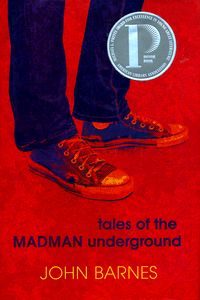
  • Tales of the Madman Underground, John Barnes

    Tales of the Madman Underground, John Barnes

    Viking, 2009, 532 pages, C$23.50 hc, ISBN 978-0-670-06081-8

    One of the paradoxes of genre publishing is that it can be as comforting in its ghetto-like nature as it can stifle those looking to try something new.  Genre fans can provide a certain predictable sales baseline, but convincing them to try something outside the boundaries of the genre can be difficult.  For every Dan Simmons able to write equally well in science-fiction, horror, fantasy and mainstream, there are a plenty of other SF writers getting no success trying to sell techno-thrillers.

    Then there are those who seem to relish breaking genre conventions.  John Barnes is, in many ways, the model of a mid-list SF genre writer, but his lengthy bibliography is filled with oddities and small surprises.  In addition to a solid core bibliography of Science Fiction novels written for adult and young adult audiences, Barnes also wrote less conventional speculative fiction: From a trilogy of men’s adventure thrillers to a light-hearted fantasy to a meta-SFictional tall tale to hard-SF novels written in collaboration with Buzz Aldrin, Barnes manages to defy and subvert expectations once every two or three novels.  I’ve got most of his bibliography (Heck, I even have his early obscure “Time Raider” trilogy in my stack of things to read) and I’m still surprised by what he dares to do.

    Now, with Tales of the Madman Underground, he turns his attention to mainstream young adult fiction.  Taking place in 1973 Ohio, this YA novel shows a few hints of Barnes’ SF pedigree: The main character read Philip K Dick and has to turn to a convention-going classmate for explanations.  A few other references can be read as reassuring winks to Barnes’ existing audience (who may be familiar with Barnes’ other young-adult Science Fiction novels), but Tales of the Madman Underground is otherwise a completely mainstream teen novel.

    It takes place over the first six days of Karl Shoemaker’s senior High School year.  He has the best of intentions: To be normal.  “Normal”, in Karl’s case, is a challenge.  Not everyone lives with an unstable widowed mother and dozens of quasi-feral cats.  Not everyone works five jobs and has to hide their money from their flighty mom.  Not everyone is a recovering alcoholic teen.  Not everyone has been branded a psychopath, sent to group therapy and pre-emptively condemned to a permanent psychological record.  Karl’s goal is to take his last year one day at a time, and be as normal as possible to avoid returning to “the Madman Underground.”  It’s not that his best friends aren’t Madmen… but he’d rather try to be normal for a while.

    I’m not going to attempt guessing how much of Tales of the Madman Underground is nostalgia for Barnes (who was 16 in 1973); it’s more useful to note that this is a novel by an experienced novelist, and that the result is a solid success.  The atmosphere of a small Midwestern town is described with idiosyncratic flavour and the characters that surround Karl are richly sketched.  The titular Madmen may have been designated as broken minds by the system, but the novel shows how even the most distressed of them can depend on each other for support and so deserve our sympathy.  (In one of the book’s best scenes, they show up the school’s newest therapist… and find out that she’s an unexpected ally.)  Karl himself is a likable protagonist, emboldened and hardened by situations that others would find desperate.  We root for him to a rare degree, and the small victories that constitute his ultimate triumph are earned many times over.

    Karl’s narration is direct, suitably profane, and addictive from the very first few pages.  The terrific dialogue is a joy to read, making the 500+pages book seem much shorter.  The narrative flow isn’t complicated, but it’s enlivened by numerous subplots (many of them relating to Karl’s numerous side-jobs) and a series of stories about the Madman Underground’s most memorable adventures.  Set in 1973, it seems just as relevant today.

    Anyone who has read more than two Barnes novels knows that he can write dark-and-repulsive like the worst of them.  And while Tales of the Madman Underground has its share of uncomfortable moments (including a sequence where we’re temporarily brought to doubt the reliability of the potentially-psychotic narrator), it features one of Barnes’ most sympathetic character yet and it leads to an unusually triumphant conclusion.  The obstacles facing Karl are formidable, but they’re overcome fairly and the last few pages are smiles upon smiles.  It adds up to one of Barnes’ most enjoyable books yet, and a rare one of his that can be described as unabashedly upbeat.  Even die-hard genre SF fans willing to genre-hop and follow Barnes in his historical adventure will get much out of it.

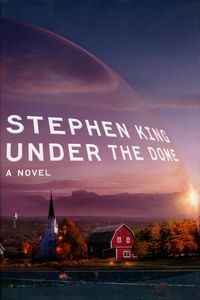
  • Under the Dome, Stephen King

    Under the Dome, Stephen King

    Scribner, 2009, 1074 pages, C$39.99 hc, ISBN 978-1-4391-4850-1

    Frankly, there’s just one thing you need to know about Stephen King’s Under the Dome:  It’s big.  It’s really, really big.  Count the pages and recall the two other King novels of similar heft: The Stand and It.   The page count shows that Under the Dome is King’s third-longest novel, and it certainly feels epic.

    The premise is simple: When a small Maine town is cut off from the world by an invisible but impassable barrier, its residents struggle to understand what’s going on and survive the experience.  But such a plot summary glosses over the totality of King’s presentation of the event.  He’s got two thousand viewpoints to play with, and if the action wisely focuses on half a dozen main protagonists, at times it feels as if the omniscient narration gives us a glimpse of every single citizen of Chester’s Mill.  The first chapter alone takes a kaleidoscopic view of what happens when the dome falls, with crashing vehicles, cut-off body parts, interrupted streams, accidents of fate locking some people in or out and other assorted phenomenon.  The omniscient narration can be chatty, but it also goes quiet when it’s time to focus on the main characters.

    Because there’s a lot more to Under the Dome than a town physically cut off from the rest of the world: Chester’s Mill has its share of bad apples, and they control the place.  When media attention brought on the city following the fall of the dome threatens to expose secrets that the guilty would rather keep hidden, the dome itself becomes less dangerous than the people inside … Psychotic murderers, crystal-meth entrepreneurs, power-crazy policemen and panicked citizen all show their true colours during the days that follow the fall of the dome.

    But it’s the details through which King tells his story that make Under the Dome such an impressive and frustrating book.  On one hand, there is enough time and space here for elaborate plotting, reversals of fortune, copious inner monologues and ample character growth.  When King activates his omniscient narration, it’s like floating above a small town and having direct access to two thousand minds in all their diversity.  On the other hand, that amount of verbiage slows the action down and frequently makes readers wish for the next plot point.  King pulls a bit too obviously on familiar plot threads about religion, serial killers, corrupt authority and civil unrest to avoid a feeling of familiarity throughout much of Under the Dome.

    There is, however, quite a bit of allegory going on under the surface of the text.  It doesn’t take much of an imagination to see the parallels between an isolated and paranoid Chester’s Mill and Bush-administration America.  The division of power between a ruthless sheriff and incompetent politicians has real-world parallels, and much of the popular hysteria cuts a bit too close to headlines of the last decade to be entirely accidental.

    Where Under the Dome doesn’t do so well is in its ultimate justification for the Dome.  It moves the novel from the Horror to the Science Fiction genre.  This is not by itself a bad thing, but it will make a number of more rigorous readers cringe given the thinness of the premise and the somewhat arbitrary way the novel is resolved.

    Still, that ending is preceded by an apocalyptic sequence that leaves few people standing, so it all evens out.  While Under the Dome can occasionally be exasperating, annoying and underwhelming, it’s also a novel that disappoints because it attempts so much: Even if he misses a few targets along the way, King still manages to hit plenty of them.  The result may not have the quasi-mythical heft of The Stand or the tight focus of “The Mist”, but it’s the kind of wide-screen horror/thriller that has become a bit too rare lately.  King being King, it’s also a book written with clean prose, compelling characters and a thicket of plot developments.  It is, in short, a perfect book for those who want to sink into a lengthy reading experience and blink their eyes back to reality a long time later.

    In its own four-pounds fashion, it’s also a powerful advertisement for ebook readers.

  • The New Face of War, Bruce Berkowitz

    The New Face of War, Bruce Berkowitz

    Free Press, 2003, 257 pages, C$41.00 hc, ISBN 0-7432-1249-5

    Released in March 2003, just as Americans were invading Iraq, Bruce Berkowitz’s The New Face of War is already showing a bit of its age.  Seven year later, thanks to two ongoing wars involving the most powerful military force on planet Earth, we’ve seen the new face of war: It’s about IEDs and insurgency and asymmetrical force projection and wireless communication and missile-armed drones.  Then again, age can also mean respectability: How best to evaluate a book dealing with future war than to measure how right it has been years later?

    Perhaps the first thing to do is to ignore the all-encompassing title.  The New Face of War doesn’t present a set of prescriptions and predictions for future warfare as much as it focuses on the changes already imposed by information technology.  It doesn’t get down into the nitty-gritty of what weapons soldiers will be using in the future as much as it charts how military forces have been refining their use of information technology to shorten their decision cycle, read enemy messages, or mount elaborate deceptions.

    For a book dealing rather heavily in abstract strategic concepts of no use to most lay readers, Berkowitz does an impressive job at vulgarizing his subject matter and offering interesting ways to ease into his most esoteric concepts.  In order to explain how information technology is revolutionizing warfare, he starts by drawing an analogy between NASCAR and Formula One, illustrates his point with a lengthy description of the Gulf War’s logistics innovations, touches upon the creation of ARPANET and ends up summarizing his main points about “the new face of war”. [P.75] It takes a special kind of military nerd to jump enthusiastically into a book that draws parallels between the Internet and warfare, but Berkowitz makes it easy with plenty of illuminating links and a helping of wry humour.

    Berkowitz knows his stuff, and the book goes deep in historical examples that are fascinating in their own right.  Perhaps the most interesting parts of The New Face of War are the illustrative digressions taking a quick trip down military history in order to show the evolution of information in warfare.  There’s a fascinating side-note about the development of torpedoes, for instance (including how they relate to The Sound of Music), and a much longer explanation of how accurate positioning systems were developed (from finding a reliable way of determining longitude to the post-Gulf War civilian co-optation of the GPS).

    It probably goes without saying that Berkowitz writes from the paranoid school of military analysis: His view of the world presupposes that America is constantly threatened and that most means are subordinate to the cause of maintaining American superiority.  This can be a bit annoying for foreign readers, or people who don’t have a built-in terrorism persecution complex.  On the other hand, Berkowitz can be reasonable in his analysis: A chapter-long discussion of the ethics of strategic assassination ends up concluding that there is no defensible rationale for it –a far cry from the right-wing pro-torture apologists who seemed to bloom so bloodthirstily during the second half of the Bush administration.

    In evaluating whether The New Face of War had survived the past seven years without losing too much credibility, the conclusion is that the book remains just as interesting and through-provoking now than in 2003.  Events since then have suggested that the information component of warfare remains crucial –US forces in Iraq and Afghanistan vastly out-powered their opponent, but local knowledge allowed insurgents to strike back effectively through very different tactics.  In dealing with a conventionally powerful enemy, insurgents have understood that they must attack in ways designed to take advantage of their strengths and minimize their exposure –a point that Berkowitz explains through the example of terrorist strikes.  Perhaps most striking is what has not happened since the book’s publication.  Berkowitz, despite spending much of his time discussing information warfare, remains sceptical about “cyber-war” and the myth of hackers bringing down modern civilization (or at the very least power plants) through the web –and in fact, there have been no significant incidents of the type since 2003.

    In this light, the years have been kind to Berkowitz’s theses as developed in The New Face of War.  The only disappointment in reading the book is to find out that the author doesn’t seem to have a blog or web site on which we can read about his latest publications.  One wonders what he’s thinking these days…

  • Worth Dying For, Lee Child

    Worth Dying For, Lee Child

    Delacorte, 2010, 384 pages, C$33.00 hc, ISBN 978-0-385-34431-9

    Lee Child’s fourteenth Jack Reacher novel, 61 Hours, ended in a cliff-hanger of sorts, with the plot resolved but Reacher desperately running for his life.  An epilogue took delight in suggesting that nobody had survived the climactic explosion that ended the novel, worrying fans of the series: Would Reacher be back?

    Of course he is.  As Worth Dying For begins, Reacher is once again travelling through small-town America, this time in the flat wilderness of wintertime Nebraska.  The narrative is obviously taking place after 61 Hours: Reacher is not only bruised and battered; he’s also heading to Virginia in the hope of meeting a character introduced in the previous novel.  Unfortunately, we only get a partial explanation of how Reacher made it out of the dire situation at the end of the last book –if you’re expecting a full answer, you may have to wait until he makes it to Virginia.  The rest of Worth Dying For has nothing to do with 61 Hours.

    In the meantime, Reacher’s got problems to solve in Nebraska.  Outraged by the sight of a beaten-up housewife, Reacher can’t help but investigate the situation and eventually understand how the small community around him has been completely taken over by a family of abusive men.  Add to that a decades-old mystery about a long-missing girl, and Reacher can’t leave such situations alone.  But there’s nowhere to hide in the flat prairies of Nebraska –especially not when multiple teams of enforcers are sent to take care of him.

    Reacher fans won’t be disappointed by this new entry, as routine as it can be at times.  Once you forgive the awkward bridge between 61 Hours and Worth Dying For, it’s another typical adventure for Reacher as an errant knight travelling throughout the US, helping those in distress and dispatching whoever tries to stop him.  He’s a quasi-supernatural protagonist, and it’s sometimes better to consider him as a semi-mythic incarnation of righteous fury than a believable character.

    Still, Child plays the thriller game almost better than anyone.  If Worth Dying For is a bit more stylistically straightforward than the previous clock-ticking 61 Hours, it’s still as good as it can be in describing Reacher’s mixture of brawn and deduction.  In a weakened state, Reacher is more dependent than ever in anticipating his opponents’ actions and the outcome of his duels (one of them pitting him alone against a truck in a field) is highly satisfying.  Anyone worrying about a weakened Reacher just has to wait until he kills a bad guy by punching him in the heart –a medical factoid transformed into a feat of utter machismo that even seems to amaze the protagonist.

    One thing that the novel also does well is exploiting the characteristics of such a desolate location.  There are only two dimensions in late-winter Nebraska, and every single point of human interest within dozens of miles is easily identifiable: When Reacher tries to act, he finds himself limited by a visible lack of options.  Cars are essential to go from anywhere to anywhere, and there are no secrets when human figures and car headlights can be spotted from such great distances.

    Otherwise, there’s not much to report, and that’s part of the novel’s let-down.  For such a grandiose title, Worth Dying For deals in small potatoes: small town, evil family, generic henchmen, desolate settings.  For Child, it’s an achievement to wring that amount of entertainment out of such limited elements, but it comes soon after the small-town drama of 61 Hours, and doesn’t stick in memory like other novels in the series did.

    Still, Worth Dying For is a good standalone entry even despite the disappointing transition between the previous novel and this one.  This being Reacher’s fifteenth adventure, his fans won’t be too disappointed yet, and Child’s continued ability to charm readers is nothing short of admirable.  But 2010 marks the first calendar year in which two Reacher novels were published, and if the results confirm that this is still the best thriller series out there, enough questions have been raised by 61 Hours’ cliff-hanger to suggest a bit of caution.

  • Memory, Lois McMaster Bujold

    Memory, Lois McMaster Bujold

    Baen, 1997 mass-market paperback reprint of 1996 original, 462 pages, C$9.50 mmpb, ISBN 978-0-671-87845-0

    Given how much I like Lois McMaster Bujold’s Science-Fiction novels, I was recently surprised to realize that I hadn’t read all of them.  I was particularly embarrassed to remember that I hadn’t even read Memory, often considered by fans to be one of the major books in Bujold’s Miles Vorkosigan series.  I had read most of what came before and all of what followed, but never that particular novel.

    It’s a mystery as to why I waited this long to finally read it.  Much of Bujold’s SF writing is set in a single universe, revolving around the character of Miles Vorkosigan and his extended family.  Not every Vorkosigan story is told in the same mode or has the same importance: They range from military SF to romance, and they can go from simple entertainment to gut-wrenching drama.  Memory is one of the key texts in the Vorkosigan saga: Deceptively summarized by the publisher as “Miles hits thirty: thirty hits back”, it’s a major novel that marks a definitive transition in Vorkosigan’s life and in the makeup of the series.  There’s definitely a pre- and post-Memory era in the Vorkosigan saga.

    As Memory begins, Miles is still having fun as his alter-ego “Admiral Naismith”, leading his own fleet of mercenaries through dangerous adventures. For him, it’s definitely a more interesting life than being stuck at home as Lord Vorkosigan in a rigid aristocracy.  But things aren’t necessarily going well: Miles is feeling the consequences of a major medical trauma, and is liable to suffer unpredictable debilitating seizures.  This has serious consequences during a hostage rescue mission, and Miles finds himself temporarily grounded as superiors and colleagues review his actions.  Throughout Memory, Miles has to confront the end of his boyhood fantasies, liquidate his invented alter-ego and finally face his future as himself.

    Coming-of-age novels usually feature younger characters breaking out of childhood into something like adult maturity, and the Science Fiction genre certainly has its share of such stories.  But growing up isn’t a binary condition: Kids don’t suddenly turn into adults until the end of their lives: Even adulthood has its stages, and Memory squarely confronts a tricky transition.  It’s a difficult assignment made even more so by the dramatic demands of an action-adventure SF series: Having Miles run around the galaxy blowing stuff up is certainly more exciting than seeing him confront his obligations as part of the aristocracy.  Bujold took huge risks in removing the exciting half of Miles’ identity and definitely scrapping those plotting avenues.

    It also forces Memory to take place largely within Miles’ head.  Oh, there’s a mystery for him to solve in trying to piece together who’s trying to sabotage Imperial Security’s leadership –but that’s thematic underpinning for Miles’ own personal reintegration.  The novel’s most satisfying moments are in seeing Miles come to grip with his life, deciding to get rid of a crutch he had created to fulfill outdated needs, and joining a more challenging society of peers.

    Perhaps the most surprising aspect of Memory is how Bujold is able to create a gripping novel out of self-contemplation.  This isn’t a surprise, of course: Bujold has long been one of SF’s most gifted writers, and the depth of the characterisation she brings to Memory, even through its tangle of subplots, is what fans can expect from her –but the result is satisfying to such a degree that it still feels like a minor achievement.   The self-awareness of the central character is scathing (rare enough in a sixth book in a series) and the process through which he comes to realize how best to live his seemingly diminished life is a crucible that feels just as real to the reader.

    I’m not in a position to suggest how accessible Memory can be to those who haven’t read the rest of the series.  It surely means most to those who care about Miles and his adventures, but my own memories of the series were dated and fuzzy, and the first few chapters of Memory do a fine job at re-establishing the important relationships required to understand the shifting that occurs later in the novel.

    While the mystery aspect of Memory isn’t much of a mystery, the rest of the book’s subplots and central dilemma easily make this one of the important entries in the Vorkosigan series.  Everything clicks, from the plotting to the characters to the prose to the impact of individual scenes.  It ends not with a sense of closing options, but with new opportunities and revitalized characters.  More series should go through this type of premise-defying shakeups.

  • Awake in the Dark, Roger Ebert

    Awake in the Dark, Roger Ebert

    University of Chicago Press, 2006, 476 pages, $18.00 tp, ISBN 978-0-226-18201-8

    A few months ago, I concluded my review of Roger Ebert’s bad-movies-reviews compendium Your Movie Sucks by promising that I would follow up with a book about his great movies.  Hence Awake in the Dark: The Best of Roger Ebert, a retrospective collection bringing together forty years of interviews, reviews and opinion pieces about cinema.  If nothing else, this collection shows the depth of material available from someone who’s been writing about movies for such a long time.  Even devoting large sections of the book to specific material (such as reprinting his “best movie of the year” reviews), there are enough treats here to surprise and delight.

    The introduction sets the tone, as Ebert describes his first experiences with cinema, and early adventures in the newspaper trade.  A number of interviews follow, most of them from the earlier part of Ebert’s career when he spent more time doing feature pieces.  (An explanation for that is found later in the book, in discussing the stranglehold that press agents now have on serious film journalism.)  Then it’s off to a selection of Ebert’s favourite movies of every year, from 1967’s Bonnie and Clyde to 2005’s Crash.

    I skimmed over the next two sections, about foreign films and documentaries, and didn’t read everything in the overlooked and underrated films segment –but the following “Essays and think pieces” are all interesting, and present a sampling of issues that have infuriated Ebert over the years: the inequality of black actors, colorization of black-and-white films, the lack of a truly-adult film rating in the United States (with consequent infantilization of American cinema), and the appeal of celluloid over digital projection.  The last section, “on film criticism” features a virtual symposium between critics Richard Corliss, Andrews Sarris and Ebert on the future of film criticism.  The coda of the book discusses the early stages of Ebert’s cancer that would eventually rob him of his voice and give him a new one as a top-notch online writer.

    It’s not exactly useful to rate the book on whether you agree with Ebert:  I certainly don’t, especially when he starts feeling nostalgic about the quality of celluloid films over new digital projection technologies.  And I just have to browse the list of his “films of the year” to start rolling my eyes at some choices.  (Crash?  Ergh.)  But the true mark of Ebert’s value as a professional writer is how pleasant to read his pieces remain even when they present disagreeable viewpoints.  It helps that despite decades of experience reviewing films, Ebert still sees them with the eyes of an ordinary filmgoer: It’s not difficult to understand why he still likes the movies, why some of them work better than others, and how much he wants every film to be successful.  Reading a selection of the films he loves is reading about a fulfilled Ebert –quite a different experience than reading one angry pan after another in Your Movie Sucks.

    Trying to fit a forty-year career between two covers is a tough assignment, but the editors responsible for selecting the pieces in Awake in the Dark have done a good job, and while this won’t be the final word on Ebert for a while (especially given the astonishing quality of his current online writing), it’s about as good a career retrospective could be as of 2006.  There’s a lot of fine reading in there –although, since much of the book is made of short reviews or essays, Awake in the Dark is best read in small chunks spread over a long period of time.

    For movie lovers, film reviewers, Ebert fans and anyone interested in critical cinema commentary, Awake in the Dark is an eloquent achievement: An entire life spent watching films, glimpsed throughout hundreds of short essays. It may not be as bitterly amusing as reading six years of awful movie reviews, but it’s far more interesting –and it shows Ebert at his best while discussing the best.