Book Review

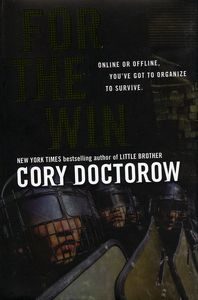
  • For the Win, Cory Doctorow

    For the Win, Cory Doctorow

    Tor, 2010, 475 pages, C$19.99 hc, ISBN 978-0-7653-2216-6

    Trying to summarize Cory Doctorow’s latest novel For the Win in a few words is an exercise in frustration, because with every “didactic” comes along a “fascinating”.  It’s a logical extension to Doctorow’s bibliography so far… except that it sometimes appears to flip over the libertarian ideology of Makers.  It’s perhaps Doctorow’s least pleasant reading experience so far… except that when it stops telling a story, it can be really good.

    For the Win is Doctorow’s second novel for the Young Adult market, and like Little Brother it’s using that readership to indulge in some blatant speech-making.  It can’t help but try to explain how the world works, and those interludes are often far more interesting than the plotting surrounding them.

    Briefly summarized, For the Win is about online multiplayer games and the strange economic phenomenon surrounding them.  The uninitiated may find this a trivial subject for discussion, but there’s a lot more under the surface that it may appear at first.  Consider that the target audience for those games are often first-world gamers with more money than time.  Combine that with gaming mechanics that are designed to keep players coming back to “grind” their way up in search of infrequent payoffs and you already have the raw elements for global exploitation, via the use of third-world workers (often children) who have a lot more time than money… and none of the protections afforded to employees in developed countries.  Could it be time to unionize?  Mix well, and you’ve got the elements of Doctorow’s uniquely contemporary thriller.

    Does it work?  In many ways, For the Win is so admirable that it doesn’t really matter if it does.  Take, for instance, that none of the main teenage characters in the novel are purely American –the only one who hails from California is such a Sinophile that he adopts a Chinese name throughout.  The rest of the characters are largely from developing countries, lending a pleasantly globalized feeling to the entire novel.  Not that it could have been otherwise, given the networked nature of its plot devices and the globetrotting scope of the narrative.  For the Win inhabits the world of the present, not some fading refraction of yesterday’s futures.

    It gets even better once Doctorow starts making links between the nature of gaming, the illusion of modern economic derivatives, the inadvertent exploitation of third-world teens by clueless first-world gamers, and the opportunities that well-connected youth have in bettering their lot in life.  Politically, I couldn’t help but be struck by the way For the Win espouses a leftish drive for unionization and tries really hard to make it fit with the increasingly swim-or-sink nature of Doctorow’s latest Makers.  There may not necessarily be a conflict once you can reconcile information-network libertarianism with worker’s right regulation, but it amounts to a complex multi-book political exploration for Doctorow, one that recalls (gasp) Heinlein’s ability to argue several points of views in successive novels –and one that also follows in Heinlein’s didactic footsteps.

    Snappy exposition aside, For the Win‘s highlights also includes a number of showcase sequences that stick in mind not for their narrative content, but for their geek wish-fulfillment power.  For instance, Doctorow lavishly imagines what it would be like to engineer your own transpacific trip via a shipping container custom-modified to act as a long-haul dwelling… complete with high-speed Internet access.  It’s the kind of bravura sequence that doesn’t really need a story, which is just as well given the lessened interest that much of the book’s plot can hold for some readers.  For the Win is full of fascinating bits, but the structure holding them together is more interesting for what it allows than the way it bolts it all together.

    But does it matter?  Doctorow’s fans are unlikely to be put off given how closely For the Win follows on the footsteps of his previous works.  Reviewers are unlikely to give the novel less than good notices for everything it does right, even though much of the story itself may lack narrative excitement.  Meanwhile, critics will jump on it and delight at whatever meaning they can tease from its chapters and links with other up-to-the-moment fiction like William Gibson’s Zero History.  Oh, and teenagers will love it.  Given all of those wins, why hold on to old-fashioned narrative values?

  • Playing for Pizza, John Grisham

    Playing for Pizza, John Grisham

    Doubleday, 2007, 262 pages, C$26.95hc, ISBN 978-0-385-52500-8

    Something very strange happens to best-selling authors once it becomes clear that they can write anything and still get it published.  In some cases, their editors become powerless to stop them from ranting about their wacky pet theories, and the result is a body of work that becomes crazier and more insular as it goes on.  John Grisham’s case is a bit more complicated, as he’s been taking more and more chances writing outside the type of novel that have made his reputation.  Skipping Christmas was a first attempt, and Playing for Pizza is just as complete a departure from Grisham’s legal-thriller roots.  It’s an Italian travelogue like The Broker, except without the serious thriller angle.  And while it’s one of the least consequential pieces that Grisham ever wrote, it’s still as enjoyable to read as anything else from him… even though you may not remember much of it a day later.

    The premise is a joke in itself, as a football player wakes up to find that he’s just fumbled a crucial game in the most enraging way possible.  Unable to find a job anywhere in North America after his very public humiliation, he accepts one of his agent’s most desperate suggestion and leaves for Italy, where he ends up on a quasi-amateur football team while waiting for the storm to settle back home.  Once settled in Parma, however, our protagonist comes to enjoy the scenery, make friends, settle scores with a mean American sports journalist (by punching him in the face, as football jocks are wont to do in settling their issues with impunity) and rediscover himself.  He also –spoiler- wins a few games along the way.

    If you’re looking for more plot, grab another Grisham book.  There isn’t much more here to Playing for Pizza than detailed description of la dolce vita as our protagonist plays tourist, then becomes an apprentice-citizen in Parma.  The football games are always followed by pizza among friends, and it’s this kind of relaxed atmosphere that ends up being the novel’s main preoccupation.  If you’re a North American having traveled to Europe, this kind of narrative will feel intensely familiar.  Strange customs!  Language issues!  Non-American lifestyles!  No parking anywhere!  Influent friends fixing problems with the law!  (For the dark side of this charmingly corrupt Italian lifestyle, read Douglas Preston’s more harrowing experience in The Monster of Florence.)  It’s a novel where you sit back and enjoy, and maybe make a note to head for the closest Italian restaurant in order to enjoy some of the food lusciously described every few pages.

    It often reads a lot like The Broker, a previous novel in which the author used his holidays as an excuse to set a novel in Italy.  This time, however, Grisham has dispensed entirely with the burden of suspense and just freed himself to write about food, tourism, football and romance, with a tone that’s all smiles.  It’s likely to appeal to a number of possible readers, but is it enough?

    Part of the problem with Playing for Pizza is that the protagonist isn’t much of anything.  A failed football player who finds that it’s better to be a big fish in a small bowl; who gets the girl for no other reason that he’s the hero of the novel; who punches people in the face when they displease him and gets away with it.  You can see how that kind of character appeals to a strong streak of wish-fulfillment, but the danger of such indulgences is that they can reach a narrow public and feel obnoxious to anyone who doesn’t identify with it.  This limits the novel’s appeal and contributes to its inconsequentiality: It’s not a hard novel to read, but try to remember something from it more than a few hours later and you’re liable to picture Northern Italy, food, small cars and maybe a few football scenes.

    This, obviously, is what Grisham intended, and a chunk of the novel’s charm is seeing the author indulge himself in a bit of meaningless fun.  Not everything has to be about southern lawyers tempted by corruption, or even about serious plot mechanics.  If Grisham is willing to use his bestselling credentials to write this kind of book –turning holiday memories in another crop of royalties–, then who are we to begrudge him his fun?  At least he’s not jumping on a soapbox and telling us about a shape-shifting lizard conspiracy threatening the world.

  • Scott Pilgrim, Bryan Lee O’Malley

    Scott Pilgrim, Bryan Lee O’Malley

    Six-book series made of…

    • Scott Pilgrim’s Precious Little Life, 2004, Oni Press, ISBN 978-1-932664-08-9
    • Scott Pilgrim vs the World, 2005, Oni Press, ISBN 978-1-932664-12-6
    • Scott Pilgrim & the Infinite Sadness, 2006, Oni Press, ISBN 978-1-932664-22-5
    • Scott Pilgrim Gets it Together, 2007, Oni Press, ISBN 978-1-932664-49-2
    • Scott Pilgrim vs the Universe, 2009, Oni Press, ISBN 978-1-934964-10-1
    • Scott Pilgrim’s Finest Hour, 2010, Oni Press, ISBN 978-1-934964-38-5

    Publishing success doesn’t often correlate with anything resembling quality, so it’s satisfying to see that one of the biggest comic series of the past few years has been Bryan Lee O’Malley’s idiosyncratic Scott Pilgrim.  Now ending its run with a sixth volume and the near-simultaneous arrival of its movie adaptation, O’Malley’s unlikely success blends a look at post-teenage male romance, videogame-inspired personal mythmaking, a deeply Torontonian setting, sharp writing, great characters and hilarious moments.  I first climbed on board the series when the fifth volume was released, but the movie adaptation gave me a great excuse to re-read the entire story in a single gulp, and revisit what makes it click.

    I am, I’ll admit, too old and too square to truly empathize with much of the series: I’m now a good decade older than the series’ cast of characters, and my own path through life has been the university-to-cubicle professional fast-track rather than the kind of erratic McJobs-and-clubs slacker universe in which Pilgrim and friends live.  But Scott Pilgrim nails that post-teenage lifestyle in stunning detail: that slice of time not quite shackled by the demands and disillusions of full adulthood, in which people come to define themselves now that they don’t have to attend classes.  Pilgrim and friends are free to exist away from their parents, live in tiny apartments, hang out at hip venues, play in garage bands, work occasionally, and get mixed-up in complex romantic entanglements.  Their universe is one of pop-culture references inspired (unlike previous generations) by videogames, their personal mythologies defined by gaming heroism as much as anything else.

    So it is that the series begins with “Scott Pilgrim is dating a high-schooler!” and ends with “So… we try again.”  In-between, it’s pure Canadian magical realism as Pilgrim falls for a mysterious girl named Ramona and must fight her seven evil exes in order to earn her affections.  That’s the plan, at least: the actual path to romantic bliss isn’t quite as clear-cut, especially when Pilgrim realises how much of “a crummy boyfriend” he’s been.  The last volume of the series is particularly unkind to its hero –and surprising to readers not expecting Scott to grow up in a hurry.

    But as with many other graphic novels, Scott Pilgrim is more memorable for its page-per-page execution than its narrative satisfaction.  O’Malley peppers his series with a near-constant stream of small delights, whether it’s a number of Torontonian references, self-aware patter, absurdly fantastical plot devices and musical moments.  The series breaks the fourth wall frequently, but doesn’t cheapen its characters’ problems.  It’s such a compelling reading experience that every time I reached in my stack of volumes to check details, I ended up re-reading dozens of pages.

    As a hip must-read reference for the younger set, it’s something that even the older ones among us are nearly certain to enjoy.  The cutting-edge references exist alongside gaming metaphors that will be familiar to anyone who has stepped in an arcade back in the eighties, and they all serve to pump up a universally appealing male romance to sustained reading enjoyment.  Don’t miss it (especially if you live in or near Toronto) and let it comfort you that, sometimes, sale numbers do point at something worthwhile.

  • Pygmy, Chuck Palahniuk

    Pygmy, Chuck Palahniuk

    Doubleday Canada, 2009, 241 pages, C$29.95, ISBN 978-0-385-66629-9

    Ever since discovering Chuck Palahniuk’s brand of outrageous fiction a decade ago, I have sometime wondered what it would take for me to really dislike one of his books.  Once you’re suitably jaded at the violence, perversion and generally antisocial behaviour of his novels, it’s hard to raise an eyebrow at his ever-increasing outrageousness.  Palahniuk is a professional provocateur, and there’s an ongoing game between him and his readers to see who blinks first.

    Now, with Pygmy, I know what makes me blink… and it turns out to be bad grammar.

    From the distance of a plot summary, there’s little in Pygmy to scare away Palahniuk’s usual fans: As the novel begins, a young trained assassin from an unspecified totalitarian regime lands in America to be adopted by a typical American family.  But this turns out to be one facet of Operation Havok, a plan to place sleeper agents in American cities where they can directly attack the Midwest way of life.  Our narrator knows everything worth knowing about America, Americans and how to kill them: He’s got intricate martial arts training, the ability to smell people down to their most intimate secrets and the equivalent of a post-graduate degree in terrorism.  Now imagine him dealing with a typical High School and you can imagine the fun.  Raised in a totalitarian regime to despise everything America stands for, it’s not a surprise if our narrator describes suburban life in utterly alien terms.

    It wouldn’t be a Palahniuk novel without the usual amount of blood, sex and over-the-top personal behaviour.  Never mind the adoptive mother’s unquenchable passion for vibrators: Barely three chapters into Pygmy, our narrator takes revenge on a bully by brutally sodomizing him –thus unleashing a latent homosexual passion that, once spurned, leads to a high school shooting midway through.  This is fairly tame material for Palahniuk readers, who have come used to far more disturbing stuff.  It helps that Palahniuk never forgets to be intensely (if darkly) funny in most of what he writes: Pygmy has a splendid opportunity to comment on modern Americana and makes the most out of it.  Perhaps the best sequence of the book is a Model United Nations featuring a bunch of horny teenagers, leading to such instant-classic lines as “Sri Lanka says Afghanistan has the biggest crush and could totally jump the bones of Morocco.” [P.84]

    But one of the reasons why this sequence works is that you can actually understand much of it.  Otherwise, Pygmy is narrated in approximate broken English, a stylistic choice which quickly goes from odd to exasperating.  Eventually, as the narrator develops his own way of describing suburban normalcy, we’re asked to decode paragraphs such as this one:

    For official record, additional reside aboard bench cushion vast breathing cow, host father.  Twitching chicken, host mother.  Dual host parent unconscious splayed wide limbs spread, neck muscles lolling heads loose until rest own shoulders, lips loose, trickling long ropes translucent saliva.  Unconscious, breathing prolonged liquid inhales, loud sputtering exhales. [P.101-102]

    This is irritating enough in small doses; now imagine an entire 240-pages book of it.  Reading Pygmy gave me horrible flashbacks to my abortive attempts to read James Joyce: my eyes skipping from one familiar word to another and my brain rejecting any attempts at making sense of the sentences, eventually resolving meaning from loose associations and accumulated context.  It’s unpleasant like little of Palahniuk’s fiction has been so far –and I kind of liked “Guts”.

    Add to that the usual Palahniuk recurring motifs used with ever-lessening effect (Repeating periodical table elements?  Now you’re reaching), the uneasy tension between the satire and the dirt-serious mechanisms of indoctrination, the too-brief usage of the book’s best character (a “cat sister” worth an entire book by herself), the often-lazy satire and the flaws of the book don’t accumulate as much as they multiply… and the result seems to confirm Palahniuk’s sliding standing ever since 2007’s Rant.  There are rewards in this novel, but they’re slight and unpleasant to decode.  Maybe it was a good thing if Pygmy waited a year in my to-read pile before being revealed as a disappointment: Now I can jump over to follow-up Tell-All and hope that it gets better in a hurry.

  • Horns, Joe Hill

    Horns, Joe Hill

    Morrow, 2010, 370 pages, C$27.99 hc, ISBN 978-0-06-114795-1

    Joe Hill is one of the most brilliant new horror writers, one who justifies the recent migration of genre horror novels from mass-market paperbacks to hardcovers.  His second novel, Horns, follows in the footstep of his debut Heart-Shaped Box in showing how, unlike some of his more gore-oriented colleagues, Hill seems to be using horror as a mechanism through which damaged characters can work out personal issues, rather than an end in itself.

    Hill’s stories usually begins with an intriguing character, and our protagonist Ignatius Martin Perrish (“Ig” for most of the novel) is an interesting guy: Physically frail, member of a rich and influential family, blessed with the love of a good woman, Ig saw his good fortune disappear when his girlfriend was found murdered a year before the novel begins.  Immediately suspected of killing her, Ig was never formally charged… but in small north-eastern towns, it doesn’t take paperwork for a community to condemn someone.  As Horns begins, Ig has spent a year in purgatory, consumed by grief, unable to work and ostracized even by his family.  On the first anniversary of the murder, Ig goes out, gets drunk and indulges in minor desecration.  The following morning, he wakes up with horns growing out of his forehead, and an uncanny ability to make other people blurt out their darkest, deepest desires.

    The story begins with a bang the moment Ig stares into the mirror and sees the horns.  Within pages, strangers tell him things no one should ever share: confessions of gluttony, lust and wrath.  Ig just has to be in their presence for secrets and desires to be expressed.  But as soon as he turns his back, people forget both about his horns and their own revelations.  Soon, Ig can’t help but learn everyone’s true opinion about him and they are damning: Everyone thinks he killed his own girlfriend, and used his family’s influence to avoid charges.  But confession by confession, Ig also learns clues that allow him to piece together the identity of the murderer, and the revelation is nothing short of shocking.  As his horns grow and his devil-like qualities develop, Ig also learns the fine art of revenge…

    Horns has a lot of things going for it, but none of them are as potent as its mixture of clear prose, attention to character and ability to ground its fantastical premise in believable details.  Ig’s personal history is gradually revealed in detail, allowing us to understand the tapestry of loyalties, betrayals, guilt and cover-ups that have so affected his life.  Horns could have used its premise in a very different fashion, but it ends up become one character’s journey to understanding and ultimate expiation.

    Which isn’t to say that Horns is a perfect novel.  Many of the clever devilish puns and references only makes sense to those steeped in Judaeo-Christian mythology and North-American cultural references: I wonder how much sense the book can make to someone coming from other contexts (or even someone who hasn’t paid attention in a while to religious teachings about hell and the devil.)  More seriously, the novel’s structure is generous in multi-chapters flashbacks, and the roaring opening doesn’t accurately reflect the rest of the novel as it soon takes on a more contemplative quality.  At times, the story seems to meander off-track to such an extent that we’re left wondering how much better it could have been if it had been published as a novella.  As it is, the novel never misses out on an occasion to explain in great flashback-reinforced detail almost all of the passing references that could have been left alone.

    But novellas don’t sell, and Horns’ accumulation of explanations ends up sketching a remarkably lived-in background for the protagonist.  There’s a fundamental pleasure in the kind of character study that Hill delivers with this novel, and it’s different from the one we can get from a straight-ahead horror thriller.  Horns may look like the latter at the end of its first few chapters, but it’s a different beast by the end of it.

    Most of the elements that made Heart-Shaped Box such a success are just as skilfully used in this second novel: The down-on-his-luck character, the fascination for music (including a Morse code tip-of-the-hat to an obvious musical inspiration on the book’s endpapers), the sly humour, the interest for personal atonement, the precise prose… it places Hill somewhere between the literary mainstream and the thrills of the horror genre: a great niche for such a promising writer.

  • The Secret, Rhonda Byrne

    The Secret, Rhonda Byrne

    Atria, 2006, 198 pages, ISBN 978-1-58270-170-7

    Yes, your honour, I am possibly the worst possible person in the world to review The Secret.

    As I stand before you explaining what would motivate me to write about a book that I found obnoxious and exasperating, I confess that I am guilty of crass materialism in all facets of my personal philosophy.  I believe that hard work and self-confidence are the way to get what we deserve.  I don’t place any trust in purveyors of pseudoscientific woo-woo.  I am allergic to much of the self-help literature.  I don’t even watch Oprah.

    I have read The Secret.  I found it at a used book-sale.  The type of book sale where they weigh your box, charge you by the pound and don’t ask to see what’s inside.  I can’t imagine that I paid more than a dollar for it.

    Well, maybe a bit more, given how it’s printed on heavy paper.  Amazon tells me that it has less than 36,000 words, but they’re all set on glossy photo-paper, and every page has a faux-scroll background, with color icons to introduce every contributor and full-color pictures of them at the end.  This is a really well-designed product.  It’s not a book as much as it’s a slick piece of Da Vinci Code-inspired marketing designed to sell other derivatives of itself.  Most of those derivatives, I assume, must try to sell the book in return.

    Oh, yes, your honour, I have understood The Secret.  The Law of Attraction is nothing more than wishing hard enough to make things come true.  Was that a spoiler?  Well, what can I say: You can probably read any page in the book and grasp as much, given how it just keeps repeating its basic points over and over, adding up potentially fraudulent, delusional or bias-confirmed anecdotes until they’re meant to look like data.  It’s all wrapped up in quantum pseudo-science spouted by professional cloud-peddlers –including my own favourite crackpot Fred Alan Wolf, who provides a telling link between The Secret and What the Bleep Do We Know?

    You could describe my overall reaction to the book as a mixture of exasperation and cackling sarcasm.  It’s actually intriguing in how it sets up a delusion that makes The Secret seem so important and all-powerful: It’s linked with safely dead figures such as Einstein, Shakespeake and Mother Theresa, then puts up a baroque system of negative belief meant to immunize believers against skeptics: According to the book, harbouring any doubt at all about wishful thinking will make it fail.  It’s then your fault if it doesn’t work.  If that’s not a cult-like indoctrination device, I’m not sure what is.

    In fact, I would propose that The Secret is a really handy pseudo-religious device to keep the proletariat down.  It’s a straight-up money transfer from the readers to TS Production LLC, and a way to keep the dissatisfied wishing for more.  If it doesn’t work, it’s not because the universe doesn’t work like that: It’s because their own faith in The Secret isn’t strong enough.  They can either reinforce it by buying another TS Production LLC product or blame mysterious elites for keeping The Secret a secret.

    What annoys me the most about The Secret is that it actually trivializes a lot of useful behavioural techniques.  Self-confidence is always a performance-booster, positive thinking can help in identifying opportunities and moving expertise from the conscious to the subconscious is a mainline to mastery… there’s a lot of common-sense in here, but it’s wrapped in pseudo-conspiracy theories, slick marketing packaging and insidious memetic content.  The Secret is probably not dangerous in that it reaps its rewards from the same people periodically picked clean by other new-age money-grabs… but it’s always a disappointment to realize that despite the demonstrable rewards of hundreds of years of rational thought, there is still a substantial appetite for such nonsense.

    Now, I understand that I’m about four years behind the times in blathering indignantly about The Secret.  People have moved on, much like copies of The Celestine Prophecy are gathering dust on so many bookshelves.  But, you know what?  When The Secret was hot, I wished for a way to read it without paying any money at all to the hucksters at TS Production LLC.  I could have borrowed it from the library, mooched it from a credulous friend or gone digging through recycling bins, but I just waited and the Universe sent a copy ripe for picking at my favourite book sale.  HOLY CRAP IT WORKS!

    Never mind, your Honour, I rest my case.

  • Suck it, Wonder Woman!, Olivia Munn & Mac Montandon

    Suck it, Wonder Woman!, Olivia Munn & Mac Montandon

    St. Martin, 2010, 269 pages, C$28.99 hc, ISBN 978-0-312-59105-2

    Amazon’s recommendation engine usually has a good understanding of what I’m looking for.  It has served me well in exploring the world of books about food, leading me from Pollan and Bourdain to Rayner, Sheehan and others I wouldn’t have discovered otherwise.  But it’s not perfect and when it starting suggesting Olivia Munn’s Suck it, Wonder Woman!, I should have been a bit more sceptical.

    My first warning sign was asking Who is Olivia Munn? It turns out that Munn is a popular entertainer who has become something of a geek celebrity over the past few years: She has a growing number of small roles in TV show and feature films but also, crucially, co-hosts a geeky cable show named Attack of the Show! and shows up regularly at Comic-Con.  Her attractiveness explains the endless stream of pictures that shows up above her Wikipedia profile in a casual Google Search.

    Welcome to the age of the micro-celebrity, then: Munn has found herself a rewarding niche in the universe of young actresses by claiming the geek flag for herself.  Suck it, Wonder Woman! is a slight attempt at an autobiography crossed with a humour book.  Subtitled “The Misadventures of a Hollywood Geek”, the book quickly shows its true colors as soon as it’s out of the Amazon packing box: Not content with a front cover design that highlights Munn’s cleavage, the back of the dust jacket urges us to discover the “Surprise on the other side”, which is to say a full-color pinup in a bikini and naval cap.  Look inside the book and you will see that, aside from the photo-insert chapter introduction and occasional galleries, Munn can also be seen on every single bottom-right page corner doing a flip-book dance.

    So, yeah: Cheesecake for so-called geeks.

    I’m not going to comment upon Munn’s shtick as a sex-symbol for geeks: That’s a line of thought that quickly veers into misogyny.  If Munn claims herself as a geek, then welcome aboard.  I’m not even going to insist on how geek standard for sex-symbols don’t include many more requirements than “female with a pulse and no visible scowl at unwanted male attention”: It’s a good insulting line to get a rise out of geeks, but it also fails to acknowledge that Munn does stand out as an attractive woman no matter the surrounding crowd.

    But what this book drives home are the reasons why I occasionally want to get as far away as humanly possible from the modern hyper-packaged definition of “geek”.  It used to be that geeks were incredibly driven people with strong technical skills and weaker social graces: In any case, it’s their attitude toward the world that counted.  Geeks were the high-school larval stage of more fully-rounded individuals who would learn how to fit in society, but would always keep their attitude of gentle manners and frequently intense curiosity about the world.

    Fast-forward to 2010, however, and “geek” has become another marketing category for the entertainment-industrial complex.  Comic-Con has become Ground Zero for the co-optation of the geek: Now, the word has become synonymous with the mindless consumption of dull comic-books, lousy genre movies, loud video games and lightweight books written by pretty girls who know which buttons to press in order to rouse their audiences.  It used to be that geeks could be counted upon to know some valuable technical knowledge of interest to the world at large: Now, just buying Lord of the Rings figurines is enough to qualify as a Hollywood-approved geek.  Newsflash: video-game trivia and glass shelves for Star Wars memorabilia don’t translate by themselves into useful contributions to society.

    I am, obviously, overreacting: It’s in the nature of geeks to be picky, and nothing forbids me from charting my own brand of nerdiness.  But as I was reading Suck it Wonder Woman! and taking in its assumed pandering, I ran mind-first into the contradictions between my own conception of geekiness and the now-approved cultural stereotype.  Geeks may be socially inept, but that shouldn’t translate into a universe in which every video-game, comic book or genre movie representation of a female seems to feature enhanced pneumatics, plastic skin and personalities tailored to appeal to male interests.  There’s something wrong if I either want to wash myself with bleach or send a neutron bomb to San Diego every time I dig into Comic-Con coverage, gaming advertisements or so-called geeky forums.  My conception of geekiness, obviously, has a lot more old-world gentlemanliness than I first suspected.

    But to return to the book I’m supposed to discuss, I’m not necessarily immune to Munn’s considerable charm: Her tales of growing up as an ethnically-mixed outcast in Midwest America touch a chord, as do her adventures as a nice girl abruptly thrown into the Hollywood cesspool.  There’s a heartbreaking chapter midway through the book that tells us about the worst day of her life, and some of her relationship advice is amusing in a way that doesn’t necessarily relate to anything geeky.  But her co-written book (take a bow, Mac Montandon, even though you barely rate a mention in the acknowledgements) doesn’t have much more content than half a dozen good blog entries.  It’s thin, breezy and empty: rather the opposite of what I would be looking for as, ahem, a geek.

    Obviously, the best possible reader for the book is someone who can answer the question Who is Olivia Munn? without having to resort to Wikipedia.  Otherwise, accidental Munn readers are going to confront a lot of unpleasant questions about contemporary geek culture, and how it relates to women.  I forget whether current feminism says it’s OK to get down with the boys as a trash-talking Princess Leia lookalike and, in doubt, would have to agree with anyone willing to fit into a brass bra.  But much like there’s a reason why I prefer referring to myself as a nerd rather than a geek (never forget the etymology of both words), I also choose to opt out of the geek marketing segment if it leads to a half-empty shell of a book whose selling points include a dust jacket that reverts to reveal a photoshopped come-on.  My ideal cheesecakes can seduce me with their minds.

  • Wireless, Charles Stross

    Wireless, Charles Stross

    Ace, 2009, 352 pages, C$31.00 hc, ISBN 978-0-441-01719-5

    Over the last decade, Science Fiction author Charles Stross has established himself as one of the genre’s top writers thanks to novels combining strong plotting, sly humour, substantial horror and enough SF ideas to inspire an entire generation of readers and writers.  Commercial imperatives mean that most of Stross’ output has taken the form of novels or series, but like many SF writers in love with the possibilities of the genre, Stross has also kept up a small but creatively rewarding stream of short stories alongside his long-form output.  Nearly a decade after the acclaimed Toast that collected many of his early work, Stross now has a new short-story collection bringing together much of Stross’ post-2000 short fiction output.

    Watchers of the contemporary SF market know how unlikely it is for a major publisher to produce a hardcover short story collection: they don’t sell as well as novels, and the tendency over the past few years has been for smaller presses to pick up those collections in a targeted appeal to reach the author’s fans.  For Ace to publish Wireless is a testimony both to Stross’ popularity and to the rewards that his fans can expect to find in his short stories.

    Those expectations are well-placed: Even before mentioning the anthology’s reprinted stories, the major reason to read Wireless is “Palimpsest”, an original novella published here for the first time.  Here, Stross tackles time-travel by confronting clichés: As we follow an operative recruited by an incredibly long-lived organization tasked with the survival of the human race, we begin by seeing how operatives are asked to murder their grandfathers.  It gets much weirder after that, as timelines are changed and overwritten from the fabric of the universe, leaving the operatives with memories contradicting history.  It’s a major novella with an ultra-wide-screen scope that is rarely seen in today’s Science Fiction.  Tackling issues spanning millions of years, “Palimpsest” (currently nominated for a Hugo) delivers on that good-old sense of wonder, sums up the state of a familiar theme and extends it a bit further.  It’s an impressive story, and its density of ideas alone justifies Wireless’s purchase: Most SF novels on the market today don’t even have a fraction of the excitement that Stross crams in a single novella.  (Better news yet: During an interview at Readercon 2010, Stross admitted that he’s thinking hard about continuing “Palimpsest” to a full-length novel.)

    The rest of the book’s table of content may be more familiar, but it’s no less thrilling.  Wireless reprints “Missile Gap”, another impressive Hugo-nominated novella that uses familiar Stross tropes and sends them out for a ride. The conclusion is similar to Stross’ classic “Antibodies”, with a Tipplerian spin: Big thinking designed to make us feel very small.  Its mercilessness is only matched by Stross’ celebrated “A Colder War”, which blends Cold War paranoia with Lovecraftian horrors; it’s an early test-run for the Laundry Files universe, and it’s still as bleakly devastating today as it ever was ten years ago.  It’s not the only test-run in the volume: “Down on the Farm” is another entertaining adventure set in the world of the Laundry Files, while “Trunk and Disorderly” is an amusing Wodehouse pastiche that prefigures some of Saturn’s Children.

    Like many other anthologies, it also comes with a bunch of weaker and slighter stories: I must have read “Rogue Farm” three times by now, and never developed any affection for it.  “MAXOS” is a short-short that’s more of a joke than anything else.  “Unwirer” is written in collaboration with Cory Doctorow and goes overboard with Doctorow’s usual didactic discourse on technological freedoms.  Finally, “Snowball’s Chance” is an amusing deal-with-the-devil story that is probably more fun for Scottish readers with a fondness for reading their accent in print.  It’s no accident if those underwhelming pieces are also the shortest in the book: Stross needs space to properly unpack his ideas.

    I have long considered “A Colder War” to be a classic of sorts, and I think that “Palimpsest” will soon join it as a defining Stross story.  To see both of them in print in the same volume is a wonder in itself.  That they come packaged with a few more of Stross’ shorter pieces will satisfy both fans and neophytes: For anyone looking to discover why Stross has become such a major SF author, Wireless densely demonstrates why even his short stories can be as satisfying as his longer work.

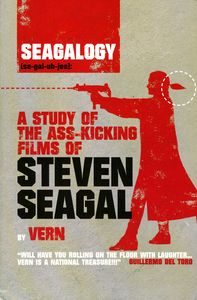
  • Seagalogy, Vern

    Seagalogy, Vern

    Titan, 2008, 396 pages, C$16.95 tp, ISBN 9781845769277

    A quick look at this book’s cover blurbs confirms that I’m not the only one surprised that Vern’s Seagalogy: A Study of the Ass-Kicking Films of Steven Seagal even exists.  For so-called serious cinephiles, Steven Seagal has stopped mattering about ten years ago, when his movies stopped showing in theaters and started going straight to DVD.  Even before then, Seagal’s movies were usually B-grade action films, the occasional exceptions (Under Siege, Executive Decision) often being hailed in spite of Seagal’s presence.  Somewhat savvier filmgoers can point at 1994’s poorly-reviewed On Dangerous Grounds as the film that broke the back of Seagal’s reputation as an actor/director, highlighting its earnest environmental monologue awkwardly inserted as a coda.

    That’s the conventional wisdom, anyway.  For Vern, though, all of Seagal oeuvre is worth scrutiny.  His thesis, quickly stated, is that Seagal’s influence on his own roles and films has been markedly stronger than many other contemporary action stars: That most movies featuring Seagal are, in fact, best considered as “Steven Seagal movies” rather than belonging to their screenwriters or directors.  Vern highlights Seagal’s pet themes and obsessions, and then charts how they are reflected in the vast majority of his work.  To top it off, he also reviews Seagal’s music CDs and energy drink.

    Everyone’s first reaction at a 395-pages book covering all things Seagal is likely to be similar to mine: No, really? Is there a subject of more trivial importance?  Couldn’t this be settled in a quick and cheap blog post?  Aren’t we wasting time, energy, paper, etc, even contemplating such matters?  Go ahead and wonder the same things.  I’ll wait for you to realize that in the end, the only valid appreciation of this book is based on results, not intent.

    Because the damning thing is that Seagalogy is a lot of fun to read.  It even convincingly proves its thesis: By the time we reach 2008’s Pistol Whipped, there’s little doubt that Seagal returns again and again to themes of official corruption, blowback and environmental degradation.  His characters are largely cut from the same clothes, featuring the same taciturn attitude, fascination for other cultures and fleeting family ties.  His methods frequently include improvised weapons, bars fights and people being thrown through glass.  No matter his screenwriters or directors (who range from video-directing pseudonyms to Oscar-nominated Hollywood veterans), Seagal remains Seagal.  For an actor often dismissed without a thought, he has shown remarkable resilience at a time where other actors simply disappeared: More than half of Seagalogy covers his direct-to-video (DTV) films, with as much attention as his theatrical releases.

    This means that Vern has gone through each movie with a fine comb, unravelling the shaky plotting of incoherently-made DTV features and telling us about scenes that barely make any sense on-screen.  He doesn’t review those films as much as he rebuilds them to see how they work (or don’t).  His commentary on DTV features is enlightening in that he has seen far more of them than most of us, and he can spot production flaws that set them apart from their more respectable theatrical brethren.  Even in structure, the book shines by its clear sections, careful interludes, meticulous appendices about minor and never-seen projects, with a poignant ending in which the author finally meets Seagal.

    It helps that Vern’s style is a straightforward mixture of straight-ahead writing, well-chosen details, self-deprecating humour and a keen understanding of the action film genre.  I’ve known of Vern ever since he started writing for aintitcool.com almost a decade ago and while I have often suspected his “Writer who is trying to go clean after a life of crime, alcohol, etc.” shtick to be indulgent performance art by either a bored film student or a struggling screenwriter, I still treasure in my archives an in-character email from him acknowledging my congratulations for a piece he’d written.  I’m not sure I would ever want to know the truth behind the pseudonym.  Much of his profane, consciously-illiterate online style is barely reflected in Seagalogy, though: At the exception of a consistent mistitling of “The Ain’t It Cool News” that plays as an in-joke, the entire book is scrupulously written and edited to the usual standards.  This isn’t a complaint: As much as I want you to read outlawvern.com on a regular basis, a book written and designed like his site would be practically impossible to read at length.

    Because, oh, yes, Seagalogy eventually becomes addictive reading even if you haven’t seen a Seagal film in a decade: For a book with a less-than-respectable subject, it quickly becomes an intelligent trip throughout the clichés of action cinema, and a fascinating discourse on all things Seagal.  It may even make you respect him for the first time.

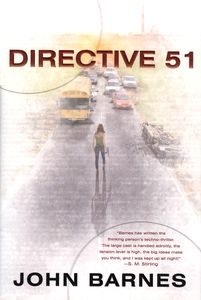
  • Directive 51, John Barnes

    Directive 51, John Barnes

    Ace, 2010, 483 pages, $32.50 hc, ISBN 978-0-441-01822-2

    One of the reasons why I’m quickly cooling off on Science Fiction’s current post-apocalyptic craze is my nagging suspicion that not everyone sees the apocalypse (whether it’s climate-, alien- or zombie-driven) as a bad thing.  There’s a streak of wish-fulfillment in “rebuilding the world” fantasies that makes me uneasy: I love the comforts of our civilization, and anyone talking about bringing it down strikes me as an enemy more than a romantic.

    Knowing this, you can probably guess why the opening section of John Barnes’ Directive 51 struck such a deep chord: As this first novel in a new trilogy begins, an uncoordinated group of eco-saboteurs, disaffected college students, back-to-the-Earth dreamers, international terrorists and other miscellaneous hoodlums spontaneously act on the belief that October 28th, 2024 is “Daybreak”: The day modern civilization dies.  Three particularly nasty pieces of work have a disproportionate impact on the story: A biological critter that disintegrates plastic and rubber, some nanotech that eats electronics, and the kidnapping of the US Vice-President.  While the breathless thriller of the vice-presidential kidnapping unfolds, our heroes from the US “Department of the Future” are introduced: a couple of brainy protagonists who desperately try to figure out what’s happening even as the world breaks down around them.

    It’s too late, though: As plastics melt away, electronics are reduced to dust and the US president declares himself mentally unfit to cope with the situation, order breaks down in more ways than one.  Before long, our protagonists are stuck between an implausibly clueless acting president, an ultra-right-wing challenger, massive systemic shortages and increasing violence.  It gets even worse as evidence accumulates that Daybreak was carefully orchestrated with follow-up strikes designed to wipe out any hope of recovery.  As the book ends, the duelling Presidents of the United States have to confront one question: Is there still an active campaign against them, or are they stuck dealing with a dead man’s switch?  (We readers, having been made privy to one crucial half-page scene [P.220], know better: something is going on, and I’d be surprised if the next volumes don’t explain how Daybreak was less spontaneous than it may first appear.)

    Given that this is the first volume of a trilogy, it’s no surprise if Directive 51 is all set-up with partial payoff: Much of the book is spent contemplating the rapid destruction of modern American civilization (with late and occasional glances at the rest of the world, which doesn’t do any better) through viewpoint characters who either caused part of it to happen or are desperately trying to mitigate the millions of deaths that follow.

    Frequent readers of these reviews know that I’ve been a fan of John Barnes’ work for a long time and so shouldn’t be surprised if I end up soft-pedaling a number of Directive 51’s annoyances.  The first chunk of the book is more irritating than the rest: In an effort to telescope as many things as possible in his “One Day” structure, Barnes’ hand is more obvious than usual in the interlocking plotting.  Worse, though, is that much of the book’s first third is spent with the terrorists, saboteurs and fools who initiate Daybreak: There’s nothing pleasant in reading about people you just want to hit on the head (with something suitably low-tech, such as a shovel or even just a baseball bat) for bringing about the end of civilization.  This explains, in part, why the VP-kidnapping subplot feels so thrilling: here’s a chance for heroics against the impending doom that cloys the rest of the novel.

    The novel gets more interesting after Daybreak is over, as our characters get the chance to be protagonists, are stuck in an impossible crisis of succession and more unusual plotting elements get their chance to shine.  The first presidential succession crisis is great good fun for political junkies readers, posing questions about personal responsibility in serving the nation even when it contradicts regulations.  Few non-rabidly political novelists ever end up writing about gunfire and insanity in the White House, so Barnes at least has that running in his favour.

    But what the second chunk of the book (“Ten Days”) ends up revealing is a curiously bloodless approach to the end of civilization: Cities burn, libraries are torched, super-weapons are detonated, billions of people die and the narration barely raises an eyebrow.  It takes a while to understand that the disaster is not limited to the US, and the novel seems to be in such a hurry to tear everything down that it barely manages to give us a sense of how bad it’s getting: There are a few moments in the narrative where the characters coolly mention how Daybreak is irreversible, that it will destroy all electronics, that it will take hundreds of years to recover from it (if ever) and those one-liners are everything we get in order to realize that this is as bad as it gets.  Perhaps worse is the lack of resentment and regret from the characters at how primitive their situation has become in a matter of days: A couple of saboteurs are treated sympathetically (well, sort of; as so often happens in John Barnes’s novels, one of them gets raped –albeit off-screen in an unusual show of restraint, although see “bloodless” above.) and even the so-called heroes end up saying things of comfort to the Daybreakers.  Hard-SF is about brainy readers more than emotive characters, but even that stance be carried too far.

    On the other hand… this novel has haunted me more than most of the others I’ve read this year.  I’d acknowledge my unusual attachment to civilization if it wasn’t for the fact that you’re reading this on a website, maybe from devices that didn’t exist as recently as five years ago.  Everyone has their particular nightmares, and when my own Maslowian hierarchy of needs is nicely fulfilled, I worry a lot about the fragility of our contemporary way of life.

    Then there’s the entertainment value of the scattered political outlook of the novel.  Barnes is a professional contrarian, and it’s amusing to see how he tweaks current partisan outlooks as the world of the novel changes around its characters.  There’s some sympathy for ultra-rich libertarians as they finally get to make use of their “Castles” enclaves built during the Obama administration even as the novel concerns itself with the (re)establishment of a national government.  A right-ring evangelical politician initially disliked by the book’s progressive heroes ends up rising to the occasion and being a preferable alternative to a delusional old-school Democrat.  Part of Directive 51‘s effectiveness lies in showing how crises can change our certitudes, so it’s no surprise if hyper-partisan readers will be upset at the novel’s shifting political sands.  More independently-minded readers will have more fun –especially when reading the amazon.com reviews accusing the novel of being a mouthpiece for whatever extremism is convenient.

    There’s also the fact that John Barnes is a seasoned SF writer, so that even when he errs, he’s able to deliver what his SF-reading public wants.  Directive 51 cleverly combines science-fictional concerns with a techno-thriller narrative mode to deliver a novel that’s up to the latest SF gadgets while delivering the thrills we expect from such a large-scale canvas.  When it gets ripping into the mechanics of pure fusion bombs, it directly scratches the sense of wonder that his readers are looking for.  (It’s also an eloquent piece of evidence for critics who argue that techno-thrillers and hard-SF are basically the flip sides of the same storytelling impulses.)  I happen to be unusually susceptible to the kind of narrative strategies used in this novel, so that purring sound you hear from my frantic pre-ordering of the book’s sequels may not necessarily translate into any similar affection from anyone else.

    Ultimately, though, the flaws and virtues of Directive 51 will be best appreciated once the story it’s starting to tell will be over.  Barnes has often upset the narrative certitudes of his previous series, and it wouldn’t be surprising if the upcoming Daybreak Zero ends up telling a different story than what we can predict.  In the meantime, Directive 51 is a flawed but fascinating end-of-the-world narrative that does a few new and interesting things.  It’s good enough to satisfy even those who are tired of SF’s current depressive phase.  Unlike all of the zombie or post-oil catastrophes, it asks the far more disturbing question: What if some people actually worked toward the end of the world as we know it?

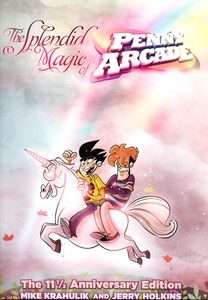
  • The Splendid Magic of Penny Arcade: The 11 ½ Anniversary Edition, Mike Krahulik & Jerry Holkins

    The Splendid Magic of Penny Arcade: The 11 ½ Anniversary Edition, Mike Krahulik & Jerry Holkins

    Del Rey, 2010, 164 pages, C$29.95 hc, ISBN 978-0-345-51226-0

    One of the great things about book collections of web-comics is that I can use them as an excuse to talk about some of my favourite on-line destinations.

    I’m not much of a gamer any more, but I still pay enough attention to the field to appreciate the genre criticism barely disguised behind the often-profane humour that the Penny Arcade guys offer three times per week.  You can read all of the archives at any time, or get the six annual collections covering the strip up until 2005 so far, but for a truly good look at Mike Krahulik and Jerry Holkins‘s Penny Arcade empire so far, you can’t do better than The Splendid Magic of Penny Arcade: The 11 ½ Anniversary Edition (take off the dust jacket for a slightly coarser alternate title)

    The book brings together a number of pieces written about Penny Arcade, its creators, the massive PAX gaming events and (more responsibly) the Child’s Play charity dedicated to providing games to sick children.  Essays describe how PAX first began (and the mistakes along the way), and how the usual “games are bad for kids” articles led Krahulik and Holkins to throw back clichés in the face of their critics by raising the social responsibility of the gaming community.  Another highlight is Penny Arcade Manager Robert Khoo’s article “Breaking the Law”, detailing Penny Arcade’s run-ins with American Greetings, now-discredited Jack Thompson and “Publisher X”. But for long-time readers of the series, a highlight is (re)reading the lengthy Wired profile about the two creators.  Penny Arcade is, in many ways, an accidental success: the article clearly establishes how everything began and then evolved.

    Weightier material aside, the chief attraction of The Splendid Magic of Penny Arcade remains the comic strips, here selected and presented out of chronology for various purposes.  Even though I can’t imagine Penny Arcade picking up new readers from this book (it’s got “for existing fans” all over it, down to an impressive gallery of tribute pieces by other geek-favourite artists), this would in fact be an ideal way to ease oneself into the universe of the strip.  There’s an introduction to the recurring characters (including a few minor ones that only fans with long memories will remember), various continuity highlights (“Paint the Line”, “Cardboard Tube Samurai”, “Twisp and Catsby”, “Armadeaddon”, “On Sorcelation”…) and a few strips selected by Krahulik and Holkins as being “the best”, with commentary throughout.  While some of the references remain obscure to people who didn’t play a particular game at the time of the comic’s publication, it’s about as quick a refresher on the various in-jokes, conventions and overall atmosphere of the strip.  (Much to my dismay, I realized during the best-of retrospective that many of my favourite pieces either featured extreme profanity or obscure geeky references that I may not even remember in five years.)

    It’s all handsomely collected in a full-sized hardcover with generous margins and plenty of incidental illustrations.  Unfortunately, a lot of the filler consists in blown-up, sometimes-edited comics panels.  (You can see the pixels!).  Another relatively low point is the unedited transcript of the Q&A section.  It’s needlessly hard to read; some editing would have been a judicious choice.

    But all in all, this is a perfect gift for the Penny Arcade fans.  Whoever is seduced by this book can already look forward to six annual collections already on shelves, and the entire run of the series on the web.  Don’t worry if some of the references are obscure: Only Gabe and Tycho understood them all in the first place, and they may have forgotten many of them already.  Just go on to the next strip and wonder in amazement at how the web has made such high-quality niche content possible.

  • The Walls of the Universe, Paul Melko

    The Walls of the Universe, Paul Melko

    Tor, 2009, 383 pages, C$28.95 hc, ISBN 978-0-7653-1997-5

    One of the charges most commonly made against the written Science Fiction genre these days is that much of it doesn’t look like the type of SF on which readers first got hooked on the genre.  This is either a good or bad thing, depending on your opinion of old-school SF: If your model of excellence was Asimov’s uncluttered prose, then the new stuff is pretentious and unreadable.  If you’re hoping for literary excellence, then the genre has never been healthier than it is right now.  Most of all, it’s an acknowledgement that Science Fiction has changed a lot since the pulp magazines, and that it can accommodate plot-driven and literary-minded readers, to say nothing of those who enjoy both.

    But from time to time, it’s worth noting that some books feel as if they have escaped from a previous decade.  So it is that Paul Melko’s second novel, The Walls of the Universe, could have been published at any point during the past forty years with very few changes.  It tackles the well-worn subject of parallel universes in a way that doesn’t rely on any recent innovations, and does so in a style that feels almost transparent once the story gets underway.

    Knowledgeable SF magazine readers will remember that the first part of the novel was published in Asimov’s in 2006, going on to be nominated for a number of awards including the Hugo and Nebula.  With this novel, Melko delivers an expansion and conclusion to his novella, taking the story further along in the same direction.  The premise is simple: A young man named John is accosted by another version of himself (“John Prime”), and receives a device that allows him to travel to parallel universes.  Unfortunately, it’s a trick: The device only works one way, and John Prime only gave away the device to get rid of the other John while he takes his place.  The novella ended with hero-John promising to investigate the mystery and return to his home universe.

    The novel eventually expands the scope of this premise, but first spends a lot of time following the parallel Johns as they learn to settle in their chosen universes.  Hero-John chooses to settle in a universe much like his/our own, intending to study enough physics to figure out the inner workings of the parallel-universe device but accidentally ending up inventing pinball.  Meanwhile, John Prime unsuccessfully tries to bring Rubik’s Cube to his new world, but ends up attracting the wrong kind of attention in addition to accidentally murdering his high-school nemesis.

    The Walls of the Universe spends a lot of time trying to keep this initial situation boiling before finally committing to expanding the canvas and sketching out the fuller implications of travel between parallel universes.  When it does, it leaves enough unanswered questions to suggest the possibility of either sequels or spinoffs; fortunately, it feels like a complete story by itself.

    But what this plot summary only suggests is the truly old-fashioned feel of the novel, which seems written from the same reservoir of wonder and imagination that characterised old-school SF.  Our hero is an engineer (of sorts) who eventually Figures it Out (in a grandly implausible display of reverse-engineering skills), tries to make things better and get along with everyone.  There’s a romance, a conflict with unsympathetic stranded world-travelers and an epilogue that corrects the book’s worst wrongs in a typical SF fashion.  The Walls of the Universe may have been marketed as an adult book, but it’s just as adequate for young adults (much like Steven Gould’s best novels) or adults who prefer a more straightforward kind of SF.

    Even with its mid-book lull and rushed ending, The Walls of the Universe remains too charming to resist.  It’s a very different novel from Melko’s debut Singularity Ring (which carried all the hallmarks, good and bad, of contemporary Science Fiction), but it’s likely to be far more accessible even to readers who are generally unfamiliar with SF.  It’s a good, traditional read that leaves readers satisfied.  If that’s what we mean by old-school SF, then we could use a lot more of it.

  • Medium Raw, Anthony Bourdain

    Medium Raw, Anthony Bourdain

    Ecco, 2010, 281 pages, C$28.99 hc, ISBN 978-0-06-171894-6

    Anthony Bourdain will be the first to recognize the unlikelihood of his accession to the ranks of celebrity cooks.  After two unsuccessful novels published in the late nineties while he was still working in New York restaurants, Bourdain wrote the now-classic exposé Kitchen Confidential with hopes that it would be read by other local kitchen professionals.  Much to his surprise, the book rode the wave of popular interest in all things foodie, became a perennial bestseller and (with some help from a TV show) made Bourdain a foul-mouthed star.  Unlike other celebrity chefs, his place has always been that of the hard-working professional scrapping away in ordinary restaurants.  Bourdain will acknowledge that his culinary talents were average, and that his unusually good fortune leaves him just as surprised as anyone else.

    That’s how we end up with Medium Raw, a collection of original essays about Bourdain’s life during the decade since Kitchen Confidential first appeared on the shelves.  Tackling a diversity of subjects from fatherhood to the quality of fast-food meat to the requirements for being a chef to the impact of the 2008 financial crisis over New York’s high-end gastronomy scene, Medium Raw is like spending an evening hearing Bourdain discuss a variety of subjects.  There’s so little structure that the book could have been a collection of magazine articles, but much of it either revolves around food or Bourdain himself.  It’s obviously a book for fans, and even those who have read Kitchen Confidential recently may feel left out if they haven’t experienced his other books and TV shows.

    Equally introspective and controversial, Medium Raw spends as much time meditating upon Bourdain’s selling-out than in designating heroes and villains.  (Heroes?  Working-class cooks like the one Bourdain profiles in “My Aim is True” or iconoclastic chefs like David Chang, discussed in “The Fury”.  Villains?  Alice Waters, as described in “Go Ask Alice” and Alan Richman in “Alan Richman is a Douchebag”.  For more, there’s an entire chapter called “Heroes and Villains”.)  A crucial difference between this and Kitchen Confidential is how stepped into foodie culture Medium Raw can feel: Bourdain not only name-checks other TV chefs presuming that we can recall who they are, but acknowledges the work done by Michael Pollan and Eric Schloesser in raising food quality issues in popular media.  For anyone even casually acquainted with contemporary food writing, it feels like a part of the mainstream.

    The best pieces of Medium Raw touch upon a variety of subjects and tone.  “The Sit Down” begins the book with a vaguely foreboding description of a confidential Ortolan tasting that will lead curious readers to Michael Paterniti’s incredible article “The Last Meal” (summary).  “Selling Out” describes Bourdain’s changing opinions about celebrity chefs and his own relationship to fame.  In “Meat”, Bourdain is horrified at the declining quality of hamburger meat and makes sombre predictions about the future of this all-American staple.  Bourdain’s expertise about the New York scene is obvious in “The Fear” (regarding the changing restaurant environment once the bankers lost their expense accounts in late 2008), while “Lower Education” includes a hilarious description of the psychological warfare that Bourdain is waging against McDonalds in his daughter’s social circle.

    Alternately funny, profane, touching, heartfelt, analytical and descriptive, Medium Raw is a grab bag of food-related pieces that shows how Bourdain has developed not just as a celebrity, but also as a writer.  It’s fully self-aware, and generous in how it gives us (still) a glimpse in the author’s life now that he’s moved up in the world.  It may be disconnected and scattered and unequal, but it’s also a fast and pleasant read thanks to Bourdain’s engaging style.  Even those who bought it with the intent to read it later may find themselves captivated after only a few pages.

  • Fever Dream, Douglas Preston & Lincoln Child

    Fever Dream, Douglas Preston & Lincoln Child

    Grand Central, 2010, 405 pages, C$32.99 hc, ISBN 978-0-446-55496-1

    The very last page of Fever Dream’s hardcover edition is an important announcement from the authors (now listed without first names on the cover) telling us that they are about to launch a new series of thrillers.  That announcement couldn’t have come at a better time, since anyone who makes it to the end of their latest novel will understand the creative fatigue plaguing the Agent Pendergast series.

    Fever Dream isn’t a bad piece of work as far as summer thrillers go… but it’s certainly generic enough to make anyone wonder what happened to the creative team that hopped so brilliantly from one set of character to another in their first few novels.  Now that they have spent seven successive novels writing about Pendergast, everything is starting to feel like routine.

    Granted, Fever Dream is a bit better than their previous Cemetary Dance: They don’t kill off a major character, they avoid much of the pseudo-supernatural hocus-pocus of their last few books and even advance one or two overarching subplots along the way.  By digging into Pendergast’s history, and in particular the events surrounding his wife’s death twelve years earlier, we also get a chance to understand what makes his character tic while he stomps around his regular haunts.  Leaving behind New York for the bayou, the normally-cool agent is also quite a bit more emotional this time around… in his own fashion: the point is not just to find who killed his wife, but to avenge her as well.

    Much of the plot, unsurprisingly enough for a Preston/Child thriller, is an investigation trying to piece together a decade-old mystery.  From smoking guns to hidden art caches, redneck confrontations and southern mansions contaminated by madness, Fever Dream even manages a few thrills along the way.  An unexpected plot development midway through the book even forces NYPD agent Laura Hayward to team up with Pendergast despite having little personal liking for the man.  There’s a touch of The Cabinet of Curiosity’s urban archaeology in seeing Pendergast deduce the existence of a hidden crypt under a Louisiana doughnut shop, while an ugly scene between Hayward and rednecks late in the book leads to a supremely satisfying revenge by the normally-imperturbable Pendergast.  While his long-dead wife was scarcely even mentioned in the previous novels in the series, she here has a faint presence that does nothing more than reinforce Pendergast’s mystique.  Elsewhere in that fictional universe, Constance Greene also gets a small part in one of the book’s subplots: Depending on its follow-up, it’s either a disappointing resolution to a promising story thread or a set-up for something even more intriguing.

    Combine those particular traits with Preston/Child’s usual clean prose, high-tech/historical plot drivers, limpid scene construction and ongoing plot threads and you have the makings of a capable thriller, if not much more: Despite improving on the previous two novels, Fever Dream is still just another minor entry in the Pendergast series, and one that can’t even be bothered to wrap up its plot threads: while the story reaches a natural stopping point, there are at least two unanswered questions leading into the next book of the series…  almost as if readers couldn’t be trusted to come back to Pendergast once Preston/Child’s new “Gideon Crew” series is launched.  Fortunately, reading the industry trades tells us that the February 2011 publication of the first Gideon Crew novel will be followed in the spring/summer by another Pendergast novel.  As a signal that the Pendergast novels aren’t anything special any more, this one is hard to miss.  Hopefully, the break will help the two authors find another creative outlet and keep Pendergast employed doing what he does best.  If that means he can take an extended break while Preston/Child go about working on other projects, then that may be for the best.

  • The Girl Who Played with Fire, Stieg Larsson (translated by Reg Keeland)

    The Girl Who Played with Fire, Stieg Larsson (translated by Reg Keeland)

    Viking Canada, 2009 translation of 2006 original, 503 pages, C$32.00 hc, ISBN 978-0-670-06902-6

    Second instalment in the massively popular Millennium trilogy of Swedish crime thrillers, The Girl Who Played with Fire continues the adventures of Larsson’s duo of righteous avengers by following up threads left open in the first volume in the context of a new mystery.  It’s a different type of story, and it leads straight to the final book in the trilogy.

    It picks up nearly a year after the events of The Girl with the Dragon Tattoo, as Lisbeth Salander comes back to Stockholm after some time spent travelling around the world.  This set up a chain of events that eventually send Salander on the run, suspected of three murders –including that of her sadistic guardian so memorably neutralized in the first volume of the trilogy.  Meanwhile, boy-scout journalist Mikael Blomkvist isn’t too far away from the story, as one of the victims was working for his Millennium magazine in exposing a prostitution network.  The strange collaboration between Salander and Blomkvist resumes anew as the stakes are raised ever higher for Salander.

    Much of the same strengths that made The Girl with the Dragon Tattoo such an enjoyable introduction to the series are in full display here:  The intricate procedural detail; the left-leaning look at modern Sweden society in all its flaws; the indignation at violence against women; the intensely genre-aware character-motivated plotting and (certainly not least) the two lead protagonists themselves.  Salander, newly refurbished and rich beyond belief, is still considered a crackpot by Swedish society at large, and The Girl Who Played with Fire goes much deeper in her personal history than anyone would expect.  This is her big novel in terms of back-story, and it cleanly illuminates a number of the character traits established in the first volume: why she’s so asocial, brilliant and driven.  Meanwhile, Blomkvist holds steady as a gifted editor/journalist, though he gets little more to do here than piece together the whole story and race ineffectually on Salander’s trail.

    That The Girl Who Played with Fire is Salander’s story is most directly reflected in its tone.  After a lengthy procedural first half, the novel gradually transforms itself in a revenge thriller, and the ending is nothing short of brutal for everyone involved.  While there is a mystery to solve, this second volume is more forward-moving than the first: it’s a thriller more than a mystery, and despite the Cold War flashbacks, we don’t go digging quite as deep in Swedish history.

    The price to pay for this story, unfortunately, the amount of sometimes-ridiculous procedural detail that Larsson crams into his novel.  This reaches an apex of sorts as we follow Salander during a page-long trip at IKEA: We get not only the specific models of what she buys, but a total of what it cost.  For all of the fuzzy warm feeling that readers may get in realizing that they’re reading the novel on the very same Poäng armchair that Salander has in her apartment, there’s a point where it’s possible to wonder How much of this is really necessary? The novel goes far beyond Salander and Blomkvist as viewpoint characters, involving an entire cast of protagonists, antagonists, friends, police and helpful bystanders.  The thriller plot itself barely begins before the first half of the book is over, and only starts cooking in the last quarter.  If nothing else, reading the novel will affirm how skilful the movie adaptation was in keeping the truly essential elements of the story.

    Still, seasoned thriller readers will find a number of interesting elements to savour.  The often-corrupt Swedish setting is just as interesting, whereas Larsson’s tweaks to the usual thriller plot templates can keep things interesting: Both heroes are kept physically apart until the very last moments of the novel, and two of the book’s big action moments go to secondary characters rather than the lead protagonists.  (In a note that will go unnoticed by most North-American readers, Larsson even gives a significant heroic role to real-life boxer Paolo Roberto, resulting in one of the best real-life cameo in any novel, ever.)

    Readers with sufficient patience and attention span to last through the often-lengthy but usually delicious exposition will only be pleased by this successful second volume.  But anyone with even the slightest interest in reading more about those two characters should keep the third volume close by, since the end of The Girl Who Played with Fire leads directly to The Girl Who Kicked the Hornet’s Nest.