Book Review

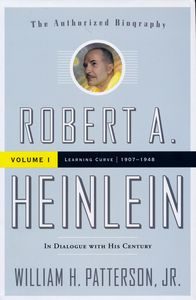
  • Robert A. Heinlein: In Dialogue with His Century: Volume 1, 1907-1948: Learning Curve, William H. Patterson Jr.

    Robert A. Heinlein: In Dialogue with His Century: Volume 1, 1907-1948: Learning Curve, William H. Patterson Jr.

    Tor, 2010, 622 pages, C$35.99 hc, ISBN 978-0-7653-1960-9

    You don’t have to be a Science Fiction historian to understand the massive influence that Robert A. Heinlein had over the genre.  His writing techniques set an example for all writers to emulate (or repudiate), his personality challenged readers to become better human beings and so it’s no exaggeration to state that entire generations of SF enthusiasts have been led by Heinlein’s example.  As a writer, a personality, and a towering figure in the SF community even more than two decades after his death, he is one of the few SF writers of the twentieth century to deserve a massive two-book biography.

    What we get with William H. Patterson Jr.’s Robert A. Heinlein: In Dialogue with His Century: Volume 1, 1907-1948: Learning Curve (count those colons!) is… something impressive, even as the first half of a bigger project.  Alas, it’s not the single best possible account of Heinlein’s life.  Like most authorized biographies, it benefits from generous access to primary sources, but suffers from a lack of critical perspective.  The author has accomplished a herculean task of bringing together a mass of information about Heinlein, but he hasn’t always been able to condense this data into a readable or insightful portrait of the man.

    It may be that the SF community has been spoiled by Julie Phillips’ extraordinary biography of Alice Sheldon, James Tiptree Jr., a fusion of fact and interpretation that remains the gold standard for SF writer biographies.  (Outside the genre, there’s also William McKeen’s biography of Hunter S. Thompson, Outlaw Journalist, to consider.)  Compared to Phillips’ work, this first volume feels flat and bloated, afraid to take a dispassionate stand about its own subject while having a hard time distinguishing between trivia and detail.  Why else spend a page detailing speeches at an Army-Navy game in which Heinlein was only peripherally involved? [P.81]

    We shouldn’t be ungrateful for the sheer amount of detail: This is a “Life and Times of” kind of biography, and if nothing else, readers will come away from the book with a meticulous understanding of 1920s Annapolis, 1930s California Progressive politics and 1940s stateside war efforts.  But if you’re getting the sense that you have to be enthralled by Heinlein before reading the book (rather than let the biography do the convincing), then you’re right.

    Readers without a deep-set case of Heinlein worship are advised to grit their teeth, skip the rah-rah-RAH introduction (in which the death of Heinlein is compared to the assassination of JFK, the Challenger explosion and 9/11) and start reading on Chapter One, which sets the tone for a book that is a great deal more factual that its hagiographical opening would suggest.  Not that the fawning tone entirely disappears later on: Patterson has a tendency to exculpate Heinlein from various errors and lapses of judgement, blaming his wife for a bad signature, not questioning official medical records and generally presuming that Heinlein knew best.  I’m also troubled at how much of the sourcing goes straight back to recollections by Heinlein’s third wife –that is, unchallenged hearsay by a highly biased source.

    This occasional fusion of overwhelming minutia and unquestioning Heinlein fanboyism makes the book feel considerably less accomplished than it actually is.  From various reports on and off-line, I understand that the editing process for the book wasn’t simple (nor, apparently, friendly) and that the result is considerably shorter than the manuscript initially submitted for publication.  The result remains a bit frustrating… about as much so as trying to make sense of the hugely complicated man that was Heinlein.

    Still, having vented my frustrations about the book, here’s why it deserves to be read widely, discussed passionately and nominated for next year’s Hugo Awards: It’s a significant piece of work, it presents new information about Heinlein and it manages to describe the broad strokes of Heinlein’s life during a very badly documented period.

    Even confirmed Heinlein fans will learn quite a few things out of this biography: Heinlein’s first-of-three marriages; the particular nature of his second one; the way he got to Annapolis; his fascination with the occult; the episode in which he nearly became a Rhodes scholar; his unpleasant first Guest of Honour experience at the 1941 Worldcon; the details of his unsuccessful electoral bid; and so many others.  Even dirty gossip gets a bit of space, as we learn of a possible affair between L. Ron Hubbard and Heinlein’s second wife.  (Read the endnotes!)  There is a lot of information here that, to my knowledge, has never received wide publication.  The magnitude of Patterson’s achievement in chronicling the first forty years of Heinlein’s life is magnified by the difficulty of getting this information, by dint of historical distance or by deliberate erasure.  (Heinlein burnt much of his own personal papers in 1947.)  To find so much information unearthed (even via unreliable sources) is a minor miracle and for that reason alone, this biography is a major piece of work that will become a significant starting point to any further Heinlein assessment.

    There’s also quite a bit of merit in how Patterson is able to trace Heinlein’s formative influences, from the rigour of his naval background to his liberal politics within Upton Sinclair’s faction of the California Democratic Party to his post-war reassessment of his political affiliation given the threat of nuclear warfare.  Heinlein’s fiction can argue opposite sides of issues in successive novels, and this biography does a fine job at showing how widely Heinlein’s experience differed from the American norm of the time.   For SF fans, I suspect that the last section of the book, after Heinlein starts selling fiction professionally, is a fascinating look at the development of the SF field at a crucial period.  There are familiar names (Campbell!  Pohl!  Hubbard!  Asimov!) and a strong sense of what the community must have been at the time.

    I also suspect that quite a few early Heinlein devotees will be astounded to read about the genesis of some stories.  One of my first significant SF reads was Heinlein’s Space Cadet, for instance, and I was stunned to learn of the circumstances in which the novel was written –Heinlein practically living as a nomad, in-between marriages, fighting rumours spread by his second wife and desperately trying to make ends meet in difficult circumstances.  Who knew?

    One thing is for sure: This book has created a lot of brisk discussion within the SF field, and will continue to do so for a while.  As with all things Heinlein, the biography is attracting passionate commenters from all persuasions, and some of the best results of the online fur-ball are a good erratum for the biography, and an informed reassessment of Heinlein’s stature within the field.  It’s a significant reminder of Heinlein’s influence still.

    The end result is a complex, meaty, substantive biography that has a number of weaknesses, but still represents the best and most complete look at Heinlein’s early life than we’ve been able to read so far.  It’s not the best Heinlein biography imaginable (I challenge anyone to do better), but it’s assured of a spot on next year’s Hugo Awards short-list, and a long half-life as an significant work of SF scholarship.  Better yet; it prefigures a second volume that will really dig into Heinlein’s fully-matured period.  That one will be a heck of a read, even –especially- if it’s as frustrating as this first volume.

  • The Reversal, Michael Connelly

    The Reversal, Michael Connelly

    Little, Brown, 2010, 389 pages, ISBN 978-0-316-06948-9

    The sheer number of Michael Connelly book reviews on this site will confirm that I’m a fan of the author: Connelly writes crisp, efficient crime thrillers, and even average efforts from him feel like top-notch novels compared to the work of other authors.

    For fans, the good news is that The Reversal once again pairs up two of Connelly’s lead characters.  If “Mickey Haller works again with Harry Bosch on a case!” means nothing to you, then go read other Connelly books first (I recommend The Poet).  But if that tagline means everything, then The Reversal is written just for you.

    It starts with, well, an unusual reversal of roles, as defense attorney Haller is offered a temporary prosecution job: An old case involving the kidnapping and murder of a child is being re-opened decades later due to new evidence, and Haller is the best chance to try the case from a fresh perspective.  This soon turns into an extended family affair as Haller gets to collaborate with his ex-wife and gets his half-brother Bosch as lead investigator.  As usual in Connelly thrillers, complications soon pile up.  Haller realizes that his case is tainted and that he’s being set up for a failure.  Meanwhile, Bosch keeps a close track on the newly-freed suspect given the troubling nature of his night-time habits.  It all leads up to a courthouse drama, but one that won’t go according to accepted procedures…

    As with other Connelly thrillers, The Reversal features a mesmerizing mixture of solid plot mechanics, credible procedural details, well-sketched characters and clean prose.  As would suggest the hybrid nature of a novel starring a lawyer and a policeman, The Reversal is somewhere between a courtroom drama and a police thriller, drawing upon each subgenre to complicate the action.  The interaction between both half-brothers seems a bit more hopeful than most of Bosch’s previous collaborations–which inevitably ended with enough bad sentiments against Bosch to make further collaborations unthinkable.  This time, both step-brothers get along reasonably well and even discuss how their daughters could play together.  Other characters such as Rachel Walling briefly show up as reminders of the expansive nature of the Connellyverse.  Meanwhile, Haller’s musings about being on the other side of the courtroom are fresh enough to bring another angle to the usual police-driven Connelly perspective.

    Where The Reversal falters is in its final fifty pages, when the meticulously constructed courtroom drama abruptly goes down in flames as the suspect does something unpredictable.  Abruptly, the novel switches gears to a disappointing ending in which gunplay takes precedence over procedure, and enough action happens off-screen to make us feel as if the novel was concluded in a rush.  A number of threads are left untied, adding to the unfinished impression.  This disappointing finale, added to a novel that doesn’t really attempt anything new, is enough to make even enthusiastic readers conclude that this isn’t one of Connelly’s best efforts.

    Fortunately, it’s still good enough to keep most readers happy and satisfied.  Connelly’s latest few books, however, have generally been underwhelming as well: There’s a limit to what he can do with Bosch (Nine Dragons showed how far he could push it) and few of Connelly’s experiments with other protagonists, including a return engagement for Jack McEvoy in The Scarecrow, have been particularly successful.  While there’s no cause for alarm yet, it’s probably best to put Connelly on some kind of advance-warning watch-list for authors stuck in their own formula.  Sure, he’s doing well with routine entries… but how long can he maintain this streak?

  • 61 Hours, Lee Child

    61 Hours, Lee Child

    Delacorte, 2010, 383 pages, $34.00 hc, ISBN 978-0-385-34058-8

    Lee Child’s eminently capable hero Jack Reacher has been in a number of desperate situations before, but I don’t think he’s ever been as cold as in 61 Hours.  Taking place in wintry South Dakota, this fourteenth Reacher novel does for sub-zero temperatures what Echo Burning did for the Texan heat.

    The set-up is ingenious: A lawyer is instructed by his incarcerated client to set up a series of events that will end up shaking a small community.  But in his driving haste, the lawyer causes an accident that strands a busload of passengers in the nearby town of Bolton.  Among the passengers is Jack Reacher… and he quickly concludes that the local police force is no match for what’s about to happen.  Asked to protect a crucial witness, Reacher realizes that there’s a lot more going on in this community than anyone could expect… and that many of the answers lie underneath a mysterious military installation not too far away.

    As with previous Reacher thrillers, the chief attraction of 61 Hours is in seeing the hero react to his environment, understand the situation, call upon new friends, use his prodigious powers of deduction, and being slowly led to confront the real threat.  It takes a while for the true plot to reveal itself, and the masterful way in which it takes shape is one of the reasons why Child remains one of the best thriller writers currently in the business.  Lesser authors will envy the skill in which the first chapter is set up, with enough procedural detail, purposeful mystery, powerful narrative hooks and ticking clock.  It’s all there in the first few pages, and Reacher fans will just want to let themselves sink in a good chair and enjoy the rest of the book.

    Most of what follows is just as good as other novels in the series.  After the frantic urban frenzy of Gone Tomorrow, Child is back to heartland America with his depiction of a cold small Dakotan community.  The presence of a supermax prison not too far away sets up a few delightful complications, whereas the nearby abandoned military base is also a rich magnet for revelations.  It climaxes in a fight in which Reacher’s usual advantages are negated, further proof that Child is still interested in mining all sorts of possibilities from his series.

    Barely worth noting is a brief reference to Reacher being identified by the Army as an aggression child prodigy; that, like his freakish gift for numbers in Bad Luck and Trouble, probably won’t ever be referred to again.   Also worth forgetting is the revelation of a criminal informer within friendly ranks: Either Child is getting predictable or he tips his hands way too early, because the mole is far, far too easy to identify even as events are occurring.

    Stylistically, 61 Hours is notable for the dramatic countdown announced by its title: All chapters end up with a reminder of the current time, and how many hours/minutes are left before… something.  That something, alas, ends up being a cliff-hanger ending.  And if you don’t want to hear more about the biggest misstep in the Reacher series since the hypnosis nonsense in Running Blind, skip the next two paragraphs:

    It’s not entirely a cliff-hanging ending: The main plot is wrapped up, the antagonist is punished and the revelations are exhausted.  The only thing left hanging, in fact, is Reacher’s fate: The story concludes with him desperately racing toward an exit, whereas the epilogue describes in rich and meticulous detail why no one could have survived his predicament.  The novel ends without Reacher in sight, most surviving characters concluding that he’s definitely dead.

    But is he?  Peeking ahead to the next Reacher novel, Worth Dying For, reveals an infuriating answer: Reacher is alive (no surprise here), but the explanation of his survival is so vague as to be useless: the various obstacles described in 61 Hours’ epilogue are not acknowledged, and so we’re left with an unfulfilled mystery.  A latter book may fill in the blanks (there are indications that Reacher sets out to meet a character introduced in 61 Hours) but who knows?  Why conclude the book in this way if it’s not going to mean anything?

    If readers can stomach its meaningless cliff-hanger, 61 Hours is another decent entry in the Reacher canon, and further proof of Child’s ability to wring thrills out of small American towns.  The chills felt by readers won’t necessarily be caused by the novel’s glacial setting.

  • Zero History, William Gibson

    Zero History, William Gibson

    Putnam, 2010, 404 pages, C$31.00 hc, ISBN 978-0-399-15682-3

    I can just imagine a conversation between myself and a time-traveling SF fan from the late eighties.

    Fan: Is William Gibson still writing?
    Me: He sure is.  In fact, he’s famous; people pay to go see interviews with him, and his latest novel Zero History just came out.
    Fan: Oh wow!  That sounds interesting!
    Me: Actually, it’s a novel set two years ago in which a recovering addict and an ex-rock star go investigate the makers of a mysterious brand of jeans.
    (Lengthy pause)
    Fan: You’ve got to be kidding me.
    Me: No, that’s actually the truth.
    Fan: Your future sucks; I’m off to play D&D with my buddies.
    (poof)
    Me: Aw, and I didn’t even have time to tell him about the iPad.

    The point being that Gibson, perhaps more clearly than any of his Hugo-winning mid-eighties contemporaries, isn’t writing the same kind of fiction than he did.  Why should he?  People grow old, change, become interested in different things and that’s perfectly fine.

    The problem may come when we insist on reading Gibson in the same way we did at first.  It’s not exactly a revelation to say that Gibson is still writing about the same things he did in Neuromancer, except that they are now all around us rather than in some unspecified future.  In many ways, his writing style hasn’t changed: It’s still heavy in visual descriptions, brand names, fashions and attitude.  Behold this sentence:

    After Clammy had decided to go back to the studio, her white plastic bottle of Cold-FX wedged precariously into a back pocket of his Hounds, departing the Golden Square Starbucks during an unexpected burst of weak but thoroughly welcome sunlight, Hollis had gone out to stand for a few moments amid the puddles in Golden Square, before walking (aimlessly, she’d pretended to herself) back up Upper James to Beak Street. [P.47, with reluctant thanks to the Russian hackers who put the entire text of Zero History on-line where it was indexed by Google, so that I could copy-and-paste the passage rather than re-type it in.]

    I went to a live Gibson interview at an Ottawa writer’s festival shortly after reading Zero History, and it’s clear that he hasn’t been interested in being perceived as a Science Fiction writer for a while.  Maybe it’s time to do both the author and the genre a favour and start distancing Gibson from SF: If he still sees the world through a prism shaped by SF, that makes him a genre-friendly mainstream author… but a mainstream author nonetheless.  Gibson would rather write the kind of fiction that Gibson finds interesting than being stuck in genre conventions.  If you squint, you can almost see Zero History as a thriller, but an unusually limp one: Like Pattern Recognition and Spook Country, this novel isn’t really interested in trifles such as narrative tension, plotting, suspense or action sequences.  It may have a laboriously set-up climax in which a hacked Festo floating penguin zaps a villain through a Taser activated by iPhone, but that duct-tape cyberpunk is all of the techno-excitement that Zero History has to offer.

    In fact, the “Bigend trilogy” he’s been working on since Pattern Recognition shows to what extent he is now recasting in fictional form what catches his attention as he surfs the web.  His novels have become inseparable from the Internet in that we’re practically asked to Google his references in describing the world of his novels.  That’s a particular form of reading pleasure, I suppose, but one that’s quite distinct from his eighties fiction.  Let’s appreciate it for what it is.

  • The Accidental Billionaires, Ben Mezrich

    The Accidental Billionaires, Ben Mezrich

    Doubleday, 2009, 260 pages, C$29.95 hc, ISBN 978-0-385-52937-2

    I suppose that The Accidental Billionaires was inevitable: In his previous non-fiction work, Ben Mezrich has shown how much he loves to write about Boston-area young men who go on to make a lot of money, and so one could only count down the minutes until he turned to the Harvard-educated founders of Facebook.  As the book’s sub-title proudly announces, what’s not to like about “A tale of sex, money, genius and betrayal”?  That’s as good a shorthand as any to describe Mezrich’s chosen specialization.

    As usual, it’s best to approach Mezrich’s non-fiction novels without any expectations of journalistic rigor.  Even though The Accidental Billionaires may be better-documented than any of Mezrich’s non-fiction so far, it’s still largely told from the perspective of a single primary source, that is Eduardo Saverin, the Facebook co-founder who was shut out of the company as it grew to become today’s behemoth.  Mezrich acknowledges this connection up-front, as well as the fact that the better-known Mark Zuckerberg “declined to speak with me for this book despite numerous requests.” [P.2] The Accidental Billionaires may rely on court documents, newspapers articles and public records, but it remains Saverin’s story –the truth, if ever it comes out, will no doubt be considerably less colourful than what’s presented here.

    If this story sounds very familiar, you may have seen David Fincher’s The Social Network, a 2010 movie reviewer’s darling partly due to a snappy screenplay penned by Aaron Sorkin.  While the film is officially adapted from the book, a number of clues suggest that Sorkin used Mezrich’s sources and storyline, then went in his own direction –indeed, even a cursory read of the book after seeing the film will reveal a number of differences: The film is tighter, uses a convenient framing device, and is filled with symbolism that reality (or even the book’s version thereof) would be hard-pressed to provide.  For instance, the book suggests that Saverin’s then-girlfriend did set one of his gifts on fire… although not quite in the way the film presents it: Saverin wasn’t there speaking on the phone as his room nearly went up in flames.

    If nothing else, The Accidental Billionaires is quite a bit more up-front than Mezrich’s other books in acknowledging its loose connection with reality, beginning with an author’s note that admits up-front that a portion of what we’re about to read is fantasy.  But questions of veracity eventually take a back seat to pure entertainment.  Anyone who has read Mezrich’s other works of docu-fiction can assume that he spiced things up in rewriting the story.  He recasts the events in the form of a quasi-novelistic narrative, providing us with scene-setting, dialogue, inner monologue and poignant scene endings.  The only question becomes… is the story interesting to read about?

    It does works well in building a compelling narrative: The Accidental Billionaires is readable in a blink.  Saverin’s betrayal as his former friend Zuckerberg allows him to be replaced at the core of Facebook is well-portrayed even though more sceptical readers will want to consider the source and Mezrich’s tendency to favour drama rather than reality.

    There’s a debate to be had, I suppose, about what standards of dramatization we’re ready to accept, and whether readers are complicit in accepting fanciful tales if they find their presentation enjoyable.  One of the biggest lies told by fiction is that there are such things as narrative arcs, momentous decisions, good or evil motivations, sharp dialogue and consistent personalities.  The Accidental Billionaires is enhanced reality, not a faithful portrait of history.

    Doubts about Mezrich’s work are complicated by a fog of legally binding settlements and greedy motivations: at this time, even solid journalistic work may be unable to reveal the real story.  Considering that Facebook isn’t even ten years old and that all of the principals are still alive, this is both troubling and temporary: Troubling in that we can’t even get a straight answer at this time; temporary because sooner or later, tempers will cool down and we may then finally understand the complex web of motivations behind Facebook’s foundation.  In the meantime, there’s at least an entertaining book to attempt making sense of it.

  • The Last Train from Hiroshima, Charles Pellegrino

    The Last Train from Hiroshima, Charles Pellegrino

    Henry Holt, 2010, 367 pages, C$33.00 hc, ISBN 978-0-8050-8796-3

    When I ordered The Last Train from Hiroshima from amazon.ca in February 2010, the media frenzy around the book had just started: Allegations about the book’s dubious veracity had started to flare up, with numerous experts identifying many mistakes in the narrative.  By the time the book arrived at my house, Pellegrino’s academic credentials had been debunked and the publisher had announced that it was pulling all copies of the book from shelves.  In some sense, my copy of the book had ridden its own Last Train from Amazon: Even today, Pellegrino’s latest remains unavailable from either amazon.com or amazon.ca, being sold by other vendors at premiums making my purchase look like a savvy investment.

    But I’m not the smart one in this story.  Frankly, I ordered the book not because of the controversy, but because I’ve been a Pellegrino fan ever since his 1998 Science Fiction novel Dust.  This had led me, through the years, to most of his bibliography, including a number of very enjoyable non-fiction books.  I won’t try to re-write my reviews: You can go explore my “Charles Pellegrino” tag to point and laugh at my credulity regarding Pellegrino’s so-called non-fiction.

    As I microwave a platter of crow for public delectation, I will at least acknowledge having had some doubts as to whether Pellegrino’s brand of emotionally-driven scientific non-fiction was entirely truthful.  There were so many uncanny anecdotes buried in the text, so many dramatic moments, so many convenient coincidences that I asked knowledgeable people at SF conventions whether Pellegrino was entirely legit, and wasn’t entirely reassured by the answers.

    When the Last Train from Hiroshima story exploded, a lot of people started scrutinizing Pellegrino’s grandiose claims.  Did he really provide inspiration to Michael Crichton’s dinosaur-cloning technique in Jurassic Park?  Is he really a renegade Ph.D. from New Zealand?  Tall tales are tall tales –but when they’re supposed to establish credibility for someone writing scientific non-fiction, they upset the presumption of expertise that readers tacitly bestow upon writers of works informing us about the world.  And once the first domino falls…

    I was frankly reluctant to read Last Train from Hiroshima for the same reasons I don’t usually read older scientific non-fiction: So many things have changed since then that I would be putting bad information in my head.  Would reading Last Train from Hiroshima skew what I thought I knew about the American nuclear bombardments of Japan?

    There’s no good way to read a book about nuclear holocaust when it comes with a constant mental warning saying “All of this may be made-up”.  True to his previous books, Pellegrino milks science and history to their most dramatic extent, putting as much feeling in the narrative as technical details.  Readers approaching the book without prior knowledge of the controversy may feel a twinge or two of pure empathy for those who died at Hiroshima and Nagasaki, to say nothing of the survivors fated to lives cut short by radioactive fallout.  For those who suspect that a good chunk of the book is made up, though, it’s a harder sell.

    Much of The Last Train from Hiroshima controversy surrounds the testimony of Joseph Fuoco, whose surprising claims about the delivery of the American bombs have been cast in doubt by just about every knowledgeable military expert.  Alas –and this really hurts—readers eventually notice that most of the American material in Pellegrino’s book is sole-sourced to Fuoco.  Cut that out and you may as well have half a book.  The scant sourcing of The Last Train from Hiroshima through a thin bibliography might as well douse the flames of doubt.  Add to the that the other questions regarding the content of the book (including Japanese testimony we might as well know nothing about), and the only thing to do is to wrap the book in heavy opaque “Memetic Hazard” tape and shelve it alongside other potentially harmful material as occult woo-woo.  It’s the only sane response.

    And if you think that the damage is limited to just Last Train from Hiroshima, you’re fooling yourself: the doubts extend retroactively to every other non-fiction book that Pellegrino has even touched.  The Jesus Family Tomb had already raked up its share of controversies along with the 9/11 section of Ghosts of Vesuvius, but the one that really rankles is Chariots for Apollo, which I had taken to be a pretty good history of the Apollo program; what’s the quotient of crap-to-fact in that one?

    And that’s the true price to pay for even a few mistakes in non-fiction books: It casts the entirety of Pellegrino’s work in question, no matter how meritorious it can otherwise be.  On the other hand, I’m still allowed to like Pellegrino’s Science Fiction.  Now there’s an irony here that I may savour for a while.

  • The Monster of Florence, Douglas Preston with Mario Spezi

    The Monster of Florence, Douglas Preston with Mario Spezi

    Grand Central, 2008, 322 pages, C$28.99 hc, ISBN 978-0-446-58119-6

    Douglas Preston is best known as an author of contemporary thrillers.  Either by himself (Tyrannosaur Canyon, Blasphemy) or collaborating with Lincoln Child (the Pendergast series), he has earned a sizable following as one of the most popular fiction writers.  In The Monster of Florence, however, he switches to non-fiction; first, with a historical description of the serial killer known as “The Monster of Florence” (“Between 1974 and 1985, seven couples –fourteen people in all—were murdered…” [P.5]) and then what happened to him when he got too close to the story (“I was accused of being an accessory to murder, planting false evidence, perjury and obstruction of justice, and threatened with arrest if I ever set foot on Italian soil again” [P.5]). It’s the story of a writer as character, and it’s as good as his novels.

    The Monster of Florence starts innocently enough in 2000, as Preston contemplates a major lifestyle change: having earned a comfortable living as an author, it’s now possible to him to envision living the life he has always imagined for himself.  Why not move to Italy’s bucolic countryside, not too far from Florence, and research a long-gestating murder mystery novel?

    But a chance encounter with a journalist and a mention of his current residence dredges up the sordid story of a serial killer preying on couples.  The first half of the book is a historical account of the crimes.  The second one is far more personal and tells of what happens when a visiting American inadvertently starts making local authorities look bad.  In-between, we get a good look at Florence, a city that has shaped Italy (Florentine upper-class dialect largely defined the Italian language after the unification of the country) and yet, even today, stands apart from the rest of the country due to its self-image as a cradle of fine culture.

    But first, the true-crime aspect: Essentially unknown to American audiences, the story of the Monster of Florence spans roughly sixteen years from 1968 to 1985.  During that time, eight couples were murdered in the hills around Florence where they had sought a bit of intimacy.  Three men have been arrested and convicted for those murders, but many still suspect that the real killer has not been caught; among them is Mario Spezi, a Florentine journalist who has covered much of the case for a local newspaper.  When Preston meets Spezi, he is quickly fascinated by the case, and the suggestion that justice has never been served upon the true killer.

    That’s when The Monster of Florence takes an unexpected turn: As Preston comes closer to the case and forms a team with Spezi, their investigative efforts start annoying the Florinese police forces, who eventually accuse Spezi and Preston with obstructing justice… and more.

    Worth keeping in mind throughout the narrative is Preston’s description of the Italian way of life, fregatura, littered with casual corruption: “doing something in a way that is not exactly legal, no exactly honest, but just this side of egregious.” [P.171]. When you’re a member of the community, fregatura works.  When you’re out, well… bad things happen.  Preston is grilled by the Florinese police forces, then told to get out of the country and stay out.  If you ever want to understand the experience of being intimidated by police authorities while visiting a foreign country, then this is the book for you.  What’s a bit of xenophobic colour compared to permanent exile?  Preston can leave (and does so), but Spezi is in a very different situation, and eventually Preston has to use every bit of influence he has in the media world to try to get his friend out of trouble.

    The first half of The Monster of Florence is ordinary: straight-ahead material, well-fleshed but dealing in criminal mysteries without a satisfactory answer.  It’s the second half of the book that raises it above the background din of similar true-crime stories.  We’re used to see thriller writers as bookish personalities in every way detached from what they write about… so it’s a bit of a shock to see a familiar author dragged into the madness of a criminal case, and the way authorities react to his efforts.  Numerous nods to other thriller figures (chief among them Thomas Harris, who was the first to write about the Monster of Florence in Hannibal) make this book of particular interest to genre readers despite its billing as non-fiction.  Ironically, it’s Preston’s personal story rather than Spezi’s descriptions of the murders that may put you off from visiting Florence.  But that’s what you can expect when a stranger-than-fiction story lands upon a novelist: a crackling good book.

  • Time Odyssey 2: Sunstorm, Arthur C. Clarke & Stephen Baxter

    Time Odyssey 2: Sunstorm, Arthur C. Clarke & Stephen Baxter

    Del Rey, 2006 reprint of 2005 original, 356 pages, C$10.99 mmpb, ISBN 0-345-45251-8

    Freakishly obsessive readers of these reviews have probably noticed a shift in my attitude toward Science Fiction over the past few years.  I read less of it (non-fiction seems more interesting to me these days), I don’t look at it so uncritically and I get less and less patient with its self-indulgences.  Anyone would be forgiven to conclude that I’m slowly moving away from the genre.

    But that’s not true: SF is still my favourite genre, and I’m going to use Arthur C. Clarke and Stephen Baxter’s Sunstorm as my proof.  Because the real test of a fan is whether they can still find something worthwhile in an otherwise average genre novel.  Sunstorm won’t go down as any kind of classic (in fact, barely five years after its publication, it has already faded away) and yet I was able to sink into it like a warm comforter.  It’s a book that I can read on auto-pilot, almost without any effort given how close the novel’s assumptions are to my own.  From the moment the dumb premise is explained and the real meat of the novel is exposed, it’s pure classic old-school SF, and it made me smile even though I can acknowledge that I have already forgotten/forgiven most of its dull or ridiculous parts.

    As the second entry in the as-of-yet-unfinished “Time’s Odyssey” series, Sunstorm is supposed to be a follow-up to Clarke/Baxter’s Time’s Eye (2004), but save for a very loose tying of both novels together by common antagonists and a viewpoint character, there’s little link between the two stories.  While Time’s Eye imagined a showdown between Alexander the Great and Genghis Khan on an Earth littered with slivers of its own past for no greater rationale than alien amusement (talk about a fanboy premise run amok), Sunstorm features the same plot-justifying aliens destabilizing the sun.  After an initial catastrophe early in the novel during while the sun pulses once with devastating results, scientists discover that within five years another building pulse of energy will essentially fry all of Earth.

    That’s when the fun begins.  Because while nearly every other non-genre writer would jump on an opportunity to write about a world coming to grip with its imminent destruction, both Clarke and Baxter hail from the old can-do school of SF as an hymn to human ingenuity.  Rather than roll over and wait for the ultimate sunburn, much of humanity unites behind a grandiose project to build a planet-sized shade that will deflect enough of the radiation.

    I have always been very susceptible to engineering-fiction, and so within pages of the project’s inception, Sunstorm was making me purr with details of how such a shield could be launched, built, assembled and steered.  Scientists come up with a series of solutions to bewildering technical problems, religious fundamentalists mount attacks on the project, hardy blue-collar workers assemble everything in orbit, governments mount last-ditch defenses to further alleviate the effect of the impending sun-storm and readers gets to enjoy a classic SF novel.  The prose is direct, the conflicts aren’t complex, the resourcefulness of the characters is considerable and the enemies are clearly identified (so are the fools, who deservedly burn after disregarding helpful scientific advice): Sunstorm can’t claim to sophistication, and that’s part of its charm.  As comfort reading for people having grown up on a certain type of Science Fiction, it’s hard to beat.

    As a follow-up to Time’s Eye, it’s too disconnected to be of much use: It solves no questions and just uses the alien threat as another plot driver.  But as a reminder of how much fun SF can be when it gets down to the essentials of why it exists as a genre, it’s a highly enjoyable read even though it’s not much of an elegant piece of fiction.  SF fans will love it, non-SF fans will dismiss it, and sometimes that’s exactly how genre novels should be.

  • The Town aka Prince of Thieves, Chuck Hogan

    The Town aka Prince of Thieves, Chuck Hogan

    Scribner, 2010 movie tie-in re-edition of 2004 original, 364 pages, C$18.99 tp, ISBN 978-1-4391-9650-2

    Sometimes, I wonder if movie adaptations somehow ennoble their source material.  Having been made subject to multi-million dollars films and subsequent marketing campaigns, source novels may be given a patina of respectability that would have completely escaped them had they stayed un-adapted.  Even unconsciously, readers may be tempted to approach them in a better frame of mind.  The movie provides images and sound to the novel’s prose, and so readers may feel as if they’re reading with a subtle wind at their back: they can easily picture characters, read through scenes knowing the overall shape of the plot and enjoy the extra richness of detail that comes from having access to non-spoken exposition, inner monologue and evocative prose.  Reader who, like me, have a habit of holding off on books until they’ve seen the movie always benefit by getting more out of the novel after the movie rather than being disappointed by film after the novel.

    Those screen-to-page comparisons usually work best when the adaptation is reasonably faithful and when both film and book are worth a look.  Pairs like Chuck Hogan’s Prince of Thieves and Ben Affleck’s The Town, for instance.  Renamed on-screen, most likely to avoid any confusion with memories of Kevin Costner’s 1992 Robin Hood film, Hogan’s novel is decently adapted, with enough differences to make happy viewers out of happy readers and vice-versa.

    Set in 1996 Boston, Prince of Thieves studies a professional bank robber named Doug MacRay, a once-promising hockey player who has since recycled himself in the criminal underground as the planner of elaborate bank robberies and armoured-car assaults.  Hailing from the North-shore neighbourhood of Charlestown, Doug and friends are the kind of robbers who do a job every few months, supplementing their cover jobs with extra cash.  But as the novel begins, one member of the group decides during a heist to take hostage a young manager named Claire, a decision that puts extra pressure on the FBI’s robbery unit to track them down and leads Doug to check up on the freed Claire days after the robbery.  Romantic complications soon ensue.  Doug, as it turns out, really wants to escape the criminal lifestyle… but first he will have to come clean to Claire, and find a way to leave his friends behind.

    Criminal thrillers are a dime a dozen, but Prince of Thieves is better than most.  Its most obvious advantage would be the satisfyingly complex plot, which mixes friendships, romance, drama, thrills and procedural details about bank robberies.  Hogan can rely on a plot that allows him to touch upon a number of sub-themes, and the novel is compelling for the way the characters are stuck between mutually contradictory emotions as they try to manoeuver between their loyalties and their true desires.  It’s a rich, old-fashioned narrative, occasionally peppered with a few action scenes.  The criminals moving the novel forward are experts at what they do, and so are the FBI agents tracking them: the result is a detailed look at the state of bank robberies as of 1996, perhaps the last great era for grabbing physical money.

    Hogan can write as well as he plots, and there are a number of turns of phrase in Prince of Thieves that are good enough to appreciate on their own.  His writing isn’t pared-down, but it’s straightforward and evocative.  Needless to say, the novel has a strong lower-class Boston-based atmosphere that ties the characters and plotting together.  It’s the written equivalent to a well-edited film: it just flows forward, rewarding the audience along the way.

    Comparisons between both forms of Hogan’s story will note that the film is lighter on technical explanations, and for some mysterious reason avoids replicating the movie theatre robbery that is one of the book’s standout sequences.  Much of the structure of the book is otherwise kept intact, save for a greatly reduced subplot involving the FBI agent character.  Both versions of the story end up with a daring robbery at Fenway Park and a thrilling chase down nearby streets.  The one significant difference that audiences are likely to remember, however, is that the film has a vastly more optimistic ending –one that delivers full satisfaction on the story’s central emotional conflict.  Seeing the film will allow readers to select their own favourite ending, which is another unfair advantage for adapted works: It’s easy to blend both takes in memory and think about a hybrid version that incorporates the best dialogue, the most striking moments and the most satisfying ending.  When a good novel begets a good film, it’s like getting the best of both medium… and there’s no artificial ennobling involved.

  • Tell-All, Chuck Palahniuk

    Tell-All, Chuck Palahniuk

    Doubleday Canada, 2010, 179 pages, C$29.95 hc, ISBN 978-0-385-66631-2

    Sometimes I wonder how many books it takes for an author to get scratched off from my “buy on sight” list.  I don’t have a definitive answer yet, but I will soon going to have another data point to consider if Palahniuk keeps going like that.  I’m not sure what happened after Rant, but everything he’s done since then has been underwhelming: Snuff couldn’t out-weird its own porn-star inspiration and Pygmy was an unreadable mess.  Tell-All manages to be a bit better than Pygmy, but not by much… and not enough to escape the feeling that Palahniuk may be due for an extended holiday.

    The novel is written as a tell-all from a woman who has spent her life caring for one of Hollywood’s biggest stars.  The stylistic devices that accompany this conceit are a deliberate appeal to movie-script lingo (“Act II, Scene One: For this next scene, we open with a booming, thundering chord from a pipe organ” [P.149]), direct addressing of the reader, repetition of a few barnyard noises, as well as the gossip-column-inspired boldfaced name-dropping of every new person, title, brand or group.

    It’s a measure of how disappointing Tell-All can be that none of the devices seem all that original; that the story itself seems familiar; and that it all feels like a faded black-and-white copy of earlier Palahniuk novels.  The opening sting of the book is “Boy meets girl.  Boy gets girl. Boy kills girl?” and even then you can hear the weary sigh of fans realizing that Palahniuk hasn’t reached any deeper in the bag of plots that the one that drives nearly any romantic suspense ever made.  A quick read through the book only confirms the impression: this is weak stuff and no amount of tepid stylistic tricks can masquerade that lack of interest.

    The execution isn’t entirely dull, but that’s not really high praise coming so soon after the unreadable Pygmy.  It’s not that Palahniuk has been lazy: The novel, taking place around 1960, is peppered by references to long-faded fifties stars.  That does have its own educational value (it reflects badly on me that I had to look up Lillian Hellman to realize that she wasn’t a fictional character), but Tell-All’s historicity offers little other than plenty of whooshing references, wasted winks and further distancing from the novel.  The appeal to nostalgia is undermined from the very first few pages by Palahniuk’s Gen-X sarcasm: I suppose that it makes sense to go back to pre-Technicolor days for a well-mannered story of fatal screen glamour, but he displays too little affection for the time and too much mean-spirited sniping to qualify for the nostalgia bonus.

    For better or for worse, Palahniuk has conditioned his fans to expect more.  Clocking in at a bit less than 200 pages, Tell-All feels both insubstantial and overblown. There isn’t much to gnaw upon, and at the same time it feels too long even midway through.  It’s a short story that has been padded to (barely) novel-length… for which we’re supposed to pay thirty dollars.  Clearly, Palahniuk’s entertainment-for-money ratio has declined precipitously in the past few years.  A quick curious look at the novel’s Amazon rating shows three-stars-out-of-five (with a histogram that peaks at two-stars-out-of-five), which is really scraping the barrel as far as Amazon rankings go.

    At some point, maybe now or maybe next book, it will be useful to start thinking about whether Palahniuk himself is in irreversible decline.  His shock-shtick has peaked in Haunted, and one wonders if the young post-adolescent males most likely to go nuts for his books aren’t turning to uncensored online forums for savage satisfaction.  Sometimes, a writer runs out of things to say and starts coasting on his reputation, and soon it will be appropriate to start wondering if Palahniuk is at that point.

    But now, though, it’s enough that Tell-All is better than Pygmy, in much the same way that a clearly suicidal person has at least taken a step away from the ledge.

  • Divine Misfortune, A. Lee Martinez

    Divine Misfortune, A. Lee Martinez

    Orbit, 2010, 307 pages, C$24.99 hc, ISBN 978-0-316-04127-0

    I have read practically everything by A. Lee Martinez, but only reviewed a few of his books: While his premises are almost always interesting, what he does with them isn’t always worth talking about.  He seems to have one favourite plot structure in his bag of tricks: show a few ordinary oddball characters in amusing genre situations and reveal one of them to be a hidden god fit to do battle against a terrible enemy beyond space and time in a bid to control all of the multiverses.  It’s not a bad plot per se –but like so many other overused things, it really starts grating when it happens over and over again.  A Nameless Witch particularly suffered from this plot device overuse, as did Monster.  Adding to the problem is that Martinez is never as enjoyable as when he’s writing about ordinary people stuck in extraordinary situations: the moment he reaches for the overblown, the metaphysical or the multiversal, I could hear my interest in his books falling to the floor… to remain there.

    With Divine Misfortune, he revisits this familiar plot, as our lead characters are once again stuck in-between warring gods.  But wait!  The premise is, for once, used effectively.  There are fewer surprises on the way from mundane strangeness to all-out divine combat.  Our ordinary character courts divine intervention from the get-go and the framework of the novel’s universe is suitable to such things.  After all, Divine Misfortune takes place in an alternate dimension in which gods are real and can be courted by mortals.  Their influence comes directly from the number of worshipers they have and if everyone wants a piece of Zeus or Yahweh, there are thousands of other gods willing to pay just a bit more personal attention to you if you can prove to be an effective worshiper.  There aren’t many differences between our contemporary North America and theirs, except for video-matching services for suburban go-getters looking for an extra advantage in life.

    People like Teri and Phil, for instance: ordinary white-collar workers looking for a bit of help for their commute and mortgage.  Teri’s never been one to worship a domestic god, but Phil thinks it’s a splendid idea, and before long the couple has settled upon Raccoon-shaped Luka, a minor god of prosperity who will make things go their way… as long as he can crash on their couch for a few days.  The welcome-in party, at least, gets epic as soon as Luka invites his friends…  and some of them start hanging around.  Divine Misfortune may be the only novel so far in which we get a laugh out of Hades being beaten at Death Ninja 3, and at Quetzalcoatl lounging on the couch, “watching telenovellas”.

    In between divine domesticity, we get glimpses at other gods, some of them definitely nastier than others.  So when Phil starts fighting off unusually violent squirrels and being used as a Job-like figure between warring gods, we’re ready for the escalation and the result feels like a logical plot development rather than something thrown in there to lead the story somewhere.  The big finale uses so many gods that it starts feeling like a comic-book cross-over event, but Divine Misfortune never quite completely loses its connection with its ordinary characters, and that’s one of the reasons why it succeeds at the exact point when some of Martinez’ other novels became less and less interesting.

    It goes without saying that the novel is joy to read, in-between the light-hearted details of a universe in which gods can directly influence human destiny.  It’s not a laugh-riot, but it’s good enough to keep up a smile during most of its duration.  While Divine Misfortune doesn’t have the mythological weight of more ambitious fantasy such as Gaiman’s American Gods, it’s after a different kind of impact and it succeeds quite a bit better than many of Martinez’ other books.  It’s probably still a bit too scattered (some of the scenes involving the antagonist felt too long and laugh-free compared to the rest) and the last act gets a bit too dark, but it’s better-handled than most of the author’s other novels –and there’s more basis for comparison there than the usual.  This is Martinez’s best since The Automatic Detective and Gil’s All-Fright Diner; I just hope that he’s got the sense to realize that he’s done the “fights between gods” shtick as well as he possibly can, and that he can now move on to something else.

  • The Pillars of the Earth, Ken Follett

    The Pillars of the Earth, Ken Follett

    Signet, 2007 reprint of 1989 original, 983 pages, C$8.99 pb, ISBN 978-0-451-16689-0

    This isn’t quite an application of the Baader-Meinhof Phenomenon (“the phenomenon where one happens upon some obscure piece of information– often an unfamiliar word or name– and soon afterwards encounters the same subject again, often repeatedly.” to quote damninteresting.com), but once I started hearing about Ken Follett’s The Pillars of the Earth, I started hearing about it everywhere.  Idle musing on which “big thick paperback” to carry along with me on a two-week trip to Australasia netted me two independent recommendations for the novel.  Then the TV miniseries went on the air, which probably in turn explained why I spotted another airplane passenger reading it in the next row.  For a book I hadn’t noticed until a few weeks ago, that’s quite a series of coincidences.

    Oh, I did know about Ken Follett –but until then, I had him pigeonholed as a writer of not-overly-interesting suspense novels, many of them featuring characters for which I couldn’t feel any sympathy.  But The Pillars of the Earth is something very different: An epic historical novel taking place from 1123 to 1174, featuring a large cast of characters all somehow involved in the building of a massive cathedral.  Not my usual kind of novel either but hey –it was big, thick and looked as if it could keep me interested during no less than eight plane flights in seventeen days.

    The risk, of course, was that the novel would prove to be a dud, and that it would fall from my hands after a few dozen pages.  Then I’d be stuck with it for a seemingly endless time.

    I shouldn’t have worried: From the very first pages, Follett does an exemplary job at establishing his characters and throwing them into difficult situations.  In the first chapter, in fact, one of our characters has his most precious property stolen, kills the thief, loses his wife in childbirth, abandons his child, sleeps with another woman and discovers that his newborn has been rescued by a monastery.  This is hard-core shock plotting, and it works unbelievably well at establishing the tone of the novel: The Pillars of the Earth is epic, harsh and pulls no punches in its depiction of twelfth-century England.  There’s as much violence as there are sex scenes –and a number of those sex scenes are violent as well.

    As with many good historical novels, The Pillars of the Earth is a mixture of modern values and historical attitudes.  The strong female characters clash with the restrictions of the era, the powerful church routinely interferes with the weak kings (it’s not as if there’s just one of them either) and a number of the things we take for granted (say, the rule of law) are still hundreds of years in the future.  Follett gives a good idea of how it must have been to live at the time, and the result is absorbing from beginning to end.

    As far as plotting is concerned, it’s a mixture of dastardly villains, pure-hearted heroes, sins committed for pure reasons and spiteful accidents.  Many characters die (some of them unexpectedly), but pretty much everyone gets what they deserve in the end.  The cathedral around which the plot revolves is built, abandoned and rebuilt more often than you’d think.  There are some coincidence-dependent plot junctions, but they don’t feel as arbitrary as predestined.  The pacing only flags during the last section of the novel, which tends to diffuse itself rather than end on a high note once the plot-lines are resolved.

    But it all amounts to an extraordinary reading experience, indeed one that is only available from big thick books such as this one: The Pillars of the Earth is an epic in the unadulterated sense of the term, and readers will be able to be comfortably absorbed by the novel until it ends.  It lives up to my friends’ hype as an amazing novel… and one that’s well worth taking along on a lengthy trip.

    For Follett, it also represented a radical shift from his more familiar cookie-cutter thrillers, and one that he still seems to enjoy: The Pillars of the Earth was only followed by sort-of-sequel World without End in 2007, but Follett now seems to be in the middle of writing a trilogy of historical novels covering the entire twentieth century.  It’s heartening to see an author taking such a chance and being rewarded for it: Another proof, if any other was needed, that it’s a good idea to write whatever you want and worry about market expectations later.

  • The Girl Who Kicked the Hornet’s Nest, Stieg Larsson (translated by Reg Keeland)

    The Girl Who Kicked the Hornet’s Nest, Stieg Larsson (translated by Reg Keeland)

    Viking Canada, 2009 translation of 2007 original, 563 pages, C$32.00 hc, ISBN 978-0-670-06903-3

    The story surrounding Stieg Larsson’s Millennium trilogy is often as interesting as the trilogy itself: Larsson, a left-wing Swedish journalist known for his anti-fascism investigations, turned to fiction writing late in life and delivered the first three books of a series before dying of a heart attack.  The books became a sensation throughout the world, finally landing in North America in 2009-2010 alongside their own movie adaptations.  While rumours abound that a fourth semi-finished manuscript exists, it does so on a computer belonging to Larsson’s long-time partner, who is now locked in a legal battle with the rest of Larsson’s family for a piece of the author’s estate.

    This has little relation to what a review of the third volume of the trilogy should be talking about, except for the open-ended question of whether this is truly the final volume of Mikael Blomvkist and Lizbeth Salander’s adventures.  The Girl Who Kicked the Hornet’s Nest picks up moments after the events of the second volume, as a badly wounded Salander is airlifted to one of Sweden’s best hospitals.  Drama follows when her equally-wounded father/enemy ends up in a room not too far away.  If the previous volume The Girl Who Played with Fire was about revenge, this one is about the consequences of going after one’s enemy with an axe, as the question of whether the Swedish state considers Salander capable of acting on her own comes back to the forefront.  It doesn’t help that she has earned the attention of a powerful faction within Sweden’s own secret services, and that they won’t stop at anything to eliminate the threat…

    Readers who have made it this far in Larsson’s series will be pleased to note that this third volume delivers everything they’ve come to expect from him: A lavishly detailed procedural novel written from an activist point of view, criticizing the underbelly of the Swedish Social-Democratic model –particularly the way it treats women.  Blomvkist once again feels like a Gary-Sue idealized representation of the author (he manages to seduce another female character without doing much more than showing up), and even gets an action scene of his own.  Salander is up to her usual tricks, except for having forgotten her Fermat Theorem Proof in the aftermath of surviving a bullet in the head.  (It’s amusing how insane this sounds once summarized from Larsson’s multi-page explanations.)  It all leads to courtroom drama, and a conclusion that not only provides a happy ending for Salander, but obliterates all of her enemies.  Given the black-and-while nature of the series so far, few will be surprised when it’s revealed that people who oppose her are all violent, stupid, and/or guilty of horrible other offenses.

    The conclusion is curiously satisfying when it shows the Swedish state activating its own self-policing mechanism: the conspiracy is taken down by the proper authorities, and not through some American-style idealized personal vendetta.  It’s one of the challenges of left-leaning writers to portray an effective and compassionate state when the unspoken rule of thrillers is that official corruption always runs deep: Larsson manages quite a deft success in portraying how even the heroes can benefit from some official help.

    Fans of the films will note once again note how much more material is in the book, from a top-level meeting for Blomvkist to an entire subplot taking place at another newspaper.  But that amount of new material also betrays Larsson’s biggest problem: An inability to tell a story efficiently.  There is no need, for instance, to begin the book by spending two pages describing how an American neurosurgeon is asked to assist in Salander’s brain surgery.  At times, the book feels like a lengthy third act to a story that could have been published as a single volume.  It’s exasperating, and the amount of stuff never shown and never missed in the leisurely-paced films adaptations suggests how much fluff there is in the series.

    Alas, we’ll never know for sure if Larsson would have written the other planned volumes in his series in a more economical fashion.  It’s ludicrous to believe that this will remain the final Millennium volume: At a time where napkin premises from long-deceased Robert Ludlum are being expanded in entire trilogies written by other authors, there will be other adventures for Blomvkist and Salander.  They may even be based on Larsson’s actual notes.  But they won’t have the surprise kick that propelled them to such popular attention.

    Considering that Larsson’s books were reportedly the first translated novels to hit the top of the English market’s best-selling list, it’s not as if he has anything left to prove, even posthumously.

  • Black Hawk Down, Mark Bowden

    Black Hawk Down, Mark Bowden

    Penguin, 2000 revision of 1999 original, 392 pages, ISBN 0-14-028850-3

    Even casual collectors know that the first edition of a book is almost always worth more than any subsequent printing, even more so when the book has enjoyed some success.  The first edition presents the book as it first arrived in the world, without too many expectations or any idea of its true impact.  A nice signed first edition copy of Chuck Palahniuk’s Fight Club or Barack Obama’s Dreams of my Father (to pick two high-profile examples) could have, at their author’s peak popularity, netted you a few thousand dollars.

    But for readers, sometimes it’s better to get a latter, updated edition –especially with nonfiction books: They can include updated information and conclude the narrative arc a bit more firmly.  So it is that a fine first edition of Mark Bowden’s Black Hawk Down will cost you a few dozen dollars, but a far cheaper paperback edition will get you an updated afterword that explains how the book became not only a commercial success, but a classic of military writing and an enduring epitaph of its subjects along the way.  After all, many readers of this review will have heard about Ridley Scott’s 2001 movie adaptation, and associate the city of Mogadishu with what the back cover of the book describes as “the longest sustain firefight involving American troops since the Vietnam War”.

    Which isn’t all that bad considering that when Bowden set out to write the book, the events were on their way to collective oblivion: Americans don’t like to think about their military defeats, and their intervention in Somalia practically qualified as such. As one of the more acute manifestations of the US’s self-image as the world’s policeman following the end of the Cold War, Somalia interrupted the triumphalism of the Gulf War and pushed Americans toward a more cautious foreign policy… at least until 2001.  The turning point of that Somalian adventure was the battle that Bowden describes in Black Hawk Down: a routine capture mission that turned spectacularly wrong when two helicopters were downed and American forces had to fight their way into the city to rescue their own.  The engagement lasted for hours and by the end of it, Americans had suffered nearly a hundred casualties –and left ten times as many Somali dead or wounded.

    Black Hawk Down tells the story of that engagement as a narrative: Based on personal recollections, recordings of the events, contemporary documentation and other sources familiar to investigative journalists, Bowden meticulously reconstructs the battle from as many perspectives as he can, then attempts to present the events as a story with recognizable characters.  The result isn’t just an exceptional piece of reporting: it’s a suspenseful, compulsively readable account of what it feels like to be under fire.  Bowden is able to get in the soldiers’ heads and portray the strange mixture of excitement and terror that comes from mortal danger.  Such credible portrayals are rare, and it’s no wonder if Black Hawk Down became mandatory reading for a generation of American military officers.  The decade since its publication may have been tumultuous in terms of geopolitics, but its impact remains: The images that we get from reading the book aren’t that different from the ones broadcast during the American invasion of Iraq.

    When Bowden started working on Black Hawk Down in the mid-nineties, he wasn’t the most likely writer to attempt such a project: An investigative reporter for the Philadelphia Inquirer, he had none of the military knowledge or unofficial connections one would presume from the final result.  But as he explains in the revised edition’s afterword, he attacked the subject like the reporter he was, and it may be this outsiders’ perspective that makes the book so accessible to various kinds of audiences.

    What’s more, Black Hawk Down has found another niche as an enduring remembrance of everyone who was involved in the events.  For a military engagement that seemed destined to be forgotten, the “Battle of the Black Sea” has, thanks to Bowden and the film adaptation of his work, now been given it due.  And the book remains as an acknowledgement of what soldiers go through in modern military engagement, portraying them at their best when confronted by the worst.  More directly, though, Black Hawk Down is a perfectly-mastered book that will continue to astonish readers for a long time, no matter which edition they can get.

  • The Tipping Point, Malcolm Gladwell

    The Tipping Point, Malcolm Gladwell

    Back Bay, 2002 revision of 2000 original, 301 pages, C$21.95 pb, ISBN 0-316-34662-4

    Ten years after publication, I come to Malcolm Gladwell’s The Tipping Point like a teenager trying to get to a wild party the morning after: The event is over, everyone has gone home, every scrap of nourishment or entertainment has been picked clean and even those who were arrested for disorderly conduct are now home after making bail.

    OK, that metaphor overextended itself, but my point is that there’s really nothing new to say about Gladwell’s book debut that hasn’t already been said by other smarter reviewers.

    By now, for instance, Gladwell’s modus operandi is well-known: He will consider an off-beat idea, bolster it with anecdotes, refer to some real academic work on the subject, link it thematically to other known examples and wrap up everything in accessible, even compelling prose.  Gladwell wasn’t the first socioeconomic vulgarizer, but it’s worth wondering if his popularity hasn’t been largely responsible for Freakonomics and its endless cohorts.  You do feel smarter after reading Gladwell and his colleagues, but it’s never too clear if it’s just an impression.

    Most of those overall qualities are obvious from his book-length debut The Tipping Point, a book that studies how an accumulation of small changes can abruptly produce a dramatic effect.  Despite Gladwell’s assertions that this is a counterintuitive idea, it really isn’t new –having been enshrined in popular culture through expressions as common as “the straw that broke the camel’s back” and, indeed, the “tipping point” of the title.  It’s a bit of an achievement that Gladwell never once mentions catastrophe theory (“sudden shifts in behavior arising from small changes in circumstances”), despite decades of mathematical research in such matters.  But that’s OK: Gladwell is in the business of selling books (many of them to so-called serious decision-makers), so it’s in his interest to pretend that this is all new stuff.

    On his way to a demonstration of his topic, Gladwell takes many roads, many of them eloquent in the narrative power of anecdotes rather than convincing research supporting his assertions.  Some scepticism, obviously, is warranted… especially in soft-science fields in which conclusive proof is so difficult to obtain.  For Gladwell, data seems to be the plural of anecdotes, and the stories he chooses to illustrate his sub-theories are often so much fun to read that readers can be expected to overlook that they are merely a few successful instances of his book’s thesis.  Tales in The Tipping Point include a look at the success of the novel Divine Secrets of the Ya-Ya Sisterhood, the resurgence in Hush Puppies, the Sesame Street / Blue’s Clues model of television shows and Airwalk’s destructive flirtation with mainstream success.  It’s wrapped up in enough psycho-babble to convince anyone that these are examples to emulate.  You can almost picture businessmen studying the book, stroking their chins and thinking Yes, this book will lead to increased sales!

    But this cynical take on Gladwell’s narrative strategies minimizes the reading pleasure of his prose.  His writing skills, honed after years in the newsroom, are able to grab readers’ attention quickly and guide them through a series of complex arguments.  Among other successes, The Tipping Point features a crystal-clear explanation of the Broken Windows theory of social decay, and the wide variety of sub-themes is enough to make intellectually-curious readers race through the book in search of the next big memetic discovery.

    I’m certainly not immune to the springboards that Gladwell builds in his book.  A brief explanation of how ethics are often largely circumstantial had me thinking out loud about making a moral argument for proper planning and preparation: Someone in a hurry or without alternatives is often forced to make choices that run counter to ethics, thrift or good social graces.  In this context, being prepared is one way to ensure virtuousness.  (But I say this as a former Boy Scout…)  Anyone reading The Tipping Point next to friends and loved one should be aware that they’re liable to keep up a stream of quotes, paraphrased ideas and grunted hunhs fit to annoy anyone within earshot.

    Fortunately, it’s this quality that makes The Tipping Point such an essential read even after ten years of being picked apart by various people.  It’s a fascinating launching pad for ideas of your own, it connects together different fields in fascinating ways and it remains a highly readable work of pop sociology.  It’s also a great introduction to the rest of Gladwell’s work: given his pre-eminence as a public intellectual, you might as well start somewhere in reading everything he’s done, right?