Book Review

  • The Last Theorem, Arthur C. Clarke & Frederik Pohl

    The Last Theorem, Arthur C. Clarke & Frederik Pohl

    Del Rey, 2008, 299 pages, C$32.00 hc, ISBN 978-0-345-47021-8

    Any critical commentary regarding this novel takes a back-seat to a simple fact: This is Arthur C. Clarke’s last novel, and it’s a collaboration with Frederick Pohl, one of the most respected veterans of the Science Fiction field.

    Everything else is practically irrelevant. The Last Theorem is practically critic-proof: no matter how good (or bad) it is, there’s a good chance that it will be read by a large audience over the next few years, as fans of both authors make their way to a quasi-legendary collaboration between two giants of the genre, and to “Clarke’s last novel”.

    So what’s left for a poor reviewer to do?

    The best ones will use this opportunity to link the novel to the co-authors’ careers. Those who know that Pohl wrote the novel based on Clarke’s outline won’t be overly surprised to find out that the book’s structure and themes most closely resemble a collection of Clarke’s usual obsessions, and that the writing style is closer to Pohl’s usual clean prose. (Not that Pohl usually wrote in a wholly different way from Clarke, mind you.)

    The story itself is closer to biography than to thriller as we spend the book following the life of one Ranjit Subramanian, a Sri Lankan whose tortuous life ends up chronicling an entire future history. Ranjit is unusually fascinated with mathematical proofs, and his pet obsession is Fermat’s Last Theorem. Unsatisfied by Andrew Wiles’ 1994 proof, our hero sets out to solve the theorem with a far more elegant proof. But there’s more to his life than mathematics: His confused love life, his semi-willing abduction by pirates and (later) his work for the United States, involvement in the establishment of a world government and the construction of a space elevator all come into play sooner of later. And that’s not even mentioning the coming alien force mentioned in the early pages of the novel.

    If you think that this gives a scattered quality to The Last Theorem, you’d be right: As a combination between a fictional biography and a collection of the author’s latest pet preoccupations, it’s not bound to the rigid demands of time, theme and place. It veers between eras, sometimes jarringly (pirates?).

    But if you think that’s a major problem, well, you haven’t read enough Clarke novels. The latter stage of his career (roughly from Imperial Earth to The Hammer of God, but especially toward the latter half of that period) produced a handful of utterly admirable works of pure science-fiction, generally less concerned with plot than neat ideas and concepts that he couldn’t wait to tell us about. Few other authors have dared write such novels, and even fewer have succeeded at it. They remain unique fiction artifacts, among the purest and oddest long-form SF texts the genre has produced. The Last Theorem is often best seen as a slightly more structured example of that form.

    Needless to say, it’s best appreciated by lifelong Clarke/Pohl fans than fresh-off-the-street readers. For civilians, The Last Theorem will be self-indulgent, packed with infodumps and without much suspense. The narration is intrusive (the three preambles leading to the novel and three postambles leading from it, many of them about Clarke, Pohl or Fermat, are a good example of the authors directly addressing the reader) and the authors often can’t be bothered to show rather than tell us outright what’s happening.

    It’s a strange reading experience, and one that trades heavily on nostalgia. But the last pages of the book only solidify the thought that many had upon learning about the book: This is Clarke’s last novel, and it’s a collaboration with Frederik Pohl. Everything else is irrelevant.

  • Skipping Christmas, John Grisham

    Skipping Christmas, John Grisham

    Doubleday, 2001, 177 pages, C$22.95 hc, ISBN 0-385-50841-7

    Western civilization (if there is such a thing) has a very strange relationship with cynicism. It is, for many people, a defense mechanism. A way to feel above a system in which we are all co-conspirators; a way to show how much better we are than everyone else; a way to assert that we’re better than our neighbors, our parents; our former naive selves. Pushed too far in that direction, cynicism can be over-used to disengage from the world and create a solipsist personal reality from which everything else looks stupid. And yet cynicism is necessary at a time where we’re bombarded with a web of emotional manipulation hiding commercial intent.

    Yes, this is a review of John Grisham’s Skipping Christmas.

    You see, it begins as our protagonists peek behind the sham that is the Christmas frenzy. Left home alone after their daughter’s departure, the Kranks make a few calculation and discover that they can afford a lavish cruise holiday as long as they refuse to spend the $6000 they usually put aside for the holiday celebrations. It means no tree, no party, no gifts, no charitable donations, no decorations.

    The first reaction of most readers will be something like “$6000? That’s your first problem right there!”, but never mind: We’re in American upper-middle-class fantasy-land, here, and sympathizing with idiots is the first requirement of this inconsequential fable.

    It helps that the Kranks, as stupid as they may be, aren’t the biggest idiots around: their entire neighborhood is even more moronic, exerting considerable peer pressure to make the Kranks reconsider their worst Christmas-blackout intentions. Their street is obsessed with decoration conformity; various charities are socially mugging them for money; everyone expects a party.

    That first asocial section of the novel is enjoyable as long as you manage to identify with a single-income couple blowing $6000 on Christmas holidays and weeping about it. If you happen to read the novel in the maniacal run-up to Christmas Eve, part of it will make you want to cheer and say “Good for you , Kranks!”.

    It’s when the plot meets a major contrivance (along a seemingly endless succession of contrivances) that things take a turn in another direction. Forced to dramatically change plans, the Kranks bow frantically to peer pressure, outspend their way into a last-minute celebration and end up saving that elusive spirit of the holidays by bowing down to the golden altar of social conformity. Minor characters provide emotional catharsis. Readers who applauded the novel’s initial cynicism are made to feel like chumps for ignoring the true meaning of Christmas.

    That’ll teach you to be cynic.

    So who’s the target audience of Skipping Christmas? Everyone and no one. Much like its protagonists, it tries to dismiss Christmas yet can’t help but pay tribute to it. People who love the first half may not be quite so taken by the second one (and vice-versa, although it works better in that direction). To give some credit to Grisham, though, the novel is never less than a joy to read, even if you almost violently disagree with what it’s trying to do: there are a number of good laughs here and there, and as long as you buy into parts of the premise, it’s amusing to see the protagonists flail away from Christmas, then back to it.

    If nothing else, this is the kind of flawed novel that is fascinating to discuss with others: Like it or not, it features plenty of things to argue about. After all, what was the last Christmas-themed novels that gets a reviewer going about the nature of cynicism in Western civilization?

    (I’ll note in passing that the movie adaptation -which I haven’t seen yet- got excruciating reviews.)

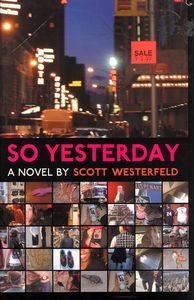
  • So Yesterday, Scott Westerfeld

    So Yesterday, Scott Westerfeld

    Razorbill, 2004, 225 pages, C$25.00 hc, ISBN 1-59514-000-X

    At this point, I don’t have to be convinced anymore that Young Adult fiction can be just as enjoyable than adult fiction for older readers, but Scott Westerfeld’s So Yesterday clues me in that there are some issues that are best discussed within the frame of a YA novel.

    I’m not necessarily talking about novel about specifically teenage issues. Obviously, YA is a natural choice for discussing first loves, teen angst, coming-of-age narratives or high school odysseys. But there are issues of universal importance that are best tackled by teenage protagonists.

    The issue of cool, for instance.

    Or, more specifically, the issue of how cool is identified, formalized and marketed to the population at large. How individual quirks can be marketed as counter-cultural icons and end up defining a demographic category. How culture is co-opted for strictly commercial goals, and how the landscape of our identities is shaped by other people. This is the kind of material that is important to all of us, no matter our age, gender or social demographic. But if you’re going to look at cool, what better protagonist than a teenager whose quest for cool occupies a significant chunk of his life?

    Meet Hunter Braque, New Yorker. His job is to spot the new trends, and report them back to his employers. If something new walks down the streets of the Big Apple, it’s up to him and his colleagues to pass it along so that marketing directors and ad agency designers make use of it. From New York to the rest of the world is just a matter of data transmission: It’s not a stretch to say that Hunter has the power to alter culture around the globe.

    But it’s not his job to worry about such things. He’s just supposed to live in the city and report on the new things that catch his eyes, snapping pictures along the way. Occasionally, he’s asked to comment on ad campaigns or walk around to demonstrate fancy new products. But everything takes a strange turn when his boss is kidnapped and he discovers a well-orchestrated marketing effort whose goals he can’t understand. A lavish launch party turns surreal when the invited jet-set is drugged and provided with party gifts of unexpected capabilities. Who’s calling the shot? And what are they selling?

    If you’ve read at least one issue of Adbusters magazine (and you should), you will figure out that Hunter has fallen through the rabbit hole into the plans of a few culture jammers. The mystery soon turns to thriller as Hunter is chased for having discovered too much. Along with a few friends, Hunter is stuck between curiosity and paranoia as he comes to realize how cool is manufactured…

    As a YA thriller, So Yesterday isn’t without flaws: There are questions raised about counter-culture financing that the novel never bothers to address, even when the answers would have been even more thematically pernicious. But on a surface level, this is a quick and efficient novel that rushes through a number of good ideas, features compelling characters and has more on its mind than a simple adventure through the streets of New York City.

    By its nature as a YA novel, talking to readers whose identities are directly shaped by marketing forces, So Yesterday also manages to tackle its themes in ways that are far more intriguing than any adult novel may have been able to do. That’s quite an achievement, and it’s a good lesson for writers who may be tempted to submit a YA book proposal. In retrospect, the thematic links between So Yesterday and Cory Doctorow’s acclaimed Little Brother (also concerned with teenage cultural sedition) are intriguing, and quite specific to YA. You won’t find quite the same stories in adult fiction; why not see for yourself if what the kids are reading is all right?

  • Wild Fire, Nelson DeMille

    Wild Fire, Nelson DeMille

    Warner, 2006, 519 pages, C$32.99 hc, ISBN 978-0-446-57967-4

    I used to believe that Nelson DeMille couldn’t do wrong, that even when he padded a wildly implausible story with hundreds of useless pages, there was always something to rescue the wreckage and send it soaring about the norm. Night Flight was the novel that disabused me of the notion, and now Wild Fire is the one that confirms that DeMille is a fallible writer after all.

    What’s dispiriting is that Wild Fire repeats a good chunk of Night Flight‘s mistakes, and indulges in a few more along the way. It’s almost as if DeMille was at a point where he didn’t have to care anymore. As a thriller, it’s botched from the get-go; as a sequel, it’s well within diminishing-returns territory; as a reflection of the zeitgeist, it’s ridiculously paranoid.

    But let’s start with the essentials: Wild Fire is John Corey’s fourth adventure, after Plum Island, The Lion’s Game and Night Flight. Like its predecessor, it’s voluntarily set in the recent past, taking place in September 2002, which is to say a year after the events of Night Flight and sometimes between 9/11 and the March 2003 invasion of Iraq.

    The historical setting is part of the conceptual problems that plague Wild Fire like they plagued Night Fall. We know how, in large strokes, the story is going to end. Given how DeMille spends his first 120 pages explaining a plan to nuke two American cities, this becomes a bigger problem than in Night Fall. We knew that Night Fall was going to run into 9/11. This time, we know it’s not going to run into a nuclear apocalypse. This transforms the novel from a suspense thriller to a procedural one, as Corey uses his skills to discover and defuse the conspiracy.

    That’s not necessarily a fatal problem: DeMille has certainly managed to produce strong novels from weaker premises. But the alpha-male charm of DeMille’s usual heroes, often the single best things about his stories, here seems to run on empty. Corey’s narration often plays up his loutish humor at the expense of his real skills as an investigator, but Wild Fire overindulges in the regard and Corey seems more like a caricature than ever before, a smart guy playing a shtick to the benefit of the peanut gallery.

    It doesn’t help that DeMille seems bored with the proceedings, throwing bones to his audience more out of expectations than organic plotting. When a much-hated recurring characters makes a brief appearance before being taken out again, it feels like a wink and a shrug rather than the culmination of a long enmity. The macho banter between Corey and just about every other character (flirtatious with the women, aggressive with the men) feels tired and ready to be taken out.

    Maybe it’s a sign that both Corey and DeMille still feel shell-shocked by 9/11. Corey can’t shut up about it, while DeMille indulges into paranoid plotting in which the American conspirators plan the deaths of millions of Americans with a sense of dutiful glee. The title of the novel itself refers to a doctrine (secret to us, but apparently known to all terrorist sponsors) in which terrorist nuclear attacks on American cities will result in the retaliatory glassification of most of the Islamic world. In some ways, Wild Fire accurately reflects the Bush-era paranoia of an American population feeling stuck between bloodthirsty terrorist and an uncaring government. But in others, the idea of a government-led conspiracy to kill Americans is fast becoming a cliché as thriller writers try to re-fight the last 9/11: Wild Fire may have been one of the first novel to touch upon that notion, but since then there have been quite a few more, including Steve Alten’s even more paranoid The Shell Game. It’s time to move on.

    And by “move on”, that includes the notion that DeMille may be better off writing original novels again. For an author who, from 1978 to 1997 wrote ten independent novel, DeMille has turned to the dark side and produced a string of five sequels, up to and including 2008’s The Gate House. Enough is enough; just kill Corey once and for all (yes; I’m at the point when I’m actually cheering for his demise) and go do something else. Because the current 9/11-obsessed, sequel-writing, formula-set DeMille is a shadow of his former self, and it’s exactly the kind of slide into self-absorbed irrelevance that has doomed a number of his thriller-writing contemporaries. He has pulled some improbable writing challenges before, but the biggest one is going to be to save his own career from implosion.

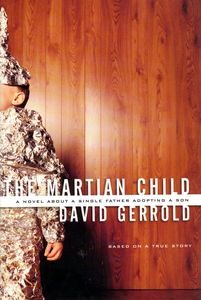
  • The Martian Child, David Gerrold

    The Martian Child, David Gerrold

    Forge, 2002, 190 pages, C$31.95 hc, ISBN 0-765-30311-6

    In Science Fiction writing workshops relying on the “Turkey City Lexicon”, there is a derogatory expression, “Abbess Phone Home”, to describe “any mainstream story with a gratuitous SF or fantasy element tacked on so it could be sold.” The expression is flippant, but the sad truth remains that genre writers can often found themselves trapped into their own literary ghetto when they try to break into a foreign market with a perfectly good non-genre story that could be published by their usual channels if only it had one or two genre elements.

    I won’t try to guess how David Gerrold came to write The Martian Child or how the genre elements found their way into what is otherwise a mainstream story, but there’s no denying that the Science Fiction elements of this novel are largely irrelevant to its greatest success: portraying with frank honesty the tough process of adopting a troubled child. The idea of a kid who may be an alien may be enough to get Gerrold’s faithful SF-reading audience to pick up the book, but it’s hardly what makes the novel so interesting. (One note without further comment that while Gerrold’s novelette that formed the kernel of the novel was published in The Magazine of Fantasy & Science Fiction in 1994 and went on to win both a Hugo and a Nebula award, the film that was adapted from the novel kept none of the science-fictional elements and was marketed as straight-up drama.)

    Like many of Gerrold’s short stories, The Martian Child weaves fiction with fact, featuring first-person narration from a David whose biographical details (gay; Californian; SF writer) are very similar to David Gerrold’s own. SF fans will feel a little chill of name recognition as Daniel Keys Moran, Todd McCaffrey and Steve Barnes each make small cameo appearances in the narrative, alongside a mention of Theodore Sturgeon. If nothing else, even the cover says “based on a true story”.

    Because Gerrold did adopt a child nearly fifteen years ago, and there’s no doubt that the experience fueled this novel. As we read all about how a single man adopts a “hard to place” child, it’s the day-to-day frustrations and incidents of the adoption, more than the hints that the child has supernatural powers, that drive this novel forward. Never mind how the child may (or may not) be evidence of an alien invasion plot: it’s the temper tantrums, the petty theft, the threats of walking away from a budding father/son connection that are the real suspense elements in this novel. This isn’t a treatise on adoption, but it doesn’t sugar-coat the experience, and gives all of the right believable details.

    For such a short novel, it packs an emotional charge far more intense than you’d expect. Part of The Martian Child’s power is how it focuses on a narrative featuring two main characters and little else. It takes place in a contemporary reality, although it may not be immune to the occasional earthquakes and Hollywood movie props. Gerrold has always been a writer with an impeccably accessible style and it doesn’t fail him here: Every word in this short novel is there for a reason, and you may very well end up reading the entire thing in one sitting, as it is probably intended.

    Given all of this, it’s a bit strange that the deniable SF elements of the novel end up feeling like a bit of a genre-friendly side-show, or a way to distinguish the novel from other similar narratives. The real meaning of “Abbess Phone Home” stories aren’t always that they fail at being genre stories, but that most of their interest lies elsewhere. So it is that The Martian Child may attract readers looking for alien changeling, but hit them with the force of a story about real humans.

  • Echo Burning, Lee Child

    Echo Burning, Lee Child

    Jove, 2001 (2005 reprint), 420 pages, C$10.99 mmpb, ISBN 978-0-515-14382-9

    Lee Child’s Jack Reacher series have always been built around the idea of the knight errant: Reacher is an ex-Military Policeman, now roaming around the United States and picking up adventures along the way. He’s not much of a sensitive man, but he knows right from wrong and seldom hesitates to do what needs to be done. But no novel in the series has made the knight-errant connection so explicitly as the scorching Echo Burning.

    This time around, adventure finds Reacher on a Texas highway, as he’s picked up by a woman in need of protection. The story that she tells Reacher doesn’t quite convince him, but he can see that she’s got real problems: Her abusive husband is about to be released from prison after a few years locked away, and she fears what he may do to her upon his return. The husband isn’t just mean; he’s also rich, and has powerful friends. Reacher soon finds himself out of his usual elements when he’s stranded on a Texas ranch far from everywhere else, hired as a ranch hand despite knowing nothing about horses.

    One advantage of a roving character is that every novel can take place in a different environment, and so it is that Echo Burning is likely to be most vividly remembered for its depiction of summertime in deep rural Texas, a place that can kill a pedestrian within a single day with heat unfit for human survival, a place where you pretty much have to drive hours in order to get from one place to another. There’s nowhere to hide in the sun-baked plains, and the novel eventually acquires a feel not terribly dissimilar to a modern western.

    But, true to Reacher’s mission, it’s also about protecting a woman and her daughter against whatever dangers surround them. This being a Child novel, the nature of the danger isn’t always what we expect, and thank to the kind of plot reversal so characteristic of the Reacher series, the story takes a different direction midway through, just as readers are likely to ask if the novel can run a few more hundred pages on the initial premise. The woman’s husband isn’t the most dangerous thing around, oh no…

    Most of Child’s distinctive skill in writing a thriller are just as successful in this novel: His lean but elegant prose, his unusually credible accumulation of details, his assured skill at plotting and characterization do much to keep us interested even as we’re waiting for things to happen. Only the ending drags a bit too long; not for what it contains, but for the way it takes too long to settle what should have been resolved earlier. But by that point in the story, it’s too late to stop reading.

    In-between the country-trotting stories of Running Blind and Without Fail, Echo Burning marks a welcome change of pace for Reacher, who gets the chance to show his skills in a restricted setting, involved in a more intimate story than usual. Even the conspiracy that is suggested by the first few passages, as a team of assassins ply their trade, is a restrained affair. One of the strengths of the Reacher series is that every novel has its own set of distinctive features (which isn’t something to be said about other long-running series), and Echo Burning is easily one of Child’s most assured book so far. It is also one of Reacher’s purest quest, focused on helping the innocent and untainted by dubious personal connections to his past. If you haven’t hopped along the Jack Reacher series, it’s not too late to start, and Echo Burning is one of the better entry points into the character.

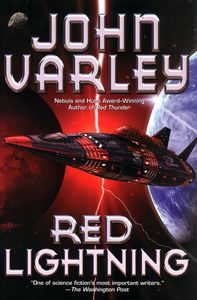
  • Red Lightning, John Varley

    Red Lightning, John Varley

    Ace, 2006, 330 pages, C$35.00 hc, ISBN 0-441-01364-3

    Every decade has its own John Varley, who went from a ground-breaking newcomer in the seventies to a Hollywood exile in the eighties to a mysterious absent in the nineties to, now, a mid-list entertainer perfectly content to tell familiar stories in aw-shucks narration.

    Nominally a sequel to Red Thunder, this novel picks up a generation later. Mars has been colonized thanks to the bubble drive, and our narrator Ray is the son of the first volume’s Manny Garcia. As the novel begins, the Earth is struck by something, and the resulting tidal wave is enough to wipe out Florida where Ray’s grandmother still maintains the family hotel. Within hours the entire Garcia clan is on the move, headed for Earth, and then into dark devastated Florida in search of their relatives.

    But it’s one of Red Lightning‘s problems is that even though the Florida expedition takes up nearly half the book, it’s not really the story that Varley wants to tell. No, the real reason for this novel is an umpteenth tale of how extra-terrestrials stage another American Revolution in Spaaace. Never mind the disaster special in the novel’s first half: Soon, we’re back on Mars, fighting against mysterious Earth forces, and using bubbles to terrorize Earth so thoroughly that no one will even think of taking over the plucky Martian colonists.

    Yes, it’s all terribly familiar. Except that instead of political sophistication, Varley has magical bubble technology on his side. The solution to pretty much every problem in the book is “more bubbles!” It gets old fast, even when Varley gets all aw-shucks-y with us.

    Fortunately, it’s the same narration that keeps the novel from being just another forgettable mid-list SF novel. Even when he’s seriously misguided, Varley’s narration is compelling on a sentence-by-sentence basis. It’s a combination of engaging storytelling, an accumulation of clever detail and a voice that doesn’t take itself seriously. It’s hard to dislike someone like that, even when they’re telling hackneyed stories that appeal to few others than libertarians looking for another hit of that extraterrestrial revolution. (They’re probably the same people who won’t mind the convenient appearance of mysterious extra-governmental forces terrorizing Mars.)

    Given the colonial rebellion that takes up most of the book’s last half, it’s ironic that it’s the low-tech dirty trip through Floridian devastation that ends up being Red Lightning‘s set-piece. But even then, the quality of the segment can be difficult to reconcile with the science-fictional setting. What would have been perfectly mesmerizing in a contemporary setting becomes impossible to justify a few decades from now. Take, for instance, the way Florida is left to fend for itself under media blackout after a tidal wave. Yes, Varley has been informed by the events following the Katrina hurricane, but there’s something too pat about the lack of foreign sources of information and ad-hoc communication networks. (Also: not every future government will be as willfully incompetent as the Bush administration.)

    The result feels disjointed, a double feature of stories that don’t go well together, jammed into a structure that can’t accommodate both a destroyed Florida and a rebellious Mars. The easy prose may make Red Lightning a fast and pleasant read, but it does nothing to patch the broken shape of the book, or the more problematic elements of its conception. Varley, of course, has been a genre Science Fiction writer all of his life. But this is one instance where stepping back from the future and writing a contemporary thriller would have been a better choice. In trying to stick to genre formulas, Varley is well on his way to diluting his own brand.

  • Futures from Nature, Ed. Henry Gee

    Futures from Nature, Ed. Henry Gee

    Tor, 2007, 320 pages, C$28.95 hc, ISBN 978-0-7653-1805-3

    The way you eat a bowl of candy may be the best way to predict how you’re going to like this anthology. Because this isn’t your usual short-story collection, and there’s a better way to approach it than to read it straight up.

    Those in the know will remember that in 1999-2000, and then again in 2005-2006 (and again once more starting in 2007 in Nature Physics), the prestigious scientific journal Nature commissioned short stories from leading scientists and Science Fiction authors. Very short short stories, none of them exceeding 1,500 words, or roughly four pages of text. Despite a few reprints in year’s best anthologies, most of those stories remained in the pages of Nature. Now the first hundred of those stories have been put together in book form, with the happy consequence that this is the genre’s first short-short-story anthology in a long time.

    Thanks to the commissioning process, the table of content of this anthology is stellar, featuring many legends of Science Fiction (Arthur C. Clarke, Michael Moorcock, Frederick Pohl) and modern masters (Vernor Vinge, David Brin, Bruce Sterling) alongside hot established writers (Charles Stross, Cory Doctorow, Kim Stanley Robinson) and relative newcomers (Brenda Cooper, David Marusek, Tobias Buckell). With a hundred stories on the menu, the list of authors reads like a the best-ever Readercon guest list, or a who’s who of SF: Any anthology that lists Warren Ellis next to Greg Egan, David Langford, Nalo Hopkinson, Scott Westerfeld and Dan Simmons (among many, many others) has got to have something for everyone. Even less-familiar names have stories worth reading, Nature having published fiction from real working scientists.

    Naturally, the price to pay for a hundred stories in 320 pages is that they’re very short. Never mind plotting or characters: Futures from Nature is all about ideas and notions, sometimes tipping over to jokes or conceptual pieces. Some authors do better than others in short form, but the size limits remain constraining. On the other hand, more impatient readers (or those who read for ideas) will be happy with quick reads that reward what they’re looking for in SF stories.

    Such a collection won’t be to the liking of everyone: Going back to the bowl-of-candy analogy, it’s easy and detrimental to read too many of those stories at once. Too much ideas sugar, not enough literary roughage: instant overdose. Instead, keep the book as bathroom reading or near the TV during commercial breaks. (This reviewer essentially finished the book by reading stories during video game loading screens.)

    The other annoying thing about Future of Nature is that the stories are strictly arranged in alphabetical order of their author’s family name. It’s all the way from Aldiss to Ziemelis without a break. While a thematic arrangement may have been overkill, a better organization may have been to present the stories in order of publication, or at least within two separate sections according to the “run” in which they were commissioned. Word-count requirements were notably looser during the first run of the series, leading to a number of perceptibly longer stories: it would have been nice to seen those stories in a separate section. (More seriously, there are no bibliographical references for the stories, or any ways to track them down to their original date of publications.)

    It may also be the case that Futures from Nature may be a better choice than most in introducing SF to non-SF readers, especially those who have a science background. While the jargon flies thick and the size constraints keep the exposition down to a minimum, there is a variety in themes yet a similarity in accessibility in Futures from Nature that make it a very different beast than most of the other short story collections you’ll find on the shelves. A collection of short-short stories doesn’t look like it demands a lot of your time. Much like a bowl of candy, it’s easy to finish it before even knowing it.

  • Rhetorics of Fantasy, Farah Mendlesohn

    Rhetorics of Fantasy, Farah Mendlesohn

    Wesleyan, 2008, 306 pages, C$33.95 tpb, ISBN 0-8195-6868-6

    One of the best things about being a Science Fiction and Fantasy genre reviewer at this point in history is the knowledge that, in many ways, the field is still young. The critical discourse about genre is still evolving, and new approaches to the field are being developed. Book like Farah Mendlesohn’s Rhetorics of Fantasy only underscore how much fun it is to read this stuff seriously, and how crazy the genre critics are willing to be.

    Because, frankly, you have to be a bit insane to attempt what Mendlesohn tries to do here: Propose not only a framework in which to classify genre fantasy, but also study the ways in which fantasy literature articulates its own nature. Working both at the macro and the micro level of criticism, Rhetorics of Fantasy is a humble sketch of yet another Grand Unified Theory of Fantasy. The enthusiasm with which it was received (I saw it sell out at two separate literary conventions I attended) says as much about Mendlesohn’s impeccable credentials than about the field’s willingness to consider new ideas.

    The innovation that most readers will keep from Rhetorics of Fantasy is Mendlesohn’s descriptive classification of fantasy literature in four big categories: Portal-Quest, Immersive, Intrusion and Liminal. The first three are easy to explain: If a character goes elsewhere strange to have adventures, it’s Portal-Quest. If adventures take place in a self-contained fantasy-land, it’s Immersive. If fantasy comes to the real world for adventures, it’s Intrusion. As for the rarer Liminal Fantasy, well, it’s fantasy in which the fantastic may itself be a fantasy. This is a gross oversimplification, of course, which is why the book has not four but five chapters. The fifth one (which is “not elective”, specifies the author on P.246) presents works that don’t fit in the established pattern and may, in fact, break Mendlesohn’s classification.

    This too reflects how much fun the SF&F critical field can be. Unlike other academicians, Mendlesohn invites criticism and counter-arguments. Rhetorics of Fantasy is meant to be a toolbox of new critical tools, not a definitive set of conclusions to put the genre in its place. Readers are invited to take and keep what works and improve the rest.

    But even allowing for dissent regarding genre sub-classification, there’s much more to the book than five bins in which we can dump the fantasy section of your local bookstore. The categories are consequences of rhetorical strategies, explains Mendlesohn in working her way up from straight prose. In classifying Tolkien’s Lord of the Rings as Portal-Quest rather than Immersive fantasy, she offers a crucial clue: Tolkien’s rhetorical strategies are about discovering the world, not inhabiting it like we do in, say, China Mieville’s Perdido Street Station. (His The Scar is another thing entirely, and Mendlesohn’s insighful analysis of it made me want to re-read it all over again.) Much of Rhetorics of Fantasy is thus concerned about the way words are put together by fantasy writers, and the inevitable consequences those choices have on how the novel is articulated. I’m sure that writer’s workshop organizers will be able to consider Mendlesohn’s analysis as inhabiting the liminal zone between critical analysis and high-level recommendations on how to write fantasy. (An inevitable conclusion to Mendlesohn’s arguments are that it’s possible to write fantasy by using the wrong rhetoric, something that ought to inform a number of writers in the future.)

    But another good way to read the book is just to be swept along the critical bon mots and delight in the insights that seem to drip off every page or so. Ultimately, I don’t feel qualified to do anything else but grin at Mendlesohn’s easy familiarity with genre literature and nod along. Most of what she says appear to be true, no matter which type of fantasy (French or English, Old or Modern, Heroic or Gritty) I try applying it to. Some of the tools I’ll be using in reading critically; others seem too cumbersome for my own purposes. (Liminal Fantasy, as you may have guessed, may be a concept too abstruse for a reviewer who’s got trouble keeping his diacritics away from his dialectics.) I’m already field-stripping Mendlesohn’s toolbox, hefting the best hammers and grips, looking at genre literature like a series of nails to be hammered and things to be squeezed together. The rest of the tools can stay in the toolbox: I’ll be back to them once I have more problems that the hammers and grips won’t be able to solve.

    And that too, is part of the fun of reviewing SF&F. Books like Rhetorics of Fantasy, written by a genius to be read by morons, will always be there to revisit, growing alongside their readers as needs be.

    [February 2009: As I keep mulling over this book, it strikes me that it would be interesting to hash around the ideas of Rhetorics of Fantasy and see whether this prose-based analysis can be adapted to other mediums such as film or comic books. When stories such as Pan’s Labyrinth seem to span all four of Mendlesohn’s categories, is it possible to deconstruct film grammar so that we’re left with the strategies used by directors to create estrangement, make us feel intrusion, allow for a degree of liminal doubt or rationalize immersion? Is it possible to apply Mendlesohn’s fantastic rhetorics to all of storytelling, rather than prose fiction?]

  • Area 7, Matthew Reilly

    Area 7, Matthew Reilly

    St. Martin’s, 2001 (2003 reprint), 490 pages, C$10.99 mmpb, ISBN 0-312-98322-0

    If ever Matthew Reilly’s publishers are scouring the web for snappy blurbs, here’s the best I can do: “Matthew Reilly is the mad man of thrillers.”

    It’s even true.

    Because other writers write thrillers as if they’ve got constraints to respect. Budgets. Logic. Physics. Reilly, on the other hand, thinks that none of those things should stand in the way of a kick-ass thriller. And seeing how much fun his novels are to read, it’s hard to disagree with him.

    Area 7 alone, for instance, has a massive underground complex filled with government secrets, advanced airplanes, traitorous special forces, serial killers and Kodiak bears. That’s beautiful, and I haven’t even told you anything yet about a President of the United States whose heart is wired to an explosive charge, and the special game that pits the President’s secret service against a renegade bunch of racist military personnel. Do I really need to? This is a novel in which, for goodness’ sake, the protagonist escape to orbit midway through the story, and them come back down for more explosive action.

    If you have already read some of Reilly’s other thrillers, you will find yourself at home: It’s got the same scope of imagination, the same madcap pacing, the same rush through mysteries and revelations. Any other writer feels like a poky geezer after Reilly’s thrill-a-chapter experience.

    The similitudes to his other novels will be obvious. Not only does Area 7 feature protagonist Shane “Scarecrow” Schofield (who also starred in Ice Station), it also takes place in a generally confined environment like the eponymous Ice Station or the library of Contest. Like most Reilly novels so far, it features a lone hero acting alongside crack teams of opposing forces, plays along with high-tech weaponry and seems aimed more at jaded action movie fans than traditional thriller readers.

    By the time our hero blasts off into orbit to duel with astronauts defecting to China and control a satellite that relays instructions to the President’s bobby-trapped pacemaker, (or something like that) it’s far too ridiculous to be taken seriously: even when it works, it works on a different level, one that takes place on the meta-fictional plane where author and reader are trying to one-up each other in a complex game of self-aware genre protocol redefinition.

    Or maybe it’s just explosive slam-bang action throughout. At some point it’s exhausting to pick where earnestness stops and parody begins. Suffice to say that if Area 7 has a flaw, it’s the same one as Reilly’s other thrillers: By pummeling readers with non-stop action and ever-crazier developments, it runs the risk of exhausting its audience. Ironically, it’s page-a-minute speed freaks rather than slower, infrequent readers that may have bigger problems reading the book: Unlike other writers who pad their narrative with description and character moments that can be skipped on the way to the next plot point, Reilly dispenses with those uneventful stretches and so trips up readers who have made a habit out of skimming. He only gets detailed when writing an action sequence in which all the small details have to be aligned. Otherwise, it’s gunshots and explosions all the time.

    It goes without saying that Reilly’s writing for a specific audience, and that this audience is considerably smaller than the total book-toting public. But his formula has become sheer performance art, and I can’t wait until I can read his next novel.

  • Defining Diana, Hayden Trenholm

    Defining Diana, Hayden Trenholm

    Bundoran Press, 2008, 285 pages, C$19.95 tpb, ISBN 978-0-9782052-0-1

    Some novels are tougher to review than others, and as far as I’m concerned, Defining Diana is right up there along with the toughest. Understand that I want to say something nice about the novel: I bought it, autographed, straight from the hands of the author. I want Hayden Trenholm to succeed at what he does, as much as I want to read great Science Fiction. As if that wasn’t enough, Defining Diana is also a publication from a Canadian small-press publisher that specializes in genre literature, and criticizing Canadian small-presses feels just as bad as kicking puppies. (I’m not saying on what authority I can make this comparison.)

    But if I had read this novel in normal circumstances, bought in bookstores from an unknown author and just any other publisher, this review wouldn’t exist. I would have read the book, shrugged and gone on to something else. The problem with Defining Diana is that it’s a generic novel that struggles for distinction in a market that churns out hundreds of other SF novels per year. What actually makes the novel special for me (its Canadian-ness, its place in the bibliography of someone I know) may not actually do anything for you.

    Even the plot summary seems to court generic ennui. In 2043 Calgary, a woman named Diana is found dead in a locked apartment, and the lacks of DNA clues don’t add up for the detectives on the scene. Faster than you can say “locked-room mystery”, Calgary Police’s Special Detection Unit is on the case. But Calgary’s a big city, other things are happening, and SDU members seem to have been selected more for their neuroses than their special detection skills…

    If defining Diana is the novel’s first pressing question, it’s soon submerged under a number of subplots. Some of them are related and other aren’t, but it all adds to a portrait of Calgary a few decades in the future. While the background elements of the future seem taken from generic mildly-dystopian SF elements (environmental degradation, pervasive corporatism, ever-present terrorism, rising fundamentalism, etc.), the concept of setting this story in Calgary bring a certain freshness to the book: Despite being Canada’s third most important SF metropolis, Calgary has yet to be mined for inspiration in the same way Toronto or Montréal have been. If nothing else, it makes Defining Diana one of the purest Canadian Science Fiction novel of the past few years, and that’s nothing to dismiss easily.

    But the problem with this novel’s multiplicity of subplots, and their conventional nature drawing equally from police procedurals and Science Fiction, is that it’s hard to avoid a certain boredom. What didn’t help were a number of deliberate writing techniques: a number of infodumps between characters who should know better; on-the-nose dialogue; and a succession of pop-culture references that feel old even by today’s standards, let alone those of 2043. All of those can be explained by a desire to make the novel more accessible to older non-genre readers. (The same writing tics often pop up in Robert J. Sawer’s fiction) But they often feel graceless, forced and useless: Few things are as exasperating as reading a few lines of dialogue and think “there’s probably a joke in there for those who watched the CBC in the seventies.” Not everyone is as jaded as I am, sure, but all of the above made reading the novel more of a chore than I expected.

    While I’m discussing small deliberate annoyances, I might as well get to the small-press-and-puppies-kicking part: Bundoran Press may want to spend just a bit more time working on the packaging of their next novels. Defining Diana‘s uninspired book design isn’t a problem, but the copy-editing has let a few amusing mistakes through (I’m still wondering what a “boarder patrol” [P.44] actually does.) and the garish cover looks as if it’s been put together from free clip-art sources. Just try to explain that SF is a respectable literature to anyone who catches you reading this.

    But now that I’m done venting, here comes the good part: As mentioned above, I don’t think there’s been a purest Canadian Science Fiction novel recently. For all of its faults, Defining Diana does something that I always find admirable, which is to define a future from modern Canadian principles. It’s urban, it’s multicultural, it’s energetic and it generally espouses good middle-of-the-road Canadian values by showing what happens if you push too far in the other direction. I’ve mentioned that Calgary seldom earns any extrapolative love from the Canadian SF community, but Canada often gets short-changed by its own authors. It’s about time that Canadian SF writers start thinking about futures set at home, even if it’s as background for deeper character stories. Defining Diana does that, and thus easily earns a place on my Aurora Awards ballot for 2008. For those who don’t care about awards, consider this: I expect that the ideal audience for this book, which is to say readers who like SF police mysteries but haven’t overdosed on them, will like the book a lot more than I did.

    And you know what? I will gladly pay cash for Trenholm’s next novel.

    (But we’ll see then whether he agrees to dedicate it to me.)

  • Running Blind, Lee Child

    Running Blind, Lee Child

    Jove, 2000 (2005 reprint), 498 pages, C$10.99 mmpb, ISBN 978-0-515-14350-8

    Every series has a weaker volume, and so I think I just found Lee Child’s worst novel in the six I’ve read so far. Not a bad batting average, especially considering how readable Running Blind remains despite a really silly conclusion.

    It’s even more remarkable considering how consistently good the Jack Reacher series has been until now, blending tough-guy narration with credible procedural details and genre-aware plot twists. It’s a telling detail that despite many far-fetched premises, the Reacher series has remained generally credible until now, where a twist too far makes the whole novel crumble on its foundations.

    But let’s not get ahead of ourselves, nor spoil the novel ahead of its time.

    Running Blind starts like many Jack Reacher novels do, with something unrelated. This time, Reacher is in New York City, enjoying an out-of-the-way restaurant while mulling over his relationship carried over from Tripwire. It’s an unusual beginning given how the rest of the series seems content to ignore previous adventures. It’s also a signal that this volume’s Reacher will be considerably more introspective than in the others. But don’t worry, because you get bone-crushing action before the end of the sixth page, as Reacher smacks down a few hoodlums intent on explaining a protection racket to a new restaurant owner. Unlike most incidents of Reacher generosity, this one has consequences leading to Reacher’s apprehension. But he’s not charged with what he expects: it turns out that around the country, women with a past link to Reacher are being murdered by what appears to be a serial killer, and Reacher fits the psychological profile of such a killer almost perfectly.

    Will Reacher be forced to clear his name? Not really, because his explanation of why psychological profile is nonsense is quickly followed by another murder for which he’s got an official alibi. Reluctantly brought inside the investigation to help, it’s obvious that he doesn’t have many friends in uniform: his presence is barely tolerated, and his solid instincts as an investigator are the only thing making him useful to the authorities.

    But this wouldn’t be a Reacher novel without at least one dramatic twist at some point during the narrative, and the one in Running Blind comes later than most as Reacher suspects that there’s no serial killer at work.

    Alas, the novel jumps off the rails soon afterward, as (SPOILER) the only way Child can bring his various impossibilities together is by asking readers to believe in a mastermind able to hypnotize a dozen people well enough to make them act upon specific instructions weeks after the hypnosis session, and collaborate willingly in their own death. And also ignore a cumbersome delivery sitting in their garage during this whole time.

    I mean: come on. That kind of cheap plotting trick may have been cute in dime novels, but it’s not because the Jack Reacher novels are the best modern equivalent to men’s pulp thrillers that Child can get away with that this time around. Never mind the moody Reacher (who gets a stay of relationship when his past paramour flees to England, resetting the continuity in time for the next novel): that dumb hypnosis plot contrivance is the one thing that separates Running Blind from the rest of its better Child brethren. It’s a shame, really, because the rest of the novel is vintage Child, with the tough prose, page-flipping rhythm and well-painted characters.

    But everyone gets a day off once in a while, and Running Blind is the weak spot so far in the Reacher series. One of the only advantages of reading the series straight through (as part of my Lee Child Reading Project) after discovering it in a late installment is the reassuring knowledge that it’s an unusual lousy episode, and that the rest of the series goes back to normal.

  • Body of Lies, David Ignatius

    Body of Lies, David Ignatius

    Norton, 2007 (2008 reprint), 360 pages, C$15.50 tpb, ISBN 978-0-393-33429-6

    The years since the cold war haven’t been kind to espionage thrillers. After the fall of the USSR, writers had a tough time finding a credible replacement for the all-powerful Soviet Empire. Trying to spy on drug cartels, North Koreans or secretive corporations sometimes worked, but often didn’t carry the same charge. But as Body of Lies demonstrates, spying is still a capable thrill generator, as long as you understand the nature of twenty-first-century intelligence operations.

    While many contemporary thrillers have taken refuge in fantasy world made of politically partisan axioms, reporter David Ignatius’ Body of Lies heads into the other direction, taking a hard look at America’s increasingly precarious place in the world. The novel begins in post-invasion Iraq, as American intelligence services are looking for ways to infiltrate terrorist networks. But their intentions aren’t matched by their power on the ground, and it’s up to agent Roger Ferris to suffer the consequences of stateside callousness when his ground operation blows up in his face. Transferred to Jordan while his marriage crumbles, Ferris finds himself stuck between his cynically slimy boss and the head of the Jordanian intelligence service. While Europe has to deal with an unprecedented campaign of suicide bombers, Ferris hits upon a plan to infiltrate a terrorist network… thanks to a dead body.

    But if there’s a recurring idea in this book, it’s that for all of their money, intentions and high tech equipment, Americans are disadvantaged when it comes to ground operations in the Middle East. Trying to run spies in foreign countries can be a difficult dance with local authorities, while terrorist networks find strength in their tech-savvy lack of central organization. In this context, Ferris is a young man with an old-school mentality, as he disdains the quick crutch of signal intelligence in favor of human assets cultivated over sustained relationships.

    Perhaps Body of Lies‘ finest achievement is in re-casting well-worn spy thriller concepts in a way that seems perfectly attuned to the current zeitgeist. Its portrayal of modern intelligence operations is credible, even as it self-avowedly riffs off a World War 2 operation as its central conceit. (Fans of Ewen Montagu’s The Man Who Never Was will be pleased.) At the same time, Body of Lies tackles several of the standby themes of espionage fiction: the twisted relationships, the power trade-offs, the lack of trust, the tension between signal and human sources, the hierarchal tensions between field operators and headquarter managers, and so on. For those who haven’t read a good spy thriller in a while, Body of Lies is a great way to get back in the genre: it’s got vivid characters, mesmerizing procedural details and crisp writing. Best of all, it’s got no visible political ax to grind beyond an acquiescence that America often makes mistakes.

    Fans of the Ridley Scott movie adaptation will be pleased to see that the film stays surprisingly true to most of the book despite the removal of one major female character and the titular body of lies. But there’s a really fascinating extra plot twist near the end of the story that wasn’t carried over the the film, a pernicious little extension of the story’s theme that becomes a bonus for those tempted by the book.

    Body of Lies is all the more remarkable in that it’s a perfectly entertaining beach read that also doubles as a solid world-aware thriller with more on its mind than just gunfights and jeep chases. It’s American without being America-centric, and modern without abandoning the lessons of the past. It’s a welcome tonic for the spying thriller, and a satisfying read for anyone who’s paid attention to the headline news over the past few years.

  • Red Thunder, John Varley

    Red Thunder, John Varley

    Ace, 2003 (2004 reprint), 441 pages, C$10.99 mmpb, ISBN 0-441-01162-4

    Genre fiction is often defined as an ongoing conversation within which a set of common attitudes are shared and forged. When genre works well, it allows writers to depend on an audience that is already sympathetic to their goals and methods. Free from re-inventing the wheel, genre writers can explore more intricate issues. But when genre goes bad, it lock both writers and readers in a set of outdated assumptions that have less and less to do with the world outside.

    This meta-conversation about genre has been ongoing in the Science Fiction community for, oh, decades, but it’s always revealing to illuminate the discussion with specific examples. Alas, John Varley’s career looks like it’s sliding into a specific case study of what can happen to a genre writer as he slides into obsolescence. The early phase of Varley’s career, with works like The Ophiuchi Hotline, was characterized by strong genre awareness and capable writing skills: Free to play around in structures built by Heinlein and his predecessors, Varley explored new issues of gender and body modification in ways that were friendly to the SF genre audience.

    But recent works like Red Thunder may be showing a writer increasingly reluctant to extend genre premises, and far more comfortable providing comfort reads to a penned-in audience. Red Thunder is fun if you’re already a Science Fiction fan, but it may not withstand a moment’s scrutiny from more demanding readers.

    Oh, it starts well enough: For all of his other faults, Varley can still write compelling narration, and Red Thunder quickly establishes not only its dynamic teenage narrator Manny (whose family is barely hanging onto a strip motel), but the rest of the Floridian characters who will come along for the ride: A rich rebellious girlfriend, a good buddy skilled in engineering matters and his no-nonsense girlfriend.

    But things take a turn for good-old pulp SF when Manny befriends a washed-up colonel and his idiot-savant brother. Thanks to a very convenient discovery and two just-as-conveniently rich characters, they’re able to slap together a few pieces (using “all-American guts”, specifies the back-cover blurb) and go to Mars in time to beat the Chinese to the landing and save a NASA mission doomed by committee-driven engineering flaws. Try as you might, I’m not sure you could come up with a pluckier story to please long-time Analog SF fans.

    It’s bad enough that the revolutionary “bubble” technology has been invented by a mentally-challenged genius speaking with a Louisiana accent. It’s the by-the-number plotting in which our teenage heroes and their redeemed captain build the ship, race to Mars, giggle at the Chinese and rescue their NASA friends that really makes the entire novel redundant. It’s a greatest-hits of common SF daydreams with nary a hint of plausible deniability. Try to tell the story to a non-SF reader: they’ll roll their eyes and mutter something like “you’re still reading this stuff?” despite your attempts at saying that this is aimed at young adults: Let’s face it, the novel was marketed at adults and makes most sense only to those who overdosed on Heinlein during their long-past teenage years.

    The only reason why Red Thunder holds together is Varley’s ability to write compelling prose. Even those who want to dismiss the novel as nothing more than reheated space-age fantasies will be hard-pressed not to enjoy the procedural elements of how a small group of teenagers are able to weld together a spaceship bound for Mars. No matter how ludicrous it is, how wobbly its foundations are and how obvious its plotting remains, Red Thunder is a fun read. Don’t blame Manny and his friends for being stuck in the dusty daydreams of a dying genre: just hop along for the ride and nod your head at the expected plot points. Varley hasn’t written nearly enough in the past decade, and once stuff like Red Thunder is out of his system, maybe we’ll be back to top form sometime soon.

  • The Somnambulist, Jonathan Barnes

    The Somnambulist, Jonathan Barnes

    Morrow, 2007, 353 pages, C$23.95 hc, ISBN 978-0-06-137538-5

    Be warned. This review has no literary merit whatsoever. It is an ignorant piece of nonsense, nonsensical, incoherent, written by an unreliable scribbler, written in painfully inept prose, frequently erroneous and willfully ridiculous. Needless to say, I hope you won’t believe a word of it.

    If I allow myself to appropriate Jonathan Barnes’ first paragraph of his debut novel The Somnambulist, it’s that I find myself in a curious position while attempting this review. I generally liked the novel, but trying to apply my usual reviewing mechanisms fails to illuminate why. Trying to classify it as fantasy is a slippery conceit leading to a discussion of “weird” fiction. And beyond it all, there’s the feeling that Barnes is laughing at every befuddled reader.

    Even trying to give a feel for the novel’s atmosphere sends us grasping for dime novels, pulp fiction, Victorian grotesque, steampunk and other qualifiers that may or may not fit. We’re not the only one struggling against labels, because even the jacket blurb makes references to Neil Gaiman, Susanna Clarke, Clive Barker… and Carl Hiaasen.

    Yes, The Somnambulist is set in Victorian London. Yes, it features a detective/magician fighting against a city-threatening menace. Yes, it flies from strange plot points to even-stranger fantastic concoctions. Yes, it does feel as if a funny mystery writer had overdosed on steampunk fantasy.

    Buy trying to give specific examples…

    There’s the title character, for instance, a milk-guzzling hulk of a man (?) who doesn’t bleed when pierced by swords. There’s a house of ill-repute, favored by our protagonist, that specializes in ladies most often seen at a freak show. There’s a firm (called Love, Love, Love and Love) whose HR regime seems based on complete brainwashing. There are uncanny murder mysteries, time-regressing bit players, murderous fiends dressed in schoolboy outfits, a librarian who seems to understand everything (as all good librarians should, but even more so) and séances that, frankly, don’t seem particularly occult considering the rest of what this novel has to offer.

    But if you’re expecting any explanation at all, well, you’re reading the wrong book.

    So maybe you can come to understand the delight and bafflement of the ordinary reader confronting a novel such as The Somnambulist, designed according to the spaghetti-throwing school of writing in which as many strange strands are thrown on a blank wall in the hope that some will stick. But not all of them do, and it’s hard to avoid concluding that some editing would have avoided a big mess on the floor.

    But when it comes to reading experiences, there’s no denying that The Somnambulist is unusual and rewarding. The shaky plot may or may not be a problem given the succession of rich details that novel has to offer. It’s not just stylish but atmospheric, and the odd mixture of influences will do much to endear the novel to readers looking for more of the New Weird mixture that has proven so elusive. It may of may not be New Weird (heck, does anyone actually care whether New Weird exists any more?), but it’s certainly weird, and feels new in all of its retro charm smacked around modern concerns. There are resonances here with Vandermeer and Mieville, although The Somnambulist more than stands on its own. Trying to classify it may give headache, but there’s no denying that the “Jonathan Barnes” sub-genre of fiction was launched with an intriguing first entry.