Book Review

  • Zoe’s Tale, John Scalzi

    Zoe’s Tale, John Scalzi

    Tor, 2008, 335 pages, C$27.95 hc, ISBN 978-0-7653-1698-1

    Some of the most difficult moments in a reviewer’s life come when a highly-anticipated work fails to meet certain expectations, or betrays an author’s otherwise sterling reputation. As much as I normally like Scalzi’s fiction, and as much as I was primed to like Zoe’s Tale, it ended up surprising and disappointing me: For the first time while reading a Scalzi novel, I felt impatient.

    Fans of Scalzi’s work so far will immediately recognize the plot of the novel: As its title suggests, Zoe’s Tale describes the events of Scalzi’s previous The Last Colony from the perspective of John Perry’s teenage daughter Zoe. Being a sixteen-year-old girl, Zoe’s perspective on the story is different, but not too different. Exception made of a small section at the end of the book, the story beats are roughly the same –-although the last few pages of Roanoke colony’s story remains in The Last Colony.

    For readers who read primarily for plot, this makes Zoe’s Tale a surprisingly unsettling experience. While it fills in the beats of Zoe’s story and explains a few passing references in its source book, Zoe’s Tale often feels like a rehash of known material; another trip around the same block in a slightly different vehicle. The Old Man’s War universe isn’t significantly deepened by this entry, nor are we getting a perspective that contradicts John Perry’s. At most, an enigmatic reference is cleared up, and events that are more important to Zoe than her father are told in more detail. (Unlike other parallax novels such as Orson Scott Card’s Ender’s Shadow, there’s also little playfulness with what readers are supposed to know from having read the previous book.) Readers may want, for extra credit, to compare a few scenes as told in both books to see the different perspectives of the two characters.

    Fortunately, there is something else than a simple plot re-hash going on here: Zoe’s Tale is perhaps best appreciated as an attempt to re-tell The Last Colony in a YA-friendly female teenager’s voice. As a style exercise, if you prefer. As such, it’s somewhat more successful: Scalzi’s attempt to write like a 16-year-old girl cleanly evokes the confusion, thrills, quirks and friendship bonds of that demographic.

    This being said, it isn’t much of a stretch for Scalzi to map his own usual sarcastic smart-ass prose style onto another sarcastic smart-ass character, even if she happens to be a 16-year-old girl on a brand-new colony world. It just so happens that her friends are, by and large, a generally sarcastic smart-ass group, and that the people she most values around her are also sarcastic smart-asses. (If nothing else, Roanoke Colony’s got a bright future in exporting comedians.) Scalzi’s has previously acknowledged his Heinleinian influences, but Zoe also echoes some of Heinlein’s teenage protagonists in that she’s the prototypical Competent Teenager; rarely wrong and of reliable judgment. It’s a typical SF character type, but the pattern can be amusing once it becomes obvious.

    Plot and characterization, however, haven’t been Scalzi’s strengths as much as his easy prose style and his humor, and in that sense Zoe’s Tale is another success for him. It’s a fast and enjoyable read that won’t disappoint his regular readers who don’t mind some déjà vu. For the others, however, Zoe’s Tale is perhaps Scalzi’s most disappointing novel so far, and one that sends the Old Man’s War universe in diminishing-returns territory. More demanding readers may want to wait until the paperback and lower their expectations accordingly.

  • Bad Monkeys, Matt Ruff

    Bad Monkeys, Matt Ruff

    Harper Collins, 2007, 230 pages, C$24.95 tpb, ISBN 978-0-06-124041-6

    For readers, paranoia isn’t such a bad trait. Not when dealing with tricky writers such as Matt Ruff, whose unpredictable output continues to surprise even those who think they know what to expect. None of Ruff’s novels so far has been ordinary, and Bad Monkeys is no exception.

    Harper Collins, at least, has done a good job designing a physical object that’s as odd as its content. Presented as a narrow yellow trade paperback with extended rounded covers, the book is meant to evoke a psychiatrist’s case jacket, which isn’t a bad choice given the content.

    For the novel begins in a white room, a holding cell where a psychiatrist comes in to interview a prisoner. Her name is Jane Charlotte, and she’s been arrested for murder. As she tells her story, we go back in time, to a childhood incident during which she realized the existence of a secret organization manipulating events behind the scenes. And that’s the kick-off to a deeply paranoid novel in which the world we know isn’t as chaotic as we think. There’s a war out there between good and evil, and two rival factions are out there recruiting and setting operatives on each other. The “Bad Monkeys” of the title is a shorthand for the “Department for the Final Disposition of Irredeemable Persons”, which is to say humans declared so irremediably evil that they have to be taken out —preferably by means of a Natural Causes gun with definitive but undetectable effects. The secret departments of the elusive organization all have bizarre names that allude to their nature (“Scary Clowns”, “Good Samaritans”, “Eyes Only”) but whose true nature remains elusive for a while.

    This, of course, may or may not a be a psychotic delusion from a troubled individual. Jane’s life (as she tells it) has been a tough one, and she hasn’t always been the most virtuous of person. Is all of this an elaborate way to account for the murders she’s been arrested for, or is it all true? Or is the truth even stranger than she imagines?

    You’re better off betting on strangeness without limits, because Matt Ruff is having a lot of fun messing with his readers’ heads throughout the novel. By the time the final twists are revealed, shell-shocked readers may be forgiven if they can’t recall what’s true and what’s not. Such mind-bending won’t be to everyone’s liking, but it does make for a lively reading experience. There’s a lot of strong scenes, a few Science Fiction elements, some good character moments, and a terrific pacing. From time to time, Ruff plays with intriguing philosophical ideas and concepts given practical form by his secret organizations, from Natural Cause guns to ant farms to Nod problems.

    It’s not a particularly long book (barely 90,000 words, by my estimates) and the writing style is deliberately kept simple, so don’t be surprised if you rush through the book in a few sittings. It’s probably best read that way too, in order to fully experience the accumulation of details, confusion and contradictions that make up the novel’s conclusion.

    This being said, the rapidly changing nature of the novel is liable to be a point of contention. While a neat writer’s trick, it also prevents readers from forming a deep emotional attachment to the material as presented: nobody likes to be fooled, and so a bit of detachment may be for the best while reading the story. Only the paranoids will get the most out of Bad Monkeys.

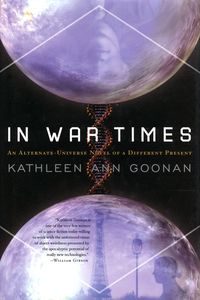
  • In War Times, Kathleen Ann Goonan

    In War Times, Kathleen Ann Goonan

    Tor, 2007, 348 pages, C$31.95 hc, ISBN 978-0-7653-1355-3

    If you’re wondering what use we possibly can have for awards, let me give you a hint: If Kathleen Ann Goonan’s In War Times hadn’t won the John Campbell Award, I wouldn’t have bothered reading it. The author’s previous works haven’t grabbed me, the subject matter of this book seems to be dedicated to another audience, and while the novel got a favorable number of reviews upon publication, it didn’t seem to establish itself as one of 2007’s must-read novels from word-of-mouth buzz.

    But it did walk away with the Campbell Award, and that strengthens its place in the SF canon. It doesn’t finalize it, of course: part of the attraction in reading this year’s Campbell winner was to determine whether the Campbell jury had succeeded in making a choice as awfully outdated as Ben Bova’s Titan, somehow selected as being a best choice of some sort the previous year.

    From the first few pages, it’s obvious that the Campbell judges have made a better choice: Goonan’s prose is well-written, and her understanding of interpersonal relationships is better than many of her colleagues. From the first few pages, in which a young soldier is seduced and then left by a female scientist during World War II, we can relax: if nothing else, this novel will be well written.

    But for a while, that’s all we get: despite a few ominous lines early on, this is the story of the young soldier, Sam Dance, as he’s shipped off around Europe (and then Japan) in order to take advantage of his top-notch technical skills. He builds a device according to plans left by his ex-lover, but it’s never too clear what the device is supposed to accomplish. Meanwhile, around him, both jazz and modern science are being invented, refined, applied and developed. Goonan’s musical knowledge has been obvious from Queen City Jazz onward, but here the characters have the chance to hob-nob with the early Greats of American Jazz, and readers who know anything about the form will be delighted to read about a few walk-in characters.

    On the flip side is the portrait of the war as seen from Dancer’s eyes, sometimes via diary entries. We eventually learn in the afterword that those entries are excerpted from Goonan’s father’s own real-life WW2 diaries. Again, In War Times is best appreciated by those with some knowledge of the time and place. Four-seventh of the book are spent in WW2, and despite a few intriguing moments here and there, there are few reasons for this book to be classified as Science Fiction rather than historical drama.

    The SF elements become more obvious after the war, although not by much until the last fifty pages. As universes diverge and the mysterious device changes by itself, Sam realizes that there’s at least another alternate universe out there, one that seems far preferable to ours. But then 1963 arrives, and Sam’s family has a chance to change things…

    Other writers would have spent their time playing around alternate universes, cleanly explaining the time-and-dimension-hopping device and the paradoxes surrounding it. Goonan is interested in other things, most notably paying tribute to her own father’s experience. It works if you’re favorably inclined toward that type of thing: It’s really difficult to say bad things about this book other than its best target audience is carefully delimited. (That, and that the final segment of the novel is pure baby-boomer wish-fulfillment, with a dash of conspiracy theory.)

    As a read, it’s worthwhile in that it takes us somewhere else, and does so in style. Does that make it one of 2007’s best novel? That depends, but for all of the Campbell jury’s enthusiasm for the book, it’s easy to see why it didn’t make much of a splash in the wider SF community: Competently written, well imagined, sure, but without the extra spark to make it something more striking. Parallels with Ian McDonald’s Brasyl, which also dealt in parallel universes, are instructive: McDonald’s novel may not have been as carefully controlled, but it had a ton of energy that made it a wild ride. That energy would have been misplaced for In War Times‘s WW2 setting, but any energy supplement would have been helpful in making the novel a more engrossing experience.

  • Infected, Scott Sigler

    Infected, Scott Sigler

    Crown, 2008, 342 pages, C$27.95 hc, ISBN 978-0-307-40610-1

    The recent resurgence of horror as a genre has been, so far, mostly confined to paperbacks, but there are signs that horror may be coming back to hardcover too. After Joe Hill’s Heart-Shaped Box, here’s another widely-available horror novel in hardcover from a new author: Scott Sigler’s Infected.

    Sigler, like many horror writers of his generation such as David Wellington and Brian Keene, is currently breaking out from niche publishers and web fan circles to traditional publishers. Sigler’s been writing for a while, relying on podcast serialization to build a fan base and hone his skills. Now, with Infected, he’s been unleashed on an unsuspecting population of bookstore readers sure to be tempted by the cover illustration’s arresting triangular iris.

    From a certain angle, Infected‘s not much more than another go on a familiar horror story: The idea of an alien invasion via radical body modification, and the fight to contain the infection. Zombies, Ebola, Pod-People: whatever the name, the tune remains the same. The novel may begin with people mysteriously turning psychotic and shooting down their families, there’s a sense that this is familiar territory, even as Sigler has mastered the art of intriguing the reader with hints of the menace looming over every character.

    But the trick’s in the execution, and Sigler’s got a mean streak. If the whole infection plot-line is familiar, what’s far more interesting is the book’s main sequence, in which ex-footballer Perry Dawsey deals with the progressive stages of his alien affliction. From a bad flu, his infection turns into something far stranger. His body is hurting in seven different places, and Dawsey isn’t the kind of man to whimper all the way to professional health care. He’ll take matters in his own hands, especially when it becomes obvious that his infection isn’t a garden-variety plague.

    Because his growing tumors start talking to him. And when he starts digging them out, they fight back using Dawsey’s own body. Faint echoes of other voices (intriguingly presented as chaotic typography) amplify and present a formidable enemy solidifying under the protagonist’s skin. No household implement is ignored as Dawsey cuts out, digs out, burns through or rips apart his growing antagonists.

    Extreme bodily harm is the name of the horror-show in Infected, and it goes without saying that readers with known sensibilities to these kinds of shenanigans shouldn’t even attempt to read this book. Thrill-seeking horror fans, on the other hand, will be overjoyed at the inventive ways Sigler can find to induce winces and gags from his readers. There’s plenty of squishy, flesh-tearing atrocities in those pages, and the result is definitely memorable: every time you think it can’t get worse, well, it does. Our protagonist certainly doesn’t make it intact to the end of the novel.

    In comparison, the overarching plot about fighting an alien invasion feels like a perfunctory attempt to provide some context and pad the story to novel length. The final climax is far more ordinary than Dawsey’s own story, and the entire book deflates a bit because of it. What prospective readers should know (despite this not being written anywhere in the hardcover edition) is that Infected is the first in an unannounced trilogy, and so the connecting material may end up becoming far more important when seen from the entire series’ perspective.

    In the meantime, readers looking for a few gruesome thrills may want to read through Infected for its clean prose, bloody developments and scary self-harm scenes. There’s no deep social message here, nor even any attempt at literary respectability. But unrepentant horror has been absent far too long from hardcover shelves, and Infected is a welcome return to the hardcore rough origins of the genre. Sequel Contagious has already been announced in time for New Year’s Day 2009.

    [February 2009: As the alien infection spreads out, Contagious attempts a bigger story. From the first scenes featuring a new President, the feel is less intensely claustrophobic and closer to wide-screen SF/technothriller. It’s a worthy follow-up (and despite being a second in an announced trilogy, it ends on a fairly definitive note) even though it’s somewhat less memorable than Perry Dawser’s appartment-bound fight against intruders in his own body. The mixture of horror and military elements is intriguings, and the confidence with which Sigler tells the story shows that he’s definitely writing for the big leagues now.]

  • The Raw Shark Texts, Steven Hall

    The Raw Shark Texts, Steven Hall

    Harper Collins Canada, 2007, 428 pages, C$34.95 hc, ISBN 978-0-00-200840-2

    The intrepid life of a book reviewer is always thrilling, but some work-related afflictions are more dangerous than others. Somewhere in the upper tier of the job’s hazards is an insatiable lust for novels that play with the very notion of novels. Books such as Mark Z. Danielewski’s House of Leaves, Kim Newman’s Life’s Lottery or Jasper Fforde’s “Thursday Next” series: Not-entirely-serious experiments with the form, borrowing elements from typography, fiction theory, genre analysis and goofy ideas to produce something that can only exist as a novel, yet isn’t “just” a novel.

    This may explain my odd affection for Steven Hall’s The Raw Shark Texts, even despite some damning problems with the book’s pacing, achievements and conclusion. It’s a novel that has fun with the idea of being a novel, and in its own way, it’s unlike anything else you’re likely to have read before.

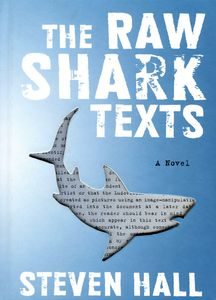
    Readers of the Canadian hardcover edition get a hint of what’s in store from the design of the book itself. A shark-shaped hole has been cut out of the front cover, giving us a glimpse at the text written on the book’s end-papers, which is a curious warning to the reader from the “curator of the Webster Fragment Collection” about the typographic effort spent in reproducing the original text as faithfully as possible.

    For the first few pages of the novel, this is a story that jumps into weirdness. A man awakens with no memory: his name is Eric Sanderson and the only link to his past is a series of written instructions to call a psychologist who will help him make sense of it all. The official story is that Sanderson is prone to occasional memory-wipes, and that he’s erected an entire support network designed to help himself re-emerge from those memory blanks.

    But there’s more to the story, and the story that emerges from the book definitely takes a turn for the fantastic: Sanderson seems to have become the target of a memetic shark feeding upon information, and the shark’s attacks are what debilitate Sanderson’s mind. In an effort to hide from the shark, previous Sanderson instances has planned defenses made of chaotic information and nonsense chaff, but this particular Sanderson iteration doesn’t intend to wait for the next attack: he goes on the offensive, investigates his own situation and comes to realize that he’s in the middle of a fight between opponents who make a memetic shark look downright plausible.

    The best thing about The Raw Shark Texts are the odd bits of invention and whimsy that Hall manages to include in his story. A typographic pipe-bomb; a scene in which the shark is glimpsed in tiles; a flip-book sequence showing and approaching shark; keyboard code-breaking; a hideout made of books; memetic boat creation; various other typographical tricks and so on. There’s a clever smile every ten pages, which goes a long way to pave over the book’s other problems.

    Because ultimately, Hall teases more than he satisfies. The glimpses at his imagined underworld are intriguing, but never cohere in a consistent fashion. The pacing of the book is uneven, with scenes of fascinated interest jammed between other scenes where nothing happens for a long time. The ending is one of those badly-paced sequences, never managing a clear victory where we should have felt triumph. Part of the problem is that Hall chooses to make his story flirt with horror, which invites greater scrutiny than, say, Jasper Fforde’s mostly-comic escapades.

    This may or may not make the novel less appealing to readers who don’t care about genre-bending meta-fiction, but it may serve to explain why some jaded readers will give high marks to this book despite problems that would have poisoned a less-ambitious novel. If your last few reading experiences have been too ordinary, take a chance and leap in The Raw Shark Texts. It’s a promising and inventive debut: Hall’s next novel should be one to watch.

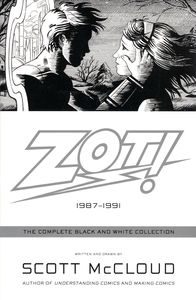
  • Zot!, Scott McCloud

    Zot!, Scott McCloud

    Harper, 1987-1991 (2008 omnibus), 575 pages, C$26.95 tpb, ISBN 978-0-06-153727-1

    These days, Scott McCloud is best-known as the thinker who came with Understanding Comics, Reinventing Comics and Making Comics, three of the most important analytical works about comics published over the past decade-and-a-half.

    But everyone’s got to start somewhere, and for years before Understanding Comics, McCloud was best-known as the writer/artist behind the comic-book series Zot!. Until recently, though, only dedicated collectors or lucky readers could read McCloud’s formative work: Collecting single issues of older comics books has always been an enthusiast’s game, and a decade-old trade paperback reprint series hadn’t managed to collect all issues of Zot!

    That’s partly what makes the news of this new Harper collection so exciting: for the first time, a good chunk of Zot! is back into print, along with restrospective comments by McCloud and some extra material thrown in for good measure.

    Zot!, simply put, are the adventures of a young teenage girl, Jenny, after she discovers a portal to another dimension –a perpetual 1965 utopian retro-future in which lives Zot, a teenage super-hero who takes a liking to Jenny in-between battling super-villains. Jenny’s world is ours, and it’s suitably complicated: Jenny isn’t doing too well at school and finds no solace at home where her parent’s marriage is disintegrating. Zot is a rare ray of sunshine in her life, especially given how his 1965 seems to be incarnated perfection.

    McCloud being McCloud, there’s a lot of clever material at play here: From a first half that seems to present light-hearted superhero stories with unusually good writing, Zot! gradually evolves along with its creator to a second half that’s grounded in our reality, tackling issues of racism, alienation and discrimination. The characterization in the last half of Zot! is daring for comics of its time, and it manages to hit emotional notes that are seldom seen in serial comics. There’s a remarkable five-issue sequence late in the book that simply follows five friends, and moments of it are heart-wrenching.

    In short, fans of the Understanding Comics trilogy won’t be disappointed by McCloud’s “early work”: It’s already witty, ambitious and multi-layered. There’s a fair bit of experimentation here, and most of it does succeed at its own objectives. McCloud’s commentary helps in placing Zot! in its proper context, and reflect on how well his experiments have held up more than fifteen years later.

    If there’s a problem with this Harper anthology, it’s that it doesn’t actually present the entire Zot! run. For reasons of economics in presenting a cheap volume, McCloud has opted to leave out the first ten full-color volumes of the series, along with a guest-illustrated issue. Let’s hope that this material will be collected in another volume entirely: despite McCloud’s assurances that the series was “rebooted” at issue 11, the first few volumes are like dropping into a party already in progress.

    Fans who have some of the previous comics or trade paperbacks may also want to hold on to them for curiosity’s sake: This Harper trade paperback is a bit smaller than the Kitchen Sink full-page reprints, and McCloud has made a few changes to the art: While those changes are all justifiable in context as they clarify facial expressions, there’s a curious pleasure in comparing the before-and-after pages.

    From a wider perspective, it’s interesting to see Zot! Being re-edited in a thick trade paperback, much like how mangas are published in Japan: given how McCloud’s been one of the pioneers in combining the strengths of both comics cultures, the physical form in which Zot! will earn its definitive run is a perfect way to give it form. Don’t be put-off by tags such as “McCloud’s first comic book series”: even today, Zot! more than holds up to careful reading. In fact, it’s a bit of a shame to see that the series ends at #36 when it reads like a prologue to an even longer sequence.

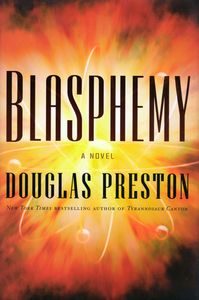
  • Blasphemy, Douglas Preston

    Blasphemy, Douglas Preston

    Forge, 2007, 415 pages, C$28.95 hc, ISBN 978-0-7653-1105-4

    Here’s the plot: In Nevada, a gifted billionaire-scientist has built a super-collider that will allow him to reach back to the conditions that existed at the beginning of the universe. As the inauguration of the machine is slowed down by technical problems, some religious groups politicize the issue. As delays and controversies heighten, the US government send an investigator to find out what’s going on. Deaths occur, and a full-scale mobilization of religious followers against the scientific project erupts even as the scientists on-site glimpse something unexpected in the first results of their experiments. Something is communicating with them via high-energy physics, something that claims to be of divine origins…

    Here’s the spoiler-free review: Douglas Preston’s Blasphemy is a techno-thriller that tackles issues of science and religion, re-using characters from Preston’s previous novel Tyrannosaur Canyon. It’s professionally written, but flawed: it may look daring at times, but it’s really reaching for the hoariest compromise in sight. The conclusion contradicts much of what has gone on until then.

    WARNING: Anything else will be a spoiler, so you may want to skip ahead to the next review.

    If you’re still with us, a short recapitulation of the place of religious faith in American genre fiction may be necessary: While recent volleys of militant atheism have done much to move the goalposts of any discussion of religious belief in the contemporary United States, most genre fiction tiptoes around such questions as so to accommodate the sensibilities of a sizable minority of believers for whom criticizing the very notion of faith is tantamount to heresy. Most genre discussions of phenomenons that may-or-may-not be manifestations of religious beliefs ultimately resolves to a curious compromise in which nearly everything is explained away as science except for a tiny piece that may-or-may-not be divine intervention. Few authors will claim a clear stake in the does-God-exist debate. There are exceptions, of course (Left Behind on one side, many of Arthur C. Clarke’s novels on the other one), but the pattern is as annoying as it’s universal, from any of the Jesus-cloned thrillers out there (see Glenn Kleier’s The Last Days) onward.

    So the tension in reading Blasphemy, at least for jaded readers, is in wondering whether Preston will clearly commit himself, or try another variation on the old “Aw, sucks, all of you can be right if you want” dodge. To Preston’s credit, he does manage to keep things in suspense for a while: the super-collider seems to open up a singularity of supernatural capabilities, up to and including an all-knowing entity communicating with them via a computer link.

    But there are a few more twists and turns to the tale, especially when Wyman Ford (returning after Tyrannosaur Canyon) corners the brilliant scientist behind the entire project and manages to make him admit that most of it was completely made up, taking advantage of a few parlor tricks in order to create a new science-based religion. But just as we think that the rug’s been pulled in one direction, there has to be an added “Strange, though, it said a lot of things I never intended.” that sends the novel in comfortable maybe-land. (Yet the epilogue makes it clear that God moves in mysterious ways.)

    There’s plenty of other stuff to discuss, such as Preston’s final ham-fisted way of portraying religious believers as bloodthirsty idiots willing to transfer their allegiances to a new religion (by the millions!) in a matter of a few days. Or how the book leaves Wyman Ford in a science-fictional world altered by the events of the novel (but don’t bet against a sequel that ignores it all). Ultimately, though, the title suggests that Preston is really about raising a stink, creating false opposition between science and faith, using the oldest non-compromise in the bag of tricks to provide a pat conclusion to satisfy everyone. It’s nothing new, nothing really unnerving. The novel tries to have it both ways, in the time-honored tradition of the hardcover popular bestseller. For all of its other faults, at least it’s a fast and easy read.

  • Killing Floor, Lee Child

    Killing Floor, Lee Child

    Jove, 1997, 407 pages, C$10.99 mmpb, ISBN 0-515-14142-9

    After going through Michael Connelly’s entire oeuvre in a reading project that took a bit more than a year (“A book per month, every month, until I’m done.”), I set out to find another author I could follow for a while. After considering and reluctantly rejecting Carl Hiaasen (fabulous novels, but ultimately too similar to invite proper reviewing), I have finally selected my new target: Lee Child, whose “Jack Reacher” novels are about as good as grown-up versions of the men’s adventure genre thrillers ever gets. Killing Floor isn’t the first Child novel I’ve read (see elsewhere on this site for my reviews of the superb Persuader and One Shot), but it’s his first one and as such a logical start to my Lee Child Reading Project, as well as an intriguing glimpse at the Reacher formula before its perfection.

    It starts just as the series’ protagonist, Jack Reacher, is arrested in a small Georgia town. Reacher happens to be at the wrong place at the wrong time: a murder’s been committed not too far away, and Reacher’s been spotted walking on a nearby road. But as Reacher notices ever-stranger things about the small town in which he’s been arrested, it also becomes obvious to the local police force that his alibi’s ironclad. Yet his freedom is just the beginning, because the murder’s just the tip of the iceberg, and Reacher won’t stop until he has found all the answers.

    Child’s strengths as a thriller writer are obvious: He combines credible nuggets of technical knowledge in a narrative framework that clearly shows his genre awareness. Killing Floor, despite one huge structural problem and a few rough edges here and there, already shows how it works.

    One of the best things about the Reacher novels I’ve read so far are how they initially masquerade their narrative nature. Killing Floor shows the way: from a singular murder mystery, it slips into a grander conspiracy mode as Reacher discovers more and more about what’s happening. For readers, it’s a sure sign that Child knows the mechanisms of the genre in which he’s writing. Better yet, it keeps everyone guessing as to where the story is going until, finally, we can see the whole picture. Most writers practice a form of this misdirection, but Child’s handling of this technique is well above average.

    Looking at the Reacher stories from the narrative ground up, the other distinctive aspect of Child’s thrillers is the convincing integration of technical trivia in the narrative. Reacher is an ex-military policeman, which gives him an expert’s understanding of expert procedures. His arrest in the first chapter is seen through his coolly detached perspective, analyzing the work of his opponents even as he’s the one being put in custody.

    The guy with the revolver stayed at the door. He went into a crouch and pointed the weapon two-handed. At my head. The guy with the shotgun approached close. Neat and tidy. Textbook moves. The revolver at the door could cover the room with a degree of accuracy. The shotgun up close could splatter me all over the window. The other way around would be a mistake. [P.2]

    Thriller fans’ appetite for this type of detail is vast, but it really serves to provide considerable credibility to the narrative. Reacher knows more than the other characters, and that makes him both a good narrator and a formidable protagonist.

    But for all the admiration that I have for Child’s novels in general, Killing Floor is his first, and it makes at least one horrible choice that severely harms the novel: the decision to balance the plot on a single whopper of a coincidence that involves not only Reacher’s wrong-place-wrong-time, but also ties it to his own family. Too much, too tidy: When even Reacher reflects that this is an unbelievable coincidence and decides to go with it, it’s a sure sign that the author’s planning has gone out of control.  [April 2024: Child does try to patch this issue as much as he can in prequel novel The Affair, but it’s not really convincing.]

    Other than that (and I don’t recall such abominable coincidences in latter novels), Killing Floor is a strong thriller entry that roars along with paragraph-by-paragraph readability and overarching structural interest. The first few chapters fly past, the pacing is steady and the final battle is an expensive set-piece that would delight any Hollywood director. It’s not a perfect debut for Lee Child, but it’s an assured one, and a good reflection of the strengths that would ensure a long-running series.

    Consider this the first of the Lee Child Reading Project series.

    [April 2024: Killing Floor is successfully revised, expanded and adapted to the screen in season 1 of Reacher.  Worth watching for fans of the books, as later plotting details vary somewhat.]

  • Deep Storm, Lincoln Child

    Deep Storm, Lincoln Child

    Doubleday, 2007, 370 pages, C$30.00 hc, ISBN 978-0-385-51550-4

    Long-suffering regular readers of these reviews are probably aware of my fascination for genre boundaries, and books that look as if they work according to a particular set of genre protocols but actually end up working from another set of rules. Sometimes it’s clever genre-bending, sometimes it’s sheer cluelessness for inexperienced authors. Sometimes, too, it’s simply hammering a cool but unusual story in a framework that faithful fans are ready to accept.

    So it is that Lincoln Child’s Deep Storm, for the longest time, is a textbook example of a techno-thriller that eventually twists itself in a science-fiction loop before disappearing in a puff of mainstream cowardice. It’s half a superb book, and half a middling one.

    Warning; a full discussion of the book requires spoilers. Readers sensitive to untimely revelations about the novel’s ultimate nature may want to skip ahead to the last paragraph of this review.

    As a genre reader, I must admit that I am in awe of the book’s first section, which sets up a mystery, then brings a capable protagonist to a remote high-tech environment in order to gradually learn about that mystery. As a techno-thriller element, it’s a well-worn plot device: The hero flies into a new environment, gets a guided tour and gradually learns a few things that don’t make sense. As the story and the threat both develop, the mystery is revealed in time for everyone to run for their lives.

    In Deep Storm‘s case, the prologue sets up a deep-sea drilling operation that produces unexpected results. Nearly two years later, medical specialist Peter Crane is flown on-board the deep-sea station, then taken down to the new underwater headquarters of a brand-new, ultra-high-tech research station. As you may expect, things aren’t going well: researchers are being driven crazy by some mysterious forces, and there are hints of traitors inside and outside the station.

    This hero-visits-research-station plot sequence is deeply embedded in the DNA of the techno-thriller genre, but Child is a reliable professional, and the first hundred pages of Deep Storm have the reassuring hum of well-maintained machinery. It creates anticipation for what’s to come, and sets up (sometimes quite obviously) everything we need to learn in the adventures to come.

    The mystery at the heart of Deep Storm (LAST WARNING: HUGE SPOILERS) is actually quite intriguing: There’s a cache of alien weapons hidden under the Earth’s crust, and plenty of ultra-high-tech warning devices buried on top of it. As a science-fictional idea, it sustains scrutiny for about the length of a short story before the holes becomes apparent (such as, well, why not hide weapons in a place that is far less volatile than a geologically active planet with a virulently aggressive biosphere?), but it’s still a neat SF surprise at the heart of what was marketed as a mainstream thriller.

    But there’s no fooling experience genre readers: The main difference between techno-thrillers and science-fiction, as genre, is not one of setting but of attitude. If the threatening breakthrough is understood, domesticated and becomes part of the human experience, it’s SF. If it’s destroyed with a naive assurance that no one will put those equations and components together ever again, then it’s a techno-thriller. Deep Storm, nods in the direction of SF with an extra kick in its epilogue, but tips its hand to the mainstream Child fans by destroying the station and the access path to below. To quote a character, “It’s a tragedy, but it’s over now. There’s no need to worry about others accessing the site. No foreign government can approach the dig interface; it’s too heavily irradiated.” [P.368] So it goes.

    Genre-definition neepery aside, Deep Storm proves that Child has the thriller-writing business down pat. This is a book that cries out for a movie, and it plays to genre expectations beautifully until it gets stuck with an idea too good for its own intended audience. It may not be entirely satisfying after a moment’s thought, but it’s thrilling beach reading from beginning to end.

  • The Afghan, Frederick Forsyth

    The Afghan, Frederick Forsyth

    Putnam, 2006, 343 pages, C$35.50 hc, ISBN 0-399-15394-2

    In an industry when a decade-long career is enough to earn writers the “veteran” qualifier, it’s sobering to realize that Frederick Forsyth has been a best-selling author for longer than many of his readers (including this one) have been alive. Since 1971’s The Day of the Jackal (which was adapted as a movie twice), Forsyth has been a reliable thriller writer, churning out complex but intensely readable novels every few years. While his best-selling glory days of the seventies and early eighties have evaporated, Forsyth has remained an elder statesmen of genre fiction, with a sideline in cranky conservative commentary for a variety of outlets.

    As such, he’s entitled to a bit of slack in discussing The Afghan. It’s the latest Forsyth, for goodness’ sake. So what if it turns out to be a paranoid tract that spends more time describing how things happen than dramatizing the action? It’s still a fascinating book, one that hints at the indulgences that professional authors with a long track record can enjoy if it suits their fancy.

    A laconic plot summary doesn’t do justice to the book. Evil Al-Quaeda plot; heroic British operative; desperate infiltration mission. You can probably guess where it goes from there, and you wouldn’t be wrong: there’s been scores of lone-wolf-against-terrorists stories in the past decades, and The Afghan is certainly one of them.

    But as most reviewers understand, it’s all in the execution.

    For instance, one thing that Forsyth does extremely well is to write a thriller according to the right-wing understanding of the world: Al-Quaeda is a real force, they actively plot against Western interests, and they’ve got both ruthlessness and a ton of money. Against them, government operatives with steely gazes and absolute moral authority are justified in using every mean necessary to protect the ignorant sheep against the gathering threat. Sacrifice, honor and shooting terrorists in the head: those are the values that Forsyth hold self-evident. Surprisingly, it works pretty well even for readers who don’t share the same world-view: Once he established the deeply paranoid world in which his characters live, the rest takes care of itself.

    But where Forsyth really distinguishes himself with this novel is the intentionally didactic tone he chooses to use. I’m not talking about Tom-Clancyesque exposition in the middle of the action (although, to be fair, Forsyth was expositioning at length a dozen years before Clancy), but almost constant technical explanations, uninterrupted by the niceties of dialogue, for pages on end. The impact is more profound than you may think: Not only does the steady flow of specialized information lend an almost-unimpeachable credibility to the tale (the staggering amount of research this novel must have required…), it also gives it a Voice-of-God quality that distracts from the novel’s most egregious shortcomings.

    Problems such as simple plotting (Hero is trained and sent somewhere, where he stops the attack. The End.), thin characters and unforgivable coincidences —from a bin Laden cameo to a preposterously unlucky plane crash. More fundamentally, the ultra-omniscient narration also paints itself in corners when comes the time to withhold information from the reader in order to create suspense. While Forsyth still manages a few outstanding scenes, such as the finale or the very cool “He’s in Canada, sir. / Take the shot, Sergeant.” exchange [P.295], they’re still held at arm’s length from the reader thanks to the dispassionate, matter-of-fact narration.

    But Forsyth’s greatest trick may be to make this narration the centerpiece of the book, the unusual quirk that comes to attract all attention notwithstanding the problems with the rest of the book. Now that’s what an old wizened veteran can do when he”s indulging himself.

  • Heart-Shaped Box, Joe Hill

    Heart-Shaped Box, Joe Hill

    Morrow, 2007, 374 pages, C$29.95 hc, ISBN 978-0-06-114793-7

    A lot of people think it’s easy to write a horror novel. Just grab a disgusting monster, sick it on unsuspecting characters and let the deaths pile up. But that’s the kind of assumption that leads to formulaic extruded product and exactly the kind of thinking that practically destroyed horror as a genre publishing category in the early nineties. The monster-kills-people type of horror is only the easiest story the genre can tell, and the best examples of the genres manage to do a lot more than that.

    Joe Hill’s debut Heart-Shaped Box is exactly the kind of novel that the horror genre should aspire to: It’s recognizably a horror story (what with a vengeful ghost and all), but it uses the framework of an implacable menace to take its characters on a deeper journey of self-discovery. Along the way, it touches upon other sub-genres: It’s a rock-and-roll novel, a road novel and a southern gothic family tragedy.

    It starts off with a strong lead character, a heavy-metal icon way past his prime living out a quiet life in upstate New York. After years on tour, Judas Coyne has settled for semi-retirement, collecting disposable girlfriends and macabre mementos. All harmless enough, until -one day- Judas end up buying a ghost on-line, and having it delivered to his house. Unlike most eBay hoaxes, this one is for real, and it has a very personal issue to settle with Judas.

    Heart-Shaped Box being a novel rather than a short story, getting rid of the ghost will take more than burning up his suit and taking to the road: As Judas discovers alongside a girlfriend who proves less disposable than he thought, the road to the ghost’s secrets is leading them south, to Florida and then to Louisiana, where Judas’ family lives. There are many terrifying moments along the way, and considerable personal injury.

    But what raises Heart-Shaped Box above the usual horror schlock-fests are the ways in which it ties itself and its horrors to deeper human concerns. Judas may be stuck with a vengeful ghost who simply wants him dead, but the story ties up Judas’ own worst excesses, the sordid history of another family, his complicated relationship with his girlfriend and the broken ties with his own parents. Hill is able to blend all of those elements together without seeming too mechanistic or deliberate about it, and the way the novel gradually moves on to a bigger canvas than just a horror story is part of the book’s delight.

    Lest this review launches itself in incomprehensible praise about “the human spirit” of the novel, it should also point out that this is a wonderfully readable and entertaining piece of work. Hill’s invention keeps things going, and his ability to set his horror in believable contemporary American location (including Denny’s restaurants) seems effortless, yet escapes a lot of other horror writers.

    In short, it’s a pretty fascinating debut from a bright young light of the horror genre. Shortly after the publication of the novel, it was revealed that Joe Hill is Stephen King’s son, and while the revelation add little to the book’s already striking qualities, it does highlight that Hill’s ability to mix the mundane and the supernatural, to use familiar elements of American culture to strengthen the horrific aspects of his story are indeed reminiscent of King’s best work. Still, Hill is already forging himself a distinct reputation: his work is solid, and readers will have a hard time waiting for his next novel.

  • The Automatic Detective, A. Lee Martinez

    The Automatic Detective, A. Lee Martinez

    Tor, 2008, 317 pages, C$16.95 tpb, ISBN 978-0-7653-1834-3

    One of the most interesting things about our genre-saturated entertainment culture is that everyone has at least some basic understanding of the specialized protocols that drive, say, mysteries or Science Fiction. We’ve caught enough TV shows rehashing the same plots, seen enough movies riffing off past ideas, read enough genre books that some useful fiction plot devices have become ingrained in our imagination. Talk about a robot, and everyone will picture a humanoid hulk of metal. Mention a Private Investigator, and everyone will see a smoke-filled office, a middle-aged guy in a trench-coat and a beautiful blonde asking for a simple favor.

    For a satirist like A. Lee Martinez, it’s a natural vein to exploit. Why not combine the clichés on SF and hard-boiled mystery fiction to create a parody of both genres? Martinez’s novels so far, starting with Gil’s All-Fright Diner, have been amusing take-offs on popular segments of genre fantasy and horror. The Automatic Detective is his first look at SF clichés, but the same instincts that have served him so well on previous books are once more displayed here.

    Mack Megaton is the hero of the story: a big, red robot designed to destroy but now trying to fit into normal society. Mack’s got anger issues, and his job as a taxi driver isn’t helping much. So when bad things happen to his neighbors and even worse things threaten Empire City, he opts for a career re-alignment and decides to do a little private investigation.

    The Automatic Detective is not meant to be serious Science Fiction. Empire City and its citizen are straight out of Pulp SF clichés, with easy jokes, silly world-building and the obvious use of familiar tropes. The narration itself is pure hard-boiled machismo made metal, with Megaton and friends worrying about oil changes, electrical charges and rusting plates. Mutants, aliens and fancy technology all make appearances, highlighting the deeper truth that this is surface SF, maybe even science-fantasy, playing with quasi-outdated SF gadgets not because they make sense, but because they’re familiar to everyone. (There’s an intriguing comparison to be made here between this book and Charles Stross’ Saturn’s Children, which attempts to re-cast familiar SF archetypes in a plausible modern world-view.)

    This sounds like a criticism of Martinez’s approach and it isn’t: From the way he piles up more and more of these references, it’s obvious that he doesn’t mean to pass this off as contemporary SF with deeper meaning: he’s out to write a romp, and he manages to reach his objective. The Automatic Detective is a good read, one that makes good use of its initial premises. Mack is a sympathetic character, and it’s not tough to cheer for him as his investigation continues. Martinez knows how to plot, and the book holds together well once the reader’s usual hard-SF nitpicking circuits are deactivated.

    In lesser hands, this could have been a mess of surface SF, with gadgets used nilly-wily without any attention to plausibility. Here, there is some rigor and a sense that Martinez’ voluntarily pulpish milieu is tied into the conceptual framework of his jokes. It’s also a fast read, which helps smooth out some of the background inconsistencies that arise when blending together so many SF devices. Purely and simply, it’s a romp and it should make a number of readers smile regardless of whether they can quote chapter and verse from Asimov and Chandler.

    For Martinez, it’s another solid hit that should solidify and broaden his reputation as one of SF&F’s most entertaining satirist. It’s not enough to have jokes: he’s able to beef up amusing premises with solid plotting, good characters and smooth writing. Best of all, his books should be accessible to a wider public who’s already familiar with the genres being parodied, whether they realize it or not.

  • The Uglies Series, Scott Westerfeld

    The Uglies Series, Scott Westerfeld

    Simon Pulse, 2005-2007, ???? pages, C$??.?? tpb, ISBN Various

    Uglies, Simon Pulse, 2005, 425 pages, C$10.50 pb, ISBN 978-0-689-86538-1
    Pretties, Simon Pulse, 2005, 370 pages, C$10.50 pb, ISBN 978-0-689-86539-8
    Specials, Simon Pulse, 2006, 372 pages, C$11.50 pb, ISBN 978-1-4169-4795-0
    Extras, Simon Pulse, 2007, 417 pages, C$19.99 hc, ISBN 978-1-4169-5117-9

    If we’re to believe those with access to Bookscan sales numbers, Scott Westerfeld has become one of the best-selling SF author of the past decade without much attention from the genre SF community. Cannily, he’s been able to pass unnoticed by tapping the young adult market: Thanks to publishing silos, most YA publishing used to pass unnoticed from the adult fiction pundits. Things have improved somewhat over the past few years as YA’s bigger sales have shamed adult SF numbers, and one of the landmark works in the field has been Westerfeld’s Uglies trilogy, which was ideally poised to benefit from the success of Westerfeld’s previous Peeps series.

    In the spirit of reportage, your fearless reviewer dared plunge into the unfamiliar murk of the YA section to bring back a boxed set of the Uglies trilogy (Uglies, Pretties and Specials) along with a standalone fourth book (Extras) set in the same universe. How does it stack up next to the adult fiction? Should we all make a stop at the YA shelves from now on? Are the kids reading this going to grow up to be good SF fans? Keep reading.

    One of the distinguishing characteristics of YA fiction is that it usually features younger protagonists, and so the initial Uglies trilogy stars Tally Youngblood, a teenage girl living in a world where there’s been quite a few changes to human society: Isolated cities exist in a post-apocalyptic landscape, and the stages of life have been formalized into distinct stages: “Littlies” grow up to be “Uglies” until their sixteenth birthday, at which point they are medically transformed into “Pretties” who enjoy a vacuous life until they grow older and become “Crumblies”. The city in which Tally lives is segregated by age, which leads to the usual hijinks in which the young ones try to see how the glamorous older set lives.

    But Tally’s not the kind of person to go with how things usually go, and so she quickly discovers life outside the city, along with hints of a past catastrophe, an underground for rebels and the disturbing secret of the medical procedures that transform Uglies into Pretties. In latter volumes, she goes through the “Pretties” transformation herself, then reluctantly gets recruited to become a “Special” operative to act on behalf of the city government. Before she’s through she’ll have time to love a few boys, start a war and completely re-shape the society she lives in. What fun!

    (The fourth volume, Extras, takes place years later with a fresh new social system and involves a largely different set of characters, though its perspective on Tally is intriguingly detached.)

    From an adult SF reader’s perspective, the series holds up a certain interest: The extrapolation of various trends in entertaining, and Tally makes for a good narrator. Where it differs from adult SF is that the explanations are more laborious and take far more time to be revealed: savvy SF readers will guess most of the twists ahead of time, and roll their eyes at the falsely-frantic pace that doesn’t lead anywhere. On the other hand, readers unfamiliar with SF in general may not find a better series to learn the particularities of the genre.

    The first volume is most interesting, as the stakes are clear and there’s an entirely new world to understand. The second volume is a notable step back, as the protagonist’s goals are less clearly defined. The third volume is bigger and more interesting, while the unplanned fourth book is an acceptable epilogue with enough space for some new ideas.

    If that’s the kind of SF that the kids are reading today, we’re in good hands: it’s not dumb, it’s not dull and it’s not fantasy dressed up in silver costumes. It’s also quite different from the Heinlein juveniles, and that ought to be a lesson for whoever wants to write SF for teens: they don’t want regurgitated ideas from the fifties, they want stories that speak to the hyper-connected present. One of the best legacies of Westerfeld’s success so far has been to open up the YA market to the adult audience, ensuring that we’ll be able to recognize the best SF authors regardless of who they’re writing for. And who knows; maybe the infusion of contemporary SF tropes will even invigorate the sometimes-moribund adult genre…

  • Multireal, David Louis Edelman

    Multireal, David Louis Edelman

    Pyr, 2008, 522 pages, US$15.00 tpb, ISBN 978-1-59102-647-1

    As a follow-up to David Louis Edelman’s debut novel Infoquake, Multireal improves upon a few problems from the first book, runs aground on the usual shoals of second-volumes-in-a-trilogy and promises much for the conclusion of the series. Fans of Edelman’s previous novel won’t be disappointed, and some skeptics will be reassured about the fate of the “Jump 225 Trilogy”.

    Readers will remember that Infoquake ended with a mind-bending technology demo of “Multireal”, a technology that allowed control over future possibilities, allowing an individual to predict and select the best outcomes of the many choices confronted on a moment-to-moment basis. Multireal focuses upon this technology while following the adventures of the driven entrepreneur Natch and the rest of the group he brings together to manage the release of this new technology product. Things aren’t looking good for him as the novel begins: beyond the usual business rivals and rabid media aggressiveness, Natch also has to contend with officials who can’t bear to see a technology as promising as Multireal stay in private hands, and hidden enemies who can’t wait to see the much-damned Natch fail at something for once.

    Perhaps the best things about Multireal, from a genre SF fan’s perspective, is how it manages to deal effectively with the possibilities of Multireal. The novel offers a series of showcases for the technology, from a flechette gunfight that ends in a perfect draw, to a stroll through London foot traffic, to a wild soccer demonstration to life-saving heroics in desperate circumstances. What seemed so far-fetched in the first volume seems natural, even inevitable this time around, which is a testament to Edelman’s growing confidence as a writer.

    It’s not the only aspect of Multireal that feels improved upon its predecessor. Many of the less-believable aspects of Edelman’s imagined future are either refined or left unmentioned, lending greater credibility to a setting that almost looked like a parody at first glance. Many of the monolithic organizations that so bothered picky readers in the first volume are now fractured and inefficient in this follow-up: The government forces are notably more nuanced thanks to infighting and power plays, adding some much-needed complexity to the “Jump 225” world.

    From a more conventional standpoint, Edelman may leave a lot of things hanging in mid-air by the end of this second volume, but he doesn’t hesitate to throw them there. Natch’s journey through this book goes from bad to worse as he suffers from black code implanted deep in his brain, loses almost every single source of support and struggles with his own beliefs. By the time A-type Natch is “reeling with ethical vertigo” on page 400, readers can be excused if they want to stand up and cheer; clearly, things are evolving. At the same time, Jara fans will be intrigued by her dramatic trajectory through the novel, as she emerges as a protagonist in her own right, trying to save the fiefdom from all enemies while trying to put away her infatuation for her former boss.

    All in all, it amounts to a strong second novel that shows how Edelman is growing as a writer. As high-tech SF novels go, this is one of the year’s good choices. It’s fun to read, interesting to think about and suggests that the third volume of the trilogy will be even better.

    [July 2007: Sharp-eyed readers will notice that a certain “Christian Suave” is hidden among the many, many Multireal blurbers. It’s my first printed blurb, and my name is misspelled. It’s a triumph both for both my ego and my integrity!]

  • Succubus in the City, Nina Harper

    Succubus in the City, Nina Harper

    Del Rey, 2008, 392 pages, C$8.99 mmpb, ISBN 978-0-345-49506-8

    I should probably start by saying that I’ve known Nina Harper for a few years as nodding acquaintances (back when she didn’t even call herself Nina Harper) and that I really wanted to enjoy this book. I should also make it clear, for calibration’s sake, that I read very little paranormal romance even though it has become one of the hottest SF&F sub-genre over the past few years.

    At first glance, Succubus in the City is the kind of book with which I wouldn’t want to be caught. A mixture between Sex and the City and The Devil Wears Prada, this novel is narrated by a succubus who’s contract-bound to deliver victims to hell after sex. But don’t worry: she’s a good girl who takes delight in sending the bad kind of men downward, and who enjoys spending time with her three demonic girlfriends when she’s not busy working at a fashion magazine. She may be three thousand years old, but she certainly appreciates the amenities of Manhattan, from designer clothes to high-end ice cream.

    In many ways, this reads like pure wish-fulfillment fantasy for the female urban professional set: Long litanies of expensive labels, blunt descriptions of shopping, sinful food, a heroine with an obligation to sleep around and send unworthy lovers to hell… Succubus in the City sometimes feels like a self-aware attempt to meld and exploit the tropes of paranormal romance with chick-lit. Not being among the target audience, I’m not sure how well it works, but I can tell you that it’s absolutely fascinating: There are probably a hundred pages in this novel that could have been cut without harming the plot, but the accumulation of brand names, hip references and upper-upper-class Manhattanite living makes for a neat reading experience: This may be an alien culture to me, but wish-fulfillment jumps gender barriers better than I expected.

    But Nina Harper is smarter than you and I, and so Succubus in the City is more than a litany of Things Women Want: there’s a fairly sophisticated mythology at play here, one where angels and demons are two sides of the same coin, where hell lives up to modern management techniques and where Satan’s top lieutenants have been at this game for thousands of years. The narrator is a three-thousand-year-old minor princess, and Harper’s take on modern society via the eyes of someone who has seen it all can be more amusing than you’d expect. This is a lighthearted novel, after all, one where Satan’s reputation exceeds his worst traits, one where the victims all deserve it and one where hell’s minions have access to their own version of LiveJournal called MagicMirror. (“Meph” is a foodie with his own restaurant reviews.) Everything is handled with a light touch and a professionals’ eye for decent plot mechanics. The details of the novel are where it works best: I was particularly happy with the character of Azz, a librarian with the look and temperament of a cat.

    Where the novel doesn’t work as well is when it tries to piece everything together. Narrator Lily and her friends are fun to hear, but it’s hard to reconcile some of their conversations with the personality of people who have lived through entire civilizations: the banter works for Sex and the City (which is explicitly referenced; the narrator thinks she’s Samantha), but for characters with that much experience in the ways of humanity… not so much. There are other issues of verisimilitude, starting from the curious lack of repercussions from taking so many people out of circulation. Most of those issues are hand-waved away with an omnipotent “Authority” that raises more questions than it satisfies: the real answer, of course, is that this is the type of fantasy where we’re not meant to ask too many questions. Which is a shame, considering the fun of Harper’s vision of hell and its servants.

    I haven’t said much about the plot so far because it doesn’t seem particularly important, even to the characters who take off to Aruba, are temporarily stumped by Google and can’t be bothered to exhibit the appropriate paranoid response at the suggestion that one of their own is conspiring against them. Trying to put a thriller plot framework on a light-hearted wish-fulfillment romantic fantasy can be tricky, especially considering the breaks for extravagant consumption.

    Add to that the considerable frustration of discovering that this is the first part of a series: the story doesn’t end as much as it is interrupted on the last page. What could have been forgivable with a “Book One of the Sexxubus Trilogy” warning ends up being a problem, at least until we are able to order the rest of the series.

    Not that this makes this novel any less fascinating to read, even when I can feel the commercial imperatives of the genre being deliberately tweaked by the author. Some authors may talk about paranormal romance as female empowerment, but Harper is the one that writes about sending unsatisfactory lovers straight to hell. Even guys like me can learn something from this book.

    [May 2009: Second volume Succubus Takes Manhattan is more of the same, with a few uneven differences: More descriptions of satanic rituals, more palace plotting amongst Hell’s minions, and a strengthened romantic intrigue between heroine Lily and her two men. On the other hand, the core strengths of the series remain: Harper doesn’t miss an occasion to go on virtual spees of wish-fulfilling indulgence. It’s all good fun, but those who haven’t been seduced by the first volume won’t have their minds changed by this follow-up.]