Book Review

  • Pandemonium, Daryl Gregory

    Pandemonium, Daryl Gregory

    Del Rey, 2008, 288 pages, C$15.00 tpb, ISBN 978-0-345-50116-5

    Since I read current novels more readily than short stories, it’s rare that I will pay attention to authors before their first novels. But Daryl Gregory was an exception, thanks to “Second Person, Present Tense”, an astonishingly good story reprinted in the Hartwell/Cramer anthology Year’s Best SF 11. On the strength of that story alone, Gregory’s first novel was worth waiting for. Fortunately, he doesn’t disappoint.

    A mash-up of genres and influences, Pandemonium is best described as a contemporary fantasy taking place in a parallel universe where people can be “possessed” by archetypes. After World War Two, instances of people acting strangely -often exhibiting abilities outside their knowledge- have multiplied, spawning research, fear, catastrophic events and a lot of curiosity. No one quite know how or why those possessions occur, but even the most skeptical have a hard time denying their existence.

    Our narrator, Del Pierce, has a closer relationship to those entities than most. As a child, he was possessed by “The Hellion”, a Dennis-the-Menace archetype whose influence had real consequences. A childhood exorcism drove the demon out, but following a car crash, it seems that it’s trying to come back… and that’s not counting the wink that Del gets from another possessed person in the first chapter. Deadbeat, unable to hold on to relationships, severely emotionally afflicted, Del may not be much of a winner but there’s no denying his character.

    Looking for clues and a way to get rid of his entity, Del travels to a convention of possession specialists, stalks an expert, partners with a somewhat wrathful nun and makes his way in America’s Midwest to find the origins of his problems. Thanks to a few twists that occasionally echo “Second Person, Present Tense”, it’s a more complex journey than you’d expect. The ending isn’t entirely happy.

    There are a lot of things to like about Pandemonium, but the accessibility of the story is perhaps the most obvious of them. Despite the scope of the changes in that world, Gregory manages to introduce the premise smoothly, allowing us to understand the world and how it differs from ours. The telling of the tale is generally straightforward, except for the intentionally shocking twist midway through. The characters are well-sketched, and the prose is easy to read.

    There are also a few memorable details. A description of a possession convention recalls a number of SF conventions, and the cameo by Philip K. Dick (himself possessed by Valis, a possession that seems to have had a beneficial effect on the writer) is only the most obvious of the unobtrusive in-jokes that pepper the novel. Gregory has a good handle on pop culture, and Pandemonium doesn’t have to scratch deep to find interesting things to say about our collective imaginary landscape.

    If the novel falters a bit, it’s in building a credible alternate history for the universe. Despite significant differences between history of the world (including a rather different fate for Richard Nixon), many pop references remain the same, along with historical event such as the O.J. Simpson trial (although it, too, ends differently). To be fair, the balance between a recognizably similar universe and the changes flowing from fifty years of possessions was nearly impossible anyway: Too much in fantasy and the novel loses its relevance, while too much in realism and the entire thing loses its appeal.

    But if you avoid looking too closely at the historical aspects, Pandemonium is a strong first novel, a perfectly satisfying read and a promising step up for Gregory. If you haven’t registered his name after “Second Person, Present Tense” and his other short stories, it’s time to stand up and take notice.

  • His Dark Materials, Philip Pullman

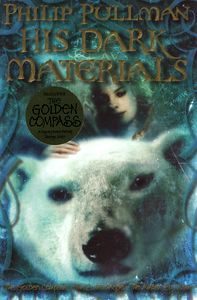
    His Dark Materials, Philip Pullman

    Knopf, 1995-2000 (2007 omnibus), 934 pages, C$24.50 tpb, ISBN 978-0-375-84722-6

    In a way, it’s sometimes a relief to review books that everyone else has read.

    Granted, my standards for “everyone else” are fairly low. But when discussing Philip Pullman’s His Dark Materials trilogy, “everyone else” is a lot of people. Pullman’s series may not have reached the mass-market hysteria that swept around J.K. Rowling’s Harry Potter series (it helped that the series became popular after it was completed), but it was often mentioned in the same breath, sold widely, earned a lot of critical attention and had its first volume adapted to the big screen with an A-list budget.

    The movie crashed and burned a hole in the studio’s budget, thereby ensuring no second and third film, but that’s not much of a big deal considering that the entire story, as conceived by Pullman, still exists happily on bookshelves, untainted by the film’s imperfections. In fact, it’s a bit of a wonder that the film existed at all given the original trilogy’s ambitious goals. While Harry Potter was an accessible experience for the entire family, His Dark Materials is significantly more complex, with a correspondingly more difficult style and thematic concerns that go well beyond the Young Adult market it was often aimed at.

    It’s a story of a young girl discovering the world, but there’s a lot more to Pullman’s ambitions than to deliver a coming-of-age story: Before she’s through, heroine Lya will discover her unpleasant parents, see friends die horribly, venture to the land of death and eventually confront The Authority itself. While the first book is generally about her, from her perspective, the latter parts of the story shatter in multiple viewpoints, some of them ending only when the characters die while striving for their goals. Along the way, Pullman hops from one universe to the other and tackles philosophy, the nature of the universe, the way science works and how people change. It’s an almost impossibly rich mixture of themes, and trying to take it all in takes time and effort.

    In fact, I’m not terribly ashamed to say that the book lay on my bedside table for nearly a year, slightly and infrequently read, until a series of airports and planes gave me sufficient motivation to finish it. It’s not particularly accessible for those who just want a story, and it takes a lot of time to rev up. By all means, see the movie to prime your imaginary engines… but don’t be surprised if it remains heavy-going.

    On the other hand, the rewards for reading the story to the end are considerable. Over and over again, it’s hard not to be impressed by Pullman’s audacity, his willingness to go to difficult places, kill favorite characters, defy convention and still manage to deliver a satisfactory conclusion. The fantasy elements he brings to the story are both complex and original, never completely tipping over in familiar tropes and surprising even seasoned genre readers. He sets a high standard for himself and dares others to keep up, which is a tough but rewarding experience as long as you keep up.

    Unfortunately, this demanding regimen makes it difficult to recommend the book widely. Readers with patience, some literary skills and a taste for more ambitious material will get the most out of this trilogy. But the beauty of reviewing works that “everyone else” has read is that, by now, everyone who wanted to read it was already done so.

  • Half a Crown, Jo Walton

    Half a Crown, Jo Walton

    Tor, 2008, 316 pages, C$28.95 hc, ISBN 978-0-7653-1621-9

    True to form for Jo Walton’s work, Half a Crown is both familiar and unexpected, successful and flawed, charming and unnerving. As the third book in the “Small Change” trilogy, it has to live up to the expectations set by its predecessors, which described the course of an alternate history in which England played nice with the Nazis. The result was fascism with a kindly British face, told in alternating chapters by young women and a detective with more and more to lose.

    This detective, Peter Carmichael, has risen through the ranks in the decade-and-a-half since the previous volume: Now head of the secret police, he spends half his time upholding the law of his government and the other half doing what he can to lessen the oppression. The years since Ha’Penny have been rough on England: In almost fifteen years of totalitarianism, the population has come to an arrangement in tolerating its oppressive government. Some people have lived nearly their entire lives under this type of regime, and find the whole thing natural.

    Which brings us to the other narrator of the story: Elvira, daughter of Carmichael’s old partner, now his ward but also eighteen and anxious to become a débutante. Her introduction into formal society won’t go as planned as a rally turns violent and police arrest her. For both Elvira and Carmichael, this is the beginning of momentous events that will change everything. 1960 London is boiling with tension, and this gives Half a Crown an extra layer of urban complexity that wasn’t immediately obvious in the first two novels of the trilogy.

    As ever, it’s Walton’s low-key extrapolation of British fascism that make up the bulk of the novel’s conceptual appeal. Draped in King and Cross, Half a Crown show that fascism can become part of the background noise –especially if one learns to ignore the occasional cries for help. If the political events of Farthing could be considered an accident and Ha’Penny can be seen as a missed chance to make things better, Half a Crown is more pernicious because it shows that totalitarianism isn’t something that will be automatically be resisted by everyone. The inertia of ordinary people, promised nothing less than what they already have, can be a surprisingly amoral force.

    As for the novel’s more conventional qualities, there’s little to say: Walton is a careful writer, and there’s a great deal to like about Half a Crown‘s characters (especially as they’re forced to make the choices their whole lives have been leading to), the slow-burn pacing and the way Walton finds essential details in commonplace things. Fans of the first volume will finally learn what happened to the Khans, although the answer and its implications may not be as reassuring as they may think.

    The only element of the book that is likely to cause controversy is the ending. The “Small Change” trilogy has been relentlessly downbeat, and though everyone can forgive a happy ending, Half a Crown seems to make things awfully easy on itself, in a way that practically begs for a dose of sarcasm. A short royal conversation, a proclamation and the whole thing is on its way out? It fits and yet doesn’t: despite the sacrifices of the characters (and yes, a recurring character does die along the way), Half a Crown‘s ending seems to wrap up too quickly and easily.

    But it’s also fair to say that the principal strength of the series has been about journeys, about the day-to-day life rather than the cusp points or the wrap-up. Walton, in a way, has attempted the portray the unstoryable, the way in which we get used to horrible things. Comfort from routine can be found in the oddest places, and upsetting this routine always feel wrong somehow, even when the change ends up (or should end up) being for the better.

  • The Greatest Sci-Fi Movies Never Made, David Hughes

    The Greatest Sci-Fi Movies Never Made, David Hughes

    Titan Books, 2001 (2008 rewrite), 350 pages, C$16.95 tpb, ISBN 978-1-8457-6755-6

    One piece of knowledge that differentiates Hollywood insiders from mere pretenders is the understanding of how difficult it is to bring a movie to the big screen. As a collaborative art form, film involves hundreds if not thousands of people, millions of dollars and years of effort. The financial risks are so high, and the number of potential projects so vast, that there are far many more ideas than production slots. No wonder, then, that there is enough material for a fascinating book about the movies that never were.

    While the idea of a book about non-existing movies may strike some as useless, David Hughes’ The Greatest Sci-Fi Movies Never Made is far more interesting than anyone may expect. Far from presenting a compendium of failures, Hugues uses this opportunity to reveal the hidden history behind some famous SF franchises, study the ways Hollywood really works, and tell fascinating stories about the film industry. Ignore the pandering “Sci-Fi” and broken toy robot on the cover: this is serious film journalism, blending information from public sources and exclusive interviews to describe development processes that may have lasted decades.

    Chances are that you will recognize many of those “movies never made”. For one thing, what we’ve seen on screens isn’t always the first concept that occurred to the film’s producers. There’s an entire chapter on the STAR TREK series of films, for instance, that sketches the false starts, development pains and secret negotiations that shaped the series. For another, good film concepts don’t necessarily die when work stops on them: often, they go dormant, awaiting only the right person for a revival. So it is that many movies judged “dead” in the first edition of Hugues’ book were revived and released before the second revised edition. THUNDERBIRDS, THE HITCHHIKER’S GUIDE TO THE GALAXY, SUPERMAN RETURNS, FANTASTIC FOUR are only four of the titles that made it out of development hell in the meantime (with WATCHMEN a few months away from release), and this edition of the book has been revised to include the postscript of those efforts.

    Most of all, The Greatest Sci-Fi Movies Never Made provides great examples of the way Hollywood really works in the myriad of ways movies can turn wrong, or never make it out of the intense competition for limited production funds. Science Fiction movies are expensive, and it’s a defining characteristic that may account for a significant number of failures: at that level of commitment, few people are willing to go on a limb and remain true to an artistic vision. And that’s assuming that the creative differences are settled, which isn’t always the case: WATCHMEN, for instance, had no less than half a dozen different directors attached to it at one time or another, all cracking their heads on the issues in adapting a comic-book masterpiece to a different medium.

    Happily enough, Hugues’ style in describing those complex stories of failure and successes is almost compulsively readable: His clean prose deftly juggles names, time-lines, interview quotes and explanations of why things didn’t go as planned. The narrative prose is clear, with the sources kept in a dense thirteen-page appendix. There’s a lot of original research, and even film buffs will find something new in there.

    Naturally, we shouldn’t mourn for all of those movies. I was particularly taken by the case of Clair Noto’s famously unproduced script “The Tourist”, intriguing in its moody description of stranded aliens, but almost certainly the kind of film that I would have hated in theaters. That the premise is eerily similar to aspects of the delightful MEN IN BLACK is something left to contemplate whenever I feel that Hollywood always makes the wrong choices.

  • The Brass Verdict, Michael Connelly

    The Brass Verdict, Michael Connelly

    Little Brown, 2008, 422 pages, C$29.99 hc, ISBN 978-0-316-16629-4

    With a bibliography that now numbers twenty volumes in sixteen years, it’s no accident if Michael Connelly’s got a keen understanding of what his fans are expecting from him. Given Connelly’s track record of bringing together practically all of his protagonists, it’s not much of a surprise to discover that The Brass Verdict features two of Connelly’s best-loved heroes so far: “Lincoln Lawyer” Mickey Haller and series stalwart Harry Bosch. The least surprising development, of course, is that for all of its twists and turns and limpid prose, The Brass Verdict remains solid Connelly.

    After two years away from the law after the events of The Lincoln Lawyer, protagonist Haller ends his self-imposed sabbatical in less-than-ideal circumstances: An acquaintance of his has been murdered, and a past agreement between them stipulates that Haller is the legal executor who gets to take care of the cases. For Haller, who planned on slowly getting back into practice after a lengthy rehabilitation period, this comes as a shock in more ways than one, especially when he realizes that one of the thirty-one cases falling into his lap is a high-profile murder case featuring one of Hollywood’s power producers. But there’s a lot more to it. Like, for instance, finding out who murdered the lawyer with the original case load. The LAPD is on the case, and they’ve sent one of their finest agents on the case: Grizzled veteran Harry Bosch, who shares another connection with Haller.

    Narrated by Haller himself, The Brass Verdict is a welcome return to the legal procedural mode last successfully seen in The Lincoln Lawyer. While Connelly’s usual perspective (via Bosch) is about police work, Haller’s an opinionated expert on law, and his digressions on the way justice is served in the real world are just as cynical as Bosch’s own handiwork. Lies, unsurprisingly, are at the heart of this novel’s thematic concerns —especially when they place Haller in a difficult position. Meanwhile, Bosch is usually somewhere in the novel’s shadows, doing his own thing.

    While The Brass Verdict stands alone by itself, there’s little doubt that Connelly fans will get the most out of it: The interplay between Haller and Bosch is better if readers already know the two characters. As usual for Connelly’s crossovers, Bosch is more scary than admirable when seen from another perspective. The Brass Verdict may be the first of Connelly’s novels to turn him into a supporting character, acting away from the narrator’s perspective and letting Haller realize how callously Bosch is using him for his own purposes. The central connection between the two characters, which has been known to faithful Connelly readers for a while, comes as a bit of an anticlimax late in the novel as the narrator finds out for himself. Meanwhile in the Connellyverse, other characters make guest appearances, from Jack McEvoy’s extended cameo to a fleeting suggestion of Void Moon‘s Cassie Black (who’s overdue for a return feature engagement after being anonymously glimpsed in at least two novels so far.)

    There are questions that linger, though: Isn’t it convenient that Haller is still another lawyer’s executor after two years away from the law? Isn’t it convenient that Bosch (just-as-conveniently back in active Homicide cases as of The Overlook) is too heartless to recuse himself from a case involving someone he knows? The questions aren’t as bothersome as the reasons why they spring to mind: Despite Connelly’s sure-footed prose and click plotting skills, The Brass Verdict often feels like a perfunctory effort, another crossover special with more emphasis on the high-concept log-line (“Haller meets Bosch!”) than the actual plot, which seems to end on a rather gratuitous fishtail.

    But there’s no need to panic yet for Connelly fans: Even at its contrived worst, The Brass Verdict won’t disappoint anyone, and does nothing to tarnish anyone’s appreciation of the author. If nothing else, it brings to mind memories of The Narrows, which also brought together known character for a result that ended up being less than the sum of its parts. Still, even at his most routine, Connelly still manages to beat most other crime fiction writers at their own game.

  • Tripwire, Lee Child

    Tripwire, Lee Child

    Jove, 1999 (2005 reprint), 401 pages, C$10.99 mmpb, ISBN 978-0-515-14307-2

    One of the advantages of reading through an author’s back-catalog the way I’m rushing through my Lee Child Reading Project (“One book per month, every month, until I’m done”) is the way I can spot subtle differences between novels. Tripwire is like most Child novels in that it features Jack Reacher and combines genre-savvy plot mechanics with strong technical details to create a top-notch thriller experience. On the other hand, this is the first Reacher novel I’ve read (out of five so far) that tackle the limits of the protagonist, and feature him against a memorable villain.

    It’s also a Reacher novel that covers quite a bit more ground than usual: after a prologue set in Key West (where Reacher is working as a pool-digger, no less), the action moves to New York, then off by commercial plane to destinations farther west. It also digs into Vietnam-era history and establishes careful ties with Reacher’s own biography.

    The best thing about it is how it finally gets rid of the coincidences that propelled the plots of Killing Floor and Die Trying: This time, the action comes to Reacher as a private detective manages to track him down in Key West. Reacher denies being himself, but soon has no choice than to go back to New York City when the detective is savagely assassinated. Trying to track down who wanted to find him, Reacher stumbles onto an old friend, and then onto unfinished business… Meanwhile, in a related plot development, a businessman is coerced into ceding a controlling share of his company to a mysterious man with a hook and a burn-scarred face. How these two plot-lines come together is one of the book’s primary point of interest, but it is by no mean the only one.

    As usual, Reacher’s knight-errant adventures lead him to a beautiful damsel-in-distress, dangerous situations, complicated back-stories and convincing background details. Tripwire includes details about things such as forensic anthropology, .38 weapons, Vietnam helicopters, prosthetics and grey-market money-lending. As usual, everything rings utterly true, lending considerable credibility to the novel.

    Also as usual, Child is skilled in keeping us guessing as to the true shape of the story. There are a series of mysteries to elucidate one after another, up until we realize that it’s been a much simpler novel than we’d been led to extect. Superb pacing (even more so considering that the novel isn’t a fight-a-page carnival), limpid writing and tough characters only add to the attraction of a superior genre thriller.

    But this time around, Tripwire does feature an unnerving antagonist, someone whose bloody murderous methods aren’t even slowed down by an office on the 88th floor of the World Trade Center. After several books where Reacher seemed to outnumber armies of paid goons, it’s a change of pace to see him go head-to-head with a villain who seems to be just as clever as he is.

    The other distinctive plot element of this nove is Child’s willingness to acknowledge Reacher’s own limits: his nomadic lifestyle may be a boon for the series’ plotting possibilities, but they don’t make him a perfect human being, and he’s got to confront a few of those limits throughout the novel as a tempting slice of normalcy is dangled in front of him. (Alas, I’ve got a feeling that we’ll seldom, if ever, hear about that again: Like most serial heroes, there is no stable future in store for Reacher.)

    None of those distinction harm Reacher as a character, and they do much to set this book apart from the other ones in the series. While Tripwire doesn’t quite attain some of the series’ high points (such as the brilliant first hundred pages of One Shot, or a few virtuoso scenes in Die Trying), it’s a decent entry that’s features a slight-enough departure to keep things interesting. Balancing the familiar with the unusual is a constant problem for series writer, but Child seems to be doing pretty well so far.

  • Alternadad, Neal Pollack

    Alternadad, Neal Pollack

    Pantheon, 2007, 290 pages, C$29.95 hc, ISBN 978-0-375-42362-8

    I’m now well in the stage of my life where friends are not just married, but actively reproducing. The changes are profound, as the new kids become the focus of their parents’ lives: suddenly, evening movie outing are impossible, and lunchtime discussions become all about showing the latest pictures of their superstar. Some people become hollow husk of their former personalities, having sacrificed every shred of it on the altar of parenthood. Lest you think I am making fun of them, let me set you straight: I’m not mocking them as much as I’m dreading that in a few years, the same thing could happen to me.

    Books like Neal Pollack’s Alternadad may not be the answer to this growing fear, but they certainly put the discussion in context. People who have read Pollack’s previous books will be surprised to learn that his latest is a memoir of his first years as a father. After all, The Neal Pollack Anthology of American Literature was literary hipness given form (from McSweeney, no less), even as Never Mind the Pollacks was a rock-and-roll novel through and through. The leap from this hipster coolness to the more conventional demands of parenthood end up forming the main concern of Alternadad, as Pollack tries to reconcile his hip formerly-single self with the demands of a growing son.

    The narrative begins in Chicago, where alternative-culture-loving Pollack meets the love of his life (although not without behaving badly enough during their first date that he’s got to beg for another one), gets married and learns of her pregnancy. Then it’s off to Philadelphia where Elijah Pollack is born, and where Pollack père gets increasingly concerned about the riskier neighborhoods that he used to find so charming when he was a carefree single.

    So it is that the bulk of the book takes place in Austin, where the Pollack family undergoes its formative years: Elijah starts going to preschool (and becomes a biter) while Neal briefly plays in a punk band, trades a drug habit for another one and gradually gets involved in community work. As Elijah grows up, music starts being a factor in the father-son relationship, as Neal is determined to give his son a solid background in what he considers cool music.

    As a narrative, it’s an engrossing read: Neal is a flawed character, but a solid narrator, and his easy prose is peppered with killer lines and flashes of insight. Part of the appeal of the book, perhaps unfortunately, is that Neal does act in ways that most would consider irresponsible: his drug habits may be recreational, but they’re constant through the book, and his decision to form a punk band and go on a multi-city tour soon after his son’s birth may not be exactly what we’d consider solid middle-ground behavior for a new father. Later on, Elijah gets expelled from preschool for behavioral problem, and Neal writes an on-line article about it that becomes a controversy magnet and an excuse for perfect strangers to criticize his behavior. Remove those elements, however, and Alternadad becomes a fatherhood narrative like many others.

    While I may not share any unsavory habits with Pollack, his narrative does address universal concerns. The transition from bachelor to husband to father is fraught with identity crises, and if Alternadad may be an extreme data point on the “personality change” scale of parenthood, it shows that some people don’t necessarily disappear once their genes have been passed on. Whether this approach is preferable to people who straighten up, become devoted brain-dead parents and carry around a photo album of chocolate-smeared infants is something that everyone will have to decide for themselves, but it’s a comfort of sort to understand that some things don’t change no matter what happens.

  • Headwind, John J. Nance

    Headwind, John J. Nance

    Jove, 2001, 432 pages, C$10.99 mmpb, ISBN 0-515-13262-4

    One of genre writers’ most essential skills is the ability to cover one’s traces. It may be the difference between acclaimed writers and the hacks. What separates a tired formula from a successful one. Robert B. Parker’s Spencer books always work in roughly the same ways, for instance, but he does it so well that few fans will mind. Parker has perfected the formula for which he’s known, and he’s got the skills to play unobtrusive variations on it. (And when he gets tired of it, he writes something else.)

    John J. Nance’s place in the thriller ecosystem is very specific: He’s the master of the civilian aviation thriller. Not only has he been a lawyer and a commercial pilot before turning to writing, he has also become a media expert in his chosen field, and his fiction has tackled everything from Cessnas to 747s. You may have heard about a few of his novels before: Both Pandora’s Clock and Medusa’s Child have been turned into made-for-TV movies, and some of his books have been acclaimed best-sellers: I’ve kept a particular fondness for Turbulence, for instance.

    But the bag of tricks for a commercial aviation thriller writer can be a small one, and run-of-the-mill efforts such as Headwind can show how formulas can be limited if they’re not handled carefully.

    The premise of this 2001 thriller, ironically, is more interesting today than it was at the time of its publication: While traveling to Europe, a former American President is indicted by a War Crimes tribunal for ordering an operation that ended up killing hundreds of innocent civilians. Only the efforts of daring airline pilots stop him from being arrested in Greece, but it quickly becomes apparent that he’s up against enemies who seem to have all of Europe’s legal authorities on their side. The president is safe as long as he’s up in the air, but one can’t remain above it all forever…

    The narrow field of civilian aviation thrillers only have a few subgenre-specific tricks up their sleeves: eventful take-offs, terrifying flights and difficult landings. The rest is just variations on a theme, and so it’s amusing to see Nance hit every one of those recipes at some point during the narrative, even when it doesn’t have much of an impact on the overarching plot. The novel starts with a bang as the president is flown out of Greece against the wishes of the departure airport. That’s not a bad introduction, and it serves to highlight the seriousness of the situation. But the other thrill-rides are far less organic to the plot: A character seemingly lives in remote Colorado for no other reason that to present a rough small airplane ride, while a flight to England is spectacularly re-routed to Ireland in an excuse for nap-of-the-earth flying. The novel’s climax is comfortably located on an empty loop as the characters try to fly somewhere, only to find out that then can’t (tee-hee, oops): their return landing is just as difficult as we’d expect in the last fifty pages of any thriller.

    More intriguing is the legal maneuvering necessary to extricate the president from his indictment. The novel may have been partially inspired by the Pinochet arrest, there’s been some real-world discussions of forcible indictments for American executive orders in the years since Headwind was published: the actions of the Bush administration led a few to muse about trying the president and his executive for war crimes. Amusingly, those same discussions rob Headwind of some of its built-in assumption of presidential innocence: Today’s readers would be far more willing to consider the possibility that any president could be indicted for valid reasons.

    Regrettably none of this makes Headwind anything more than a routine milk run in the universe of thrillers, whether they’re based on civilian aviation or not: the plot threads are showing a bit too clearly, and there’s a sense that the novel is gliding in-between the expected plot beats. Nance’s done better before and will almost certainly do better in the future. But his mastery of thriller mechanics isn’t perfect yet, and it’s books like Headwind that show why.

  • Die Trying, Lee Child

    Die Trying, Lee Child

    Jove, 1998 (2005 reprint), 434 pages, C$10.99 mmpb, ISBN 0-515-14224-7

    This second novel in my Lee Child Reading Project (“One book per month, every month, until we’re done”) also happens to be Child’s second novel, and the one where his formula gets an extra push in the right direction. It still relies on an abominable coincidence, but one that happens on the first page rather than halfway through the novel like in his previous Killing Floor. Like all of Child’s novel, it also cleverly masquerades the true nature of the plot until midway through, and provides plenty of opportunities for Child the chance to spout credible technical information.

    Child’s early novels seem undermined by coincidences, but Die Trying at least has the decency to put it in the first chapter and go on from there, after a perfunctory comment by the characters about the unlikeliness of it all. It just so happens that Jack Reacher, ex-Milityary Policemen, master of all trades, roving vigilante, series hero, is walking down a downtown Chicago street when a woman he bumps into is kidnapped. Caught between the woman and her abductors, Reacher is told to get in the car along with the woman and not ask any questions.

    Reacher, naturally, is quick to understand that he’d better do what he’s told: There are too many people on the streets of Chicago to risk an immediate confrontation. Later on, though…

    But first, Reacher and his unwilling companion get to make closer acquaintance. She’s a brilliant FBI agent and the daughter to an influential soldier. As Reacher and her are thrown in a van and carried across a good chunk of the country, the reader spends the first half of the novel wondering just what kind of plot is going on here. Why the abduction? Where are they being taken? Scenes presenting the FBI’s frantic search for the kidnapping victim help raise the suspense, to say nothing of a few creepy scenes in which an escape-proof holding cell is built and tested with violent results.

    True to the series’ motif of hiding the true shape of the story with a lengthy prologue, Die Trying doesn’t put its cards on the table until page 150: Reacher’s companion has been kidnapped by a right-wing militia to exert leverage on the US government as they plan on declaring independence for their territory. Reacher is obviously going to spoil their plans, but that’s when the fun of the novel kicks in: Not only is he able to make sense of situations long before anyone else can (he accurately deduces his companion’s identity within minutes thanks to a few simple details), but his abilities border on the superhuman. Die Trying has a few set-pieces demonstrating Reacher’s uncanny time-sense (which he uses to fake out a credulous member of the opposition) and another hard-hitting demonstration of his sniper skills. It’s not entirely believable (some skills erode when not in practice), but Reacher’s entitled to a few super-abilities in his own series, and those sequences allow Child to set up some intricate technical demonstrations.

    It all amounts to another highly satisfying reading experience for Child fans: the action moves at a steady pace, the prose is never less than compulsively readable, and it all wraps up in a gigantic explosion for those who deserve it. Written in a slightly different fashion by a less-capable author, the Jack Reacher series would feel like bargain-basement men’s adventure series. But Child is a capable professional, and so his series steadily hits its target with unnerving accuracy. Now, if only Child could get out of the habit of using coincidences as plot drivers…

  • Enter the Babylon System, Rodrigo Bascuñán & Christian Pearce

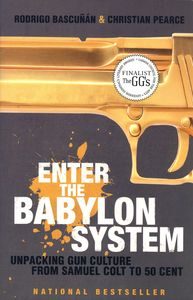
    Enter the Babylon System, Rodrigo Bascuñán & Christian Pearce

    Vintage Canada, 2007, 360 pages, C$22.00 tpb, ISBN 978-0-679-31389-2

    The link between guns and modern hip-hop is as obvious as the genre’s music videos, but serious explorations of the subject aren’t quite as common. While the subject is good for alarmist sound-bite news reports, a serious exploration of the subject would require journalists with some understanding of hip-hop culture and the capability to analyze both the statistics and the human elements of the situation.

    Fortunately, that’s exactly what we get from Rodrigo Bascuñán and Christian Pearce’s Enter the Babylon System, a book-length exploration of the link between urban culture and firearms. “Unpacking gun culture from Samuel Colt to 50 Cents”, as the subtitle suggests. Both authors are co-owners of Pound, “Canada’s largest hip-hop and urban culture magazine”, which speaks well of their interest and affection for the culture put under the microscope. But if you were expecting the kind of mealy-mouthed excuse that so often seems to come from groups under fire, think again: Both authors are quick to admit that there is a problem in hip-hop’s fascination for guns. The opening pages of the book make it clear that gun culture has a price measured in lives, as innocent bystanders and not-so-innocent criminals are both caught in the crossfire. The authors aren’t interested in denying the link between guns and hip-hop: They’re keen, however, on exploring the roots of that fascination, and its consequences.

    After a vastly entertaining introduction that hints at the decidedly entertaining style in which the book is written (mixing statistics, news reports, hip-hop lyrics, artist interviews and well-penned editorializing), the book spends its “first chamber” discussing “the trade of the tools”: The weapons so often rhapsodized about. Readers who can’t tell the difference between a Glock and an AK-47 will be well-armed after reading a chapter that takes a hard look at weapon manufacturers, their products and their self-serving rhetoric. Latter meaty chapters discuss the gun distribution circuits (a process that involves a surprisingly low number of known crooked dealers), the way guns are depicted in popular culture outside hip-hop and the myriad of ways guns are used, from crime to suicide to military operations.

    It’s a lively, entertaining, enraging book. Definitely written from a Canadian perspective, Enter the Babylon System doesn’t even attempt to excuse facilitators of gun violence. It’s difficult to come away from the book, for instance, without feeling that the NRA, regardless of it’s members’ purest intentions, is a borderline psychotic association that has taken a pro-violence mandate that goes far, far beyond protecting gun owners’ rights. The United States are quite naturally blamed for the influx of illegal gun in Canada, but one of the book’s surprises is an exploration of Canada’s home-grown gun makers.

    Unfortunately, the book sometimes steps upon its own qualities. Utterly knowledgeable about hip-hop culture, the authors often assume the same understanding from their readers. And, as entertaining as the author’s style can be to read, some transitions and linking passages can feel forced and deliberately opaque, dampening the reading experience.

    But even with those minor issues, Enter the Babylon System is a brilliant piece of engaged investigative journalism. It weaves together an impressive amount of material into a compelling storyline, one that goes beyond easy summaries to truly delve into the roots of gun culture. It’s compelling reading about a distasteful subject, and it’s a shame that the book was only published north of the frontier rather than down south where it could do some greater good.

  • Implied Spaces, Walter Jon Williams

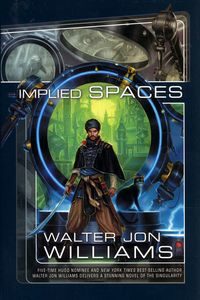
    Implied Spaces, Walter Jon Williams

    Night Shade, 2008, 265 pages, US$24.95 hc, ISBN 978-1-59780-125-6

    It’s not entirely true that Walter Jon Williams has been away from Science Fiction for a long time; it just feels that way. In the years since Aristoi (1992), Williams has written a space-opera trilogy, several well-received short stories, a mainstream catastrophe novel, a Star Wars novel, a yet-unfinished urban fantasy series and has been involved in writing alternate reality games. But from a certain viewpoint, Implied Spaces looks like William’s first standalone far-future pure-SF novel in sixteen years, and it’s somewhat of a return to form for him.

    If Aristoi was ten year ahead of its time, Implied Spaces often feels like a mix CD of the coolest bit of contemporary SF. It first looks like epic fantasy, but is eventually revealed to be far-future pure Science Fiction, with an immortal adventurer slumming in artificial worlds with a powerful sword and an even-more-powerful cat to his side. Before the story is through, we’ll deal with a renegade AI, zombies, grandiose space battles, and oodles of other stuff in a relatively short 265 pages. S.M. Stirling, in his back-cover blurb, calls it a “Sword & Singularity” novel, and it’s a better description than most.

    What’s certain is that Williams is having fun: the entire novel is written with a carefree eye toward fancy set-pieces and high-tech twists blending together the entire catalog of modern SF tricks and gadgets. It’s a fast read, and one that gets more than a few smiles along the way.

    It’s also a great deal less conventional than you’d expect. Thanks to the novel’s post-human artificial environments, the structure of the story seems to oscillate between set pieces in exotic locales, followed by quiet chats in relaxing rooms where the novel’s stakes are raised and explained. Once the pattern becomes clear, it almost starts being amusing as the story’s Big Ideas become nothing more than exposition sequences forming the connecting tissue between otherwise-unrelated fantasy sequences. One wonders if the novel could be adapted for the theater with a few minor tweaks.

    But peer closely at the novel’s architecture, and something else emerges: the awful suspicion that we’re in the hands of an author deliberately aiming at fan-favorite targets. AI using a cat proxy? Check. Pirates, ninjas and zombies? Check. Antagonist/Protagonist? Check. “Using a star as a flamethrower” [P.183]? It was awesome in E.E. Doc Smith’s time, and it’s just as awesome today.

    It’s terribly unfair to suggest that Implied Spaces is a made-to-order romp that uses the familiar elements, or “power chords”, of contemporary SF in a deliberate and calculated fashion. But up to a certain point, Williams’ last spate of novels may have conditioned readers to think of it in that fashion: Since 1999’s The Rift, Williams has been trying to reinvent his career in different fashions, with media tie-ins and a military SF trilogy cold-bloodedly similar to many best-selling such series. Assuming the worst, which is to say an author deliberately returning to the heart of genre SF by writing a novel playing with the last decade’s buzzwords, it’s still not a bad thing: Implied Results is an interesting and entertaining novel, and it seems to have garnered Williams some of his most sustained genre attention in years.

    SF writers have always written to market, and there’s nothing wrong with that —except when the rivets show. Frankly, it’s good to have Williams back in the genre-SF pool, competently speaking the language and riffing off the sense-of-wonder expectations of his readership, earning a place alongside the current heavy hitters of the genre. It may or may not be from the heart, but it’s certainly worth the price of a hardcover book.

  • The Bonfire of the Vanities, Tom Wolfe

    The Bonfire of the Vanities, Tom Wolfe

    Bantam, 1987, 690 pages, C$6.95 mmpb, ISBN 0-553-27597-6

    I’m not sure what makes a middle-brow classic, but I think that The Bonfire of the Vanities qualifies on most counts. Let’s see: it was widely-reviewed, sold really well, was adapted in a big-budget Hollywood movie (which tanked spectacularly, forever earning another place in history) and has earned 155 amazon reviews so far, which it pretty darn good for a book published ten years before the whole Internet thing took off. Better yet: Tom Wolfe is still writing and commanding attention today, lending further heft to the importance of his first novel.

    The assignment, should we choose to admit it, is to read 1987’s The Bonfire of Vanities and see how well it holds up today. Once the novel has moved from contemporary headlines to historical context, does it retain the energy of the period, or does it fade away in irrelevance?

    The Bonfire of the Vanities certainly feels like it couldn’t exist anywhere but in mid-eighties New York. A pre-Guliani New York riddled with crime and racial tension, home to the poorest and the richest, playground of the self-styled “Masters of the Universe” ruling over Wall Street and, by extension, the rest of the world. Sherman McCoy is one of those men to whom everything is owed: He can make multi-million commissions by moving around billions of dollars in government bonds, eking out massive profits from razor-thin percentage fractions. He lives in a multi-million-dollars apartment that he can barely affords, owns the requisite Mercedes and has a just-as-requisite affair with another married woman. But a late-night tryst turns sour as he makes a wrong turn in the Bronx and his car ends up hitting a young black man. Outraged media reports quickly lead to an investigation and a very public trial of Sherman’s entire life. In the process, we get to study New York society in action, as Sherman becomes the focus of the media, is thrown to the wolves by his former acquaintances, tries to salvage his honor and loses everything along the way. Right, wrong, fair or unfair become distant considerations in the face of a hefty look at that society at that time.

    But beyond a modest crime story anchoring a rich study of characters in distress, The Bonfire of the Vanities is written with self-conscious verve. Passages are written in quasi stream-of-consciousness style, allow us inside the confused minds of the characters. Sherman is quickly exposed as an insecure man barely holding on to his social position. His latter passage through the New York prison system is as harrowing a sequence as anything written in a suspense novel. As flawed as he is, Sherman almost looks like a hero compared to the venal and petty characters that surround him.

    The novel is filled with terrific set-pieces, lucid explanations of the way things really work, from the stockbroking room to the justice system or the complexities of upper-society New York. Tom Wolfe may be a media-friendly self-promoter, but there’s a real interest in his prose, even when it becomes flashy and self-indulgent to the detriment of storytelling. It succeeds where other writers would fail miserably, and remains interesting even when it loses its way.

    So, yes, The Bonfire of the Vanities is still worth a read even today. It’s a terrific throwback to another era, and a novel that manages to combine ambitious literary goals with a clear and intriguing storyline. The set-pieces are terrific, and the prose is unique. Ah, if all mainstream fiction was just as good, I may never need to read genre fiction again…

    [October 2008: Amusingly, I ended up reading The Bonfire of the Vanities at the beginning of the Credit Crisis of 2008, a time where Wall Street finance salesmen ended up in the news again. Strikingly, a good number of the articles and news reports discussing the crisis (nearly 2000 as I trawl news.google.com in mid-October) referred to the brokers as “Masters of the Universe”, the expression coined by Wolfe in the novel. Now if that’s not a proof of an enduring classic, I’m not sure what is…]

  • The Brief Wondrous Life of Oscar Wao, Junot Diaz

    The Brief Wondrous Life of Oscar Wao, Junot Diaz

    Riverhead, 2007, 340 pages, C$15.50 tpb, ISBN 978-1-59448-329-5

    During the summer of 2008, the drums of the genre-SF critics starting passing along shocking news: for the second year in a row, the Pulitzer prize for fiction had been given to a geek-friendly book. A year after Cormac McCarthy’s The Road, it was Junot Diaz’s turn to walk away with the prize for The Brief Wondrous Life of Oscar Wao, a mainstream novel about a genre-obsessed nerd. After earning raves from the mainstream press, the novel then proceeded to win over SF reviewers, who got a copy from the general fiction stacks and Declared It Good.

    There are plenty of reasons to be so enthusiastic: Diaz’s first novel is an enthralling mix of multi-generational family history, immigrant experience, macho storytelling and geek references. It’s got a little bit of magical realism in-between tales of the Dominican diaspora and American geek name-dropping.

    At a distance, the story is simple, as narrator Yunior tells the story of the titular life of Oscar Wao, a former roommate whose life was shaped both by a terminal case of geekness and a family curse dating back to 1940s Dominican Republic. The story moves both forward and backwards in time, following Oscar in one direction as his life begins in 1974, and up generations as the tale discusses Oscar’s Mother’s childhood and then deeper in time to Oscar’s Grandfather’s life immediately after World War 2. Three shadows always loom over the narrative: Oscar’s own shortcomings (especially in the romance department), the terrible legacy of Dominican dictator Rafael Trujillo and the even more unnerving menace of the fukú curse placed over Oscar’s family. As the title suggests, the story may not have an entirely happy ending.

    But don’t get the impression that this a dour novel, because The Brief Wondrous Life of Oscar Wao shines brightest when the narrator’s confidently sarcastic voice goes riffing on the beauty of Dominican women, the absurdities of life under Trujillo or Oscar’s burgeoning nerdiness. Yunior, we’re supposed to understand, is the type of pure Dominican male who hits the gym thrice weekly, knows the hippest clubs and leaves a trail of conquered women. (If the novel will have a weakness for some readers, it’s that it’s written in a very masculine voice.) Yet when comes the time to tell the story of Oscar , nothing short of SF&F references will allow Yunior (who refers to himself as a Watcher) to do justice to the tale. So one gets to read passages such as…

    Beli, who’d been waiting for something exactly like her body her whole life, was sent over the moon by what she now knew. By the undeniable concreteness of her desirability which was, in its own way, Power. Like the accidental discovery of the One Ring. Like stumbling into the wizard Shazam’s cave or finding the crashed ship of the Green Lantern! [P.94]

    If nothing else, The Brief Wondrous Life of Oscar Wao features the strongest narrator voice you’re likely to read this year, a near-perfect blend of literary ambitions and genre references. I don’t think I’ve ever read a novel quite like this, nor one that exemplifies some of the best aspects of (North-)American culture blending like this one. It’s both a terrific mainstream novel and an even more fulfilling geek-friendly novel. A full understanding of the novel is probably impossible outside comic-friendly hip Dominican readers, but don’t let that dissuade you from giving this novel a read. It’s got much to teach to anyone who thinks the values of mainstream literature are incompatible with genre readers.

  • The Accidental Time Machine, Joe Haldeman

    The Accidental Time Machine, Joe Haldeman

    Ace, 2007, 275 pages, C$8.99 mmpb, ISBN 978-0-441-01616-7

    Joe Haldeman may be an acknowledged master of Science Fiction, but his work has been quite uneven over the past decade an a half. This, of course, is a polite way of saying that he’s capable of the worst (Forever Free), the dull (Forever Peace), the competent (Camouflage) and the intriguing (The Coming) without warning. One never quite knows what to expect from a Haldeman novel, largely because he rarely attempts sequels or series, but also because his track record so far spans the entire range of critical opinions.

    So to say that The Accidental Time Machine is a surprise isn’t entirely surprising. The title is accurate, given how it describes the adventures of a young disaffected MIT student stuck with a sophisticated custom-made lab device that surprisingly ends up sending itself forward in time. As Matt Fuller discovers, this machines works according to precise rules: Every time he activates it, the machine sends itself in the future for a duration twelve times that of the last jump. From micro-second jumps, Matt activates the machine to jumps days, weeks, months and then years in the future. Then things get interesting.

    The most obvious attraction of The Accidental Time Machine is the time travel element itself. As Matt jumps from era to era, the world changes, slightly at first, then more radically as the jumps span decades and centuries. Many readers loved it when the protagonists of Haldeman’s The Forever War came back home from decade-long missions only to find utterly transformed societies, and this novel occasionally offers the same kind of conceptual kick. Matt goes through theocracies, post-scarcity economies and strange far-future adventures, and the result is a satisfying grab-bag of speculations, none of them radically new, but all intriguing to some degree or another.

    But the real star of the book, for once, aren’t the ideas as much as the characters experiencing it. Matt is our anchor through the novel: recently single, generally apathetic, troubled by job problems, Matt is the ideal character to send through progressively farther futures. He’s both smart enough and isolated enough to look forward to the next jump. He learns much during his trip, including how to woo a comely young woman he accidentally picks up during his jumps. The conclusion, which would have been a nightmare from certain perspectives, ends up being a true charmer in great part because our characters are so happy through it all.

    It’s no accident if “charm” ends up being The Accidental Time Machine‘s single most distinctive trait. It’s a short book in an age of bloated monstrosities, and it flows without a hitch. Haldeman’s prose is classic stripped-down elegance, and there’s no reason to stop reading. This is partly a throwback to an earlier kind of SF, but not necessarily a less-successful piece of work. Even with a subject so familiar as time travel, Haldeman finds a few clever wrinkles and wisely doesn’t neglect his characters. While The Accidental Time Machine may not create the kind of gob-smacked admiration as more ambitious contemporary works of SF, it’s got most other contenders beaten down in sheer likability. This is mid-list SF as it should be: Accessible, interesting, short and warm. Readers who have been let down by some of Haldeman’s latest few books ought to be pleased by this one.

  • The Execution Channel, Ken MacLeod

    The Execution Channel, Ken MacLeod

    Tor, 2007, 285 pages, C$31.00 hc, ISBN 978-0-7653-1332-4

    Trying to discuss Ken MacLeod’s The Execution Channel is a lot like chasing a slippery bar of soap over a slick floor: It never stays still, defies any strong grip and presents serious potential for bruised shins in the effort. The novel cloaks itself in misleading genre protocols before revealing itself to be something entirely different, shoving optimism where readers have been conditioned to expect the worst. Alas, a good case can be made that the novel is never as good as when it’s being really, really awful.

    Like all of MacLeod’s novels so far, it’s an intensely political piece of work. But unlike most of McLeod’s books so far, it’s a near-contemporary thriller that benefits from our familiarity with today’s world. Taking place in a near future where terrorism has grown even more vicious, The Execution Channel begins with a nuclear detonation on British soil, then follows a group of characters as governments go through an acute period of rage in trying to identify and catch the terrorists. There’s a conveniently well-connected family at the center of the story, one with a pacifist daughter, a solider son and a traitorous father. But there’s also a coordinated disinformation effort, a few conspiracy theorists, strong international tensions and a mysterious “execution channel”.

    One thing’s for sure: MacLeod can do dark like few other writers. From the opening pages, we’re presented with a world that teeters on the brink of irremediableness, a world where the value of bad information has become higher than the true story. A world where viewers can tune in to a channel that solely presents violent executions. A world where conspiracy theorists are markedly better-informed than their saner relatives. A world where paid government operatives deliberately seed misinformation on blogs. A world racing to nuclear war and ever-more powerful weapons. “The War on terror is over. Terror won” says the front-cover blurb, and the impact is profound: Reading The Execution Channel is like taking an all-expense trip to a vision of how bad things could get within half a decade.

    It’s written like a techno-thriller and reads like a particularly paranoid one: MacLeod has never been so accessible and so depressing. It uses just the slightest amount of future shock to sends current trend to a break point, and seeds just enough new ideas into the mix to please SF fans.

    But if The Execution Channel looks like something at first, it doesn’t necessarily mean that it will stay like that until the end. Throughout the course of the book, MacLeod betrays expectations three times. The first betrayal, that of the world in which the story takes place, is more amusing than consequential. The second betrayal, which shifts the novel’s genres in a fairly spectacular fashion, is clearly announced both by the author’s pedigree and by significant in-story clues. It’s the third betrayal that hurts most, ironically by providing an optimistic conclusion after nearly three hundred pages of increasing grimness: By that point, the fact that some characters will survive the story seems like a disappointment after so much grimness.

    The biggest irony is that The Execution Channel serves the exact same science-will-save-us-all conclusion that’s been one of SF’s most reliable motif over its decades of existence. But by juxtaposing it onto a realistic framework of real-world horrors, it makes it feel hollow and undeserved. Whether this is reading a message where none were intended, or if the author is trying to tell us something about SF readers’ unrealistic expectations, is left to the reader to articulate.