Book Review

  • The Surrogates, Robert Venditti & Brett Weldele

    The Surrogates, Robert Venditti & Brett Weldele

    Top Shelf, 2008, 256 pages, US$19.95 tpb, ISBN 978-1-891830-87-7

    Good news, bad news: The Surrogates is a decently-imagined standalone Science Fiction story that deals with intriguing themes and stands alone away from superhero fantasies. On the other hand, the rough art is a tough sell in this era of slick computer-shaded photorealism, and the story has fairly embarassing plot holes.

    As the mainstream comics publishing industry matures and tackles other things than the superhero fantasies that have been their backbone for the past few decades, one of the most promising developments has been the trend toward limited series later collected in trade paperback. The Surrogates was originally published in 2006-2007 by Top Shelf Comics, and this trade paperback collects all five issues of the miniseries along with extra making-of material.

    The subject matter is intriguing: tackling the familiar SF idea of remote-controlled bodies, The Surrogates imagines a world where such technology has passed in common use: People purchase custom robotic bodies and stay home, living through their surrogates and their enhanced physical attributes. As the story begins, a masked criminal in Atlanta is destroying surrogates for reasons of his own. A policeman placed on the case quickly finds out what it means to live “for real” again when his surrogate is destroyed during the investigation. He suspects the intervention of a nearby preacher who cautions followers about mediated lives, but the truth is more complex than it appears.

    The problem with comics tackling SF themes is that, bluntly speaking, they’re usually well behind the times in terms of genre sophistication. The Surrogates, as strong as it is in a few areas, is a perfect example of those issues. It’s never quite credible in making us believe that less than fifty years from now, everyone will be using surrogates whose components can be traced back to one company. Real technology diffuses into the real world in complex ways: there’s competition, multiple models, people who refuse to buy into the new technology and various other knots of complexity. I, ROBOT (the movie) was similarly dumb in its treatment of its principal plot device, and for the same reason: the plot hinges on One Way, One Truth and One Answer. Point out that, well, there’s an awful lot of iPod clones on the market today and the plot of these stories crumbles away.

    Hence my dubiousness regarding the extrapolation in The Surrogates. From a written-SF fan’s perspective, it doesn’t help that the idea of surrogates have been explored in many stories for decades. It’s not an entirely original plot device. Anyone looking at the last decade alone can unearth Laura J. Mixon’s Proxies, David Brin’s Kiln People and (tangentially, but vigorously) Richard Morgan’s Altered Carbon as examples of the form, and that’s not even going into short stories.

    But it is new in the comic book universe, and what matters is what the writer does with it, right? Fortunately, writer Venditti does better when comes the time to makes his characters come to life: His lead protagonist is a credibly beaten-down policeman who learns to re-discover his outer humanity, and the plot involves a good variety of interesting characters. Preachers are often mis-used in SF and The Surrogates doesn’t escape that trap, but at least it does something unexpected with it.

    But where The Surrogates will really divide readers is at the surface level of the art, which is an odd mixture of pen sketches and computer-enhanced coloring. I found it dreary, unfocused and unpolished, like being stuck in a nightmare —but looking at other reviews, I see that it’s an approach that has fans. It’s a good thing that the script is the strongest part of The Surrogates: careful buyers will flip through the book before purchasing it to get an idea of whether they’ll have an allergic reaction to the art.

    Despite everything, The Surrogates is worth a look to see where the comics medium is going regarding authentic SF ideas. It’s not entirely successful, but it’s a great deal more ambitious than most SF graphic novels on the market, and when it work, it really works.

    (You won’t be surprised to learn that the big-budget movie adaptation will feature Bruce Willis and come out in summer 2009.)

  • A Theatre Near You, Alain Miguelez

    A Theatre Near You, Alain Miguelez

    Penumbra Press, 2004, 370 pages, C$45.00 hc, ISBN 1-89413-138-X

    I must have passed on Alain Miguelez’ A Theater Near You in local bookstores for two or three years before finally buying it. As a lavishly-illustrated specialized publication from a boutique publisher, this wasn’t a book I could hope to see on sale at some point. What’s more, I do have a deep interest in the book’s subject matter: I spend most of my waking hours in Ottawa, and I’m a steady moviegoer: A book about “150 years of going to the show in Ottawa-Gatineau” is almost tailor-fit for my tastes, even if it ends up being one of my most expensive books purchased so far.

    Fortunately, it’s worth every penny. Miguelez’ history of movie-going in the Ottawa area is a superbly-produced book that will certainly become the last word on the subject. It’s unbelievably well-researched (with 424 endnotes spread over ten pages), filled with a variety of historical facts, and it understands the economic, civic and cultural ramifications of its subject. A Theatre Near You deals perfectly with the language issues particular to Ottawa, demonstrates a keen understanding of the city’s history, and logically packages a complex subject in an easily-digestible structure. Its readability is also enhanced by clever graphic design: Nearly every single one of its pages sports visual material of some sort.

    It starts earlier than anyone would expect, going back all the way to the mid-nineteenth century theaters founded when Ottawa was still lumberjack-shack Bytowne and Canada was still a vague notion. Miguelez then moves on to the electric era with the Nickelodeons, then the “Early Legitimate Cinemas”, the “Downtown Picture Palaces”, the “Talking Picture Theatres”, the “Post-War Theatre Boom”, a quick unabashed look at the wave of “Porno theaters” that briefly flourished when single-screen theaters tried to survive in difficult times, then the “Theaters in Malls and Office Complexes” and finally the current “Megaplexes” era.

    Miguelez was able to sketch portraits of these eras with historical documentation and occasional memories from people who went or worked at those theaters. Each theater in Ottawa’s history (!) gets its own section, and the result is highly satisfactory. Miguelez himself becomes part of the story when discussing the closure of the Elgin or the Sommerset, and his first-hand knowledge of theaters in the area becomes more and more obvious as we move closer to the present day.

    For the historical buff, A Theatre Near You is a fascinating open door on Ottawa’s history, and the place of cinema in the Canadian capital’s cultural life. Even longtime Ottawa residents may be surprised to find out about such things as the Russell Hotel, or the now-gone Canal Street. (The postcard illustrations of downtown in the first third of the book are amazing.)

    I obviously never paid enough attention to my local history, because I was gob-smacked to find out about the existence of Le Français, the Regent or the 2,000+-seats Capitol and amazed at how much of Ottawa’ past cinema history remains visible in downtown today. The strange empty space next to the upper-Bank Street Staples is explained in this book, and if I stretch my neck a bit from my cubicle, I can see the empty space left behind the gas explosion that destroyed the Odeon in 1958. Those historical fact progressively mesh with my own memories as I recall the Sommerset (where one can now purchase milk where I was sitting at the premiere of GO in 1999), the Elgin sign that still stands proudly or the wonderful Mayfair still kicking after decades of continuous showings. One can easily imagine a walking tour of downtown pointing out the dozens of past theaters, some of which are still standing. (One of the most intriguing bits in the book is the suggestion, perhaps fanciful, that the Place de Ville theater has been mothballed, “the cinemas still in place, waiting for another tenant to occupy the space.” [P.311]) [January 2014: As of early 2014, the Place de Ville theater still exists in its mothballed state, albeit maybe not for long as this Ottawa Rewind article and this subsequent CBC news article suggests.]

    General movie buffs may be more interested in learning that Ottawa may have been the site of the first public motion picture projection in Canada:

    “Ottawa brothers Andrew and George Holland pioneered movie exhibiting in Canada. With their Edison license, their kinescope shows on Sparks Street were Canada’s first contact with the moving pictures. Holland Avenue is named after them.” [P.83]

    More recently, Ottawa’s grandiose Capitol theater hosted many Canadian movie premieres. Best yet: There are credible arguments that the first Canadian multiplex was Ottawa’s own Elgin theater. (What is certain is that the owner who had the bright idea of creating “The Little Elgin” went on to become the president of the Cineplex chain.)

    Despite a few annoying typos, a lack of an index and passages that could have been re-written once more, especially near the end of the book, A Theatre Near You is easily one of my favorite books of the year. I doubt that it will be particularly interesting to anyone outside the Ottawa area, but it’s the best book one could imagine on its particular subject.

    It’s also likely to remain the definitive book on Ottawa-area theaters for the same economic reasons that are explained throughout the book: With the progressive passage of films to the digital realm and the consequent acceleration of direct digital distribution, I don’t think that we’ll get many more new theaters in the area. Since 2004, only one theater has opened in faraway Barrhaven, and despite the revival of the St-Laurent multiplex as a discount theater, the 2006 shake-up in theater ownership only suggests a dwindling market: The Mayfair and Rideau always feel on the verge of closing down, and plans for a new downtown picture house have not materialized. Once day-and-date direct digital distribution becomes commonplace (something that may be as near as five years away), theaters will become a charming upscale throwback to an earlier area.

    But even if that happens, A Theatre Near You will be there to testify about cinema’s history in the Ottawa area. If you are or know an Ottawa-based cinephile who likes history, this is a perfect gift idea.

    [January 2009: Alain Miguelez was kind enough to write and acknowledge the review. Thanks!]

  • Saturn’s Children, Charles Stross

    Saturn’s Children, Charles Stross

    Ace, 2008, 323 pages, C$27.50 hc, ISBN 978-0-441-01594-8

    One of the most vexing issues to face genre SF these days is the necessity to put away outdated futures. Seminal writers in the fifties may have have imagined glorious visions of housewives in space, but we know a bit better: We know that housewives will be rare in the future, and we suspect that space travel is likely to remain impractical for humans. Any modern SF writer worth his books’ cover price has to stop and consider whether the ideas hardwired in the collective DNA of the genre are still possibilities knowing what we know now.

    Charles Stross is one of the smartest genre SF writers on the market today, so it’s a delight to see him come up with a novel that squarely confronts those issues in Saturn’s Children. It’s an updated homage to Heinlein and Asimov that seeks to tie classic extrapolations to a future we can still imagine from today. It’s a romp, it’s typical Stross (perhaps too-typical Stross) and it’s a terrific read for those weaned on classical SF.

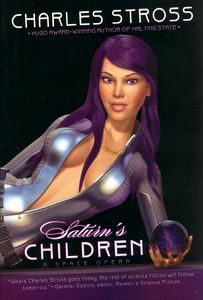
    While perfectly readable on its own, Saturn’s Children is best appreciated with a curriculum of previous reading experiences. Since it’s an explicit homage to Heinlein and Asimov, it’s best appreciated with some knowledge of those authors. In particular, it features a heroine, Freya, with strong similarities to the titular heroin of Heinlein’s Friday (the cheesecake cover of the American edition of the book may be too outrageous for some, but it is a blatant reference to Michael Whelan’s infamous Friday cover), tours the solar system much like in Heinlein’s The Cat Who Walks Through Walls (along with descendants like John Varley’s The Golden Globe) and freely quotes attitudes from much of Heinlein’s middle-to-late period. Since Saturn’s Children also riffs on the power chords of the Three Laws of Robotics, familiarity with Asimov’s I, Robot is suggested.

    It begins as narrator Freya contemplates suicide. You would too if you were in her situation, a female sexbot created to serve the needs of a human race that has since disappeared, now stuck above Venus with little means to her credit. Fortunately, Freya is one of many fembots cast from the same model, and they try to help each other when they can. Shortly after being summoned by one of her sisters, Freya is stuffed in a ship and sent off to Mercury, where her Grand Tour of a post-human Solar System only begins. Fans of Stross’ work won’t be surprised to learn that espionage, thrills, secret identities, romance and high-tech jargon are all included in the tour. The prize is a dazzling recasting of Heinleinian and Asimovian themes in something that feels convincingly modern, up to an including a neat extrapolation of the social vulnerabilities of Asimovian-wired robots left without human masters.

    Saturn’s Children is most distinctive when it points and smirks endearingly at the trail left by Heinlein, Asimov and other well-respected SF legends. Heinlein’s well-known quote about the need for humans to be generalists is upended with a rude reference to trading other people’s skills for sexual acts. Other specialized jokes abound: A crucial poultry-shaped MacGuffin is referred to as a “Plot Capon” while the threat of humans being genetically re-created becomes “pink goo”. And so on; even if this a standalone book, the more you remember about SF, the more jokes you’ll get.

    As a Stross book, it’s largely what fans have learned to expect from the author: it hits the usual techno-jargon, humor, romance, thrills and hints of horror that figure so often in his work. Readers who loved his previous books will completely satisfied by this one. (Conversely, those who still don’t get what Stross is trying to do won’t be any closer to an answer with this one.) Stross has attained the status of a reliable author a while ago, but at the price of delivering excellent novels that are perhaps a bit too similar. From an uninformed perspective, Stross writes very quickly: due to a number of factors, his fans have enjoyed twelve novels in six years, an insane pace that doesn’t allow any margin for error. As a result, Saturn’s Children may be superbly entertaining, but also feel just a bit too familiar to be truly impressive. (On-line chatter suggests that he’s aware of the issue and is about to slacken the pace a bit, which should be for the best.)

    Small quibbles about Stross’ prodigious writing output aside, Saturn’s Children is another solid hit for him, and a superb example of genre Science Fiction at this moment in time. It makes interesting use of familiar tropes with contemporary thinking, and it’s a wonderful read from beginning to end. Stross has been accumulating fans ever since coming to prominence with his first novel, and this merely keeps up his winning streak.

  • From the Notebooks of Dr. Brain, Minister Faust

    From the Notebooks of Dr. Brain, Minister Faust

    Del Rey, 2007, 390 pages, C$17.95 tpb, ISBN 0-345-46637-3

    This, dear readers, is the decadent era of the superhero in pop culture. There are now so pervasive, such a part of the entertainment-retail complex that there is nowhere for them to go but down, preferably in a cloud of ridicule. The symptoms are clear, and clearer as I re-write this in September 2008: After HANCOCK, it’s clear that it’s a free-for-all in the superhero field, and notwithstanding oddities like BATMAN RETURNS, it’s clear that humor is one way of dealing with a now-overly familiar topic.

    That’s tying Minister Faust’s From the Notebooks of Dr. Brain to a heavy conceptual framework, but it’s also true that Faust is perverting the comic-book superhero tradition in two ways in his second novel, one of which is obvious from the get-go, with the other becoming apparent only as the novel goes on and maintains a facade of false humor.

    (Readers overly sensitive to spoilers may want to skip ahead to the last paragraph of this review.)

    The first of Faust’s hacks on the superhero form is well-presented in the packaging of the novel. Written as if from the pen of “Dr. Eva Brain-Silverman”, psychologist to superheros, From the Notebooks of Dr. Brain is re-titled Unmasked! When Being a Superhero Can’t Save You From Yourself and presented as a self-help book for the average hyper-hominid. If you’ve read any pop-psychology book before, this will feel instantly familiar, as Dr. Brain can’t help but structure her narrative around common super-heroic psychological issues, and pepper the narrative with a thick cloud of well-titled syndromes and cute acronyms.

    It’s not your average self-help book though, because it does tell a story. As Dr. Brain is tasked with treating the dysfunctional relationship of the top members of the Fantastic Order Of Justice (FOOJ), some of whom are not meant to be riffs on existing superheroes. Who would associate Batman with pro-fascist The Flying Squirrel? Who could recognize Superman in the quasi-moronic Omnipotent Man? There isn’t any link at all between Wonder-Woman and Iron Lass! Well, oh, okay. (Other winks to superhero canon are peppered through the narrative, two of the earliest ones being “the city of Los Ditkos” and the “Crisis of Infinite Dearths.” )

    But as Dr. Brain deals with her super-powered subjects, another external threat emerges, linked with the escape of super-villains, an upcoming election within the FOOJ and the death of one of the greatest superheroes of all times. What happens as the novel goes on become stranger and stranger, as one of the story’s most lucid character is systematically belittled by the narrator. The character’s racially-charged rhetoric may be overt, but it’s strange to see him marginalized, especially given Faust’s own minority-friendly first novel.

    But nothing is an accident, and the unreliability of the narrator eventually becomes a window through which we understand that Faust’s building an entirely different critique of the superhero genre, one that obliquely discusses the nature and social ramification of the power fantasies implicit in the superhero genre. Brain herself may be either evil or clueless, but that doesn’t change anything to the way the novel says one thing and means another in its closing chapters. It does place readers in a curious position, though: After a fun start, From the Notebooks of Dr. Brain becomes less and less amusing, until the smiles become bitter with resentment.

    As a novel, it’s a clear step up from the occasionally-messy The Coyote Kings of the Space-Age Bachelor Pad. The style is snappy, the characters all have distinctive voices, the twists are striking and the entire novel seems far more controlled. It’s a mystery why Faust hasn’t received more attention for this unnerving, but worthwhile second novel. As a decadent take on the superhero genre, it’s about as good as it gets.

  • Heaven, Ian Stewart & Jack Cohen

    Heaven, Ian Stewart & Jack Cohen

    Warner Aspect, 2004 (2005 reprint), 428 pages, C$9.99 mmpb, ISBN 0-446-61103-4

    I may blow my entire Science Fiction credibility out of the room by mentioning the following, but here goes: I’m not a big fan of alien-centric SF. Strange, isn’t it? But put down those pitchforks and allow me thirty more seconds to explain that one. I’m more interested in the extrapolative aspect of SF; in its ability to illuminate the familiar with the unfamiliar. The problem with alien-centric SF is that is too often feels like a self-satisfied series of tricks that are of interest to the author and few others. “Card tricks in the dark”, to cite the Turkey City Lexicon again.

    Add to that my lack of interest in SF that tackles religious themes (it’s been done before, folks) and that explains why I never really bothered seeking out a copy of Ian Stewart and Jack Cohen’s Heaven. Both authors, respected scientists in their own fields, had previously shown an impressive ability to match scientific speculation with adequate fiction in their first novel Wheelers. I had to wait until I saw a paperback copy of Heaven deeply discounted at a used book sale before committing to their follow-up.

    I shouldn’t have waited that long. Despite a back-cover blurb that suggests a worst-case-scenario of alien-centric SF crossed with pure religion-bashing (“…mariner Second-best Sailor leans this his planet is discovered by evangelists…”), Heaven turns out to be a lot more palatable than my own prejudices had led me to believe. Oh, it’s not an immediately compelling read, at least at first: I ended up re-reading the first fifty pages once I realized that if I hadn’t been hooked by the first few pages, there really was something intriguing going on.

    Once properly set up, Heaven flies by with a succession of neat ideas and better-than-expected plotting. Stewart and Cohen won’t be mistaken for great prose stylists anytime soon, but their affection for their imagined aliens shows through, and it’s a minor marvel that they can make a deeply alien life form so compelling. Their specialty is xenobiology, and it shows in their portrait of a aquatic life-form with a strong kinship to coral. Comfortable with the language, the common assumptions and the writing quirks of genre science-fiction, the authors then proceed to deliver an unusual adventure that plays with the usual tropes of SF.

    It’s not a book that I would suggest to someone who’s new to Science Fiction, since it fills a very intriguing niche in the SF ecosystem: The kind of novel written by practicing scientists, far more comfortable with ideas and conceptual issues than in delivering a standard reading experience. Fans of Hal Clement, Charles Pellegrino or John Cramer’s regrettably few novels will understand what kind of SF this is: the pure bedrock of the genre, crammed with speculations while unburdened by notions of literary respectability.

    And yet explicit comparisons with Cramer and Clement do a disservice to the considerable reading pleasure offered by this novel once the basic language of the novel is established: There are a few neat tricks in Heaven‘s prose, the coolest of which being a discussion between chunks of a planet-spanning intelligence. The novel doesn’t always make sense, but it usually sacrifice logic for hard-hitting visuals: The scene that illustrates the titular “heaven” is nonsense, but it’s an utterly memorable image nonetheless.

    All in all, Heaven ends up being a small surprise. It doesn’t try to be for everyone and so will probably appeal to those who are already familiar with genre SF, but it’s an overlooked delight for that readership. The lesson learned here is that authorship should trump subject matter in choosing a book to read. If you loved something by an author, don’t be afraid to disregard what you think you know about the subject of their next book. You may be pleasantly surprised.

  • The Mirrored Heavens, David J. Williams

    The Mirrored Heavens, David J. Williams

    Bantam Spectra, 2008, 409 pages, C$14.00 tpb, ISBN 978-0-553-38541-0

    I didn’t like this novel and it feels like a defeat.

    I started it with the best intentions, after all: I love high-tech SF thrillers, and everything about The Mirrored Heavens suggested the equivalent of a techno-thriller kicked a hundred years in the future, with super-powered operatives, competent terrorists, tensions between global power blocks and spectacular disasters. It’s got effusive blurbs by authors I like a lot, leading with a front-cover blurb from Peter Watts. I like SF, I like thrillers. What could possibly go wrong?

    Indeed, from some angles, The Mirrored Heavens still feels awesome. The complex power dynamics within the dystopian world described by Williams are credible and unpredictable. The relentless pacing of the book, where crises barely resolve themselves before there’s another rushing at full speed, is the type of breathless rhythm that’s missing from several novels. Some of the set pieces are spectacular in the way only wide-screen action sequences can be. Heck, even Williams’ staccato prose is among the best I’ve read this year. Try this early paragraph for a taste:

    Marlowe opens up on the two suits at point-blank range, his wrist-guns set for flechette swarm. The armor worn by Marlowe’s targets is good. It’s nowhere near enough. Marlowe cuts through it like he’s wielding a giant buzzsaw. The figures he’s facing suddenly aren’t figures anymore. Marlowe fires his thrusters, plunges down the shaft toward what’s left of them. He lands on the roof of the elevator car. He leaps through the open doors from which the dead men emerged. [P.34]

    Now imagine 400 pages like that.

    And that’s part of the problem: As the book’s events accumulated, as the four main characters dispatched entire armies of faceless opponents, destroying chunks of cities and changing the history of their world by their actions, I found myself increasingly numb to the novel’s impact.

    This isn’t normally a problem: My number-one complaint about novels these days is that they’re too long and too dull. 400 pages of action ought to have been a plus, not a minus.

    I finally realized what had been bothering me upon reading the novel’s Appendix, which presents a time-line of world history for the next hundred years. The amazing thing about it is that year by year, item by item, things get constantly worse in order to lead to Williams’ nightmarish future where even the U.S. is under martial leadership. There have been a lot of SF thrillers in the past few years (indeed, they make up most of the output of acclaimed new authors such as Charles Stross, Alastair Reynolds and Richard Morgan), but their menagerie of secret agents and super-powered operatives are usually fighting to preserve or bring about a desirable world: they’re the wolves guarding the sheep with whom the readers are supposed to identify. But there’s no such thing in The Mirrored Heavens: The entire world is bleak and whatever the characters will do won’t change a thing in improving everyone’s lot. It’s like having gunfights and car chases on the deck of the Titanic: they’re all doomed anyway.

    The novel’s other annoyances (a punchy style that never lets up; ridiculously over-powered characters; humorless tone) would not have been problems in other circumstances, but here they feel magnified by the novel’s lack of success in earning at least a bit of empathy.

    On of the toughest skills in being a reviewer is trying to dissociate a personal distaste from a more dispassionate consideration of a work’s strengths and weaknesses. It’s an admirable but futile quest since all reviews are subjective, but trying to explain where The Mirrored Heavens goes astray raises an uncomfortable doubt: The fact that I don’t like it right now doesn’t mean I may not like it in other circumstances; once I won’t be overdosing on SF thrillers, for instance. Fortunately, everything about this book screams of a sequel: we’ll see then if there’s any improvement.

  • Zima Blue, Alastair Reynolds

    Zima Blue, Alastair Reynolds

    Night Shade, 2006, 280 pages, C$17.95 tpb, ISBN 978-1-59780-079-2

    The stories in this Alastair Reynolds collection have two things going for them when compared to the rest of the author’s work: They’re short, and they’re not part of his Inhibitors future history.

    Given that the vast majority of Reynold’s work so far is made of thick fat novels all taking place in the Inhibitor universe, this may sound like damning with faint praise. But my problem with Reynolds’ fiction is simple: His novels are far too long, and they keep happening in a universe that I don’t find particularly interesting. In fact, some of my favorite Reynolds stories so far (Chasm City and The Prefect) and quasi-standalone stories that explore outskirts of the Inhibitor universe. Reynolds is a capable author, but he’d be even better if he showed some control over his prodigiously lengthy output.

    Considering those objections, Zima Blue seems tailored for optimistic nay-sayers like myself. A collection of Reynold’s non-Inhibitor short stories so far (the Inhibitor short stories are in Gollancz’ Galactic North) they offer a look at what he can do with a smaller freer canvas. It’s an ideal introduction to his work, and it may even please those who couldn’t stand the verbiage of his novels. Every one of the collection’s eleven story is accompanied by notes giving a glimpse into Reynolds’ life and inspirations. An introduction by Paul J. McAuley completes the content.

    The two stories that bookend the collection offer a good way to go from the Inhibitors stories to the more varied universes in this collection. The last story, the titular “Zima Blue”, is a meditation about memory and art placed over an imagined universe that teems with possibilities. It’s a companion to the first piece “The Real Story” in that both take place in a fairly optimistic universe in which a journalist named Carrie Clay goes around trying to understand celebrities. (In his story notes, Reynolds hopes to write more of those stories, but warns us not to hold our breath.)

    It’s not the only pair of linked stories in the collection: “Hideaway” and “Merlin’s Gun” share a common character and a baroque space-opera setting, but I regret to say that neither particularly grabbed me. Perhaps the next time I re-read them…

    Given that most of Reynolds’ short-stories so far have been published in the United Kingdom, most of the stories collected here will be unknown to American readers. Of the two exceptions collected in Hartwell and Cramer’s year’s-best anthologies to date, only “Beyond the Aquila Rift” is reprinted here, and it’s just as good now as upon a first read –perhaps even more so, given the big twists. (The other year’s-best story, “Tiger, Burning”, was published too late for inclusion.)

    One story is original to this volume. “Signal to Noise” is a strong and memorable narrative of parallel universes and lost lovers, a rare near-future story that shows a promising direction for Reynolds should he choose to step back from the far-future space opera that has been his specialty until now.

    The other standout piece in the book, “Understanding Space and Time”, neatly encapsulates its goal and appeal in its title. I suspect that this is one of the pieces that immediately serve to distinguish those who love SF for its aspirational attitude toward knowledge from those who just like the stuff for other reasons: It’s both overwritten and simplistic, but I’m reasonably certain that it will leave other SF fans thrilled with a glimpse at the unknown.

    On the design side of things, Night Shade Books should be praised for having been inspired by the design of Reynolds’ Gollanz/Ace books to deliver a cover that fits well on the shelf with the rest of the author’s work. It’s a small detail, but the kind of service that makes Night Shade such a dependable publisher both for readers and authors. Zima Blue is the kind of single-author short story collection what too often gets forgotten by major publishers, much to the detriment of everyone. If it can manage to make me look more favorably upon Reynold’s works… imagine what it can do for you.

  • Hippo Eats Dwarf, Alex Boese

    Hippo Eats Dwarf, Alex Boese

    Harcourt, 2006, 278 pages, US$14.00 tpb, ISBN 0-15-603083-7

    My idealistic streak would dearly love to see a world where truth and accurate information would triumph over lies and nonsense. Alas, the human brain isn’t wired this way, and the mass of disinformation that clogs the Internet is just a reflexion of how, as a species, we’re just not very good at this whole idea of an “objective reality”

    Billed as “A Field Guide to Hoaxes and Other B.S.”, Alex Boese’s Hippo Eats Dwarf is most fascinating as a punchy compendium detailing some of the ways humans lie to each other. It’s profoundly depressing even when it’s hilarious, and it’s an eye-opener even for those who think they’ve seen everything, on or off the Internet.

    The central conceit of the book is to teach readers how to distinguish between hoaxes and reality. (The title refers to a widely-known urban legend in which a set of circumstances lead a hippo to swallow a dwarf. It usually involves a circus cannon.) So each chapter of the book is peppered with “Reality Rules” (eg: “Reality Rule 11.1: There’s nothing real about reality TV”) that are meant to guide readers but actually introduce the next set of anecdotes, incidents, hoaxes and outright falsehoods (mixed with the infrequent truth) that Boese brings together in one handy hyperactive package.

    Generously illustrated and printed in bi-chromic black-and-green, Hippo Eats Dwarf is as entertaining as it’s useful. The structure of the book unpacks itself in bite-sized segments peppered with short definitions, “Case Files” sidebars, question-and-answer “Reality Checks” and sub-categories, along with pictures and illustrations. One can argue about its bilious shades of green, but the design of the book is up to its content in terms of making it as reader-friendly as possible. It’s great bathroom reading, something that the book itself explicitly encourages: “Should you find yourself reluctant to put down this book despite a burning need to go to the bathroom, there is a perfect solution. Read the book on the toilet. You have my permission.” [P.175]

    Such an unpretentious tone works well given the subject, especially when readers are tempted to ask who Boese thinks he is to slice between truth and fiction. As it happens, Boese is a former science history student whose abandoned doctoral dissertation led to a rather interesting career as a self-taught “hoaxpert” whose web site remains a reference point for anti-hoaxers. Hippo Eats Dwarf is the second of his three books so far, but Boese’s slightly-sarcastic tone occupies an interesting mid-point between credibility and sympathy: he may snark, but the acid never overwhelms the wonderful aspect of the things he brings to our attention. The entire thing is remarkably funny.

    Even for those who think they’ve reasonably well-informed about the quasi-infinite weirdness of modern human society, Hippo Eats Dwarf has a number of new stories to tell. Some of them are amazing; others are just depressing as we wonder how, exactly, do people fall for this kind of obviously silly stuff. Despite Boese’s protestations late in his introduction (“the question of why our world has become so hippo-eats-dwarf is an interesting one, but that’s another topic I don’t address at length.” [P.3-4]), this book is a lengthy collection of the variety of reasons why people will prefer to invent, and believe, outright falsehoods. Best of all, it demonstrates such things by an encyclopedic enumeration of practical cases rather than dry academic discussion.

    Contrarily to other books that look good upon browsing and end up flat on close reading, Hippo Eats Dwarf is a solid and content-filled book that delivers upon even its own outrageous back-cover promises. It looks good and leaves an even better impression. It won’t do much to fight against the human propensity to believe nonsense, but it may set a few things straight in your mind. Can you afford to let this book slip by?

  • Neuropath, Scott Bakker

    Neuropath, Scott Bakker

    Penguin Canada, 2008, 306 pages, C$26.00 tpb, ISBN 978-0-14-316871-3

    Scott Bakker’s Neuropath is a heck of a book despite not being much of a novel. Despite being marketed as a futuristic thriller in which a psychologist is asked to fight a serial killer, it’s really more of an argument, a game between the author and the reader. It’s an attempt to undermine the very foundations of the thriller, to deny the very possibility of a free agent in a genre that is predicated on an active protagonist. I admire it a lot despite not caring for it very much as a thriller.

    The first fifty pages are as good as the first few pages of a thriller ever get: Thomas Bible is a psychologist, a teacher and a divorced man trying to make the world better from his children. But everything changes once FBI agents set foot in his office one August morning: They want his help in tracking down a particularly sadistic serial killer who just happens to be Tom’s best friend.

    The twist here is central to Neuropath‘s central theme: Our serial killer knows enough about neurology and technology to hack into his victim’s brain and make them kill themselves with glee. But there’s more, because Tom knows that his friend Neil is not killing other people as much as he’s proving an ongoing argument about the nature of consciousness: For someone convinced that consciousness is an illusion, there can be no guilt in murder. And Tom is the audience for the demonstration.

    If it seems like an intriguing justification laid atop a fairly standard thriller plot, you’re not too far off from the novel’s intent. Bakker is using the latest real-world discoveries in the field of neurology to argue about whether consciousness really exists as a decision-maker, or if it’s rather a set of confabulation and justifications for a set of unconscious behavior. As disturbing as it may sounds, the more we understand about the inner working of the brain, the less consciousness-as-driver seems likely. Neuropath is an attempt to work out the consequences of such a conclusion, and apply them to the framework of a serial killer mystery.

    For the seasoned thriller reader, Neuropath occasionally seems to be doing everything wrong. The novel lathers repetitive exposition sequences, stops dead in its track in-between plot beats, features a main character who can’t be called a protagonist by sheer lack of initiative and reaches a climax thanks to the actions of third parties. Tom has to pop pills to alter his brain chemistry so that he can act, and even that can’t help him but being a witness to the novel’s final moments. You really have to look at the novel at a certain angle in order to appreciate all the genre-tweaking that Bakker does.

    Some flaws remains unforgivable no matter how pernicious the rest of the novel wants to be: Neuropath‘s rhythm stops dead between its first third and last half. The females characters tend to have clichéd plot functions. Much of the exposition repeats itself. The ending seems overly abrupt, missing an extra-sarcastic epilogue. In his rush to overturn the conventions of the thriller genre, Bakker seems to forget that they exist because they work, and that shooting them down carries its own price.

    My suspicion (and hope) is that the novel will find its audience not among the beach readers looking for another crime thriller, but with seasoned critical readers with a good understanding of genre protocols. The philosophical argument carried by the novel is more interesting that the story it tells, and that may not, indeed, appeal to everyone.

    Such is Neuropath: a complex, not entirely comfortable book whose weaknesses aren’t nearly as damaging as you may think, and in fact form part of the novel’s appeal. It may not work all that well as a thriller for various reasons (intentional and unintentional, conscious or unconscious), but I have a hunch that once I’ll tally up my most memorable books of 2008, this one is going to rank fairly high despite its flaws.

    [September 2008: No review of Neuropath should exist without at least a glance at Peter Watts’ Blindsight and a few stories such as Daryl Gregory’s “Second Person, Present Tense”: This “neuropunk” sub-genre of science-fiction is doing some pretty interesting things with the latest research in consciousness, clawing back further and further the notion of free agency and active consciousness. I predict a lot of buzzing around these areas over the next few years.]

  • Wanted, Mark Millar and J.G. Jones

    Wanted, Mark Millar and J.G. Jones

    Top Cow, 2008, 192 pages, C$19.99 tpb, ISBN 978-1-58240-497-4

    This is not your usual comic-book super-hero miniseries.

    Mark Millar has something else in mind. He wants to show you a world where the super-villains have won. He wants to riff off Fight Club and The Matrix in a super-heroic context. He wants to make you cheer for an utterly amoral loser physically modeled after Eminem. He wants to take your money and make fun of you. (Not you, casual reader, but you, comic fanboy with a serious $40-dollar-a-week habit at the comic-book shop.)

    It starts where its readers live, with a lead character who has already been destroyed by modern life: Wesley Gibson is a young man with a steady job and a girlfriend, but both of those things are a farce: his job is an abusive dead-end cubicle nightmare, while his girlfriend is having an affair with his best friend –along others. Wesley’s a hypochondriac, suffers from panic attacks, and doesn’t seem to have any worthwhile hobbies beyond complaining about himself. But a few hyper-violent pages later, things change: A mysterious woman named Fox (whose appearance is clearly modeled after Halle Berry) tells him that he’s the son of a freshly-slain master assassin, and that an all-powerful organization wants him to continue the family legacy. After casually slaying most of a diner in order to prove her claims of legal impunity, she takes Wesley to the organization’s headquarters where he learns that his panic attacks are merely the undisciplined manifestation of an incredible talent for concentration. One issue later, he’s a master assassin (“The Killer”) learning how super-villains have destroyed all super-heroes and rewritten the history of the world to the one you learned in school. Another issue later, and The Killer is embroiled in a war between the last remaining super-villains, a war that claimed his father and may destroy him.

    Wanted doesn’t deal in niceties. It just takes five pages before the first hyper-graphic death. One super-villain has scatological powers. Foul language is pervasive. Fox (and eventually Wesley) have no moral compunction about killing innocents who annoy them. (In describing his training hit-list, Wesley enumerates: “My old geography teacher. The girl next door, that guy across the street who kicked my ass for scratching his old Mustang… The chick who said no when I asked her to a movie, that guy who set his dog on me… My bank manager, my landlord, that Hispanic guy in the record store with the attitude…” The only surprise is that he doesn’t kill his old girlfriend, but there’s a plot reason for that.) Small wonder if the Hollywood movie adaptation made it to screens shortly after the trade paperback, even without the super-villains.

    For a while, it looks like a slickly-produced but irredeemable exercise in pointless nihilism. (Not every Fight Club wannabe understands Palahniuk’s point.) A guilty joy to read, sure. Anything more, though?

    But every review of Wanted mentions the last two pages of the series with good reason: It’s as clear a deconstruction of comic-book fanboyishness as can be printed. It’s a slap in the face of everyone who’s been swept away in the story. In many ways, it’s the series’ chaotic moral center, its final attempt at redemption after an utterly amoral story meant to stroke readers in the most indulging ways possible. It’s what raises Wanted from a mildly interesting power fantasy to a pernicious commentary on such fantasies. [July 2008: And, typically, it’s the only part of the book that the movie adaptation gets completely wrong, transforming bone-cutting sarcasm into crowd-pleasing bravado.]

    It’s that ending that warrants a look at Wanted for anyone who falls outside the familiar stereotype of the comics fanboy. Millar may or may not have pasted a quick cheap tag to a pandering ultra-violent story, but there’s no denying that it radically changes the impression left by the book for the better. And if you’ve seen the film… you haven’t seen anything yet.

  • Strip Tease, Carl Hiaasen

    Strip Tease, Carl Hiaasen

    Warner, 1993 (1996 reprint), 418 pages, C$8.50 mmpb, ISBN 0-446-60066-0

    Submitted for your consideration: the strange idea that some good authors are worth reviewing once but not twice.

    It’s a concept that touches upon the traditional definition of a hack: a professional writer who can be counted upon to deliver what’s expected. Less-kind definitions of “hack” focus on the mercenary intent of the writer as if it necessarily necessarily excluded any quality from the resulting work —but genre readers know better than that. Some professionals quickly learn that good formulas work consistently, leading to writers-as-brand names like Clive Cussler. The experience of reading their books remains consistent from one to the other: if it’s a thrill to read the first one and determine what makes it different from the rest of genre fiction, there’s little to say afterwards, especially in series where real change is kept to a minimum. (Cussler’s last few novels have been worth a review in part because he has started tinkering with his usual approach.) I find myself unable to review Robert B. Parke’s Spenser novels, for instance, even if I absolutely love them: they deliver exactly the same experience all the time: There’s little left to say except “Wonderful, another success in a long series.” In my just-finished quest to review all of Michael Connelly’s fiction at a pace of one novel per month, I often ran out of things to say beyond repeating Connelly’s strengths and seeing how the novels linked to previous books.

    Which generally brings us to Carl Hiaasen’s particular brand of comic crime fiction in that I have never been disappointed by his books, but it’s hard to find anything distinctive to say once a first review has been written. His madcap novels of silly South Florida crimes each feature entirely different plots, generally new characters and strange new Floridian sub-cultures, but they all share a similar feel. All can boast of a large cast of characters, criss-crossing plotting, limpid writing and a light atmosphere nonetheless leading to tense moments. Hiaasen has found a winning formula, and there’s little reason for him to deviate from it. That makes him an utterly dependable authors, and one who deserves a massive monthly back-catalog reading project. Alas, it also makes it almost impossible to review Hiaasen on a monthly basis: There’s a limit to how much space a plot summary can take when the critical content of the review remains the same.

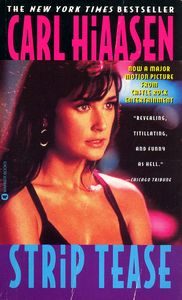
    If I make an exception for Strip Tease, it’s that I haven’t reviewed Hiaasen in years, and I wanted to flag down why that was so. Furthermore, Strip Tease remains to this day the only one of Hiaasen’s non-juvenile crime novels to have been adapted to big screen. I never saw the 1996 film STRIPTEASE, but I can still remember the public titillation at the idea of then-hot Demi Moore playing the lead exotic dancer. Never mind that the movie was a critical flop and a commercial under-achiever: It’s probably still the only Hiaasen title that the vast public can recognize. (“Hey, look, there’s Demi Moore’s on the cover!”) I suppose that there’s something to be written about how Hiaasen’s fine-tuned style doesn’t lend itself to a flat film adaptation, but that will wait until I get to see the film.

    As for the book itself, well, it’s all you’d expect from a Hiaasen novel: Decent characters (including a single mom strip-teasing to support herself and her daughter) faced against antagonists both evil and stupid, complex plotting, wonderful prose style, tongue-in-cheek commentary on the less glamorous side of Florida life, moments of well-executed tension, progressive politics and an epilogue that wraps up everything. No disappointment here: Just a good solid dark comedy. Read one Hiaasen, and that will be enough to tell you if you are likely to love the other ones. (You can even read them out of order.)

    So don’t mind me as I spend the next few months reading through the entirety of Hiaasen’s work to date. Just don’t be surprised if I somehow don’t manage to review every single one of those books. Or if I end up discussing other things than the book when I do.

  • The Yiddish Policemen’s Union, Michael Chabon

    The Yiddish Policemen’s Union, Michael Chabon

    Harper Collins, 2007, 414 pages, C$33.95 hc, ISBN 978-0-00-714982-7

    This book’s a mystery to me.

    Yes, I know it’s a genre mystery: Stories of policemen investigating murders can’t be anything else, even when they take place in an alternate reality where a Jewish state was established in Alaska at the end of the forties. Think of elements of police mysteries, and they’re in the book: the down-on-his-luck investigator, the victim, the mob, the clues, the investigations, the romantic complications… Michael Chabon has written a good solid piece of crime fiction, and that part’s no mystery. And if that’s not enough, there’s bits of fantasy, thriller, science-fiction and romance here and there.

    No, what really grabs me as I finish the novel is how little I cared for it even as I can recognize all of the elements that usually compel me. To put it bluntly, it took me weeks to finish the book. I never felt any desire to pick it up, except for the duty to finish it. Even as I noticed clever bits, they never gave me a reason to be involved with the story. I now read other reviews, and they all seem to be talking about a much better book, even when I can vouch for their factual exactitude. (And that’s why you should really look elsewhere if you’re hoping for a meticulous and dispassionate analysis of the novel’s characteristics.)

    From afar, The Yiddish Policemen’s Union has it all: Murder mysteries? Alternate histories? Geopolitical implications? Bring them on! The idea of an Alaskan Jewish territory is novel enough to be intriguing, and the mechanics of setting a mystery in an exotic settings has worked for other writers from Tony Hillerman on down. Even the Wikipedia summary of the book has me recalling neat moments and telling details.

    But the reality of reading the book is different. Part of it is the Yiddish question. It may seem strange to criticize a book for the density of its imagined cultural references when I’m an enthusiastic graduate from the school of SF With Weird Aliens, but the key is that the Yiddish culture of the book isn’t that imagined. Every page of the novel carried along the sound of specific references whooshing over my gentile head. Every. Single. Page.

    Worse: a lot of the in-jokes and clever references were not decipherable from the text itself, as is usual from wholly-imagined alien cultures. Lack of knowledge is a terrible and difficult thing to admit, but so I must confess for you to understand why I didn’t get from The Yiddish Policemen’s Union the charge that other readers seems to have enjoyed. As I (weakly) edit this review, the novel (a mainstream bestseller) has won the Sidewise, Nebula, Locus and Hugo Awards: an rare coup that suggests that a lot of people actually loved the novel. (Whether it deserves any of the “best science-fiction novel of the year” accolades is another bloody debate for another time.)

    So, hey, I report and you make up your own mind.

    This being said, I’ve got the feeling that this is a book that I may enjoy a lot more the second time around, probably shortly after the movie inevitably makes its way to theaters. That’s the great thing about objectively good books that don’t quite click: there’s always another chance to change our minds.

  • The Resurrected Man, Sean Williams

    The Resurrected Man, Sean Williams

    Pyr, 1998 (2005 reprint), 529 pages, C$28.00 hc, ISBN 1-591-02311-4

    (Read in French as Reconstitué, Bragelonne, translated by Pascal Huot)

    As a reasonably-bilingual francophone with easy access to English bookstores, I seldom have any need to read fiction translated from the original English. But occasionally, some titles slip past me, only to pop up years later in French translation.

    In the case of Sean Williams’ The Resurrected Man, the oversight may be simpler to explain than most: Originally published in Autralia in 1998, the novel was republished in 2005 by Pyr, then a brand-new publisher with minimal distribution in Canada. Things have changed since, but not in time for The Resurrected Man to be readily available or widely reviewed in North America.

    And yet, Sean Williams’ name isn’t completely unknown: In collaboration with Shane Dix, he has written a number of imaginative SF series published by Ace Books. So it wasn’t a complete surprise if The Resurrected Man proved to be so interesting. What was more surprising was to find out by way of a French translation of an American republication.

    A hybrid between classic Science Fiction and police procedural thriller, The Resurrected Man has the merit of taking an idea, and exploring it until all the juice has been squeezed dry from the concept. In this case, it’s all about teleportation: In a future where instant transportation around the globe is the norm, a murderer is making copies of young women in transit, for torture and murder. When a man finds himself in his apartment after months in limbo, authorities are quick to suspect him of the crimes, and if not him, then another copy of him. It quickly gets more complicated.

    One one hand, The Resurrected Man is a beautiful example of extrapolative SF. There’s an entire new world in this novel, a world that turns around a crucial piece of new technology whose facets will drive nearly all aspects of the plot. Williams is merciless in teasing out the implications of his imagined system, constantly racing past the obvious and not-so-obvious plot points. The idea that a copy of our hero may be the killer is brought up no latter than the first fifth of the novel, leaving plenty of time for stranger theories.

    In lazy or inexperienced hands, this way of writing SF can be overly schematic: See novels such as Kevin J. Anderson’ Hopscotch for plot twists that are obvious from the moment the universe is explained. Williams, to be entirely honest, isn’t immune to dumb developments: The book hinges on a basic security flaw, explained by graphs, so glaringly obvious that it would send any self-respecting network engineer in hours of uninterrupted debugging: it’s a small wonder that it’s a tolerated at all in the universe of the novel.

    But small nits aside, The Resurrected Man plays the extrapolation game well and adds an extra layer of geopolitical complexity on top of it: A refreshing mish-mash of cultural influences and non-American slang add flavor to the novel, making it fit perfectly well in this decade’s trend toward more world-aware SF. (I’ll note that several of the most representative books of this trend, from Ian MacDonald’s River of Gods to his Brasyl to Joel Shepard’s Killswitch, all come from Pyr’s group of non-American authors.) I was very amused to find out that bits of The Resurrected Man even take place in Quebec and my Ottawa/Gatineau area. (although, when Williams wrote the book, it was still called Ottawa/Hull.)

    The Resurrected Man‘s checkered publication history let it slip past many genre observers, and that’s a shame: Slickly-written and well paced, it’s a novel that has survived admirably well the past ten years, and which holds up well to today’s more demanding standards. SF purists and fans of futuristic murder mysteries will love it; I, for one, am genuinely sorry that I missed it when it was republished in 2005.

  • Friday Night Lights, H.G. Bissinger

    Friday Night Lights, H.G. Bissinger

    Da Capo, 1990 (2000 revision), 357 pages, C$10.95 mmpb, ISBN 0-306-81425-0

    This is going to sound like a cliché, but trust me: This may be a book about football, but you certainly don’t need to know anything about the sport to enjoy it.

    That’s largely because H.G. Bissinger’s Friday Night Lights is less about football than the people who care about football. In 1988, a thirty-something east coast journalist moved across the country in an effort to spend a year living in Odessa, a small Texas town whose high school football team attracts twenty thousand fans every weekend. For a year, Bissinger would use Odessa’s legendary passion for high school football as a prism through which to study the town. The result of his experience would prove to be even more striking than he expected, mixing sports, culture, class, race, gender and politics in a landmark book.

    For a 1990 book, Friday Night Lights has left quite a mark. Hailed as a significant work (“Sport Illustrated’s #1 Football Book of all Time”, says the back cover), well-adapted to the big screen in 2004, even spawning a well-received TV show, Bissinger’s work has obviously touched a nerve going well beyond “a football book”.

    The reason for this enthusiasm is perceptible from the first pages of the book, as Bissinger’s smooth prose immediately tackles its subject. Not the Permian Panthers football club, but the madness surrounding them in Odessa. The issues facing the town: rusting industries, ingrained racism, feelings of class resentment against the neighboring white-collar town of Midland, and so on. Then there’s the team: Bissinger efficiently portrays the very different young men on the team, and the expectations facing them.

    One of those young men is “Boobie” Miles, an academically-disadvantaged teenager with bright prospects for a football-filled future. The Panthers come to depend on him, which proves to be a dramatic trap when Miles is injured early during the season. This story, out of so many, comes to form the dramatic backbone of the book in-between chapters dealing with bigger issues.

    It’s not much of an exaggeration to say that Football is Odessa’s religion, not after the colorful way that Bissinger describes the town: The professional-grade football stadium next to the school (raising issues of academic funding, especially when it’s revealed that the health-care budget of the team is bigger than the textbook budget of the entire English department), the radio talk shows, the signs in people’s lawns, the celebrity attained by the players: small wonder if, after graduating, the Odessa players feel such a let-down in college football.

    But to many readers without a strong interest in football, it’s Bissinger’s social study of Odessa that will hit the mark. Football is essential to the city, and just as essential in understanding its issues of racial segregation, gender roles, anti-intellectualism, political preferences and class. Bissinger makes effective use of well-written anecdotes, statistics, eyewitness accounts and third-party sources to give a convincing portrait of the events of life in Odessa during 1988-1989. (Sadly, the book lacks an index.)

    This paperback movie tie-in edition makes effective use of the intervening years by presenting a satisfying postscript describing where the players are, ten years later. Cinephiles will note that the excellent movie adaptation only focuses on the football team, leaving much to discover in the book for socially-minded readers.

    Absorbing and fascinating like only the best non-fiction can be, Friday Night Lights has escaped its initial billing as a sport book to become a capsule social study. It’s a wonder to read and a thrill to recommend: don’t miss it, even if you don’t know anything about the finer points of football.

  • Snuff, Chuck Palahniuk

    Snuff, Chuck Palahniuk

    Doubleday Canada, 2008, 197 pages, C$29.95 hc, ISBN 978-0-385-66468-4

    Chuck Palahniuk has always been a writer defined by gross excess. So when he announced that Snuff was going to deal with the pornographic film industry, readers cringed in anticipation: what kind of novel would that turn out to be?

    The fun with the book starts before even cracking it open: The striking cover art, dominated by an open lipsticked mouth, features letters carved with outlines of women and copulating couples. The theme carries inside, with end-papers making a good attempt at presenting the Kama Sutra’s top positions. The book itself is entirely printed in brown, dirty letters running for almost two hundred pages.

    The content is initially up to the worst expectations: We find ourselves on the set of a pornographic film, where an aging porn-star is trying to set a record. There are six hundred men in the green room of the studio where the movie is being shot, and they are all expected to perform on her. Palahniuk, of course, doesn’t miss a detail as he describes the logistics of the event and the horrible consequences of double-dipping when unmentionable bodily fluids have to be managed with precision.

    Four characters end up sharing the novel’s point-of-view: Mr. 600, a veteran porn actor; Mr. 72, a young kid with a sentimental streak; Mr. 137, with his mysterious past and even murkier intentions; and Sheila, the producer working hard to keep the show rolling. The interactions between the characters run deeper than expected: Palahniuk hasn’t chosen his viewpoint characters randomly.

    As the novel progresses, a central complication emerges: The characters realize that this is meant to be the porn-star’s last film, that she means to die on camera –forever sealing her legacy and her world record. But nothing is ever so simple, and Palahniuk’s still got a few dramatic revelations up his sleeve. Stylistically, there’s a certain interest in the structure of the novel, which almost works as a one-set theater piece with no nudity; alas, flashbacks and a few last chapters taking us out of the warehouse and onto the set damage the restraint of that aspect of the book.

    This is a very short novel: from quick word-count estimates, it can’t be more than 60,000 words long, and probably ends up much shorter than that. But even at that length, it feels a bit bloated and repetitive. Even though Palahniuk’s usual catchphrases are toned down (the closest ends up being the “…Back Door Dog Pile” titling motif that seems to dominate the cited porn film titles that aren’t puns or parodies of something else.), the novel seems to grind itself in place between the time the hook is explained and the moment where the characters reveal who they really are. The conclusion feels like a lame placeholder put there while waiting for a better idea.

    That this is a joyless novel isn’t much of a revelation: Palahniuk’s dark humor may be entertaining, but it’s not the kind of thing to make you smile once the book is over. The emphasis on the pornographic industry carries its own problems: it’s almost by definition a field so shameless as to be un-parodiable, and what Palahniuk comes up to try to shock his readership isn’t even up to the industry’s own horror stories. So the reader ends up in a limbo where laughs, eroticism and interest are kept far away.

    It’s certainly a Palahniuk novel, but it also ends up being one of his most disappointing, especially after the impact of his previous Rant. There’s an irony, I suppose, in the idea that a shock writer would be defeated by a shocking setting. But Snuff leaves the impression that it would have been tighter and more interesting had it been boiled down even further, either as a short story or an alternative theater play. Regular Palahniuk readers will enjoy it (since they know what they’re getting into), but this is not likely to be a book that will gain him new ones. In a way, Palahniuk has set himself up to fail: the book is too extreme for the average reader, too tame for the fan, and not showing anywhere near the new directions felt in Rant. A minor work, while everyone waits for the next one.