Reviews

  • DOA: Dead Or Alive (2006)

    DOA: Dead Or Alive (2006)

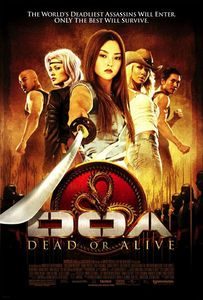
    (On DVD, June 2008) Bikinisploitation, anyone? As excuses go to show bikini-clad good-looking young women doing martial arts scenes, this film is as good as it needs to be: The visuals are slick, the action scenes are fun, the plot reaches a decent clever/dumb balance. It’s based on a series of video games (including a bouncy-bouncy volleyball spin-off that does make it in the film), but you don’t need to be a gamer to appreciate the way the film consciously goes for PG-13 titillation. No one bleeds, no one shows more skin than a bikini allows, everyone gets to throw a few kung-fu kicks (which must be tougher than you think in bare feet) and there’s little left to do but cheer in bemused satisfaction. The featured actresses aren’t all equally compelling (Devon Aoki: Yes. Generic blondes? No.) but at least director Cory Yuen manages to keep things hopping with dynamic editing, relatively rapid fight sequences and a few beautiful shots here and there. Here’s a safe prediction if you happen to see this film with a group: The guys will like it and the girls will be bored.

  • Black Sheep (2006)

    Black Sheep (2006)

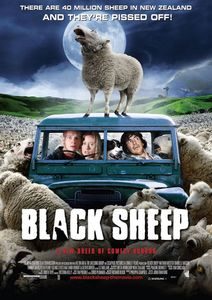
    (On DVD, June 2008) In the venerable genre of “horror movies when seemingly-innocuous things kill people”, this isn’t one of the bad ones: The idea of sheep turning into carnivorous monsters has a kick to it, and the New Zealand team putting it all together has enough cleverness to use the concept to its fullest extent. It’s not revolutionary, particularly funny or scary, but it goes through all of the right motions at a decent rhythm. The leads are sympathetic enough, the gore is suitably over-the-top and the fun just keeps on piling up. It could have been funnier or slicker (we’re still far away from Shaun Of The Dead or Tremors) but there really isn’t much more to say about it: Killer sheep, decent production values and enough fun for any gore-hound.

  • Bandidas (2006)

    Bandidas (2006)

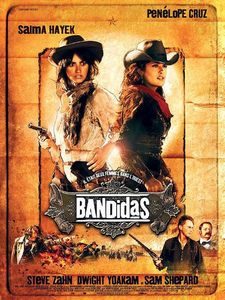
    (On DVD, June 2008) Penelope Cruz and Salma Hayek as late-19th-century Mexican outlaws: Can this film get any better? More importantly: does it even matter? This isn’t high art: as a Zorro-like feature, this film is equally underwhelming when it comes to comedy and action: There is a lot of both, but it rarely rises above the most obvious material. Luc Besson’s hand in the script is instantly recognizable whenever the two lead heroines quarrel over how to kiss the nearest unavailable guy, severely undercutting whatever pro-feminist message the films might have wanted to carry. The action is brief and ordinary (save for a bravura shot late in the film that tries to show a complicated sequence of events in one-take slow motion), though it may not matter as much as you think given then film’s reliance on silly capers rather than gun-slinging action. Fortunately, Bandidas itself is generally enjoyable: although practically released straight-to-video in North America, the film is more enjoyable than many blockbusters, and often prettier. Leaving aside the hotness of the lead actresses, there is some fantastic cinematography here, with wide sweeping shots of the Mexican countryside and a crisp, fun-filled feel to the images captured by the camera. Though some scenes could have been tightened (especially during the generic, imposed first act), the film moves in high gear once the protagonists go naughty and the rest is decent, reasonably enjoyable entertainment. As far as B-movies go, this is a solid rental choice… especially if the very thought of Cruz and Hayek tussling around in frilly underthings is enough to perk your, er, interest.

  • Strip Tease, Carl Hiaasen

    Strip Tease, Carl Hiaasen

    Warner, 1993 (1996 reprint), 418 pages, C$8.50 mmpb, ISBN 0-446-60066-0

    Submitted for your consideration: the strange idea that some good authors are worth reviewing once but not twice.

    It’s a concept that touches upon the traditional definition of a hack: a professional writer who can be counted upon to deliver what’s expected. Less-kind definitions of “hack” focus on the mercenary intent of the writer as if it necessarily necessarily excluded any quality from the resulting work —but genre readers know better than that. Some professionals quickly learn that good formulas work consistently, leading to writers-as-brand names like Clive Cussler. The experience of reading their books remains consistent from one to the other: if it’s a thrill to read the first one and determine what makes it different from the rest of genre fiction, there’s little to say afterwards, especially in series where real change is kept to a minimum. (Cussler’s last few novels have been worth a review in part because he has started tinkering with his usual approach.) I find myself unable to review Robert B. Parke’s Spenser novels, for instance, even if I absolutely love them: they deliver exactly the same experience all the time: There’s little left to say except “Wonderful, another success in a long series.” In my just-finished quest to review all of Michael Connelly’s fiction at a pace of one novel per month, I often ran out of things to say beyond repeating Connelly’s strengths and seeing how the novels linked to previous books.

    Which generally brings us to Carl Hiaasen’s particular brand of comic crime fiction in that I have never been disappointed by his books, but it’s hard to find anything distinctive to say once a first review has been written. His madcap novels of silly South Florida crimes each feature entirely different plots, generally new characters and strange new Floridian sub-cultures, but they all share a similar feel. All can boast of a large cast of characters, criss-crossing plotting, limpid writing and a light atmosphere nonetheless leading to tense moments. Hiaasen has found a winning formula, and there’s little reason for him to deviate from it. That makes him an utterly dependable authors, and one who deserves a massive monthly back-catalog reading project. Alas, it also makes it almost impossible to review Hiaasen on a monthly basis: There’s a limit to how much space a plot summary can take when the critical content of the review remains the same.

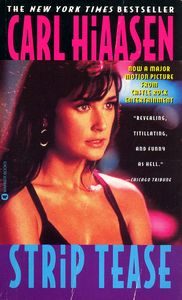
    If I make an exception for Strip Tease, it’s that I haven’t reviewed Hiaasen in years, and I wanted to flag down why that was so. Furthermore, Strip Tease remains to this day the only one of Hiaasen’s non-juvenile crime novels to have been adapted to big screen. I never saw the 1996 film STRIPTEASE, but I can still remember the public titillation at the idea of then-hot Demi Moore playing the lead exotic dancer. Never mind that the movie was a critical flop and a commercial under-achiever: It’s probably still the only Hiaasen title that the vast public can recognize. (“Hey, look, there’s Demi Moore’s on the cover!”) I suppose that there’s something to be written about how Hiaasen’s fine-tuned style doesn’t lend itself to a flat film adaptation, but that will wait until I get to see the film.

    As for the book itself, well, it’s all you’d expect from a Hiaasen novel: Decent characters (including a single mom strip-teasing to support herself and her daughter) faced against antagonists both evil and stupid, complex plotting, wonderful prose style, tongue-in-cheek commentary on the less glamorous side of Florida life, moments of well-executed tension, progressive politics and an epilogue that wraps up everything. No disappointment here: Just a good solid dark comedy. Read one Hiaasen, and that will be enough to tell you if you are likely to love the other ones. (You can even read them out of order.)

    So don’t mind me as I spend the next few months reading through the entirety of Hiaasen’s work to date. Just don’t be surprised if I somehow don’t manage to review every single one of those books. Or if I end up discussing other things than the book when I do.

  • The Yiddish Policemen’s Union, Michael Chabon

    The Yiddish Policemen’s Union, Michael Chabon

    Harper Collins, 2007, 414 pages, C$33.95 hc, ISBN 978-0-00-714982-7

    This book’s a mystery to me.

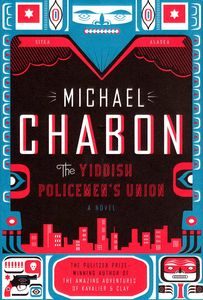
    Yes, I know it’s a genre mystery: Stories of policemen investigating murders can’t be anything else, even when they take place in an alternate reality where a Jewish state was established in Alaska at the end of the forties. Think of elements of police mysteries, and they’re in the book: the down-on-his-luck investigator, the victim, the mob, the clues, the investigations, the romantic complications… Michael Chabon has written a good solid piece of crime fiction, and that part’s no mystery. And if that’s not enough, there’s bits of fantasy, thriller, science-fiction and romance here and there.

    No, what really grabs me as I finish the novel is how little I cared for it even as I can recognize all of the elements that usually compel me. To put it bluntly, it took me weeks to finish the book. I never felt any desire to pick it up, except for the duty to finish it. Even as I noticed clever bits, they never gave me a reason to be involved with the story. I now read other reviews, and they all seem to be talking about a much better book, even when I can vouch for their factual exactitude. (And that’s why you should really look elsewhere if you’re hoping for a meticulous and dispassionate analysis of the novel’s characteristics.)

    From afar, The Yiddish Policemen’s Union has it all: Murder mysteries? Alternate histories? Geopolitical implications? Bring them on! The idea of an Alaskan Jewish territory is novel enough to be intriguing, and the mechanics of setting a mystery in an exotic settings has worked for other writers from Tony Hillerman on down. Even the Wikipedia summary of the book has me recalling neat moments and telling details.

    But the reality of reading the book is different. Part of it is the Yiddish question. It may seem strange to criticize a book for the density of its imagined cultural references when I’m an enthusiastic graduate from the school of SF With Weird Aliens, but the key is that the Yiddish culture of the book isn’t that imagined. Every page of the novel carried along the sound of specific references whooshing over my gentile head. Every. Single. Page.

    Worse: a lot of the in-jokes and clever references were not decipherable from the text itself, as is usual from wholly-imagined alien cultures. Lack of knowledge is a terrible and difficult thing to admit, but so I must confess for you to understand why I didn’t get from The Yiddish Policemen’s Union the charge that other readers seems to have enjoyed. As I (weakly) edit this review, the novel (a mainstream bestseller) has won the Sidewise, Nebula, Locus and Hugo Awards: an rare coup that suggests that a lot of people actually loved the novel. (Whether it deserves any of the “best science-fiction novel of the year” accolades is another bloody debate for another time.)

    So, hey, I report and you make up your own mind.

    This being said, I’ve got the feeling that this is a book that I may enjoy a lot more the second time around, probably shortly after the movie inevitably makes its way to theaters. That’s the great thing about objectively good books that don’t quite click: there’s always another chance to change our minds.

  • The Resurrected Man, Sean Williams

    The Resurrected Man, Sean Williams

    Pyr, 1998 (2005 reprint), 529 pages, C$28.00 hc, ISBN 1-591-02311-4

    (Read in French as Reconstitué, Bragelonne, translated by Pascal Huot)

    As a reasonably-bilingual francophone with easy access to English bookstores, I seldom have any need to read fiction translated from the original English. But occasionally, some titles slip past me, only to pop up years later in French translation.

    In the case of Sean Williams’ The Resurrected Man, the oversight may be simpler to explain than most: Originally published in Autralia in 1998, the novel was republished in 2005 by Pyr, then a brand-new publisher with minimal distribution in Canada. Things have changed since, but not in time for The Resurrected Man to be readily available or widely reviewed in North America.

    And yet, Sean Williams’ name isn’t completely unknown: In collaboration with Shane Dix, he has written a number of imaginative SF series published by Ace Books. So it wasn’t a complete surprise if The Resurrected Man proved to be so interesting. What was more surprising was to find out by way of a French translation of an American republication.

    A hybrid between classic Science Fiction and police procedural thriller, The Resurrected Man has the merit of taking an idea, and exploring it until all the juice has been squeezed dry from the concept. In this case, it’s all about teleportation: In a future where instant transportation around the globe is the norm, a murderer is making copies of young women in transit, for torture and murder. When a man finds himself in his apartment after months in limbo, authorities are quick to suspect him of the crimes, and if not him, then another copy of him. It quickly gets more complicated.

    One one hand, The Resurrected Man is a beautiful example of extrapolative SF. There’s an entire new world in this novel, a world that turns around a crucial piece of new technology whose facets will drive nearly all aspects of the plot. Williams is merciless in teasing out the implications of his imagined system, constantly racing past the obvious and not-so-obvious plot points. The idea that a copy of our hero may be the killer is brought up no latter than the first fifth of the novel, leaving plenty of time for stranger theories.

    In lazy or inexperienced hands, this way of writing SF can be overly schematic: See novels such as Kevin J. Anderson’ Hopscotch for plot twists that are obvious from the moment the universe is explained. Williams, to be entirely honest, isn’t immune to dumb developments: The book hinges on a basic security flaw, explained by graphs, so glaringly obvious that it would send any self-respecting network engineer in hours of uninterrupted debugging: it’s a small wonder that it’s a tolerated at all in the universe of the novel.

    But small nits aside, The Resurrected Man plays the extrapolation game well and adds an extra layer of geopolitical complexity on top of it: A refreshing mish-mash of cultural influences and non-American slang add flavor to the novel, making it fit perfectly well in this decade’s trend toward more world-aware SF. (I’ll note that several of the most representative books of this trend, from Ian MacDonald’s River of Gods to his Brasyl to Joel Shepard’s Killswitch, all come from Pyr’s group of non-American authors.) I was very amused to find out that bits of The Resurrected Man even take place in Quebec and my Ottawa/Gatineau area. (although, when Williams wrote the book, it was still called Ottawa/Hull.)

    The Resurrected Man‘s checkered publication history let it slip past many genre observers, and that’s a shame: Slickly-written and well paced, it’s a novel that has survived admirably well the past ten years, and which holds up well to today’s more demanding standards. SF purists and fans of futuristic murder mysteries will love it; I, for one, am genuinely sorry that I missed it when it was republished in 2005.

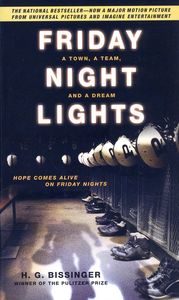
  • Friday Night Lights, H.G. Bissinger

    Friday Night Lights, H.G. Bissinger

    Da Capo, 1990 (2000 revision), 357 pages, C$10.95 mmpb, ISBN 0-306-81425-0

    This is going to sound like a cliché, but trust me: This may be a book about football, but you certainly don’t need to know anything about the sport to enjoy it.

    That’s largely because H.G. Bissinger’s Friday Night Lights is less about football than the people who care about football. In 1988, a thirty-something east coast journalist moved across the country in an effort to spend a year living in Odessa, a small Texas town whose high school football team attracts twenty thousand fans every weekend. For a year, Bissinger would use Odessa’s legendary passion for high school football as a prism through which to study the town. The result of his experience would prove to be even more striking than he expected, mixing sports, culture, class, race, gender and politics in a landmark book.

    For a 1990 book, Friday Night Lights has left quite a mark. Hailed as a significant work (“Sport Illustrated’s #1 Football Book of all Time”, says the back cover), well-adapted to the big screen in 2004, even spawning a well-received TV show, Bissinger’s work has obviously touched a nerve going well beyond “a football book”.

    The reason for this enthusiasm is perceptible from the first pages of the book, as Bissinger’s smooth prose immediately tackles its subject. Not the Permian Panthers football club, but the madness surrounding them in Odessa. The issues facing the town: rusting industries, ingrained racism, feelings of class resentment against the neighboring white-collar town of Midland, and so on. Then there’s the team: Bissinger efficiently portrays the very different young men on the team, and the expectations facing them.

    One of those young men is “Boobie” Miles, an academically-disadvantaged teenager with bright prospects for a football-filled future. The Panthers come to depend on him, which proves to be a dramatic trap when Miles is injured early during the season. This story, out of so many, comes to form the dramatic backbone of the book in-between chapters dealing with bigger issues.

    It’s not much of an exaggeration to say that Football is Odessa’s religion, not after the colorful way that Bissinger describes the town: The professional-grade football stadium next to the school (raising issues of academic funding, especially when it’s revealed that the health-care budget of the team is bigger than the textbook budget of the entire English department), the radio talk shows, the signs in people’s lawns, the celebrity attained by the players: small wonder if, after graduating, the Odessa players feel such a let-down in college football.

    But to many readers without a strong interest in football, it’s Bissinger’s social study of Odessa that will hit the mark. Football is essential to the city, and just as essential in understanding its issues of racial segregation, gender roles, anti-intellectualism, political preferences and class. Bissinger makes effective use of well-written anecdotes, statistics, eyewitness accounts and third-party sources to give a convincing portrait of the events of life in Odessa during 1988-1989. (Sadly, the book lacks an index.)

    This paperback movie tie-in edition makes effective use of the intervening years by presenting a satisfying postscript describing where the players are, ten years later. Cinephiles will note that the excellent movie adaptation only focuses on the football team, leaving much to discover in the book for socially-minded readers.

    Absorbing and fascinating like only the best non-fiction can be, Friday Night Lights has escaped its initial billing as a sport book to become a capsule social study. It’s a wonder to read and a thrill to recommend: don’t miss it, even if you don’t know anything about the finer points of football.

  • Snuff, Chuck Palahniuk

    Snuff, Chuck Palahniuk

    Doubleday Canada, 2008, 197 pages, C$29.95 hc, ISBN 978-0-385-66468-4

    Chuck Palahniuk has always been a writer defined by gross excess. So when he announced that Snuff was going to deal with the pornographic film industry, readers cringed in anticipation: what kind of novel would that turn out to be?

    The fun with the book starts before even cracking it open: The striking cover art, dominated by an open lipsticked mouth, features letters carved with outlines of women and copulating couples. The theme carries inside, with end-papers making a good attempt at presenting the Kama Sutra’s top positions. The book itself is entirely printed in brown, dirty letters running for almost two hundred pages.

    The content is initially up to the worst expectations: We find ourselves on the set of a pornographic film, where an aging porn-star is trying to set a record. There are six hundred men in the green room of the studio where the movie is being shot, and they are all expected to perform on her. Palahniuk, of course, doesn’t miss a detail as he describes the logistics of the event and the horrible consequences of double-dipping when unmentionable bodily fluids have to be managed with precision.

    Four characters end up sharing the novel’s point-of-view: Mr. 600, a veteran porn actor; Mr. 72, a young kid with a sentimental streak; Mr. 137, with his mysterious past and even murkier intentions; and Sheila, the producer working hard to keep the show rolling. The interactions between the characters run deeper than expected: Palahniuk hasn’t chosen his viewpoint characters randomly.

    As the novel progresses, a central complication emerges: The characters realize that this is meant to be the porn-star’s last film, that she means to die on camera –forever sealing her legacy and her world record. But nothing is ever so simple, and Palahniuk’s still got a few dramatic revelations up his sleeve. Stylistically, there’s a certain interest in the structure of the novel, which almost works as a one-set theater piece with no nudity; alas, flashbacks and a few last chapters taking us out of the warehouse and onto the set damage the restraint of that aspect of the book.

    This is a very short novel: from quick word-count estimates, it can’t be more than 60,000 words long, and probably ends up much shorter than that. But even at that length, it feels a bit bloated and repetitive. Even though Palahniuk’s usual catchphrases are toned down (the closest ends up being the “…Back Door Dog Pile” titling motif that seems to dominate the cited porn film titles that aren’t puns or parodies of something else.), the novel seems to grind itself in place between the time the hook is explained and the moment where the characters reveal who they really are. The conclusion feels like a lame placeholder put there while waiting for a better idea.

    That this is a joyless novel isn’t much of a revelation: Palahniuk’s dark humor may be entertaining, but it’s not the kind of thing to make you smile once the book is over. The emphasis on the pornographic industry carries its own problems: it’s almost by definition a field so shameless as to be un-parodiable, and what Palahniuk comes up to try to shock his readership isn’t even up to the industry’s own horror stories. So the reader ends up in a limbo where laughs, eroticism and interest are kept far away.

    It’s certainly a Palahniuk novel, but it also ends up being one of his most disappointing, especially after the impact of his previous Rant. There’s an irony, I suppose, in the idea that a shock writer would be defeated by a shocking setting. But Snuff leaves the impression that it would have been tighter and more interesting had it been boiled down even further, either as a short story or an alternative theater play. Regular Palahniuk readers will enjoy it (since they know what they’re getting into), but this is not likely to be a book that will gain him new ones. In a way, Palahniuk has set himself up to fail: the book is too extreme for the average reader, too tame for the fan, and not showing anywhere near the new directions felt in Rant. A minor work, while everyone waits for the next one.

  • Where In The World Is Osama Bin Laden? (2008)

    Where In The World Is Osama Bin Laden? (2008)

    (In theaters, May 2008) So Morgan Spurlock, having done his best to anti-super-size America, now goes abroad in an attempt to find Osama Bin Laden. No, he doesn’t find him, but I don’t think he ever means to: the real goal of the film is to go abroad and provide an ordinary-man’s view of the relationship between the USA and the Middle East in these turbulent times. The conclusion will be obvious to anyone: People don’t like the American government’s policies, but are OK with Americans because, hey, we’re all alike. It’s hardly a stunning revelation, but I suppose there’s always a place for Geopolitics 101 in the Blockbusters of the nation. Spurlock’s faux-naive act can be grating at times (randomly asking Arab shoppers “do you know where Osama bin Laden is?” isn’t exactly hard-hitting documentary skill), but he’s a sympathetic figure and the variety of techniques at his disposal (songs, false video-games, interviews, more interviews) is enough to keep anyone interested. There are even two remarkable sequences in the film: one where Spurlock raises the ire of an orthodox Jewish neighborhood in Israel, and another one where his questions to Saudi high-school students lead to the abrupt end of the interview. People expecting much more than a reasonably entertaining documentary will be disappointed, but I think that the real audience for this film needs to hear some obvious statements before any real progress is made. Whether they’ll ever see the film itself is another matter entirely.

  • Vampire’s Kiss (1988)

    Vampire’s Kiss (1988)

    (On DVD, May 2008) Nicolas Cage is rarely dull even when he’s not very good, and Vampire’s Kiss is one of the first citations on the list of his oddball projects. While everything about the film suggests a supernatural connection between a man and the vampire seductress who bit him, the reality of the film is far more fascinating, portraying an unrepentant womanizer sinking deeper and deeper in madness after convincing himself he’s turning in a vampire. While it does have a number of darkly humorous moments, it’s one death too far to be a funny film. It’s not an entirely successful one either, as Cage overacts with a grossly annoying British accent in the middle of a script that’s not quite focused enough. Still, some of the scenes are showpieces (yes, this is the film in which Cage eats a live cockroach) and the unusual re-use of vampire mythology is enough to earn this film a dark little place in any horror fan’s heart. Special note much be made of the splendidly multicultural female casting in this film, from an early role for director Kasi Lemmons to Jennifer Beals (as the vampire) and Maria Conchita Alonso as Cage’s terrified office assistant. Plenty of subtle and not-so-subtle details hint at the film’s thematic ambitions, which may warrant a second viewing for viewers mystified by the entire experience. The DVD, fortunately, contains an enlightening commentary by Cage and the film’s director.

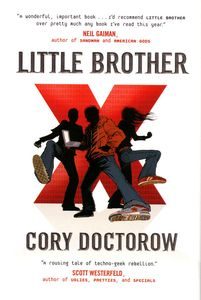
  • Little Brother, Cory Doctorow

    Little Brother, Cory Doctorow

    Tor, 2008, 382 pages, C$19.95 hc, ISBN 978-0-7653-1985-2

    As a mild-mannered reviewer, I try to avoid throwing around terms like “importance”. But reading Cory Doctorow’s Little Brother, it’s hard to avoid thinking that of all the books I’ve read recently, this one has the best chances of carving its own little place in history.

    If it does become an important book, it won’t be by accident: Doctorow has deliberately set out to write something controversial with this book, and even the broadest-minded readers may experience twinges of discomfort at some points.

    It begins with a group of high-school friends skipping school to play an alternate-reality game in downtown San Francisco. But the game is soon interrupted by a terrible terrorist attack, and soon our narrator Marcus (otherwise named W1n5t0n) is apprehended on suspicions of terrorism. Roughly interrogated by authorities, he’s eventually released… but not all of his friends are, and San Francisco is soon overrun by police forces intent on maintaining an excess of peace and order. What’s a teenager to do? Rebel against the overreaching authorities, of course.

    Little Brother is literally written to rouse the young ones. A tale of hip high-tech resistance, this is a novel made to be put on the YA shelves of your local bookstore, read by disaffected teenagers and passed around in impromptu book clubs as the coolest thing ever. It makes Science Fiction (or at least techno-thrillers) look good, and serves as yet another reminder to adults that the hottest, most vibrant corner of SF is now written for young adults. Unlike past attempts at SF-for-teens, this doesn’t take place in a far deep-space future, but within the next five years, and tackles issues that are of vital interest to everyone right now.

    Best of all, it’s shamelessly, almost aggressively didactic. Marcus is pissed at the system, and his narrative is filled with tips and tricks on how to defeat it. Confound sensors, detect cameras, burn out RFIDs and hack the Internet using the how-to tutorials in this book. If Doctorow’s learned one thing about the Heinlein juveniles, it’s that there’s nothing wrong with a lot of exposition as long as it’s entertaining, and so Little Brother partly becomes an instruction manual on how to live in today’s world using today’s technology.

    This novel, more than many other “forward-looking” works of SF, lives in the now. It’s not a 9/11 novel as much as it’s a post-9/11 story that deals with our response to those events. Beyond the hacking tricks, this is also a novel of social engineering, one that ties together digital activism with the fight for civil liberties. In Little Brother, Doctorow finds the ultimate fictional expression so far of the mindset he espouses daily on the wildly popular blog Boing Boing. What looks like “digital rights management” to some actually becomes “civil rights restrictions” to others, and it’s difficult to separate one threat from another in the big cauldron of issues.

    So difficult, in fact, that chunks of Little Brother feel both reasonable and seditious at the same time: As Marcus fights the system that has unjustly harmed him, he espouses notions that are uncomfortably close to an anarchic strain of libertarianism. If there’s a serious political objection to make against Doctorow’s novel, it’s that Marcus’ rebellion is flashy and cool, but the other side of the revolution –the steady pressure from the less-radical masses —is given short thrift as an agent of change.

    But that wouldn’t be nearly so cool, and the novel does nod in the direction of mass opinion as Marcus finds himself too close to the middle of a movement that has escaped him. Doctorow’s techno-utopianism has a big bad enemy, but has no use for the little anonymous jokers who would use the very same tools to make trouble simply for the lulz.

    But we’re getting deep in considerations that would be wasted on lesser novels. As it stands, Little Brother is not just a joy to read, it’s a wonder to discuss. Its emphasis on civil rights is unusual no matter which segment of the population it’s marketed to, and its modern vitality is a welcome breath of fresh air in a field that seems content on paying homage to the past. As a part of Doctorow’s bibliography, it eclipses his previous books to become his masterpiece so far: I may like Down and Out in the Magic Kingdom a lot, but it doesn’t compare to the anger of Little Brother, and the intensity of Doctorow’s preoccupations match that of Overclocked as a faithful representation of the author’s defining themes.

    Young or old, conservative or liberal, SF fan or not, Little Brother is a novel of the here and now, carefully attuned to the era’s pet psychosis and designed to make us question what we take for granted. It’s the rare novel that tries to create better citizens. Time will tell whether its impact will survive its own print run, but it’s already making waves and creating discussion.

    [August 2008: Huh, look at that: there a quasi-Orwellian “1985” encoded in the ISBN of the book. Happy accident?]
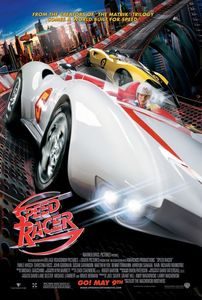
  • Speed Racer (2008)

    Speed Racer (2008)

    (In theaters, May 2008) The Wachowski’s post-The Matrix return to the big screen as writers/directors may not be profound (it is an adaptation of a kid’s Japanese TV animation show), but it clearly shows their gift for pedal-to-the-metal visual storytelling. Big, bright and colorful like few other live-action film, Speed Racer sticks close to its source material and feels like a trip to a surreal parallel universe where gravity is a suggestion and eye-popping architecture is the norm. Few frames in this film aren’t green-screened, color-corrected and CGI-enhanced. For moviegoers interested in the state of the cinematographic art, this is it. It’s a shame, then, that it’s slaved to such a simple story geared to the younger set, a story that missteps by mixing up cute monkey sidekicks alongside corporate machination and a family-friendly message: There doesn’t seem to a be coherent audience for what Speed Racer has to say. But even with that handicap, there’s something fascinating in the way the Wachowskis choose to structure their story: It’s not rare for the film to play with storytelling by featuring flashbacks-within flashback, flash-forwards, inter-cut segments and all sorts of neat storytelling tricks that are wasted on the material, but manage to make the film far more interesting that it would have been if told in a more straightforward fashion. The dizzying structural tricks blend with the flashy visuals for a pure cinema experience that may not make much sense afterward, but certainly feel cool enough in the theater as long as anyone’s brain can sustain the assault. As with other Wachowski films so far, the details are often more interesting that the main film itself: beyond the bland Caucasian nature of the Racer family, the other characters are pleasantly multicultural, if not counter-cultural (a black viking?!), and there are tons of small jokes hidden in the corners of the screen. The images can be breathtaking even as their meaning is bland. Sure, Speed Racer could have been better, but it’s already a remarkable achievement despite its flaws.

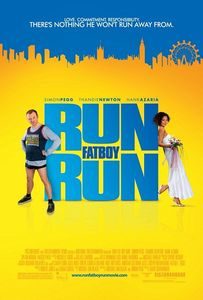
  • Run Fatboy Run (2007)

    Run Fatboy Run (2007)

    (In theaters, May 2008) The problem with “likable loser” movies is the balance to find between the likability and the loserness. Simon Pegg is gifted enough to put the audience on his side as the titular Fatboy, but the script doesn’t give him much to play on: Throughout Run Fatboy Run, saner members of the audience will wonder how and why his ex-girlfriend (Thandie Newton, who has seldom looked better) almost married him. And that’s before the screenwriter cheats and actively sabotages her relationship with her new beau. To be fair, however, the entire third act of Run Fatboy Run is a huge unbelievable cheat, destroying a character at the benefit of another, and pulling the type of Hollywood finish that doesn’t do much more than remind us that things never happen like that in real life. As with so many romantic comedies, the fun of the film isn’t in the main story as in the secondary characters, the subplots and the details. Alas, some of the material is so interesting as to overwhelm the rest: I was captivated by India de Beaufort’s presence, and wished more of the film would have been centered around her, or Dylan Moran’s more-interesting sidekick. While Run Fatboy Run itself isn’t particularly bad or irritating, it’s curiously uninvolving and never earns its conclusion as much as it tries to manipulate it more blatantly than most.

    (On DVD, May 2009) There isn’t much to say about the DVD edition of the film: It’s still an average comedy, and the DVD commentary doesn’t do much to give us insight in the film-making process. On the other hand, India de Beaufort is featured in a number of deleted scenes, so it’s not as if revisiting the film on DVD was a complete waste of time.

  • Redbelt (2008)

    Redbelt (2008)

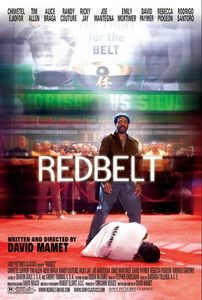
    (In theaters, May 2008) David Mamet makes very personal films, and that can be a boon as much as a problem depending on the end result. In some ways, Redbelt is a perfect follow-up to films such as The Heist and Spartan: all take place in rough milieus, featuring laconic men to exemplify Mamet’s idea of solid masculinity. All involve aspect of crime and deception. But what worked so well before seems overblown and unnecessary here: As a martial-arts instructor is conned into participating in a tournament, the plot twists itself beyond logic and plausibility, showing the heavy hand of the screenwriter as characters are manipulated toward a specific end. The film itself feels long and dull, Mamet’s hypnotic dialog not making the film any easier to take seriously. Even the ending, with its unconvincing staging and abrupt conclusion, fails to do much to redeem the rest of the film. I suspect that Mamet fans will find much to like, but viewers unwilling or unable to adapt to Mamet’s particular way of seeing things may not be so lucky.

  • Iron Man (2008)

    Iron Man (2008)

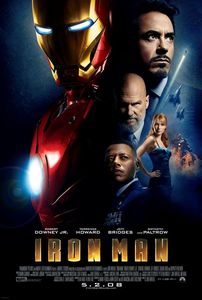
    (In theaters, May 2008) After so many disappointing superhero films leadened by dull origin stories and barely saved (if at all) by their action scenes, it’s refreshing to find that Iron Man is a superb first entry in a franchise that succeeds through sheer attention to character more than impressive pyrotechnics. Robert Downey Jr is absolutely perfect as arrogant super-genius Tony Stark: his bad-boy manners are compelling in simple dialog scenes, lending credence to the theory that superheroes are only as interesting as their secret identities. He makes the film click long before he suits up and punches through tanks. As for the action scenes, they’re not as numerous as you may think (four, maybe five of them) and they definitely take a back step compared to more unconventional scenes in which Stark thinks, designs, refines and tests his Iron Man suit. A decent sense of humor underscores the entire film, and if there are a number of plot issues (not all of them relating to Stark’s medical condition and the steps he takes in order to solve it), the entire film flows far more quickly than one would expect. While there’s still plenty of room for the series to improve (there isn’t much of an antagonist this time around, for instance), this a solid and confident first entry, well worth a look.