Year: 2010

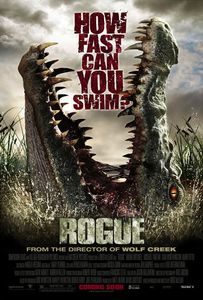
  • Rogue (2007)

    Rogue (2007)

    (On DVD, August 2010) I have no particular fascination for giant crocodiles, but I’m always interest in a a well-made monster movie.  So it is that Rogue, despite having been released straight-to-DVD in North America after a successful theatrical run in its native Australia, is a surprisingly efficient horror movie pitting humans against one particularly vicious croc.  The first pre-horror section of the film, ironically, may be its best as directory Greg McLean gives us a gorgeously photographed guided tour of Northern Territory nature, complete with so many dangers that our boatful of tourist characters should really start to worry.  Things don’t remain as credible as a series of mishaps shipwrecks our protagonists on a small island in the middle of a giant crocodile’s habitat.  Sam Worthington has a significant early role as a cocky redneck, but it’s Michael Vartan who becomes the thinking man’s action hero as the tide rises and their options grow smaller.  Never mind the obvious objections and plot-holes in stranding characters on an island twenty meters away from relative safety: Crocs seemingly can’t walk on land in this film, and the reward in suspending our disbelief is seeing a few good suspenseful sequences.  It doesn’t work as well late in the film as the action moves to a studio-built lair in time for a straight-up man-against-nature fight.  But Rogue is sufficiently successful by then that it doesn’t matter as much as you’d think: It’s meanly efficient most of the time, and enjoyable for the rest of it.  Tourists heading to the Australian wilderness may think twice before seeing the film and adding to their worries, though.

  • Scott Pilgrim vs. The World (2010)

    Scott Pilgrim vs. The World (2010)

    (In theaters, August 2010) For a movie that only highlighted how truly old I am getting, I enjoyed Scott Pilgrim vs the World from beginning to end.  Transforming a fairly ordinary post-teenage romantic comedy into an mythological epic through fantastical devices such as videogame combats given life, Scott Pilgrim becomes a relentless, sometimes exhausting blend of action, romance and comedy gold.  Given that director Edgar Wright is best known for manic comedies Hot Fuzz and Shaun of the Dead, the whip-fast editing, witty dialogue and reality-defying direction should come as no surprise.  What is a bit more unusual, however, is the way Wright plays along with the grammar of cinematic storytelling, telescoping scenes together, taking fantastical flights of fancy in the middle of grainy indie dramatic scenes, or varying his approach just to keep things fresh.  This third successful film only highlights how Wright is pushing the envelope of comedy directing, daring older audiences (cough-cough) to keep up.  As a fan of the Bryan Lee O’Malley’s graphic novel series, I had a clue about what was in store.  But I couldn’t predict how cleverly the script would condense, simplify and amplify the storyline of the comic book into something that feels even more grandiose.  Streamlined to make the hero’s final success feel even more rewarding, Scott Pilgrim vs the World should please most fans of the original, while allowing newcomers to grab the graphic novels and find further delights in them: the way material from the book is rearranged in a new plot will keep fans of both versions entertained.  The resemblance of some actors to their graphic equivalent is astonishing, and their delivery of the dialogue, in a mixture of arch line readings and mumbled deadpan quips that I find irresistible, is often far funnier than the material would suggest.  I’m still only half-sold on Michael Cera as Pilgrim, but the supporting cast is strong and notable performances include Kieran Culkin as the cool roommate and Ellen Wong as a hot-tempered high-schooler.  But even better yet is the way Toronto plays itself as a big city capable of hosting cool stories: The script’s Canadian references are not only hilarious, but on-target as well.  Still, it’s not all fun and games as Scott Pilgrim has a few things to say about urban romance during post-teenage years (there are practically no older adults in this film, nor any need for them), or the way modern personal mythmaking comes from genre-dominated gaming rather than older sources of inspiration.  It all amounts to a hilarious, heartfelt, dynamic film that appealed to me in ways that felt very personal.  I’m not sure it could have been any better.

  • Step Up 3D (2010)

    Step Up 3D (2010)

    (In theaters, August 2010) There are times when I find myself in a movie theater with no clear idea of why I have chosen to see the film in front of my eyes.  This wasn’t one of those times: Despite my scepticism for the 3D movie craze and my complete lack of knowledge in the field of dancing, the trailer for Step Up 3D mesmerized me as much as it made me laugh.  But what it promised more than anything else was an experience: Dance films have a physicality that approaches that of action movies, and the thrill I get from seeing good dance cinematography isn’t dissimilar to that of a well-mastered martial art sequence (also see; parkour).  I also suspected that many of the self-conscious devices characterizing 3D movies wouldn’t be half as annoying in a format halfway between a film and a concert.  I was proven right on almost all accounts: Step Up 3D is an exhilarating time at the movies for what it shows as soon as the music starts.  As a narrative experience, it’s as basic at it can be with paper-thin plotting, amiable characters, a few stereotypes and no surprises whatsoever.  But never mind the story as long as it strings along the dance sequences: that’s when Jon Chu’s direction takes flight and the film soars.  While the film’s three showcase sequences are the dance battles between rival groups, Step Up 3D also has time to sneak in some ballroom dancing and a number that could have been lifted straight out of a classic musical comedy.  Other highlights include a waterlogged dance sequence and a mesmerizing robot-rock performance by “Madd Chadd” Smith (Go ahead, watch it on YouTube).  But the sequence that really sold Step Up 3D to me is a sweet and charming street-dancing sequence taking place in long uninterrupted shots, a sequence so full of joy that it does what countless other serious movies have failed to do: make me happy to be human and to live in a world where such scenes exist.  There’s a primal joy in seeing other people move in extraordinary ways, and for once my lack of knowledge in a field paid off as I saw the film’s dancing from an unprejudiced eye.  I half-expected to like Step Up 3D; I didn’t expect that I would like it that much.  The 3D, for once, helps a lot in correctly putting us in the universe of the film: the artificiality of 3D efforts pays off when the dancers are purely playing to the camera, waving their hands in our faces.  For once, I’m not sure if the film will be as effective in 2D.  No matter, however: I don’t think I’ve enjoyed a theatrical experience as much since Grindhouse.

  • Horns, Joe Hill

    Horns, Joe Hill

    Morrow, 2010, 370 pages, C$27.99 hc, ISBN 978-0-06-114795-1

    Joe Hill is one of the most brilliant new horror writers, one who justifies the recent migration of genre horror novels from mass-market paperbacks to hardcovers.  His second novel, Horns, follows in the footstep of his debut Heart-Shaped Box in showing how, unlike some of his more gore-oriented colleagues, Hill seems to be using horror as a mechanism through which damaged characters can work out personal issues, rather than an end in itself.

    Hill’s stories usually begins with an intriguing character, and our protagonist Ignatius Martin Perrish (“Ig” for most of the novel) is an interesting guy: Physically frail, member of a rich and influential family, blessed with the love of a good woman, Ig saw his good fortune disappear when his girlfriend was found murdered a year before the novel begins.  Immediately suspected of killing her, Ig was never formally charged… but in small north-eastern towns, it doesn’t take paperwork for a community to condemn someone.  As Horns begins, Ig has spent a year in purgatory, consumed by grief, unable to work and ostracized even by his family.  On the first anniversary of the murder, Ig goes out, gets drunk and indulges in minor desecration.  The following morning, he wakes up with horns growing out of his forehead, and an uncanny ability to make other people blurt out their darkest, deepest desires.

    The story begins with a bang the moment Ig stares into the mirror and sees the horns.  Within pages, strangers tell him things no one should ever share: confessions of gluttony, lust and wrath.  Ig just has to be in their presence for secrets and desires to be expressed.  But as soon as he turns his back, people forget both about his horns and their own revelations.  Soon, Ig can’t help but learn everyone’s true opinion about him and they are damning: Everyone thinks he killed his own girlfriend, and used his family’s influence to avoid charges.  But confession by confession, Ig also learns clues that allow him to piece together the identity of the murderer, and the revelation is nothing short of shocking.  As his horns grow and his devil-like qualities develop, Ig also learns the fine art of revenge…

    Horns has a lot of things going for it, but none of them are as potent as its mixture of clear prose, attention to character and ability to ground its fantastical premise in believable details.  Ig’s personal history is gradually revealed in detail, allowing us to understand the tapestry of loyalties, betrayals, guilt and cover-ups that have so affected his life.  Horns could have used its premise in a very different fashion, but it ends up become one character’s journey to understanding and ultimate expiation.

    Which isn’t to say that Horns is a perfect novel.  Many of the clever devilish puns and references only makes sense to those steeped in Judaeo-Christian mythology and North-American cultural references: I wonder how much sense the book can make to someone coming from other contexts (or even someone who hasn’t paid attention in a while to religious teachings about hell and the devil.)  More seriously, the novel’s structure is generous in multi-chapters flashbacks, and the roaring opening doesn’t accurately reflect the rest of the novel as it soon takes on a more contemplative quality.  At times, the story seems to meander off-track to such an extent that we’re left wondering how much better it could have been if it had been published as a novella.  As it is, the novel never misses out on an occasion to explain in great flashback-reinforced detail almost all of the passing references that could have been left alone.

    But novellas don’t sell, and Horns’ accumulation of explanations ends up sketching a remarkably lived-in background for the protagonist.  There’s a fundamental pleasure in the kind of character study that Hill delivers with this novel, and it’s different from the one we can get from a straight-ahead horror thriller.  Horns may look like the latter at the end of its first few chapters, but it’s a different beast by the end of it.

    Most of the elements that made Heart-Shaped Box such a success are just as skilfully used in this second novel: The down-on-his-luck character, the fascination for music (including a Morse code tip-of-the-hat to an obvious musical inspiration on the book’s endpapers), the sly humour, the interest for personal atonement, the precise prose… it places Hill somewhere between the literary mainstream and the thrills of the horror genre: a great niche for such a promising writer.

  • The Secret, Rhonda Byrne

    The Secret, Rhonda Byrne

    Atria, 2006, 198 pages, ISBN 978-1-58270-170-7

    Yes, your honour, I am possibly the worst possible person in the world to review The Secret.

    As I stand before you explaining what would motivate me to write about a book that I found obnoxious and exasperating, I confess that I am guilty of crass materialism in all facets of my personal philosophy.  I believe that hard work and self-confidence are the way to get what we deserve.  I don’t place any trust in purveyors of pseudoscientific woo-woo.  I am allergic to much of the self-help literature.  I don’t even watch Oprah.

    I have read The Secret.  I found it at a used book-sale.  The type of book sale where they weigh your box, charge you by the pound and don’t ask to see what’s inside.  I can’t imagine that I paid more than a dollar for it.

    Well, maybe a bit more, given how it’s printed on heavy paper.  Amazon tells me that it has less than 36,000 words, but they’re all set on glossy photo-paper, and every page has a faux-scroll background, with color icons to introduce every contributor and full-color pictures of them at the end.  This is a really well-designed product.  It’s not a book as much as it’s a slick piece of Da Vinci Code-inspired marketing designed to sell other derivatives of itself.  Most of those derivatives, I assume, must try to sell the book in return.

    Oh, yes, your honour, I have understood The Secret.  The Law of Attraction is nothing more than wishing hard enough to make things come true.  Was that a spoiler?  Well, what can I say: You can probably read any page in the book and grasp as much, given how it just keeps repeating its basic points over and over, adding up potentially fraudulent, delusional or bias-confirmed anecdotes until they’re meant to look like data.  It’s all wrapped up in quantum pseudo-science spouted by professional cloud-peddlers –including my own favourite crackpot Fred Alan Wolf, who provides a telling link between The Secret and What the Bleep Do We Know?

    You could describe my overall reaction to the book as a mixture of exasperation and cackling sarcasm.  It’s actually intriguing in how it sets up a delusion that makes The Secret seem so important and all-powerful: It’s linked with safely dead figures such as Einstein, Shakespeake and Mother Theresa, then puts up a baroque system of negative belief meant to immunize believers against skeptics: According to the book, harbouring any doubt at all about wishful thinking will make it fail.  It’s then your fault if it doesn’t work.  If that’s not a cult-like indoctrination device, I’m not sure what is.

    In fact, I would propose that The Secret is a really handy pseudo-religious device to keep the proletariat down.  It’s a straight-up money transfer from the readers to TS Production LLC, and a way to keep the dissatisfied wishing for more.  If it doesn’t work, it’s not because the universe doesn’t work like that: It’s because their own faith in The Secret isn’t strong enough.  They can either reinforce it by buying another TS Production LLC product or blame mysterious elites for keeping The Secret a secret.

    What annoys me the most about The Secret is that it actually trivializes a lot of useful behavioural techniques.  Self-confidence is always a performance-booster, positive thinking can help in identifying opportunities and moving expertise from the conscious to the subconscious is a mainline to mastery… there’s a lot of common-sense in here, but it’s wrapped in pseudo-conspiracy theories, slick marketing packaging and insidious memetic content.  The Secret is probably not dangerous in that it reaps its rewards from the same people periodically picked clean by other new-age money-grabs… but it’s always a disappointment to realize that despite the demonstrable rewards of hundreds of years of rational thought, there is still a substantial appetite for such nonsense.

    Now, I understand that I’m about four years behind the times in blathering indignantly about The Secret.  People have moved on, much like copies of The Celestine Prophecy are gathering dust on so many bookshelves.  But, you know what?  When The Secret was hot, I wished for a way to read it without paying any money at all to the hucksters at TS Production LLC.  I could have borrowed it from the library, mooched it from a credulous friend or gone digging through recycling bins, but I just waited and the Universe sent a copy ripe for picking at my favourite book sale.  HOLY CRAP IT WORKS!

    Never mind, your Honour, I rest my case.

  • The Other Guys (2010)

    The Other Guys (2010)

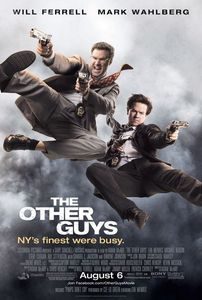
    (In theaters, August 2010) I don’t usually enjoy Will Ferrell’s brand of semi-retarded adolescent-grown-old comedy, so my expectations going into The Other Guys were as low as they could be.  That explains my surprise at this generally successful buddy-movie cop comedy.  Of course, everything will look great after the disaster that was Cop Out earlier in 2010; still, The Other Guys has a lot of fun cataloguing, tweaking and subverting an entire list of action movie clichés.  It starts with a treat of a cameo, as Dwayne Johnson and Samuel L. Jackson play bigger-than-life parodies of the action-movie cops we’re used to see on-screen.  Then it’s back to “the other guys” who fill the paperwork and do the actual investigation that goes on behind the usual action sequences: Will Ferrell as a nebbish cop with a wild past and normally-staid Mark Wahlberg as a competent policeman held back by a mistake.  The film comes with half a dozen of respectable action sequences, and a steady stream of hilarious moments.  Of course, it doesn’t always work: The danger is subverting conventions that exist given their storytelling power is that the subversion often robs the film of its story. At times, The Other Guys is too scattered and less satisfying than it should have been.  Another problem is that the material is so broad that it’s often uncontrolled: a number of scenes run too long and feel too dramatic in the middle of so much silliness.  (The credits, for instance, wouldn’t feel out of place in a Michael Moore film.) Those tonal problems can be annoying:  While the film generally takes place in a recognizable reality, it also occasionally slips up and spends a few moments in a far more fantastical Simpsonesque universe, and the shifts between both tones only reminds us of realism’s dullness.  But the advantages of such a scatter-shot approach are that sooner or later, another good moment will come along to make everyone forget about the latest dull sequence.  A number of eccentric characters all get their moment in the spotlight (few more so than Michael Keaton’s father-figure captain or Eva Mendes as a supposedly-plain wife), much as a few standout sequences really pop, such as a bullet-time sequence of wild debauchery tableaux, continued abuse of the protagonist’s poor Prius and a purely indulgent slow-motion boardroom shootout.  The Other Guys isn’t focused and runs out of laughs toward the end, but bits of it are clever and its overall impact is surprisingly charming.

  • Suck it, Wonder Woman!, Olivia Munn & Mac Montandon

    Suck it, Wonder Woman!, Olivia Munn & Mac Montandon

    St. Martin, 2010, 269 pages, C$28.99 hc, ISBN 978-0-312-59105-2

    Amazon’s recommendation engine usually has a good understanding of what I’m looking for.  It has served me well in exploring the world of books about food, leading me from Pollan and Bourdain to Rayner, Sheehan and others I wouldn’t have discovered otherwise.  But it’s not perfect and when it starting suggesting Olivia Munn’s Suck it, Wonder Woman!, I should have been a bit more sceptical.

    My first warning sign was asking Who is Olivia Munn? It turns out that Munn is a popular entertainer who has become something of a geek celebrity over the past few years: She has a growing number of small roles in TV show and feature films but also, crucially, co-hosts a geeky cable show named Attack of the Show! and shows up regularly at Comic-Con.  Her attractiveness explains the endless stream of pictures that shows up above her Wikipedia profile in a casual Google Search.

    Welcome to the age of the micro-celebrity, then: Munn has found herself a rewarding niche in the universe of young actresses by claiming the geek flag for herself.  Suck it, Wonder Woman! is a slight attempt at an autobiography crossed with a humour book.  Subtitled “The Misadventures of a Hollywood Geek”, the book quickly shows its true colors as soon as it’s out of the Amazon packing box: Not content with a front cover design that highlights Munn’s cleavage, the back of the dust jacket urges us to discover the “Surprise on the other side”, which is to say a full-color pinup in a bikini and naval cap.  Look inside the book and you will see that, aside from the photo-insert chapter introduction and occasional galleries, Munn can also be seen on every single bottom-right page corner doing a flip-book dance.

    So, yeah: Cheesecake for so-called geeks.

    I’m not going to comment upon Munn’s shtick as a sex-symbol for geeks: That’s a line of thought that quickly veers into misogyny.  If Munn claims herself as a geek, then welcome aboard.  I’m not even going to insist on how geek standard for sex-symbols don’t include many more requirements than “female with a pulse and no visible scowl at unwanted male attention”: It’s a good insulting line to get a rise out of geeks, but it also fails to acknowledge that Munn does stand out as an attractive woman no matter the surrounding crowd.

    But what this book drives home are the reasons why I occasionally want to get as far away as humanly possible from the modern hyper-packaged definition of “geek”.  It used to be that geeks were incredibly driven people with strong technical skills and weaker social graces: In any case, it’s their attitude toward the world that counted.  Geeks were the high-school larval stage of more fully-rounded individuals who would learn how to fit in society, but would always keep their attitude of gentle manners and frequently intense curiosity about the world.

    Fast-forward to 2010, however, and “geek” has become another marketing category for the entertainment-industrial complex.  Comic-Con has become Ground Zero for the co-optation of the geek: Now, the word has become synonymous with the mindless consumption of dull comic-books, lousy genre movies, loud video games and lightweight books written by pretty girls who know which buttons to press in order to rouse their audiences.  It used to be that geeks could be counted upon to know some valuable technical knowledge of interest to the world at large: Now, just buying Lord of the Rings figurines is enough to qualify as a Hollywood-approved geek.  Newsflash: video-game trivia and glass shelves for Star Wars memorabilia don’t translate by themselves into useful contributions to society.

    I am, obviously, overreacting: It’s in the nature of geeks to be picky, and nothing forbids me from charting my own brand of nerdiness.  But as I was reading Suck it Wonder Woman! and taking in its assumed pandering, I ran mind-first into the contradictions between my own conception of geekiness and the now-approved cultural stereotype.  Geeks may be socially inept, but that shouldn’t translate into a universe in which every video-game, comic book or genre movie representation of a female seems to feature enhanced pneumatics, plastic skin and personalities tailored to appeal to male interests.  There’s something wrong if I either want to wash myself with bleach or send a neutron bomb to San Diego every time I dig into Comic-Con coverage, gaming advertisements or so-called geeky forums.  My conception of geekiness, obviously, has a lot more old-world gentlemanliness than I first suspected.

    But to return to the book I’m supposed to discuss, I’m not necessarily immune to Munn’s considerable charm: Her tales of growing up as an ethnically-mixed outcast in Midwest America touch a chord, as do her adventures as a nice girl abruptly thrown into the Hollywood cesspool.  There’s a heartbreaking chapter midway through the book that tells us about the worst day of her life, and some of her relationship advice is amusing in a way that doesn’t necessarily relate to anything geeky.  But her co-written book (take a bow, Mac Montandon, even though you barely rate a mention in the acknowledgements) doesn’t have much more content than half a dozen good blog entries.  It’s thin, breezy and empty: rather the opposite of what I would be looking for as, ahem, a geek.

    Obviously, the best possible reader for the book is someone who can answer the question Who is Olivia Munn? without having to resort to Wikipedia.  Otherwise, accidental Munn readers are going to confront a lot of unpleasant questions about contemporary geek culture, and how it relates to women.  I forget whether current feminism says it’s OK to get down with the boys as a trash-talking Princess Leia lookalike and, in doubt, would have to agree with anyone willing to fit into a brass bra.  But much like there’s a reason why I prefer referring to myself as a nerd rather than a geek (never forget the etymology of both words), I also choose to opt out of the geek marketing segment if it leads to a half-empty shell of a book whose selling points include a dust jacket that reverts to reveal a photoshopped come-on.  My ideal cheesecakes can seduce me with their minds.

  • The Last Airbender (2010)

    The Last Airbender (2010)

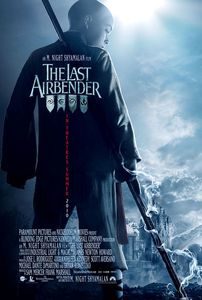
    (In theaters, August 2010) I haven’t seen the original anime series, so I can only judge the film on its own merits rather than as an adaptation.  By this yardstick, The Last Airbender is a mess of breathless mythmaking, indifferent characters, repetitive CGI, terrible dialogue, fuzzy motivations and sometimes-spectacular visuals.  It’s practically impossible to care about a film that spends so little time fleshing out its lead characters that a romance is established by voice-over narration.  (And that’s saying nothing about the blank hole of charisma that is the film’s titular protagonist.)  The story jumps frantically from one scene to another with minimal transition, never giving life to any lasting interest in what’s happening beyond the special effects.  Even by the climax of the film, it’s still explaining what we need to know in order to understand what’s going on.  It’s inept film-making with a stunning budget, but even in describing how much The Last Airbender doesn’t work, it’s hard not to notice that a few things do: The world-building is intriguing enough to make me me interested in the original series, whereas for all of his increasing faults as a writer, M. Night Shyamalan still has a few skills left as a visually ambitious director.  Some of the lengthier battle shots, in particular, are almost wonderful.  But little of this matters once the Typical Fantasy Big Battle is over: By the time The Last Airbender sets up a sequel, all that’s left to viewers is a dull shrug of the shoulders.  As far as hopeless first-instalment-in-planned-fantasy-trilogies go, this is barely above Eragon and quite a bit worse than even The Last Compass.  I saw the film in 3D by accident (no, really: who knew the local dollar theater had more than one 3D screen?) and not only does it add absolutely nothing to the experience, but it may even be taking away some of it.

  • Wireless, Charles Stross

    Wireless, Charles Stross

    Ace, 2009, 352 pages, C$31.00 hc, ISBN 978-0-441-01719-5

    Over the last decade, Science Fiction author Charles Stross has established himself as one of the genre’s top writers thanks to novels combining strong plotting, sly humour, substantial horror and enough SF ideas to inspire an entire generation of readers and writers.  Commercial imperatives mean that most of Stross’ output has taken the form of novels or series, but like many SF writers in love with the possibilities of the genre, Stross has also kept up a small but creatively rewarding stream of short stories alongside his long-form output.  Nearly a decade after the acclaimed Toast that collected many of his early work, Stross now has a new short-story collection bringing together much of Stross’ post-2000 short fiction output.

    Watchers of the contemporary SF market know how unlikely it is for a major publisher to produce a hardcover short story collection: they don’t sell as well as novels, and the tendency over the past few years has been for smaller presses to pick up those collections in a targeted appeal to reach the author’s fans.  For Ace to publish Wireless is a testimony both to Stross’ popularity and to the rewards that his fans can expect to find in his short stories.

    Those expectations are well-placed: Even before mentioning the anthology’s reprinted stories, the major reason to read Wireless is “Palimpsest”, an original novella published here for the first time.  Here, Stross tackles time-travel by confronting clichés: As we follow an operative recruited by an incredibly long-lived organization tasked with the survival of the human race, we begin by seeing how operatives are asked to murder their grandfathers.  It gets much weirder after that, as timelines are changed and overwritten from the fabric of the universe, leaving the operatives with memories contradicting history.  It’s a major novella with an ultra-wide-screen scope that is rarely seen in today’s Science Fiction.  Tackling issues spanning millions of years, “Palimpsest” (currently nominated for a Hugo) delivers on that good-old sense of wonder, sums up the state of a familiar theme and extends it a bit further.  It’s an impressive story, and its density of ideas alone justifies Wireless’s purchase: Most SF novels on the market today don’t even have a fraction of the excitement that Stross crams in a single novella.  (Better news yet: During an interview at Readercon 2010, Stross admitted that he’s thinking hard about continuing “Palimpsest” to a full-length novel.)

    The rest of the book’s table of content may be more familiar, but it’s no less thrilling.  Wireless reprints “Missile Gap”, another impressive Hugo-nominated novella that uses familiar Stross tropes and sends them out for a ride. The conclusion is similar to Stross’ classic “Antibodies”, with a Tipplerian spin: Big thinking designed to make us feel very small.  Its mercilessness is only matched by Stross’ celebrated “A Colder War”, which blends Cold War paranoia with Lovecraftian horrors; it’s an early test-run for the Laundry Files universe, and it’s still as bleakly devastating today as it ever was ten years ago.  It’s not the only test-run in the volume: “Down on the Farm” is another entertaining adventure set in the world of the Laundry Files, while “Trunk and Disorderly” is an amusing Wodehouse pastiche that prefigures some of Saturn’s Children.

    Like many other anthologies, it also comes with a bunch of weaker and slighter stories: I must have read “Rogue Farm” three times by now, and never developed any affection for it.  “MAXOS” is a short-short that’s more of a joke than anything else.  “Unwirer” is written in collaboration with Cory Doctorow and goes overboard with Doctorow’s usual didactic discourse on technological freedoms.  Finally, “Snowball’s Chance” is an amusing deal-with-the-devil story that is probably more fun for Scottish readers with a fondness for reading their accent in print.  It’s no accident if those underwhelming pieces are also the shortest in the book: Stross needs space to properly unpack his ideas.

    I have long considered “A Colder War” to be a classic of sorts, and I think that “Palimpsest” will soon join it as a defining Stross story.  To see both of them in print in the same volume is a wonder in itself.  That they come packaged with a few more of Stross’ shorter pieces will satisfy both fans and neophytes: For anyone looking to discover why Stross has become such a major SF author, Wireless densely demonstrates why even his short stories can be as satisfying as his longer work.

  • Renaissance (2006)

    Renaissance (2006)

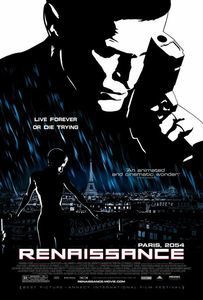
    (On Blu-Ray, August 2010) Renaissance has many faults, but at least it’s interesting to look at.  Computer-animated in stark black-and-white from motion-captured actor performances, director Christian Volckman’s film still has no equals in terms of sheer looks: Directly inspired by the palette of noir films, Renaissance strikingly presents 2054 Paris as a maze of known monuments, fancy modern architecture and impossible vistas.  (I’m particularly interested in knowing how the Seine has fallen down about a hundred meters)  Alas, the story powering the visuals isn’t much to discuss: Not only does it rely on crime-thriller clichés, it concludes on a downbeat note that mocks much of its science-fiction credentials.  The characters are generic and so is the dialogue: at times, there is no other choice than to focus on the visuals given the lack of interest of the story.  Fortunately, there’s a lot to admire in the sights alone: a car chase leads us to a glass-bottomed Notre Dame plaza, a reflection ends up matching two faces perfectly, someone falls through a plate-glass window, a rainstorm suddenly looks so pretty… Given how the entire film is a gigantic visual experiment, it’s not particularly surprising or problematic if some of the staging and animation doesn’t quite work.  What’s worse, though, is that Renaissance’s stark-contrast cinematography may end up producing a headache after only 90 minutes.  It doesn’t help that even after seeing the story to the end, there isn’t much in the script to suggest such a radical visual approach: While I’m sure that it’s less costly to animate a future Paris than to try to re-create it in live-action, there is little in the story (except the film noir heritage) to suggest stark contrasts, black-and-while vision or any other kind of visual reality-bending.  Still, there aren’t enough stylish adult animation experiments around, so it’s a shame that the film’s lack of box-office success and lacklustre reviews may work to discourage any such experiments in the future.  Not even Renaissance’s clunky script and tiring cumulative impact can take away the sheer joy of seeing something fresh on-screen. The R1 Blu-Ray edition, sadly, features the film and nothing else: for such a visually different film, it would have been interesting to have even a cursory look behind the scenes.

  • Chrysalis (2007)

    Chrysalis (2007)

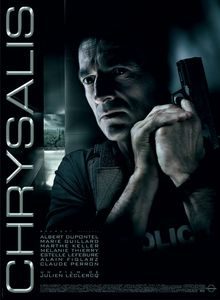
    (On DVD, August 2010) Few people in North America have seen this French Science Fiction film: I don’t think Chrysalis was ever released in theaters, even in Quebec, and its R1 DVD release has been in the direct-to-video ghetto.  That’s a shame, really, because even though the film is a mixed bag, it does manage to tell an ambitiously twinned story based on an authentic SF device.  Albert Dupontel, equally at ease in action sequences and smaller-scale drama, hauntingly plays a grieving “mad dog” policeman hunting down a master criminal.  But the key to Chrysalis ends up being in another storyline featuring a mother and her convalescent daughter.  It’s less straightforward than the usual near-future action thriller, and quite a bit more stylish as well: Writer/director Julien Leclercq never hesitates to show us conventional scenes in unconventional ways, starting with the cold black-and-blue cinematography.  His choices are often effective, especially during two spectacular action sequences: The opening shoot-out opens up with a bang, whereas a later foot-chase sequence starts with a generously long one-shot that is more impressive than fifteen frantic cross-cut.  Film students will be pleased to note that the film’s style differs according to the subplot: The police scenes are brutal, whereas the camera lingers calmly in the medical clinic where much of the other half story takes place.  Too bad that the inane dialogue often drags on long enough to make us notice the limits of the film’s budget: While the Paris 2025 establishing shot, holo-gadgets and two concept cars are convincing, the film eventually feels constrained… although it’s an eloquent compliment to the design crew that it takes a while before realizing so.  Overall, Chrysalis is a pleasant discovery that’s a notch above the usual direct-to-video material.  The DVD contains an informative making-of documentary that discusses the film’s action highlights and mentions the cultural challenges in making an “anticipation” film in France (it also mentions the design contribution of Renaissance’s director Christian Volckman).  There were a few better SF movies in 2007, but not that many more: SF fans shouldn’t ignore this one.

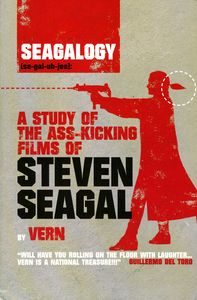
  • Seagalogy, Vern

    Seagalogy, Vern

    Titan, 2008, 396 pages, C$16.95 tp, ISBN 9781845769277

    A quick look at this book’s cover blurbs confirms that I’m not the only one surprised that Vern’s Seagalogy: A Study of the Ass-Kicking Films of Steven Seagal even exists.  For so-called serious cinephiles, Steven Seagal has stopped mattering about ten years ago, when his movies stopped showing in theaters and started going straight to DVD.  Even before then, Seagal’s movies were usually B-grade action films, the occasional exceptions (Under Siege, Executive Decision) often being hailed in spite of Seagal’s presence.  Somewhat savvier filmgoers can point at 1994’s poorly-reviewed On Dangerous Grounds as the film that broke the back of Seagal’s reputation as an actor/director, highlighting its earnest environmental monologue awkwardly inserted as a coda.

    That’s the conventional wisdom, anyway.  For Vern, though, all of Seagal oeuvre is worth scrutiny.  His thesis, quickly stated, is that Seagal’s influence on his own roles and films has been markedly stronger than many other contemporary action stars: That most movies featuring Seagal are, in fact, best considered as “Steven Seagal movies” rather than belonging to their screenwriters or directors.  Vern highlights Seagal’s pet themes and obsessions, and then charts how they are reflected in the vast majority of his work.  To top it off, he also reviews Seagal’s music CDs and energy drink.

    Everyone’s first reaction at a 395-pages book covering all things Seagal is likely to be similar to mine: No, really? Is there a subject of more trivial importance?  Couldn’t this be settled in a quick and cheap blog post?  Aren’t we wasting time, energy, paper, etc, even contemplating such matters?  Go ahead and wonder the same things.  I’ll wait for you to realize that in the end, the only valid appreciation of this book is based on results, not intent.

    Because the damning thing is that Seagalogy is a lot of fun to read.  It even convincingly proves its thesis: By the time we reach 2008’s Pistol Whipped, there’s little doubt that Seagal returns again and again to themes of official corruption, blowback and environmental degradation.  His characters are largely cut from the same clothes, featuring the same taciturn attitude, fascination for other cultures and fleeting family ties.  His methods frequently include improvised weapons, bars fights and people being thrown through glass.  No matter his screenwriters or directors (who range from video-directing pseudonyms to Oscar-nominated Hollywood veterans), Seagal remains Seagal.  For an actor often dismissed without a thought, he has shown remarkable resilience at a time where other actors simply disappeared: More than half of Seagalogy covers his direct-to-video (DTV) films, with as much attention as his theatrical releases.

    This means that Vern has gone through each movie with a fine comb, unravelling the shaky plotting of incoherently-made DTV features and telling us about scenes that barely make any sense on-screen.  He doesn’t review those films as much as he rebuilds them to see how they work (or don’t).  His commentary on DTV features is enlightening in that he has seen far more of them than most of us, and he can spot production flaws that set them apart from their more respectable theatrical brethren.  Even in structure, the book shines by its clear sections, careful interludes, meticulous appendices about minor and never-seen projects, with a poignant ending in which the author finally meets Seagal.

    It helps that Vern’s style is a straightforward mixture of straight-ahead writing, well-chosen details, self-deprecating humour and a keen understanding of the action film genre.  I’ve known of Vern ever since he started writing for aintitcool.com almost a decade ago and while I have often suspected his “Writer who is trying to go clean after a life of crime, alcohol, etc.” shtick to be indulgent performance art by either a bored film student or a struggling screenwriter, I still treasure in my archives an in-character email from him acknowledging my congratulations for a piece he’d written.  I’m not sure I would ever want to know the truth behind the pseudonym.  Much of his profane, consciously-illiterate online style is barely reflected in Seagalogy, though: At the exception of a consistent mistitling of “The Ain’t It Cool News” that plays as an in-joke, the entire book is scrupulously written and edited to the usual standards.  This isn’t a complaint: As much as I want you to read outlawvern.com on a regular basis, a book written and designed like his site would be practically impossible to read at length.

    Because, oh, yes, Seagalogy eventually becomes addictive reading even if you haven’t seen a Seagal film in a decade: For a book with a less-than-respectable subject, it quickly becomes an intelligent trip throughout the clichés of action cinema, and a fascinating discourse on all things Seagal.  It may even make you respect him for the first time.

  • Banlieue 13: Ultimatum [District 13: Ultimatum] (2009)

    Banlieue 13: Ultimatum [District 13: Ultimatum] (2009)

    (On DVD, July 2010) As a follow-up to the first Banlieue 13, this sequel does the expected: Bring back the lead characters to do the same things again in a slightly bigger context, while avoiding messing too much with the formula.  It works decently: David Belle and Cyril Raffaelli are just as great as the action heroes of the sequel, and while there’s a little less parkour this time around, the mix is still heavy in good action sequences.  Between a martial arts demonstration in which a Van Gogh painting is used (Jackie Chan-style) as a weapon, a chase sequence in which a character makes his way down from a tall building complex, or a video-game-inspired fight featuring the captivating Elodie Yung, Banlieue 13: Ultimatum delivers as an action movie.  Director Patrick Alessandrin keeps control of the mixture, and the budget of the piece only shows its limits in a regrettable decision not to show some of the ending explosions.  While Luc Besson’s script is its usual mix of ham-fisted populism, sexy misogyny and thin rationales, there’s something intriguing in the way it sets up a multicultural union of interest against staid reactionary “Harriburton” capitalism.  There may not be a whole lot of substance to this film, but it’s got its pulse on significant Parisian social issues.  Anyone who liked the first film will feel just as satisfied with the sequel. The Region-1 DVD comes complete with a short but enlightening making-of documentary that highlights most of the film’s high action points, and appears to reflect the fun that everyone had in making the picture.

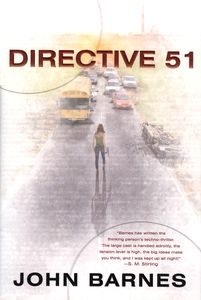
  • Directive 51, John Barnes

    Directive 51, John Barnes

    Ace, 2010, 483 pages, $32.50 hc, ISBN 978-0-441-01822-2

    One of the reasons why I’m quickly cooling off on Science Fiction’s current post-apocalyptic craze is my nagging suspicion that not everyone sees the apocalypse (whether it’s climate-, alien- or zombie-driven) as a bad thing.  There’s a streak of wish-fulfillment in “rebuilding the world” fantasies that makes me uneasy: I love the comforts of our civilization, and anyone talking about bringing it down strikes me as an enemy more than a romantic.

    Knowing this, you can probably guess why the opening section of John Barnes’ Directive 51 struck such a deep chord: As this first novel in a new trilogy begins, an uncoordinated group of eco-saboteurs, disaffected college students, back-to-the-Earth dreamers, international terrorists and other miscellaneous hoodlums spontaneously act on the belief that October 28th, 2024 is “Daybreak”: The day modern civilization dies.  Three particularly nasty pieces of work have a disproportionate impact on the story: A biological critter that disintegrates plastic and rubber, some nanotech that eats electronics, and the kidnapping of the US Vice-President.  While the breathless thriller of the vice-presidential kidnapping unfolds, our heroes from the US “Department of the Future” are introduced: a couple of brainy protagonists who desperately try to figure out what’s happening even as the world breaks down around them.

    It’s too late, though: As plastics melt away, electronics are reduced to dust and the US president declares himself mentally unfit to cope with the situation, order breaks down in more ways than one.  Before long, our protagonists are stuck between an implausibly clueless acting president, an ultra-right-wing challenger, massive systemic shortages and increasing violence.  It gets even worse as evidence accumulates that Daybreak was carefully orchestrated with follow-up strikes designed to wipe out any hope of recovery.  As the book ends, the duelling Presidents of the United States have to confront one question: Is there still an active campaign against them, or are they stuck dealing with a dead man’s switch?  (We readers, having been made privy to one crucial half-page scene [P.220], know better: something is going on, and I’d be surprised if the next volumes don’t explain how Daybreak was less spontaneous than it may first appear.)

    Given that this is the first volume of a trilogy, it’s no surprise if Directive 51 is all set-up with partial payoff: Much of the book is spent contemplating the rapid destruction of modern American civilization (with late and occasional glances at the rest of the world, which doesn’t do any better) through viewpoint characters who either caused part of it to happen or are desperately trying to mitigate the millions of deaths that follow.

    Frequent readers of these reviews know that I’ve been a fan of John Barnes’ work for a long time and so shouldn’t be surprised if I end up soft-pedaling a number of Directive 51’s annoyances.  The first chunk of the book is more irritating than the rest: In an effort to telescope as many things as possible in his “One Day” structure, Barnes’ hand is more obvious than usual in the interlocking plotting.  Worse, though, is that much of the book’s first third is spent with the terrorists, saboteurs and fools who initiate Daybreak: There’s nothing pleasant in reading about people you just want to hit on the head (with something suitably low-tech, such as a shovel or even just a baseball bat) for bringing about the end of civilization.  This explains, in part, why the VP-kidnapping subplot feels so thrilling: here’s a chance for heroics against the impending doom that cloys the rest of the novel.

    The novel gets more interesting after Daybreak is over, as our characters get the chance to be protagonists, are stuck in an impossible crisis of succession and more unusual plotting elements get their chance to shine.  The first presidential succession crisis is great good fun for political junkies readers, posing questions about personal responsibility in serving the nation even when it contradicts regulations.  Few non-rabidly political novelists ever end up writing about gunfire and insanity in the White House, so Barnes at least has that running in his favour.

    But what the second chunk of the book (“Ten Days”) ends up revealing is a curiously bloodless approach to the end of civilization: Cities burn, libraries are torched, super-weapons are detonated, billions of people die and the narration barely raises an eyebrow.  It takes a while to understand that the disaster is not limited to the US, and the novel seems to be in such a hurry to tear everything down that it barely manages to give us a sense of how bad it’s getting: There are a few moments in the narrative where the characters coolly mention how Daybreak is irreversible, that it will destroy all electronics, that it will take hundreds of years to recover from it (if ever) and those one-liners are everything we get in order to realize that this is as bad as it gets.  Perhaps worse is the lack of resentment and regret from the characters at how primitive their situation has become in a matter of days: A couple of saboteurs are treated sympathetically (well, sort of; as so often happens in John Barnes’s novels, one of them gets raped –albeit off-screen in an unusual show of restraint, although see “bloodless” above.) and even the so-called heroes end up saying things of comfort to the Daybreakers.  Hard-SF is about brainy readers more than emotive characters, but even that stance be carried too far.

    On the other hand… this novel has haunted me more than most of the others I’ve read this year.  I’d acknowledge my unusual attachment to civilization if it wasn’t for the fact that you’re reading this on a website, maybe from devices that didn’t exist as recently as five years ago.  Everyone has their particular nightmares, and when my own Maslowian hierarchy of needs is nicely fulfilled, I worry a lot about the fragility of our contemporary way of life.

    Then there’s the entertainment value of the scattered political outlook of the novel.  Barnes is a professional contrarian, and it’s amusing to see how he tweaks current partisan outlooks as the world of the novel changes around its characters.  There’s some sympathy for ultra-rich libertarians as they finally get to make use of their “Castles” enclaves built during the Obama administration even as the novel concerns itself with the (re)establishment of a national government.  A right-ring evangelical politician initially disliked by the book’s progressive heroes ends up rising to the occasion and being a preferable alternative to a delusional old-school Democrat.  Part of Directive 51‘s effectiveness lies in showing how crises can change our certitudes, so it’s no surprise if hyper-partisan readers will be upset at the novel’s shifting political sands.  More independently-minded readers will have more fun –especially when reading the amazon.com reviews accusing the novel of being a mouthpiece for whatever extremism is convenient.

    There’s also the fact that John Barnes is a seasoned SF writer, so that even when he errs, he’s able to deliver what his SF-reading public wants.  Directive 51 cleverly combines science-fictional concerns with a techno-thriller narrative mode to deliver a novel that’s up to the latest SF gadgets while delivering the thrills we expect from such a large-scale canvas.  When it gets ripping into the mechanics of pure fusion bombs, it directly scratches the sense of wonder that his readers are looking for.  (It’s also an eloquent piece of evidence for critics who argue that techno-thrillers and hard-SF are basically the flip sides of the same storytelling impulses.)  I happen to be unusually susceptible to the kind of narrative strategies used in this novel, so that purring sound you hear from my frantic pre-ordering of the book’s sequels may not necessarily translate into any similar affection from anyone else.

    Ultimately, though, the flaws and virtues of Directive 51 will be best appreciated once the story it’s starting to tell will be over.  Barnes has often upset the narrative certitudes of his previous series, and it wouldn’t be surprising if the upcoming Daybreak Zero ends up telling a different story than what we can predict.  In the meantime, Directive 51 is a flawed but fascinating end-of-the-world narrative that does a few new and interesting things.  It’s good enough to satisfy even those who are tired of SF’s current depressive phase.  Unlike all of the zombie or post-oil catastrophes, it asks the far more disturbing question: What if some people actually worked toward the end of the world as we know it?
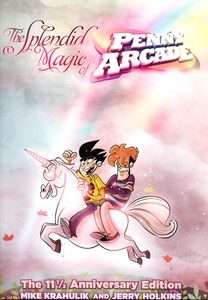
  • The Splendid Magic of Penny Arcade: The 11 ½ Anniversary Edition, Mike Krahulik & Jerry Holkins

    The Splendid Magic of Penny Arcade: The 11 ½ Anniversary Edition, Mike Krahulik & Jerry Holkins

    Del Rey, 2010, 164 pages, C$29.95 hc, ISBN 978-0-345-51226-0

    One of the great things about book collections of web-comics is that I can use them as an excuse to talk about some of my favourite on-line destinations.

    I’m not much of a gamer any more, but I still pay enough attention to the field to appreciate the genre criticism barely disguised behind the often-profane humour that the Penny Arcade guys offer three times per week.  You can read all of the archives at any time, or get the six annual collections covering the strip up until 2005 so far, but for a truly good look at Mike Krahulik and Jerry Holkins‘s Penny Arcade empire so far, you can’t do better than The Splendid Magic of Penny Arcade: The 11 ½ Anniversary Edition (take off the dust jacket for a slightly coarser alternate title)

    The book brings together a number of pieces written about Penny Arcade, its creators, the massive PAX gaming events and (more responsibly) the Child’s Play charity dedicated to providing games to sick children.  Essays describe how PAX first began (and the mistakes along the way), and how the usual “games are bad for kids” articles led Krahulik and Holkins to throw back clichés in the face of their critics by raising the social responsibility of the gaming community.  Another highlight is Penny Arcade Manager Robert Khoo’s article “Breaking the Law”, detailing Penny Arcade’s run-ins with American Greetings, now-discredited Jack Thompson and “Publisher X”. But for long-time readers of the series, a highlight is (re)reading the lengthy Wired profile about the two creators.  Penny Arcade is, in many ways, an accidental success: the article clearly establishes how everything began and then evolved.

    Weightier material aside, the chief attraction of The Splendid Magic of Penny Arcade remains the comic strips, here selected and presented out of chronology for various purposes.  Even though I can’t imagine Penny Arcade picking up new readers from this book (it’s got “for existing fans” all over it, down to an impressive gallery of tribute pieces by other geek-favourite artists), this would in fact be an ideal way to ease oneself into the universe of the strip.  There’s an introduction to the recurring characters (including a few minor ones that only fans with long memories will remember), various continuity highlights (“Paint the Line”, “Cardboard Tube Samurai”, “Twisp and Catsby”, “Armadeaddon”, “On Sorcelation”…) and a few strips selected by Krahulik and Holkins as being “the best”, with commentary throughout.  While some of the references remain obscure to people who didn’t play a particular game at the time of the comic’s publication, it’s about as quick a refresher on the various in-jokes, conventions and overall atmosphere of the strip.  (Much to my dismay, I realized during the best-of retrospective that many of my favourite pieces either featured extreme profanity or obscure geeky references that I may not even remember in five years.)

    It’s all handsomely collected in a full-sized hardcover with generous margins and plenty of incidental illustrations.  Unfortunately, a lot of the filler consists in blown-up, sometimes-edited comics panels.  (You can see the pixels!).  Another relatively low point is the unedited transcript of the Q&A section.  It’s needlessly hard to read; some editing would have been a judicious choice.

    But all in all, this is a perfect gift for the Penny Arcade fans.  Whoever is seduced by this book can already look forward to six annual collections already on shelves, and the entire run of the series on the web.  Don’t worry if some of the references are obscure: Only Gabe and Tycho understood them all in the first place, and they may have forgotten many of them already.  Just go on to the next strip and wonder in amazement at how the web has made such high-quality niche content possible.