Month: January 2021

  • The Scarlet Pimpernel (1934)

    The Scarlet Pimpernel (1934)

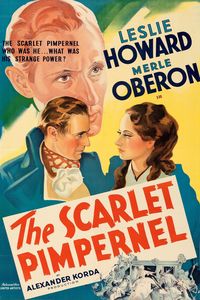
    (On Cable TV, January 2021) There’s a special place for The Scarlet Pimpernel (the character) in fictional history, considering that it inspired the motif of (super)heroes with a hidden identity, preceding Zorro, which preceded Batman. Considering that Emma Orczy’s The Scarlet Pimpernel (the novel) is an adventure tale set at the time of the French Revolution featuring a mild aristocrat-by-day becoming a wild swordsman-by-night, it’s possible to imagine any adaptation leaning on one or two directions, either as a swashbuckling adventure, or as a period costume drama. Unfortunately for me, I was expecting the first and received the second in the 1934 version of The Scarlet Pimpernel. While the film is not devoid of sword-fighting action sequences, it mostly goes in the period drama direction. The costumes and sets are sumptuous, but modern viewers will miss the steady pace of action sequences that more modern adaptations would have been sure to include. It’s not entirely fair to second-guess the storytelling instincts of previous generations—after all, producer Alexander Korda clearly knew what he was doing, and the result was one of Great Britain’s top-grossing films of 1934. But modern viewers will find it impossible to watch The Scarlet Pimpernel and not see where the film could have been pumped up with more action for an even more engaging result—as it is, it feels too slow, too talky and too dull despite a fascinating premise. Oh well—seeing how the Three Musketeers have been reinterpreted in steadily more action-filled ways over the decades, maybe it’s not a good idea to wish for a remake.

  • Deathtrap (1982)

    Deathtrap (1982)

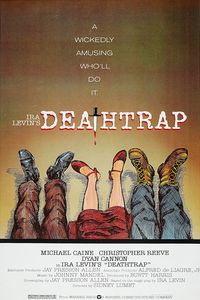
    (On Cable TV, January 2021) Murder mystery and theatrical metafiction meet in Deathtrap, an enjoyable and unpredictable dark comedy starring Michael Caine and Christopher Reeves. It opens on Caine as a playwright experiencing a fourth failure in a row and retreating to his rural mansion, where he explains to his wife that he just read the most brilliant play by a complete novice, and the best plot he can think about is to murder the young writer and steal the play. Shortly thereafter, he invites the apprentice playwright home… but saying more would be a disservice, so quickly does the film go through different narrative configurations. Christopher Reeves plays the younger writer with an edge rarely seen in other films from him—not only does Deathtrap feature an explicit homosexual kiss (albeit as a mark of villainy—the early 1980s weren’t that progressive), but there’s a shot that makes him look like a maniacal Bruce Campbell at some point. The somewhat forgotten Dyan Cannon (whose career peaked between 1969 and 1982) has a decent role here, but the stars are clearly Caine and Reeves, especially as their antagonism becomes more explicit. Given the film’s origin in a long-running, widely acclaimed play by Ira Levin, there are plenty of metatheatrical references to be found (“It’s a two-act play with five characters,” says one of the five characters of a two-act play…), which adds both to its comedy and wittiness. The limited number of characters, dark comedy, secluded location and featured role for Caine immediately draw parallels with 1972’s Sleuth, but while both movies belong to the same subgenre, they’re sufficiently different as to make a great double feature rather than repeat themselves. (You could also make a double feature with 2019’s Knives Out, considering the wall-of-weapons and mystery-writers-getting-into-the-business motifs.)  The metafiction carries through to the climactic ending, which seems cheap at first glance but appreciates with time. Even with its quirks, Deathtrap remains a very enjoyable comic thriller, not always audience-friendly at times but certainly surprising and memorable.

  • Boys’ Night Out (1962)

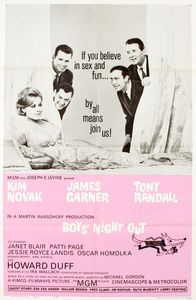
    Boys’ Night Out (1962)

    (On Cable TV, January 2021) What I like about 1960s sex comedies is the very specific tone that they have, sufficiently freed from the Hays Code to tackle more salacious topics such as the ongoing sexual revolution, but still unwilling to be vulgar about it—it’s naughty without being upsetting and while I wouldn’t want to see that tone everywhere, it’s a welcome change of pace. The premise of Boys’ Night Out is simple, what with four men pooling their money to rent an apartment in Manhattan. If you want to compare eras and tone, keep in mind that there’s a 2014 “erotic thriller” called The Loft (itself a remake of a 2008 Dutch film) that shares that exact same premise—but the later R-rated film goes all-in on graphic content and murder. Boys’ Night Out is arguably funnier to modern-day audiences, as we can clearly picture where the film could but chooses not to go—because while our four men (three married, one divorced) may tell the others that they’re in for the young blonde “housekeeper” inhabiting the apartment, things are very different (and much funnier) once the married men get their night out: One simply wants to eat more than the health food prepared by his wife; another wants to talk without constantly being interrupted; the third simply wants to repair things around the apartment. Meanwhile, our divorced protagonist (the very likable James Garner) falls for the housekeeper and gets jealous of the achievements made up by his three friends. It’s all slightly naughty but not really, and the film does hit a good rhythm during its second third, especially when the “housekeeper” is revealed to be doing field research on a sociology thesis exemplified by the three married men. Boys’ Night Out offers a comic take on the Mad Men-ish era of henpecked husbands living the commuter train lifestyle, blunt gendered stereotypes and all. It does become less effective during its third act, as the comedy wears out while the film desperately tries to wrap up everything in a way that leaves everyone happy, wives included—the pace slows down considerably, and by the time the last fifteen minutes roll by, there aren’t any surprises left—just a drawn-out execution of something entirely predictable. Tighten that third act and it would be a much better film—but it serves well as a time capsule comedy, as a showcase for Kim Novak playing broad comedy, or another very similar film featuring Tony Randall in a very familiar role. Boys’ Night Out is fun and practically plays as family-friendly entertainment despite the subject matter, so innocuous is it in presenting its then-risqué subject matter.

  • Cary Grant: A Brilliant Disguise, Scott Eyman

    Simon & Schuster, 2020, 576 pages, C$47.00 hc, ISBN 978-1501192111

    Whenever people find out I’m a big Classic Hollywood fan, one of the questions I often get is “Who’s your favourite actor?” Trying to explain that there’s a lot of them and picking one would be incredibly reductive takes too long, so I’ve gotten in the habit of answering, “Cary Grant.”  It’s not only true, but it’s also a pretty safe choice, as these things go: Unlike other actors who had more range or a deeper craving for dramatic depth, Grant usually played the same kind of likable character. Intensely charming to the point where calling him a paragon of charisma is underselling it, Grant’s on-screen image remains remarkably timeless. The epitome of Classic Hollywood, Grant was the kind of person for whom someone came up with the old saw, “men wanted to be him; women wanted to be with him.”

    That Cary Grant wasn’t born Cary Grant was not a secret. Any half-decent studio-approved profile of him during his working career usually mentioned that he was born Archibald “Archie” Leach in lower-class Bristol. What’s more, there are at least two explicit references to Leach’s “death” in Grant’s films (visual in Arsenic and Old Lace, spoken in His Girl Friday). The man who would become Cary Grant reinvented himself once he got to Hollywood — and (decades later) legally changed his name the day he became an American citizen. But as Scott Eyman demonstrates in the exemplary Cary Grant: A Brilliant Disguise, the gulf between the man and his screen person was never wider than the one between Leach and Grant. You can certainly interpret his life in three acts as he became Grant in name, struggled to keep up with his screen persona, and finally managed to close the gap after retiring from acting.

    The facts of Grant’s life are easy enough to grasp from Wikipedia’s blandly descriptive article. Joining a musical hall troupe and travelling to America to escape a poor upbringing (and terrible family dynamics — his mother committed to an asylum by his father, who led the young Archie to believe she was dead), he arrived in Hollywood at the beginning of the sound era, where an apprenticeship from 1932 to 1936 led to an incredible string of successful performances in romantic comedies from 1937 to 1944. His stardom thus assured, Grant kept going through familiar motions for a few years until a hiatus in 1953. Called back to the big screen by Hitchcock after some globetrotting, his next few projects revived his career and gave him another run of great movies from 1955 to 1963. Unusually enough, Grant decided to retire in 1966—years before invalidity or box-office irrelevance and, incidentally, the year before Hollywood completely changed with the arrival of New Hollywood. His next twenty years were spent doting on his daughter and reinforcing his second career as a businessman, only infrequently acknowledging his past as a movie icon. Despite two nominations, Grand never won a competitive Oscar — he was awarded an honorary one in 1972. He died of a sudden cerebrovascular incident in 1986, in a small town where he was slated to attend an intimate Q&A event.

    But those facts barely scratch the complexity of the man. While audiences always expect a difference between actors and the character they play, the gulf between Leach and Grant was stark. Even before discussing Grant-the-character, Grant-the-actor was a deliberate creation of Leach-the-man: Taking bits and pieces of other people he admired upon his arrival in Hollywood, he built a refined, sophisticated persona that he then spent years trying to become. The difference could be seen through exceptional insecurity, lower-class reflexes at odds with his status as a superstar actor (such as an aversion to spending money) and a strong self-loathing of his profession. In later years, Grant wouldn’t spend much time associating himself with classic Hollywood, nor would he encourage his daughter to follow in his footsteps.

    Eylman delves deep into Grant’s life throughout the book. Already familiar with the Classic Hollywood era, he’s able to properly contextualize Grant’s films and career against a backdrop of studio contracts and an evolving industry. Nearly ever Grant film is described with entertaining production notes and box-office results, tracking the genesis of projects and their impact on his life and career. On a personal level, the biographer is able to follow Grant’s quirks and lifestyle (such as his never-finished Hollywood mansion, and his more easygoing life in Palm Springs). Grant was a man of substantial complexity, and A Brilliant Disguise manages to portray his contradictions with some finesse: he was at once incredibly cheap (to the point of nickel-and-diming guests) and incredibly generous, sending gifts and substantial amounts of money to friends and people in need. Much has been made of Grant’s sexuality over the years, and while Eyman finds plenty of evidence to suggest that Grant was variously bisexual at times during his life (including some late-life confessions that he had same-sex flings as a young man, but preferred heterosexual relationships the older he got), he’s on much more interesting ground in telling us that “Grant was on nobody’s team but his own.”  Five marriages are enough to be intriguing on their own.

    Still, the main psychodrama running throughout the narrative is one of dissociation and eventual reintegration between Leach and Grant. You may expect the biography to be over by the time Grant retires from acting and stops talking about Hollywood but there’s still a good hundred pages or so describing Grant as an older man, clearly more at peace with both halves of himself than he’d even been. He becomes relaxed, generous, just as charming but now with the knowledge that he had nothing further to prove. There’s a rather likable atmosphere in those later chapters, as Grant obsessively documents his daughter’s life, flies to business meetings around the world and occasionally acknowledges his film accomplishments. Grant’s late-life Q&A sessions would have been unthinkable earlier during his life when he was a master of the no-answer interviews revealing little about himself.

    Fans of Old Hollywood will find plenty to like here, whether it’s the clear backdrop of how Hollywood changed from 1930 to 1965, or the appearances by other Hollywood celebrities. Eyman is too good to indulge in unverified gossip — the anecdotes here are telling without being salacious. Still, I did not expect to read about Grant smashing Oscar Levant’s parked car with his own in a fit of jealous rage over the same woman. The book is intelligible to all, but most clearly aimed at those with some familiarity with Grant and his era of stardom. I found quite a few new revelations here—including the strong suggestion that Grant worked with British movie mogul Alexander Korda during WW2 in helping the British intelligence services keep tabs on Hollywood—Eyman uncovers enough details in Korda’s FBI file about his American intelligence operation and a curious sudden end to Grant’s attempts to serve the war effort to suggest that Grant eventually found covert employment—although proof remains elusive and possibly unattainable.

    As far as biographies go, Cary Grant: A Brilliant Disguise meets the gold standard of the genre. Exceptionally well-researched yet compellingly written to give us a great glimpse at the man and his times, it’s a captivating portrait of Cary Grant and his evolution. It’s terrific reading, with the only hiccup being the use of unfamiliar expressions probably stemming from Leach’s working-class English background. It’s good enough that readers will feel as if they have a good working approximation of Grant in their heads by the time the book is over. While I’m not quite an authority on the subject, it does feel like a definitive biography — it sets a very, every high bar for any subsequent effort.
  • Hellraiser III: Hell on Earth (1992)

    Hellraiser III: Hell on Earth (1992)

    (In French, On Cable TV, January 2021) Even if Hellraiser III manages to run with the very last moments of Hellraiser II and much of its thematic content, this third entry clearly marks a shift in the series. The main narrative of the first two films is abandoned along with its protagonist, and the emphasis is placed on showing more of the Cenobites in an urban environment. The usual “raising of the dead by blood sacrifice” eventually leads to an entire nightclub being killed or possessed, and a few scenes set at night in downtown Generic City, USA. The plotting feels much closer to any other horror film of the time, and the place reserved for the gore clearly shows how the film aligns itself with the expectations of the genre horror fans. (New director, moving production to the United States and a takeover by genre-focused studio Dimension will do that.) Parts of Hellraiser III are better than you’d expect, especially for the third instalment of a series that is slowly becoming worse at each instalment. The subplot about Pinhead being a British officer fighting to regain his humanity is developed from the previous film, as is the somewhat underwhelming “pillar” that appears at the very end of the second film. The nightclub massacre, as gory as it is, finally shows what happens when the series goes all-out in its flesh-tearing horror—and the showdown in the city streets outside, as limited as it is, finally expands the series outside the walls of its previous settings. On the other hand, Hellraiser III can be frustratingly generic at other times, running through the motions of a formula horror narrative. The best thing you can say about it is that while it’s slightly less interesting than its predecessor, it’s not yet bad enough to stop watching the series. But just wait.

  • Tenet (2020)

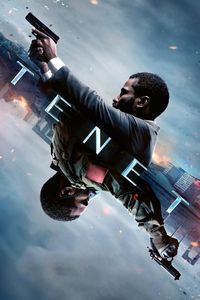
    Tenet (2020)

    (Video on-Demand, January 2021) I’m favourably predisposed toward anything from writer-director Christopher Nolan, but it’s not an uncritical stance, especially when Tenet doesn’t quite manage to meet its own objectives. It’s certainly, unmistakably a Nolan film: You can quickly recognize his thematic preoccupation with time, his love for spy thrillers, his willingness to play with narrative structure and the thematic winks toward filmmaking. You can once again experience the cool palette of colours, the crisp cinematography, the bombastic score and many of his usual favourite actors. (The theatrical experience of watching Tenet was reportedly marred by inappropriate sound mixing, but that doesn’t seem to be the case on home video—and I watch movies with subtitles anyway.)  But Nolan can be too clever for his own good, and Tenet’s gimmick—reversing the time flow—is intriguing at first, then nonsensical in its details, then fascinating again when it leads to big novel action sequences, then incomprehensible again when you start asking questions. Tenet hovers perilously on the edge of disbelief, sometimes retreating to the unquestioning safety of a slam-bang action sequence, at other times hampered by its own confusion. I did love much of the first half-hour for the way it sets up a high-octane modern spy thriller, as if James Bond dove in Science Fiction and reinvigorated its formula. John David Washington makes for a good action hero, and while I’m already steadily growing more favourable to Robert Pattinson, this is the film that reassured me that he’s going to age into a great career. Elizabeth Debicki improves the longer the film goes on, ultimately getting up to Widows-level shenanigans late in the third act. Michael Caine has a terrific one-scene cameo, and Dimple Kapadia is also quite intriguing in a strong supporting role. Still, the star here is Nolan, as he builds an ambitious film that goes back and forth in its temporal narrative and delivers impressive showpieces. Fans of time-travel movies will learn to recognize the usual touches of the genre—Tenet is a film that benefits from a second watch, or reading a thorough analysis of it shortly after first viewing. The action sequence at the middle of the film is easily better than the too-chaotic conclusion that mars the third act—I recognize what Nolan was trying to do, but much of it simply appears confusing for confusion’s sake—or worse for visuals that don’t fit into the overall logic of the film. Compared to the luminous clarity of Inception, Tenet feels undercooked, leading viewers to ask questions about plausibility that are not to the film’s benefit. I still had a good time watching it, but I can’t help but remain unsatisfied by the result—it’s 75% of a great movie, and while that’s far preferable to most contemporary thrillers, it falls short of what Nolan usually delivers.

  • Come Fly with Me (1963)

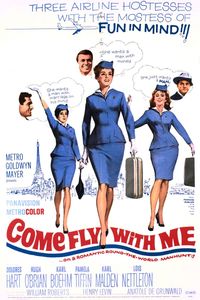
    Come Fly with Me (1963)

    (On Cable TV, January 2021) In retrospect, the popularization of passenger air travel in the 1960s had some really weird second-order effects, and one of the most trivial of them was a small but distinctive wave of pop culture focused on the new archetype of the stewardess. From the funny 1965 Jerry Lewis vehicle Boeing, Boeing to the naughty 1969 “exposé” Coffee, Tea or Me?, stewardesses held America’s attention during the 1960s, and Come Fly with Me was one of the earliest examples of the form. Alas, it pales in comparison to its spiritual inheritors—While Come Fly With Me features no less than three parallel romances between our lead trio of stewardesses and their passengers and flying crew, it has very little grace or elegance in how it presents its romantic subplots. As directed by Henry Levin, it’s far less funny or flirty as it presents itself, and becomes predictable far too early, with little in terms of small details to keep it interesting. While it does remain an illustration of the time and how international air travel could be presented as aspirational to mass audiences of the time, there is very little to Come Fly with Me to make it interesting to modern audiences. Compared to the outdated but still funny farce of Boeing Boeing, it makes Come Fly with Me seem much smaller and conventional. Even the date of the film isn’t much of an excuse—while the Hays Code was still generally applicable in the early 1963, I can point to many more salacious romantic comedies of the time that easily outwit Come Fly with Me in terms of naughtiness or comedy. It’s an occasionally interesting glimpse at the past, but not something worth booking an airplane ticket for.

  • The Last of Sheila (1973)

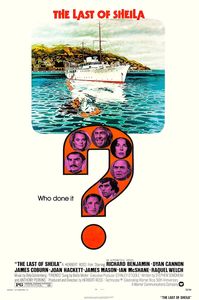
    The Last of Sheila (1973)

    (On Cable TV, January 2021) There’s something primal and timeless about a good murder mystery—the universal stakes of death being on the line, and the playful nature of the convoluted plotting that usually accompanies such films. The Last of Sheila has, to put it bluntly, not necessarily aged well: The muddy cinematography is clearly from the early 1970s, as are the sometimes-hideous fashions and the contemporary details that pepper the film. Here, a Hollywood mogul calls six “friends” for a Mediterranean holiday aboard his yacht. But what they discover early on is that the puzzle-obsessed mogul has fun and games in mind for them: Six days, six stops, six enigmas to resolve. But what they eventually discover is that the mogul has a much darker scheme in mind—a year earlier, his wife was killed in a hit-and-run, and the guilty driver is among them. Then it gets more complicated—all the way to an ending where the survivors all find killers and guilty consciences. The cast is interesting, what with James Coburn having far too much fun as the mogul, and guests played by a motley crew, including an old James Mason, a young Ian McShane, and Raquel Welch in the middle of her peak popularity. The script, from unlikely scribes Anthony Perkins and Stephen Sondheim (who used to host murder mystery parties), is suitably twisty, witty and clever—I’m not too sure that the third act is as spectacular as it should be given its more intimate setting, but it satisfies well enough. Despite being visibly stuck in the early 1970s, The Last of Sheila is highly watchable—even more so for fans of the actors involved, but accessible to all, especially once the fun and games start.

  • That Hamilton Woman (1941)

    That Hamilton Woman (1941)

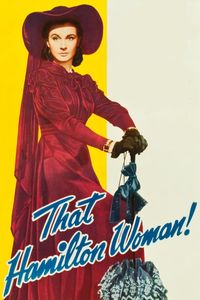
    (On Cable TV, January 2021) By most standards, That Hamilton Woman was 1941’s equivalent to a sure-fire blockbuster. Despite Britain being under siege by the Nazi regime, producer Alexander Korba was betting on a number of strong box-office factors: It’s a film that paired then-wedded superstars Vivien Leigh (still riding high on Gone with the Wind) and Laurence Olivier. It tackled a salacious affair involving revered eighteenth-century national hero Horatio Nelson. Lavishly produced, it features great costumes and impeccable technical credentials for the time. Despite being a historical film, it clearly made clear parallels between fighting the tyranny of Napoleon with the effort of fighting Hitler. In other words, That Hamilton Woman was the perfect thing to whip up popular fervour at a time that needed it. Alas, such virtues don’t always travel well across eighty years, and so to modern audiences it feels like a film constrained. Putting aside how 1940s period dramas haven’t necessarily aged well in terms of narrative pacing, histrionic melodrama or insistent soundtrack, this film feels limited by the censorship of the time, unable to portray the adulterous relationship at the core of its narrative with the honesty that modern audiences would expect. It doesn’t help that Leigh plays an exceptionally annoying character in the first half of the film, setting a bad tone from the get-go. In other words, I had a rough time getting through That Hamilton Woman—the strongest elements remain the propagandist nature of its narrative in whipping up fighting fervour in the Commonwealth. (On the other hand, I was primed for that, having just watched the documentary feature Churchill and the Movie Mogul a few days earlier.)

  • Monkey Beach (2020)

    Monkey Beach (2020)

    (On Cable TV, January 2021) We usually talk about movie formulas as being bad things, but an underappreciated aspect of their nature is that to have a formula, you need to have enough examples of something to distinguish the formula. When it comes to underrepresented kind of cinema, the emergence of a formula can be the sign of a healthy subgenre. So it is that, in between Monkey Beach and near-contemporary The Incredible 25th Year of Mitzi Bearclaw (and the inverse of Through Black Spruce), we have an emerging formula: The young indigenous woman leaving the big city to return to the reserve, where her supernatural powers help untangle family problems, sentimental complications and her own maturation. Monkey Beach has a bigger budget and a literary origin: It’s adapted from Eden Robinson’s well-received novel, can boast of some amazing cinematography and can anchor itself to Adam Beach as a marquee name. Grace Dove is quite good in the lead role, with special mention of Tina Lameman’s performance as guiding elder Ma-Ma-Oo. The BC landscapes are gorgeously portrayed, and director Loretta Todd gives the film a strong atmosphere. Unfortunately, the film struck me as more technically successful but not quite as interesting as The Incredible 25th Year of Mitzi Bearclaw: far more leaden in its messages, not as charmingly odd in its presentation and a bit too serious for its own good, Monkey Beach feels like the staider, po-faced cousin of Mitzi Bearclaw. This being said, I couldn’t be happier that there are no less than two movies poking at the same topic in their own way—First Nations cinema in Canada is still too rare, although I’ve seen no less than six such movies in the past six months now that the airwaves are free to present something other than Hollywood blockbusters during the pandemic void. I really would like to see a third and a fourth example of this “back to the reserve” formula: counter-intuitively, there are representativeness and strength in formula.

  • Hellbound: Hellraiser II (1988)

    Hellbound: Hellraiser II (1988)

    (In French, On Cable TV, January 2021) While most people associate the Hellraiser series with the grotesque Cenobites (including the pinheaded series icon), the first film doesn’t have them on-screen for long—it’s mostly about the teenage protagonist’s creepy uncle being resurrected from the dead by blood sacrifice. Sequel Hellbound tries to have more of the Cenobites and develop the series’ hellish mythology without losing track of the first film’s overall plot. Here, our teenage protagonist (Clare Higgins, as cute as in the first film) does her best to reunite with her dead father, and gets the means to literally go to (a) hell in order to pursue him, despite the efforts of her murderous stepmother, reborn through the series’ usual blood sacrifices. In trying to play with a mythology invented by someone else (Clive Baker only being peripherally involved in this instalment), director Tony Randel manages to deliver a thoroughly average horror film—while there are a few effective moments, especially in the first half of the film when the evil stepmother makes a skinless entrance, Hellbound is watchable without being particularly compelling… which counts as a failure given the fascinating untapped possibility of its premise. The moment-to-moment cohesion of the film is also frequently dodgy, given how it seems to skip from one visual set piece to another. Compared to other late-1980s horror movies, Hellbound is not bad—but the expansive nature of its premise means that the special effects limitations of the time do prevent the film from reaching its fullest potential. There are at least half a dozen supernatural horror movies of that era that are simply better in every respect. Although, after watching the subsequent instalment in the series, I’m surprised to note how much material introduced in Hellbound pays off in the next movie.

  • Rev (2020)

    Rev (2020)

    (On Cable TV, January 2021) The sole distinction earned by Rev is being a GTA-set GTA. Or, to unpack this a bit, of being a Grand Theft Auto game set in the Greater Toronto Area. Unfortunately, Rev also has to contend with being an amoral low-budget film, both of which severely limit its effectiveness. Stuck without an action sequence budget, Rev muddles through a story that doesn’t include a single expansive action scene: don’t expect car chases or shootouts, because this is a film that exemplifies “look, but do not touch the expensive rented cars that we can’t afford to trash.”  The other problem is a lack of morals—Scorsese-style, the film is heavily narrated by its protagonist, a young man turning to crime because a steady job is too boring and he doesn’t have the basic skills required for customer service or managing his boss. His sole claim to being a hero has to do with being forced to work with the police, but he (in the tradition of such films—I don’t writer-director Ant Horasanli has a single original idea for Rev beside setting it in Toronto) eventually reneges on that. There’s a useful comparison here to be made with the Fast and Furious series that Rev is so intent on imitating—the Fast and Furious characters may not be law-abiding, but they have strong personal morals and likable traits that are completely absent here. Our protagonist loves making money, stealing his boss’s girlfriend (which goes over more smoothly than you’d expect in the end) and not working for The Man—making him of dubious likability if you’re not a part of the same sociopathic set. Low budget action plus rock-bottom morals make Rev easy to dismiss as nothing more than a wannabe close of much better films. It didn’t have to be like that—from a visual perspective, Rev stretches its budget as far as it can go with some really good cinematography, adequate acting (I won’t argue with Vivica A. Fox and Hannah Gordon) and dialogue that, from time to time, can be amusing. But it’s all in the service of something intensely predictable and completely meaningless, trivializing crime with a fairytale distinction between bad criminals and “good” criminals engaged in the proverbial “cool crime of car thievery.”  Rev is the kind of film that went wrong at the scripting stage, chasing an audience without understanding that it’s got to be about more than making money and running off on the beach.

  • Radioactive (2019)

    Radioactive (2019)

    (On Cable TV, January 2021) I was, really, really primed to like Radioactivity. I’ve always liked the story of Marie Curie, and I’ve liked much of director Marjane Satrapi’s work in different media. But the result steadily slips sideways the longer it goes on, to a point where I can’t really recommend the results. This is the third film about Marie Curie that I’ve seen in the span of a year, and if it’s easily the more technically polished, it ranks a distant third behind the classic 1943 Greer Garson biopic, and the far more comedic 1997 Les Palmes de M. Schutz. Proudly going for the obvious angle of presenting Curie as a feminist icon, Radioactive overplays its hand to the point of becoming unlikable, distorting the historical records and losing itself in tangents. The entire film is a flashback from Curie’s death that eventually flashforwards to events occurring decades later, and while the effect isn’t confusing, it’s scattered in a way that diminishes the film. The romance between Curie and her husband gets far less screen time considering that at least half the film is set after her famous discoveries, and the film sufficiently deviates from the record to have Curie physically assault her husband in a rage that has no basis in history. To be clear: I am not opposed to movies taking liberties with history (as was the case in the two other films I keep comparing Radioactive to), but when a movie about a scientist released in information-rich 2019 starts messing with fact in order to hammer thematic points that are already perfectly obvious, my disenchantment overweighs whatever admiration I can have for other aspects of the film. Technically, it’s up to the state of the art, using CGI and editing to blur one period with another, move back and forth in time and present her heroine in the best possible light. Rosamund Pike is really good in the lead role, but the film shouts its themes over her performance to an extent that diminishes the good work she does. It’s a deep paradox that while Radioactive is all about Marie Curie, she’s far less likable or admirable here than in the other two movies about her.

  • L’amour en fuite [Love on the Run] (1979)

    L’amour en fuite [Love on the Run] (1979)

    (On Cable TV, January 2021) Wrapping up the Antoine Doinel series with a fifth and final instalment, L’amour en fuite once again follows the biography of François Truffaut’s celebrated alter ego, now in his mid-to-late thirties and picking up the pieces of his life after the divorce foreshadowed by the previous film and a successful autobiographical novel. But he’s still the same flighty lover hopping from one conquest to another, and things quickly come to a boil when, after a first half focused on him, the film allows two of his past flames to meet and compare notes. L’amour en fuite makes copious use of its kinship with the four previous films of the series by showing clips from those films to illustrate what characters are talking about, something that doesn’t feel like as much of a crutch than you’d think. Truffault’s somewhat humorous touch is still present, although the weight of the film is in characterization rather than flashy stylistic techniques or overly comic moments. As such, L’amour en fuite often feels like a staider film than its immediate predecessors—it’s inwardly reflective to the point of approaching hermetic self-containment, and its finality is more a matter of chronological evidence and Truffaut’s death rather than stemming from any kind of grand wrap-up. I still liked it, but I suspect that it’s more out of devotion to Truffaut and his idiosyncratic style than in the film itself, or when it’s compared to its predecessors.

  • The Turning (2020)

    The Turning (2020)

    (On Cable TV, January 2021) With the rise of digital post-production, it’s easier than ever to make pretty films without much substance, and that’s how The Turning is liable to impress most viewers with its atmosphere, while leaving them confounded on a narrative level. While the film can point to the Henry James novella “The Turn of the Screw” as inspiration, the actual story doesn’t go much beyond “governess of two kids in a gothic manor becomes obsessed by ghosts,” before giving up and offering two conclusions for its audience to digest. By the time the credits roll, there’s a sense of having been bamboozled by indecisive filmmakers incapable of choosing between an ending or another. The Turning isn’t the first film to play this trick, but others in the same vein (such as Savages) seemed far more deliberate about it—here it just feels sloppy. On the brighter side (not by much), the atmosphere of the film is generally successful, bathed in overcast days, spooking mansion nights and enough psychopathic behaviour from the kids to send anyone else screaming for the exit. Director Floria Sigismondi gets half-marks for managing at least half the film, while Finn Wolfhard is too successful at portraying a detestable kid. If it wasn’t for the inconclusive ending, there wouldn’t be much to say about The Turning—it follows a well-trodden path without offering much ingenuity, and after a while it becomes the kind of annoying film you just want to razz mercilessly. Looking at the production history of the film, it becomes amazing that such a protracted production history with a complete eleventh-hour reboot would end up with something so meaningless, but that’s often the case with projects so ill-conceived that they shouldn’t have been undertaken in the first place.